
In short
How much do transformer language models memorize vs generalize, and what mathematical threshold triggers “grokking” (learning rules) instead of rote storage.
Guest backgrounds
The episode is hosted by Deep Dive hosts (no guest bios provided in the transcript). They discuss a multi-institutional research paper from Meta, Google DeepMind, and Cornell.
Key claims
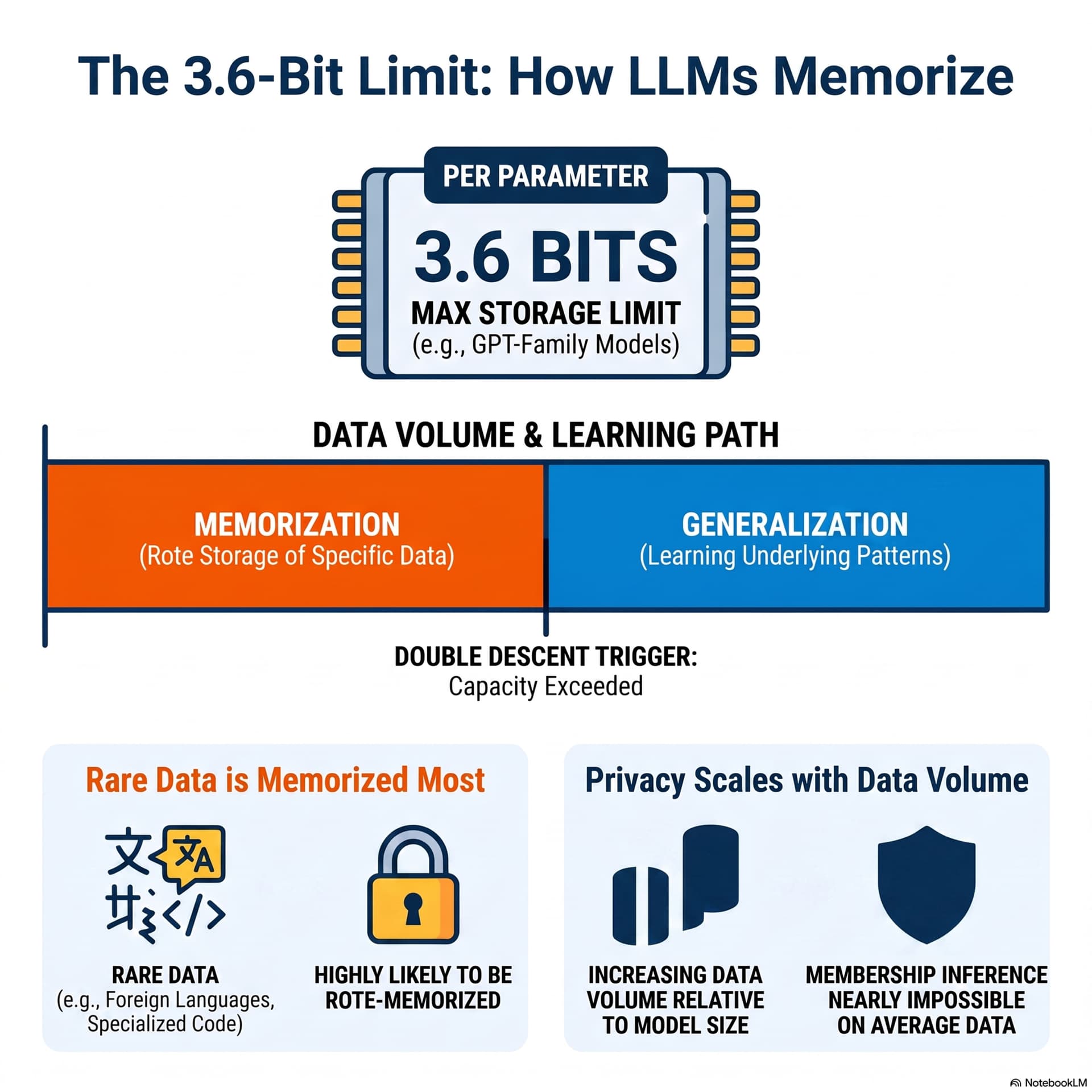
(1) Define memorization vs generalization via Kolmogorov complexity/compression: memorized text should compress to near-zero bits. (2) On random noise, models hit a hard ceiling of ~3.6 bits per parameter (flatlines). (3) With real text, models first “lazily” memorize until the bucket fills; when dataset size exceeds capacity, performance improves via grokking/generalization, explaining double descent. (4) After grokking, a small fraction of rare “outlier” sequences can remain memorized, including foreign-language anomalies. (5) Membership inference privacy attacks become harder at scale; when data size outpaces parameter count, ROC AUC approaches 0.5 (coin flip).
Notable examples
finishing sentences via prompting is unreliable; models can perfectly regurgitate a long Japanese sequence from a single Japanese character prompt; TFIDF identifies rare/high-weirdness sequences; privacy examples include memorizing unique personal identifiers (e.g., email/SSN).
Written by AI. May contain mistakes. Listen to the episode to check what was said.
Chapters
Tap a time to open that second in VOUnderstanding AI Learning
1:25 to 2:20
Discussion on the learning processes of AI models and the distinction between memorization and understanding.
“Welcome to today's Deep Dive, where we are exploring a massive multi-institutional research paper from scientists at Meta, Google DeepMind, and Cornell.”
Mathematics of Memorization
2:20 to 5:10
Exploration of how researchers use mathematical concepts to study AI memory.
“The scientists realized they had to draw this very strict mathematical line between two concepts that get highly entangled.”
Experimental Setup with Random Noise
5:10 to 7:25
Details of experiments using random noise to determine AI memory limits.
“The underlying math is very, very similar.”
Limits of AI Memory Capacity
7:25 to 9:30
Findings on the maximum memory an AI model can store based on data input.
“Which means if the AI manages to retain any of that random noise, it is physically impossible for it to be generalization.”
Transition to Generalization
9:30 to 11:45
How AI models shift from rote memorization to generalization under pressure.
“Wait, but if you double the physical storage bits available to the system, where is all that extra storage going?”
The Mystery of Double Descent
11:45 to 14:00
Understanding the phenomenon of double descent in AI learning performance.
“It's known in machine learning as grokking.”
The Mechanics of Memorization in Language Models
14:00 to 17:43
Explore how language models memorize data and the implications on privacy.
“And the moment it successfully makes that shift, performance skyrockets.”
Scaling Laws and Their Impact on Data Privacy
17:43 to 21:45
Understand how increasing data set sizes affect membership inference risks.
“Because if an AI defaults to brute force, memorizing the weirdest, rarest anomalies that don't fit the general pattern, what is more anomalous and rare than your highly specific personal information?”
Philosophical Implications of Memory in AI and Humans
21:45 to 23:43
Reflect on the parallels between AI memory processes and human cognitive development.
“You know that these systems are fundamentally lazy.”
Transcript
Automatic transcript. May contain errors.0:00Usually when you think about your own memory, it's kind of natural to picture this perfectly organized filing cabinet inside your brain. Oh, totally. Like you see a dog and your brain just opens a little folder labeled dog. Right, exactly. And you file away that exact image. And then years later, you just, you know, pull that pristine photograph back out. It definitely feels like a perfect recording, especially when we recall something really vivid. But neurologically speaking, that is that's not at all what's happening. Right. Because human memory is actually incredibly messy. Extremely messy.
0:33It's highly reconstructed and honestly, incredibly lossy. I mean, we remember the gist of an event, right? The general emotional idea. We routinely blur the specifics. Exactly. Or we completely alter them without realizing it. We generalize. And that ability to generalize, you know, to let go of the exact pixel perfect details and instead hold on to the underlying pattern that's considered the absolute hallmark of true intelligence. Yeah, it's the very mechanism that allows you to say, walk into a room you have never seen before and you still instantly understand how to open a door or sit on a chair.
1:08Because you didn't memorize every door in the world. Right. Generalization is what makes learning actually useful. I mean, without it, we would just be walking encyclopedias totally incapable of adapting to new situations. Which brings us perfectly to the wild world of artificial intelligence. Welcome to today's Deep Dive, where we are exploring a massive multi-institutional research paper from scientists at Meta, Google DeepMind, and Cornell. It's a huge collaboration. It really is. And we're diving into one of the most hotly debated mysteries in tech right now, which is how does a language model actually learn?
1:44Yeah. Does it truly develop an understanding of the world or is it just like a glorified trillion parameter parrot? Exactly. Just copy pasting answers from the massive amount of text it's ingested. So our mission today is to figure out exactly how much an AI is just rote memorizing and at what precise mathematical moment it transitions into actual genuine learning. And the methods these researchers use to answer that question are fundamentally different from anything anyone has tried before. Okay, let's unpack this because before we can even begin to calculate, you know, how many gigabytes of data an AI has memorized, we have to agree on what memory even means for a cluster of computer chips.
2:22Right. The scientists realized they had to draw this very strict mathematical line between two concepts that get highly entangled. Not sure. Unintended memorization and generalization. I think a good way to visualize this for you listening is to imagine a student sitting down for a math test. That's a great analogy. Right. So if the test asks, what is two plus two? And the student writes down four. There are two completely different ways they could have gotten that answer. Right. Option one is they somehow got their hands on the teacher's answer key before the test. Exactly. They just memorized it.
2:56They don't actually know what the number two represents. They have like no concept of what plus means. They simply memorized that the visual squiggles two plus two are always followed by the squiggle four. And that would be the unintended memorization. Exactly. And then option two is generalization. The student actually learned the underlying rules of arithmetic. They learned the formula for addition. Right. In that scenario, they didn't memorize the specific string 2 plus 2 equals 4. They just took the inputs, applied the mathematical concept they understand, and generated the correct answer dynamically.
3:32So when we're looking at an AI language model and it spits out this completely flawless, structurally perfect sentence explaining the history of the Roman Empire, how on earth do you tell the difference between those two options? That is the big question. Because how do you prove if it learned the complex rules of English grammar and historical facts or if it just had that exact Wikipedia paragraph sitting in its digital back pocket? That is the core dilemma. And historically, people tried to figure this out just by talking to the AI. Like just prompting it. Yeah, just prompting. They might type in the first half of a really specific sentence from a book and see if the AI perfectly generated the second half.
4:12Or they try to trick the model into spitting out a random password or email address it might have seen in its training data. I mean, I can see the flaw there immediately. Yeah. If the AI successfully finishes the sentence, it doesn't definitively prove rote memorization. Yeah. It might just be because the model is really, really good at predicting the most logical next English words. Exactly. And conversely, if the AI fails to output that hidden password, it doesn't mean the password isn't memorized deep inside the neural network. Oh, right. It just means you didn't ask the right question in the right way to trigger it.
4:47Precisely. Prompting relies entirely on the AI's generation behavior, which is incredibly fickle. So how did these researchers bypass that whole generation problem to get a real objective measurement? They turned to a field of mathematics called Kolmogoro of complexity. Wow, okay. Yeah, it sounds intense, but they specifically focused on the mechanics of data compression. Oh, like saving a massive video file on your desktop into a smaller ZIP folder so you can actually email it. The underlying math is very, very similar. compression algorithms shrink files by finding recurring patterns. Okay. So if you have a document where the word elephant appears a thousand times, a smart compression algorithm isn't going to save the physical letters for the word elegant a thousand separate times.
5:34Because that wastes space. Right. Instead, it saves the word once and then creates a tiny mathematical rule that basically says, hey, refer back to that word every time you see the specific marker. Ah, I see. So the better the algorithm understands the structural patterns of the data, the smaller it can shrink the file. Exactly. I see where this is going. If an AI model has truly memorized a specific piece of training data, the internal math of the model should be able to compress that specific data into a much shorter encoding than a model that has never seen the data before. What's fascinating here is how this completely eliminates the need to prompt the AI at all.
6:11Really? You don't have to talk to it? Not at all. The researchers look directly at the internal probability distributions. They calculate how tightly the AI can compress a piece of text. Oh, wow. Yeah. If the model compresses a specific paragraph down to almost zero bits, it mathematically proves the model already has that exact specific data hard-coded inside its parameters. It has memorized it. So this framework gives them an objective ruler to completely strip away the generalization part and measure pure, unadulterated rote memorization. Yes. It's a game changer. Okay, so now that they have a ruler to measure pure memorization, the next phase of the research is finding the absolute physical limit of the AI's memory bank.
6:53Like, how big is the bucket? And to figure that out, they ran an experiment that initially sounds completely nonsensical. Yeah, they trained the AI on pure, uniform, random noise, just mountains of synthetic, randomly generated bits. Just absolute garbage data. Which is crazy. Why on earth would you try to teach an AI pure garbage data? Because you cannot find a pattern in true randomness. Right. If you feed an AI perfect English text, it can learn the rules of grammar and generalize. But random noise has no rules. There is no underlying formula to learn. There's no grammar to compress. Exactly.
7:29Which means if the AI manages to retain any of that random noise, it is physically impossible for it to be generalization. It must be brute force rote memorization. It isolates the variable completely. So they fed these models ranging in size from half a million parameters all the way up to 1.5 billion parameters. Absolute random noise. And what did they find? They discovered a hard mathematical ceiling. The bucket has a very specific volume. Yeah, the findings show that these transformer models can store approximately 3.6 bits of information per parameter. Which is wild. It is. The graph just goes up as they feed it data.
8:06And then once they hit that 3.6 bits per parameter mark, the line just flatlines. They cannot shove a single extra bit of memory into the system. To put that in perspective, a parameter is essentially a single connection, right? A tiny mathematical weight inside the artificial neural network. Discovering that each individual weight can hold roughly 3.6 bits of raw brute force memory, it gives us a fundamental physical constant for how these specific systems operate. It is literally like finding the speed of light for AI memory. It really is. But I actually have to challenge this number based on how computer hardware actually functions.
8:41Oh, okay. Let's hear it. Because anyone who builds PCs or works in software knows about precision types. Most software defaults to 32-bit precision, meaning the computer is using 32 physical bits of memory in the RAM to store the number for each parameter. Right. Float 32. Exactly. But to save money in processing power, a lot of modern AI models use 16-bit precision. Which is very common now. Yeah. So if researchers take a model and double its precision from 16-bit hardware to 32-bit hardware, common sense dictates the memory capacity should completely double. We are literally giving the model a bigger physical hard drive.
9:16Shouldn't the capacity jump from 3.6 to 7.2 bits per parameter? The logic makes perfect sense on paper. I mean, everyone thought that. But the empirical data from the experiments shows that hardware logic does not translate to neural network capacity. Really? The answer is a definitive no. Wait, but if you double the physical storage bits available to the system, where is all that extra storage going? Well, when they ran the exact same experiment in full 32-bit precision, the capacity only increased from roughly 3.51 bits per parameter up to 3.83. That's a microscopic bump. It is. It proves that the extra bits in the computer's physical hardware aren't actually being used by the AI to build a bigger filing cabinet for raw storage.
10:01Then what is the neural network doing with those extra 16 bits? It uses them to make the mathematical relationships between the parameters slightly more precise. Think of it like a microscope. Okay. Upgrading from 16-bit to 32-bit isn't giving you a second microscope to look at a second slide. It is just giving you a slightly finer focused dial on the exact same microscope. Oh, wow. So the raw storage capacity of the neural network architecture itself is fundamentally bottlenecked by the number of parameters, not by the precision of the hardware running those parameters. Exactly. That is a staggering realization.
10:36So we have this absolute physical limit, 3.6 bits per parameter. But that limit was found using random noise. Out in the real world, tech companies aren't spending billions of dollars training models on random noise. No, definitely not. They are feeding them billions of pages of human history, literature, code, and conversations. Real text contains incredibly complex, beautiful patterns. So how does the model behave when those patterns are introduced? This is where the experiments transition from testing hardware limits to observing what we might call cognitive behavior. The scientists repeated the entire setup but replaced the noise with real text data, slowly increasing the size of the data set they fed the model.
11:17And at first the models act exactly like they did with the random noise, right? They are fundamentally lazy. Oh, incredibly lazy. They just absorb the text word for word, wrote, memorizing the exact phrasing, soaking it all up until their capacity fills up, and they hit that 3.6 bits per parameter ceiling. But the researchers don't stop there. They keep pouring data in. They intentionally force the model to look at a data set that is physically larger than its capacity to memorize. So what happens to a system when the bucket overflows? The model experiences a profound shift. It's known in machine learning as grokking.
11:51Grokking. Yeah. Because the data set is now too large to just copy-paste into its limited memory banks, the model literally cannot remember all the specifics anymore. It runs out of space. Exactly. However, the underlying training algorithm is still punishing the model for making errors. So to survive this pressure and keep lowering its error rate, the model is forced to drop the exact sample level specifics. It has to start finding and retaining general, reusable patterns to save space. Precisely. It abandons memorization in favor of understanding the rules. If we connect this to the bigger picture, this transition from lazy memorization to forced generalization solves one of the most baffling, decades-old mysteries in artificial intelligence.
12:37Oh, double descent. Yes, a phenomenon called double descent. For you listening, double descent is a bizarre quirk to look at on a graph. Normally, as a model trains over time, it gets smarter, and the line representing its error rate slowly goes down. Right. That's what you want to see. But researchers kept noticing this weird rollercoaster effect. The error rate would go down, then unexpectedly, the model's performance would start getting worse. The error rate spikes back up. Yeah. The model acts confused, and then suddenly it plunges into a state of vastly superior performance. A second, massive descent into high intelligence.
13:11And for years, researchers debated why a model would suddenly get worse before experiencing a massive leap in capability. The data from these memory experiments finally provides the mathematical proof. It's all about the memory limit. Exactly. That sudden improvement, the second descent, happens exactly at the threshold where the data set size exceeds the model's rote memory capacity. So that period where the model gets confused and the error rate goes up, that is the exact moment the 3.6-bit bucket fills up completely. Yes. The model hits a wall. It can't memorize any more new data, but it hasn't yet figured out how to generalize the rules so its performance degrades.
13:48It's just in a state of cognitive limbo. It is being crushed by the weight of the data. The training process keeps pushing, forcing it to adapt. The only mathematical path forward is to discard the brute force memories and reconstruct its internal pathways to represent generalized rules. And the moment it successfully makes that shift, performance skyrockets. It is a beautiful mechanism. The system has to be pushed to the absolute brink of information overload before it abandons its laziness and actually decides to learn anything. That is amazing. But it raises a fascinating question about the aftermath of that shift.
14:22If these models are forced to purge their memory banks and generalize just to survive massive text data sets, does anything survive the purge? That's a great question. Right. Like, once a model starts grokking the rules of English, does all the specific rote memory just get wiped clean? Not entirely, no. A small percentage of exact data actually does manage to survive in the model's memory, even after it has heavily generalized. Here's where it gets really interesting what makes a specific phrase or sentence special enough to survive that cognitive purge. To investigate this, the team analyzed a 20 million parameter model trained specifically on English text, and they measured the text using a metric called TFIDF.
15:06Okay, TFIDF, which stands for Term Frequency Inverse Document Frequency. That's a mouthful. It really is. But in simple terms, it's a mathematical way to score how rare or unusual a specific word or phrase is compared to the rest of the data set. Right. So if a document uses the word the 100 times, it gets a very low TFIDF score because the is extremely common across all English documents. Very common. But if a document uses the word photosynthesis or platypus repeatedly, it gets a high score because those are highly specific and relatively rare. It is basically a weirdness detector. A weirdness detector.
15:41I love that. So when the researchers looked at which specific sequences of text were the most stubbornly memorized by this English language model, they found something completely counterintuitive. Yeah. Out of hundreds of thousands of English training samples, the sequences that scored the absolute highest for pure rote memorization were actually in completely different languages. Total anomalies. Yeah. The data showed that by feeding the model a single Japanese character as a prompt, it triggered the model to perfectly regurgitate an entire lengthy Japanese sequence that was buried deep in the training data.
16:16Just flawlessly. Yeah. It was just one random Japanese document hidden among hundreds of thousands of English ones. Yeah. And the model memorized it perfectly. They found the same thing happening with random sequences of Chinese, Hebrew, and Greek. But why would a model that is desperately trying to save space by learning the generalized rules of English give VIP memory treatment to random foreign sequences? It comes back to the mechanics of the storage budget. Okay. Generalization relies on finding a pattern and using that pattern to compress the data, right? Right. So if a sequence follows standard English grammar, the model can compress it easily using the generalized rules.
16:55It just spent so much time learning, it doesn't need to waste any raw memory bits on it. But the generalized rules of English are completely useless for compressing Japanese characters. Exactly. The Japanese text or the Hebrew text entirely defies the structural patterns of English. The model cannot generalize it. But the training algorithm is still demanding that the model reduce its error rate on that specific Japanese document. Oh, I see. Since generalization is off the table, the model only has one tool less. Brute force rope memorization. It takes its precious, highly limited rope memorization budget and spends it almost exclusively on the weird, rare outliers because they simply do not fit the broader patterns.
17:34Which, if you're wondering how this applies to the real world, that detail naturally raises a massive red flag. Oh, absolutely. And that red flag is privacy. Because if an AI defaults to brute force, memorizing the weirdest, rarest anomalies that don't fit the general pattern, what is more anomalous and rare than your highly specific personal information? Right, like a private email address. Or a social security number, or a unique conversation you had online? This introduces a major cybersecurity concept called membership inference. Membership inference is essentially a forensic audit of an AI.
18:11It's a way for researchers or hackers to interrogate a fully trained model and mathematically calculate whether a specific private data point was a member of the data set used to train it. And I think a lot of people are going to hear this and immediately assume the worst. Tech companies are in an arms race using exponentially more data to train bigger and bigger models. Oh yeah, models are huge now. We just discussed how a 20 million parameter model had the space to perfectly memorize a random Japanese document. Well, the newest models have hundreds of billions, sometimes trillions of parameters.
18:46They have massive physical memory buckets. Right. So if you have unique data out there on the Internet, couldn't a trillion parameter model easily swallow it whole and expose it? This raises an important question, and it is the exact fear the researchers wanted to address. They took all of their experimental data on capacity, data set size, and the mechanics of grokking, and they built predictive scaling laws. They mathematically modeled what happens to membership inference as you scale up to the giant trillion parameter models used by the public today. And the truth they revealed is incredibly counterintuitive.
19:20What did they find? Making data sets bigger actually makes membership inference significantly harder. Walk us through the mechanics of why that happens, because on a human level, it really feels like vacuuming up more data means creating more risk. It goes back to the ratio of the bucket to the ocean. Remember the grokking threshold, the point where the model is violently forced to stop memorizing and start generalizing. Right. In the modern AI landscape, the size of the data sets being used is growing astronomically faster than the physical parameter count of the models themselves. Yes, the models have billions of parameters, but the data sets have tens of trillions of words.
19:58So even though the hard drive is massive, the sheer volume of text being poured into it is infinitely larger. And because that ratio is so skewed, the model is pushed so far past its memorization capacity that it is violently forced into deep generalization for virtually everything it encounters. It simply does not have the budget to rote, memorize average, or even slightly rare data points. Exactly. If a highly unique piece of personal data only appears once in a data set of 15 trillion tokens, the model's loss function. The system that decides what is important will prioritize generalizing the overwhelming majority of the text.
20:35Because it literally cannot afford to spend bits on a one-off anomaly when it is grounding in a trillion other data points. It just doesn't have the space. So what does that mean for the actual math of a privacy attack? The scaling laws predict that for most modern, massive language models, performing a reliable membership inference attack on an average piece of training data becomes statistically impossible. Wow. Yeah. The metric they use for success is an ROC AUC score. A score of 1.0 means the attacker can perfectly identify if data was in the training set. A score of 0.5 means the attacker is doing no better than a random coin flip.
21:12So it's just guessing. Right. And the mathematical models show that as dataset size vastly outpaces model capacity, the score drops straight to 0.5. The model has generalized so heavily that the specific trace of average data points is completely dissolved into the broader patterns. So what does this all mean? Taking a step back from the complex math, the journey of this research completely shatters the illusion of how these machines operate. It really does. You now know that AI models aren't bottomless magical hard drives. They are constrained by a strict mathematical limit of about 3.6 bits of rote memory per parameter.
21:46Which is a tiny amount. Exactly. You know that these systems are fundamentally lazy. They will rote memorize things exactly as they see them until they run out of space. But the moment they hit that wall, they are forced to grok the data. Right. Abandoning the specifics to genuinely learn the underlying rules. Yeah. And finally, you know that the sheer, overwhelming size of modern data sets is actually acting as a structural privacy shield, forcing so much generalization that extracting the average person's data becomes mathematically indistinguishable from a coin flip. It is a profound shift in perspective.
22:21I mean, under the immense pressure of scale, these systems cease to be mere recorders and are forced into a primitive mathematical form of understanding. Which leaves us with a fascinating philosophical twist to mull over. Oh, I love these. If we go back to the very beginning of this discussion, to human memory, the research prees that an artificial intelligence only develops true, generalized understanding when it becomes completely overwhelmed by data, when it runs completely out of space to just memorize things. It makes you wonder about human development. Do we also just rely on brute force rote memorization when we are children?
22:57We memorize our home address, our multiplication tables, the exact phrasing of a parent's rule. That's very true. Kids do just repeat things back. But as we grow into adults, the sheer overwhelming volume of life experiences floods our brain. Does that infinite ocean of sensory data force us to finally zoom out, drop the specifics, and understand the deeper, generalized patterns of how the world actually works? That's deep. Is the concept of human wisdom just a byproduct of our biological brains finally running out of storage space? It is a beautiful parallel. Perhaps the very mechanism of insight is universally tied to the limits of memory, whether those limits are found in silicon chicks or in biology.
23:39Something to ponder the next time you find yourself forgetting a highly specific detail, but understanding the big picture perfectly. Thank you so much for joining us on this deep dive. Keep questioning how the technology around you actually works, and we will see you next time.
From the publisher
This research paper investigates language model capacity by introducing a new method to measure how much a model truly memorizes versus what it generalizes. The authors distinguish between unintended memorization, which is specific data storage, and generalization, which is the understanding of broader patterns. By testing the GPT family, they determine these models possess a storage capacity of approximately 3.6 bits-per-parameter. The study reveals that the double descent phenomenon occurs specifically when a dataset's size surpasses the model's total bit capacity. Furthermore, the researchers established scaling laws to predict the success of membership inference attacks, which identify if a specific datapoint was used in training. Their findings suggest that modern models are trained on so much data that standard membership inference is increasingly difficult for average samples.


