
In short
How to report evaluations when an LLM judges another model’s outputs, arguing that “raw accuracy” is statistically biased and that confidence intervals must account for judge error.
Guest backgrounds
No guests are mentioned in the transcript (just the hosts).
Key claims
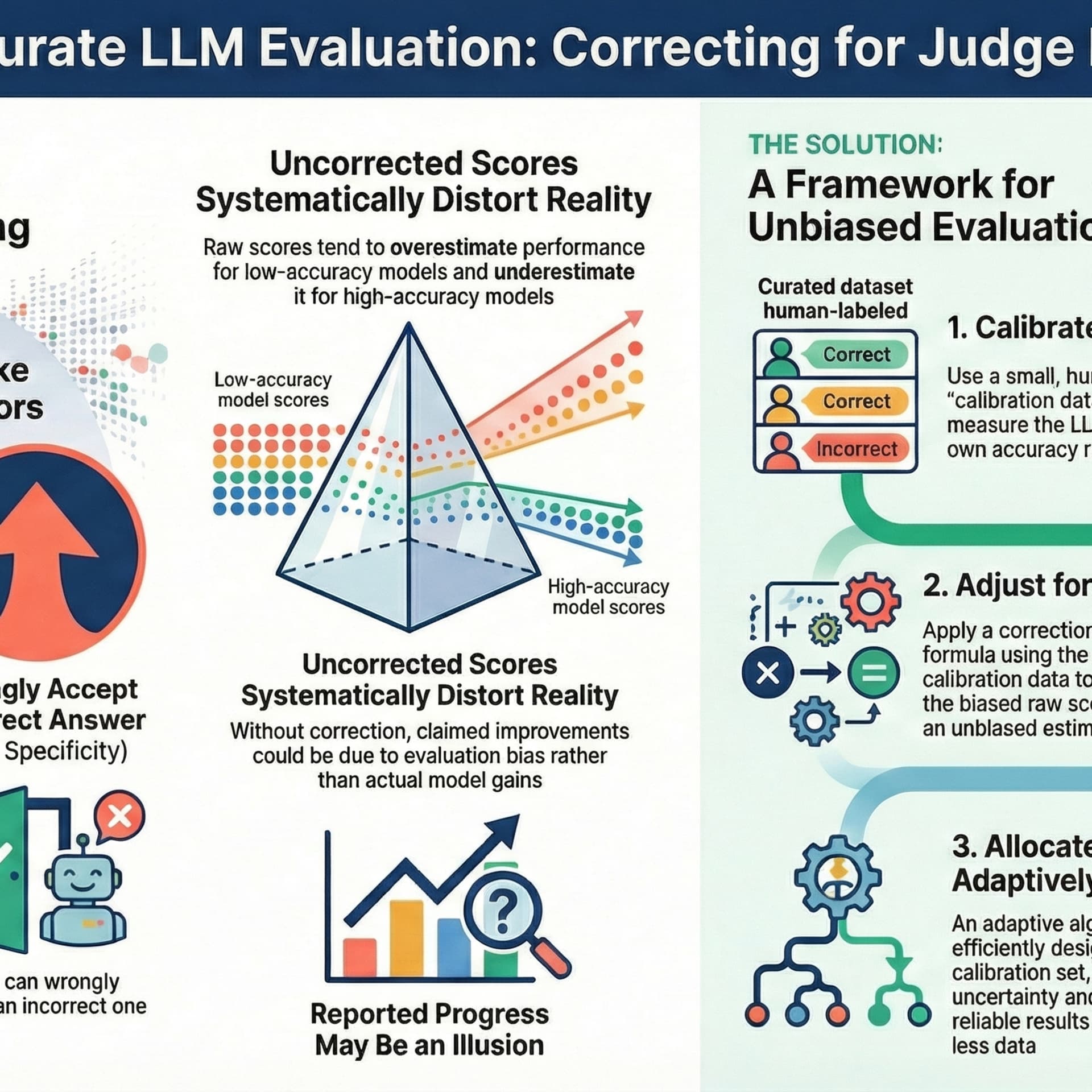
LLM judges are imperfect like medical diagnostic tests, with sensitivity (true positive rate) and specificity (true negative rate). Raw scores systematically overestimate weak models (low specificity) and underestimate strong models (low sensitivity), with bias flipping around ~75% true accuracy. Fix by calibrating the judge using a small human-labeled dataset, estimating sensitivity/specificity, applying a bias-adjustment inversion, and building confidence intervals that include uncertainty from both the large test set and the calibration set.
Notable examples
Math grading; bias flip below vs above ~75% accuracy; naive 50/50 calibration split vs adaptive allocation yielding tighter intervals (e.g., 80–90% vs 84–86%).
Written by AI. May contain mistakes. Listen to the episode to check what was said.
Chapters
Tap a time to open that second in VOUnderstanding the Limitations of LLM Judgments
0:45 to 2:31
Exploration of the statistical issues with using LLMs as judges for evaluations.
“Because right now you see papers reporting this single raw accuracy number.”
Analyzing Sensitivity and Specificity of LLM Judges
2:31 to 4:25
Discussion on the concepts of sensitivity and specificity as they apply to LLMs.
“And that drift, that's the statistical bias we have to fix.”
Calibration and Error Correction Techniques
4:25 to 6:15
Explanation of how to measure and correct biases in LLM scores through calibration.
“And the way we do that is with a step called calibration.”
Building Reliable Confidence Intervals
6:15 to 8:02
Detailed discussion on the importance of confidence intervals in reporting accuracy.
“The next and equally critical step is building a proper confidence interval.”
Optimizing Calibration for Accurate Results
8:02 to 10:09
Strategies for effectively allocating resources in calibration to improve accuracy.
“And the answer is yes, if you want reliable science.”
Transcript
Automatic transcript. May contain errors.0:00Welcome back to the Deep Dive. Today we are tackling one of the biggest shifts happening in AI. It's this moment where we stopped asking humans to grade AI and started asking AI to grade other AI. We're talking about LLM as a judge. Exactly. LLM as a judge. And, you know, it makes sense if you're trying to assess something like code quality or factual accuracy for a massive new model. Human evaluation is just it's too slow. It's incredibly expensive. So we outsource it. We get a bigger, supposedly smarter LLM like a GPT-4 and make it the judge. It's fast. It's scalable. It's cheap. But, and this is the paradox we're digging into today based on some really rigorous new research, if an LLM is the judge, how much can we actually trust its verdict?
0:45Right. Because right now you see papers reporting this single raw accuracy number. We'll call it the raw score. And our mission for this deep dive is to show you why that number is, frankly, statistically broken. And more importantly, what the right way to fix it is. This isn't about bringing statistical rigor to the whole process. The shortcut is misleading. The rigor, it's absolutely mandatory. Okay, so let's get right into the core issue, the problem of a noisy judgment. What does that mean? I mean, when we have an LLM grading another model's work, it's not a perfect oracle, right? Not at all.
1:17And that's the fundamental assumption you can't make. The judge is imperfect. And in statistics, we have a way to quantify that imperfection. We actually borrow it from, of all places, medical diagnostic testing. Medical testing, like for a disease. Exactly. Think of the LLM judge as a test for correctness. And just like a medical test, it can have false positives and false negatives. Okay, that's a great analogy. So how does that map onto an LLM, say, grading a math problem? So we have two key probabilities. First, there's specificity. This is the judge's ability to correctly identify an answer as incorrect when it really isn't correct.
1:52So it's good at spotting the duds. It doesn't let bad answers slide. Precisely. That's your true negative rate. Then second, you have sensitivity. That's the probability the judge correctly marks an answer as correct when it truly is correct. Got it. So that's the true positive rate. It gives credit where credit is due. Right. Now, in a perfect world, both of those would be 100%. The judge would be a perfect oracle. But we don't live in a perfect world. We absolutely do not. And when specificity and sensitivity are imperfect, and they always are, that simple raw score you see reported, it starts to drift away from the true accuracy of the model being tested.
2:31And that drift, that's the statistical bias we have to fix. So this noise, does it just push the score up or down randomly? Yeah. Or is there a pattern to the error? This is what's so fascinating. It's not random at all. It is an inherently systematic bias. And the direction of that bias actually depends on how good the model you're testing is. Anyway, so the error changes. It isn't consistent. It flips. So let's say you're testing a pretty weak model. Maybe its true accuracy is only, say, 30 or 40 percent. The LLM judge's raw score will almost always overestimate its performance. So it'll look better than it is.
3:06Yes, a positive bias. This happens because the judge isn't specific enough, it's too lenient, and it wrongly accepts answers that are actually incorrect. It's giving too much partial credit to a struggling student. That's a perfect way to put it. But now consider the opposite. You're testing a state-of-the-art model that's already, say, 90 % accurate. Okay. The reverse happens. The raw score will probably underestimate its true accuracy. A negative bias. Why? Because of low sensitivity. The judge becomes too strict. It starts wrongly rejecting answers that are actually perfectly correct. That is profound.
3:41So two different research labs using the exact same LLM judge could have biases pushing in completely opposite directions just because one is testing a weaker model and the other a stronger one. That is the direct implication. The research paper gives an example where, you know, depending on the judge's error rates, this bias flips right around the 75 percent mark. Below that, you're overstating performance. Above it, you're underselling it. So some of the performance gains we're reading about might just be evaluation bias and some huge breakthroughs might be getting statistically hidden. It's a real possibility.
4:15And it makes it clear that the raw score just isn't trustworthy. So how do we fix it? We don't know the judge's true error rates, its sensitivity and specificity when we start. We have to measure them. And the way we do that is with a step called calibration. This is a classic statistical technique, actually. It's drawn from what's called prevalence estimation. Which is? It's the method epidemiologists use to figure out how many people actually have a disease when they know their diagnostic test isn't perfect. Ah, so we need to stop testing the model for a second and start testing the judge. Spot on.
4:50To do that, you need what's called a calibration data set. This is a small but very high quality set of examples that have been labeled by human experts. The ground truth. So this is where the extensive humans come back into the picture. For a small critical task, yes. You take maybe 100 examples, 50 you know are correct, 50 you know are incorrect, and you have the LLM judge greet them. And that shows you exactly how often it makes mistakes on both types of answers. That gives you your estimates for its sensitivity and specificity? Correct. And once you have those numbers, those error rate estimates, you can apply a mathematical formula.
5:25It's an inversion. Okay, so in simple terms, what does this formula actually do? It takes that flawed, raw score, and it essentially filters it backward through the judge's known imperfections. It mathematically undoes the distortion. The result is what we call the bias-adjusted estimate, or the corrected score. And this gets us much closer to the model's true accuracy. Substantially closer. And what's amazing is that it works really well, even though our measures for the judge's error rates are themselves just estimates from that small sample. As long as your calibration set is decent, you're on your way to statistically sound reporting.
6:02Okay, so we've corrected the number itself. Yeah. But in statistics, a single number without an error bar is, well, it's not very useful. It's almost meaningless, right? You have to know your uncertainty. So correcting the score is only half the battle. It absolutely is. The next and equally critical step is building a proper confidence interval. And this is where it gets a little more complex. because with LLM as a judge, you're dealing with dual sources of variance. Dual sources. I thought we just had to worry about our test set size. That's the common mistake. You have two different things introducing randomness.
6:36The first is what you just said. The uncertainty from your main evaluation, your big test set. The more examples you run, the smaller that error gets. Standard stuff. But the second source, the one people often ignore, is the calibration data set uncertainty. the error from that small human-labeled set we use to measure the judge. Ah, because our estimates of the judge's sensitivity and specificity aren't perfect either. They have their own uncertainty. Exactly. So you have these two distinct sources of randomness compounding. And if you build a confidence interval that ignores that second source, that calibration error, your interval is basically a lie.
7:13So what happens if you do that? If you just calculate a standard confidence interval on your raw score, ignoring all this? The results from the research are, well, they're shocking. The confidence interval you build from that naive raw score, it achieves nearly zero coverage. Zero. You mean you think you have a 95 % confidence interval, but it almost never actually contains the true value. That's what it means. You're claiming a level of scientific certainty that just isn't there. It's statistically untrustworthy. Wow. Whereas the proper method, the one that builds a more complex interval that captures variance from both the test set and the calibration set, that one stays right around the 95 % coverage it promises.
7:52This all sounds much more rigorous, but also more expensive. I mean, we started using LLM as a judge to save on human labeling costs. Is the statistical payoff worth it? That's the perfect question. And the answer is yes, if you want reliable science. But it leads us to the final and maybe most practical part of this, optimization. Okay. Since the test instances themselves are cheap, you can earn millions of them, the total uncertainty in your final corrected score becomes dominated almost solely by the calibration sample. So the huge test set is basically free, and the small calibration set is the expensive bottleneck.
8:28Exactly. So all your strategic thinking should go there. How do we spend our limited human labeling budget? How do we split it between labeling examples that are truly correct versus those that are truly incorrect? I guess the default would be to just do 50-50. That's the naive approach, and it's almost always wrong. The key insight is that these two types of calibration labels contribute asymmetrically to the final error. Meaning, one type of error from the judge might be causing more damage to our final number than the other. You've got it. If your judge is, say, really bad at identifying incorrect answers, it has low specificity, then that side of the equation is pumping a ton of uncertainty into your result.
9:10So we should spend more of our budget investigating the judge's biggest weakness. Precisely. The research proposes an adaptive allocation strategy. You start with a small pilot calibration sample. Think of it like a recon mission. And what does this little pilot sample tell you? It gives you a first guess at the judge's error rates. And from that, you can estimate the error ratio, basically. How much more uncertainty is coming from the incorrect side versus the correct side, or vice versa. And then you use that ratio to spend the rest of your budget smarter. You got it. You calculate the optimal allocation for the rest of your labels.
9:45You pour your resources into sampling the side that's causing the most statistical noise. This tightens the final confidence interval as much as possible for your fixed budget. And the simulations confirm this works. They do. This adaptive approach consistently produces shorter confidence intervals for the same exact cost compared to a simple 50-50 split. We're talking the difference between saying your model is somewhere between 80 and 90 percent accurate versus confidently saying it's between 84 and 86 percent. That precision is everything. Okay, so let's tie this all together. We started with this paradox.
10:18LLM judges are cheap and scalable, but their raw scores are biased. And we learned that correcting that score is non-negotiable because the judge's own imperfections, its sensitivity and specificity, systematically warp the results. Then we have to report that corrected score with a valid confidence interval, which means accounting for two sources of uncertainty, one from the big test set and one from the small, crucial calibration set. If you ignore that second one, your error bars are meaningless. So if you're out there using LLM as a judge, the big takeaway seems to be stop focusing on just running millions of test cases.
10:56That's the easy part. Put your brainpower and your budget into designing that calibration step as smartly as possible. An adaptive allocation of those precious human labels is the most direct path to reliable, transparent results. At the end of the day, reliability comes from statistical rigor, not just raw scale. Which leaves us with a final thought. The statistical soundness of your next big LLM evaluation might depend less on the side of your test set, you know, the N, and more on how intelligently you design the composition of your small critical calibration data set. That really does flip the script on how we think about big data evaluation.
11:31It demands that our experimental budget be driven by statistical risk, not just by what's convenient. That's it for this deep dive. Thank you for joining us.
From the publisher
This paper introduces a statistical framework to address the significant challenge of noisy and biased accuracy estimates that arise when utilizing Large Language Models (LLMs) as judges. The text explains that the raw proportion of correct judgments is unreliable because the LLM judge possesses imperfect specificity and sensitivity, leading to distorted results depending on the true accuracy level. To counteract this, the authors develop a **simple plug-in bias-adjusted estimator** that corrects the results by estimating the LLM judge's internal error rates from a separate calibration dataset. Furthermore, the framework provides a practical method for generating **statistically sound confidence intervals**, ensuring that the reported uncertainty incorporates variance from both the main test set and the calibration sample. This approach is optimized through an **adaptive allocation algorithm** designed to efficiently distribute calibration resources, thereby minimizing the length of the confidence intervals and increasing the overall reliability of LLM-based evaluations.


