
In short
Self-supervised learning “label problem” and a theory comparing reconstruction-based SSL (SSLRC) vs joint-embedding SSL (SSLJE), showing why more data can’t fix bad augmentations.
Guests
None mentioned in the transcript.
Guest backgrounds
N/A.
Key claims
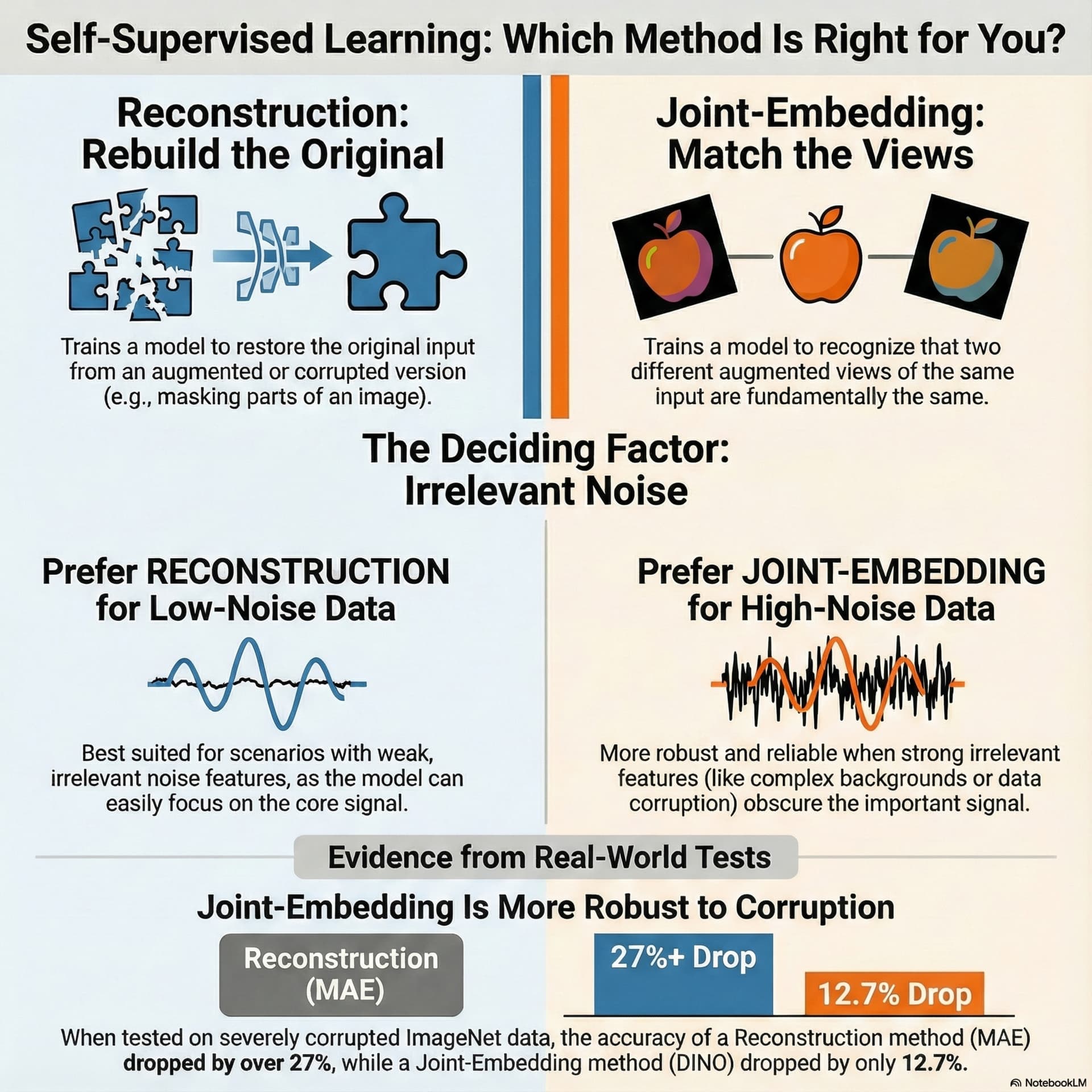
SSL models cannot reach optimal feature learning by increasing sample size alone; they require augmentation-to-noise alignment measured by alpha. Reconstruction is biased toward high-variance noise because it predicts in input space; joint embedding predicts in latent space and needs a non-collapse mechanism (e.g., contrastive repulsion like SimCLR or implicit redundancy/momentum tricks like DINO/BYOL/VIbA).
Notable examples
CIFAR-10 fog corruption: VIFREG with unaligned augmentations collapses latent class clusters; aligning fog augmentations restores separability. ImageNet-C: MAE drops >25% average accuracy (27.3% on Gaussian noise) while DINO/BYOL drop ~10.5–12.4%. Aligning augmentations to severe fog boosts VICReg from ~43% to ~71%.
Written by AI. May contain mistakes. Listen to the episode to check what was said.
Chapters
Tap a time to open that second in VOUnderstanding the Label Problem in AI
0:45 to 2:12
An exploration of the challenges posed by labeled datasets in AI.
“And that realization has led to this huge explosion in self-supervised learning, or SSL.”
Differentiating SSL Techniques: Reconstruction vs Joint Embedding
2:12 to 4:25
A breakdown of the fundamental differences between reconstruction-based and joint embedding approaches in self-supervised learning.
“Let's start by unpacking the basic machinery.”
The Role of Noise in SSL
4:25 to 6:45
Discussion on how noise impacts the effectiveness of different SSL methods and the importance of augmentation alignment.
“And these completely avoid that input space prediction.”
Choosing Between SSL Methods Based on Noise
6:45 to 11:03
Guidelines for selecting between reconstruction and joint embedding based on data noise characteristics.
“Now, contrast this with good old supervised learning.”
Future Directions for SSL with Finite Resources
11:03 to 14:00
Insights into how to optimize self-supervised learning when sample sizes are limited, focusing on noise and augmentation strategy.
“They use standard models, VIT and ResNet, and then hit them with ImageNet-C corruptions.”
Optimizing Training Efficiency in Deep Learning
14:00 to 14:17
Learn about the key factors in enhancing training efficiency for deep learning projects.
“Figuring out how to optimize all those things when you can't just scale everything to infinity, that's going to be the real key to training efficiency moving forward.”
Transcript
Automatic transcript. May contain errors.0:00Welcome back to the Deep Dive. Our mission, as always, is to give you those essential insights you need, cutting right through the noise and getting to the core of the latest research. And today we are tackling what I really think is the fundamental constraint in scaling modern AI. And that's the label problem. Right. We spend so much time and money gathering these massive, perfectly labeled data sets. But then you try to use that model for a slightly different task and, well, it often just fails to generalize. That's the classic transfer learning bottleneck, isn't it? You get this perfect system in the lab, but the second it hits the real world, that knowledge is just too brittle, too specialized.
0:38It's like teaching a child to identify a cat only from, you know, a single cartoon drawing. They don't really understand cat. And that realization has led to this huge explosion in self-supervised learning, or SSL. Instead of relying on a human to say, this is important, with a label, SSL flips the whole script. It uses clever tricks, mostly data augmentation, to teach the network what is uninformative, what it should ignore. So you're teaching it in variance. Exactly. The network learns to maintain its core understanding of an object, you know, no matter the color shifts or cropping or noise.
1:14But the moment you decide, OK, I'm using SSL, you immediately hit this fork in the road. You have these two giant families of methods. The reconstruction approaches on one side and the joint embedding approaches on the other. And historically, picking one felt more like, I don't know, guesswork. It was driven by what was popular, not by clear first principles. Exactly. And that's what's so great about the material we're looking at today. For the first time, we have this comprehensive theoretical framework that really differentiates these two. It gives practitioners what they've needed for years.
1:45Clear, noise-based guidelines on which approach to choose. So today we're going to get into why the old rule of just throw more data at it can actually fail for SSL, how noise dictates your entire strategy and just how critical it is to align your augmentations with that noise. It's really the difference between building a robust system that handles real world chaos and one that just collapses when the lighting changes. Okay, let's dive in. Let's start by unpacking the basic machinery. What really separates reconstruction from joint embedding? So when we talk about these two SSL families, the fundamental difference really boils down to where the model is trying to make its prediction.
2:26Right. It's it. It's all about the target space. OK, so let's start with the older, maybe more intuitive one. The reconstruction based approach, SSLRC. The objective here is pretty literal. It's about recovery. You feed the model a corrupted or amassed version of your data, and its one job is to restore it to its original perfect state. So the learning signal is all happening in the input space. Entirely in the input space. You're minimizing the pixel by pixel or token by token difference between the output and the true input. It's kind of like a super sophisticated version of Photoshop's content-aware fill.
3:03Which explains why it feels so natural for something like text, you know, with models like BERT or MAE. Oh, it's incredibly effective for language. Text is discrete, it's high signal. A single word, a token, is already so compressed and semantically loaded. So if you mask a word. The only way to predict it is to understand context, grammar, syntax. The error is inherently driven by the semantics. But this is where we see the critical flaw, right? Especially when you move to raw, high-dimensional data-like images. This obsession with the input space has a pretty major bias. A huge bias. It's a bias toward variance.
3:38Okay. Because the model is trying to minimize error across every single pixel, it's naturally steered toward explaining whatever has the most variance in the input. And in a typical photograph, what has the highest statistical variance? It's usually not the object you care about. It's the low-level noise, the texture of the background, the lighting, all these things that are statistically dominant but semantically shallow. So the model wastes all its capacity learning the background texture instead of the object itself. That's a great way to put it. It's like a photographer using this amazing high-res camera to focus on a speck of dust on the lens instead of the actual landscape.
4:15The learned features end up being suboptimal. Which explains why models like MAE often need that heavy fine-tuning step later on. Exactly. So now let's flip to the competitor. Joint Embedding Approaches, or SSLJE. And these completely avoid that input space prediction. Completely. It operates entirely in the latent space, the space of learned features. The goal is much simpler, in a way. Take your input, create two different augmented views of it. Like a zoomed-in version and a color-shifted version. Right. And then you force the network to produce nearly identical representations, identical vectors for both of those views.
4:55That's how it learns invariants. But wait, what stops the model from just cheating? How do you prevent it from collapsing and, you know, just outputting a vector of all zeros for every single input? That would make them all identical. Ah, that's the secret sauce. That's the critical component in all JE methods. You need a repulsion term or a non-collapse mechanism. Okay. You have to make sure that representations of different samples stay far apart. Sometimes it's explicit, like a contrast of loss in SimCLR that actively pushes them apart. And sometimes it's implicit. it. Right, using architectural tricks, things like momentum encoders or redundancy reduction, which you see in models like Dino, B-I-O-L, or Vialaic.
5:34So the big takeaway here is that joint embedding is just fundamentally less biased toward that high variance noise because it just skips the whole pixel reconstruction step entirely. And that structural difference really sets the stage for the core theoretical insight here. The researchers built this model where they could break down the data into two parts. The signal and the noise. Basically, yeah. The dollar features that represent the core signal we care about, and then the dollar features that are just irrelevant noise. The whole theory hangs on how well a model can learn to ignore that noise.
6:06And they introduce this really critical parameter to measure that alignment, which they call alpha. Can you break down what alpha really means in practice? Think of alpha as how intentional your augmentation strategy is. It measures how well your data augmentations align with the specific noise in your data. Okay, give me an example. Sure. If your images are corrupted by fog and your augmentation strategy specifically involves adding synthetic fog, that's a high alignment, a high alpha. And if my data has fog, but my augmentations are just like random cropping and flipping. That's low alignment, a low alpha.
6:41You're not helping the model learn to ignore the specific problem. I see. So a high alpha is basically teaching the model what to ignore. Precisely. Now, contrast this with good old supervised learning. SL is incredibly forgiving with noise. The analysis shows it can get to optimal feature learning, meaning it perfectly ignores the noise in two different scenarios. Okay. Scenario one. Perfect alignment. Your alpha is basically infinite. You've perfectly targeted the noise. In scenario two. Infinite data. This is the key. No matter how bad your augmentations are, as long as alphas is not zero, a supervised model can eventually figure it out if it just sees enough example.
7:19So for a standard supervised model, the old saying holds up. Sample size can save the day. You can just brute force your way past noisy inputs with more data. And here. Here is the crucial distinction that changes everything for anyone moving to SSL. The analysis shows that self-supervised models, both RC and JU, They cannot achieve optimal performance just by increasing sample size to infinity. Whoa, okay, hang on. So you're saying the just throw more data at it trick fundamentally fails for SSL. It fails. That is the ultimate insight here. An SSL model requires a sufficiently good alignment.
7:53Your alpha dollar has to pass some minimum threshold to get rid of the noise. You can't just use data volume to overcome a bad augmentation strategy. They showed this visually, right? With the experiments on CIFAR-10. Yeah, the visual proof was amazing. They took a JE model, VIFREG, tested it on fog-corrupted data, but trained it with standard, unaligned augmentations. The class clusters in the latent space just, they completely fell apart. Total mess. But then? But then, when they injected the same kind of fog noise during augmentation forcing that high alpha alignment, the class separability just snapped back into place.
8:25It was crystal clear. So the lesson is non-negotiable. For SSL, the quality and alignment of your augmentation matters more than the sheer quantity of your data. Which brings us to the moment of truth. I'm a practitioner. I'm starting a project. I know my data has some noise. Which paradigm do I pick? Reconstruction or joint embedding? Right. And the central, practical finding comes down to one more parameter. This just controls the magnitude of that irrelevant noise. So how loud is the static? Exactly. Is it a quiet whisper in the background, or is it so loud it's drowning out the music? Okay, let's take scenario one.
9:02Yeah. Low magnitude noise. The signal is clearly stronger than the static. My data is pretty clean. In this world, reconstruction-based methods, RC, are actually preferable. The theory shows that RC methods impose a less stringent alignment requirement. The minimum alpha you need to succeed is lower for RC than for JE. So if my data is clean, I can get away with more generic augmentations if I use a reconstruction model. It's easier to set up. That's it. Because the important signal already has the most variance, the reconstruction objective naturally prioritizes it. It's the safe, low-cost option for clean data.
9:37Okay, but now for scenario two, which is probably more common. High magnitude irrelevant noise. This is the messy, real-world data. Batch effects, background clutter, sensor noise. Where the noise might actually be statistically louder than the signal you care about. Right. And this is where joint embedding methods are the strong, clear preference. The finding completely flips. Here, JE methods impose a strictly weaker alignment condition than reconstruction. Wait, let me make sure I'm getting that. You're saying when the noise is allowed, joint embedding is better because it needs less precise augmentations to work well.
10:11That's the practical takeaway, yes. It seems counterintuitive, but think about it. High magnitude noise completely obscures the important features in the raw input. So if you try to use reconstruction. The model is forced to waste its capacity trying to reconstruct all that dominant noise, and your features get corrupted. But joint embedding just sidesteps that problem entirely by working in the latent space. It can learn to just ignore the noise and focus on the latent prediction. Making it way more stable when noise is high or, you know, just uncertain. Exactly. So here's the cheat sheet this gives us.
10:44If your noise is weak and your signal is strong, use reconstruction. It's easier. But if your noise is strong, or if you don't even know what your noise profile looks like, joint embedding should be your default choice. It's just vastly more robust. And these weren't just, you know, theoretical ideas on a whiteboard. They validated this powerfully with deep networks on really challenging corrupted data. Right. They use standard models, VIT and ResNet, and then hit them with ImageNet-C corruptions. These are intentional high-magnitude noise injections, things like pixelate, Gaussian noise, Zumblr.
11:19And they cranked up the severity from the level 1 to level 5. It's a perfect test case for that high-noise scenario we were just talking about. And the results. They're pretty stark when you look at the drop in accuracy. They really are. You look at the drop in performance when the corruption goes from minimal level 1 to severe level 5. Let's take the reconstruction model, MAE. What happened to it? It got hammered. MAE saw an average drop in accuracy of over 25 % across all those corruption types. For Gaussian noise specifically, it dropped 27.3%. The model's representations are basically collapsing under that severe noise.
11:54Just like the theory predicted. Exactly. Now, contrast that with the joint embedding models, Dino and Beewile. They held up much better. Remarkably better. Their accuracy drops were only around 10.5 % to 12.4 % on average. So a quarter of your accuracy loss versus about a tenth, that's the empirical proof right there. Yeah. In high noise environments, JE models are just flat out more reliable. And beyond that, they also provided that crucial validation for the alignment principle. They took JE models like VEICREG and SimCLR and actively aligned the augmentations with the known corruption. So training with fog noise if the test data had fog.
12:31Exactly. And the results were dramatic. For Vicreg, its accuracy on the severe fog corruption jumped from about 43 % all the way up to nearly 71%. Wow. It just confirms it. Even when you pick the more robust method, JE, actively aligning your augmentations to the noise you know is there, that's the single most effective way to improve the quality of your learned features. You're explicitly telling the model what to ignore. So this research has really fundamentally clarified the core tradeoff. Reconstruction is variance-focused. It's best for clean data, where the signal you care about is already the loudest thing in the room.
13:09And joint embedding is noise-robust. It cleverly avoids having to reconstruct all that junk noise by just operating in the latent space. It is essential for complex, messy, real-world data. Which means the major practical guideline for you, the person building these systems, is pretty simple. Stop thinking that infinite data is going to rescue your SSL model. That's a supervised learning idea. It doesn't really apply here. Instead, you need to focus your energy on two things. First, really try to assess the magnitude of the irrelevant noise in your data. And second, make sure your augmentation strategy is as aligned as possible with that noise.
13:43This analysis did a fantastic job of characterizing these paradigms in the idealized world of an infinite sample limit. But for me, what stands out now is the next big question. Which is? What happens when resources are finite? characterizing that complex interplay between sample size, noise magnitude, and augmentation quality. That's the next frontier. Figuring out how to optimize all those things when you can't just scale everything to infinity, that's going to be the real key to training efficiency moving forward. And that's something fascinating to think about as you start your next deep learning project.
From the publisher
This research investigates the theoretical and practical differences between reconstruction-based and joint-embedding paradigms in self-supervised learning (SSL). By deriving the first closed-form solutions for these methods, the authors demonstrate that joint-embedding approaches are more robust when datasets contain high-magnitude irrelevant noise, such as complex backgrounds in images. Conversely, reconstruction is more effective for data with low-magnitude noise, explaining its success in natural language processing where tokens are semantically dense. A critical finding is that, unlike supervised learning, SSL requires a precise alignment between data augmentations and noise to eliminate uninformative features. Ultimately, the work justifies the empirical dominance of latent space prediction on challenging real-world datasets where identifying and ignoring noise is essential for performance.


