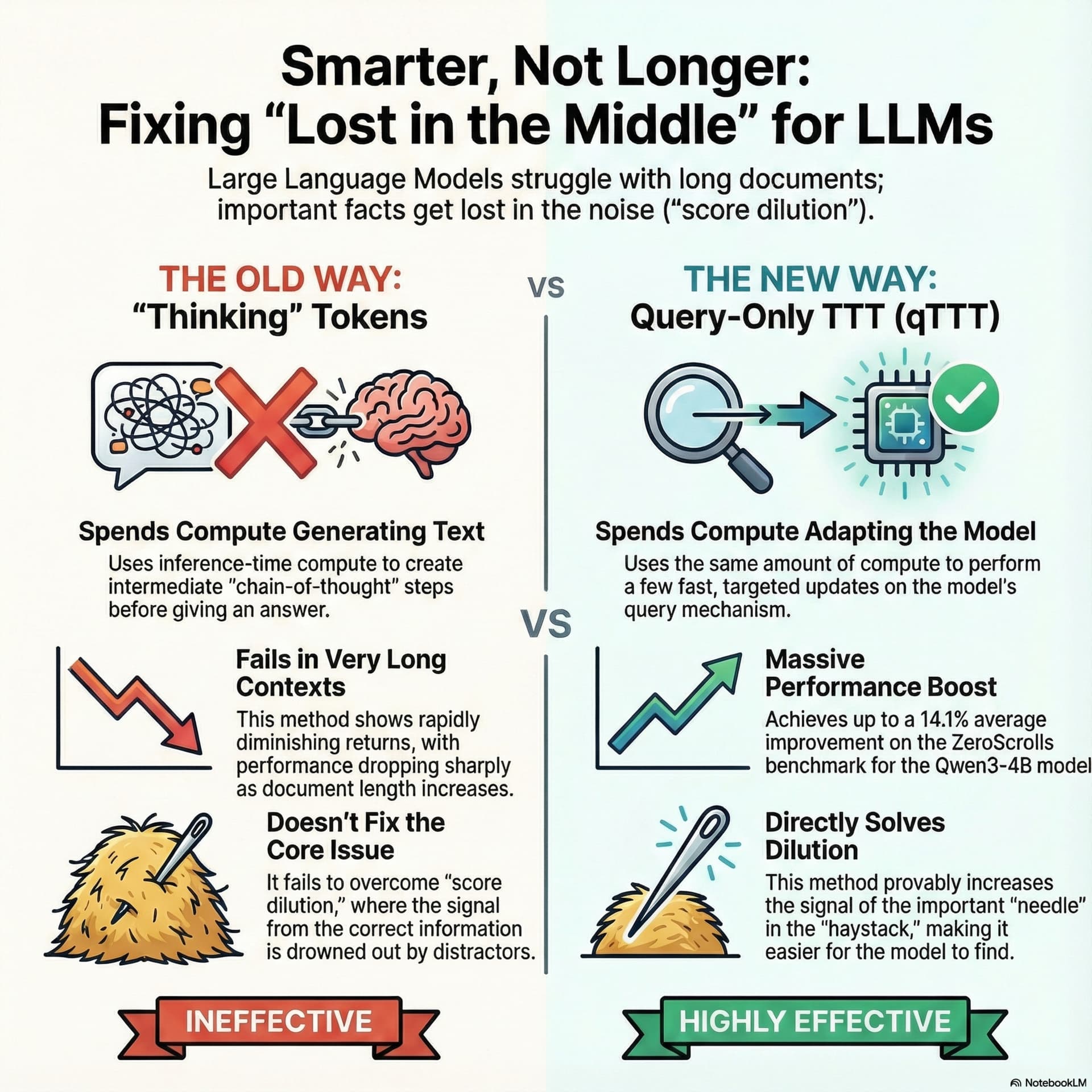

In short
Long-context LLMs fail at “needle in a haystack” retrieval due to score dilution in self-attention; the episode explains the math and presents Query-only Test-Time Training (QTTT) as a fix.
Guests/backgrounds
No guests are mentioned in the provided transcript; it’s a host-led “Deep Dive” discussion.
Key claims
Performance drops monotonically as context length grows; extra “thinking tokens” (more compute) gives diminishing returns because attention access is unchanged. Score dilution occurs because softmax attention mass is diluted by many distractor tokens, requiring a target-vs-distractor logit margin that scales as omega(log context length).
Notable examples
Code bug localization with surrounding code growing from ~5 to 10,000 lines; transaction-log error detection with operation sequences growing from ~25 to 500. QTTT freezes KV cache and updates only query (Q) projection matrices over ~2,000-token spans, yielding large LongBench V2 gains (e.g., +12.6 points for Qwen3-4B).
Written by AI. May contain mistakes. Listen to the episode to check what was said.
Chapters
Tap a time to open that second in VOThe Paradox of Long-Context LLMs
0:45 to 2:36
Understanding the limitations of large language models with extensive context.
“A single function definition, a key fact buried deep in a document, and their performance just collapses when things get too long.”
Exploring the Needle in a Haystack Problem
2:36 to 3:28
Investigating the challenges of retrieving important information from vast data.
“A single line of correct code looks almost identical syntactically to a line with a subtle bug.”
Current Solutions and Their Limitations
3:28 to 4:43
Examining the inadequate traditional solutions to long-context retrieval.
“Just give the model more time, more compute.”
Understanding Score Dilution
4:43 to 6:16
Delving into the mathematical limitations of self-attention in LLMs.
“The score is calculated, and then a softmax function is applied to turn all those raw scores into probabilities, attention mass.”
Introducing Query-Only Test Time Training (QTTT)
6:16 to 8:06
An overview of a novel method to improve information retrieval performance.
“They are just looking through the same faulty, blurry lens again and again.”
How QTTT Addresses Score Dilution
8:06 to 10:34
Explaining how QTTT works to enhance model focus on essential information.
“You do a single expensive pre-fill to compute and cache the key and value representations.”
Results and Implications of QTTT
10:34 to 12:04
Discussing the performance improvements observed with QTTT in various tasks.
“And that's how it satisfies that logarithmic margin requirement you mentioned.”
Transcript
Automatic transcript. May contain errors.0:00Welcome to the Deep Dive. This is the place where we take some pretty complex research, we tear it all down, and then we try to deliver the essential knowledge straight to you. And today, we're wrestling with, I mean, it's really one of the greatest paradoxes in modern AI. We've been living in this era of promise, you know, the promise of large language models with these massive context windows. We're talking models that can theoretically ingest millions of tokens, enough to read an entire scientific corpus or a whole series of books. Or even just maintain a conversation history so long you forget how it even started.
0:35Exactly. But when researchers actually put this to the test, the empirical evidence is, well, it's jarring. These massive LLMs, they consume way more text than they can reliably use. They just, they miss crucial details. A single function definition, a key fact buried deep in a document, and their performance just collapses when things get too long. It is the Achilles heel of scaling. I mean, we've achieved the physical capacity to feed the model an entire library, but the model's ability to reliably retrieve that one critical piece of info. The needle. The needle. It just drops off a cliff as the haystack grows.
1:08And it's deeply frustrating, especially for fields like, you know, knowledge synthesis or massive code review. So that's what we're asking today. What is the structural, the technical reason for this catastrophic failure? Our mission is to unpack a phenomenon called score dilution, the hidden killer of long context retrieval, and then introduce a really brilliant computationally smart solution called query-only test time training. Or QTTT. It basically figures out how to fix the model's focus at the exact moment it needs it most. Okay, so to get this, we first have to understand the problem, the needle in a haystack problem.
1:46Right. To really understand the failure, you have to appreciate the controlled environment the researchers built to test this limit. They created these synthetic tasks that were simple in their objective, but just punishingly difficult in execution. They kept the needle, that one piece of relevant info fixed, but then they systematically just ramped up the surrounding haystack. The context length. The context length,$2. And this lets you see the performance drop-off purely as a function of the document getting longer. And the examples they chose, they weren't just, you know, theoretical. They modeled real-world pain points for LLMs, like the bug localization task in code.
2:20They asked models to find and fix a single-line logical bug, but the context grew from, say, five lines of code. All the way up to 10 ,000 lines of perfectly fine surrounding code. Wow. And that's a great example because the noise to signal ratio is just extreme. A single line of correct code looks almost identical syntactically to a line with a subtle bug. So the model has no easy visual cue. It has to rely purely on its attention mechanism to spot that one little anomaly in a huge sea of valid but distracting data. And they did similar things with transaction logs, right? Having it find a single error code, like negative evil.
2:58Yeah, in a sequence of banning operations that grew from 25 to 500, again, same needle, but the haystack gets exponentially bigger. And the results. Across the board, they were just clear and devastating. Standard in-context performance drops sharply and monotonically. Meaning, without exception, it just keeps getting worse. It just keeps getting worse. It's not a slight dip. It's a clear structural limitation that's baked right into how these models process information. Okay, so this is where we have to talk about the fix that everyone tries. Yeah. The current standard solution. Just give the model more time, more compute.
3:33The chain of thought tokens. Right. Generating these intermediate thinking tokens. The hope is that the model can sort of reason its way to the buried fact. And that approach, it works beautifully in short context, complex reasoning tasks. We've seen that. But here in the long context retrieval scenario, the research shows the solution gives you rapid diminishing returns. So it stops helping. It stops helping. As the context truly explodes, those thinking tokens, they just converge right back to the failure zone of the vanilla model. So we're spending this huge compute budget on an internal monologue that just doesn't work.
4:08Why? Why is that budget failing? And I think that brings us to the formal diagnosis. It does. The reason is a core mechanism in the LLM called score dilution. Score dilution. And this isn't about bad training data or, you know, poor reasoning. It's a mathematical limitation in the self-attention mechanism itself. Okay, so it's in the architecture. Exactly. So for listeners who might need a quick refresher, self-attention uses queries, or Q, to search against the keys, K, of the document. Right, Q, K, and V. Q, K, and V. It uses those scores to then weight the values, V, which contain the actual information.
4:44The score is calculated, and then a softmax function is applied to turn all those raw scores into probabilities, attention mass. And the softmax denominator, that's the key here. That is the entire problem. Standard self-attention is static and it operates with finite precision. Every single token in the context, whether it's the needle or just a distractor, contributes a non-zero score to that softmax denominator. So when you introduce thousands or tens of thousands or millions of these distractor tokens. The haystack. The haystack. That denominator just inflates massively. I'm picturing it like dividing a single pie.
5:19The needle, the fact you want, it might have the highest raw score. It deserves the biggest slice. But if you invite a million distractors to the party and every single one gets a tiny microscopic sliver of that pie, the target share still gets, well, diluted. Its probability just weakens until it's negligible. That is precisely the score dilution effect. The needle vanishes because its statistical relevance is washed out by the sheer quantity of the haystack. And to counteract this, the paper established a mathematical necessity. The model needs a huge target distractor logit margin, basically how much the needle stands out.
5:55And that margin has to scale logarithmically, specifically omega log, as the context length dollars grows. A logarithmic margin. So the signal needs to get exponentially louder just to keep its head above water as the context grows linearly. It does. And that explains why generating more thinking tokens fails. Those tokens are created using the exact same static attention mechanism. The parameters haven't changed. They are just looking through the same faulty, blurry lens again and again. They scale the decoding effort, but they don't change how the model accesses the evidence. So they can't reliably amplify that signal from the buried target.
6:30Let's go back to our needle analogy. If the haystack just keeps growing, spending compute on thinking tokens is like shouting your query louder or spending a long time rephrasing the question all while you're still standing miles away. You're using the same static blurry binoculars. What you really need is a way to adjust the focus. You need to adjust the focus right where the needle is, and that means you have to update the model's parameters. Okay, but hang on. That's the whole challenge, right? If we agree we need to adjust the parameters, that means training or adapting on that huge context.
7:00And training on a million tokens is, it's just prohibitively expensive. That is the crucial tension point. And it's what necessitates the solution. Query-only test time training. It builds on the general concept of test time training, or TTT, where you adapt the model to a specific input right at inference time. Yet the cost you mentioned, at naive TTT, updating everything, you said it's infeasible. Wildly infeasible. For a context of around 100 ,000 tokens, which is big but not even the limit, the researchers calculated that one single full-parameter TTT step Just one step. is FLOP, equivalent to generating about 120 ,000 decoding tokens.
7:39Wow, 120 ,000 tokens for one step. That's like running a marathon just to sharpen a pencil. Exactly. And the bottleneck is that every update to the model's parameters, it alters the keys and values, which means you immediately invalidate the massive KV cache you built up. Ah, so you have to recompute everything over and over. Compute over. We need adaptation, but we absolutely cannot afford to touch K or V. And this is where the elegance, the computational frugality of QTTT comes in. So how do they decouple the evidence storage from the evidence access? It's a two-step process. Step one is standard.
8:12You do a single expensive pre-fill to compute and cache the key and value representations. K and V. Right. It takes time, but here's the critical part. Those cache tensors are then frozen for the entire adaptation process. K and V represent the evidence in the document, and that document doesn't change. So if K and V hold the fixed contacts, freezing them, it basically locks in the memory of the document, so we only have to train the search function, the query, to navigate it. Precisely. Step two is the magic. They execute a few very lightweight gradient updates, but only on the query, the Q projection matrices.
8:47Everything else is fixed. And importantly, this adaptation happens over an ID, randomly sampled, contiguous span of tokens,$2 ,000, which is much smaller than the total context length,$2. So by freezing KNB, you get all the benefit of targeted adaptation without the computational nightmare. We just sidestepped that whole 120 ,000 token problem. The beauty is that the KV cache remains completely valid because we only adapt Q. This preserves the efficiency that makes long-context LLMs work at all. Okay, so adapting the query matrices, that fundamentally changes the self-attention calculation. Can you walk us through the technical reason why updating only the query works so well against score dilution?
9:26I can, because self-attention is all about similarity. It's the dot product of the query and the key, Katie. Right. So since K and V are fixed, the evidence is unchanging. Adapting Q directly reshapes how the model accesses that evidence. It modifies the similarity score for this specific task. The gradient update for QTTT is engineered to directly counter dilution. The step explicitly moves the current query's projection weights toward the relevant target key. The needle. The needle. And importantly, away from the average attention weight, I mean, moody, which is just the aggregated noise from all the distractors.
10:02This is the perfect time for the camera analogy. This is all about focus. Think of the LLM's attention mechanism as a high-powered camera lens. When the context is cluttered, the haystack is huge. The static lens gives you this wide, slightly blurry focus, that blurriness, that score dilution. QTTT is like manually adjusting the focus ring on that camera. You freeze the scene, that's KNV, so you don't have to rescan the whole haystack. You just manipulate the focus mechanism, Q, to lock onto the needle, and it instantly becomes sharp and clear against that blurry background, And that's how it satisfies that logarithmic margin requirement you mentioned.
10:37And that margin increase is largest precisely where you need it most in those long context situations where the initial attention was most diffuse and score dilution was rampant. And they even matched the budgets. They said, OK, instead of spending compute on generating, say, 8000 weak thinking tokens, let's spend those exact same FLOPs on QTTT updates. Yes, they showed how practical this is by matching that computational budget. A budget that's equivalent to generating about 8 ,000 thinking tokens could instead pay for roughly 32 QTTT steps, adapting Q over these small 128 token spans. So they spent the budget on raising the margin instead of just generating low value text.
11:18And the results really do speak for themselves. The performance lift just from this inference time trick is substantial. I mean, QTTT delivered consistent major games across different models and benchmarks. For the Quinn 3-4-B model, they saw average improvements of 12.6 percentage points on the really demanding Longbench V2 benchmark. 12.6 points. That is a massive jump just from reallocating compute at inference time. And 14.1 percentage points on the zero-school subsets. Critically, the biggest gains were in retrieval-driven tasks and multi-hop reasoning things like long dialogue history and multi-document QA.
11:55So the exact tasks that were failing before. The exact tasks that need that precise, targeted access to diffuse evidence invalidates the whole hypothesis. QTTT directly solves the score dilution failure. So the conclusion is actually a really practical one for anyone deploying these models. It is. Reallocating your inference time compute budget from thousands of weak thinking tokens to a small targeted number of query updates is just a vastly more effective strategy. You have the benefit of adaptation without changing the architecture or doing any expensive pre-training. Okay, so to summarize this journey for you, the learner.
12:28LLMs were struggling with these massive contexts because of a structural weakness score dilution. The haystack was inflating the attention denominator, the relevant fact, the needle, it just vanished into all that static noise. And trying to generate more internal monologue with thinking tokens failed because it was just using the same blurry static lens. the elegant and really computationally frugal solution, QTTT, reuses the existing context information, that frozen KV cache, and applies these swift gradient updates only to the query matrices. It manually sharpens the model's focus right at that crucial moment of inference.
13:03It's a complete paradigm shift. Spend your compute budget on adaptation rather than on low value generation. So with that, here is a provocative thought for you to mull over. The research showed that QTTT was way more effective than thinking tokens, but the test used a fixed budget. So given that QTTT only needs a few steps to really sharpen its focus, how might the next generation of LLM systems evolve to dynamically decide when to stop generating those low-value thinking tokens, those blurry internal monologues, and automatically trigger a high-value adaptation like QTTT to refine the prairies instead?
13:37That ability to dynamically switch gears could finally unlock the true potential of these multi-million token contexts. Thank you for joining us for the Deep Dive.
From the publisher
Large language models often struggle with long-context tasks because the attention mechanism suffers from **score dilution**, where relevant information is overwhelmed by surrounding "distractor" tokens. Researchers found that common **inference-time scaling strategies**, such as generating additional "thinking tokens," fail to solve this problem as context length increases. To address this, the authors propose **query-only test-time training (qTTT)**, a computationally efficient method that updates only the model's **query projection matrices** for a specific input. By performing a single prefill to cache **keys and values** and then applying targeted gradient updates, the model learns to better distinguish the "needle" of relevant information from the "haystack" of noise. Experiments across **LongBench-v2** and **ZeroScrolls** benchmarks show that qTTT consistently outperforms traditional methods and thinking tokens. This approach suggests that **adapting model parameters** during inference is a more effective use of compute than simply increasing the length of the generated output.


