
In short
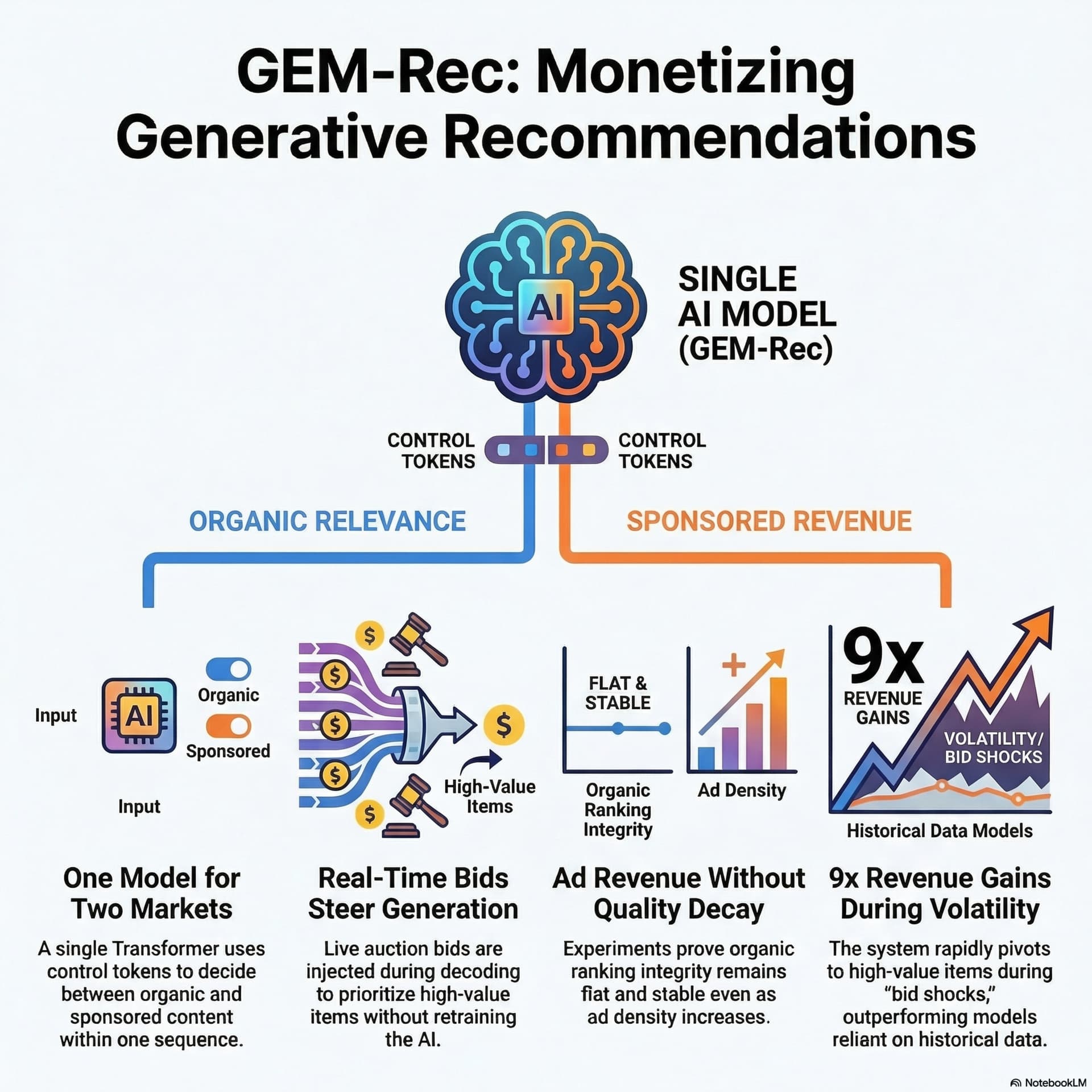
GE Rec (Google) bid-aware generative recommendation for balancing organic relevance with real-time sponsored ad auctions, using control tokens and bid-aware decoding.
Guests
None mentioned; only host dialogue.
Guest backgrounds
Not applicable.
Key claims
Generative retrieval (e.g., “Tiger”) can generate recommendations from semantic IDs, but standard models ignore economics. GMREC factorizes organic vs ad decisions with org/ad control tokens, then uses bid-aware decoding (beam search with a Lambda “aggression dial”) to steer toward higher bids without retraining. Hierarchical semantic IDs prevent irrelevant categories (e.g., tractors) from being boosted.
Notable examples
Steam and Amazon beauty/sports/toys simulations under first-price auctions; “bid shock” where 5% inventory bids are multiplied 10x. At Lambda 0.5, ad rate stays ~7.1% but high-paying ads become 81.5% of ads; ~9x revenue uplift; 100% generative validity (no hallucinated products).
Written by AI. May contain mistakes. Listen to the episode to check what was said.
Chapters
Tap a time to open that second in VOThe Evolution of Recommendation Algorithms
1:20 to 4:30
Learn how generative retrieval represents a major shift from traditional ranking methods.
“Well, today we're going to look at how that duct tape is finally being ripped off.”
Understanding Semantic IDs in Recommendations
4:30 to 7:33
Discover how semantic IDs enhance the recommendation process by providing deeper context.
“But there is a pretty fatal flaw here when you try to apply this brilliant author to the real world of business.”
The Monetization Clash and Its Challenges
7:33 to 13:21
Examine the conflict between organic preferences and monetization in AI-driven recommendations.
“The AI cannot adapt to live market pricing without being completely retrained from scratch, which, you know, takes days or even weeks.”
Ensuring Organic Integrity in AI Recommendations
13:21 to 14:00
Learn about the safeguards in place to maintain organic integrity in AI monetization.
“You might see a running shoe that isn't your usual brand because that competitor brand bid higher, but you will never ever see a tractor.”
Understanding Bid Guarantees in Advertising
14:00 to 15:44
Learn how bid guarantees function in ad systems and their impact on user experience.
“Which is a heavy academic term, but it's basically a mathematical guarantee to the advertisers paying the bills, right?”
The Importance of Organic Integrity
15:44 to 16:50
Discover the concept of organic integrity and its significance for digital platforms.
“But the researchers needed to know what happens when you actually turn this loose in a simulated marketplace.”
Real-World Testing of GMREC
16:50 to 19:10
Examine how GMREC was tested using real-world data and its implications.
“A 100 % generative validity rate means the AI never hallucinated a fake item.”
The Bid Shock Experiment
19:10 to 20:02
Understand the bid shock experiment and its insights into market volatility.
“The system instantly substituted low-value ads for high-value ones dynamically on the fly within the microsecond generation window.”
Future Implications of Bid-Aware Frameworks
20:02 to 21:22
Explore the potential future applications of bid-aware frameworks beyond ads.
“It is evaluating semantic matches and market values simultaneously, exploring vast branching mazes of concepts to find the exact perfect intersection of relevance and revenue.”
Transcript
Automatic transcript. May contain errors.0:00I want you to, um, just for a second, imagine you are sitting on your couch, right? Yeah. You're scrolling through your favorite digital feed. Oh, yeah. Totally zoned out. Exactly. Just totally zoned out. Maybe you're on a shopping app or a video platform or, I don't know, browsing a gaming store. And under your thumb, it just feels like this perfectly seamless, effortless flow of content. Right. Just one thing after another. Yeah. Item after item magically tailored to your current mood. Yeah. But right there, just behind the glass of your screen, there is this hidden, hyper-fast war happening in literal microseconds.
0:40Oh, absolutely. It's a bloodbath behind the scenes. It really is. It's this intense, invisible battle between what you genuinely want to see, the pure organic content, and what advertisers are actively paying to shove in front of your eyeballs. And that right there is basically the massive structural tension that defines almost every single platform you use today. On one side, the platform really wants to show you pure user preference, right? So you don't just get annoyed and close the app. Obviously, yeah. But on the other side, they have this cutthroat reality of digital economics. I mean, they have to make money.
1:11And for a long time, the software trying to balance those two opposing forces has essentially just been duct taping them together in a really clunky way. Well, today we're going to look at how that duct tape is finally being ripped off. We're taking a deep dive into a fascinating research framework from Google called GE Rec. Yeah, this one is a game changer. It really is. We are going to explore how artificial intelligence has finally figured out how to mathematically marry the pure intelligence of a modern recommendation algorithm with the chaotic real-time reality of live auction monetization.
1:49It's kind of wild how they pulled it off. So, OK, let's unpack this, because before we can talk about the money, we have to understand the brain of the machine, right? How recommendation actually works today is just it's entirely different from how it worked even like three or four years ago. Oh, the shift has been monumental. I mean, we are moving away from this older model called the discriminative ranking, and we're moving towards something known as generative retrieval. Right. So let's break those down so you, the listener, can see exactly how this impacts your own feed. So discriminative ranking, that's the old school method.
2:18Yeah, the classic way. I always picture it like a tired, slightly overworked librarian. Like you walk in and the librarian has this massive static card catalog. They pull up a subset of items, score them one by one based on, you know, your past checkouts, rank them highest to lowest and just hand you a list. Exactly. Like you liked a mystery novel last time. So here are 10 other mystery novels. Right. It is functional, but it is incredibly rigid. The tired librarian is a really great way to think about it, to be honest, because the system isn't really thinking, it's just sorting. Yeah, just checking boxes.
2:52Exactly. But generative retrieval, on the other hand, is a totally different beast. Modern models, like there's one called Tiger, they treat recommendations the exact same way a large language model treats text. Which is fascinating. It really is. Instead of picking a pre-existing book from a list, the AI is effectively generating the recommendation from scratch, step by step. And the mechanism they use to do this relies on something called semantic IDs, right? This is where it gets really clever. Oh, the semantic IDs are the secret sauce here. Because instead of just assigning an item a random barcode number, which, let's face it, tells the computer absolutely nothing about what the item actually is, the AI converts every single item in the database into a hierarchical code.
3:37It basically maps out the fundamental nature of the product. Yeah. So think of a semantic ID like a highly specific zip code for concepts. Oh, I like that. Right. So the first digit represents a broad region. The second digit is the city. The third is the neighborhood. OK. So if we translate that to products. If we translate that to products, the first part of a semantic ID might mean clothing. The next part drills down to shoes. The next narrows it to running shoes all the way down to the specific brand, the foam density, the color. Wow. So when the AI looks at your browsing history, it isn't just seeing a list of random barcodes or SKUs.
4:15It actually understands the deep semantic narrative of what you are interested in. It treats your history like an unfinished sentence. And its only job is to predict the next logical word in your journey. Which is a beautiful way to design a system. It totally stops being a tired librarian and against an author, you know, writing a custom evolving story of your interests, which is brilliant. But there is a pretty fatal flaw here when you try to apply this brilliant author to the real world of business. Yeah, the flaw is that this brilliant generative AI is completely, utterly blind to economics.
4:51Standard generative models are trained to optimize for one thing and one thing only, which is semantic likelihood. Like, what is the user most likely to want next? It just wants to please the user. Exactly. They treat every single item in the universe as an organic prediction target. They completely ignore budgets, profit margins, and, you know, the auction dynamics that actually govern sponsored content. Which brings us to the monetization clash. Because I think a very natural question to ask here is, well, if the AI is so incredibly smart, why can't we just explicitly tell it to show some ads?
5:23Like, why is fixing this business blindness such a massive engineering headache? The headache really comes from the fact that organic items and sponsored items operate under entirely different, often conflicting objectives. Okay. An organic item is selected purely based on estimated user preference. There's no price tag attached to the decision at all. Right. It's just pure relevance. But a sponsored item, however, has a mixed objective. It absolutely must be relevant to you. Otherwise, you won't click it and the advertiser wastes their money. But it also incorporates financial bids and potential auction revenue for the platform.
5:59Wait, let me push back on this for a second. If an advertiser runs a sponsored ad for running shoes and people click on it, that data gets recorded in the platform's history, right? Sure, yeah. So why not just train the AI on a giant blended mix of all the historical organic clicks and the historical ad clicks? Like, if the ad worked yesterday, won't the AI just inherently learn that it'll work today? That is the exact trap a lot of early systems actually fell into, and it fails for two big reasons. Okay. First, if you just train an AI on a mixed jumble of data, it gets incredibly confused about the signals.
6:33It doesn't know if an item was clicked because it was truly the best item or just because it was artificially placed at the very top of the page. Oh, that makes sense. You can't distinguish the context. Right. But the second much larger issue is that relying only on historical logs locks the entire system into past valuations. You mean it assumes today's money is the exact same as yesterday's money. Precisely. And live auction bids fluctuate constantly. I mean, advertisers adjust their bids dynamically based on their current inventory, the time of day, or just their confidence in a new product.
7:05Let's say an advertiser realizes they have a massive surplus of inventory, maybe a warehouse totally full of last year's tech gadgets, and they suddenly multiply their ad bid by 10 for a massive 24-hour flash sale. Okay. If your AI is only trained on historical logs, it is completely oblivious to that new opportunity. It would treat that highly lucrative ad the exact same way it treated a low-value ad from last month, simply because the semantic relevance hasn't changed. Oh, wow. Yeah. The AI cannot adapt to live market pricing without being completely retrained from scratch, which, you know, takes days or even weeks.
7:41Wow. Okay, so the AI is a brilliant author, but it's a terrible salesperson. Basically, yeah. If you mix the peer preference data with the volatile money data, the AI's brain essentially just breaks. So how did the researchers behind GMREC actually fix this? They structurally factorized the recommendation task. Okay, big words. Yeah, I know. But they effectively split the AI's brain into two distinct modes using something called control tokens. They added two specific tokens to the AI's vocabulary, the org token for organic and the ad token for sponsored. Ah, okay. So by doing this, they forced the model to decouple two very different decisions.
8:18It separates the decision of whether to show an ad from the decision of which ad to show. Let's use an analogy here to make this really concrete. Think of your feet like a live television broadcast, right? The control token is the network executive sitting in the control room. Their only job is to look at you, the audience, and decide, is this a safe moment to cut to a commercial break without making the viewer change the channel? That is the slot decision. Right. If the executive says yes, they hit the ad token, then and only then does the sales department step in to figure out which specific commercial will make the network the most money at this exact second.
8:59That's the item decision. I love that. The television broadcast analogy perfectly captures the sequence. Yeah. Because when the AI generates the org token, it runs in pure preference mode. It simply retrieves the item that maximizes the semantic match to your history. Like the normal stuff. But the moment it generates the ad token, it shifts gears entirely into monetization mode. It starts looking for items that historically succeeded as sponsored impressions, meaning they were both relevant to the user and economically viable for the platform. OK, so the control tokens solve the when. They teach the AI the natural rhythm of your scrolling to figure out, you know, when an interruption is actually acceptable.
9:39Exactly. But that still doesn't solve the live pricing problem we just talked about, the whole flash sale problem. How does the sales department, in our TV analogy, actually run that live auction in microseconds to capture that new money? So this is where we get into the second half of the solution, which is really the underlying engine of GMREC. They call it bid-aware decoding. Bid-aware decoding, okay. Right. And it relies on a critical mechanism known as beam search, which is controlled by a mathematical dial called Lambda. Okay, we need to spend some time here because beam search sounds incredibly dense.
10:12But if we picture the AI generating those semantic IDs, you know, those zip codes we talked about earlier, it doesn't just guess one path. No, not at all. Beam search is essentially like navigating a massive branching maze. But instead of walking down one path, hitting a dead end, and having to walk all the way back, the AI sends out multiple clones of itself to explore several promising paths through the maze at the exact same time. That's the perfect visualization. During this generation phase, the AI is exploring multiple branches of the product tree simultaneously. Okay. And while it is exploring that maze, it looks at a pre-computed table of live auction bids.
10:52Because the items are organized hierarchically by their semantic IDs, the model actually knows the maximum bid available down any specific branch of the tree. Oh, that's smart. Yeah, it knows the highest bid sitting at the end of the shoe branch versus the highest bid down the shirt branch. So let's run a slow motion replay of a microsecond auction here. The AI is standing at an intersection in the maze. It needs to generate the next digit of the zip code. The path to the left has a million-dollar advertiser bid waiting at the end of it. The path to the right only has a$10 bid. This is where that Lambda dial comes into play, right?
11:28Lambda is essentially an aggression dial for the platform's revenue goals. It is the ultimate control lever. When the platform turns the Lambda dial up, The system dynamically boosts the mathematical probability of the high bidding items in real time. It acts like a magnet. As the AI explores the maze, a high lambda setting physically pulls the AI's generation path toward the most lucrative outcomes early in the sequence. Wow. Yeah. It shifts the AI toward the money without needing to retrain a single line of code. But I have to ask a crucial user experience question here because this sounds incredibly risky.
12:04It does. If we are artificially boosting the probability of an item just because an advertiser is throwing a mountain of cash at it, does this mean a completely irrelevant, terrible item could win the auction? Like if my semantic history clearly shows I'm looking for running shoes, could the AI hallucinate and suddenly give me an ad for an industrial tractor just because the tractor company cranked their bid to 50 bucks a click? Right. That is the exact nightmare scenario for any platform, and it is exactly why the architecture of those semantic ID zip codes is so vital. Okay, how so? The hierarchical structure acts as a built-in semantic relevance filter.
12:41Because the decoding process happens step-by-step down the branches, the AI is only capable of boosting branches that are already semantically plausible based on your history. Ah, so the AI won't even look at the tractor branch of the maze. It's walled off from the start. Precisely. If your history dictates you are in the clothing and footwear region of the maze, the tractor region is mathematically inaccessible. That's amazing. The system effectively prunes low-value or completely irrelevant branches entirely out of the micro second-generation process before the money can even influence the decision.
13:15Wow. The high bid might steer the car, but the semantic ID hierarchy keeps it firmly on the road. You might see a running shoe that isn't your usual brand because that competitor brand bid higher, but you will never ever see a tractor. That is wild. It is evaluating the pure semantic match and the raw market value simultaneously, just dynamically adjusting the odds in a fraction of a second. Yeah, it's a huge leap forward. But even with that filter, I mean, messing with the generation probabilities of an AI sounds like playing with fire. Yeah. If a platform gets greedy and cranks that lambda dial to the absolute maximum, how do the researchers prove it doesn't just completely ruin the user feed?
13:53Well, they provide two major theoretical guarantees to prove the system's stability. Okay. The first is called allocative monotonicity. Which is a heavy academic term, but it's basically a mathematical guarantee to the advertisers paying the bills, right? Exactly. It means that if an advertiser increases their bid, the system mathematically guarantees an equal or greater chance of their ad actually being shown. The AI won't accidentally penalize them for bidding higher due to some weird generation quirk. Right. The system is completely rationally responsive to economic signals. It provides trust for the marketplace.
14:27But the second guarantee is the one that really matters for your experience as a user scrolling the feed. It's called organic integrity. OK, wait, let me make sure I'm synthesizing this correctly. Because they split the brain using those control tokens, you know, locking the ad strictly behind the ad token. Does that mean injecting all this chaotic, high stakes bidding money into the monetization side of the brain doesn't leak over and infect the preference side? You've hit the nail on the head. Organic integrity is the holy grail for digital platforms. Wow. It guarantees that because the bid modulation, that artificial magnetic pull toward the money, only happens after the ad token is selected, the internal ranking of the purely organic items remains mathematically untouched.
15:12So the platform can aggressively crank up that lambda dial, increasing the ad pressure to hit like a quarterly revenue goal. Yeah. And doing that will change how often you see an ad. We'll substitute organic slots for ad slots. But the organic content you do see, the videos or products that aren't sponsored, remain perfectly cleanly calibrated to your genuine interests. Exactly. The underlying intelligence of what you organically desire isn't distorted by the money happening in the background. The feed remains completely trustworthy. That is incredible. Now, theory is wonderful. Math on a whiteboard is great.
15:46But the researchers needed to know what happens when you actually turn this loose in a simulated marketplace. Right. Time to test it. And they didn't use small samples. They put GMREC to the test using massive real-world data sets. They used data from Steam, the massive video game storefront, as well as Amazon categories like beauty, sports, and toys. Huge data sets. Yeah. And they ran these simulations using a first-price auction model. Right. And a first price auction model simply means the winner of the ad slot pays exactly what they bid, which creates a very highly competitive, aggressive marketplace.
16:21Very aggressive. And when they ran the numbers, they mapped out what is known as the Pareto frontier. Which is essentially the visible curve of the tradeoff. It showed a smooth, highly predictable curve that platforms can ride. They can slide up and down between maximum relevance for the user and maximum revenue for the business just by turning that lambda dial. And, crucially, across all of these intense tests, the framework achieved a 100 % generative validity rate. We should really highlight why that is so important. A 100 % generative validity rate means the AI never hallucinated a fake item.
16:57Never. Think about how disastrous that would be in an e-commerce setting. Imagine the AI generates the absolute perfect running shoe for you. It perfectly targets your aesthetic. You get excited. You click buy. And then the platform realizes that shoe doesn't actually exist in the warehouse. Right. The AI just made it up to satisfy the algorithm. Yeah, a total disaster. But GRAC never did that. Even under intense bid pressure, it always generated a valid semantic ID for a real product that actually existed in the inventory. It didn't buckle. Yeah. But here's where it gets really interesting. Yeah, the bid shock.
17:29Yes. To test how fast this AI could react to chaos, they ran an experiment called the bid shock. Because the real world isn't static, you know. The system has to adapt to sudden market volatility. So to test this, the researchers artificially grabbed just 5 % of the inventory in the simulation and abruptly multiplied their bids by 10. A massive 10x bid shock. Exactly. I love this experiment because it simulates sheer market panic. Imagine a company realizing a trend is dying like fidget spinners a few years ago. What a quick example. Right. They have millions of fidget spinners in a warehouse, and they need to dump them immediately before they become totally worthless.
18:08So the marketing team panics and cranks their ad bid by 10x to flood the zone. The results on the Steam dataset under this exact scenario were stunning. What happened? When the system ran on its historical baseline, meaning Lambda was set to zero, the AI totally ignored the new high bins. Yeah, it was trapped in the past, completely blind to the fact that someone was willing to pay 10 times the going rate, But with just a modest tweak, turning the Lambda dial up to just 0.5, the composition of the user's feed transformed instantly. And we aren't talking about flooding the user with a wall of fidget spinner ads, right?
18:43The user's experience didn't get destroyed. Far from it. At Lambda 0.5, the total ad rate for the user only rose slightly, hovering at about 7.1 % of the total feed. Oh, wow. So 93 % of the feed was still pure organic content. But the share of those newly high-paying ads, it jumped to represent 81.5 % of all the ads shown. Wow. So it kept the interruptions incredibly low, but it made absolutely sure that every single interruption maximized revenue. Yes. The system instantly substituted low-value ads for high-value ones dynamically on the fly within the microsecond generation window. Unbelievable.
19:19And the final result for the platform, a 9x revenue uplift. Nine times. Nine times the revenue captured without retraining a single line of code and while keeping the ad load at just 7%. That is staggering. It completely validates the entire architecture. So let's step back and summarize what this means for you, the listener. We have moved entirely away from the blunt force rudimentary days of just shoving a high-paying ad into a rigid predetermined slot on a web page. Thank goodness. Seriously. We have officially entered an era of an elegant generative economy. It is an economy where the AI dynamically balances your deeply personal desires with the harsh financial realities that keep the platform servers running.
20:02Yeah. It is evaluating semantic matches and market values simultaneously, exploring vast branching mazes of concepts to find the exact perfect intersection of relevance and revenue. So the next time you're swiping through your feed and you see an eerily relevant sponsored product pop up, I want you to remember that you aren't just looking at a static targeted app. No, you're not. You are looking at the winner of a hyper fast bid aware generative option. You are looking at an AI that perfectly calculated exactly when you were ready for an interruption and which bid was actually worth your attention, all without breaking the flow of your organic story.
20:38It really does change how you look at your screen, doesn't it? The invisible mechanics are just as fascinating as the content itself. It does. And so what does this all mean for the future? I want to leave you with a final provocative thought to mull over. OK. If generative models like GMREC can now perfectly balance human preference with complex economic incentives in real time, could this bid-aware framework eventually step outside of just retail ads? Could it be used to dynamically negotiate the price of the actual content you watch, the services you use, or even the daily news we consume, dynamically shifting based on how badly the AI mathematically knows you want to see it?
21:18Wow, that is a very big, very complex question for the future of the Internet. Something to think about the next time you open an app and start scrolling. We'll leave it there for today. Keep diving deep.
From the publisher
The provided research introduces GEM-Rec, a unified generative framework designed to balance organic user recommendations with platform monetization. While traditional generative models focus solely on semantic relevance, this new architecture integrates commercial bids directly into the retrieval process using specialized control tokens. By decoupling the decision to show an ad from the specific item selection, the system can learn successful historical placement patterns while remaining responsive to real-time auction dynamics. The authors introduce a bid-aware decoding mechanism that steers the model toward high-value items without requiring constant retraining. Theoretical proofs and experiments demonstrate that this approach maintains organic integrity, ensuring that increased ad pressure does not distort the quality of non-sponsored content. Ultimately, the framework allows digital marketplaces to dynamically optimize for both user satisfaction and platform revenue within a single, scalable model.


