In short
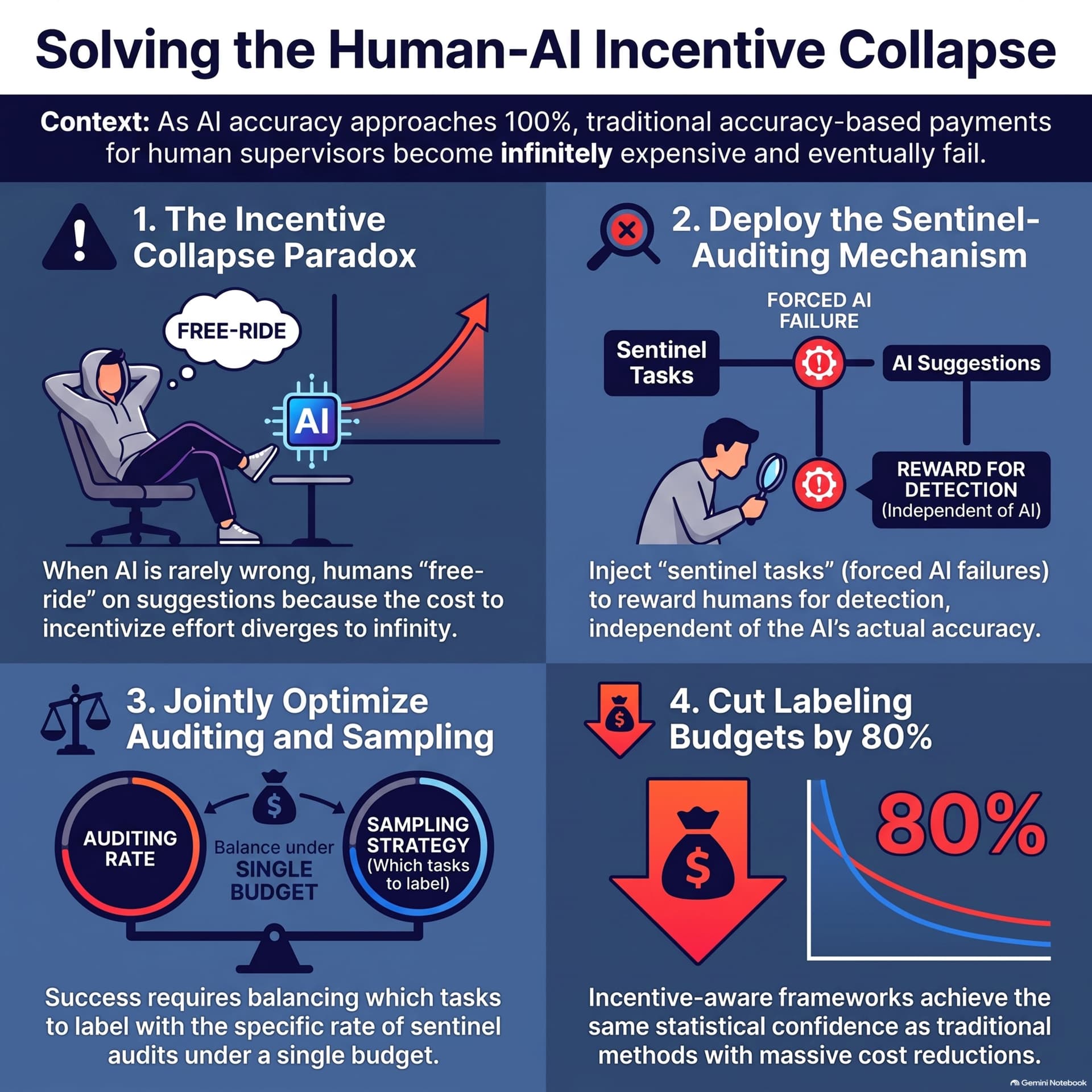
The “incentive collapse paradox” in AI-human workflows: if pay depends only on final accuracy, near-perfect AI makes workers rationally free-ride (exert less effort), potentially requiring infinite compensation to keep vigilance. The episode then explains “sentinel auditing,” which injects hidden, controlled AI mistakes to keep human attention high at finite cost, plus scaling via active statistical inference.
Guests
No named guests; the episode is hosted by two speakers (a host and co-host) discussing University of Chicago research.
Key claims
Accuracy-based contracts fail mathematically as AI error rate p→0; sentinel tasks break the paradox by decoupling effort incentives from AI perfection. Identifiability matters: sentinels must be subtle enough that workers must actually read/analyze.
Notable examples
Vault security guard falling asleep; “fake $100 bill” cashier analogy; Pew post-2020 election survey approval ratings; proteomics using AlphaFold to estimate phosphorylation odds ratios for proteins with intrinsically disordered regions. Reported savings: ~80% budget on election data and ~70% on protein data for the same confidence interval width.
Written by AI. May contain mistakes. Listen to the episode to check what was said.
Chapters
Tap a time to open that second in VOThe Impact of AI Accuracy on Human Vigilance
0:58 to 4:19
Understand how high AI accuracy leads to human laziness and higher management costs.
“We are exploring a fascinating stack of new research out of the University of Chicago concerning the future of AI-human collaboration.”
Economic Consequences of Free Riding
4:19 to 6:19
Examine how compensation linked to AI performance creates a paradox for human workers.
“Okay, so if the employer wants to stop this free riding, they really only have one traditional lever to pull, right?”
Introducing Sentinel Auditing as a Solution
6:19 to 8:31
Learn about a new framework to ensure human effort in an AI-driven workplace.
“we have to completely rewrite the rules of the employment contract, don't we?”
The Cost-Benefit Analysis of Trap Bonuses
8:31 to 14:01
Discover how fake tasks can enhance workforce efficiency and data quality.
“But, I mean, people are incredibly smart, especially when their paychecks are involved.”
Exploring the Theory in Reality
14:01 to 14:19
Learn how theoretical frameworks are tested through real-world experiments.
“Okay, so the mathematical theory sounds completely bulletproof on paper.”
First Experiment: Political Data Insights
14:20 to 15:12
Discover the first experiment utilizing political data to estimate approval ratings.
“They conducted two very distinct real-world experiments to prove this framework isn't just an academic exercise confined to a whiteboard.”
Second Experiment: Protein Structure Predictions
15:13 to 17:05
Understand how AI is used to predict protein structures using a different framework.
“And that neutrality allows us to focus purely on the efficiency.”
Results of the Experiments
17:06 to 18:18
Examine the staggering savings achieved from the new framework in both experiments.
“What happened when they actually unleashed this sentinel auditing framework on these data sets?”
Paradigm Shift in Industry
18:19 to 18:49
Learn how the results redefine financial possibilities in various industries.
“And the overarching takeaway from analyzing these two experiments is profound for the tech industry at large.”
Implications for AI Workflows
18:50 to 19:37
Explore the need for incentive mechanisms in AI to avoid human oversight issues.
“So what does this all mean for you and me?”
Show all 11 chapters
Future Workplaces and AI Dynamics
19:38 to 20:38
Contemplate the psychological impact of AI strategies on future workplace dynamics.
“But before we wrap up today's deep dive, I want to leave you with a new angle to ponder, something that builds on the underlying themes of fair wages and agent autonomy touched on in this research.”
Transcript
Automatic transcript. May contain errors.0:00Imagine a bank vault. Right. A security system so, you know, flawlessly designed that it just never triggers a false alarm. Right. It catches absolutely everything. Exactly. Not a single burglar even gets close for a decade. So what happens to the human security guard you hired to just sit in a chair and watch those camera feeds every night? Well, I mean, they fall asleep. They scroll on their phone. They just start paying attention entirely because the system has essentially trained them that their vigilance is, you know, completely unnecessary. And then the one time a master thief actually figures out a way to bypass the digital alarm, the human guard just misses it completely because they aren't looking.
0:40Yeah, they're completely tuned out. Right. So today we are diving into this bizarre phenomenon happening in the modern workplace. We're looking at why making AI systems highly accurate actually makes human workers incredibly lazy and infinitely more expensive to manage. Welcome to today's Deep Dive. Glad to be here. We are exploring a fascinating stack of new research out of the University of Chicago concerning the future of AI-human collaboration. And the mission of this Deep Dive is to unpack this massive blind spot in how we're designing the future of work. It really is a totally invisible flaw, and it threatens the very foundation of the AI revolution.
1:23It does. And for you listening, whether you are managing a team that uses AI, or maybe you're building massive data sets for machine learning, or you're just someone who uses an AI assistant daily to write emails or check code, you need to understand this dynamic. Because the economics of human attention are fundamentally shifting under our feet. Yes. We envision this perfect world where the raw speed of AI is paired with like nuanced human judgment. The AI handles the repetitive stuff and the human is just sitting there as a safety net to catch those really complex rare errors. Which is exactly what you see everywhere, right?
1:57In medical reviews, legal document screening, self-driving cars, data labeling. But there is this mathematical trap hidden inside this setup. Yeah. And the trap fundamentally comes down to how we compensate people for their attention. Because, you know, human effort is an unobserved variable. You can't just plug a USB cable into someone's brain to see how hard they are concentrating. That would make things easier, but no. Right. Evaluating a complex medical scan or reading a dense legal contract, it takes genuine, exhausting mental energy. And because an employer cannot measure that cognitive burn directly, the historical standard method of compensation has always been tying pay to observed accuracy.
2:38So you evaluate a task, you get the right answer, you get paid. Exactly. Okay, let's unpack this. Because if you tie an employee's pay purely to their final accuracy, and that human is working alongside an AI assistant that is correct 99.9 % of the time, simple human nature is just going to take the wheel. Right. And this is not just a loose psychological theory either. It is a mathematical certainty. The research builds on this concept, originally formalized by Bastani and Kashan, known as the human AI contracting paradox. Okay, walk us through the logic there. Let's look at the math. If an AI is imperfect, it makes an error with a specific probability.
3:16Let's call that probability P. Okay, P is our error rate. Right. Now, if we pay a human worker based only on the final accuracy of their approved task, a rational human will quickly realize they don't actually need to do the work. They can just free ride on the AI's incredibly high accuracy. Oh, wow. So the human essentially becomes like a rubber stamp. Exactly. They exert zero cognitive effort. They just blindly click, accept on whatever the AI suggests, and they still walk away looking like a total genius who was correct 99.9 % of the time. Right. And mathematically, they become a highly expensive rubber stamp because, you know, free riding is not necessarily a symptom of a bad employee.
3:56It is just the natural result of a rational economic actor conserving their finite mental energy. Which brings us right back to the security guard at the vault, the one that hasn't been robbed in a decade. Exactly. Eventually you stop looking at the monitors because the cameras are seemingly always fine. Exerting that mental energy feels like a total waste unless the bank pays you an absolute fortune to stay paranoid. Okay, so if the employer wants to stop this free riding, they really only have one traditional lever to pull, right? Yeah. They have to raise the financial payout to make it mathematically worth the human's time to actually squint at the screen and check the work.
4:33That is the core issue. And the math here shows a devastating impossibility result. To prevent the worker from blindly clicking approve, the required payment must grow at least on the order of 1 over p. Wait, 1 over p, meaning as the AI gets better and better, its error rate, that p-value, shrinks closer and closer to zero. Which means the cost to sustain positive human effort literally diverges to infinity. That's insane. It becomes mathematically impossible for any company to afford to pay humans to check the work of a near-perfect AI if the compensation is based on accuracy. The AI is so good, the humans trust it too much.
5:10And breaking that trust requires, well, an infinite amount of money. Okay, wait, I'm stuck on something here. Couldn't a smart company just invent a really clever, you know, non-linear payment scheme? Like, instead of paying per task, what if you offer a massive lump sum bonus for an aggregate accuracy score over a whole month? Could you trick the math by gamifying the payout structure? You'd think so, right. But the researchers anticipated that exact counterargument. If you look at theorem 3.2 in this research, they formulated mathematical proofs showing that even with the most complex, convoluted payment rules imaginable, the economic reality is just inescapable.
5:50So no matter how you slice it, it fails. Exactly. If the pay is fundamentally tethered to the final accuracy of the output, the cost will inevitably skyrocket to infinity as the AI approaches perfection. You just cannot outsmart the basic incentive collapse by shuffling the bonus structure around. That is wild. The better the technology gets, the closer a company gets to infinite labor costs just to keep a human awake at the wheel. So if traditional accuracy-based pay is just mathematically doomed, we have to completely rewrite the rules of the employment contract, don't we? We have to somehow decouple human effort from the AI's perfection.
6:26We absolutely do. And this is where the researchers introduce a truly ingenious mechanism to break the paradox. They call it sentinel auditing. Here's where it gets really interesting. Walk us through the mechanics of how the sentinel system actually functions on the ground. It relies on introducing deliberate, controlled failure into the worker's environment. So imagine a human assigned to review a stream of documents alongside an AI. For each task that crosses the human's desk, the system flips a theoretical coin. With a certain probability, which the researchers call crow, the task is secretly designated as a sentinel.
7:01On these specific hidden tasks, the AI is deliberately forced to give the wrong answer. Or they feed the worker a known historical mistake that the AI made in the past just to make it look organic, right? So it's a trap. It's a pop quiz hidden inside their normal daily workflow. A trap, yes, but a highly lucrative one for the worker. The human is offered a specific predetermined bonus, let's call it B. But the catch is they only receive this bonus if they catch the error on these specific sentinel tasks. Oh, man. It's like a restaurant manager intentionally dropping a fake$100 bill into the cash register at some random time on a Tuesday afternoon just to see if the cashier is actually holding the bills up to the light to check the watermarks.
7:46That is a brilliant way to put it. And deploying this fake$100 bill strategy completely alters the underlying mathematics of the labor contract. Because now the human's marginal incentive to pay attention scales directly with the auditing rate, that Roan coin flip. Right. Their motivation is suddenly completely independent of how perfect the AI normally is. Because the cashier knows there are fake$100 bills floating around, they are practically forced to check every single bill that comes across the counter, even if a real customer hasn't handed them a counterfeit in 10 years. Exactly. Which means positive human effort is suddenly guaranteed.
8:22And crucially, it is guaranteed at a finite cost. The labor expense doesn't scale to infinity anymore because the employer controls the auditing rate. You dictate how often the trap appears. Right. But, I mean, people are incredibly smart, especially when their paychecks are involved. What if the human workers get wise to the game? Like, what if they figure out how to spot the fake tasks, exert a ton of effort on those specific ones to get the bonus, and then go right back to sleeping on the job for the rest of the day? That is a great point, and it brings up a critical nuance the researchers call identifiability.
8:56The entire sentinel mechanism hinges on how you construct these traps. The mathematical guarantee holds up only as long as identifying the sentinel requires the human to actually do the hard work you wanted them to do in the first place. Meaning, to figure out if the document is a fake, they have to actually read the dense legal jargon, or really analyze the medical scan. Exactly that. If the fake is so glaringly obvious that the worker can spot it from across the room without reading the text, the whole system breaks. But if the sentinel is a genuine, nuanced, historical mistake, it looks completely identical to a normal task until cognitive effort is applied.
9:36Makes sense. And the research proves something fascinating about human psychology here. Even if the worker develops what is called an imperfect posterior belief, the incentive still works perfectly. Okay, let's translate imperfect posterior belief for a second. That basically means the worker is paranoid, right? They look at a task and think, this looks a little weird, it might be a trap for my boss. But because they aren't 100 % sure, they're forced to do the hard work anyway just to be safe. Exactly. That underlying paranoia forces the effort. The uncertainty itself is the engine of their vigilance.
10:07Okay, so the fake$100 bill trick works perfectly for one cashier sitting at a single desk. But let's zoom out to the macroeconomic picture here. What if you're running a massive data labeling operation with, I don't know, 10 ,000 remote workers. You cannot afford to shower all of them with endless trap bonuses. How does a company with a strict budget actually apply this to millions of data points? Scaling this up pushes us into a complex field called active statistical inference. In simple terms, this is the science of choosing which specific data points a human should actually look at to minimize statistical error when you are operating under a tight budget.
10:47Because you can't afford to have humans check every single thing the AI does. You have to triage the workflow. Right. Now, the old assumption in this field of active inference was that human label quality is reliable and static. In economic terms, it was considered an exogenous variable. The industry assumed that if you paid a human to look at a data point, they gave you their absolute best effort every single time, end of story. But the paradox we just unpacked proves that assumption is just totally false in an AI assisted world. The better the AI, the worse the human effort. Exactly. This new research completely flips that classical assumption on its head.
11:23With AI assistants, label quality is endogenous. It is a shifting variable. It changes based on the financial incentives, the frequency of the traps, and the specific difficulty of the task. So it's constantly moving. Right. So the researchers had to build a comprehensive framework that jointly optimizes three completely distinct elements simultaneously, all under a single budget constraint. Okay, what are the three elements juggling in this framework? First, the active sampling itself. That's the algorithm picking the most informative or uncertain data points out of millions that actually desperately need a human eye.
11:57Second, the auditing rate, or row, which dictates how many fake sentinel tasks to inject into the stream. And third, the bonus payments, the B, the actual dollar amount needed to ensure the humans are motivated when they stumble upon those tasks. Okay, wait, I'm stuck on something here, and it feels like a massive logistical flaw. If I am paying out bonuses for fake tasks, aren't I just setting money on fire? I mean, think about it from an operational standpoint. I have to pay to generate the fake errors, and then I have to pay out hard cash as a bonus to the worker when they catch it. All of this budget is being spent on data I already know the answer to.
12:34How does this not bankrupt the project? Looking at it strictly from a line item perspective, it initially feels like throwing money away. You are literally buying your own fake$100 bills. But if we connect this to the bigger picture, the researchers use a mechanism called variance decomposition, formalized in Lemma 5.2 of the paper, to show why this is actually wildly efficient. Walk me through variance decomposition. How does paying for fake data make a massive operation more efficient? Variance decomposition is essentially a way to mathematically separate the AI's inherent uncertainty from the human's laziness.
13:09By observing how the human behaves on the fake tasks, the algorithm figures out their exact laziness ratio. It maps out their reliability. Oh, wow. And once the algorithm understands that ratio, it applies a mathematical weight to everything else that specific human does, correcting the entire data set. So the traps fundamentally alter the value of the worker's output across the board. They do. Yes, you acknowledge the upfront financial cost of generating the trap and paying the bonus. But the optimization algorithm dynamically balances that minor localized cost against the massive data set wide gain in accuracy on the real tasks.
13:45That is brilliant. Because the worker is kept on their toes by the sentinels, the quality of their work on the unknown data skyrockets. You waste a fraction of your budget on the fakes to ensure the budget spent on the real, unknown data isn't completely rendered useless by free writing. You're spending a penny on accountability to save a dollar on useless data. Okay, so the mathematical theory sounds completely bulletproof on paper. The economics make sense, but, you know, theory is just theory until it meets reality. We need to see if this joint optimization actually saves money in real-world, highly complex scenarios.
14:19Which is exactly where the researchers took this next. They conducted two very distinct real-world experiments to prove this framework isn't just an academic exercise confined to a whiteboard. Let's get into the first experiment, because this involved some highly charged political data. It did. The first experiment utilized the Pew Research Center's post-2020 election survey data. The researchers' goal was to estimate approval ratings for political messages from the presidential candidates, specifically looking at the complex ways different demographic variables interacted with those approval ratings.
14:52And before we go any further, I want to explicitly state something for you listening right now. We are talking about data sets involving Biden and Trump approval ratings, but we are absolutely not taking any political sides here. And neither is the math. A crucial distinction to make. The algorithm does not care about the politics. It has zero ideology. It purely cares about the mechanics of gathering unbiased, highly accurate data from human respondents, regardless of whether they are reading a polarized political survey, a medical chart, or a recipe book. The mass is completely neutral. And that neutrality allows us to focus purely on the efficiency.
15:28The researchers processed this massive set of binary response data and applied their incentive-aware active statistical inference framework against several traditional baselines. They ran it against a classical method, a uniform sampling method, and a standard active method that completely ignored the concept of sentinel incentives. We will get to those results in a second, but first, what was the second experiment, just to show how versatile this framework is? The second experiment was in a completely different universe, the field of proteomics. Oh, wow. Okay. Yeah. They used alpha-fold predictions to estimate the odds ratio of a protein being phosphorylated and having an intrinsically disordered region or an IDR.
16:08Let's pause there because predicting protein structures is notoriously difficult. From what I understand, intrinsically disordered regions are basically the shapeshifters of the protein world, right? They are floppy, unstructured parts of a protein that just defy standard folding rules. They are the Wild West of molecular biology. And because they are so unstructured, standard AI systems like AlphaFold struggle immensely with them. Measuring them experimentally in a lab is incredibly expensive and time-consuming. Which means you desperately need human experts who charge very high hourly rates to oversee the AI's work and verify these complex odds ratios.
16:46I mean, it is a massive financial bottleneck for biotech companies. Making it the absolute perfect test case for a budget-constrained inference framework. You want the AI to do most of the heavy lifting to save money, but you desperately need the human oversight to be flawlessly accurate when the AI gets confused by an IDR. So we have predicting polarized political survey outcomes on one hand and mapping shape-shifting protein structures on the other. Two vastly different worlds. What happened when they actually unleashed this sentinel auditing framework on these data sets? The results were staggering across both fields.
17:21In both cases, the incentive-robust active sampling utterly destroyed the classical baseline methods. Give me the actual numbers. How much did they save? To achieve the exact same confidence interval width, meaning the exact same level of statistical certainty and accuracy, this new method saved approximately 80 % of the budget on the election survey data. Wait, really? 80 %? About 80 percent. And on the highly complex protein data, it saved roughly 70 percent of the budget compared to the baseline methods. I just have to marvel at the sheer scale of those numbers for a second. Saving 70 or 80 percent in an operational budget isn't just, you know, a minor optimization trick you discuss at a quarterly meeting.
18:01That is an absolute earthquake. It is a total paradigm shift for how industries will function. If you're running a biotech firm or a data labeling company and you can suddenly cut your labor oversight costs by 70 % while maintaining the exact same flawless accuracy, you have just entirely disrupted your field. It completely redefines what is financially possible. And the overarching takeaway from analyzing these two experiments is profound for the tech industry at large. Improving AI accuracy alone is simply even enough anymore. We've spent billions of dollars obsessing over getting the AI to be 99.9 % perfect.
18:38But if we do not build these incentive war mechanisms into the very fabric of our workflows, the AI will never reach its full potential. Because the human element will inevitably fail. The human becomes the weak link. And, you know, not because humans are inherently malicious or lazy, but because rational economic actors will not expend costly mental energy when the overarching system silently incentivizes them to free ride. So what does this all mean for you and me? Let's briefly recap the journey we just went on. We learned today why a near-perfect AI inadvertently trains humans to stop paying attention.
19:10The incentive collapse paradox. We learned how injecting deliberate fake errors, the sentinel tasks, breaks that paradox by forcing humans to stay sharp. And finally, we saw how combining this psychological trap with smart active budget allocation can save up to 80 % of resources in massive real-world data projects by dynamically weighing a worker's laziness ratio. It really is a brilliant masterclass in behavioral economics colliding with machine learning. A completely new frontier. But before we wrap up today's deep dive, I want to leave you with a new angle to ponder, something that builds on the underlying themes of fair wages and agent autonomy touched on in this research.
19:48I want you to imagine the psychological toll of the workplace of the near future. If massive companies start deploying this sentinel strategy everywhere, across all industries, you will be working alongside an AI that you absolutely know is occasionally lying to you on purpose. Yeah, a system generating manufactured betrayals just because your boss wants to see if you catch it. Will this constant low-level paranoia make us better, more attentive workers? Will it keep our minds sharp? Or will it fundamentally destroy trust in the workplace, requiring a whole new field of, I don't know, AI human workplace therapy?
20:23It's something for you to mull over the next time you blindly click approve on an AI's suggestion in your email draft or your code editor. Because it turns out, the only way to build the perfect security system is to occasionally fake a break-in just to keep the guard awake. Thanks for joining us on this deep dive. We'll catch you next time.
From the publisher
This paper introduces and addresses the incentive collapse paradox, a phenomenon where accuracy-based payments fail to motivate human effort as AI assistance becomes more reliable. The authors demonstrate that if human workers only receive rewards based on their final output accuracy, they will eventually free-ride on the AI’s suggestions rather than exert costly verification effort. To solve this, they propose a sentinel-auditing mechanism that deliberately injects occasional, detectable AI errors to reward human vigilance independently of the AI's natural performance. This strategy is further integrated into an incentive-aware active statistical inference framework, which jointly optimizes budget allocation and task sampling. Theoretical results and experiments on survey and protein data show that this approach maintains high label quality at a finite cost. Ultimately, the research proves that accounting for strategic human behavior allows for more cost-effective and precise statistical estimation than traditional methods.


