In short
How “search subsidies” work in directed search, and how AI assistants in an “agentic economy” tokenize search costs, letting platforms profit by inducing excess (computationally inefficient) evaluation.
Guest backgrounds
No guests are named in the transcript; only two hosts are speaking.
Key claims
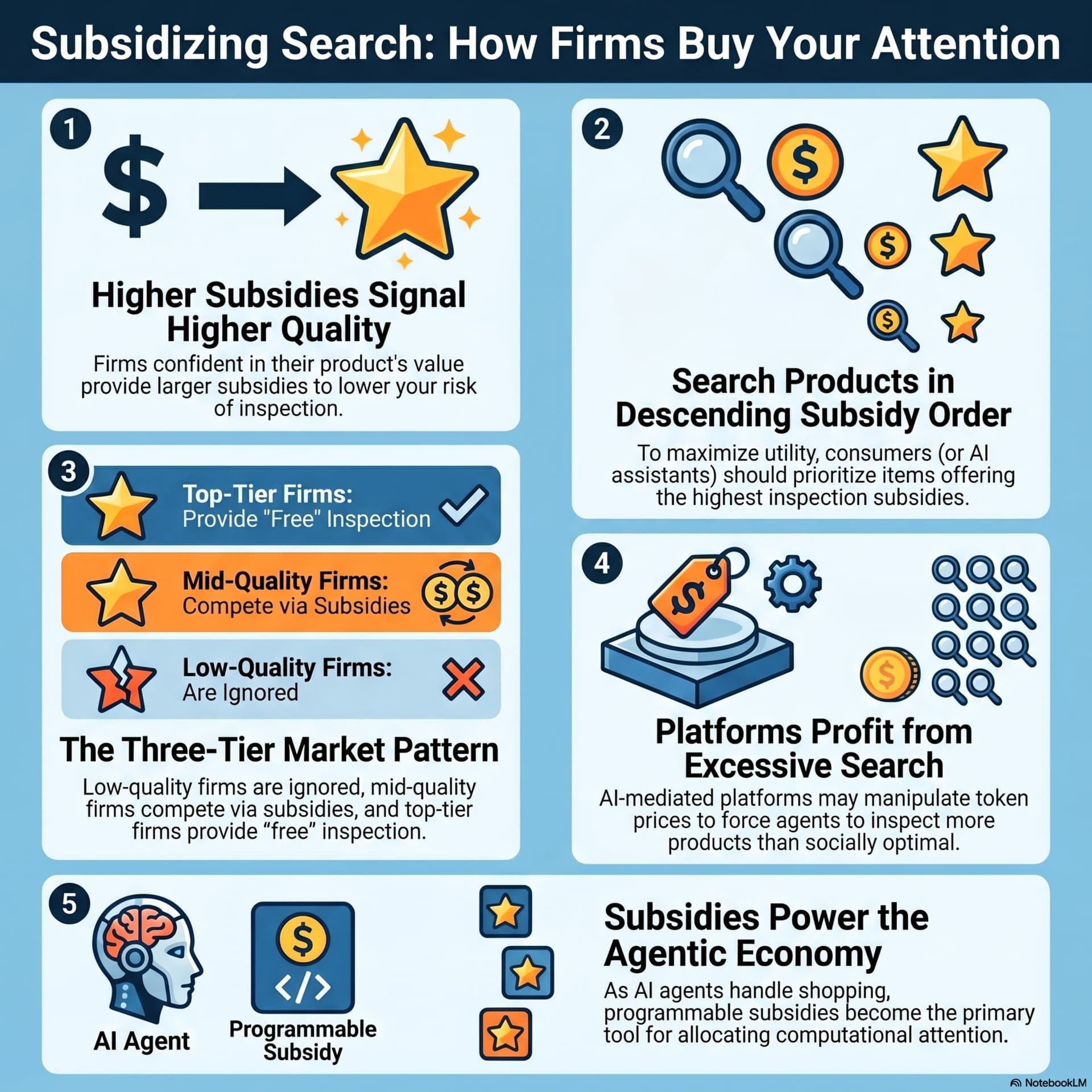
Sellers subsidize consumer evaluation to both reduce net search cost (instrumental) and signal quality (informative). In equilibrium, higher-quality firms offer larger subsidies, but subsidies cap at the consumer’s maximum inspection cost (C), creating a “step increasing step” pattern: low-quality firms offer zero; middle tiers separate via increasing subsidies; top tiers pool at the cap. With AI, attention becomes compute tokens; platforms hosting AI set token prices and can maximize profit by lowering token prices to force more firms into the pooled “top” set, causing the AI to inspect more options than is socially optimal (“excess search”).
Notable examples
graduate programs covering travel/hotel/meals; car dealerships giving $50 gift cards for test drives; free art gallery receptions with open bars; car test-drive subsidy cap example ($50).
Written by AI. May contain mistakes. Listen to the episode to check what was said.
Chapters
Tap a time to open that second in VOUnderstanding Search Friction
0:45 to 2:02
Exploration of how search friction impacts consumer choices and market strategies.
“It's everywhere once you start looking for it.”
The Role of Subsidies in Markets
2:02 to 4:48
Discussion on how markets use subsidies to compensate for search friction and signal product quality.
“And then we're going to look at the massive curveball that is coming for all of us, which is how the explosive rise of AI assistance is about to completely tokenize and, well, totally upend this entire system.”
The Economics of Attention
4:48 to 7:23
Explanation of how firms use subsidies as signals of quality and the dynamics of market competition.
“The mathematics of market equilibrium dictate that higher quality firms will always offer larger subsidies.”
The Shift to AI in Consumer Choices
7:23 to 12:09
Analysis of how AI is changing consumer search processes and the implications for market dynamics.
“And because of that hard cap, the market settles into a very specific reality, often referred to as a step increasing step equilibrium.”
The Concept of Digital Tokens
12:09 to 13:32
Discussion on how AI transforms consumer attention into digital tokens and its implications for sellers.
“Unlike human shoppers, algorithmic agents don't get tired.”
Monopoly and Search Efficiency
13:32 to 14:00
Exploration of how platforms monopolize pricing of attention tokens and the impacts on search efficiency.
“It is like hiring a hyper-efficient personal shopper who charges you by the footstep, and the stores in the mall are directly paying for the shopper's shoes just to get them to walk down their aisle.”
The Pricing of Computational Attention
14:00 to 14:42
Explore how tech platforms price digital tokens for AI attention.
“If attention is now this digital token, someone has to price that token.”
Inefficiency and User Experience
14:42 to 16:41
Understand the implications of inefficient search strategies on user experience.
“But if a platform intentionally engineers an inefficient maze for my AI, wouldn't the AI eventually give me bad results?”
Artificial Mazes and Market Distortion
16:41 to 18:08
Learn how platforms create inefficiencies to maximize profits.
“The AI runs at the speed of light, so to you, the result feels instant and perfectly tailored.”
The Transition in Attention Economics
18:08 to 19:24
Examine the shift from human attention to algorithmic attention.
“The platform optimizes for a world where your AI is forced to over-evaluate.”
Show all 11 chapters
The Provocative Question on AI Usage
19:24 to 20:08
Consider whether AI assistants save time or create hidden costs.
“Which leaves us with a lingering, provocative thought, one that completely reframes how we use technology today.”
Transcript
Automatic transcript. May contain errors.0:00You know, usually when we talk about making a choice, whether that's buying a new household appliance, picking a graduate school, or honestly, just deciding where to eat dinner, there's this underlying. assumption that we are the ones doing all the heavy lifting. Right. The consumers. Exactly. Yeah. I mean, the evaluation process, it takes time, it takes energy. And frankly, it takes a massive cognitive toll. Yeah. Like you're the one staying up late reading reviews. Oh, absolutely. You're driving to different showrooms, you're crunching numbers in a spreadsheet. And economists actually have a very specific term for that exhaustion.
0:33Oh, really? What's that? We call it search friction. It basically encompasses the literal, you know physical costs of evaluating an option as well as the cognitive and temporal costs of figuring out what you actually want to buy search friction okay right but here is where the dynamic completely flips and well this is exactly what we're digging into today for this deep dive yeah because markets know that you're exhausted yeah exactly yeah they are acutely aware of this search friction so what do they do they try to offset it by literally paying for your attention. They do. It's everywhere once you start looking for it.
1:08Right. Think about it in the real world. Graduate programs, they will often cover your flight, your hotel, and your meals just so you will come visit their campus and meet the faculty. Or car dealerships practically handing you a$50 gift card just to walk through the doors and take a test drive. Yes. Or even, you know, in the art world, high-end galleries host these lavish, completely free receptions with open bars just to draw people in to look at the paintings. It's a remarkably universal tactic, really. Across both online and offline markets, you face these search frictions, and the sellers are actively competing to completely offset those frictions for you.
1:47And the mission for our deep dive today is to uncover the hidden economics of how these companies subsidize your search. We're going to decode how these subsidies actually act as a secret mathematical signal. A signal that reveals the true underlying quality of a product. Yes. Exactly. And then we're going to look at the massive curveball that is coming for all of us, which is how the explosive rise of AI assistance is about to completely tokenize and, well, totally upend this entire system. It really is a fascinating economic puzzle. I mean, what we are looking at is a relatively new kind of market dynamic called directed search.
2:24Directed search. Yeah. In the past, we thought of consumer attention as something firms just fought over with, like flashy billboards or catchy jingles. But in this modern landscape, attention isn't just fought over, it's strategically subsidized. Okay, let's unpack this. We know firms try to reduce our evaluation costs to get us in the door. But why do some firms offer these massive irresistible subsidies, like flying you entirely across the country, while others offer absolutely nothing? Well, to understand the logic, you have to realize that a search subsidy plays a dual role. It's doing two very different jobs at the exact same time.
2:59Okay, what's the first job? First, a subsidy is what we call instrumental. That simply means it lowers the net cost of considering a product. Making it cheaper to look. Right. If a car dealer gives you$50 for a test drive, and your time and effort are roughly worth$50 to you, your net cost to evaluate that car essentially drops to zero. Which immediately enlarges the pool of products you're willing to even look at. Exactly. You're more willing to explore. Okay. I am with you so far. The instrumental role gets me in the door by covering my time. But you said there was a second job. Yes. And this is the crucial part.
3:36The second job is that the subsidy is informative. It acts as an incredibly powerful signal of quality. Informative how? Well, think about this from the seller's perspective. You only earn a profit if the consumer actually buys the product after evaluating it. Right. They have to close the deal. Exactly. If you know your product is absolutely terrible, paying someone$50 to figure out it's terrible is a very fast way to go bankrupt. Wait, hold on. If higher quality means a higher subsidy, doesn't that just mean the richest firm wins regardless of actual quality? I see what you mean. Like, how does the market prevent a terrible but wealthy company from just buying everyone's attention with massive subsidies?
4:17That is a great question. But you have to separate a firm's bank account from its unit economics. A wealthy firm with a terrible product still loses money on every single inspection if no one ever buys the product. Because they keep paying out the 50 bucks, but nobody buys the car. Right. Right. Businesses, no matter how rich, do not like setting money on fire. The only way a subsidy makes financial sense is if the firm has a high probability of closing the sale. Okay, that makes sense. And this leads us to a foundational concept in the economics of attention, which is the subsidy sorting principle.
4:51The mathematics of market equilibrium dictate that higher quality firms will always offer larger subsidies. Always. Always. Yeah. Because only they have the conversion rates to justify that upfront cost. Is this like a confident, high-end restaurant offering free, amazing appetizers to get you in the door, knowing you'll stay for a massive, expensive dinner? Well, a terrible restaurant wouldn't dare do that because you'd just eat the free bread and flee. That is a perfect analogy. The terrible restaurant knows you will take the freebie and run, so offering it is a losing strategy. The high-end restaurant knows their quality will capture you.
5:25So they can afford the risk. Exactly. And because of this dynamic, the absolute mathematically optimal strategy for you, the consumer, is to use what is called a descending subsidy index rule. A descending subsidy index rule. That sounds a bit dense. What does that actually look like for me on a Tuesday when I'm trying to buy something? It basically means you should always evaluate products in descending order of how much they subsidize your search. Meaning I just look at the biggest bribe first. Basically, yeah. You look at the firm offering the biggest subsidy first because that high subsidy is effectively a mathematical guarantee of high quality.
6:04You evaluate them. And if it's a match, great. Exactly. If not, you work your way down the list to the next highest subsidy and you only stop when the expected payoff of your search turns negative. Meaning the cost of evaluating the next option outweighs the likely benefit. You got it. Okay, so the market essentially sorts itself. The bad products literally can't afford to fake being good, so I can just follow the money. But wait. If I am the absolute best car dealer in the world, and I know everyone who test drives my car will buy it, why not offer$1 ,000 for a test drive? Why not a million? If higher quality means a higher subsidy, what happens when they hit the ceiling?
6:44That is exactly where the math gets incredibly interesting. You are right to point out that there is a ceiling. We call that ceiling the maximum cost of inspection, or C. Okay. A firm isn't going to subsidize your search beyond what it actually costs you to do the searching. If your time and effort to test drive a car is valued at$50, a$50 subsidy perfectly offsets your friction. Right. Going to$1 ,000 isn't a search subsidy anymore. It's just a bizarre, unconditional cash giveaway that eats into their profit margin for no added search benefit. Ah, I see. So there's a hard logical cap on the subsidy based on the actual friction I experience.
7:23Exactly. And because of that hard cap, the market settles into a very specific reality, often referred to as a step increasing step equilibrium. Step increasing step. Oh, yeah. And to understand how this works, we have to look at a concept known as Cho and Kreps of forward induction reasoning. Forward induction reasoning. Let's break that down. In simple terms, it means you, the consumer, look at a firm's current action, like paying a huge subsidy, and logically deduce their future confidence. Okay. You induce that they wouldn't waste money up front unless they absolutely knew you would eventually buy the product.
7:59Oh, it's like a poker player making a massive aggressive bet right out of the gate. You logically induce that they must be holding an incredible hand. Exactly. That's exactly it. Got it. So applying that to our market of subsidies, what does this step increasing step reality actually look like? Like if I'm looking at the worst firms at the bottom, what are they doing? Well, step one, the lowest quality firms know they have a losing hand because their quality is so low. They know they won't make a sale even if they get you in the door. So they don't even try. Right. Following that logic, they offer zero subsidy.
8:33And because consumers follow the descending subsidy rule we just talked about, these firms are literally never inspected. You just get ignored. Totally. They are priced out of existence, completely ghosted by the market. OK, so the junk products are out because they can't afford the subsidy. But what about the perfectly average, you know, middle of the road companies? That's step two. How do they prove they are better than the bottom tier without going bankrupt trying to mimic the top tier? They separate themselves through strictly increasing subsidies. Maybe one slightly below average firm offers a$10 value, a truly average firm offers$15, and a slightly above average firm offers$20.
9:11Oh, I see. In this intermediate tier, the subsidy acts as a perfect transparent signal. Their subsidy perfectly reveals their exact quality to the consumer. So they step up their subsidies just enough to beat the guy below them, but not so much that they ruin their own margins. Exactly. So in that middle tier, it's a perfectly logical ladder. Higher subsidy equals slightly better product. So what happens when we reach the absolute top tier? The best of the best. That's step three. Remember that ceiling we talked about? The maximum cost of inspection. The$50 in our car example. Right. All of these top tier firms have the phenomenal profit margins and the supreme confidence to offer the maximum possible subsidy.
9:55They hit the cap. Oh. So instead of separating themselves by offering more and more, they all hit the ceiling and pool together at the exact same maximum subsidy. Oh, they pool together. Yes. What's fascinating here is the fundamental tension this creates. At the very top tier, differences between the absolute best firms are totally obscured. Because they're all offering the exact same 50 bucks. Precisely. You have a pool of maybe five or 10 amazing options, and they are all offering you the exact same maximum subsidy to look at them. That seems like a problem. It does make search slightly inefficient for society because the perfect sorting mechanism has broken down at the highest level.
10:34The signal is jammed by the ceiling. Right. But, and this is a big, but for you and me, it makes the inspection entirely free for the consumer. Wait, so I get free search at the top, but I'm essentially flying blind among the top tier options because they all look exactly the same. Exactly. You are blindly picking among the best of the best. It's a great problem to have as a consumer, honestly. Yeah, I guess so. You get costless evaluation, even if you have to randomly check a few of them in that top pool to find the perfect fit. Here's where it gets really interesting, though. Everything we just talked about, the test drives, the college visits, the human exhaustion of evaluating choices.
11:10Right. This entire dynamic is based on human search frictions. It is based on what catches our eye, our limited patients, the literal physical effort of browsing a website or driving to a store. Human constraints, yes. But what happens when humans stop doing the searching? That is the pivotal shift we are living through right now. We are entering what economists are calling the agentic economy. The agentic economy, meaning we are using agents to do the work. Yes. Consumers are rapidly delegating discovery to AI assistants. Think about how you might use a sophisticated large language model today.
11:48Okay. You don't browse 10 different tabs anymore. You give an instruction. You say, scan every major electronics retailer, check their return policies, factor in shipping speeds, and buy the cheapest 32-inch monitor that will arrive at my door by Friday. And then I just go make a sandwich while the AI does the heavy lifting. Exactly. The human friction is completely gone. Unlike human shoppers, algorithmic agents don't get tired. They don't suffer from decision fatigue. They don't get distracted by a flashy banner ad or a clever jingle. They just relentlessly follow programmed utility functions to find exactly what you asked for.
12:22So if I'm understanding this, attention is no longer abstract. But AI isn't exactly free, right? I mean, running those massive queries across the internet takes computing power. That is the critical insight that changes everything. AI search has measurable physical costs. Like server costs. Yes. Every single time your AI assistant evaluates a product, it generates auditable computational events. We're talking about API calls, massive database queries, and token usage. So it's been commodified into a measurable physical unit of compute power. The sellers aren't paying for my psychological attention anymore.
12:59They are literally paying the platform's electricity and server bills. Spot on. In this agentic economy, consumer attention has been transformed into a literal contractible unit, which is the token. Wow. And because these tokens have a hard cost, the entire subsidy model we just discussed evolves. Sellers can now purchase inspection tokens directly from the tech platforms hosting these AI assistants. Just skip the line. By buying these tokens, the seller subsidizes the AI's compute costs, pushing their products ahead of competitors in the AI's algorithmic evaluation queue. Okay, my mind is spinning a bit.
13:33It is like hiring a hyper-efficient personal shopper who charges you by the footstep, and the stores in the mall are directly paying for the shopper's shoes just to get them to walk down their aisle. That is a fantastic way to visualize it. The stores aren't trying to woo you with free appetizers or gift cards anymore. They're paying the computational toll required for your AI to simply look at their digital inventory. But wait, let's think about the mechanics of this. If attention is now this digital token, someone has to price that token. Right. And the platform, you know, the massive tech company hosting the AI, they control the tokens.
14:10So how do they set the price? Do they want to make it as cheap and efficient as possible for the AI to find me that 32-inch monitor? That brings us to the final and perhaps most consequential piece of this economic puzzle. The platform has an absolute monopoly on pricing this computational attention. Because they own the AI. Right. They set the token price. And if you run the revenue optimization models for a monopolistic platform in this scenario, you arrive at a rather shocking conclusion. Let's hear it. The platform maximizes its profits when search is intentionally inefficient. Wait, inefficient?
14:43But if a platform intentionally engineers an inefficient maze for my AI, wouldn't the AI eventually give me bad results? Wow. And wouldn't I just switch to a different, more efficient AI platform? How do they get away with this without ruining the user experience? Ah, but you have to remember how fast the AI works and how the platform actually makes its money. Okay. Their revenue is simply the price of a token multiplied by the number of tokens consumed by the AI. Now, remember that step-increasing-step reality we talked about earlier? Yeah. That top tier where all the high-quality firms pool together because they hit the subsidy cap?
15:19Right, the VIP room where everyone hits the ceiling and looks exactly the same to the consumer. Exactly. The platform realizes that if they intentionally lower the price of an inspection token, they effectively lower the ceiling. Making it cheaper. They make it much cheaper to offer the maximum possible subsidy. By lowering the token prices, the platform intentionally induces massive pooling among the top and intermediate firms. Oh, wow. Suddenly, it's not just the top five elite firms in the VIP room. It's the top 50 firms. Oh, I see where this is going. Because the token is cheap, even the pretty good, average firms can afford to buy the maximum subsidy and jump into that top pool.
15:59Precisely. And because all 50 of those firms are offering the exact same maximum subsidy, your AI assistant can't mathematically tell which one is the absolute best right away. Because the signal is jammed for 50 firms instead of five. Exactly. So what does the AI have to do? It's forced to inspect all of them. it has to evaluate significantly more options than is actually socially optimal to find your perfect monitor. Just burning through tokens. Yes. Economists call this excess search. But going back to my user experience, why don't I notice this happening? Because to you, the human, the difference between an AI scanning 5 firms and 50 firms is maybe an extra 300 milliseconds.
16:38You don't see the maze. Right, because it's a computer. The AI runs at the speed of light, so to you, the result feels instant and perfectly tailored. but to the server. The AI was forced to read thousands of extra lines of data, generating microns of revenue per token for the platform on every single step. Unbelievable. The platform more than makes up for the lower token price by driving massive artificial search volume. If we connect this to the bigger picture, the platform is extracting tremendous rent from the opacity it creates. It creates a digital fog. To the consumer, it appears completely benign, even beneficial.
17:14Because they don't feel the weight. Right. The individual algorithmic inspections feel cheap or even free because they are fully subsidized by the sellers. You never see the cost. Man. But the platform deliberately distorts the market, forcing sellers into this massive indistinguishable pool purely to rack up astronomical token fees behind the scenes. So what does this all mean? It means these tech platforms are essentially creating artificial mazes for our AI assistants. Yes. They're profiting off the extra miles the AI has to run to find what we ask for. Going back to my analogy, it's like the mall owner intentionally redesigning the floor plan to be as confusing and long as possible.
17:54Right. Just so that hyper-efficient personal shopper we hired has to walk past every single store and the stores have to pay the mall owner for the privilege of being walked past. That is exactly what is happening under the hood of the agentic economy. The platform optimizes for a world where your AI is forced to over-evaluate. They monetize the friction that they themselves have engineered. Wow. Okay, let's do a quick recap because we have covered some seriously profound ground today. We certainly have. We started by looking at how subsidies, like a paid flight or a gift card, aren't just simple discounts or freebies.
18:29They are a complex, hidden sorting hat that reveals true market quality. True. If a firm pays for your attention, it is a mathematical signal based on forward induction reasoning that they are incredibly confident you will actually dye their product. Because bad firms can't afford to fake it. Exactly. But as we hand the reins of our decision making over to AI, the entire landscape shifts. Platforms are now commodifying attention into compute power, selling inspection tokens to sellers, and deliberately designing the market to be computationally inefficient just to maximize their own volume and fees.
19:05It is a profound transition in how commerce functions. We have moved from human attention being wooed by free appetizers and test drives to algorithmic attention being taxed by digital monopolies. That's wild. The search friction hasn't disappeared. It has just been tokenized and captured by the platform. Which leaves us with a lingering, provocative thought, one that completely reframes how we use technology today. As you increasingly delegate your choices to AI assistants to save yourself time, energy, and cognitive headache, consider that your AI is navigating a hidden, highly tokenized economy that you cannot see.
19:41That's right. The platform hosting that AI might be purposefully designing the marketplace to make the AI over-search just to rack up massive fees from sellers. Could the platform be subtly shaping what options end up in front of you based on who is willing to pay the highest compute toll? It's highly likely. So ask yourself, are you actually saving time or is your algorithmic assistant being secretly paid to endlessly wander the digital aisles on your behalf? It is a vital question we all need to be asking as we rely more and more on these invisible agents. We really do. Thank you so much for joining us on this deep dive.
20:15We will catch you next time as we continue to unpack the hidden systems that run our world.
From the publisher
This paper explores a market model where competing firms use subsidies to reduce the cost of product inspection for consumers. Through a subsidy-sorting principle, the authors demonstrate that higher-quality firms naturally offer larger subsidies to signal their value and secure priority in the search order. This behavior results in a unique equilibrium where low-quality firms are ignored, intermediate firms distinguish themselves through increasing subsidies, and top-tier firms pool at the maximum subsidy cap. The study further examines how AI-mediated platforms can manipulate this dynamic by pricing "inspection tokens" to extract profit. While this platform intervention can lead to excessive search beyond what is socially optimal, it maintains consumer welfare by reallocating surplus from sellers to buyers and the platform itself. Ultimately, the research characterizes how monetary incentives can efficiently organize consumer attention and information revelation in digital marketplaces.


