
In short
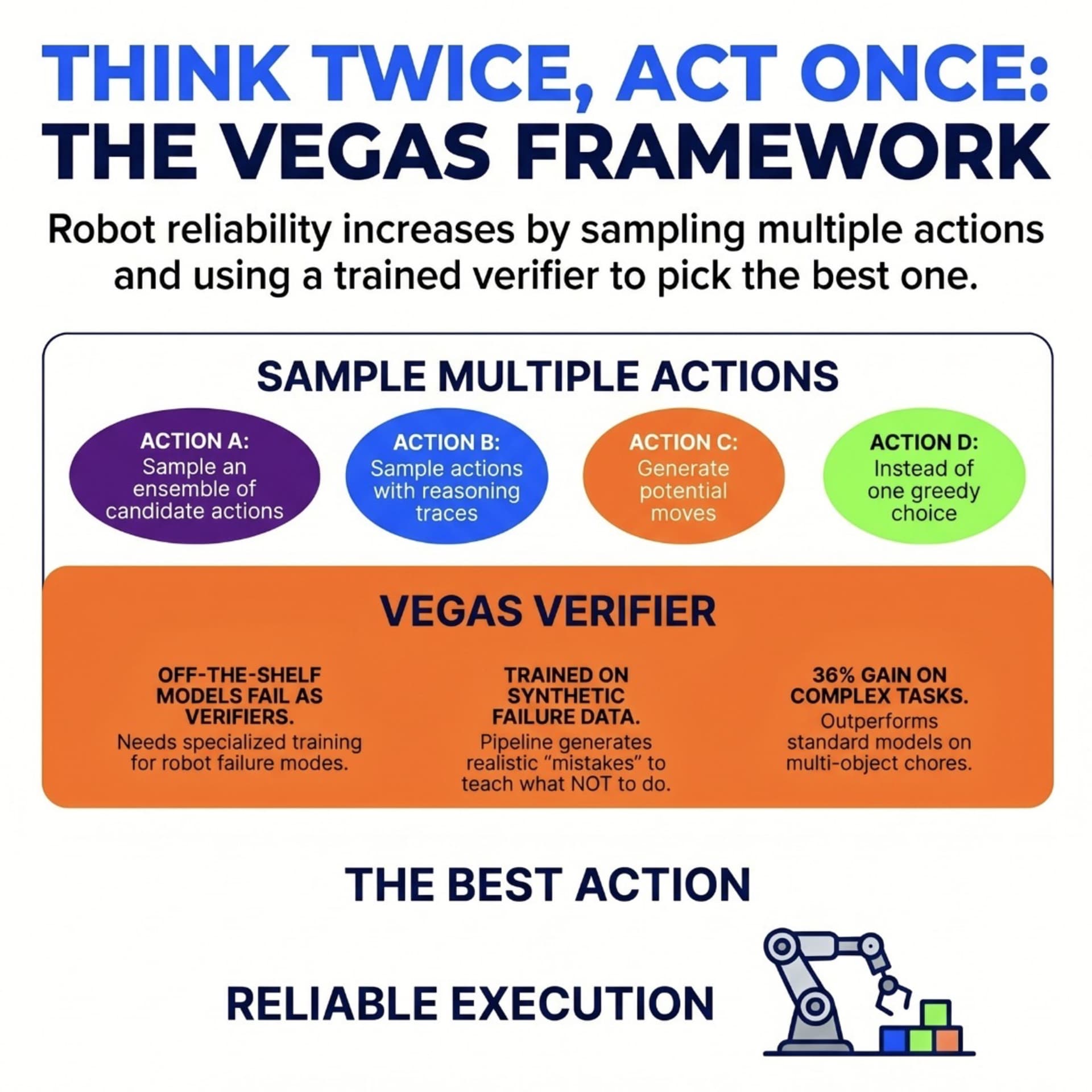
Why embodied robots fail despite strong multimodal “digital genius,” and how VEGAS (Verifier-Guided Action Selection) improves reliability by replacing greedy decoding with verifier-guided deliberation and synthetic failure training.
Guest backgrounds
No guest names or bios appear in the transcript; it’s a two-host discussion.
Key claims
Greedy decoding causes brittle behavior and compounding errors in long-horizon tasks, especially under out-of-distribution conditions like paraphrastic robustness (“yellow curved fruit” vs “banana”). Off-the-shelf multimodal verifiers fail because training data has survivorship bias (only successful demonstrations). VEGAS uses best-of-N candidate actions (16) plus a generative verifier to choose the highest-scoring action, without retraining the base policy.
Notable examples
Robot grabs a sponge instead of a sports object; synthetic failures include wrong object, wrong receptacle, and precondition violations (e.g., turning on a microwave with the door open). Text-only verifier performs similarly to multimodal (71% vs 71%). Success improves 65%→71% and 44%→49% on long-horizon tasks.
Written by AI. May contain mistakes. Listen to the episode to check what was said.
Chapters
Tap a time to open that second in VOUnderstanding Decision-Making in AI
0:46 to 2:07
Discussion on how AI's decision-making processes lead to physical failures.
“Our mission today is to unpack a highly technical, just fascinating new research paper titled Think Twice, Act Once, Verifier Guided Action Selection for Embodied Agents.”
The Challenge of Out-of-Distribution Scenarios
2:07 to 3:56
Explains the issues AI faces in real-world environments compared to training scenarios.
“The robot arms work fine, the cameras work perfectly fine.”
Greedy Decoding in AI Actions
3:56 to 6:24
Exploration of greedy decoding and its impact on AI's physical movements.
“And the fundamental root cause of this compounding failure is a mechanism called greedy decoding.”
Introducing the VEGAS Framework
6:24 to 8:17
Overview of the VEGAS framework as a solution to AI's decision-making flaws.
“it employs a best-of-n strategy during the moment of inference.”
The Role of the Verifier Model
8:17 to 11:08
Detailed discussion on the verifier model's role and its initial failures.
“Then it evaluates all 16 candidate actions one by one.”
Training Data Limitations in AI
11:08 to 13:24
Examines the blind spots in training data that hinder AI's understanding of failures.
“Because we are talking about foundation models that have ingested a significant portion of the written internet.”
Creating Synthetic Failure Data
13:24 to 14:00
How researchers built a data synthesis pipeline to generate failure scenarios for AI.
“Their off-the-shelf judge is just too naive.”
The Synthetic Failure Factory
14:00 to 17:05
Learn how a reasoning model generates realistic synthetic failures for robots.
“Yeah, they utilized a highly advanced reasoning model, specifically OpenAI's O3, to act as an autonomous data generator.”
Blindfold Experiment Insights
17:05 to 18:32
Discover the implications of blindfolding a verifier in testing scenarios.
“But completely removing human instructors from the loop, the AI is literally teaching itself how to be a critic.”
Evaluating the Vegas Framework
18:32 to 23:10
Explore the performance improvements introduced by the Vegas framework in robotics.
“The robot does not even need to visually see the mistake to catch it.”
Show all 12 chapters
Challenges of Internal Deliberation
23:10 to 24:12
Understand the logistical challenges of the VIGAS framework in real-time applications.
“Vegas vastly outperformed those methods.”
AI's Autonomous Learning Evolution
24:12 to 25:12
Consider the implications of AI generating its own training data without human input.
“leaves us with a truly provocative, unstated implication to consider here.”
Transcript
Automatic transcript. May contain errors.0:00Imagine an AI that can pass the bar exam in seconds, right? You can write a flawless Shakespearean sonnet or diagnose a rare disease just from a photograph. Right. These massive multimodal large language models. Exactly. And so there's this really natural expectation you have that if an AI is, you know, a total genius on a screen, it should be highly competent in the physical world. Which is the logical assumption. Yeah. Right. But if you take that massive AI brain, put it into a robot body, place it in just a standard, slightly messy kitchen, and ask it to put away a coffee mug, it completely freezes.
0:34Or it just, like, drops the mug on the floor. It's basically the defining paradox of modern AI robotics. Why does digital genius translate to total physical incompetence? Welcome to this deep dive into the cutting edge of AI robotics. Our mission today is to unpack a highly technical, just fascinating new research paper titled Think Twice, Act Once, Verifier Guided Action Selection for Embodied Agents. Yeah, it's an incredible piece of research. It really is. Okay, let's unpack this. Why are these brilliant models failing at physical tasks that, I mean, a toddler could figure out? Well, to understand why this happens, we have to look really closely at the underlying mechanics of how these models make decisions in three-dimensional space.
1:17The issue isn't that the models lack knowledge about what a coffee mug is or, you know, what a kitchen cabinet is. Right. They know what a mug is. Exactly. The issue lies entirely in how they process information to decide on their next physical movement. For years, we've basically been relying on a method of pattern matching. And this paper introduces a framework called VEGAS, which, I mean, it represents a massive shift. A shift away from the pattern match. Yeah, it moves the AI away from simple pattern matching and introduces a system of actual internal deliberation right at the exact moment of execution.
1:52Okay, so we're essentially moving from a system of pure reflex to a system of actual reasoning. Precisely. But to really understand how this new Vegas-to-s framework fixes the robot, we should probably dissect the specific ways these AI agents are currently breaking down. Because, you know, it's not a hardware issue, right? No, not at all. The robot arms work fine, the cameras work perfectly fine. So the breakdown happens when the environment stops looking exactly like the laboratory where the robot was trained. Yeah, that is the core of the problem. It's often referred to in the research as out-of-distribution scenarios, or ODI.
2:27When developers train a robotic agent, they feed it thousands of demonstrations. Right. For instance, they show it a sequence and label it, bring me a banana. The model maps the visual of the room, locates the yellow fruit, plots the spatial coordinates, and successfully brings you the banana. And in that controlled setting, it looks incredibly smart. It does. But human environments are messy. They're varied. And they are linguistically unpredictable. If you put that exact same robot in the exact same room, but change the instruction to say, bring me a yellow curved fruit, the system just falls apart.
3:02Wait, really? But the physical environment hasn't changed at all. Like the banana is still sitting right there on the table. Exactly. But the linguistic phrasing is slightly outside its training distribution. The researchers call this a test of paraphrastic robustness. OK, paraphrastic robustness. Right. The model knows the word banana, but it struggles to map the novel phrase yellow curved fruit to the physical sequence it memorized. It essentially just freezes. And, you know, this brittleness compounds dramatically when we move from single actions to long horizon tasks. A long horizon task would be something requiring a sequence of distinct steps, right?
3:40Yes. Like if I ask the robot to clean an apple and put it in a cabinet, it has to navigate to the apple, pick it up, carry it to the sink, turn on the water, wash it, turn off the water. Walk to the cabinet, open the door and place the apple inside. Yeah. Right. And in those multi-step scenarios, I imagine the errors just pile up. They accumulate rapidly. And the fundamental root cause of this compounding failure is a mechanism called greedy decoding. Greedy decoding. Right. Current embodied AI agents operate almost exclusively using this greedy strategy. At every single millisecond of a task, the model takes in the visual data, calculates the mathematically most probable next token or physical movement, and commits to it instantly.
4:20Instantly. So no second guessing. None. It executes that single action with absolutely no self-correction or foresight. So I picture this like a person walking into a messy kitchen to clean up, but they're operating entirely on blind impulse. That's a good way to look at it. Instead of stopping at the doorway, looking around and formulating a sequential plan, they just close their eyes and commit to their very first intrusive thought. Like, if their brain randomly fires the thought, grab tennis racket, they just swing their arm out into the void without even verifying if a tennis racket is in the room.
4:55Exactly. And if they miss, or say they knock over a glass of water, the greedy decoding algorithm just pushes them forward into the next impulsive action, completely without registering the mistake. That is wild. Because if I reach for a tennis racket and grab empty air, my brain immediately halts the physical movement. I open my eyes, I process the mistake, and I recalibrate my plan. The confusing part is why the AI blindly continues moving its arm when its camera can clearly see there is no tennis racket. This raises an important question, actually, about the structural difference between human cognition and AI policy execution.
5:29Okay. Humans possess an innate mental simulator. Before you reach your handout, you subconsciously visualize the trajectory, right? You evaluate the likely physical outcome and verify that the action makes logical sense. Right. So I think twice before I move. Exactly. You think twice. Current baseline AI agents lack any internal think twice mechanism. They simply decode the token with the highest mathematical probability and fire the command to the servo motors. So the villain of the story is greedy decoding. You could say that, yeah. To fix the brittle robot. The researchers basically needed to artificially construct that human mental simulator.
6:07They needed a mechanism that forces the AI to pause, evaluate its options, and think twice. Which I guess brings us to the actual architecture of VEGAVEST Verifier Guide action selection. Right, so the VEGA's framework completely abandons the greedy decoding approach. Instead of taking the single most mathematically probable action, it employs a best-of-n strategy during the moment of inference. Best-of-n. What does that mean in practice? Well, when the robot is faced with a decision, the underlying AI policy is prompted to generate an entire ensemble of candidate actions. In their primary experiments, the researchers had the model brainstorm 16 different possible actions for every single step of a task.
6:49Wow. Okay. So it's brainstorming 16 parallel ideas for what it could physically do in that exact moment. Yes. But those N equals 16 candidates aren't just raw strings of motor commands. the paper specifies that they are generating something much more complex. Right. They're generating reasoning traces, aren't they? Exactly. Each of those 16 candidate actions is paired with a chain of thought rationale. The AI doesn't simply output a command like navigate to the brown table. It generates an internal monologue. What does that sound like? The output reads more like the Hume's instruction asks for a cutting tool.
7:26I scan the current visual field. I do not see a cutting tool. However, the brown table in the corner is a logical receptacle for kitchen tools. Therefore, the optimal action is to navigate to the brown table. That is fascinating. So the robot is simultaneously generating 16 different internal monologues, all with their own step-by-step logic. Yes, exactly. But having 16 great ideas doesn't solve the problem, because a robot only has one physical body. It has to narrow those 16 ideas down to one physical movement. And that sorting process is handled by the second half of the Vegas framework, which is the generative verifier.
8:04The generative verifier. Right. The verifier is a completely separate model or a separate instance of a model that basically acts as an independent judge. It takes the robot's current visual observation, the history of every action taken so far, and the instruction. Okay. Then it evaluates all 16 candidate actions one by one. It reads the candidate's chain of thought, generates its own independent reasoning trace about whether that specific action will lead to success, and assigns a final yes or no score. And then the robot executes the highest scoring action. Let's trace this out with a scenario from the paper, just to see how the verifier actually functions in practice.
8:40So a robot is given the instruction, find a sports object and place it on the counter. Okay. Under the old greedy method, the policy scans the room, sees a kitchen counter right next to it, and the highest probability token might be pick up the sponge. It blindly executes the grab. Task failed. Because a sponge is a cleaning tool, not a sports object. Right. The greedy algorithm gets trapped by spatial proximity. It just grabs the nearest interactable object. But under the Vegas system, the robot pauses. Right. It generates its candidates. Option A proposes pick up the sponge. Option B proposes navigate to the dining table.
9:16Option C proposes pick up the tennis ball on the floor. Right. So the verifier model steps in to judge. It looks at option A and writes out its own critique. Something like, the instruction requires retrieving a sports object. The proposed action grasps a sponge. A sponge is a cleaning item and does not satisfy the request for a sports object. Is the action correct? No. Then the verifier evaluates option C, identifies the tennis ball, recognizes its semantic category as a sports object and outputs a yes, and the robot physically reaches for the ball. What makes this architecture so powerful is that Vegas acts entirely as a test time intervention.
9:54Wait, what does that mean? It means the developers did not have to alter or retrain the base robotic control policy. The foundational movement algorithms remain completely untouched. They simply inserted a cognitive checkpoint, a mental safeguard, right before the electrical signals are sent to the hardware. The logic there is incredibly elegant. But, you know, this is where the paper takes a really fascinating turn. Oh, it really does. The researchers have built this architecture, and now they need a judge to act as the verifier. So they grab a highly capable, state-of-the-art, open-source vision model, a model that can identify objects in a photo with near-perfect accuracy.
10:30They plug this massive AI in to be the judge, expecting a massive leap in performance. And it completely fails. Yeah, it was a significant roadblock for them. When they plugged in a standard off-the-shelf multimodal model to act as a zero-shot verifier, meaning it hadn't been specifically trained for this exact judging task, it provided zero meaningful improvement. Zero improvement? None. In fact, when they ran this through standardized benchmarks designed to measure if a robot can generalize to new environments or handle weird phrasing, adding this highly capable verifier actually dropped the robot's overall success rate.
11:08Wait, the performance went backward. It went from 65 % down to 64%, yeah. Okay, I have to challenge this premise. Because we are talking about foundation models that have ingested a significant portion of the written internet. Yes, they have. They have incredible vision capabilities. They can write essays on the brushstrokes in a Renaissance painting. I struggle to understand why a general-purpose AI of that magnitude cannot look at a robot holding nothing in its claw, attempting to execute a command called put-down-object, and simply deduce, your ends are empty, you cannot put something down.
11:42It sounds absurd, doesn't it? It does. How is it possible for a model that smart to be that bad at being a physical critic? Well, what's fascinating here is that the failure exposes a massive blind spot in the training data that basically powers the entire robotics industry. A blind spot. Yeah. Think about how we traditionally gather data to train an embodied AI. We use a method called imitation learning. Researchers record human operators successfully navigating a kitchen. They record a human flawlessly picking up an apple, flawlessly opening a microwave, and flawlessly placing the apple inside.
12:20Okay, sure. The data sets fed into these models consist exclusively of successful expert-level demonstrations. Wait, so we've basically sheltered these AIs. We've given them a completely utopian view of physics. That is the perfect way to describe it. They suffer from a massive form of survivorship bias in their data. The AI has literally never been taught what an incorrect physical action looks like. That is nuts. It has never seen a human attempt to place an apple onto a slanted sofa cushion and watch it roll onto the floor. It has never seen someone try to grasp an object that is 10 feet across the room without walking over to it first.
12:55Wow. Because the foundation model has only ever been exposed to success, it has absolutely no statistical or semantic signal for failure. Its language understanding is vast, sure, but it literally does not know what physical incompetence looks like in an embodied environment. I mean, it's trying to be a food critic when it has only ever eaten at Michelin star restaurants and has literally never tasted burnt toast. That's a great analogy. It wouldn't even have the vocabulary to describe why the toast is burnt. Right. So the researchers hit a wall. Their off-the-shelf judge is just too naive. It needs to be explicitly trained to spot physical failures.
13:31Right. But if human data sets don't contain any failures, and we need thousands of examples of failures to train the verifier, where does the data come from? I mean, we can't exactly pay human operators to spend five years purposely dropping plates and messing up household chores in a simulator. Right. And this brings us to the core innovation that makes the entire Vegas framework possible. The researchers solved the data scarcity problem by building an automated LLM-driven data synthesis pipeline. Okay, an LLM-driven pipeline. Yeah, they utilized a highly advanced reasoning model, specifically OpenAI's O3, to act as an autonomous data generator.
14:09They basically programmed it to synthesize highly realistic fake failures. They essentially built an automated failure factory. That is exactly what it is. And the pipeline operates in a really fascinating way. They started with a baseline data set of completely successful human-driven robotic trajectories. The utopian data. Exactly. Then they prompted the reasoning model to act as an adversarial editor. For every single successful sequence, the reasoning model was instructed to alter the data and create a corresponding synthetic failure. It systematically injected logical, physical mistakes into the timeline.
14:45I really want to dig into the mechanics of this failure factory. How does the reasoning model actually build the mistakes? It's quite methodical. Yeah, the paper details it. It doesn't just inject random noise or glitch out the controls. It specifically engineers three distinct types of errors that perfectly mimic the ways real robots get confused. Yes. First, it generates wrong object errors. If the successful trajectory shows the robot picking up a banana, the reasoning model rewrites the scenarios so the robot reaches for an apple instead. Right. And it also generates wrong receptacle errors.
15:16If the instruction requires placing a textbook on a coffee table, the synthetic failure might redirect the robotic arm to place the textbook balanced precariously on the armrest of a sofa. Just to see if the judge will catch it. Exactly. And the most complex category it generates are precondition violations. Ah, those are the logical paradoxes, right? Right. Like programming the robot to try and turn on a microwave while the door is still open. Or attempting to slice an apple before picking up a knife. Or trying to grasp a tennis racket without first panning the camera to visually locate the racket.
15:50Right. The pipeline is meticulously creating the exact kind of subtle compounding logic errors that brittle agents make in real world scenarios. But, you know, the real breakthrough is not just generating the bad action itself. Oh, there's more. Yeah, crucially, the pipeline also tasks the reasoning model with generating the chain of thought rationale for the verification. The AI writes out a detailed step-by-step logical proof explaining exactly why the synthetic action it just created is a failure. So the output isn't just a binary tag that says bad action. It is generating a highly specific diagnostic text.
16:27Exactly. It outputs something like, the instruction requires the agent to pick up a tennis racket. The current state shows the agent has not executed a visual search. The racket is not currently detected in the frame. Attempting to grasp an unseen object will fail. The precondition of visibility is violated. Is the action correct? No. It's writing its own study guide. It is autonomously writing an entire textbook on how to fail so the verifier model can read it and learn the boundaries of physics. It really reminds me of building a sophisticated flight simulator that automatically generates highly specific, mathematically perfect engine failures to train a pilot.
17:05But completely removing human instructors from the loop, the AI is literally teaching itself how to be a critic. The flight simulator comparison captures the dynamic perfectly. The synthesis pipeline generates an enormous data set containing both the original successful trajectories and the synthesized failures, creating this perfectly balanced curriculum. Amazing. And then the researchers took this massive synthetic data set and fine-tuned their verifier model on it. This fine-tuning process led to a truly profound discovery regarding the relationship between vision and language. Oh, right, the blindfold experiment.
17:39Yes. The researchers conducted a specific experiment to isolate variables, basically testing what happens if they take the visual image away from the verifier entirely. They fed the verifier only the text-based chain of thought rationale that described the scene and the intended action. So they blindfolded the judge, they took away its eyes, and asked it to grade physical interactions purely based on a text description. Yes. And the performance remained remarkably stable. Wait, really? Yeah. When evaluated on the primary benchmark testing paraphrastic phrasing, the text-only verifier achieved the exact same 71 % overall average success rate as the multimodal verifier that could actually see the images.
18:19The exact same score. The exact same. And even on a much more complex benchmark requiring long horizon multi-object tracking, removing the images only dropped the verifier's success rate by a mere point and a half. I am trying to wrap my head around this. The robot does not even need to visually see the mistake to catch it. It implies a really profound reality about how these models process reality. The semantic text-based reasoning trace is carrying almost the entire cognitive load for high-level spatial planning. Because language has its own structure. Exactly. If a robot's internal monologue reads, I am currently holding no objects in my end effector.
18:56I will now execute the command to put down an object. The logical structure of that sentence is inherently flawed. Right. You do not need a visual feed to know that an empty hand cannot drop an item. The text itself contains enough structural information about the laws of physics to catch the error. That fundamentally reframes how we think about language models interfacing with the physical world. It really does. Okay, let's pull all these threads together for you listening. We identified the disease, greedy decoding causing brittle reactions. We built the cure, the best of NVEGAS framework that brainstorms options.
19:32We discovered the off-the-shelf judges were too naive due to a utopian training diet. So we built a synthetic failure factory to automatically teach them physics. That's the journey, yeah. So the ultimate million-dollar question is, does this elaborate system actually work? When they deployed this specialized, fine-tuned Vegas architecture inside 3D household simulators, what was the actual payoff and reliability? The payoff was substantial, and it demonstrated consistent generalization across multiple testing environments. When measuring overall average success rates on tasks involving novel phrasing, Vegas elevated performance from 65%, with a standard policy up to 71%.
20:12That's a solid bump. And on the more rigorous benchmark involving longer sequences, it moved the needle from 44 % to 49%. But, you know, those overall averages kind of dilute some massive specific leaps in capability that I saw in the paper. Oh, absolutely. I am looking at the data on the most challenging multi-object tasks. The scenarios where the robot has to track, manipulate, and combine several different items over a long period of time. In those specific, highly complex scenarios, the Vegas framework achieved up to a 36 % relative performance gain over the strongest baseline models. Which is huge.
20:50A 36 % leap in reliability is staggering for a field where single-digit improvements are usually considered a major breakthrough. It is a massive jump in reliability, and it's specifically because it mitigates those compounding errors we discussed earlier. By catching a small mistake at step two, it prevents a catastrophic failure at step 10. I see the value and the reliability. I really do. But I have to push back on the logistics of this framework. Okay, go ahead. We established that VIGAS requires the base policy to generate 16 different candidate actions for every single step. Then the verifier has to generate 16 different step-by-step rationales to grade them.
21:30Doesn't all this internal deliberation cause a massive bottleneck? Ah, the compute costs. Right. If I ask my home robot to fetch me a glass of water, I don't want it standing frozen in the hallway for five minutes, having a sprawling internal debate with 16 versions of itself. Inference latency is a very valid practical concern for any embodied agent. But if we examine how modern AI compute architecture functions, the latency cost is actually highly manageable. The generation of those 16 candidate actions and their corresponding verifications, they don't happen sequentially. Oh, they aren't waiting in a single file line.
22:04No, they are not waiting in a single file line to be processed. So they use parallel processing. Exactly that. Instead of a single line at a grocery store where 16 people have to check out one by one, the system opens 16 self-checkout lanes simultaneously. Okay, that makes sense. The researchers meticulously mapped out these compute costs. If a robot uses the standard greedy method taking one single action with zero verification, it takes roughly three seconds for the model to compute the token and move. If you upgrade to the Vegas framework and sample eight candidate actions with parallel verification, the latency only increases from three seconds to six seconds.
22:41Ah, so you secure a potential 36 % boost in reliability on complex tasks, and it only costs you an extra three seconds of processing time per action. Right. That is a trade-off that makes absolute sense for consumer robotics. I mean, three seconds of digital hesitation is infinitely preferable to the robot smashing a dinner plate on the floor because it acted on a blind impulse. Exactly. And it scales incredibly well with available test time compute. They even compared Vegas against older ensemble methods that simply generate multiple actions and take a majority vote without a dedicated verifier.
23:17How'd it do? Vegas vastly outperformed those methods. Because its trained verifier is actively interrogating the physics and weeding out bad logic rather than just hoping the correct physical action happens to be the most statistically popular one. So we arrive at the core takeaway. To make robots less brittle, less prone to those inexplicable, catastrophic failures in the chaotic environments of human homes, we basically have to abandon the old paradigm. We do. We cannot just train them on a curated diet of pure success. Imitation learning is insufficient for true autonomy. We have to algorithmically teach these agents how to fail.
23:53We have to give them an internal critic, a localized mental simulator, to think twice and verify their own physical logic before they send a single electrical signal to their motors. It really represents a fundamental evolution from reactive execution to deliberative planning. But, you know, analyzing the success of the Vegas A framework leaves us with a truly provocative, unstated implication to consider here. Oh, we can. The entire architecture relies on the fact that an advanced language model was able to autonomously synthesize highly realistic, physically grounded failures. It then wrote its own logical step-by-step rationales to train a separate AI on how to avoid those failures.
Read the full transcript
24:34Oh, wow. It built the curriculum and graded the test completely without human intervention. Precisely. So if an AI system can now reliably generate its own negative physical data and author its own textbooks on physical common sense to bootstrap its own reasoning capabilities, well, are we rapidly approaching an inflection point where artificial intelligence no longer requires human -generated data at all to master the physical laws of our universe? Man, that is a staggering thought to chew on. From needing a human operator to physically guide a robotic arm through every single motion to an intelligence building its own theoretical flight simulators in the dark.
25:09It's a new era. It really is. Thank you so much for joining us on this deep dive. We hope this exploration gives you a completely new framework for understanding the invisible deliberative logic happening behind the cameras the next time you see a robot navigating a physical space. Keep questioning the mechanics behind the magic. Keep learning, and we'll catch you on the next deep dive.
From the publisher
The provided text introduces **VEGAS (Verifier-Guided Action Selection)**, a novel framework designed to improve the reliability of **multimodal large language model (MLLM)** agents in complex, real-world environments. While standard AI agents often fail in new or long-term scenarios by committing to a single, incorrect action, **VEGAS** enables them to "think twice" by sampling multiple potential moves and evaluating them through a **generative verifier**. Because standard models perform poorly as verifiers without specific guidance, the researchers developed an **LLM-driven data synthesis pipeline** to create a training curriculum filled with realistic failure cases and corrective reasoning. Experiments conducted in simulated environments like **Habitat 2.0** and **AI2-THOR** demonstrate that this verification step significantly boosts performance, particularly in difficult tasks requiring long-horizon planning. Ultimately, the research shows that **specialized verifier training** is essential for creating robust autonomous agents capable of self-correction during execution.


