
In short
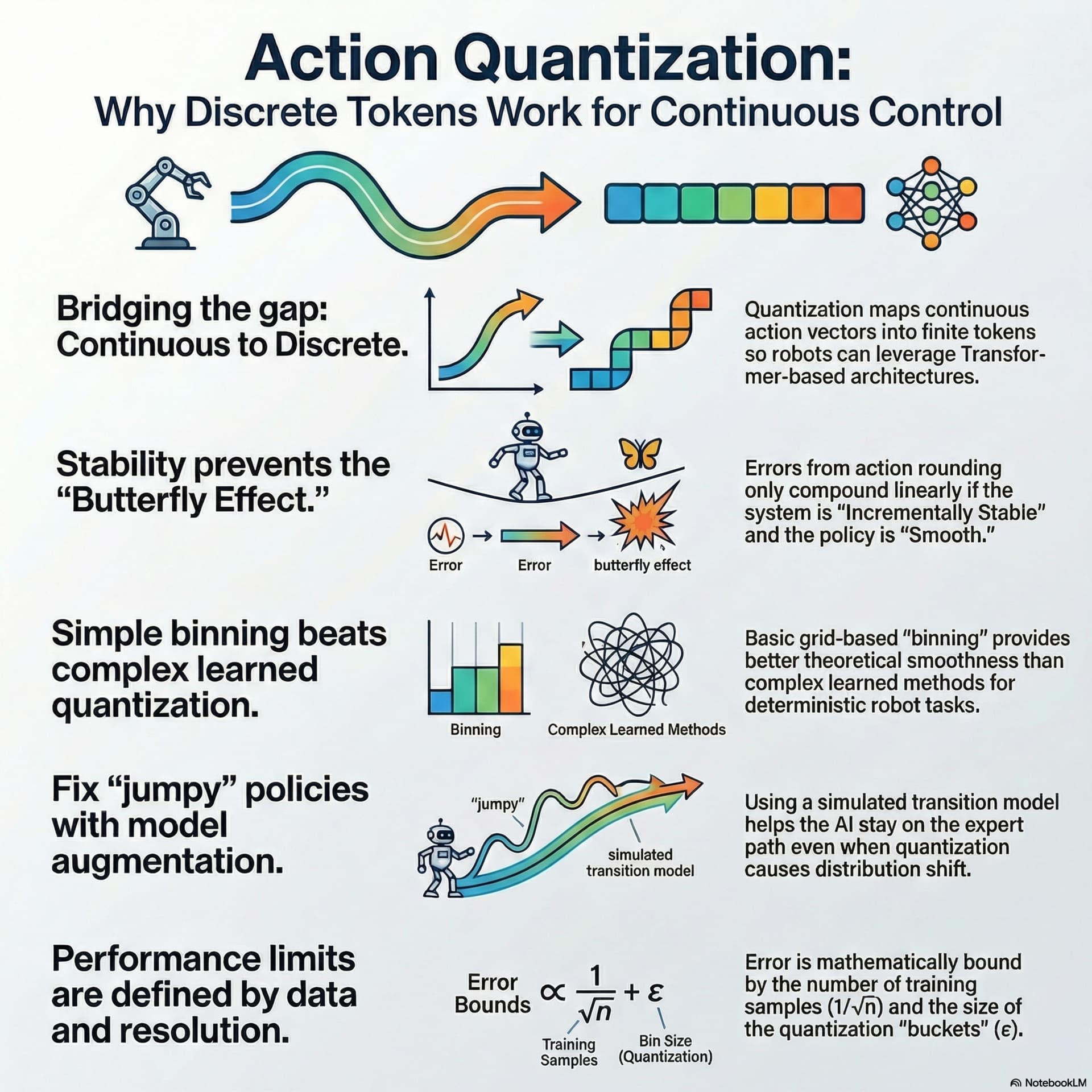
Behavior cloning for robotics fails in the real world because continuous control actions are quantized into discrete tokens, creating rounding errors that compound over time (horizon). The episode explains action quantization, probabilistic incremental input to state stability (PIS), relaxed total variation continuity (RTVC), and remedies like stochastic policies, uniform binning quantizers, and model-based augmentation.
Guest backgrounds
No guests are named in the transcript; only two hosts speak.
Key claims
(1) Small quantization errors push the robot into out-of-distribution states never seen in training, causing compounding mistakes. (2) Stability can come from the environment (PIS), otherwise the policy must be probabilistically smooth (RTVC). (3) Deterministic experts are brittle under quantization; stochastic experts handle deviations. (4) Uniform grid binning beats learned, jagged quantizers. (5) Model-based augmentation (planning in a simulated transition model) prevents policy “panic.”
Notable examples
autopilot/steering-wheel rounding; racing game keyboard vs analog steering; “grooved highway lanes” absorbing drift; pencil balancing (unstable dynamics); thermometer analogy for uniform vs learned quantizers; 90-degree panic swerve when the policy hits an undefined state.
Written by AI. May contain mistakes. Listen to the episode to check what was said.
Chapters
Tap a time to open that second in VOThe Challenge of Action Quantization
1:16 to 3:40
Explore the challenges AI faces in translating continuous human actions into discrete commands.
“So our mission today is to decode how we translate the continuous actions of daily life into the discrete, chunky tokens that AI needs to function.”
The Limitations of AI in Physical Environments
3:40 to 6:12
Understand the consequences of rounding errors in AI and how they escalate into failures.
“They build a discrete dictionary for the robot to use, but the moment you do that, you introduce a distortion.”
The Role of Environmental Stability
6:12 to 7:28
Learn how environmental factors can either mitigate or exacerbate AI errors.
“But wait, if AI is just making, like, random rounding errors based on a grid, wouldn't those errors occasionally just cancel each other out?”
Smoothness in AI Policies
7:28 to 10:20
Discover how the smoothness of AI policies can prevent catastrophic failures in robotics.
“So it's like driving on a highway that has deep physical grooves worn into the center of the lane.”
Quantization Methods: Simple vs. Complex
10:20 to 14:02
Compare the effectiveness of simple binning quantizers against complex learning-based quantizers in robotics.
“If the state is exactly X, then do exactly Y.”
Understanding Behavior Cloning and Quantization
14:02 to 18:11
Explore the impact of quantization methods on AI behavior and decision-making.
“And it snaps the input to a completely unrelated token on the other side of the codebook.”
Model-Based Augmentation: A Solution
18:11 to 19:48
Learn how model-based augmentation aids AI in unpredictable environments.
“The math proves that this model-based augmentation drastically shrinks the horizon-dependent quantization error.”
Implications for Human Perception
19:48 to 21:22
Consider the implications of AI tokenization on human perception.
“completely bypassing the need for real-world smoothness.”
Transcript
Automatic transcript. May contain errors.0:00Imagine an AI robot that spends like 10 ,000 hours perfectly cloning a human driver. It watches mountains of data. It memorizes every microscopic twitch of the steering wheel, every gentle pressure on the brake pedal. It looks flawless in the lab. Right. Completely flawed. But the moment you put this multimillion dollar machine on a real highway, it drives into a ditch in under five seconds. Yeah. And why? Because its artificial brain rounded a decimal point. Yeah. And that rounding error, I mean, that is the hidden trap of modern robotics. It's wild. It really is, because the physical world we live in is a continuous, unbroken flow of motion.
0:39But the AI models we rely on, they're fundamentally incompatible with that fluidity. They process reality in these choppy, isolated blocks. Right. So today on this deep dive, we are exploring the really fascinating and honestly sometimes terrifying intersection of artificial intelligence, robotics, and the physical world. Absolutely. Specifically, we're looking at how AI models learn to perform physical tasks by just watching humans, which is a process known as behavior cloning. But to really understand why these systems succeed or fail, we're digging deep into the hardcore math behind something called action quantization.
1:16Yeah, that's the key term here. So our mission today is to decode how we translate the continuous actions of daily life into the discrete, chunky tokens that AI needs to function. and how we keep these systems from taking a microscopic error and snowballing it into a catastrophic crash. Exactly. And to grasp the sheer scale of this challenge, we really have to start by looking at the language these AI brains actually speak and why that language is so fundamentally at odds with physical movement. Because right now, the gold standard for these systems is the autoregressive model. Okay. This is the exact same underlying architecture, the transformers that power large language models.
1:56Oh, right. The models that write essays or generate code for you. Yes, exactly. They're incredibly powerful at predicting the next logical step in the sequence. They are. But the mechanism behind that prediction relies on a finite dictionary of discrete symbols. Like words. Words, letters, code snippets. Yeah. When a transformer is trying to predict the next word in a sentence, it calculates the probability for every single word in its dictionary, and it just picks the most likely one. Makes sense. But it can only do that because the dictionary has a hard limit. There are only so many words. But the physical world doesn't have a dictionary.
2:31No, it doesn't. I mean, physical space is continuous. There are infinite fractions of a millimeter between point A and point B. Right. So if you asked a transformer to calculate the probability of every possible angle you could turn a steering wheel, the math just completely breaks down. Because it's infinite. Exactly. You cannot assign a percentage to infinity. The model would just freeze up, requiring infinite computing power. Okay, let's ground this in a real-world scenario, because it sounds a lot like playing a racing video game. Oh, that's a great comparison. Right, because in a real car, you have a steering wheel, which is a continuous input.
3:07You can turn it a fraction of a degree or a fraction of a fraction of a degree. All right. But if you play a racing game on a computer keyboard, you only have the left and right arrow keys. You're forcing a smooth, continuous curve of movement into a discrete binary button press. You either turn or you don't. That's spot on. And the math refers to this exact compromise as action quantization. Action quantization. Yeah. Engineers take the infinite possibilities of physical movement, what they call the continuous action vectors, and they map them to a finite set of tokens or bins. Like putting them into little buckets.
3:43Exactly. They build a discrete dictionary for the robot to use, but the moment you do that, you introduce a distortion. A rounding error. Yes. Even if the AI perfectly clones the human expert's behavior, it is physically impossible for it to replicate the action flawlessly. It just lacks the vocabulary to express the exact fraction of a degree the human used. So if the human driver turns the wheel left by, say, 1.003 units, but the AI's dictionary only has a token for turn left, one unit. Right. The eye executes its closest token, and we get a rounding error of.003. Precisely. And in a vacuum, a deviation of.003 units seems completely negligible, right?
4:24Yeah, you'd think so. But the problem is that in robotics, actions don't happen in a vacuum. They happen sequentially over time. Okay. Time is the factor that amplifies everything, and it creates this massive vulnerability. I want to push back on that a bit, actually. Sure. Because human drivers are making micro errors all the time. We oversteer, we understeer, we drift a fraction of an inch and then just naturally correct it. Right, we do. So why does a fraction of a degree matter so much to a highly advanced robot? That is the big question. And the difference lies in what the research calls the horizon.
5:00The horizon. Yeah, it's the total length of time the AI is operating continuously. See, in behavior cloning, the AI is trained on pristine data of a human doing the task perfectly. Okay. So the AI's entire worldview is based on that narrow corridor of perfect execution. It's never seen a mistake. Exactly. But when you deploy the AI in the real world, that tiny rounding error from the quantization physically moves the robot. Oh, I see. It pushes the robot into a physical position, a state that the human expert never demonstrated in the training data. Right, because the human expert never made that specific AI rounding error.
5:36Exactly. So there's literally zero training data on how to recover from that exact physical coordinate. Yep. The AI is now effectively blind. It finds itself in an unfamiliar state, so the model has to guess the next action. It's a bad guess. Usually yes. Because it's guessing based on out-of-distribution data, it makes a slightly larger error. Oh, wow. And that larger error pushes the robot into an even more unfamiliar state. The AI guesses again, the error multiplies, and the mistakes compound exponentially. It snowballs. It snowballs. Within seconds, a microscopic rounding error turns into a complete system failure.
6:14But wait, if AI is just making, like, random rounding errors based on a grid, wouldn't those errors occasionally just cancel each other out? You would think so, right? Yeah. Like, if it rounds down to the left one second and then rounds up to the right the next, It seems like it should naturally hover around the correct path rather than always spiraling into a crash. That's a really common assumption, but the math actively disproves it. Random errors do not naturally cancel each other out in a complex sequence unless the physical environment itself forces them to. The environment forces them. Yes.
6:46The research highlights a critical mathematical concept here called probabilistic incremental input to state stability, or PIS. Okay, let's break down PISS because that is quite the acronym. It's a mouthful. Input to state stability. What is the actual mechanism happening there? Think of the input as the action the robot takes. Okay. And the state as the physical consequence of that action. Right. Incremental stability means that a tiny change in the input only causes a bounded, manageable change in the state over the long term. So it doesn't spiral out of control. Right. Right. For a system to have PISs, the physical dynamics of the environment must have a natural tendency to absorb and dampen those small errors.
7:27Okay. So it's like driving on a highway that has deep physical grooves worn into the center of the lane. That is a perfect analogy. Right. So if the AI's rounding error makes the tires drift a fraction of an inch, the physical slope of the road naturally pulls the tires back to the center. Yes. That physical pull is P-I-S-S in action. If the environment is naturally stable, like those grooved lanes, the math shows that the quantization error only grows polynomially over time. Meaning it's slow. Exactly. It remains bounded and manageable. But if the environment lacks that inherent stability-like, imagine trying to balance a pencil upright on the tip of your finger.
8:08Oh, impossible. Right. Any microscopic deviation feeds into gravity, the errors compound exponentially, and the system fails almost instantly. Wow. When you put it in the context of, you know, relying on a car's autopilot at 70 miles per hour, it's wild to think that we are heavily relying on the physical stability of the road itself to keep microscopic AI rounding errors from steering us into the median. It's a little unnerving, yeah. But you can't always guarantee a perfectly grooved road. So if the physical world won't forgive the error, how does the AI's internal rulebook compensate? Well, that introduces the second major requirement in the research.
8:46If the environment isn't stable, the AI's policy, which is the rulebook it uses to decide its next action, that policy must possess a specific mathematical property. It's called relaxed total variation continuity, or RTVC. Okay, another heavy term, relaxed total variation continuity. How does that translate to the robot's actual behavior? It dictates how the rulebook handles deviations. Essentially, it means the policy has to be probabilistically smooth. Smooth. Yeah. If the AI finds itself slightly off the expected path, maybe a millimeter to the left of where the training data said it should be, its resulting action cannot wildly diverge from what it would have done on the correct path.
9:27It has to keep its cool. Exactly. The response to a small error must be a proportionately small correction. So if I'm driving and I drift one inch further left than usual, a smooth policy means I recognize the drift and I just gently angle the steering wheel back to the right. But a non-smooth policy means I realize I'm one inch off. The rulebook has no instructions for that specific inch. So I completely panic and jerk the wheel 90 degrees to the right and send the car into a ditch. Yeah, that's exactly what happens. And the mechanism behind that panic is really fascinating. Why does it panic?
10:01Well, the research provides this massive wake-up call regarding what types of AI rulebooks are actually smooth. The math demonstrates that deterministic experts almost always fail this smoothness test when their continuous actions are quantized into tokens. Wait, a deterministic expert meaning an AI with strict, rigid rules, right? Yeah. If the state is exactly X, then do exactly Y. Exactly. You would normally assume that highly strict rules are the safest way to program a robot. You really would assume so. But deterministic policies are essentially just massive lookup tables. They map one specific, highly precise state to one exact action.
10:39Oh, I see where this is going. Yeah. So if the rounding error places the robot in a state that is just 0.001 % different than what's in the training data, the deterministic rulebook literally has no output for that number. It's just a blank page. Exactly. It results in an undefined action. the rigid rule shatters because it doesn't know how to interpolate between the exact coordinates in memorized. So a strict rulebook is actually brittle. It can't bend, so it just breaks. Precisely. The data shows that stochastic experts are the actual solution here. Stochastic. Yeah. These are policies that operate on probability and Gaussian distributions.
11:17Instead of rigid if X, then exact Y rules, they output a probability cloud. They calculate that if you are near state X, you should perform an action near Y. Oh, that makes sense. Because they intrinsically think in probabilities and ranges rather than absolutes, they naturally possess that RTVC smoothness. They gently adapt to the rounding errors instead of hitting an undefined state and panicking. That makes total logical sense. Yeah. A probabilistic rulebook bends instead of breaking. But, okay, if we know the rulebook needs to be smooth, How does the actual chopping process like, the quantizer, that creates the tokens in the first place, how does that affect the smoothness?
11:57Oh, massively. Because if you're an engineer building a state-of-the-art robot today, I mean, the instinct would be to use a highly advanced AI-learned system to chop up the actions, right? Rather than just laying down a basic uniform grid. Well, the tech industry naturally defaults to complexity, right? They assume a fancy learning-based quantizer is vastly superior. here. But the research proves the exact opposite is true. Really? Yeah. The mathematical findings contrast two main approaches here. On one side you have learning-based quantizers. Okay. These are highly complex algorithms, like Kameen's clustering, that analyze the training data and create these intricate custom code books to represent the action vectors.
12:38Sounds expensive. It is. And on the other side you have binning-based quantizers. And this is literally just laying down a simple, uniform, evenly spaced grid over the continuous actions? I really want to understand the mechanism of why the simple grid wins out. Okay, let's look at an analogy. Let's compare this to a digital thermometer. Good, I like that. Right, so a dumb uniform grid is like a thermometer that only reads in whole numbers. If the real continuous temperature shifts from, say, 72.1 degrees to 72.9 degrees, the uniform grid simply moves the output from 72 to 73. Right. It's a small, bounded jump.
13:15That bounded jump is the absolute key. Now, apply that same temperature shift to the complex learning-based quantizer. Okay. The learning-based model creates its custom codebook by clustering the data it saw during training. It draws these weird, jagged, hyper-optimized boundaries around the actions it recognizes. So it's not a neat grade. It's a bunch of custom shapes perfectly tailored to the training data. Exactly. It's highly irregular. And it looks absolutely perfect during training because it memorized the expert's exact movements. Right. But during deployment, the continuous data is going to inevitably hit one of those rounding errors we talked about.
13:51The snowball. Right. So if an action falls just a fraction of a millimeter outside one of those custom jagged shapes, the learning-based quantizer doesn't know where to put it. Oh, no. The mapping collapses. And it snaps the input to a completely unrelated token on the other side of the codebook. So going back to the thermometer, the complex AI sees 72.9 degrees, a number that happens to fall just outside its custom cluster. And instead of just moving to 73, its internal mapping completely breaks and it suddenly outputs 150 degrees. And that massive jump is what triggers the 90 degree panic swerve in the robot.
14:28Wow. The complex learning quantizer completely violates the RTVC smoothness requirement because it overfits to the training data. It's too smart for its own good. Pretty much. Meanwhile, the dumb binning quantizer, because it is just a uniform, predictable grid, it naturally preserves the underlying geographical structure of the actions. Oh, I get it. Yeah, it guarantees that a 1 % shift in the physical real world only ever results in shifting one single bin over on the grid. It naturally preserves that crucial smoothness, which keeps the snowballing error tightly bounded. The underlying math is essentially telling the cutting-edge AI industry, stop overthinking it.
15:07Just use a basic grid if you want the robot to survive an unpredictable environment. It really is. It's a profound demonstration that when you are forcing the continuous physical world into discrete tokens, predictability and structural integrity are far more valuable than complex, hyper-optimized memorization. That is fascinating. But let's look at the worst-case scenario. Okay. What if an engineering team is forced to use a complex quantizer for a specific task? Or what if they're dealing with a physical system where they simply cannot guarantee that their AI's rulebook is probabilistically smooth?
15:40It happens. If the robot is going to panic the moment it hits an unfamiliar state in the real world, how do they prevent a crash? I mean, it has to act somewhere. The research actually outlines a brilliant mathematical remedy for this exact situation. It's called model-based augmentation. Okay, what does that do? Well, the problem, as we've established, is that acting directly in the unpredictable real world forces the robot into unfamiliar states, right? Right, where its non-smooth policy shatters. Exactly. So the remedy is to stop letting the AI make its decisions while interacting with the real world.
16:16Wait, if it can't interact with the real world to make decisions, what's the alternative? It has to gather data from somewhere to figure out its next move. It creates its own internal reality. Its own reality. Yeah. The engineers build what is known as a transition model. This is an entirely simulated internal version of the physical environment, but crucially, it is constructed only using the safe, familiar data from the training phase. Wait, so the robot essentially pauses, closes its eyes, and boots up a VR simulation of the task inside its own head. That is the functional mechanism, yes. It rolls out what the math calls an auxiliary trajectory inside the safe simulation.
16:54The AI plays out the next 10 or 20 steps of the PASC in this internal model. And because the simulation is strictly gowned by the training data, the simulation enforces the training distribution. So it never gets confused. Right. The AI never encounters a truly out of distribution state while it is planning. Okay, so it gets to figure out the exact sequence of discrete tokens, the exact button presses, and a perfectly safe environment where its rulebook won't shatter. Yes. And then what? It opens its eyes and just executes that exact sequence blindly in the physical world. Exactly. It locks in the sequence of tokens and executes them.
17:33Now, it does cause some deviation because the real world will always differ slightly from the simulation. Right. There's always going to be some wind or friction or something. Absolutely. But here is the magic of the math. Because the decisions were made safely inside the internal model, the execution entirely bypasses the smoothness requirement. Because the errors in execution are just physical deviations. They aren't feeding back into the AI's decision-making loop to cause the rulebook to panic. Bingo. The policy never has the opportunity to hit an undefined state and swerve 90 degrees. It fundamentally alters the equation.
18:10That's incredibly clever. It is. The math proves that this model-based augmentation drastically shrinks the horizon-dependent quantization error. It proves that when dealing with discrete tokens, sometimes changing where the AI thinks is significantly more effective than changing how it thinks. Wow. Let's zoom out and recap this journey, because the mechanics of this completely shift how I view artificial intelligence interacting with physical space. It's a lot to take in. It really is. So we started with the realization that to use the most advanced autoregressive models, we have to chop the continuous flowing reality of our physical world into discrete, chunky tokens.
18:48And that chopping inevitably creates rounding errors. And because of the horizon, the compounding nature of time, those microscopic errors can snowball into absolute disaster. Right. But the math provides solutions. The physical environment itself can save the robot if it has inherent PIS stability, acting like grooved lanes on a highway to naturally absorb the errors. And if the environment isn't stable, the AI's internal rulebook must be smooth, which means utilizing probabilistic stochastic experts rather than rigid, brittle, deterministic rules. Exactly. Furthermore, we found that simple, uniform binning grids actually outperform advanced, learned tokenizers, because they preserve the structural boundaries of the actions, which prevents the system from overfitting and panicking.
19:33And finally, when all else fails and the rulebook just isn't smooth, the ultimate fail-safe is model-based augmentation. giving the robot a built-in internal simulator so it can plant its tokens in a safe, predictable space, completely bypassing the need for real-world smoothness. It is a highly complex, mathematically beautiful dance of managing inevitable distortion. It really is. It makes me look at, you know, a human barista pouring a latte, or a driver navigating a busy street in a completely different way. Oh, absolutely. The sheer amount of continuous physical data they are processing seamlessly without a second thought is just staggering.
20:11And, you know, that seamless processing leaves us with a really fascinating final thought for you to mull over. Oh, what's that? Well, we've just spent this deep dive exploring how forcing a continuous physical world into discrete AI tokens fundamentally alters how a machine learns. Right. It introduces compounding errors, requires probabilistically smooth rule books, and demands elaborate internal simulators just to keep the system from crashing. But what does that mean for human perception? Where does human perception factor into discrete tokens? Well, it raises the question of whether our brains are actually processing the true continuous flow of reality at all.
20:48Oh, wow. Or is our own consciousness just running its own highly evolved biological binning quantizers to make sense of an overwhelmingly complex universe? I've never thought about that. When you reach for a cup of coffee, are you experiencing continuous physical reality? Or is your brain just frantically smoothing over its own biological rounding errors before you drop the mug? Well, that is absolutely going to keep me up at night. I will definitely be watching the continuous motion of my own hands very closely the rest of the day. Good luck with that. Thank you so much for walking through the mechanics of this with me.
21:19And thank you to everyone listening. Until next time, keep questioning the curve.
From the publisher
This research provides a theoretical foundation for behavior cloning using action quantization, a common practice in robotics and large-scale AI models where continuous signals are converted into discrete tokens. The authors analyze how quantization error and statistical complexity interact to influence a model’s performance over time. Their findings demonstrate that stable dynamics and smooth policies are essential for preventing small errors from compounding into significant failures. The study specifically highlights that binning-based quantization is more reliable than learning-based methods when imitating deterministic experts. To address potential instability, the paper proposes a model-based augmentation that improves accuracy without requiring high levels of policy smoothness. Finally, the researchers establish information-theoretic lower bounds to define the fundamental limits of learning from quantized demonstrations.


