In short
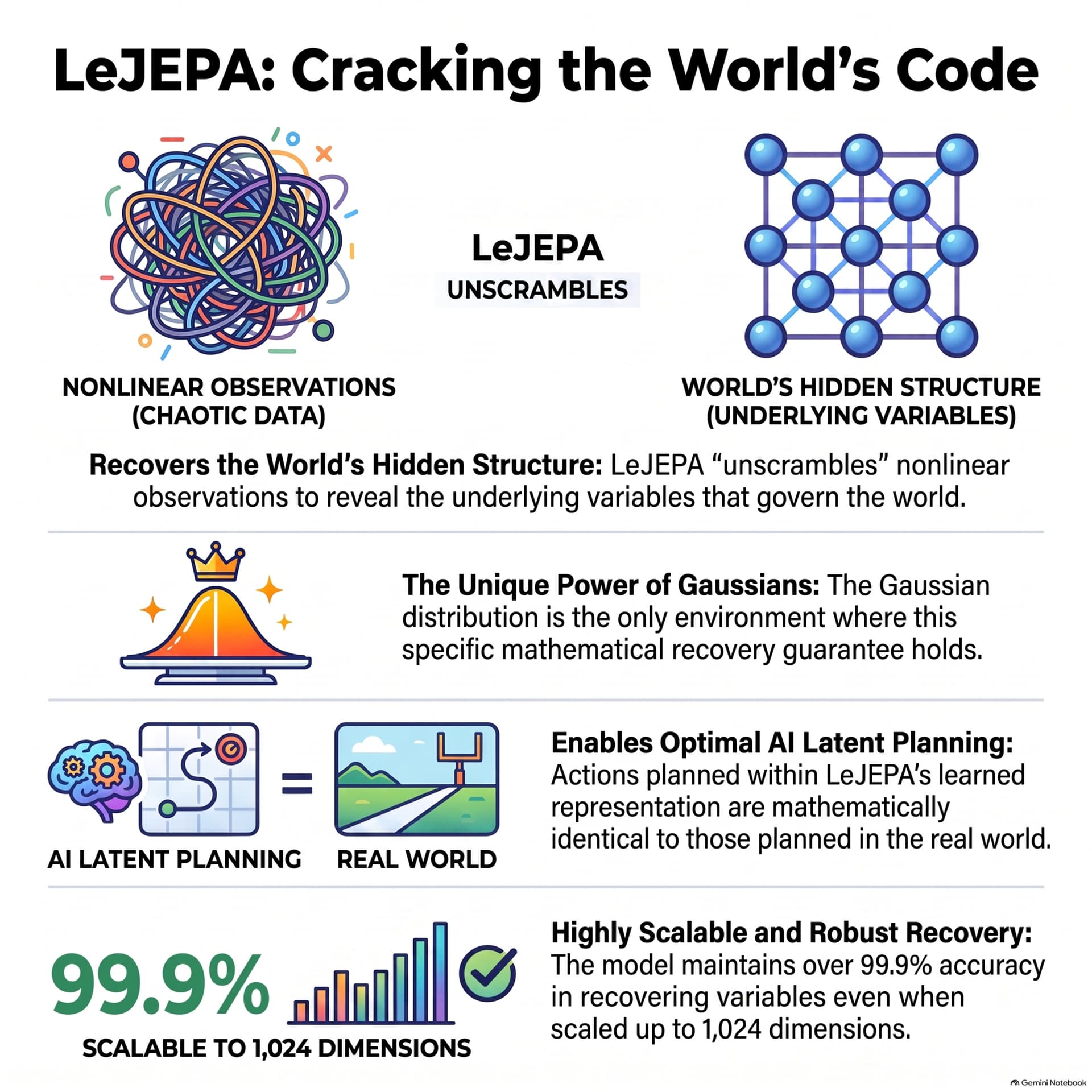
When LeJEPA (Joint Embedding Predictive Architecture) learns a reliable “world model,” i.e., linearly identifiable latent variables from pixel observations, and when that guarantee fails in real robotics.
Guests/backgrounds
No named guests or credentials are provided in the transcript; it’s a host-led deep dive with two speakers discussing the paper.
Key claims
Raw observations are “shadows” of latent variables mixed by nonlinear processes (Plato’s cave). LeJEPA achieves linear identifiability via two training rules: pull positive pairs together and use a SIGREG regularizer to enforce a Gaussian-shaped embedding distribution, which mathematically penalizes nonlinear “cheating” (Hermite polynomial argument). Approximate identifiability degrades gracefully under noise; scaling to up to 1024-dimensional latent spaces works better than InfoNCE-style negative-pair methods. However, goal-directed robot trajectories can break learning because they concentrate data and hit hard joint limits, violating the Gaussian assumption.
Notable examples
2D simulated robot arm with shoulder/wrist angles; random Gaussian-walk exploration succeeds, while efficient reinforcement-learning reaching fails. Planning in latent space matches optimal physical planning when identifiability holds.
Written by AI. May contain mistakes. Listen to the episode to check what was said.
Chapters
Tap a time to open that second in VOUnderstanding AI's Learning Process
0:45 to 1:48
Discussion on how AI differs from human understanding of physical mechanics.
“You don't just see a silver blur moving downward.”
Introduction to LEGEPA
1:48 to 2:32
Overview of the LEGEPA system and its goal to learn true world models.
“Our mission is to explore a breakthrough piece of research that answers this exact question.”
Plato's Cave Analogy
2:32 to 3:21
Exploration of how AI perceives reality through an analogy to Plato's cave.
“Before we even get to the AI, how does the physical world actually present itself to a machine in the first place?”
Latent Variables vs. Observations
3:21 to 4:13
Discussion on the difference between latent variables and AI observations.
“In mathematics, we draw a hard line between what we call latent variables and observations.”
The Challenge of Representation Learning
4:13 to 4:51
How representation learning impacts AI's ability to understand reality.
“Wow, that sounds like an absolute nightmare to untangle.”
The Need for Linear Identifiability
4:51 to 5:36
Explanation of linear identifiability as a solution to AI's understanding challenges.
“But the moment the lighting changes in the real world or the object moves into a shadow, the AI fails catastrophically because its internal map of reality is entangled.”
Simple Rules for Complex Problems
5:36 to 6:05
Introduction to the two rules that help LEGEPA learn effectively.
“They might be rotated or flipped in the AI's memory, but they are structurally perfectly intact.”
Rule 1: Pulling Positive Pairs Together
6:05 to 7:20
Detailed explanation of the first rule and its significance in AI learning.
“I love simple rules for complex problems.”
Rule 2: The SIGREG Regularizer
7:20 to 8:23
Discussion on the second rule and how it prevents trivial collapse in AI.
“Rule 2 introduces a regularizer called SIGREG.”
The Math Behind the Learning Process
8:23 to 10:14
Exploration of how Hermite polynomials relate to AI learning.
“I am struggling a little to bridge that gap.”
Show all 17 chapters
The Gaussian Assumption and Its Risks
10:14 to 11:35
Discussion on the Gaussian distribution assumption and its implications.
“It has unbaked the cake because any twisted, scrambled recipe yields a lower score.”
The Central Limit Theorem in AI
11:35 to 12:35
Connecting the central limit theorem to AI learning in the real world.
“It's absolutely true that individual microvariables in the world are highly non-Gaussian.”
Theorem 3: Approximate Identifiability
12:35 to 13:34
Overview of how the AI's learning is resilient in real-world conditions.
“This is where the research transitions into measuring what happens when this perfect theory collides with incredibly messy, imperfect, real-world training.”
Scaling Up: Testing in High Dimensions
13:34 to 14:01
Discussion on the challenges of testing AI in high-dimensional spaces.
“They tested it on models with up to 124 dimensional latent spaces.”
Exploring LeJEPA's Unique Learning Process
14:01 to 17:45
Learn how LeJEPA uses positive pairs to maintain an accurate world model.
“And older self-supervised models, like InfoNCE, completely choked and degraded under that kind of high-dimensional pressure.”
The Importance of Data Distribution in AI Learning
17:45 to 18:19
Discover why random exploration in learning models is crucial for AI understanding.
“It desperately needs to explore the world randomly in all directions equally.”
From Observation to Active Interaction
18:21 to 22:35
Understand the shift from passive observation to active experimentation for AI.
“We've journeyed from the shadows of Plato's cave through the net and bell math of Gaussian shapes all the way to a flailing robotic arm.”
Transcript
Automatic transcript. May contain errors.0:00Welcome to the deep dive. You know, for those of you listening who really want to just cut through the noise and deeply understand the mechanics of the technology that's shaping our world, I want you to try and picture something for a second. Okay. Picture watching a toddler, right? They're sitting in a high chair and they drop a spoon on the floor. Oh, yeah. A classic. Right. They lean over, they watch it hit the floor, and then they immediately demand that you pick it up so they can just, you know, do it again, again. Testing your patience. Exactly. But we look at that and we think, well, you know, that's just gravity.
0:35It's a fundamental rule of the physical world. And because you have that rule locked in your head, you can safely navigate reality. But you're not just seeing a silver blur. Exactly. You don't just see a silver blur moving downward. You actually understand the underlying mechanics of the spoon falling. But when we start talking about artificial intelligence, suddenly that baseline understanding of reality gets completely murky. It really does. Yeah. We constantly hear about AI, you know, learning, but how do we actually know if a neural network truly understands the physical mechanics of our universe?
1:09Or is it like just doing a really good job of memorizing patterns of pixels? I mean, that distinction is basically everything right now in the field. It's the difference between memorizing a flat two-dimensional map and actually understanding the physical terrain you're walking on. We're currently building these massive systems that can, you know, generate just stunningly beautiful images or write incredibly articulate text. Which is amazing. It is. But when you ask those exact same systems to operate a machine in physical reality, that lack of a true structural understanding of physics becomes a really critical and sometimes dangerous failure point.
1:47Which is exactly why we are going deep today. Our mission is to explore a breakthrough piece of research that answers this exact question. Yeah, it's an exciting one. We are going to look at a mathematical proof that shows exactly when an AI learns a true, reliable world model. We'll be looking under the hood of a system called LEGEPA, which stands for Joint Embedding Predictive Architecture. That's a mouthful. It is, yeah. But we're going to break down how it mathematically unscrambles chaotic observations to find the true underlying variables of reality. And we'll trace how it scales all the way up to incredibly complex 10 ,024 dimensional spaces and eventually actual robotic arms.
2:31It gets wild. It really does. Okay, let's unpack this. Before we even get to the AI, how does the physical world actually present itself to a machine in the first place? So to understand how an AI learns the world, we first have to recognize how the world naturally hides information from the AI. Okay, what do you mean by hides? Well, there's a brilliant philosophical analogy the paper uses to frame this, and it's Plato's cave. Oh, right. Imagine you're chained inside a dark cave, right? You're facing a blank wall. Behind you is a fire, and people are walking past that fire holding up various objects.
3:01But you can't turn around. Exactly. You never get to turn around and see the real three-dimensional objects. you only ever observe their flat two-dimensional shadows projected onto the wall in front of you. So if I'm an AI system driving a car, my camera feel like the raw pixels coming into my system? Those are just the shadows on the wall. Precisely. In mathematics, we draw a hard line between what we call latent variables and observations. Okay. Latent variables are the true independent degrees of freedom in the physical world. So for a moving car, the latent variables are its exact GPS position, its velocity, its mass, maybe the angle of the sun hitting its windshield.
3:41The actual reality. Right. Those are independent facts about reality. But the AI doesn't get a neat little spreadsheet of those facts. It gets an observation. The shadow. Yes. The physical world takes all those clean, separate, latent variables, and it runs them through a highly chaotic, nonlinear mixing process. So it's scrambling them all up. Totally scrambled. It mixes the car's velocity with the glare of the sun and the object's mass with the shadow of a passing tree and projects all of that tangled mess into a grid of pixels. Wow, that sounds like an absolute nightmare to untangle. And it's like it's like someone baked a cake.
4:18Oh, I like that. Yeah. So they took flour, eggs, sugar and milk, which would be our pure latent variables, and they whisk them together and bake them into this highly complex, completely transformed cake. That's exactly what's happening. So the AI's job is to look at the baked cake, the shadow on the wall, and somehow reverse engineer the exact amounts of raw ingredients. Right. But if it's completely scrambled together, how can the system ever know for sure what the original variables were? Well, you've just described the core foundational problem of representation learning. If an AI scrambles an object's position with its color and its internal memory, it might still score really well on a highly specific narrow test in a lab.
5:00Sure, because it memorized the answers. Exactly. Yeah. But the moment the lighting changes in the real world or the object moves into a shadow, the AI fails catastrophically because its internal map of reality is entangled. Because it thinks the color is attached to the position. Right. The position and the color are glued together in its brain. So to fix this, what we really need is a mathematical guarantee known as linear identifiability. Linear identifiability, meaning it successfully identifies the real variables in a straight one-to-one way. You hit the nail on the head. It means we have a strict mathematical guarantee that the AI's internal representation has perfectly recovered the underlying latent variables of the world.
5:44They might be rotated or flipped in the AI's memory, but they are structurally perfectly intact. Up until now, this kind of ironclad guarantee didn't really exist for these types of predictive AI architectures. It was just guesswork. A lot of it, yeah. But this breakthrough research shows that Legeppa actually achieved this using just two surprisingly simple rules during his training process. All right. I love simple rules for complex problems. What's the first one? Rule one is simply pull positive pairs together. Positive pairs. Yeah. A positive pair is just two related views of the exact same underlying content.
6:16So think of two adjacent frames in a video of a ball flying through the air. Like split seconds apart. Right. Or two slightly different camera angles of the same moving object. The AI is mathematically penalized if its internal representations, its understanding of those two frames, are far apart. Okay, that makes intuitive sense. I mean, frame A and frame B are a fraction of a second apart. The physical reality of the baseball hasn't changed much, it just moved an inch. Exactly. So the AI should view them as highly related. But wait, if the only rule is to pull related things together, wouldn't the AI just take the lazy route?
6:53What do you mean? Couldn't it just compress every single video frame it ever sees into one single identical black pixel? Like if everything is just one dot, then all pairs are perfectly together and it never gets penalized, right? That is a phenomenal observation. And in the field, we actually call that the trivial collapse problem. Trivial collapse. The AI takes the path of least resistance and learns absolutely nothing. And that is exactly why we need Rule 2. Rule 2 introduces a regularizer called SIGREG. A SIGREG, all right. Its entire job is to force the overall distribution of the AI's data to take the shape of a perfect Gaussian bell curve.
7:32A bell curve. Okay, so most of the data is clustered in the middle, and it tapers off symmetrically on the sides. Exactly. It forces the data to be spread out. So the AI is caught in this mathematical tug of war. Right. Rule 1 is shouting, pull these specific related frowns as close together as possible. But rule two is shouting, keep the entire universe of data spread out in this multidimensional bell curve shape. So it physically cannot collapse everything into a single point anymore. It can't. It's trapped. Okay, I follow the tug of war. But let's go back to my baked cake metaphor. You're telling me that by applying just these two opposing forces, pulling consecutive video frames together, and keeping the overall data spread out like a bell curve, the AI can unbake the cake.
8:15It really can. It can magically reverse engineer the raw, pure ingredients of physical reality from that. What's fascinating here is that the math proves the AI has absolutely no other choice. Really? Yeah. If the world transitions with a certain kind of independent additive noise, meaning objects in the world, move somewhat predictably, but with a tiny bit of random variation, these two opposing rules literally force the AI to perfectly linearly match the true world variables. I am struggling a little to bridge that gap. How does forcing data into a bell curve force the AI to unbake the cake?
8:52To truly understand how this works, we have to look at the underlying math, specifically something called Hermite polynomials. Hermite polynomials. Okay, that sounds heavy. I know throwing polynomial math into the mix sounds intense, but let's ground it. Imagine stretching a flexible net tightly over a perfectly smooth, round bell. Okay, I've got the net. I've got the bell. The shape of the bell represents our perfect Gaussian distribution rule two. Now, the AI wants to pull two connected nodes on that net closer together to satisfy rule one. If the AI pulls that net in a straight, uniform way, a linear mapping of the net slides smoothly and stays perfectly matched to the shape of the bell beneath it.
9:28Right, it glides over it. Exactly. But if the AI tries to be clever and warps, twists, or pinches the net to force two nodes together artificially, that is a nonlinear distortion. Ah. And if you pinch or twist a net stretched over a bell, it bunches up. It stops fitting flush against the surface. Exactly. The math of Hermite polynomials prove that any degree of nonlinear twisting strictly reduces the correlation between those related video frames when constrained by that bell shape. So it gets punished. Mathematically punished, yes. Yeah. The bunching ruins its score. A quadratic twist drops the score.
10:02A cubic pinch drops it even further. The absolute maximum possible score the AI can achieve happens when its internal representation is a perfect, flat, linear map of the true latent variables. Wow. So it's mathematically locked in? It is. It has unbaked the cake because any twisted, scrambled recipe yields a lower score. Okay, here's where it gets really interesting. Because the math is beautiful, but I have to push back on the fundamental premise here. Go for it. isn't assuming the whole world is a neat little bell curve, a massive vulnerability? I mean, the real physical world isn't perfectly Gaussian, right?
10:36No, it's not. Like if I drop a ceramic coffee mug on a tile floor, it shatters into a hundred pieces. That's not a gentle, symmetrical bell curve of data. That's a sudden, chaotic, completely unpredictable spike. Right. If this entire undaking process relies on reality being a smooth bell curve, doesn't this whole framework just fall apart the second the AI leaves the laboratory? That is the exact right question to ask. And the researchers address it really rigorously. In fact, theorem two in this proof is the converse direction. What does that mean? It proves mathematically that the Gaussian distribution is the unique shape where this guarantee holds.
11:13If you try to enforce any other shape, the AI will learn a warped, tangled representation. So the Gaussian isn't just a convenient choice for the math. It's the only key that fits the lock. But wait, that just makes my point stronger. If the Gaussian is the only key to the lock, but the messy real world isn't shaped like a Gaussian keyhole, aren't we stuck? Well, if we connect this to the bigger picture, we have to consider the central limit theorem. Okay, refresh my memory on that. Sure. It's absolutely true that individual microvariables in the world are highly non-Gaussian. A single photon hitting a camera sensor, or the chaotic trajectory of one tiny shard of that shattered coffee mug can be wild and unpredictable.
11:54Right. But task-relevant variables, the things we actually care about navigating, like the center of mass of a moving car or the trajectory of an oncoming person, those are aggregates of millions of microvariables. Ah, okay. And by the central limit theorem, when you sum up many independent random variables, their collective behavior strongly tends toward a Gaussian distribution, regardless of their chaotic individual shapes. Okay, I see. So you're saying that at the macro level, the level where physical objects actually interact, move, and bump into each other, reality behaves enough like a Gaussian distribution for this net and bell math to actually work?
12:31You've got it. But we don't just have to take the theoretical maths word for it. Okay. This is where the research transitions into measuring what happens when this perfect theory collides with incredibly messy, imperfect, real-world training. Because in a real neural network, you never achieve a flawless bell curve. There's always noise. There's always some error. Right, because neural networks are basically just throwing massive amounts of compute at a problem until the error margin gets small enough to be useful. They aren't pristine mathematical equations in practice. Exactly. Which brings us to a crucial part of the paper.
13:06Theorem 3, approximate identifiability. The proximate. Yes. This proves that when the AI encounters that real-world noise, the mathematical guarantee degrades gracefully, not catastrophically. So it doesn't just break all at once. No. If your training loss is low, your AI have a highly accurate linear map of the world. If the air is a bit higher, the map is slightly warped, but the car doesn't suddenly think a shadow is a brick wall. And to prove this resiliency, they scaled the system up dramatically. They tested it on models with up to 124 dimensional latent spaces. 124 dimensions. I mean, that is a staggering amount of variables to keep straight.
13:46My brain hurts trying to visualize a four-dimensional space. How do you even manage 1024 without scrambling them all together? You can think of it like an AI trying to balance a spreadsheet with 1024 independent columns simultaneously, updating every fraction of a second. That's insane. It is. And older self-supervised models, like InfoNCE, completely choked and degraded under that kind of high-dimensional pressure. Why did they fail? Well, those older models relied on contrasting negative pairs, meaning they had to constantly compare a video frame to thousands of unrelated frames to figure out what it wasn't.
14:21In a 1024-dimensional space, everything looks completely different from everything else, so that negative comparison math just breaks down, becomes computationally impossible. Oh, I see. But because Legepa only uses positive pairs and relies on the elegant Net and Belgaussian rule to prevent collapse, it maintained an almost perfect linear recovery of the world, even at 1024 dimensions. So it scales beautifully. That's a huge victory. But testing massive spreadsheets of data in a server farm is one thing. When did they actually test this on moving objects? Oh, the most revealing part of the entire research was the robot reacher experiment.
14:57Oh, hey, break that down for me. They simulated a two-dimensional lobotic arm with a shoulder joint and a wrist joint. The AI's job was to watch raw, messy pixel video feeds of this arm moving around and figure out the true underlying variables, which in this case are simply the physical angles of the shoulder and the wrist. Just the two angles. Right. And they tested the AI by making it watch two completely different types of movement data. Okay, what was the first type? In the first condition, the arm just wiggled around randomly. It took what we call a Gaussian random walk. So just aimless exploration, like a toddler lying in a crib, just flailing its arms in every direction to see how its joints work.
15:37Precisely that. Now, in the second condition, they used actual goal-directed trajectories generated by a reinforcement learning, or LAL, policy. Reinforcement learning. Right. This means the robotic arm was moving purposefully. It was reaching incredibly efficiently from a starting point directly to a target object over and over again. Okay, let me pause and think through this. The AI is watching the exact same physical robot arm in the exact same environment. In one video, the arm is flailing randomly like a toddler. Yeah. In the other video, it's moving with highly structured, efficient, purposeful logic.
16:13I would intuitively assume the purposeful movement is vastly superior data, right? It's showing the AI how the arm is actually supposed to be used in the real world. That is the exact intuitive jump most engineers make. but the results were the polar opposite. Really? Yes. The highly structured, goal-directed trajectories completely broke the AI's ability to learn the world model. Watching the random, flailing toddler walk succeeded perfectly. The AI isolated the shoulder and wrist angles into a clean, unbaked map. But watching the purposeful, efficient agent completely tangled the AI's understanding of physics.
16:51Wait, why? Why would watching a robot successfully achieve a goal break the AI's understanding of how reality works? It comes down to how goal-directed behavior fundamentally changes the data. When an efficient agent reaches for a target, it takes the shortest, lowest entropy path. It doesn't explore all directions equally. Because it's trying to be fast. Exactly. And more importantly, to get to the goal as fast as possible, the efficient agent often slams its joints into their physical limits. It whips the wrist joint to its maximum rotation and hits a hard stop. Ah, it hits a physical brick wall.
17:22And hitting a brick wall is definitely not a smooth, symmetrical bell curve. Exactly. Instead of a smooth curve of movement, the data just violently spikes at the edge of the robot's physical limit. It completely violates the core net and bell Gaussian assumption. Oh, wow. Yeah. To build a perfect, reliable world model, an AI cannot just sit back and watch highly optimized, efficient experts. It desperately needs to explore the world randomly in all directions equally. It needs that messy, random noise. It literally has to play like a child to understand the mechanics of its environment, rather than just rushing straight to a goal.
17:59That is just deeply profound. I mean, if we just feed an AI thousands of hours of YouTube videos of human beings performing tasks perfectly, it might learn to flawlessly mimic the task, but it won't actually understand the underlying physics, because it hasn't seen the messy, random, boundary-pushing exploration that defines the actual limits of the physical world. You've captured the core insight perfectly. The distribution of the data it learns from matters just as much as the mathematical equations running in the background. So what does this all mean? We've journeyed from the shadows of Plato's cave through the net and bell math of Gaussian shapes all the way to a flailing robotic arm.
18:35For you listening right now, why does this matter to your life? It's the big question. Right. Well, if you're trying to keep up with the staggering pace of AI, this is the fundamental dividing line between a chatbot on your phone and a physical robot in your house. A chatbot is probabilistic. It looks at the shadows on the wall and just guesses the next most likely shadow. That's why it hallucinates facts. But if we want an AI to safely drive cars at 70 miles an hour or perform delicate surgeries or manage physical power grids, it absolutely cannot hallucinate physics. It needs a mathematically reliable world model.
19:08And that necessity leads directly to theorem four in this research, optimal latent planning. Okay, wait on me. If the AI achieves this linear identifiability we've been unpacking, a magical property emerges. Planning a physical trajectory inside the AI's own head, its latent mathematical space, becomes perfectly identical to planning in the true physical world. Meaning, if the AI visualizes a straight-line path to avoid an obstacle in its internal memory, that specific thought decodes flawlessly into an optimal physical straight line movement of its real world tires. Exactly. Because its internal representation is just a perfectly preserved, rotated version of reality, any measurement like finding the shortest, safest distance between two points works exactly the same in the AI's mind as it does on the real asphalt.
19:56So you don't need a translator. Right. Engineers don't have to build massive, error-prone translation layers to guess what the AI wants to do. The straight line in the digital mind is the straight line in the physical world. During the robotic arm experiment, when they tested the AI that trained on the random toddler flailing, its internal plans matched the perfect mathematically optimal control paths almost identically. It's like the AI finally steps out of Plato's cave. It unchains itself, turns around, looks directly at the actual 3D objects and says, oh, I get it now. It's no longer guessing based on shadows.
20:28It's calculating based on true physical reality. It represents a profound paradigm shift. We are moving from empirical guesswork, hoping the AI understands the world, to having a mathematical blueprint that proves the system has successfully recovered the physical structure of reality. Okay, let's take a step back and appreciate the journey we just took. We started with the realization that raw camera feeds are just messy, tangled shadows of reality. We looked at how Legepa uses a brilliant tug-of-war pulling related frames together while forcing the data into a Gaussian-Bill curve to mathematically force the AI to unbake those shadows.
21:03We saw how any non-linear cheating by the AI bunches up the net, punishing it and forcing a perfect linear map of reality. And we proved it with a robotic arm, discovering the deeply human truth that playful, random exploration builds better models of the universe than rigid, goal-directed behavior. This raises an important question, though, as we look to what comes next. Oh. Yeah, the research clearly shows that to build this perfect map, the AI requires isotropic random exploration. It needs the data to be nicely distributed in all directions. But as we discussed with the shattering coffee mug, the real world often isn't neat and symmetrical.
21:41Goal-directed, real-world behavior breaks this passive learning model. Right. If the world's variables are heavily non-Gaussian and constrained by hard physical limits, the AI might not be able to just passively sit back and watch video feeds to learn how the universe works. Oh, wow. So if passive observation isn't mathematically enough to guarantee it learns the real variables, what does it have to do? It'll have to actively intervene. It'll have to poke and prod the physical world itself, observing how the environment reacts to its specific random action. Like a scientist. Exactly. It'll have to stop acting like a passive audience member and start acting like a scientist conducting experiments.
22:19In the field, this points toward the next great frontier, causal representation learning. The AI won't just be an observer trapped in the cave. It will have to step into the light and start physically moving the objects itself to truly map out cause and effect. A future where AI isn't just watching us through cameras, but physically interacting with our world in order to truly understand it. It changes the entire paradigm from a machine that passively watches to an entity that actively experiments. That murky camera feed we talked about at the start. It only becomes a crystal clear window into reality when the AI reaches through the glass.
22:54Thank you for joining us on this deep dive. Keep questioning the mechanics behind the technology shaping our future, and we'll see you next time.
From the publisher
This research paper introduces a mathematical framework to prove that LeJEPA (a specific self-supervised learning architecture) can accurately recover the hidden structure of the world from complex data. The authors establish that when a model combines an alignment loss with Gaussian regularization, it achieves linear identifiability, meaning the learned representation is a simple rotation of the world’s true latent variables. This property is shown to be unique to Gaussian latent distributions, as any nonlinear distortion of the representation would strictly degrade the model's predictive performance. Furthermore, the study demonstrates that this linear recovery is essential for optimal latent-space planning, allowing an agent to navigate a learned model as effectively as the real world. The theory is supported by experiments ranging from 2D simulations to high-dimensional robotic control tasks, confirming that the model's training objectives act as a reliable proxy for structural accuracy. Ultimately, the work provides a formal foundation for building World Models that are mathematically guaranteed to be faithful to the environments they represent.


