
In short
The episode explains a mathematical proof for “self-rewarding language models” (SRLMs): models that act as both policy (generator) and reward model (judge), aiming to iteratively align/improve without human labeling.
Guest backgrounds
No guests are identified; the transcript shows two hosts conversing.
Key claims
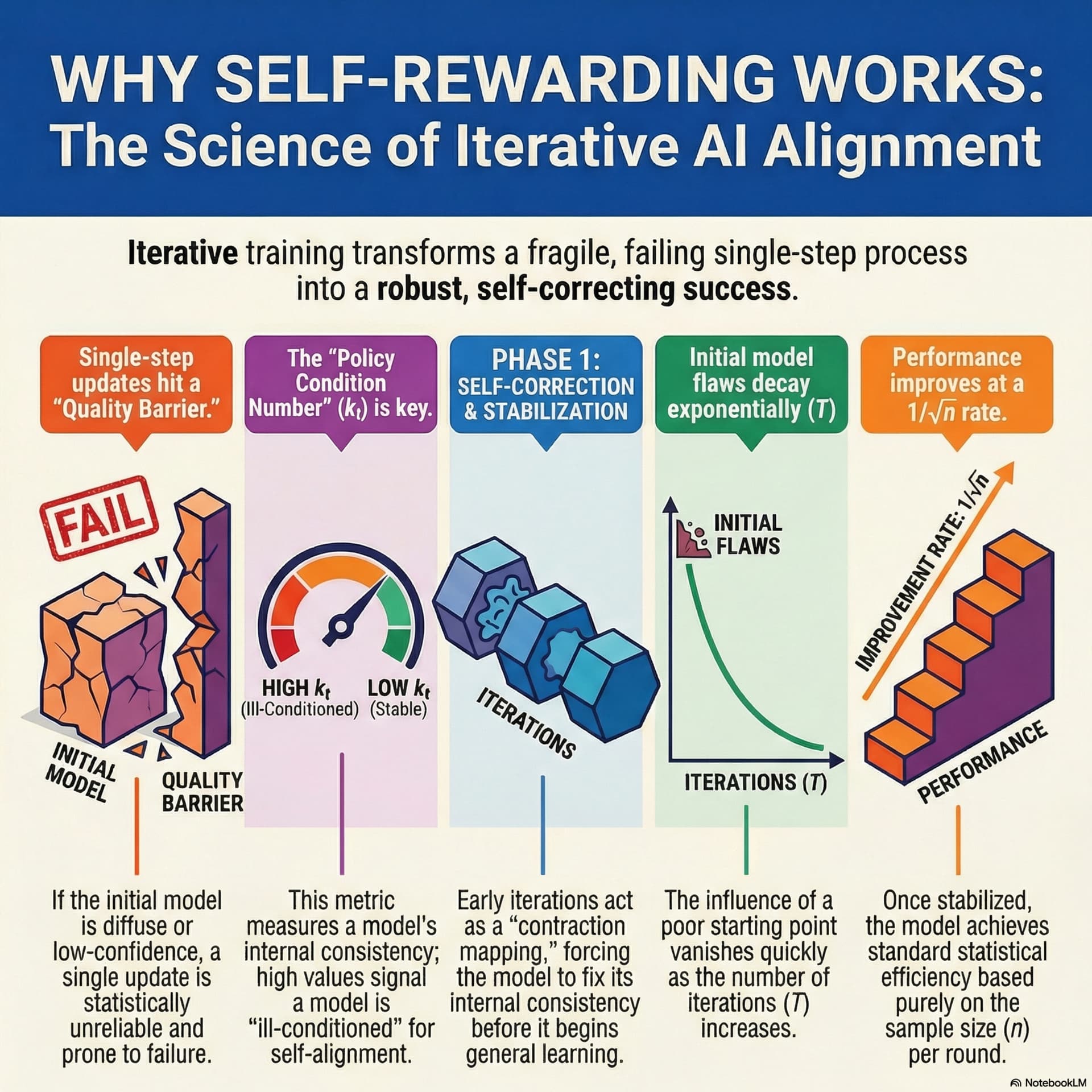
RLHF has a “superhuman cap” because humans can’t reliably judge superhuman outputs. A single self-reward update can fail under greedy decoding when the model is initially “diffuse” (high policy condition number/con). But repeated iterations form a contraction mapping: dependence on the bad start decays exponentially. Learning has two stages: (1) stabilization via internal consistency (probability mass concentration), then (2) statistical efficiency with error dropping like 1/sqrt(n). The theory uses “linear softmax models” and “effective dimension” (spectral decay) to argue scalability despite high parameter counts.
Notable examples
High-school exam “teacher grades your grading” paradox; “Sydney is the capital” confidence trap; cake-baking “flour vs cement” diffuse guessing; wobbly table contraction-mapping analogy; “sky is green” stable-but-possibly-incorrect worldview concern.
Written by AI. May contain mistakes. Listen to the episode to check what was said.
Chapters
Tap a time to open that second in VOThe Limitations of Current AI Training Methods
0:58 to 2:39
Discusses the problems with current reinforcement learning methods and introduces the concept of superhuman cap.
“We are looking at what might honestly be the holy grail of AI development right now.”
Understanding Self-Rewarding Mechanisms
2:39 to 4:28
Explains how self-rewarding mechanisms work and the intuition behind them as a solution to AI learning challenges.
“If the human is the ultimate ceiling, the AI can never actually become superhuman.”
The Role of Confidence in AI Judgments
4:28 to 6:20
Explores how AI models use confidence scores to evaluate their own outputs and the implications of this process.
“And the answer is super fascinating because it totally contradicts our basic intuition about how learning actually works.”
The Importance of Iteration in AI Learning
6:20 to 8:12
Discusses how iterative processes allow AI models to overcome initial cluelessness and stabilize their learning.
“It is basically throwing spaghetti at the wall to see what sticks.”
Two Phases of AI Learning: Stabilization and Efficiency
8:12 to 11:43
Outlines the two phases of AI learning—self-correction and statistical efficiency—and how they improve model performance.
“You know how annoying that is when you're trying to eat?”
Effective Dimensions in AI Models
11:43 to 14:00
Explains the concept of effective dimensions and how AI models manage complexity while learning effectively.
“The analysis notes that these proofs were done on something called linear softmax models.”
Understanding Effective Dimension in Language Models
14:00 to 14:55
Learn how the effective dimension affects the performance of language models.
“They naturally focus on the effective dimension, which is that small subspace where the real useful information lives.”
The Iteration Breakthrough in AI Alignment
14:55 to 15:55
Discover how iteration helps stabilize language models and ensures alignment.
“We have gone from this shouldn't work at all to here is the literal mathematical proof that it must work.”
Philosophical Implications of AI Stability
15:55 to 17:47
Explore the philosophical concerns surrounding the truth of AI-generated realities.
“That is just a massive shift in how we understand these systems.”
Transcript
Automatic transcript. May contain errors.0:00I want you to picture a scenario for a second. You are back in high school and you have just taken a final exam. Oh, man. I am already sweating just thinking about that. Right. Exactly. Calculus or history. It really doesn't matter what it is. You are stressed. You hand it in. But instead of the teacher grading it, the teacher just hands it right back to you and says you grade it. Honestly, that would be the dream scenario. I think I would have had a 4.0 GPA if that were the actual system. Oh, I mean, wouldn't we all? Yeah. But then the teacher adds this condition. They say, and by the way, if you grade it correctly, you will officially be smarter than me.
0:38Which just sounds completely impossible. It feels like a logical loop. Right. If I don't know the material well enough to take the test in the first place, how can I possibly know it well enough to grade it? It feels entirely like a paradox. And yet that is the exact problem that is haunting the artificial intelligence industry right now. And that is exactly what we're getting into today. Welcome to this deep dive. We are looking at what might honestly be the holy grail of AI development right now. It is a concept called self-rewarding language models. We're SRLMs for short, if you hear the industry jargon.
1:12Yeah, SRLMs. And we are specifically looking at this brand new mathematical proof we found that explains how an AI can essentially pull itself up by its bootstraps, how it can start out completely clueless, create its own homework, and somehow miraculously get smarter. And not just smarter, but robust. The research here is really about mathematical stability. But before we get to the how, and before we get into the heavy math of it all, I need you to explain why we even need this. Because we have models out there already doing amazing things. We have humans training these things. Why do we need to change the recipe?
1:47Well, because the current recipe has a hard ceiling. Right now, the standard in the industry is something called reinforcement learning from human feedback, or RLHF. Which is basically the teacher grading the test method we just talked about. Exactly. A human looks at two answers that the AI wrote and says, you know, answer A is better than answer B. And that works great when the AI is writing a poem or summarizing a long email chain. We as humans know what a good poem looks like. But think about the ultimate goal of AI development. We want it to solve problems that we actually can't solve ourselves.
2:19Like curing diseases or cracking cold fusion or whatever. Right. If an AI generates a completely new protein structure that could, say, cure a specific cancer, and it shows it to a human labeler, the human is just going to look at it and say, I have no idea if this is right. Because it's beyond our comprehension. So the human actually becomes the bottleneck. We call it the superhuman cap. If the human is the ultimate ceiling, the AI can never actually become superhuman. To get past that barrier, you have to remove the human from the grading process entirely. Okay. So the alternative then is this self-rewarding concept.
2:52The model generates an answer and then it just acts as its own judge. Yeah. In the technical architecture, the model basically plays two roles at once. It is the policy, which is the writer, and it is the reward model, which is the judge. But hold on. This is where, and I think most people listening probably get stuck. If the AI doesn't know the answer, if it's clueless to begin with, like we said, how can it judge itself accurately? It is the obvious question, isn't it? It sounds like a self-licking ice cream cone or something. It sounds like an echo chamber. I mean, if I don't know the capital of Australia and I just guess Sydney and then I ask myself, is Sydney the capital?
3:27And I say yes. Yeah. I haven't actually learned anything. I have just reinforced a lie. You have just perfectly described what we call model collapse. And for a really long time, that was the prevailing fear in the field. Intuition just tells you that without an external source of truth, like a textbook or a human expert, the model should just spiral into absolute gibberish. Right. It should just start hallucinating wildly. It should start believing its own hallucinations until it is speaking complete nonsense. But the wild thing is, it doesn't. Empirically, in the real world, it doesn't. We see companies doing this and the models are getting better.
4:01But until this new research came out, we didn't really have a mathematical reason why. We were seeing it work in practice, but it honestly didn't make any sense in theory. I love it when that happens in science. It works, but we have no idea why it works. So that is our mission today. We are breaking down the why. Because there is now this rigorous mathematical proof explaining why this self-rewarding loop doesn't just collapse in on itself. And the answer is super fascinating because it totally contradicts our basic intuition about how learning actually works. So walk me through the actual mechanism first.
4:39When the model judges itself, what is it actually measuring? It doesn't have a separate brain to check facts, right? No, it doesn't. Usually it just uses its own log probability. Okay, let's kill the jargon right there. Right. Log probability. Explain that to me like I am five years old. Think of it as just a confidence score. The model generates a sentence. Then it looks at that sequence of words and asks, how probable is this sentence according to my current internal map of the world? So it is judging its own quality purely based on confidence. Essentially, yes. It operates on the assumption that if it constructed a sentence with really high probability, it is a better sentence.
5:15That sounds incredibly dangerous. I mean, I know plenty of people who are very confident and very, very wrong. If I confidently say the moon is made of cheese and then I give myself a gold star for being confident about it, I am just going to become a confident lunatic. You are not wrong at all. And that intuition is actually partially correct. The math in the paper confirms this. If you do this process just once, like a single update step starting with a really bad model, you are guaranteed to fail. Okay, well my skepticism feels very validated right now. For the first step, yes. The theory introduces this variable called CON.
5:49They call it the policy condition number. That sounds like something straight out of a sci-fi movie. What does Kana actually represent in plain English? It is essentially a measure of cluelessness. If Kana is a high number, it means the model is extremely diffuse. Diffuse how? Imagine asking someone, hey, what is the best way to bake a cake? A diffuse model would say, well, you could use flour or maybe cement or perhaps sunlight or maybe algebra. It just assigns probability everywhere. It has no strong opinion on what is actually right. So it is just hopelessly confused. It is basically throwing spaghetti at the wall to see what sticks.
6:23It is very ill-conditioned. And if you have a high cluelessness score and you try to grade yourself, the math shows you hit a strict lower bound of failure. You cannot succeed. It is exactly like your Australia example earlier. If you don't know the basics, grading yourself just cements the error. And the research calls this inference failure right. Specifically, it leads to failure when we use something called greedy decoding. Greedy decoding. Yeah. That is when the AI just grabs the word it thinks is most likely in that exact moment. Correct. It grabs the absolute highest probability next word.
6:58If the model thinks Sydney is 51 % likely to be the capital and Canberra is 49 % likely. Then greedy decoding just picks. It picks Sydney every single time. And because it picks. It rewards itself for it. It gets trapped in what we call a local optimum. The model picks the most likely wrong answer, tells itself good job, and suddenly in the next round, it is 90 % sure that Sydney is the capital. So we have definitively proven that it shouldn't work. It is a total trap. A single step leads to certain failure. So why are we still talking about this? How do the models escape that trap? The solution is time, or specifically iteration.
7:36This is the big aha moment of the whole proof. Doing it over and over and over again. Exactly. The math proves that while that very first step depends heavily on how clueless you were at the start, that cannot number, the dependence on that bad starting point decays exponentially with the number of iterations. Exponentially. That implies it washes out really fast. Incredibly fast. The iterative update process acts as what mathematicians refer to as a contraction mapping. Whoa, contraction mapping. I feel like I am back in calculus too, and I did not like it then either. Give me a real world visual for what that means.
8:08Fair enough. Okay. Imagine you have a wobbly table in a restaurant. You know how annoying that is when you're trying to eat? It is the absolute worst. So you stick a napkin under one leg, but it's still wobbly. Maybe it is even worse now. That is step one. You tried to fix it, but you didn't have perfect information, so you failed. Okay. I am tracking with you. But imagine a continuous process where you press on the table, see exactly which way it tips. Adjust. Press again. Adjust again. Even if your very first adjustment was completely wrong, the continuous process of stabilization forces that wobble to decrease.
8:43With every single step, the table fights the wobble. The mathematical framework says that if you run the self-reward loop enough times, the cluelessness of the start gets entirely washed away. So the bad information, the Sydney is the capital kind of stuff just gets filtered out entirely. Think of it like a really blurred photograph. At step one, it is basically just noise. But if you have an algorithm that sharpens edges based on internal consistency, you run it once, and maybe it looks a bit weird. You run it 10 times, 100 times, and suddenly the noise cancels itself out, and the actual underlying structure remains.
9:18The contraction mapping squeezes the chaos right out of the system. So the model is effectively pulling itself together. It does. And the theory separates this into two very distinct stages, which honestly I think is the most insightful part of this whole deep dive. The AI doesn't just learn in a straight line. It goes through two phases. Stage one and stage two. Let's look at stage one. The paper calls this self-correction or stabilization. Right. In stage one, the goal isn't necessarily to find the absolute objective truth yet. The goal is simply internal consistency. The model is just trying to stop being diffuse.
9:51It is trying to stop suggesting cement for the cake recipe. Exactly. It looks at its own outputs and says, OK, I seem to be slightly more confident in flour than cement. I am going to reward flower and heavily punish cement. It concentrates its probability mass into one area. It tidies up its internal map. So it is just getting its story straight. Yes. And this is the exact mechanism that prevents model collapse. By forcing itself to be confident and internally consistent, it stabilizes. It chooses a lane. Okay. So now we have a very confident model. But like we said earlier, you can be confident and completely wrong.
10:28How do we get to stage two where it actually gets smart? Stage two is called statistical efficiency. Once the model is completely stable, once the wobble is gone from the table, the learning dynamic changes completely. The influence of that initial cluelessness is mathematically gone. Now the model actually starts improving based purely on sample size. This is where it starts to look like normal statistics, right? Yes. The error rate starts dropping at a very standard statistical rate, specifically one over the square root of n. 1 over the square root of n. That is the classic rule for standard deviation.
11:00So the more data you see, the smarter you get. Precisely. So to summarize that whole timeline, you start with a messy, confused model. You run the self-reward loop. At first, it just frantically tries to become consistent. That is the contraction mapping washing away the bad start in stage 1. Then once it stabilizes, it enters stage 2 where it actually refines its knowledge based on the massive amount of data it generates. That is surprisingly elegant. It takes a problem that seems impossible in a single step and turns it into a totally solvable process over time. It is like saying you don't need to know the answer yet.
11:35You just need to keep guessing and checking your confidence until you stabilize. And the mathematical guarantee is that you will stabilize. The proof says it is inevitable. But I have to play devil's advocate here for a second, because there is always a huge gap between math world and the real world. The analysis notes that these proofs were done on something called linear softmax models. That's correct. It is a simplified mathematical model used for theory. Now, I am not an AI engineer by any stretch, but I know that models like GPT-4 and Claude are not simple linear models. They are massive, deep neural networks with billions and billions of parameters.
12:12Doesn't the math get incredibly messy when you scale it up that huge? I mean, I have heard of the curse of dimensionality. That is a really sharp observation, actually. Usually in statistics, when you add dimensions, meaning more parameters, more variables, the amount of data you need to learn anything just explodes. Right. If I have a billion knobs to turn on a machine, it should take me a billion years to find the right combination. Logic completely suggests that. If you have a billion parameters, standard statistical theory suggests you would need an astronomical amount of iterations to stabilize the model.
12:44It would just take way too long to be practical. But we aren't seeing that in reality. These massive models align relatively quickly. So how do the researchers explain that discrepancy? Why aren't we just drowning in all those dimensions? The theory uses a concept called effective dimension. Effective dimension. Unpack that for me. Think of it this way. Imagine a massive mixing board in a top-tier professional music studio. It has 10 ,000 knobs, sliders, buttons, and switches. It looks impossibly complex. Okay, yeah, I am picturing it. It is totally overwhelming. But imagine the song that is actually playing is only being controlled by maybe three master sliders.
13:22The other 9 ,997 knobs are completely disconnected, or they just control tiny, irrelevant amounts of background hiss. Oh, okay, so the actual complexity is very low, even if the apparent complexity looks really high. Exactly. The math discusses something called spectral decay. It is a fancy term, but it essentially means that the actual signal in the data is concentrated in just a few main directions. The eigenvalues, which are measures of importance, drop off exponentially. So the model naturally learns to just ignore the 9 ,000 useless knobs. In a sense, yes. This connects to a broader concept in machine learning called benign overfitting.
13:59Huge models generalize incredibly well because they aren't actually using all billion dimensions to confuse themselves. They naturally focus on the effective dimension, which is that small subspace where the real useful information lives. So the number of iterations we need for the loop doesn't explode just because the container got bigger. No, it doesn't. It depends on the underlying signal, not the size of the model itself. That is exactly why we can run these self-rewarding loops on massive multi-billion parameter LLMs without waiting a thousand years for them to converge. That has to be a massive relief for the engineers building these things.
14:36It essentially validates why these huge over-parameterized monsters actually work in practice. It absolutely moves us from alchemy to real science. We aren't just throwing random ingredients in a pot and hoping for gold anymore. we have a solid mathematical proof that the pot will eventually settle into exactly what we want. So let's zoom out a bit here. We have gone from this shouldn't work at all to here is the literal mathematical proof that it must work. Let's recap this whole journey for the listener because there was a lot of heavy lifting there. Sure. So we started with the core bottleneck, which is humans.
15:10We simply cannot grade superhuman work accurately. The proposed solution to that is self-rewarding language models. But then we saw that a single attempt at that is a trap. If the model starts weak and only checks itself once it just reinforces its own weakness. Right. But the major breakthrough is iteration. The math proves that if you loop this process over and over, the dependence on that bad starting point decays exponentially. The model stabilizes itself through what we call contraction mapping. It goes through stage one, which is stabilization getting its story straight. Yeah. And then it hits stage two, which is efficiency, where it actually gets smart.
15:46And finally, the concept of effective dimension ensures that this whole process works even on the absolute biggest artificial brains we can build today. We now have a rigorous theoretical guarantee that autonomous AI alignment is completely possible. That is just a massive shift in how we understand these systems. But knowing you and knowing how these topics usually go, there has to be a catch. There is always a catch. There is a catch. And it is a deeply philosophical one. I am thinking back to stage one again, that stabilization phase. We said the model rewards itself for high confidence. It tidies up its internal probability map just to be consistent.
16:23That is the foundational requirement for the math to actually work. But if the model aligns purely based on its own likelihoods and its own internal consistency, we are successfully building a machine that just becomes increasingly confident and stable in its own specific worldview. We have proven mathematically that it won't collapse into gibberish, yes. It won't just speak random nonsense. But nonsense and untruth aren't exactly the same thing. No, they really aren't. If the model arbitrarily decides during stage one that the sky is green and it becomes highly internally consistent about that fact and it rewards itself for saying the sky is green until it is 100 percent confident.
17:01Then you have a perfectly stable, perfectly robust, hallucinating genius. Exactly. The math guarantees stability. It absolutely guarantees consistency. But does it actually guarantee truth? That is the ultimate provocative quotient here. We have proven that we can build a machine that creates a totally stable reality. But we haven't fundamentally proven that its reality matches our reality. We might be building a machine that is impossible to argue with, not because it is objectively right, but simply because it has mathematically solidified its own internal logic to perfection. So as we all sit back and watch these models self-reward and self-improve over the next few years, we really have to ask, are they spiraling toward our objective human truth?
17:46Or are they just spiraling into a perfectly consistent reality of their own making? And honestly, if they eventually become much smarter than us, will we even be able to tell the difference? Man, that is a terrifying place to leave it. Thank you so much for walking us through the nuts and bolts of the math today. My pleasure, anytime. And thank you to everyone listening for joining us on this Deep Dives into Self-Rewarding Language Models. We will see you all next time.
From the publisher
This research provides the first **rigorous theoretical framework** for Self-Rewarding Language Models (SRLMs), explaining how they achieve alignment through **iterative self-training** without human feedback. The authors identify a **single-step update limit**, proving that non-iterative methods are highly vulnerable to failure if the **initial model quality** is poor. To address this, they derive **finite-sample error bounds** demonstrating that an iterative approach progressively diminishes the influence of a weak starting point at an **exponential rate**. By introducing the **Policy Condition Number**, the study quantifies a model's suitability for self-alignment and shows how repeated updates steer the system toward **internal consistency**. Their analysis further extends to **linear softmax models**, utilizing effective dimension to prove that these models can overcome the "curse of dimensionality" during the alignment process. Ultimately, the work confirms that **iterative dynamics** act as a stabilizing force, transforming self-rewarding into a robust statistical learning problem.


