Ask ChatGPT
 Big Take
13 Oct 2026 · 18m · 9 chapters
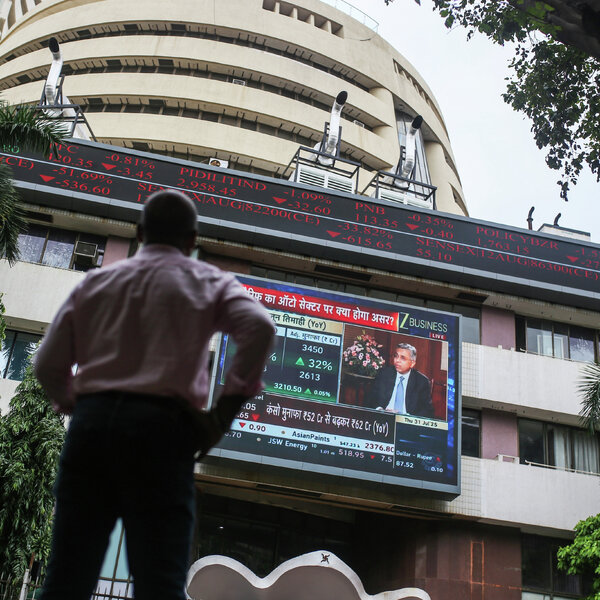
India’s retail-driven options trading boom during the pandemic, how it became the world’s biggest equity options market, why many retail traders lost heavily, and how SEBI responded with reforms while trying to balance market openness with speculation risk.
Savio Shetty, Bloomberg reporter covering India equity options in Mumbai; previously a derivatives trader himself.
Options are highly leveraged and complex; in India, low trading costs, easy online brokerage access, weekly index options, and pandemic-era retail participation created a “perfect storm.” Retail losses totaled over $33B (2022–2025) with about 9/10 individual traders losing. SEBI accused high-frequency firm Jane Street of index manipulation, temporarily banning it; SEBI estimated $4.3B net profits during the period.
option prices rising ~4,000% in under 30 minutes; SEBI tripling minimum contract size and reducing weekly expiries to one; volumes falling 30–40%; speculative flow shifting toward commodities like gold.
Written by AI. May contain mistakes.
Learn the fundamentals of options trading in simple terms.
“ChatGPT Work is a new way of working in ChatGPT that can take action across your apps and files, stay with a project for hours if needed, and turn a goal into finished work.”
Learn the fundamentals of options trading in simple terms.
“Today on the show, India's options trading frenzy.”
Explore the increase of retail traders in India's options market.
“You have this urge to become rich that suits, I think, the gambling instinct.”
Understand the risks associated with trading options in India.
“growing from fewer than 1 million in 2019 to nearly 10 million in just a few years.”
Examine the regulatory responses to India's trading market issues.
“There was no company saying that we've had a great quarter to update.”
Discover the changes in India's derivatives market after regulation.
“Some people treat ChatGPT like some kind of smart search engine and some use it to get work done.”
Learn how changes in regulations affected retail trading in India's options market.
“It also cut the number of index options that expire on a weekly basis to just one, making it harder for people to make frequent, highly leveraged bets.”
Explore how traders have adapted by moving to different markets following regulatory changes.
“another part of the market gets angry and says, what are you doing?”
Understand the psychological impact on retail investors after experiencing significant losses.
“And I think that is something that kind of comes back to me that beyond just moving numbers on the screen, there were dreams that were crushed.”

Get the gist, explore an idea or ask about something said.
 Claude
On Big Take, what are the key points of this episode?
Searching your listeningAutomatic transcript. May contain errors.
0:00Most meeting note takers get the easy words right and the important ones wrong. The client's name, the acronym, Whisperflow NoteTaker is built to get the hard words right. It takes notes on any meeting platform, Zoom, Google Meet, Teams, even WhatsApp calls, keeps every meeting searchable, and connects to Claude or Chat GPT so you can ask, what did we agree to last Tuesday? Free to try on Mac and Windows at whisperflow.ai. That's W-I-S-P-R flow dot A-I. Some people treat ChatGPT like some kind of smart search engine, and some use it to get work done. ChatGPT Work is a new way of working in ChatGPT that can take action across your apps and files, stay with a project for hours if needed, and turn a goal into finished work.
0:46It's designed to help you move from a chaotic starting point to a reviewable first version. So all the source materials, briefs, and scattered information that you have to grind through to turn into something useful can just become something useful. Put ChatGPT to work on your most ambitious ideas and projects. Get started at ChatGPT.com by selecting Work Mode, available on Plus and Pro plans. Wise is the smart way to manage the currencies you need around the globe. When you send money abroad using your bank, you could get hit with hidden fees and exchange rate markups. There's a better way. Try Wise.
1:22Wise uses the exchange rate you'd usually find on Google with no unwelcome surprises. Plus, most transfers happen in under 20 seconds, which means your money arrives in less time than you've been listening to me. It's simple and free to sign up when you download the Wise app. Be smart. Get wise. T's and C's apply.
1:44Bloomberg Audio Studios. Podcasts. Radio. News. At its very peak, how dominant did India become in global options trading? Oh, it was absolutely insane. There were products being introduced left, right and centre. Savio Shetty is a Bloomberg reporter covering India equity options in Mumbai. He tracks derivatives trading in India and was, for a time, a derivatives trader himself. I remember jokingly pointing this out in the actual interview. and I was told that, yes, yes, that is exactly what we are looking for. So I fit the bill. India is the world's biggest equity options market by trading volume.
2:27And during the pandemic, it experienced an unprecedented boom. Everyone thought, I'm the next Jim Simmons. I am the next Ray Dalio. I have multiplied my money 5x, 10x. With those retail investors came some of the world's most sophisticated trading firms, eager to cash in on a rapidly growing market. You had big Wall Street folks coming here and wanting a piece of the pie. And then the tide turned. Wall Street firms hire quant traders, billions of capital, lots of other things to make money. And here you had suddenly people who had no clue what an option was on Monday, trading them on Friday. Retail traders lost billions of dollars.
3:10That billion of dollars for a country that has a current account deficit, significant strain on its currency always. The fallout was swift. With losses mounting, India's markets regulator swept in with a host of reforms. But I think with the way things move in financial markets, there is always something new that will come up. If you have to ask where has the speculative flow gone, it's probably gone into commodities. This is the Big Take Asia from Bloomberg News. I'm Rebecca Chung-Wilkins in for one ha. Each week we take you inside some of the world's biggest and most powerful economies and the markets, tycoons and businesses that drive this ever-shifting region.
3:57Today on the show, India's options trading frenzy. Who got rich, who got burned, and why regulating this market is such a delicate balancing act.
4:17Savio, so tell me, as if you're speaking to probably not your grandmother, but my grandmother, in layman's terms, how does options trading actually work? First of all, I'll say hello, grandmother. It was nice to meet you. Bloomberg's Savio Shetty says it's impossible to understand India's options boom without first understanding how complicated options are to begin with. Derivatives have futures, they have options, they have forwards. Options are the most, I think, difficult to understand, which is why you will see a lot of financial engineers get into this. Savu and I started with the basics.
4:54If you take a particular sport, let's just take, for example, football. The equities trading or the trading is playing the football. Options is essentially betting on who's going to win that game. So it's a derivative based on an underlying product. That underlying product can be absolutely anything. It can be weather, equities. But at its very core, an options contract is a punt, is a risk, is a call on where do you think that asset is going to go. Whether Spain defeats Argentina 1-0, 2-0, 3-0. You can also play a draw if you think Spain and Argentina are not going to score. In the financial market, an option is simply putting money on where the price of something will go.
5:38Up, down, all the same. Trades also come with various layers involving timing, limits and expiration dates. You pay a small amount up front. If you're wrong, you lose the money. If you win, you can win a lot. It's a leveraged product. It's probably one of the most leveraged products that there is. We've had cases in India where option prices have risen 4 ,000 % in under 30 minutes. It's interesting because even for people who work in finance, this is a complex product. Trading firms on Wall Street have quants, they have specialised traders. So how did ordinary people in India get involved in this?
6:19I think it was the perfect storm, to be very honest. I think it's a storm right now. Indians have always shied away from the stock markets. But the population is getting younger. You have this urge to become rich that suits, I think, the gambling instinct. India has very low data prices. Reliance Jio, which is one of the world's largest telecom operator, was launched in 2016 at absolutely dirt cheap rates. So you have a lot of people being on the internet, browsing stuff, looking at stuff, brokers who have reduced fees for trading. To give you an example, Zerodha charges 20 rupees for one trade, which is probably 20 cents on the dollar.
7:06Finally, you had the pandemic. You had a lot of people suddenly sitting at home. Some of them worried about their jobs, what is going to happen, how are we going to have money, and then the ease of trading. India made it very easy to trade. A person who had never touched a financial instrument could open a brokerage account in under one day. And Savio says, unlike in the US, retail traders in India didn't need to put a certain amount of money in their brokerage account to trade. People could start trading with as little as$10. What made it more appealing to start dabbling in options versus all of the traditional products like stocks that are just much simpler to understand.
7:50I mean, how much does a stock rise in a day? Rises, what, 5%, 10 %? What do I make? That's nothing. An option can really rise because it's a leverage product. And the definition of leverage is I pay$1, but I get the leverage of$10,$20,$30. So if it moves up even by one more dollar, I make 20, 30x. As more ordinary people piled into the market, the number of retail traders exploded, growing from fewer than 1 million in 2019 to nearly 10 million in just a few years. India's exchanges like the NSE and BSE added to the frenzy by rolling out weekly options contracts on different indexes. These gave traders a fresh chance to bet on the market every day of the week.
8:35It was a casino. One day I'm going to casino one, on Tuesday I'm going to casino two, casino three, casino four, casino five. By the number of contracts traded, India became the world's biggest derivatives market. The bets on options grew far bigger than the underlying stocks themselves, and to a greater degree than in other markets. Why does it matter? Why is it a worry if the derivatives market suddenly starts to dwarf the underlying assets? I think the plain answer to that is that a lot of people who don't understand what they're getting into lose money. and that money can enter far more stable assets, long-term growth, not only equities.
9:17I mean, there are cases in options where people have lost fortunes in half an hour. These are contracts where if you don't get to your target within a certain period of time, you will lose money. So you not only have to get the direction right, you also have to get the timing right. By 2023, India's markets regulator, the Securities and Exchange Board of India, or SEBI, found that roughly 9 out of 10 individual traders were losing money. More than$33 billion were wiped out between 2022 and 2025. And the ones making money? Professional, high-frequency trading firms. An HFT is essentially someone who buys and sells not in minutes, not in seconds, probably in milliseconds.
10:00One HFT firm in particular caught the attention of regulators, Jane Street, a quantitative trading firm in New York. Jane Street was essentially accused by the Indian regulator of trying to manipulate the index and make money. Markets in India start at 9.15. Suddenly, at say 10.11, the market would collapse or it would rise. And there was no underlying cause to explain this movement. There was no government official speaking. There was no company saying that we've had a great quarter to update. This happened twice. So I think people started realising that we have a haunted house here. We need to find who the ghost is.
10:39SEBI accused Jane Street of index manipulation and temporarily banned it from operating in India. It estimates that Jane Street made$4.3 billion in net profits during that period. Jane Street, for its part, denies any wrongdoing and has appealed the case. SEBI also rolled out new restrictions on options trading in an attempt to protect retail investors. The regulator cannot force you to not trade. It can't say, please don't trade. It has to keep a free or fair open market. What it can do is that the door to the party was made of plastic and people would just come in. Now it decided to put an iron door, put a couple of more locks, make it a little more difficult to come.
11:21Jane Street and Sebi didn't respond to Savio's request for comment on his reporting on what happened in the options market. But when one door closes, another opens. After the break, the new way India's retail traders are trying to strike it rich and how regulators are scrambling to keep up.
12:01is the typos and the result sounds like you wrote it four times faster than typing. So the email that used to take two minutes now takes 30 seconds. Whisperflow is free. Download it at whisperflow.ai. That's W-I-S-P-R flow dot A-I. Some people treat ChatGPT like some kind of smart search engine and some use it to get work done. ChatGPT work is a new way of working in ChatGPT that can take action across your apps and files, stay with a project for hours if needed, and turn a goal into finished work. It's designed to help you move from a chaotic starting point to a reviewable first version. So all the source materials, briefs, and scattered information that you have to grind through to turn into something useful can just become something useful.
12:47Put ChatGPT to work on your most ambitious ideas and projects. Get started at chatgpt.com by selecting Work Mode, available on Plus and Pro plans. Running a small business takes everything you've got. But with Chase for Business, you're not alone. They bring together local support and a broad range of resources to more than 7 million customers. With a deep understanding of your day-to-day needs, they provide products and guidance built to help you thrive. Right now, earn$500 when you open a new Chase Business Complete Checking account for new business checking customers with qualifying activities.
13:21Offer expires January 21st, 2027. Chase Business Complete Checking has the flexible tools you need to accept payments, make deposits, and manage your finances with confidence. Learn more at chase.com slash podcast biz offer. Chase, make more of what's yours. Fees may apply to Chase Business Complete Checking Accounts. The$500 offer is available for new business checking accounts with qualifying activities through 1-21-2027. Eligibility and qualification requirements must be met. Additional restrictions may apply. Please speak with a business banker for more information. JPMorgan Chase Bank, NA.
13:56Member FDIC.
14:05When India's markets regulator SEBI tightened the rules around short-term speculative trading in 2024, it roughly tripled the minimum size of an options contract, meaning it cost retail investors far more to get in on the action. It also cut the number of index options that expire on a weekly basis to just one, making it harder for people to make frequent, highly leveraged bets. And it has helped. Volumes have fallen by 30-40%. But I think the regulator has, to be very honest, been accused at times of throwing the baby out with the bathwater. So the 10 % who made money were like, dude, we were making money.
14:44Why did you stop this? So what does the market look like now? India is still the world's largest derivative market. I don't think we are going back to the heydays of India's derivatives boom ever again. Markets have changed. Brokers have lost, obviously, trading revenue. Exchange has definitely lost revenue. The world's largest derivative exchange, which is the National Stock Exchange, just recently got listed. And there was a cut in their asking price because I think investors realized that the heydays may probably be off. India is still a growing market. But I think those heydays are gone. Regulators wanted retail investors to redirect their finances into safer products.
15:27But is that actually happening? Now, most traders have moved to other parts of the market. So there is the commodities market. India has this deep affiliation to gold. The largest listed commodity exchange in India is the multi-commodity exchange MCX and it's seen its share price rally significantly because volumes have increased. Of course it also has to do with gold's rally and what is happening globally with that. I know most of the traders who've made some money in the markets. They've increased their time horizon. They've gone into ETFs interestingly. So maybe that is another avenue that could probably see some kind of enhanced trading.
16:08So there is talk of having longer dated options. They are essentially called leaps, where at least you're not going to get song to the moment or lose money the moment you enter it. So I think the regulator is doing its part. But from an Indian perspective, there are not a lot of asset classes to put money in. And it does underscore this dilemma, I think, that regulators were trying to get out with this issue over the options risk, which is they want a robust market and they want a deep market that's maturing, but they don't want it to become speculative or too speculative. So what is the challenge there?
16:43Can regulators actually figure out that balance? I think it's difficult. I think we sometimes don't give regulators enough credit on how complicated it gets. Because when they try and take care of one part of the market, another part of the market gets angry and says, what are you doing? It's not easy. There are certain ideas that the regulator has been provided with. One of them is to have something like South Korea has, which is like an examination where you first learn about these products some number of hours before you start trading complex derivative products. Then there is a minimum net worth that Rebecca has to be worth X, Y, Z dollars before she puts money.
17:31If there are signs that the commodities derivatives market is heating up, are there any guardrails to prevent history repeating itself? It seems very clear from SEBI's approach that it wants the commodity market to grow. If it wants it to grow, it will be highly unlikely that they're going to put strong guardrails right now. The question to ask then is, what are the chances that equities repeat here? So I think one of the reasons why equity saw the kind of boom they did was because of the weekly options. Those options don't exist on the commodity side. So it's quite unlikely that you'll see the same fervor or the same scope and size that we saw in equity options.
18:17unless, of course, exchanges introduce these kind of contracts, like a weekly gold contract or a weekly, you know, crude oil contract, which I think is highly unlikely, given that commodities are far more volatile than equities. Savio, what is the lesson here? I think it depends on who you ask what the lesson is. If you ask the person who burned his entire savings, it would be probably not jump on every fad that comes in there is nothing called get rich quick i think for regulators it is probably very easy to blame and say you know you should have looked at these products before how can you do this how can you do that but india was accused of being closed for a very long time for not having this so you have to balance that but i think the The overlying part here is that Indians retail traders lost billions of dollars.
19:18We've had people who've taken debts for five years, 10 years, moneylenders calling them weddings of sons and daughters being pushed forward, maybe not even happening. And I think that is something that kind of comes back to me that beyond just moving numbers on the screen, there were dreams that were crushed. there were a lot of things that probably went wrong. When you get these big moments, these sort of boom and bust cycles, it does sometimes leave a scar on the population and it can make them hesitant to invest again. I'm curious, sort of big picture, do you think this has left any kind of aftermath sort of psychologically on the retail investor?
20:02Absolutely has. I have no doubt that it has. but I think with the way things move in in financial markets there is always something new that someone will manufacture maybe the regulators lose and regulations a bit here and there and you will always have that so I don't think the boom and bust cycle will ever ever you know stop the aftermath will be that derivatives as Warren Buffett had once called them are weapons of mass destruction. If you do not know what they are, it will blast and it will leave a crater. And as with most craters, they don't get filled with over time, they might become a bit less visible, but they still exist.
20:50This is the Big Take Asia from Bloomberg News. I'm Rebecca Chung Wilkins. To get more from the Big Take and unlimited access to all of Bloomberg.com, subscribe today at bloomberg.com slash podcast offer. If you like the episode, make sure to subscribe and review The Big Take Asia wherever you listen to podcasts. It helps people find the show. Thanks for listening. See you next time.
21:29notes, prompts to chat GPT. Whisperflow is a voice to text app. Instead of typing, you talk and it types for you in any app on your Mac, Windows, iPhone, or Android. It takes out the ums, fixes the typos, and the result sounds like you wrote it four times faster than typing. So the email that used to take two minutes now takes 30 seconds. Whisperflow is free. Download it at whisperflow.ai. That's W-I-S-P-R flow dot A-I. If you listen to financial news, you know a lot of time to spend thinking about what's next. The next opportunity. The next investment. The next move. But sometimes what matters most is being ready for what you never saw coming.
22:09For more than 75 years, Cincinnati Insurance has worked with independent agents to help protect businesses, homes, valuables, and more. Because planning for the future isn't only about knowing what's next. It's about making sure you're ready for what you can't predict. Let Cincinnati Insurance make your bad day better. Find an independent agent at CINFIN.com. For big business, AI opened up a world of promise, but that world of promise turned into a world of pain. Cost spiraling, data trapped, security and governance risks multiplying, and ROI out of reach. That's why enterprises turned to Boomi to connect data, apps, and AI, helping them operate securely, efficiently, and at scale.
22:53Boomi turns a world of AI pain into a world of AI gain. As Boomi says, we got you. Head to boomi.com. That's B-O-O-M-I dot com.
When millions of retail investors piled into India’s options market to get rich quick, losses mounted and regulators launched a sweeping crackdown.
On today’s Big Take Asia podcast, guest host Rebecca Choong Wilkins and India equities reporter Savio Shetty break down how the world’s largest options market unraveled, why regulators are struggling to police the country’s latest craze and where traders are placing their bets now.
Read more: How India Built (and Broke) the World’s Biggest Options Casino
Further listening: Inside Jane Street: The Enigmatic Firm That Rules Wall Street
Watch, from Originals: How India's Day Retail Traders Lost Billions
Host: Rebecca Choong Wilkins; Guest: Savio Shetty; Produced by Naomi Ng and Yang Yang; Edited by Crispina Robert and Julia Weaver. Engineering by Sean Carter II.
See omnystudio.com/listener for privacy information.