Ask ChatGPT
 Big Take
9 Nov 2026 · 20m · 7 chapters
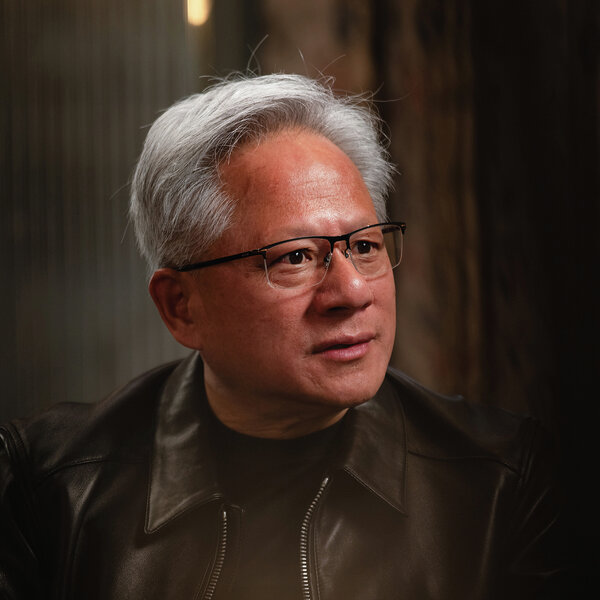
Jensen Huang’s admitted affair with a woman suspected of being a Chinese spy, and how it could affect NVIDIA’s dominance in the AI chip supply chain, U.S.-China relations, export controls, and the broader AI economy.
Sarah Fryer, Bloomberg Big Tech editor; Mike Shepard, Bloomberg tech policy editor. Both discuss the scandal’s implications for policy, markets, and national security.
Huang is portrayed as central to NVIDIA’s strategy and Washington ties, with no clear succession plan. U.S. intelligence worries include possible information gathering or influence, and whether devices were compromised. NVIDIA says it has no reason to believe secrets were compromised and that Megaspeed’s offshore chip rental is legal under export rules.
Megaspeed International (launched 2023) as NVIDIA’s major Southeast Asia buyer; U.S. investigation into possible chip diversion to China; Trump’s defense of Huang and potential APEC/Xi meeting; market uncertainty after AI stock selloffs and upcoming Anthropic IPO.
Written by AI. May contain mistakes.
Exploration of the affair involving Jensen Wong and its potential effects on NVIDIA.
“Today on the show, the CEO and the suspected spy.”
Discussion on NVIDIA's operations and potential risks following the scandal.
“They have tried to play it down, but we're seeing things from a far different perspective today.”
Analysis of how the scandal affects Jensen Wong's influence in the AI sector.
“The problem maybe is that NVIDIA is so dominant that there really aren't a lot of alternatives.”
Examine the implications of the NVIDIA scandal on U.S.-China relations.
“And maybe people wouldn't even want him to be the one saying that anymore, given that he has shown to have lied about this affair.”
Exploring the implications of NVIDIA's CEO scandal on U.S.-China relations.
“Mike, looking ahead, I am curious what this means for U.S.-China relations.”
Discussion on how NVIDIA's challenges impact investor confidence and the AI market.
“It was just last week that we were thinking, oh, do we think NVIDIA is going to sweep in and save this company or maybe they'll sweep in and save that company?”
Analyzing the critical juncture for the AI industry amidst political and financial pressures.
“Things have bounced back a bit since then, but what are you expecting for the week ahead?”

Get the gist, explore an idea or ask about something said.
 Claude
On Big Take, what are the key points of this episode?
Searching your listeningAutomatic transcript. May contain errors.
0:00When you own your own business, you own every decision. Catch the red eye or take the 6 a.m. Make a new hire or promote internally. Celebrate a win with the toast at the gate or unwind at the lounge. Big props to this team. Some decisions are a win-win, like earning eight times points on Chase Travel. Chase Sapphire Reserve for Business, the business card that gives back all you put in. Visit chase.com slash reserve business to learn more. Cards issued by JPMorgan Chase Bank, any member of DIC, subject to credit approval. Terms apply. When you're a business owner interested in expanding to new markets, there's a lot to consider and countless questions to answer before making the call.
0:38The most important one being, are you ready? That's where ChachiPT comes in. Give it a goal, add your files, and ask chat to help you map out different scenarios for the future of your business. So when growth is on the table, you've got an expansion plan ready to implement. Get started at ChachiPT.com. Bloomberg Audio Studios Podcasts Radio News This is like something out of a soapy TV show. It really is. And it's something that came out of nowhere and really could not have come at a worse time for this moment that we're in with the artificial intelligence boom considering all the pressure it's under.
1:21Chen Sen Wang is probably the person responsible for the AI boom. If you could pin it on any one person, like he is at the center of it all. He is the hype man. He is the financier. He is building the chips that go into these data centers and has really driven this moment in our economy. And without him, what would it look like? I don't think anyone has a good answer.
1:56I'm Sarah Holder, and this is The Big Take from Bloomberg News. Today on the show, the CEO and the suspected spy. Bloomberg Big Tech editor Sarah Fryer and tech policy editor Mike Shepard on what Jensen Wang's affair means for the future of NVIDIA, the U.S.-China relationship, and the AI boom.
2:21On Sunday, Jensen Wong, the CEO of the chipmaker NVIDIA, admitted to having an affair with a woman who's a suspected Chinese spy. Her name is Alice Wong. They're not related. But Mike, what do we know about her and about Megaspeed International, this company that she's associated with, which is the largest buyer of NVIDIA's chips in Southeast Asia? Well, we actually don't know that much about Alice Wong. She was, prior to all this, a broadcaster. She worked in television in China and then moved over into business with this gaming company known as Seven Road and then somehow worked her way into converting a portion of that company into what's called a NeoCloud.
3:08And that is a company that specializes in hosting data center operations for AI developers. And they need to buy a lot of chips to be able to do what they do. But she hasn't really responded to requests for comment. And Megaspeed also is a relatively new venture. She helped to launch it back in 2023. But they quickly became one of NVIDIA's biggest customers in Southeast Asia, buying billions of dollars of the company's AI chips. And the question is, what were they doing with those chips? And the company said that, look, everything was legal and above board. Housing those chips outside China and allowing Chinese companies to use them and rent the computing space offshore is legal under U.S.
3:55export controls. But if any of those chips were diverted to China, that would be a problem and a violation. And that has been the subject of a U.S. investigation that we've reported on over the past year. And there hasn't really been a conclusion to that. But just laying it all together, the U.S. inquiry, her relationship with Jensen Wong, it really casts a lot of NVIDIA's comments about the ties between not only the two executives, but between the two companies in a whole new light. They have tried to play it down, but we're seeing things from a far different perspective today. As you mentioned, Mike, Bloomberg previously reported that the U.S.
4:37government was investigating both Megaspeed's ownership structure and this question of whether it was smuggling NVIDIA chips to China. What has NVIDIA said about its relationship with Megaspeed, you know, perhaps before these new allegations of the affair surfaced and these specific concerns that the U.S. government had raised? It's tried to characterize its dealings with Megaspeed as being perfectly normal and within the confines of U.S. export controls. And in fact, they've told us that, look, you can't wish new export controls just because you don't like that China is able to rent computing space offshore unless that is prohibited.
5:16You know, it's fair game for business. So renting is OK. Renting offshore is OK. diverting or selling directly is not. That's correct. And in its statement from the weekend, NVIDIA's board said it has no reason to believe that either national security or NVIDIA secrets were compromised. But why are U.S. intelligence officials concerned about Jensen Wong's relationship with Alice Wong? Was this about influence or information gathering, or is it not yet clear? It's unclear, but those are the things that they would be looking at. What sort of information was Alice Wong able to glean from Jensen Wong in those private moments?
5:58Remember, Jensen has forged this close relationship with President Donald Trump and other senior members of the administration. And he may be privy to certain private conversations, and perhaps he divulged those. There's also the question of, you know, were his devices, his mobile phone and other computing equipment, were they secure in her presence? And was she somehow able to steer things a certain way with him? And what has the Chinese government said about these allegations? They have pushed back very hard against this. They've called this a baseless smear campaign as recently as overnight, early Monday morning following Jensen Wang's admission of the affair and all the days of reporting on the relationship between the two.
6:46Sarah, this scandal is calling attention not only to Huang's activities, but to the huge amount of control he really exerts at NVIDIA. He reportedly has something like 60 direct reports, and the company doesn't have a clear succession plan in place for him. Can you tell me a little bit more about how Huang runs NVIDIA and how the scandal could complicate things at the company? NVIDIA is known for having a grueling top-down work culture where it really is a cult of Wong. Like, is it his decree? Okay, then we need to get it done quickly. And he really has not set up NVIDIA with any sort of number two.
7:27If you look through the ranks, there's nobody who is a replacement for what he does, which so much of it is his own personal relationships, his own ideas about how things should go. And he's been open about that. I think he thinks that he's the only person that can do this. And so he didn't set up the company in such a way that anybody else would be able to. And that is very risky given that it's not just about NVIDIA. There's a whole host of companies, including very large ones in the AI boom, that are reliant on NVIDIA's money, chips, deal banking, relationships in Washington, all these things from NVIDIA's CEO.
8:14And so if there is even a slowdown or a question mark around whether NVIDIA will be able to deliver on its promises given this ongoing investigation, if companies try to distance themselves from doing deals with NVIDIA and try to get chips from elsewhere, it could have a really interesting reshaping of the market. The problem maybe is that NVIDIA is so dominant that there really aren't a lot of alternatives. There aren't a lot of alternatives to NVIDIA's chips and there aren't a lot of alternatives to dealing with the man himself. The man himself, Jensen Wong, has also been a strong voice arguing the AI industry doesn't need more regulation, that the industry doesn't need to slow down the development of frontier models.
9:02And he's also argued that the U.S. should consider allowing NVIDIA to sell more of its advanced chips to China. And I wonder if this kind of impacts his ability to be an advocate for any of these kinds of positions. He definitely was like the number one voice of the China doves. He was really he was he was out there saying, like, you need to let China use NVIDIA's chips. Otherwise, they're going to develop their own. and then they have a chance of beating us in the AI race. So I think he was just such a strong proponent. If he was a sort of lone voice trying to say that everything's fine, that voice has just become a lot less credible.
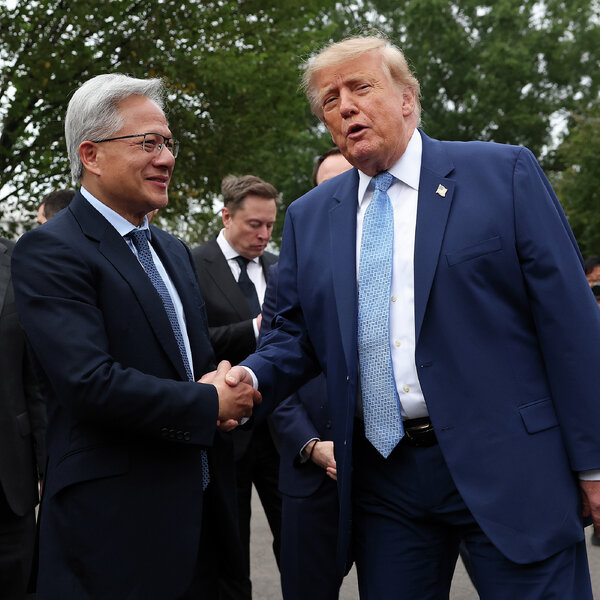
9:49And maybe people wouldn't even want him to be the one saying that anymore, given that he has shown to have lied about this affair. Hmm. President Trump also defended Huang on Sunday and said essentially he should stay on as CEO. How much influence might Trump have on whatever comes next, Mike? Well, his influence over his administration is significant and more so than in past administrations where presidents really would leave it to their subordinates and cabinet members to make difficult decisions and choices and then have it presented to the commander in chief. The president in this case really does take a top-down approach and a very interpersonal one as well.
10:37And he has formed this bond with Jensen Wang over the past nearly two years. Jensen has accompanied the president to the Middle East, to the U.K., and even to China on global trips. And he has been a regular, a real fixture, Sarah, at all of these White House events on artificial intelligence, where the president has named Jensen in the audience and, where's Jensen? Is Jensen here? And then singled him out for praise for being such a leader in the space of artificial intelligence. And remember, the president is depending on the AI boom as a centerpiece of his economic agenda. And if you look at the role that the infrastructure buildout has had in GDP growth, it's really pivotal.
11:22And if you take that away, you really see, you know, a much softer version of the economy. And the president and his advisors are also aware of that as well.
11:37Coming up, how the scandal may impact U.S.-China relations and the AI trade.
11:48This is the Bloomberg Tech Minute brought to you by Chachi PT. I'm Carol Masser. Chinese automakers have become famous for turning cars into rolling smartphones decked out with large touchscreens and flashy software. Now they're going back to design basics, touting the return of buttons and knobs. The reintroduction of physical controls coincides with a broader push by Chinese regulators to overhaul the EV industry's potentially harmful design choices. China's Ministry of Industry and Information Technology proposed updated national vehicle standards that specify certain functions, like those that control headlights or change gears, should be physical rather than digital.
12:26While door handles have been the most high-profile change resulting in millions of cars being recalled, screens have also drawn scrutiny because they can pose a safety risk should they lose power or brake. The trend of adding physical controls is not limited to China, with Mercedes-Benz Group also introducing buttons in its new models. That's the Bloomberg Tech Minute brought to you by ChachiPT. Get started at ChachiPT.com. This is the Bloomberg Market Minute brought to you by Comcast Business. The markets faced plenty of challenges this year. Rising energy costs, higher interest rates, pushback to massive artificial intelligence spending.
13:04But through it all, stocks keep breaking records. And some analysts think they still can with a focus on the fundamentals. Nadia Lovell is head of global equity strategy at UBS. Earnings has been good and continues to be good. And while, you know, we might be past the peak in earnings growth, we're not past the peak in earnings level. But others like Miller-Tabak strategist Matt Maley say those challenges could eventually lead to a downturn. Whenever we see a significant rise in bond yields like we have and a significant rise in oil prices like we have, The stock market always or pretty much always ignores it for a while.
13:38And Wall Street may be starting to take notice. A recent Citigroup index shows more analysts cut rather than raise their earnings forecasts for corporate America for the first time in more than five months. That was the Bloomberg Market Minute brought to you by Comcast Business, one partner powering 90 percent of the Fortune 500 and millions of small businesses. When you add it all up, no one does business like Comcast Business.
14:10Mike, looking ahead, I am curious what this means for U.S.-China relations. President Trump is expected to attend an APEC summit in China next week and meet with Chinese President Xi Jinping. Jensen Wang traveled with the president to China back in May. And on Sunday, reporters asked the president whether he'd take Wang with him again. Mr. President, is he going to go with you on your trip to Asia next week? I don't know, but I'd certainly take him. I mean, we'd have to find. I haven't heard he's done anything wrong. He dealt with somebody, but, you know, so does everybody else. China and the U.S., of course, have had tensions over access to advanced chips in the past.
14:49So, Mike, how could this scandal at NVIDIA affect the conversation that Trump potentially has at that meeting and the relationship between the two countries moving forward? Well, one of the things, Sarah, we'll have to watch out for is if there is any sort of reprisal by the U.S. against China over this. I mean, if you step back and think about it, one of the U.S. top geopolitical rivals is targeting the CEO of a company that is foundationally important to the AI boom here in the U.S. that for long stretches has been the most valuable company in the world by market capitalization and somebody who is just such a fixture and so close to the president.
15:29And it's hard to imagine that the U.S. would not bring this up in some really sternly worded fashion with China and its leaders. But it's unclear what sorts of consequences may emerge. And remember that the trade truce that the two sides had agreed to just weeks ago, it seems, during the summit in Washington between Xi Jinping and Donald Trump, that only lasts until January 10th. So this will be an irritant and a complication to talks about extending it. Really, the quid pro quo in it really involved the U.S. holding off on penalties, including tariffs on Chinese goods, so that China would continue to allow the flow of rare earths to U.S.
16:13companies. Sarah, these revelations are arriving at a very fragile time for the AI industry. Already, investors were jittery about AI companies' spending and debt. Then we saw this big sell-off of AI stocks late last week after the U.S. midterms where Democrats won control of both chambers of Congress. Now there's a scandal at one of, if not the most foundational companies in the AI infrastructure space. Is this an NVIDIA problem or could this become a problem for the whole industry? And how soon? It was just last week that we were thinking, oh, do we think NVIDIA is going to sweep in and save this company or maybe they'll sweep in and save that company?
16:54I mean, that was the role that they played in the industry is making sure that they could seed the companies that they wanted to see succeed with capital, with resources, with chips. So I think that is so critical to the flow of money without NVIDIA's backing, without Jensen Huang's support. Do things happen more slowly? Does the AI trade get more complicated? Do some of these companies that you need money now have trouble getting it in this environment? So I think that it is a really serious problem for the industry, especially if it drags on with a lot of uncertainty about what is safe to work with NVIDIA on.
17:43Yeah, is this a new opening for NVIDIA's competitors here? It may be. If you were thinking about diversifying away from NVIDIA's chips, this may be a factor in your decision to do it sooner. As of this taping at about noon Eastern, NVIDIA shares were down around 6%. That is significant, but I am wondering how to read that. Is it actually a sign that markets think NVIDIA will be able to get through this without removing Huang? Would you expect that reaction to have been bigger, Mike? You know, there have been reports in the past, and we've covered all of these episodes, where CEOs have had indiscretions and relationships with subordinates and others that have really roiled those companies.
18:30But this is at a different level where the person in question involved with the CEO is also suspected of acting on behalf of an adversary's intelligence agency. So for investors, it is just a question that they don't even have the answers to right now. And it's going to depend largely on the outcomes of the investigations, not only by the board, but by whatever U.S. law enforcement and intelligence and congressional investigations and inquiries turn up additionally about the relationship between the company and Megaspeed and also about Jensen Wong and Alice Wong. So much of the AI industry and the growth of the AI industry is pinned on hypotheticals, on uncertainty.
19:15And the way that the market has priced it in over the last few years, it includes a lot of the hope that AI will be a dramatic success. And I think that this incident adds just this extra layer of uncertainty to the future of the industry at a time when... there were already cracks beginning to form, already a lot of uncertainty bubbling. Just to get a temperature check on the broader market, Sarah, you've been alluding to some of the broader headwinds for AI right now and how this scandal at NVIDIA might affect them. Last week was obviously a total bloodbath. On Thursday,$2.3 trillion of value was erased from the NASDAQ 100 in just one day.
20:01Things have bounced back a bit since then, but what are you expecting for the week ahead? I think a lot of the market sentiment is going to hinge on Anthropic and how they plan to go forward with their IPO and whether there's a lot of demand for that offering. So I think that that will maybe be as big of an event for the markets as the midterms. I think maybe even more financially important just how people see that because it'll trickle down to the rest of the industry. Usually companies try to go public before the Thanksgiving holiday because the markets are considered less receptive to an IPO during the holidays.
20:49So if that goes to plan, I think that that will be seen as a positive sign. If that IPO is delayed or dramatically reduced in its ambitions or anything along those lines, I think then that would be taken as a negative sign. Mike, help put this all together for us. There's uncertainty around NVIDIA and Jensen Huang's future, sell-off in AI stocks, a different political landscape coming in Washington. Are we looking at a critical inflection point for the AI trade? You know, a year from now, we may really look back at this moment, not just as one moment with Jensen Wong, but a series of moments that really maybe burst the bubble a little bit on the hope that Sarah was just talking about.
21:41Everybody is pinned so much on this idea of AI as a generational transformational technology that, you know, is ushering in a new industrial revolution to use Jensen Wong's own words. And we may reflect on this moment as when, you know, a little bit more of reality set in. And that's because at the local level, we're seeing pushback to the data centers that are so critical to powering this technology. We're seeing doubts even among investors about the health and viability of the financing of the AI trade. And now we're seeing politically the pushback, too, against some of the positions taken by companies like NVIDIA trying to defend their own interests, but whether those interests really align with those of the U .S.
22:30And the pressure will come not only from here in Washington, but at statehouses across the country and also in the markets as well.
23:00It helps people find the show. Thanks for listening. We'll be back tomorrow.
23:30Connects to Claude or Chat GPT, so you can ask, what did we agree to last Tuesday? Free to try on Mac and Windows at whisperflow.ai. That's W-I-S-P-R flow dot A-I. Wise is the smart way to manage the currencies you need around the globe. When you send money abroad using your bank, you could get hit with hidden fees and exchange rate markups. There's a better way. Try Wise. Wise uses the exchange rate you'd usually find on Google, with no unwelcome surprises. Plus, most transfers happen in under 20 seconds, which means your money arrives in less time than you've been listening to me. It's simple and free to sign up when you download the WISE app.
24:07Be smart. Get wise. T's and C's apply. This is Robert Smith from Business History. If you're listening to this, there's a good chance you're a small business owner. And like every small business owner, you started with a dream to do what you love and watch it grow. What you probably didn't dream about? Keeping up with cyber threats. That's where MasterCard can help, with access to tools that help identify cyber threats to better protect your business. Building your dream business? Priceless. For cybersecurity in a changing world, there's MasterCard. Learn more at MasterCard.com slash smallbusiness.
Nvidia CEO Jensen Huang is at the center of the circular AI economy — and news of his extra-marital affair with an alleged Chinese spy has hammered Nvidia’s stock and threatened to roil markets.
On today’s Big Take podcast, host Sarah Holder is joined by Sarah Frier, managing editor for big tech, AI and startups, and tech policy editor Michael Shepard to discuss how Nvidia, the AI sector and the US government are navigating the scandal, its fallout and the investigations ahead.
Read more:
Nvidia Scandal Creates Risks for Whole AI Industry, Not Just CEO
We have a special Bloomberg subscription offer for podcast listeners at Bloomberg.com/podcastoffer.
Host: Sarah Holder; Guests: Sarah Frier and Michael Shepard; Produced by David Fox; Edited by Tracey Samuelson; Engineering by Emma Munger
See omnystudio.com/listener for privacy information.