
 Brand Growth Heroes
18 Jun 2025 · 53m

 Add vo to ChatGPT or Claude to ask about everything you hear
vo listened to this episode to put together the overview and transcript, so there may be the odd mistake.
How Small (a D2C sustainable laundry/dishwashing brand) uses a Chief Growth Officer (Neil Campbell) and Chief Marketing Officer (Hilary Strong) to scale from early challenger growth to structured, data-led growth. They cover audience definition, KPIs, subscription retention, experimentation, and the D2C vs retail decision while expanding internationally.
Neil Campbell, CGO at Small; e-commerce background including Naked Wines and Amazon; 25 years industry experience; focuses on customer lifetime value, acquisition economics, experimentation, and data. Hilary Strong, CMO at Small; 11 years at Unilever plus agency experience; leads consumer insight, brand positioning, messaging, and “what’s acceptable” for campaigns.
Sustainability must be mainstream-price and convenient; D2C enables direct customer feedback and lower guesswork; CMO sets the “playground” (tone, emotional cues), CGO adds data-driven detail within it; success is measured by awareness/consideration (CMO) and LTV vs CAC (CGO); email should be triggered/engagement-based, not broadcast.
Small launched in 2018; targets 30–50 family households; over a million households tried Small; ~£44M sales forecast; bundle pricing experiments to attract high-LTV subscribers; reading 500+ customer emails/day personally; customers travel to meet Small in person; impact steering group with CEO/investor/Hygiene Bank.
0:00We're kind of in a world now where we're probably on for about sort of 44 million in sales this year. And then we're just on a constant expansion drive, both within the UK where we're adding more products and deepening our services, but also in France and Germany where we're expanding internationally as well. Hilary decides the kind of broad canvas of who are the customers that we're going after, what sort of language and emotional cues are going to resonate. And that gives me what I would call a playground. and this playground's got fences. There's things I shouldn't do and there's things that I, you know, if I knock up against it, Hillary will tell me off.
0:35Fiona Fitz: Did you ever wonder what a chief growth officer actually does or why a company might need both a chief growth officer and a chief marketing officer? I've been in the industry for 25 years and believe it or not, these roles are relatively new, borrowed from the worlds of tech and e-commerce pure plays. So I decided it was high time to investigate. What exactly does a chief growth officer do and how do they work alongside a chief marketing officer in a high growth brand? To find out, I called up the best CGO I know, my old pal Neil Campbell, whose e-commerce CV includes Naked Wines and Amazon and who is now chief growth officer at Small.
1:10Fiona Fitz: I asked him to invite his CMO, Hilary Strong, so we could really break it down. What's the difference between these two roles? How do they work together in a high growth brand? What does best practice look like when scaling a D2C brand? And trust me, this is not just theory. Small is a pioneering D2C sustainable cleaning brand that has reshaped the industry in the UK, making switching to sustainable cleaning effortless and risk-free. We get into how Small builds an obsessively loyal customer base where people literally travel across the country just to meet the brand in person. We ask the big question that every D2C scaling brand faces, do you stay D2C focused or do you expand into retail?
1:49Fiona Fitz: And finally, the step change from organic growth to structured, more scalable growth, what really moves the needle beyond just doing marketing? If you're a scaling consumer brand, this episode is basically a cheat sheet for building the D2C side the right way. Let's dive in.
2:07Fiona Fitz: Hilary Strong and Neil Campbell from Small Laundry Detergent, welcome to Brand Growth Heroes. Hey Fiona. Hi Fiona. Thank you for having us. You're so welcome. So look, as I was saying in the intro, I really wanted to get you guys on because I know Neil for years, obviously, Small is one of those brands that we all look at and think, wow, how are they doing that? And you two work together as chief growth officer, chief marketing officer. And I wanted to give our listeners the opportunity to understand how those two roles can work together at a really big level compared to lots of us who are still scaling our businesses at an earlier stage.
2:44Fiona Fitz: So first of all, tell us about Small. tell our listeners, you know, what it is, where they can find it, how they use it, who buys it. And then later on, we'll get into how you guys work together and pick apart how a growth officer and a chief marketing officer work together. Hilary, do you want to kick it off or Neil, anyone? Yeah, well, I'll start and yeah, Neil, you chip in. So brief, plodded history of Small, launched in 2018. We were really like the first big challenger brand in the laundry and dishwash market. So if you think laundry has always been dominated by big brands, so Unilever, Procter & Gamble, Essie Johnson, but laundry is one of those things everybody has to do.
3:22We all have to have clean clothes.
3:31Fiona Fitz: Welcome to Brand Growth Heroes, the leading podcast for the founders of Challenger grocery brands. I'm your host, Fiona Fitz. My 25 years at global giants such as Nestle and challenger brands such as Goo Chocolate Puds, Chobani and Strong Roots, as well as coached over 400 scaling brands, means I have the experience to ask the questions that truly matter and get you the insight that will inspire you to think differently and drive serious growth for your brand.
4:01So Small launched in 2018 with the ambition of really just shaking up a really traditional industry, looking at all the things we felt the big brands weren't doing very well and scooping all of that up into something that just felt like a really fresh proposition for customers.
4:18Fiona Fitz: But it was started by two people who were in Unilever, right? Originally. Yeah, exactly. So Nick Green, Paula Kwasi, they're our two co-founders. So they launched the business in 2018. They had both met at Unilever, but had left many years ago and both gone off and done different things, both doing different e-commerce projects and then came back together to set up small. This is, you know, probably a story for another day and maybe a story for another podcast because we don't go massively into the backstories of founders on this show because there's loads of podcasts that do that really well.
4:47Fiona Fitz: Just to give a bit of context to our listeners, were they disheartened with the laundry market as they knew it? I mean, what was it from a kind of a sustainability or a personal passion that they designed and launched small? I think it was both of them have families, both of them have kids. And I think both of them, like I said looked at this category of just going this is really dull like everybody has to buy laundry detergent but when you walk down the aisle and I'm thinking back like now to 2016 2017 when they were forming the business and the idea you know that is a really boring aisle it's like full of great big plastic bottles and boxes quite big shouty brands and I think they just felt like it was ripe for something better and when you look at how small was launched originally back in 2018 it really was set out to tackle all of those things.
5:37So don't go to a supermarket. Don't lug a big bottle home. Why not have a super concentrated capsule that is delivered to your door? You order it online. You tell us how often you run your machine and we will do the work of working out how often you need a pack delivered. So you never have too much and you never run out. So really trying to take something off your agenda. Very much so. Yeah. Just like one less thing to worry about. We will sort this for you. We will give you a great product. It will arrive when you need it. And you are never going to have to go down that aisle ever again.
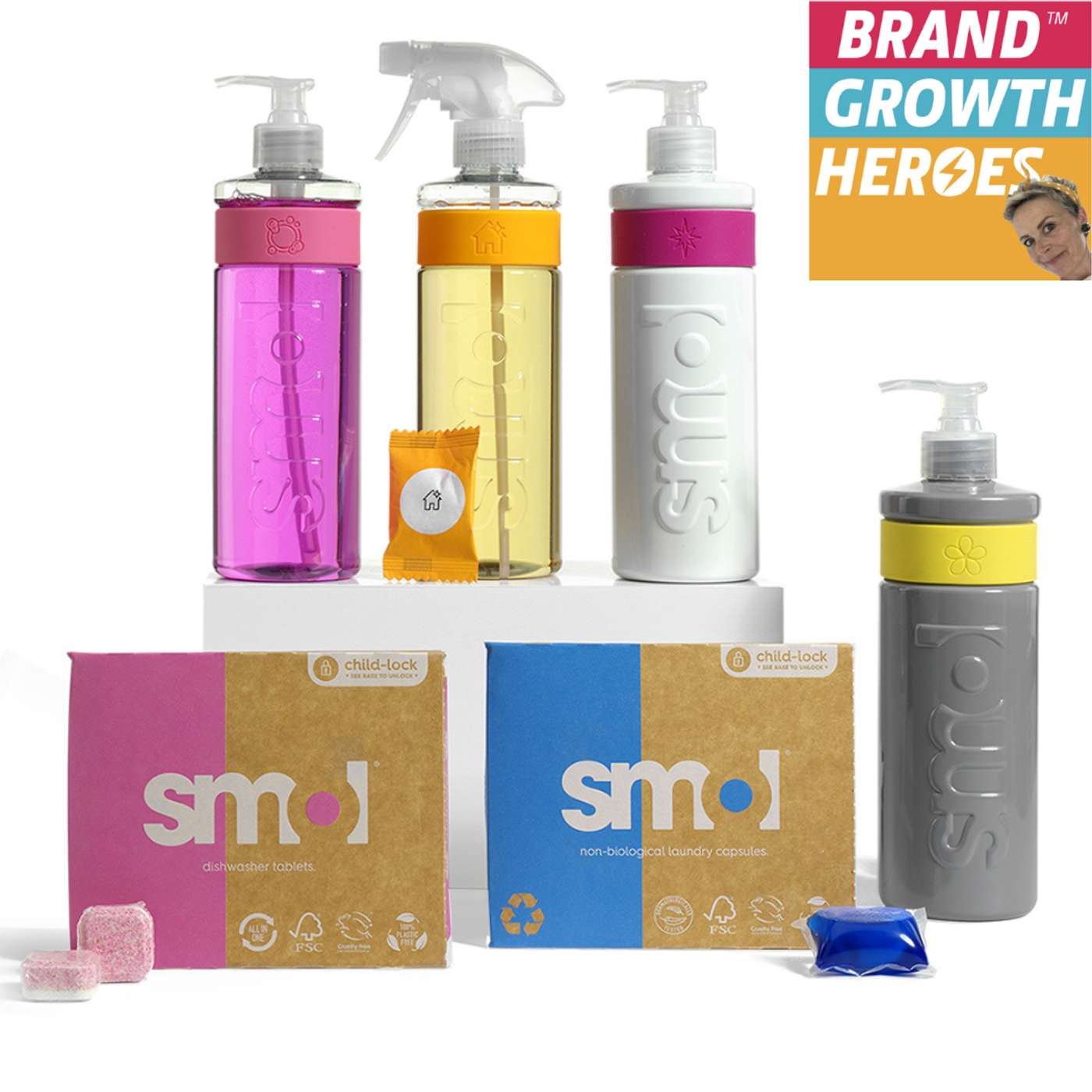
6:11Fiona Fitz: Was anyone doing that already? Like in the world? Not at the time. Oh, not to my knowledge. Okay. So they really were at first. Certainly not in the UK. Yeah, it was super disruptive. So fast forward now to what size you are now. Neil, do you want to jump in here? What size are you now? And how many packets or what kind of products do you sell? And how many do you sell per month? Yeah, so as Hilary says, we started off in laundry and we very quickly built out a range of products from there such that we're really covering a full range of cleaning products now. So dishwasher tabs, washing up liquid, Fabcom, stain gel.
6:48Fiona Fitz: Fabcom. Fabric conditioner. It's okay. I think we all made the leap, but I just had to say it because it sounds really cool. Very good. And then like multi-purpose sprayers, for example, which for us come in a hydratable kind of format. So all you have to do is send out the tablets rather than lots and lots of plastic spray bottles. And so we've really kind of expanded from there. And we're kind of in a world now where we're probably on for about sort of 44 million in sales this year. And then we're just on a constant expansion drive, both within the UK where we're adding more products and deepening our services, but also in France and Germany where we're expanding internationally as well.
7:26And yeah, so it's just really interesting. And I think the one thing I would add to, you know, sort of Hillary's kind of founding story of Small is that it was really founded with this idea of sustainability shouldn't cost more. You know, so how do we make sustainable choices, something that, you know, 95 percent of people can do? And that's how we really affect change, you know, within the wider kind of cleaning category. And so one of the kind of key things for us is obviously the products have got to be better for the planet. They've got to be convenient and get them to people's houses. is they've got to work.
7:56So they've got to clean and not be a kind of trade off that. But they've also got to be a mainstream price. And so I think one of the reasons we've done quite well and expanded is that we've really kind of focused on how do we make these products the same prices as the big sort of category leaders.
8:10Fiona Fitz: And I was really surprised at that when I was preparing for this. As you know how much I prepare for this show, we'll wink at that. As a mum of three, it's getting more and more difficult. But I couldn't believe actually how reasonable the products were. I mean, they really are quite reasonable. I've got a question, though, to pick up on what you said, Neil. So 95 % of people, and maybe that was a throwaway remark, but imagine that was their vision back then. What's your household penetration in the UK now? Are you able to share that? And what's your aim? Or maybe, Hilary, you know that better.
8:39Fiona Fitz: More or less, you don't have to give me the exact figure. Probably about over a million people have tried small in the last few years. So probably somewhere around 5%, sort of 6 % market share of laundry capsules now. and then penetration would be a kind of four or five percent. Huge headroom. I mean, huge headroom for growth. Yeah. Well, there's two sides to that, isn't there? On the one hand, there is huge headroom because as I've said, and as Neil alluded to, all of those categories we're in are categories that all of us have to buy. We all have to shop. We all have to use those. So in terms of growth, there's huge, kind of huge potential, but also, you know, that mix that Neil describes of kind of performance, convenience, price, and always where the better for the planet and better for people kind of angle, it massively resonates with customers.
9:27So to be in a position where a brand that has very rarely spent any money above the line and built very much through growth activities, to be in a place where, you know, 1.5 million households have tried small, 40 % of UK households have heard of us, it's giving us a really, really solid base from which we can keep growing.
9:44Fiona Fitz: And I think, Neil, the last time we spoke, well, a couple of years ago, because we were about to do this show just before I got diagnosed, and we actually had it in the diary, didn't we? We did. We had it in the diary and then I got diagnosed and went to cancel, which was pretty crappy. So thank you for hanging on in the meantime. That's okay. I think at the time you said to me that one of your key strengths was the fact that you had such a high repeat rate or subscriptions, wasn't it? Subscriptions. Yeah, we were talking about the kind of subscription angle. And obviously, if you get in the subscription angle, you get into, you know, places like Naked Wines and Gusteau and Helt Refresh and those sort of businesses.
10:17And as Hillary sort of mentioned, everyone has kind of cleaning products, whereas in naked wines, someone might not be drinking wine or they have lots of other options as to where they get their wine from. You know, everyone is kind of buying these kind of cleaning products and they're a sort of commodity product. And so one of the things we find, especially when you kind of price them at a mainstream, very competitive price, is that if they do the job, if they hit the kind of things on performance, convenience, better for the planet, then you generally retain the customer very well. And so we kind of find that, obviously, cleaning habits are very personal and especially fragrance are very personal to people.
10:52But once people find a product that they like, we sort of find that the repeat rates compared to other subscription businesses for us are very, very high. And that's sort of served small well and really kind of built that sort of foundation of growth on that.
11:04Fiona Fitz: I'm thrilled to introduce Brand Growth Hero's newest partner, Jolson. Jolson is a leading B Corp certified commercial law firm that specializes in guiding the founders of scaling CPG brands. With long-term relationships with clients like Little Moons, Trip, Eat Natural, Bear, Graze and Pulsin, Jolson is also famous for advising the Innocent founders in their landmark sale to Coca-Cola. And believe it or not, they still work with the Innocent founders at Jamjar Investments today. I'm especially impressed by how Jolson sets founders up for long-term success and by their commitment to championing female founders.
11:42Fiona Fitz: Recently, I asked one of Jolson's managing partners, Phil Halesmith, to talk to us about how Jolson supports female founders on their scaling journey. We're fortunate to have worked with loads of female founders who've had some very successful businesses, raised huge amounts of capital and are happy to give back. And that's part of what we're trying to do in terms of running a regular program that supports them both here in the office, but also enabling them to actually access getting VC financing. If you'd like to find out more about Jolson's female founder club, Hercules, why not go to their website www.jolsonlaw.com or send a quick email to hello at jolsonlaw.com.
12:18Fiona Fitz: Huge thanks to Brand Growth Heroes podcast sponsors, Jolson. Now let's get back to the show. So talk to us about, imagine I am the target customer, right? And I haven't yet, which I haven't started buying small. I still, you know, lug it around in my go to the supermarket and pick it up. How do you find out where I am? Which of you two finds out where I am? Who defines who I am? and then how do you find me and then how do you bring me on that journey to from discovery through consideration trial great experience through repeat and I imagine advocacy who wants to start you know talk to me about that in terms of defining who we think kind of our core audience is that sits with me on the kind of the marketing side so you know and that's kind of rooted in you know really solid consumer insight you know so who's out there everyone's buying laundry who are the people who you know are kind of we think are best suited to small and one of the biggest things the biggest reasons that people come to small and the biggest reasons they stay is all around this need to feel like i'm doing something to feel like i'm making a difference so in the seven years that small's been going you know sustainability has become a bigger and bigger and bigger agenda point you know people need to feel like they are somehow contributing to solving kind of the climate crisis and they're also increasingly wanting to support smaller businesses um disruptive businesses businesses that they feel are genuinely more people-centric um rather than kind of you know more performative gestures or kind of you know dialogue so um in terms of finding those people and defining them that's kind of sits with me as a start point would i be one of them am i too old now i'm 49 i've got three kids three three kids 100 percent you're we do three watches a day three washes a day.
14:08You're in, you're definitely in.
14:10Fiona Fitz: So I imagine you've got some groups that are more valuable than others. I mean, literally, will you really get into this? Because I think, you know, you've had your career, your background, it's worth saying is you'd 11 years in Unilever. You know, you've worked globally. You've had your own agency. Ton of experience. So like get as nitty gritty marketing science-y as you want on this because I want to share that with everybody. When you start saying marketing science, that's probably going to get more into Neil's work. But I mean, you know, part of the reason we're here today is to talk about how the two of us complement each other and this is for me is a really good example so I will talk a lot to the whole team and that's both Neil's team and my team about who our target audience is and what do they need and we'll often talk about the kind of the sweet spot so the sweet spot for us is a combination of demographics so we might be saying okay our sweet spot is probably going to be 30 to 50 year old families massively time poor very likely to have one two three kids they could have young kids they could have older kids you know and we talk about you know families for whom laundry you know the laundry basket is never empty and household chores you know a never-ending hassle awful so this sort of my life like relentless mouse wheel yeah and trying to stay on top of laundry and cleaning and the dishwasher's, you know, it's either, it's always full, you know, it's either waiting to go on or it's waiting to get unstacked.
15:36And then what we'll do, um, is also with, within my team is go out and be talking to those customers. So people who aren't customers yet of small, but consumers and saying, what are you buying now? What do you need? Um, how do you feel about life? You know, what are the problems you've got? How do we solve them? And then we will feed all of that into Neil's team to then get into how do we better target those people. So that's where the kind of handover starts.
16:06Fiona Fitz: Do you define which segments are kind of strategically more valuable to the business or do you, Neil? Well, I would describe it as Hillary decides the kind of broad canvas of, you know, kind of, you know, what are the products that we're kind of doing? Who are the customers that we're going after? What sort of language and emotional cues are going to resonate with them? and, you know, therefore, how should we kind of talk about this stuff? And that gives me what I would kind of call a kind of playground. And this playground's got fences. There's things I shouldn't do, and there's things that I, you know, if I knock up against it, Hillary will tell me off for being, you know, too price-led or too offer-led or something like that.
16:48But then within that, I will, you know, go and, you know, well, we create ads. We've got an amazing creative director, Matt, who generates lots and lots of ads with his team. But I will go and take the process of, okay, let's put those ads and those themes and those topics into Facebook. And let's find out which pays. And through the process of experimentation and looking at the data and really make sure, do those ads really resonate on Facebook and TikTok? And how do you make them different on TikTok versus on Facebook? how do we make it different with our partnership kind of customers and so I guess I would sort of say I add the detail so Hillary really sort of sets the tone and sort of what's acceptable and where do we go and what products do we have to sell and I sort of say okay well how can I maximise that on a detailed basis and using data to kind of do that
17:42Fiona Fitz: So you colour inside the lines with the palette of colours that Hillary has given you but you can decide what colour t-shirt the girl on the drawing is wearing Exactly. And I'd argue she probably draws the lines as well. So yeah, as a kid, I was definitely someone who stuck inside the lines. And that's why this kind of rule suits me very well. From a kind of objectives, you know, the objectives with each of your roles, so a CMO and chief growth officer, what are you objectivized on that is different from each other? So it's like one brand awareness and one brand loyalty and one is sales. I mean, how does that work?
18:16With me and kind of my team, thinking a lot about awareness, consideration, what do people understand about small? So how many people know of us? Are they people who we want to know about us? And what do they think and believe and know about small? And that's almost to kind of Neil's point and taking that analogy, am I creating the right playground? And do I know that that's working? That's brilliant. That's where all of my focus is on.
18:45Fiona Fitz: And Neil, then what's your team KPI done? Yeah, so I almost have the easier task because mine is a lot more measurable, which is why I'm sort of data guy and the kind of math guy. But we're really about customer lifetime value and specifically how does that customer lifetime value compare to what we pay for the customer? And so I have a lot more kind of numbers behind that. Does everything else waterfall down out of those? So are those the top two macro kind of objectives and then all the rest are KPIs that lead to those. So for example, like for acquisition, you've got the cost of advertising and the cost of whatever.
19:20Fiona Fitz: And for lifetime value, it's whether they drop out or stay in and how much they buy when they're in. Is there anything bigger than the two of those? Are those the two biggest? Those are pretty much the two biggest, because if we get those right and they're right relative to each other, then everything else kind of works. But obviously underneath apps, so for example, lifetime value, it is about how many subscriptions do they have? How much do they use those subscriptions? whether or not they retain, whether or not they refer other customers to us. So all the things that we can manage. But everything ladders up into one of those two.
19:50Absolutely.
19:51Fiona Fitz: That was really my thing, yeah. That's what I wanted to understand. And then similarly on the cost of acquisition, for example, obviously there's the money that we give to Facebook or TikTok for the media spend. But then there's also how good is the offer that we're going to give because if we have an amazing offer, we get loads of customers, but they all leave two weeks later, then we've just wasted a lot of money because what we really want is long-term mature customers and things like that. So I do a lot of designing of the offers and how do we kind of sell that to them and how do we balance that with brands?
20:21Fiona Fitz: So you guys have almost a purely DTC business and that's an active decision that you've made and I'm sure you're asked to make it over and over again should we not have a big let's look again this year should we not have retail and then 18 months later let's look again should we focus on retail or should we focus on DTC I'm imagining. Oh, 100%. we're pausing we're pausing and just going yes at the moment you're still focusing on DTC why and why not in both why not do both at the same time because you could so why not do both yeah it's an interesting one so the reason why we focus on DTC to now is that it's been very successful for us and we've grown very fast and we've learned a lot about our customers and the absolute beauty of a direct to consumer business is that you know everything that your customers do and if you have any questions you can ask them and they give you amazing feedback and you know we launch new products and we get to see how they respond um so tech's a lot of gonna guess work out um which is really good um at the same time and we are present in sainsbury's at the minute and we're kind of working on okay where do we kind of take this only on our laundry products and so you know there's a lot more that we could do in fact only on our laundry capsules and not on the kind of wider laundry range um but the the fact of the matter is is that you know when do people think about which laundry uh brand to buy they think about it when they're standing in the laundry aisle at the supermarket and so there's a thing that kind of goes actually from a branding perspective you know so maybe there's not a direct link of retail straight into kind of growth and subscriptions but from a branding perspective there probably is a sort of saying okay you just have to be present where people are thinking about this stuff and therefore you know how do we make that work at the same time we're you know as i we're very keenly priced and we really want to, if someone subscribes to us, we really want to reward that sort of loyalty.
22:11So you get into these retail, what happens if Sainsbury's discount and things like that. So yeah, it's a constant debate for us, but I think we're starting to say, well, if the direct growth stuff is starting to have less returns and not drive growth as much as we'd like, there's definitely a time in which we You have to go big in retail because that's where people are thinking about this stuff. And it will actually help the direct business as well.
22:36Fiona Fitz: But while DTC is growing as strongly as it is, then you focus 100 % on that. Yeah, there's certainly less pressure, you know, in the sense of if we can grow DTC, then, you know, that's what we're set up for. You know, that's our supply chain. That's our pricing strategy. And as Neil said, you have all the benefit of, you know, of a direct relationship with customers. So, yeah, I mean, we were laughing as we came into that question because it's, of course, you know, we're in a category where the vast majority is bought in retail. But, you know, the pricing does big complications. You know, it's a category where 80 percent of laundry is sold on promotion.
23:16So, you know, the big brands will sit at, you know, 35p a capsule, but then drop down, you know, and we have a really different approach to pricing. We want to have a sort of an everyday low price where customers know what they're paying and that will never change and we'll never mess around with it. So looking at how that fits into retail just creates challenges and questions, you know, and so far we haven't had to answer them.
23:39Fiona Fitz: There must be a great way, though, of like totally turning it on its head. You know, when you're in the tourist office in a foreign country, right, in a local village and you go into the tourist office and you're waiting in a queue. okay there's this like a greetings card stand and there's all these vouchers right there's vouchers for things so imagine you could come up with a trial product that had really high margin for Sainsbury's yeah so like it's basically like you know ridiculous margin for Sainsbury's they definitely want to give it shelf space okay and I'm I go past and I'm going to pick up my aerial tabs or whatever I'm going to pick up but same time I'm like oh my god look at that that's like a trial product and it's only 80p.
24:19Fiona Fitz: I don't realise Sainsbury's getting 60p. But then when I bring it home to try it and it's one wash, I get five quid off or 20 quid off my subscription and it's a QR code. So you're getting into my house, Sainsbury's is doing fine, you're on shelf, I'm buying it, it's no skin off my nose because it's only a quid. I mean, is that not a solution? These are all the kind of questions that we have and I'll hardly make that happen. And then I'll flip that as well and say, and how do you do something similar on TikTok shop? Because TikTok shop is also kind of huge. But it's an interesting insight because essentially what you're pointing out is the fact that Sainsbury's sell Amazon gift cards, despite the fact that Amazon sell half the stuff that's in a Sainsbury's.
25:01Why do they do that? Because it's ridiculously high margin for them and it's a bit of a no brainer.
25:05Fiona Fitz: So if you're going to use that now, I do want a commission, okay? So if you use that idea, I do expect a little cut on that. TM.
25:16Fiona Fitz: If this episode is inspiring you to think about new ways that you can drive growth for your business, don't forget to click follow or subscribe on your favourite podcast app and even leave a review. Your small gesture has a big impact on me and my business and will be truly appreciated. So imagine this is going all the way looping back to that question that I didn't ask because I wanted to get in that bit about which channel you're focusing on. So imagine now So we're, because we're here today to talk about how your chief growth officer and chief marketing officer work together. I'm trying to build my team.
25:47Fiona Fitz: I'm a five million quid business. I'm both retail and e-commerce, right? And I haven't really placed my bet in one or the other. Let's say I'm 60-40 or I'm 70-30. And I decide that I need a head of e-commerce or a head of growth. And I bring that person in. And at the moment, there's only a digital marketing manager, really and probably someone who's quite junior in e-commerce sales yeah and in marketing I might have a head of marketing but that head of marketing probably doesn't know a lot about e-commerce or performance marketing like imagine you guys were at the beginning what choices did you make to build your teams up and which roles did you fill when and what do those teams look like now and how does everybody work together oh there's loads of questions in there I know sorry I could answer the question we could answer the question based on the truth in terms of how we developed, you know, so is this because, you know, of Nick and Paula's kind of background was Unilever was from more from a brand place.
26:42And, you know, we brought a CMO in first and there were certain disciplines, for example, email that originally sat under me. I think when, you know, when Neil joined the business, what he brought was such a strong skill set that was very much not my skill set.
27:00Fiona Fitz: So this is interesting. Was when Neil, before you joined Neil, so there was a pure marketing part to the business, yeah? So you were in charge of the kind of the marketing strategy part, Hilary, and the execution, I presume that. Yeah. What did Neil bring? So this is exactly the point that a lot of these brands listening are at. What did he bring that you guys almost didn't know you didn't know? What did he bring in? I think we knew we didn't know it, which is why we brought him in. I don't know, though. I do not know what I don't know. So paint it out to me. What we were doing, I think, really well at that point was we knew what brand we had.
27:33We knew our positioning. We knew our target audience. We knew what kind of innovation and how to grow the brand through innovation. What we didn't have. And we had, you know, we had performance marketing people. You know, we had kind of more execution going on. And a lot of that was being kind of led by Nick and by Paula. But what I think Neil brought was just way more experience, a stronger growth mindset. So, you know, rather than, as he alluded to, I think earlier in our conversation, less necessarily about kind of performance marketing, but a much bigger point of view about growth. He had brought that experience from a ton of other businesses, you know, across e-commerce.
28:16He brought discipline. He brought a maths brain. he brought absolute minute eye data detail um that certainly is not it's definitely not my kind of skill set i can look at i can look at numbers but i wouldn't necessarily know the question to ask about them and where to go with those numbers so you know i think we were a stage in terms of our growth where we needed that level of experience and that level of seniority you know and to come in and build out growth as a function for us as a business, which we didn't have at that time. We had some of the activities going on, but they weren't being led by an expert in growth.
28:57And that's what happened when Neil came.
28:58Fiona Fitz: And this is really interesting, because I am sure that when you guys were doing what you were doing really well, right, otherwise you wouldn't have grown the business as far as you had. What size was the business when you came in, Neil? Oh, God, I can't remember. 20 million, 25 million. So around that, you'd done really well already. You know, it wasn't like you weren't doing really well. This is what I want to get to. This is the whole crux of it for me. What is the difference? Because you were growing the business. So what is that step change between the growth that you were creating and then this, if we're trying to recruit for a chief growth officer, what is the difference between what we're all just doing in terms of growing our businesses and this step-changing growth thinking that a growth officer, the right type of CGO, Chief Growth Officer, will bring in?
29:42Fiona Fitz: Thank you. That's what I'm trying to say to him. Thank you. Sorry for bearing with me. No, no, no. It's a really good question. And, you know, kind of growth roles and silly titles like Chief Growth Officers, they're quite sort of poorly defined in general. And in different companies, it means different things. I think we're definitely, you know, coalescing, coalescing around in the DTC world what actually it means and what actually it kind of covers. And there's various kind of great networks in London for that. But I would sort of describe it as, you know, when I kind of came into small, Hilary oversold it.
30:14She said performance marketing people. We had one performance marketing person who was a really awesome girl called Mihaela, who was kind of running the ads and running the accounts. But I sort of came in and took a bit more of a kind of holistic approach to that because it came at a time that we wanted to sell a lot more kind of products. We were expanding the kind of customer ranges. it sort of came at a time at which we sort of like a lot of low-hanging fruit on Facebook had sort of you know had been exhausted and we were starting to sort of see our kind of CPS rise and so it then kind of came to this question of what is the economics of you know a customer and and how do we kind of manage that hence why kind of email came under me because email was largely let's send out our newsletter and sort of you know tick along.
30:59Fiona Fitz: That's where we all are now I I mean, me and the rest of like a lot of people listening to this, that's exactly where we are. So we've got someone doing ads. We're doing a bit of email, but nothing's moving the dial. So what do we do? Take email, for example. Email sort of came under me. It became much more of a kind of wider engagement kind of thing. So not just us broadcasting out messages to customers. We sort of set ourselves a goal of kind of going, how do we be this sort of trusted advisor to kind of customers? and really think about, okay, when these things have happened, these are the kind of engagements that we should send, and mostly stuff that is therefore triggered by what a customer has done.
31:35So if they've just subscribed, what does that kind of flow look like? If they've been a customer for a while, what does that flow look like? If they've given feedback on the product, how do we work that into a message? And yeah, it just overall becomes something that goes, right, let's really set a goal for this. And one of the goals we obviously set for engagement is, can they refer customers, for example. And then within acquisition, for example, so within kind of performance marketing, which is a big chunk of our acquisition, it was really about bringing, I guess, some commercial thinking, a real experimentation kind of culture, and really underlying that with data.
32:15So, now, random example, we sold some, let's talk about actually, we had a kind of bundle product, which was all our things together. But to be honest, it wasn't very keenly priced. But the customers who came off it were absolutely amazing customers because they join on five subscriptions, maybe they lose one, but then from that point forward, they had loads and loads of subscriptions. And so one of the things I sort of said was, okay, how do we push this? So how do we get the pricing of this product right such that it's going to attract more customers, but not so good that it attracts just bargain hunters?
32:48How do we track those customers who subscribe over time? How do we redesign this bundle to be more products which we think we can sort of build ads around? That sort of experimentation and sort of slightly more kind of commercial thinking, all because we know that a customer who comes in and takes four subscriptions on day one has a higher lifetime value. Therefore, I can support a higher cost of acquisition. That helps us get over the fact that our cost of acquisition is starting to kind of rise as well, that kind of stuff. So it's those sort of tactics.
33:17Fiona Fitz: So it's more you're coming in, you're giving it space, you're giving it time, you're giving it focus. because you're giving it thinking, you're looking at product proposition, promotional propositions, you're looking at lifetime value. Who are we targeting? How are we targeting them? We're trying to engage them rather than just sell to them all the time. And we're not just sending out emails for the sake of sending out emails. It's this entire customer experience. Yeah. Yeah, and I'll give you a classic example. So before I joined, everyone could have told us what our kind of revenue per customer was every month.
33:49And everyone could have told us, how much it costs to acquire a customer. No one could have told me how much the revenue per customer was for a customer who joined on one of these bundles, one of these starter pack bundles. And sort of when you get into the data and sort of split those customers apart, then suddenly find, oh, that behavior really drives valuable customers. We should go do more of that behavior. And I could repeat that across our bundles, our spreads products, our customers who take two SKUs of laundry instead of one SKU of laundry, all that.
34:18Fiona Fitz: Is it a bit like in retail, instead of just looking at our Tesco performance per SKU, but looking at like, what's the rate of sale of the top 100 stores with a particular SKU? Or what's the rate of sale of the top 50 stores in London versus the top 50 stores in the rest of the country? And then looking at the Dunhumbi data and understand which of the shopper groups are representing that and what else they're buying and how often they buy. It's exactly the same as that really. Yeah, because in a retail world, you have to rely on the Dunhumbi data. And if you want to really understand your customers, you have to get into, OK, well, when people buy us, what are they overlapping with?
34:54When people never buy us, what are the products they're buying? Work all that out into kind of proposition. The beauty of kind of DTC is that we know all that because we kind of we see it sort of happening. And that's really strong for us. And that's actually some of the stuff that I work out. We then feed back to Hillary on the kind of brand side and sort of say, oh, this is this inside that we should scratch and research and work out. And that falls into her camp to kind of do.
35:14Fiona Fitz: So let's talk about that. How do you guys work? like what's the weekly or monthly cadence or quarterly cadence? How do the two teams, when do you come together? Which information do you share regularly and how? How do you work? So Hilary, you've got so much kind of consumer insight stuff and you're drawing out that canvas. What's the forum for all sharing this? In some ways, it's easy. You know, you have to remember that we're still only 140 people, you know, in total small. So we're kind of in touch all day. So, you know, it's a pretty fluid kind of business and there's a lot of constant sort of dialogue between our teams.
35:47On a really practical level, Neil and I meet every single week. We'll spend some time together talking about what each of us is working on, asking questions about if there's something he's got going on that I want to know more about or vice versa. We also bring, I mean, our teams are working on projects together the whole time. So it's really not a question of Neil's team and my team. People in our teams are talking the whole time. An example, two hours ago, one of my team, who's an innovation manager, Lucy, did a presentation to a chunk of my team, Neil's team, the creative team about the dishwasher market.
36:23So talking about latest trends, competitor activity. So there's a real kind of fluidity, you know, in terms of sort of sharing of information. Lots of our teams sit on projects together. So certain things, initiatives where we're looking at new propositions, you know, an engagement project might have people from my team sitting on it to bring either consumer insight or if Neil's team need a particular new product developing to support that proposition, then my innovation team will pick that up.
36:51Fiona Fitz: So lots of cross-functional teams, project-based teams. Just a lot of conversation. And then there is more discipline in the sense of we have regular meetings and we have regular meetings where we bring both teams physically together as well. So there's kind of a combo of structure, but also just kind of constant dialogue. Before we started, we talked about the idea of lead users and outliers. And you had some lovely stories about how sometimes it isn't just about segmentation or segmenting groups of customers, but how actually you do look at and talk to just one customer. Tell us a little bit about that, Hilary, because I think that's really important in terms of this detailed touch.
37:30I think it's the joy, you know, Neil's touched on it a couple of times. You know, we've talked about the joy of being a direct-to-consumer business where you know your customers in a way that you never can, you know, as a retail business. We also, a big value for small is about human kind of interaction. So, you know, we might get 500 emails a day. Every single one of those emails is read by somebody in our team. We don't use chatbots. We don't use AI for that. We read an email and we write a response based on what the customer needs to know or needs help with. and so when you do that also on Facebook you know on organic we've got our own kind of community managers who are reading comments both on paid ads organic ads we're running community groups and when you do all of those activities you know you start to get to know individuals you know we know who some of our top contributors are on social we've got customers who you know are massive advocates for small you know they dive in on on social chats and defend the brand and give information um we've even had one customer travel down from edinburgh to an event we were doing in manchester because he was really keen to actually meet small in person um and he's he's one of our most loyal customers so i i honestly think that's having started my career in unilever to now be working you know e-coms of you know direct to consumer it's one of the nicest things about doing what I do is being able to do that alongside customers.
39:00We've got just one other example. We've got an impact steering group. Impact is in our DNA. It's what we are here to do is deliver positive impact. So when you switch to small, you are genuinely making a difference to people and planet. And we're about to invite three customers to join a steering group, which will also include Nick, who's our CEO. It will include one of our investors. It will include the CEO of the Hygiene Bank, who are a really big partner for us in tackling hygiene poverty. So that's the level of involvement and relationship that we want to have with customers, which is just another way of kind of reason that small is a really kind of different and pretty special place to work.
39:43Fiona Fitz: You started this by saying, you know, 140 people. How many people work on each of your teams? My team is about 25 in total, partly also because that includes all of customer service, which is quite a big team for us. We've chosen to invest in that team with people. And they're really interesting choices, I think, for people listening. So I'm imagining, you know, you've got the founder of a brand that's tracking at, say, five or seven million at the moment, and they're thinking, OK, well, when I'm going to be tracking at 45 million, what will my team look like so if you had to kind of break it into groups of kind of sub teams under you yeah what do those what do each of those teams do so under me i've got if i start with customer service i've got about four 13 14 people not all full time but working in customer service that also includes french and french and german teams is that like uh on on socials on phones email mainly on email So we use Zendesk.
40:40So most of our customer service is via email. We also have a help center within our website. But the majority of the interaction with customers is via email. I've then got a communication team that includes a head of comms. We've also then got PR, organic social, community managers. That's another three people on community management because with the volume of activity that we're creating through things like paid, and there's obviously a lot of comments questions um a lot of dialogue a lot of kind of community building um then got an innovation team so that team is looking at how do i bring products we know what are the right mixes um working with suppliers to you know develop products packs fragrances um then got an r &d team who look after all of the claims making sure that we are really really watertight that's a really important value for us is in the current kind of climate of greenwashing.
41:38We hold ourselves to really high account in terms of what we say and how we say it. And then customer insight, so kind of consumer insight, which is a team that there's a really lovely overlap with Neil's kind of more data and sort of business analysis team.
41:53Fiona Fitz: So how many direct reports do you have then? I have about eight direct reports. That is huge. So a lot of your job is going to be as well, people management and, you know, culture. And I suppose the reason I'm making that point is, is, you know, that's a choice you guys are making. But like, it's a lot of work and it's a lot of experience needed and a lot of particular type of personality. And leadership is going to be really important. And I suppose I'm thinking about, you know, founders who might be thinking, right, am I the right person to lead the business from 10 to 20 million or 20 to 40 million?
42:28Fiona Fitz: You know, you might need to be bringing in someone with blue chip experience or different experience to yourself because maybe you don't want to as a founder to be managing eight direct ports who each have four or five people underneath them. And that managing stuff is a lot harder for us because we're a 100 % remote company as well. Are you? Okay. I was going to ask that question. Within 140, yeah. So we've obviously got a warehouse operation, which is all real people in one place. Yeah. So for a company of our scale, within the 140, there's about 60 working in our warehouse. And actually that's reasonably unusual, but actually we consider it strategic as well because we've got so many subscriptions.
43:04We can save costs by sort of packing some of the products into boxes and things ourselves. And we just don't want to kind of outsource that to a third party. But yeah, and then the rest is 100 % remote, which makes that management task a lot harder.
43:15Fiona Fitz: So what about you, Neil, then? What are the direct reports of the sub teams under you? I've got about four direct reports and about 12 in total. So I've got three in performance marketing, including influencers, because that's a real sort of feed into performance marketing in terms of creative for us. I've got two who work in sort of wider partnerships and affiliates. I've got three who work in data analysis. I've got two who work in that sort of email slash engagement kind of piece. And then I've got one who looks after international as well. And then I've got an odd contractor who does a bit of SEO and stuff like that for us as well, which is not huge.
43:54And I'm desperately hoping I haven't forgotten anyone there as well.
43:57Fiona Fitz: Yeah, I was just thinking the same thing. You have so many people in charge of fairly hefty functions and departments that actually, it's not like you have a head of brand, Hilary, do you, other than you? No. So a lot of the strategic thinking has to be done by you. And Neil, the same with you. You've got a lot of people who've got like really chunky jobs to do. But in terms of the actual thinking, you're not just managing teams who are doing all the thinking. There's a lot of big thinking pieces need to be done by both of you guys. Yeah. Well, one of the reasons I work in startups and scale-ups like small is that I still quite like doing work.
44:28I don't want it to be 100 % the kind of management job. And so, yeah, I'm still doing quite a lot of the thinking, quite a lot of the kind of task definition and the sort of project scoping, purely because I really like it, but also because, you know, we're at a stage where we're kind of shaping growth, and it really needs to be done by someone who wants to get kind of hands-on. And so for scale-ups, you're right that you might need blue-chip experience. You've got to be very careful that you don't come and take a blue-chip person who isn't an individual contributor or isn't a sort of gets dirty.
44:57The real warning sign for us is people who kind of go, I'll come in, but I'm going to need this agency and this agency and this agency. And it's like, no, no, you've got to get your hands dirty. And I think both Hilary and I are very much like that. And anyone who works in the scale up has to be like that.
45:11Fiona Fitz: It's a great point. And in the same way that you get asked over and over again, you know, should we look at present the case for retail? Do you get asked to look at whether we should be office based or not? or is that just a given that you're going to be remote as part of the founder values? It is in our DNA and we have no desire to kind of change it. It does mean that we work extra hard to get people together and we do a small fest every year where we get the entire company and do a bit of a kind of mini festival and things like that. Largely, by the way, not around sort of sitting, boring presentations, but mostly around let's just chat to each other and get to know each other.
45:49But yeah, we're very committed to that.
45:51Fiona Fitz: So how do you get to know each other in a fully remote business? I know you can get together, but you can't get together all the time. So how do you know what somebody's really like? It really requires effort. That's the best way I can kind of put it. I mean, it's worth adding, you know, remote for us wasn't post-COVID. We always were remote, you know, right from kind of the get-go. So sort of from my design. And we haven't mentioned, Hilary, that you're sitting in Barcelona at the minute. I'm in the UK. Okay. Something now when I'm recruiting people, I spend actually quite a lot of the recruitment talking to them about how do you feel about remote because it's really you know it's very common for someone to say yeah I love that I love the idea of the flexibility but it you need to take people on who understand what working remotely means and sign up to that and and it requires all of us to work so not just me as a manager or as a leader taking the time to get to know my team and checking in fairly frequently I need people who come to the team and and have a level of self-awareness about about how they like to work, what level of interaction they need with people and people who are willing to create that for themselves.
46:58So I always say to the team, if you want to go to a co-working, we'll pay that. If you want to come into London and meet up and work with Neil's team, we'll sort that. But only you know how you need to work and what level of contact you need with people. And you have to be responsible for making that happen. So it requires work from all of us. You have to be really mindful of it.
47:19Fiona Fitz: It's amazing because I've worked within remote situations a lot in my life, a lot earlier than COVID because I was working internationally with Chobani and things like that. But I would still go to the office in Amsterdam two days a week. And so I can't imagine, well, then I suppose I work remote with lots of clients and I know that I get to know them really well. But I just can't imagine an entire team doing it. But it obviously works incredibly well. So it's great. There is, I mean, there is also a lot of interaction. You know, we spend, we're a lot of time on Slack. We're in meetings and phone calls most of the day together.
47:55And the team will, you know, as I just said, we encourage them to create the working way that they need to. So, you know, I've got people in my team who once a week will go down to the warehouse and work there for the day. We have office space there that they can use. We've got at least once a week different people will work from the same co-working together and sometimes that'll even be outside of London where we've got people who work together or kind of are close to each other in the Midlands so there is a lot of kind of contact in different forms both physical and you know in real life but also kind of day to day.
48:30Fiona Fitz: Okay okay thank you both so much for for all of this it's really uh really insightful and really valuable where to next what is the next phase of growth, Neil, for the business, looking at you because you're in charge of growth. Yeah, we're kind of growing on kind of multiple kind of fronts. So I would sort of say in the UK, we are deepening our kind of relationship with customers. So we've got so many kind of products and so many customers who have lots of subscriptions in the UK. I think that's a real opportunity for us to sort of say, you know, because traditionally we've always sent out each subscription one box at a time, but we can start to kind of group those together and do really interesting stuff around kind of box delivery and once you're getting a kind of regular box from us i think that opens up a whole world of opportunity because it's very easy to get you to take more subscriptions or other products so that's one thing in the uk um i think also in the uk we're looking at just uh um i said how do we be more brand led so how do we you know is our growth sort of starting to saturate a little bit and therefore we should be really take the leap and invest a lot more in kind of brand stuff which is obviously something that hillary has loads of plans on and i sort of sit in the background and kind of keep score on um and then internationally as well so i think you know small is all about having kind of more impact and you know that means kind of both going internationally also kind of getting lots more kind of you know uh products through you know we just want people to kind of you know look at all the plastic single use plastic and sort of chemicals that they're throwing out every single week and think there's got to be a better solution for this and we're going to come and get that solution and so So, yeah, that's where we're kind of growing.
50:05And so, yeah, it's a really exciting time to be involved. That's just a super interesting place to work.
50:09Fiona Fitz: Exciting times for you then, potentially focusing on brand more. Does that mean we're going to see more of small in which way? Yes, it means you're going to see more of small. It's going to be kind of, look, I think like loads and loads and loads of sort of startups and scale-ups. that balance between investing in brand building and kind of the day-to-day of kind of acquisition and performance marketing is something that Neil and I talk about, you know, the whole time. So, as Neil said, you know, one of the things we need to do in the next year or two is start investing more in brand, which will have a really different set of metrics.
50:45It'll be much more about are we building the brand that will continue to fuel growth for the next five or 10 years, you know not just in the UK but in France and Germany so yes you'll see more of Small it will be later this year and I can't tell you which channels yet that's okay partly because we
51:02Fiona Fitz: haven't finished writing the media plan listen thank you both so much I really appreciate you both coming on today and I'm sure loads of listeners will be far clearer on how chief marketing officer and chief growth officer work together indeed what you actually do as a chief growth officer and how it makes a difference and the best of luck to Small in the next part of your growth. I know it must be a really exciting time. You're doing so well and I'm sure there's a massive big P &G or Unilever out there who's going to try and snap you up and you'll have to say no, no because we're doing fine. They're already copying our packaging and our sort of product formats and things like that so they might as well buy the company as well.
51:39Fiona Fitz: Exactly, exactly. Alright, have a gorgeous day and a great week. Thank you so much for having us, Fiona. Thank you so much. Thank you. Cheers. Bye.
51:51Fiona Fitz: Well, we rarely get to hear that level of strategic detail from such seasoned brand leaders. So a huge thank you to Hilary and to Neil for sharing all of that. We covered the real secrets behind D2C growth, I suppose, from how marketing and growth teams need to work together to why small is doubling down on its direct relationship with customers. And we also got an inside look into how data and insight driven decisions help turn occasional buyers into diehard brand fans. If you love this episode, please follow, review and share Brand Growth Heroes podcast. And if you're a founder or marketeer in the trenches, let me know your thoughts either here or on LinkedIn.
52:29Fiona Fitz: I'd love to know what resonated most for you. See you next time for more gritty detail on how to grow your consumer brand.
52:42Fiona Fitz: As always, thanks again to my tech guru and sound engineer Jip Bagan of Bala Groove and my podcast producer, Catherine of Social Cues
What’s the ACTUAL difference between a Chief Growth Officer and a Chief Marketing Officer,what do they do and why might a high-growth brand need both?
BGH host Fiona Fitz has been in the industry for 25+ years, and believe it or not, these roles are relatively new, borrowed from the worlds of tech and e-commerce, pure plays. So we decided it was high time to investigate what exactly a chief growth officer does and how they work alongside a chief marketing officer.
In this episode of Brand Growth Heroes, Fiona digs into that exact question with two of the most strategic minds behind one of the UK’s most successful DTC brands, smol. Neil Campbell is Chief Growth Officer, and Hilary Strong is Smol’s Chief Marketing Officer. Together, they break down how they work in tandem to scale a brand that’s grown to £44M in sales, without relying on traditional advertising or a big retail presence.
Neil and Hilary explore how customer lifetime value, subscription retention, and channel strategy combine to build a high-repeat-rate, mission-led brand. They also discuss how Smol segments its audience, turns data into action, and balances performance marketing with long-term brand building.
If you’ve ever wondered how to move from organic to scalable growth—or whether it’s time to bring in more senior commercial firepower to your team, this conversation will give you both the strategic context and the practical next steps. You’ll hear how Smol has built a brand so loved that customers travel across the country just to meet the team in person and why they’re still holding off on going big in retail despite the temptation.
This episode is packed with real-world insight, actionable strategy, and a glimpse into what modern DTC growth leadership really looks like. Enjoy!
Useful Links:
Follow smol on Instagram & Facebook
A small favour: If this episode inspires you to think about new ways to drive business growth, please hit FOLLOW and even leave a review! This tiny gesture means the world to us and allows us to share these nuggets of insight and value with you more often. We see every new follower and read every review, so thank you in advance!
=============================================================
Thanks to Brand Growth Heroes’ podcast sponsor - Joelson, the commercial law firm
=============================================================
If you're a founder, you already know how much of your energy goes into building the perfect product, creating standout branding and connecting with your consumers.
But don’t forget that scaling a CPG business also comes with a maze of legal complexities that can make or break your business journey. From contracts, term sheets and regulatory compliance to protecting your brand's intellectual property as you expand, it's essential to get it right.
And that starts with the right legal partner.
So we're thrilled to introduce Joelson, a leading commercial law firm that specialises in guiding the founders of scaling CPG brands, as Brand Growth Heroes' sponsor.
With long-term relationships with clients like Little Moons, Trip, Eat Natural, Bear Graze, and Pulsin, Joelson is also famous for advising the innocent founders in their landmark sale to Coca-Cola! As a female team, we are especially impressed by Joelson's commitment to championing female founders in CPG.
Not many law firms are also BCorps, nor do they specialise in helping founders navigate the legal challenges of scaling without stifling the creativity and momentum that got you here in the first place. So thanks, Joelson—we’re delighted to have you on board.
If you'd like to get in touch to find out more, why don't you drop them a line at hello@joelsonlaw.com!
==============================================
A tiny favour: If this episode inspires you to think about new ways to drive business growth, please could you click FOLLOW or SUBSCRIBE on your favourite podcast app and leave a review?
This small gesture from you means the world to us, and allows us to share these nuggets of insight and value with you more often.
You won’t want to miss the next episode, in which Fiona Fitz talks with another successful founder of a challenger brand who shares more valuable insights into driving growth.
Please don't hesitate to join our Brand Growth Heroes community to stay updated with captivating stories and learnings from your beloved brands on their path to success!
Follow us on our Brand Growth Heroes socials: LinkedIn, Facebook, Instagram and YouTube.
Thanks to our Sound Engineer, Gyp Buggane, Ballagroove.com and podcast producer/content creator, Kathryn Watts, Social KEWS.
Scan the code with your iPhone camera
Listen in the app.