 Brand Growth Heroes
27 Oct 2026 · 35m

 Add vo to ChatGPT or Claude to ask about everything you hear
vo listened to this episode to put together the overview and transcript, so there may be the odd mistake.
Thomas Hal Robson-Kanu, founder of The Turmeric Co, argues for “food as medicine/medicine as food,” positioning turmeric as a clinically backed, functional blend that can reduce pain, inflammation, and metabolic disease—potentially rivaling medication. He explains how the company’s proprietary, trademarked blend uses raw, bioavailable ingredients (not pasteurized juice-based functional drinks) and how consumer demand is shifting toward tangible health changes.
his blend’s benefits over time are equivalent to standard medication for specific health markers; consumers seek measurable improvements, not just “good for you” perception; independent clinical research and 20,000+ testimonials support efficacy; mass adoption will drive societal change as information spreads.
whole turmeric roots plus other raw ingredients; Yakult as an example of “gratification” without felt benefit; “a shot every six seconds” and retail shelf competition.
Thomas Hal Robson-Kanu—ex-international Premier League footballer turned entrepreneur; built The Turmeric Co with his father after injuries and chronic pain led him to raw functional ingredients.
0:00Thomas Hal Robson-Kanu: The benefits that our blend has on specific health markers over time are equivalent to what standard medication and drugs can offer. And so all of a sudden you're sort of taking a step back and it's it's bigger than just a functional wellness space. Like this is food as medicine and medicine as food.
0:26In this next conversation, I chat to Thomas Hal Robson-Cannu, an ex-international and Premier League footballer who takes us through his pretty inspiring view of the food industry, the future and food as medicine.
0:45Thomas Hal Robson-Cannu, welcome to Brand Growth Heroes.
0:50Thomas Hal Robson-Kanu: great to be here Fiona thank you for having me thank you so much for coming on the show you very kindly gave up some of your time to come and speak to us on the Brand Growth Heroes Mini MBA this year and everybody absolutely adored the hour you gave us it was so full of kind of leadership wisdom and we were just having a laugh about that you me just now and I was saying how great it was and you were going to go oh god really but you've built such an incredible business and a manufacturing business, right? All around one ingredient. Tell everybody who doesn't know, and they'd have to be blind at this point, about Tumor Co.
1:29What is it? What have you built? Where is it going? Let's get into it.
1:33Thomas Hal Robson-Kanu: Yeah, no, thank you so much for that intro as well, Fiona. Yeah, it was a pleasure speaking with some of the brand growth network and teams there. It was a really insightful discussion and that passion, you live and breathe it when you're in the industry and you're an entrepreneur and you're trying to build something more often than not unique. And so, yeah, I think the term at Co is that thing which is unique. And it was essentially how do we bring a genuinely authentic, functional blend of ingredients to market for people in all different walks of life to experience the potential benefits of.
2:17Thomas Hal Robson-Kanu: And yeah, essentially, I was a young teenager who had a dream of playing internationally and in the Premier League as a footballer. And I unfortunately suffered two major injuries, which required surgery and two and a half years of rehabilitation. And I was essentially hampered with chronic pain and inflammation. and that pain and inflammation was then hampering me from basically living a firstly living a life pain-free but then trying to compete and play at a decent level in football and I was prescribed medications and painkillers and anti-inflammatories which my body had an adverse reaction to and yeah essentially my father and I researched raw natural ingredients and began to come across these functional ingredients which supported anecdotally the benefits that I was seeking and yeah it was things like whole watermelons, pomegranates, pineapples, you know the core of pineapple, whole ginger roots and subsequently whole turmeric roots and yeah essentially the long story short is my father created this blend, I was now 17 years of age, I began consuming this blend religiously and after six weeks I was completely pain-free.
3:40Welcome to Brand Growth Heroes, the leading podcast for the founders of Challenger grocery brands. I'm your host, Fiona Fitz. My 25 years at global giants such as Nestle and Challenger brands such as Goo Chocolate Puds, Chobani and Strong Roots, as well as coached to over 400 scaling brands, means I have the experience to ask the questions that truly matter and get you the insight that will inspire you to think differently and drive serious growth for your brand.
4:12Thomas Hal Robson-Kanu: Yeah, that journey allowed me to have a career in professional football, completely pain-free, allowed me to play at the highest level. And a decade later, my father and I decided to bring that blend, that same functionality of all of these raw ingredients to market. And yeah, that was the eventual birth of the turmeric company. And so the turmeric company, whenever I say it, whenever I'm talking about you guys when I'm helping other brands and I'm using you guys as an example on single-minded focus, I always say the turmeric co. Do you say turmeric co or turmeric company? I do say the turmeric co, yeah.
4:50Thomas Hal Robson-Kanu: That's okay. Or turmeric. And I say turmeric as well. And June, my partner, says to me, where'd you get that from? And I say, that's what we say in Dublin. That's what we say in Dublin. Whenever I get a word wrong, I just say, that's what we say in Dublin. But so is it actually a blend then rather than just squeezed turmeric? Yeah, it's a unique proprietary blend, which we subsequently trademarked and we have elements of it as our proprietary process. Your IP as well. Yeah, exactly. And essentially it's, yes, raw bioavailable turmeric is one of the key elements, but it's every ingredient that goes into it.
5:29Thomas Hal Robson-Kanu: So, you know, you can go into many different retailers and supermarkets and you can see functional shots on the shelf. But actually, when you break down the ingredient list, a lot of them are apple juice, are orange juice. Sometimes even water, you know, they're in a glass bottle. So they've been pasteurized, which depletes nutritional value. So it's like what we've created is a blend of ingredients where every ingredient is genuinely there for a purpose. I didn't know. I didn't know that. And I know it's so hard to explain all your messaging on pack for any brand. But I know that, you know, if you've got, so I'm standing in front of the shelf in my local Tesco in Port Aaron.
6:11And I said to you before, you know, you've got like eight facings there, which I just think is such a stand, like a proclamation of how well a brand is doing when they've got loads of facings in a rural, smallish Tesco superstore. And you've got eight facings. There's also Planish and there's also some private label stuff. And I think if I'd known that you guys had this blend where I'm imagining each ingredient helps the major ingredients get assimilated by the body or by the cells or all that bioavailability stuff, I would be even more attracted to what you do. So how do you choose or how did you choose or how has that changed over the years?
6:51And, you know, I know we're going to talk about the phases of growth and stuff, but like at the beginning, how you described what you were making and how you describe it now, has that evolved? Have you learned what works, what doesn't work in terms of consumer understanding and engagement?
7:05Thomas Hal Robson-Kanu: Yeah, it's a really good question. And I would say when you look at the functional wellness space, you know, not even functional beverage, not even the shot space, not even supplements, like the total functional wellness space, there is a lot of noise. and again with noise you're having to compete for attention all of the time you know and that attention typically costs money because you know you have to compete in out of home you have to compete on shelf you have to compete on price you have to compete on messaging and so all of these factors come in and you know there's brands within the space who are you know established brands have you know some experience within the sort of space but what we're finding is that consumers who are shopping within this functional wellness space and particularly the functional shop space are genuinely looking for a health benefit and so what I mean by that is probably a decade ago maybe a decade and a half or two decades ago, brands who had good for you products could market to consumers and it would be enough for the consumer just to think they're being healthy when consuming it, for them to be acquired as a new customer and for them to retain as a returning customer.
8:32Thomas Hal Robson-Kanu: and actually what we're seeing in this space is that consumers are actually looking for a tangible change a positive change to their health when they are picking up a functional shot and so why i say this and why it's important is because you know we don't see the shot category or even the supplement category as our competition because actually our competition is the painkillers the anti-inflammatories the standard medication where actually the benefits that our blend has on specific health markers over time are equivalent to what standard medication and drugs can offer and so all of a sudden you're sort of taking a step back and it's it's bigger than just a functional wellness space like this is food as medicine and medicine as food and there has never been a brand or a product or a blend who could genuinely sit in this space you know you think about even like the yakults of the world like you know you when you have a yakult everyone at one point had a yakult in their fridge right you thought you were being healthy but you didn't actually feel the benefit whereas consumers genuinely are looking for a reduction in pain a reduction in inflammation a reduction in metabolic disease and so natural foods in a a genuinely functional form and blend can have that impact.
9:59Thomas Hal Robson-Kanu: And that's exactly what we believe and we see our products doing.
10:07Hey, just a quick word about Brand Growth Hero's partner, Jolson. So look, as a founder, you've got loads on your plate. Fundraising, shareholders, co-founders, co-manufacturing, product, NPD, you name it. Scaling is really complex and the legal side of scaling can be really complex too. who your legal partner is really matters because it's not something we can afford to get wrong. That's why I work with Jelsen. Jelsen have worked with brands like Little Moons, Trip, Two Chicks, Graze, Costa Malika and they've even advised the innocent founders on their sale to Coca-Cola and they still work with them today at Jam Jar.
10:40And for me, it's not just that they're brilliant at what they do, but they're also really good people. They care about founders, they care about doing things properly and that really matters. And they're also one of the few law firms that's both B Corp certified and a member of 1 % for the planet. Recently, I asked managing partner Paul Chappie, why does a scaling brand need a corporate lawyer? So you definitely need someone that's going to have your back, that is going to be looking at those pitfalls that may be coming in the future, preferably someone that knows the industry, because having that context is really important when negotiating, be that commercial agreements or funding arrangements.
11:22And at the end of the day, you really need to have someone that you can trust and obviously can negotiate hard when they need to. You're not going to believe this, but Jolson is actually offering a free legal consultation to any founders who listen to Brand Growth Heroes podcast. And I would definitely take them up on it. You'll find a link to book now directly here in the show notes below, or just drop a comment underneath the episode and I will connect you with them directly. And now let's get back to the show.
11:57We're diving into something that's becoming increasingly important, I think, in your business, in your life, in your future, the future that you're planning for the business and the industry and the category as a whole. But let's leave it there for a second, because I don't want to lose the fact that you have grown a huge foundation, a significant foundation, right? I think you said to me that you are doing, what was it, eight figure years in terms of size of business. I mean, that is a substantial business size. You're in very many households in the UK and how that is reflected back, I suppose, is the number of transformations that you've made in people's lives.
12:40So you talk about the number of like kind of life-changing testimonials, is that what you say? So talk to us about that because that's the underpinning, isn't it? And then, and tell me how you link, how do you link that to the kind of the clinical studies that I presume will be available or are available already that say that your blend or turmeric in general actually does have these medical benefits? Before then going to the place where we can actually say that on pack, because I'm, are we far off from that?
13:10Thomas Hal Robson-Kanu: Yes. Yes. Okay, so talk to us about how do you link all those things? What's the journey to link all of those things to make this a food is medicine as food category rather than just a juice category or a shot category? Yeah, I think so when you look at that, I think it actually goes deeper and you have to look back further than, you know, our typical horizon would be, you know. So, you know, we typically deal in generations, you know, maximum centuries, right? But beyond a century, you're not really that concerned what actually took place. But if we go back millennia, there is evidence showing that raw ingredients such as turmeric, such as roots, such as herbs were used as medicines.
13:59Thomas Hal Robson-Kanu: And so it actually is a step further back than what is the purpose of sort of the functional wellness supplement space. You actually begin to look at what is the purpose of food. And so at some stage, food shifted from a form of nourishment to a form of gratification. and so if we treat treat it consistently food as nourishment you would look at the processing you would look at the ingredient makeup you would care about the nutrient value the the the the quality of the foods that we consume all of this would just become normal you know just be the norm but at some point in our journey in civilization and society We have lost that connection.
14:57Thomas Hal Robson-Kanu: We have lost that connection with food and food has shifted towards gratification. And that has led to a world which we live in today where there's never been more obesity. There's never been more metabolic disease, dis-ease than we have today. And how can that be? And so the answer is in front of us. Right. So my point is, is that actually. we're not doing anything new in in our in the the terms of civilization and how we should actually and how we historically and previously in past you know previous generations and millennia before us how they treated food it was treated as medicine like what you put into your body actually dictates the outcome of your life of your health you know whether that's food whether that's sleep whether that's you know the the information you consume the media the stress you know all of that like it was accepted but at some point we lost that understanding or that acceptance that food is medicine medicine is food lifestyle impacts and creates outcomes of of of our health like And so all of a sudden we moved from a functional root based understanding of health and life and we live in this treatment base.
16:26Thomas Hal Robson-Kanu: So we just let the ailments manifest. We let the ailments materialize. And then we just treat those ailments, you know, with medication and with prescription and, you know, just do this and change as opposed to actually understanding that the roots of our lifestyle, the roots of our nutrients and food and what we drink and what we consume was the creation of the manifestation of ill health. So my point is, is that with the Turmeric Co, all we have done is put a blend of raw, functional, now clinically backed ingredients together in a convenient form, which fits into the lifestyle narrative that we're so used to, fast paced, you know, convenience, but actually is doing good when consumed over time.
17:14Thomas Hal Robson-Kanu: So when you look at the shot space and there's apple juice shots and orange juice shots and water, we're just like, well, that's actually not the competition. Like if you're looking for a functional, genuinely positive beverage or, you know, food, beverage, supplement, whatever you want to call it, shot, then when you understand all of that, you would only choose one option. And so we're just on this journey of education and, you know, whenever it happens and whenever, you know, we're open to it. It's just happened to me, the way you've spoken and listening to you just now. I mean, it's almost like I find it melodically soothing.
17:55You know, it's like when you're going to sleep and you're listening to it. And I've just had this, wow, you're so right. I'm interviewing people with this tiny lens, you know, with this tiny short term recent category lens when actually and I think maybe it's because it's coming on the back of an interview I did with Aduna, which launched last week. I don't know if you've listened to it. Fabulous brand based on ancient ingredients, the baobab tree. And they're building quite a substantial brand of some very, very niche ingredients. Not so much in the food as net medicine, but in the kind of the glow from the inside out.
18:30They don't necessarily push the food as medicine bit, but they know it's there. You know, they believe that thousands of years of use in Africa in the same way. It's really interesting the way you're looking at this. So how do you leap forward then and create an industry in a world which is way bigger than just the supermarket shelf where you're fixing some of those issues? And you mentioned the clinical results. What are those clinical results and are you allowed to talk about them? how do you weave that in to how you market the brand in order to I assume not to make loads of money but to create a change in the world I'm assuming that's what you're being motivated by
19:10Thomas Hal Robson-Kanu: yeah definitely I mean look like um I was fortunate enough to have a career in the Premier League and internationally in football for well over a decade and made the decision to set up this business and you know grow it and scale it because of the impact that we're having on people's lives you know we've we've had over 20 000 like genuine life-changing testimonials where people have lived in pain you know for a number of years and haven't found a solution until they have begun to utilize our blend and and you know as amazing as being a premier league player is and scoring at that level like there is no more gratification than you can have when you hear that a blend which started in your kitchen is now changing positively someone's life and so yeah very much that is the the motivator the drive for what we're doing and when I think about you know well how do we how do we make this the norm like essentially that's that's what we're asking isn't it like how do how do we create a ritual which actually isn't a ritual it just genuinely is part of everyday life like how do you how do you make that for people it's as almost as waking up and having a coffee in the morning or you know the majority of people will even now like have a coca-cola you know if they're out and about like it's just ingrained into our society into our culture and really for us like some of the interesting work that we've done to begin to validate our product range was around independent clinical research you know so once you publish a piece of research which is independently run like it's out there in the ether and so we are now in the age of information we have never been able to exchange information at the speed that we are able to today and so what that means is that for us all we need to focus on is the efficacy the testimony the community like the change that takes place when people use our range like that's all we need to do and and so the focus isn't around how can we do an out-of-home marketing campaign you know how can we you know leverage the 2000 elite sports players who use our range like it we're not we don't really we're not thinking about that we're genuinely just thinking about incrementally continually having a compounding positive impact on society because at some point at some point whether it's due to the um the context environment yeah whether it's due to the economic environment that we're in i.e the nhs no longer can sustain the level and cost of ill health that we have you know whether it's due to an awakening in the masses of well why would we have this ultra processed food which is carcinogenic and has been killing us for decades like well let's actually reclassify what we call as food because the turmeric co shot range is food and i would argue that the majority of ultra processed foods that we consume is not food so actually maybe a classification change in food takes place, whatever it is, which will tip the momentum and the shift of society and awareness and awakening towards, well, why wouldn't you have a term at CoShop?
22:49If you're getting value and insight out of the conversations we have with the founders and business leaders on Brand Growth Heroes podcast, then please like, follow, subscribe wherever you're watching or listening to the podcast, whether that's iTunes or Spotify or YouTube, or whether you're connecting with us on LinkedIn or Instagram. It really matters. It matters that you click that button. It matters that you comment. It matters that you engage. We love hearing from you. So write a comment, write a review on iTunes. Tell us if it's making a difference to you. Tell us if you like it. Thank you so much.
23:20I mean, this is huge thinking. I'm loving it. It's huge thinking. It's like behavioral shift at a mass level thinking. It's really visionary. How do you make some of that happen in our lifetime you know what what does it take is it is going to take another pandemic or the NHS collapsing or you know not that you'd wish that upon anyone but like if you are you willing to wait with the compounding in in the in the in the longer term if none of those big shifts happen are you willing to let it just happen slowly
23:54Thomas Hal Robson-Kanu: i i don't know i don't know if we have a choice and actually the thing is is that when it does happen we're gonna need to be ready like so it's not okay so actually that willingness of like you want to be let's have it tomorrow you know and don't be wrong like we i think we sell a shot every i think it's like every six seconds or something like that currently right so we're we people are using our products regularly already, but I'm talking mass, you know, mass scale. And at that level of mass scale, we're ultimately going to have like a mass societal shift. Like we would have genuinely had such an impact on society in a positive way, which I don't think I've seen in my lifetime.
24:46Thomas Hal Robson-Kanu: and so yeah so so what is my purpose what's the driver why why do i keep doing what i'm doing is because i genuinely believe that we're building the building blocks to accommodate that shift whenever it happens because yeah we're going to have to be ready when it does and it will be against all of the norms because you know the food and beverage industry the medicinal industry the pharmaceutical industry, like they don't accept the position and what I am saying as the norm. But what I'm saying is, is that it is the norm. Because if you break it down and get back to, you know, first principles thinking and actually just look at the facts, then it's just almost like too obvious to see.
25:32Thomas Hal Robson-Kanu: And so this is my point around being in the age of information. before if you think two decades ago or even three or four decades ago what were the sources of information you'd have to go to the public library you'd have to you know listen to what your grandmother said you know old wives tales like information like that was almost like kept in secret it was only passed through small sources to maintain that level of understanding of that information. And so now information is everywhere. And so actually, when that dam begins to burst, you won't really be able to stop it. Wow. So obviously how you lead this business is going to be very important because a great movement needs a great leader, a great team needs a great leader.
26:25And I'm wondering, I was listening back to the VIP fireside you did for the mini MBA, as we mentioned. And one of the things that struck me was just how focused you were on the different parts of the cogs and the wheels in your business that make the difference and how clear you were around what is necessary in order to move those cogs and optimize them. It seemed to me that you were always talking about optimizing certain things, you know. And I'm wondering, where does that come from? You know, where does that understanding of where to focus and then the consistent optimising of those, the important bits, where does that come from?
27:04Where did you learn that?
27:06Thomas Hal Robson-Kanu: Well, I think the consistent optimising, you know, I would call it like continuous improvement. And yeah, I lived a life as an athlete, as an elite athlete competing against the best players in the world week in and week out. And what does that actually look like to do that? You have to be in that constant state of optimising. You have to be willing to learn and relearn and evolve and challenge and push yourself and keep developing. And so I think that element from elite sports and being an athlete at that level definitely has served me into setting up a business and working to try and make it successful within business.
27:55Do you get taught that when you're in football or when you're like an elite athlete? Do you get taught by coaches to kind of, OK, ask the question, you know, what matters here? And I focus in on what matters like or does it just come naturally?
28:10Thomas Hal Robson-Kanu: It's a good question. For as many, I think it's harder to become a professional footballer in today's day and age than it is to get into Oxford or Cambridge. and the point I'm making there is I saw so many young players fail during my period of going through what I went through and you know I faced so much more adversity physically than a lot of my teammates who came nowhere near making it right and so is that the norm well I think it's part of is part of the ingredient you need to be successful, you know, because if you're not going to continually challenge yourself and, you know, yes. So it's part of, it's part of who you were already and then compounded maybe by coaches and mentors or on the, on the, I think, yes, I think, I think, so where does it come from that drive?
29:04Thomas Hal Robson-Kanu: Where does any drive come from? It comes from firstly having a vision. And I think that's, you know, one of the things that I talk about when speak with other founders and entrepreneurs is like that don't you have to have a vision like what is your vision that you're looking to achieve and and it's almost like you're taught sometimes and to to not dream like don't don't think too big you know don't don't be too you know trying is that really going to happen no just like temper your expectations like so we're taught then not to not to have a vision but then if you don't have a vision a vision which inspires you how do you how do you how do you have the passion needed to drive a business forward and persevere through the enormous amount of challenge and adversity that you will face so my point is is without that vision that genuine vision which gets you up in the morning that excites you you're never going to be successful because actually when you face adversity the biggest determinant of being successful is how willing you are to persevere and how willing you are to persevere again from my perspective is intrinsically tied to the vision that you have and when you don't have a vision you're more likely to give up you're more likely to let those challenges come up against you and break you and so yeah I think I think that's really really important and why I'm saying that is simply I had a vision when I was a kid of playing in the Premier League so when I faced those ACL injuries those surgeries that pain and constant inflammation I was willing to keep persevering through the challenge and eventually if you're willing to persevere for long enough you will come through it and that is a fact.
31:01That's amazing. You're an amazing speaker. You really are. You're a fab speaker. Really inspiring. Thank you. So Thomas, if you could, you know, kind of share some thoughts that you're having at the moment about the world of food and bev or wellness and for founders coming up the track, what would you say? What would you say to people out there right now?
31:25Thomas Hal Robson-Kanu: i would say that there's there's brands and there's products out there who are genuinely here to make a difference and and and that difference is a positive difference to society um in the form of health and wellness and i think that there are there are a handful of products like on shelf and and outside of like core staples like you've got core nutrients you know fiber are you know veg meat etc like these are for me like fundamentals of an optimal nutritious lifestyle okay but then there are also products and foods and protocols out there which have a bigger impact than a lot of medications that we take today and so what does that actually mean like what what is what's the significance of that like well the significance of that is is actually that is a fundamental shift if accepted in society from where we have come from to where we would go in the future and and yeah for me I think I'm an entrepreneurial space it's a challenging space right and there's lots of brands out there there's lots of products who are trying to do good but there are a handful there are a few who are actually doing good and I think it's like identifying those backing those supporting those and and really helping create this positive snowball you know this compounding positive impact on on society and and and it's coming and I think you know the buy-in that we see from retailers from customers you know even from um the healthcare space like we we speak with hcps healthcare professionals and their first message is i'm i'm really keen to reduce the reliance on our of our patients on on medication like that's really powerful like that's like i don't think you know two three decades ago that wasn't a thing it wasn't a thing it was just take this but actually now healthcare professionals clinicians are aware that actually they can begin to reduce reliance on medication but you need solutions you need alternative options out there and the alternative options are always
33:50Thomas Hal Robson-Kanu: the original the origin the origination like where where did it come from you know it came from earth it came from it came from you know it's not something man-made it's not something synthetic it is the the raw the raw compound the raw ingredient the raw um the raw root so yeah well thank you thomas thank you so much for coming on to share uh your vision and your thinking it's really um stirred something inside me and particularly how you've reframed you know the very short period of time that we all imagine the food industry versus really you know the thousands and thousands of years that people have been using natural products to for their ailments it's always lovely to chat to you it always feels like a really positive experience thank you so much wishing you so much luck in creating this shift this movement um towards food as medicine and yeah i hope to see you again soon great thanks for having me Fiona pleasure
34:54Loads goes into the planning, preparation, production and particularly editing and sound engineering around Brand Growth Heroes episodes. So my first thanks to my tech guru and sound engineer Jip again of Bala Groove and also to the rest of the Brand Growth Heroes team who all put in so much hard work to bring these episodes to you.
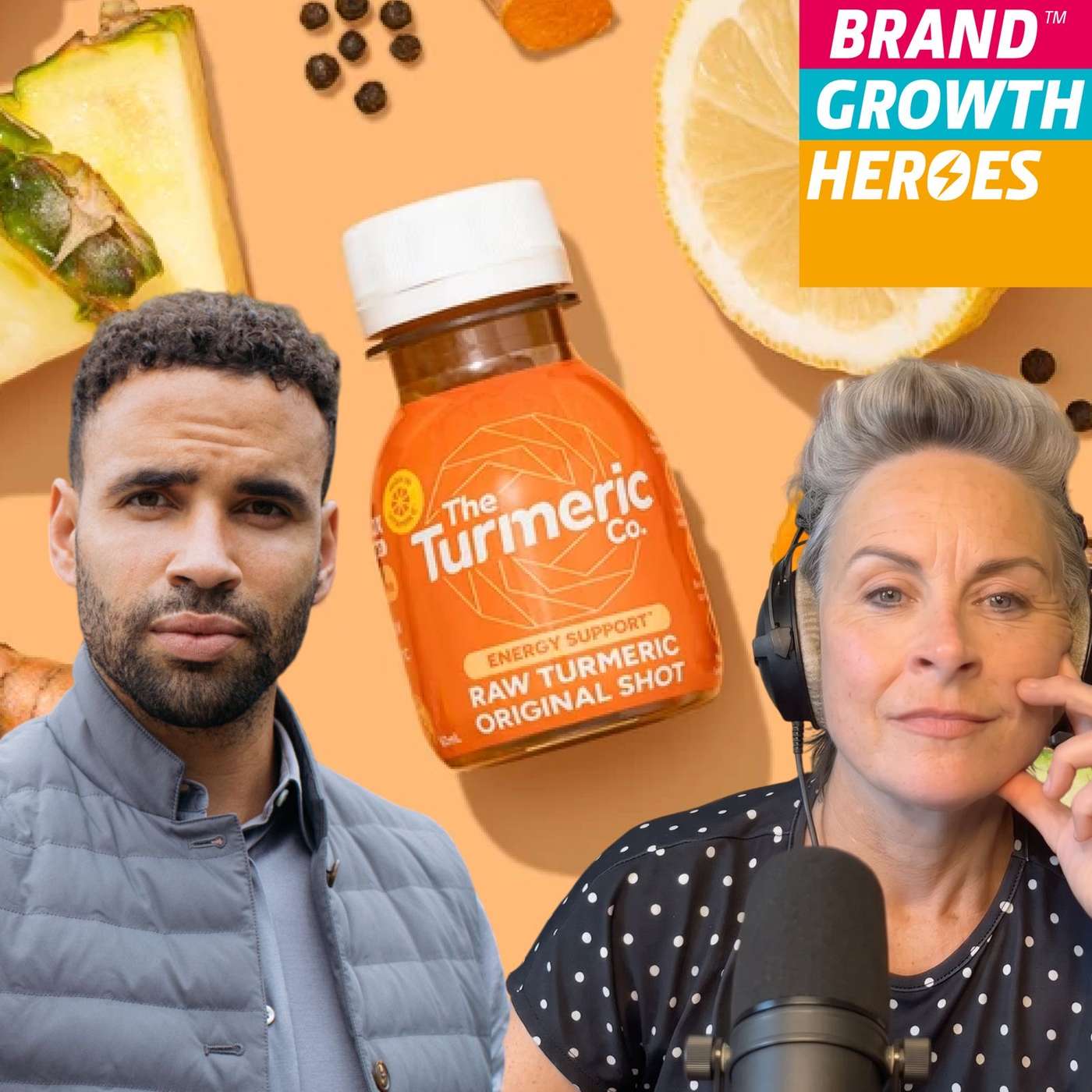
The Turmeric Co. | Why Other Wellness Shots Aren't the Competition
What if the biggest opportunity for your consumer brand wasn't actually in the category you're competing in?
In this episode of Brand Growth Heroes, I'm joined by former Premier League and international footballer Thomas Hal Robson-Kanu, founder of The Turmeric Co., to explore how he's building a functional wellness brand with ambitions that go far beyond the increasingly crowded wellness shot category. Thomas shares the extraordinary personal story behind the business, the proprietary blend developed with his father, and why he believes the future of functional food and drink could be much bigger than most of us imagine.
The Turmeric Co. has become a substantial challenger brand, with Thomas reporting more than 20,000 customer testimonials describing life-changing experiences and estimating that the business sells a shot approximately every six seconds. But what I found particularly interesting was how differently Thomas thinks about brand growth, consumer health, competition and the opportunity ahead. We talk about his vision for food as medicine, the importance of clinical research and consumer education, and the leadership lessons he's brought from elite professional football into building a scaling CPG business. It's a conversation that challenged me to think beyond the supermarket shelf and reconsider how we define the categories our brands operate in.
What You'll Learn
Key Topics Discussed
DID YOU LEARN SOMETHING GOOD? Reviews, follows and shares are basically my 'rate of sale' - please do me a massive favour and hit the button to follow, or to share the love by sharing this episode with another founder building a challenger brand, a colleague or a mate or anyone trying to work out how to build a sharper, more focused business.
AND!
Don't forget to FOLLOW or SUBSCRIBE to Brand Growth Heroes on your favourite podcast app, and even LEAVE A REVIEW - both of these actions make a MASSIVE difference to our mission to help more founders just like you.
IF you leave a review with your name and I can find you on LinkedIn, I promise to write to say thanks!
*** Thanks to Brand Growth Heroes’ podcast sponsor — Joelson, the commercial law firm ***
If you're a founder, you already know how much energy goes into building the perfect product, creating standout branding and connecting with consumers.
But scaling a CPG business also brings legal complexities that can make or break your growth journey - from contracts and regulatory compliance to protecting your intellectual property.
That’s why we’re proud to partner with Joelson, the leading commercial law firm with 10000s of hours experience supporting the founders of scaling consumer brands, just like you.
Joelson works with brands like Little Moons, Trip, Eat Natural, Bear Graze and Pulsin, and advised the innocent founders on their landmark sale to Coca-Cola - and they still work with them at JamJar Investments today!
Joelson is offering a FREE LEGAL CONSULTATION to all BGH listeners (https://joelsonlaw.com/contact/bookings/ We HIGHLY recommend you take them up on it, you'll learn a LOT. (Don't forget to let them know you booked becauase you listened to Brand Growth Heroes)
********
Follow Brand Growth Heroes to learn more from winning founders scaling Challenger Brands:
Instagram (https://www.instagram.com/brandgrowthheroes)
LinkedIn (https://www.linkedin.com/company/brand-growth-heroes/?viewAsMember=true)
Youtube (https://www.youtube.com/@brandgrowthheroes)
Find out more about the programmes and courses Fiona runs here (https://www.brandgrowthheroes.com/mini-mba-2026)
Join the NextGen CPG WhatsApp group for founders leaning in to the value that a leadership approach to engaging with AI can unlock for businesses like yours. https://mailchi.mp/fionafitzconsulting.com/building-ai-native-challenger-cpg-brands
Credits
Thanks to our Sound Engineer, Producer and all-round HERO Gyp Buggane at Ballagroove.com and to Charlie at CBMedia - Mention BGH when you contact them for special listener offers.
Scan the code with your iPhone camera
Listen in the app.