 Brand Growth Heroes
15 Oct 2026 · 47m

 Add vo to ChatGPT or Claude to ask about everything you hear
vo listened to this episode to put together the overview and transcript, so there may be the odd mistake.
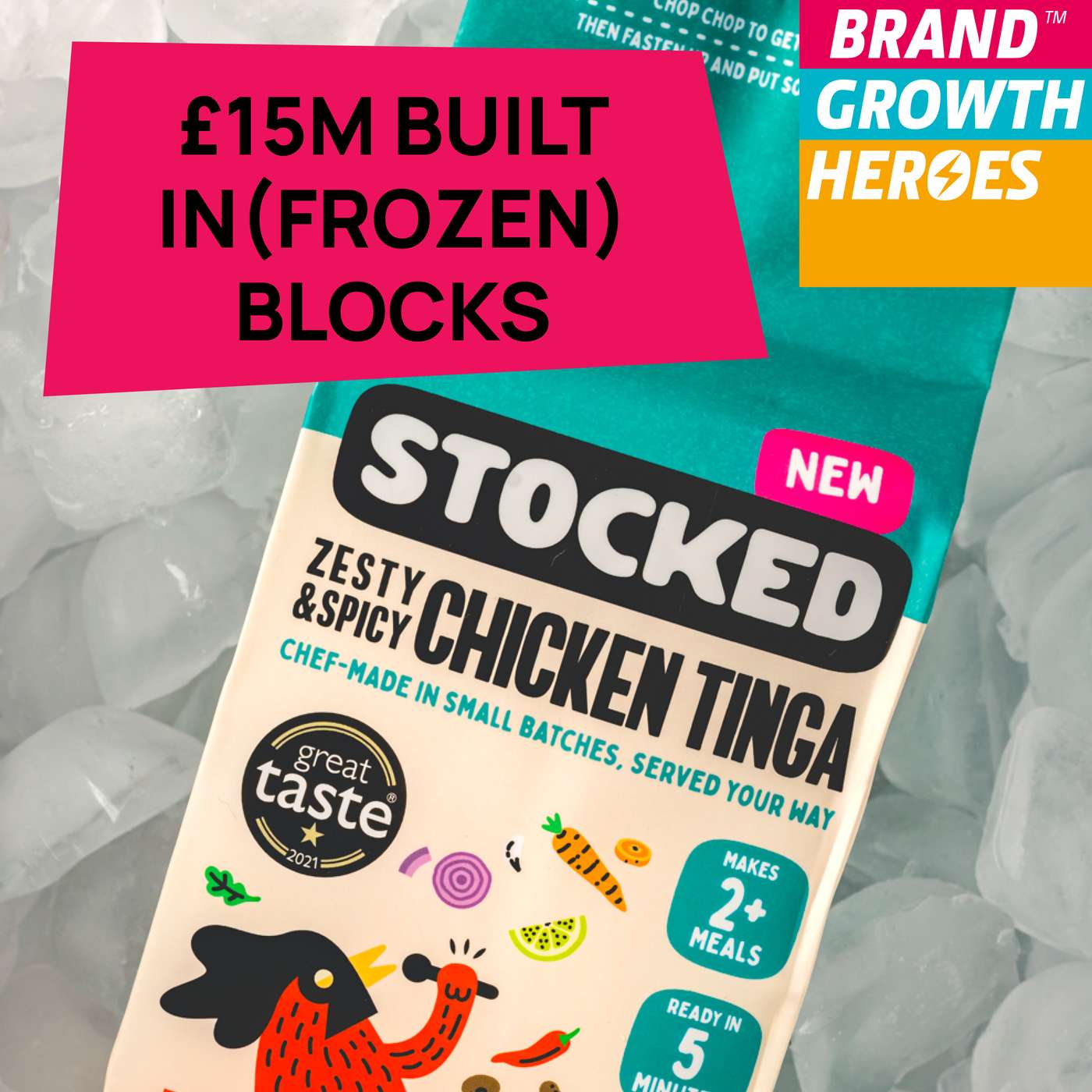
Stocked’s growth story for its frozen, ready-to-cook “meal blocks” (portion-sized chef-cooked meals). They discuss building a manufacturing facility, changing consumer behavior, scaling from D2C to retail, and using Dragon’s Den for social proof.
Average run rate is about £15M/year; started around £4K/month four years ago; hit ~£1M run rate by Jan 2024; Dragon’s Den uplift was smaller than expected but drove major growth (60% month-on-month) and retailer interest (Iceland, Ocado). They keep manufacturing in-house (handmade, chef-led) and believe it’s a moat.
Chicken tinga, beef chilli, curry chickpeas; use cases like burritos, loaded nachos, toast with a fried egg, and lunch “block + rice” reheating; retail listings including Ocado (from Nov 2024), Waitrose (80 stores, Jan 2025), and Sainsbury’s planned end of September.
Charlie Gilpin and Sam Moss, co-founders of Stocked (Sam previously ran a London street-food company; worked in restaurants and on tours including Katy Perry/Spice Girls; Charlie has a food background and led early production/recipe development).
0:00Sam Moss: And we had some great advice from a founder who was in that sort of partnership. And he says, yeah, you know, ultimately get someone to come in with you 50-50. And it means that you share all the highs, but also quite importantly, all the lows as well, because there are plenty of those.
0:21Charlie Gilpin: Sam and Charlie from Stocked are founders who are creating a completely new category, a category of frozen, ready-to-cook meals that you can pull out of the freezer, but in portion-sized blocks. They're already hitting an average run rate of about 15 million a year. I met them four years ago when they did a Brand Growth Heroes programme, when it was still just a six-week programme. I think they were on that cohort with Freya Bone Broth, and it was around the time that Bull Bean and Perfect Head did the programme too. So they're one of our big success stories. Obviously, they've built all of that growth themselves.
0:56Charlie Gilpin: We're just happy to have met them. We have a great conversation where we talk to them about building their manufacturing facility, changing people's behaviours, bringing something completely new to the market, what it's like to be co-founders and friends and tons more. Let's dive in.
1:15Charlie Gilpin: Charlie Gilpin and Sam Moss from Stocked. Premium chef made just like home. pre-portioned ready meals. Welcome to Brown Growth Heroes. How are you guys doing?
1:26Sam Moss: Very well. Thank you so much for having us. A great intro. Yeah, thanks.
1:30Charlie Gilpin: You're so welcome. It has been four years since we have looked at each other in the eyes, right? I think the last time I was sitting on my couch in, it was probably August, September 22, and I knew I'd been diagnosed with breast cancer. And you guys had reached out to see if we could work more formally together post the Brand Growth Heroes programme that you'd done and I couldn't say that I couldn't and I was gutted because I really wanted to work with you and look how well you've done without me. You're amazing. So tell everybody what Stocked is. If you have any packs there, by the way, I should have said, hold it up.
2:12Charlie Gilpin: Tell everyone what Stocked is and how amazing you're doing because you are just brilliant.
2:17Sam Moss: I've got some flat, some flat unfilled packaging there. Okay, go first. We make high-quality chef-cooked frozen meals. And instead of freezing them into a tray with a film, we freeze them into handy little blocks, actually shaped to the size like this, but this one's made out of resin. And that allows our customers to choose their own portion size and serve their food in loads of different ways. And all they've got to do is heat them up and serve them with rice, pasta, wraps, whatever they want, and to have a meal that feels like it's cooked at home, but it's the batch cooking done for you.
2:56Charlie Gilpin: Welcome to Brand Growth Heroes, the leading podcast for the founders of Challenger grocery brands. I'm your host, Fiona Fitz. My 25 years at global giants such as Nestle and Challenger brands such as Goo Chocolate Puds, Chobani and Strong Roots as well as coached to over 400 scaling brands means I have the experience to ask the questions that truly matter and get you the insight that will inspire you to think differently and drive serious growth for your brand.
3:29Charlie Gilpin: And it does taste absolutely amazing. Your chicken tinga. I still dream about your chicken tinga. And this is the kind of thing that anyone who has cooked food and bulk cooked food in cubes for babies will do, but never think to do for themselves. So you can have like two cubes, or they're rods really, aren't they? Or three, depending on how hungry you are, depending on whether it's lunch or dinner. I love it. I absolutely love it. Like it's genius. And I can't believe that nobody had ever invented this before. But because it wasn't out there, it was a kind of a difficult thing to get, for people to get their heads around, wasn't it?
4:01Charlie Gilpin: So talk us through, when we worked together and you were doing the Brangarithura's programme in 2022, You were doing about 4K a month and now you're doing, what, nearly 15 million a year at run rate?
4:16Sam Moss: Yeah, thereabouts. But it's interesting that you say that about people freezing it themselves for their babies because that was actually the origin of the idea. That's how my mum used to cook for me as a baby. And I would batch cook on weekends, but I would hate throwing away Ziploc bags, so much plastic waste. Tupperware took up loads of space in the freezer and I just thought there had to be a better way and my mum told me about the fact that she used to do that and I thought why is that not a thing for adults it's quicker to heat up it's flexible to portion and because it's flexible to portion you could actually eat in more versatile ways so you could have two blocks of chili con carne in a burrito for lunch four blocks with rice for dinner or make you know eight blocks and have loaded nachos when you've got friends coming over so that flexibility versatility and convenience we just thought other people might pay to have in their freezer as well.
5:07Sam Moss: Absolutely.
5:08Charlie Gilpin: And the other thing I think is like when you think about, say, a Charlie Bigham's costs, you know, eight, nine quid, but it's just one meal. Whereas if I buy stocked and I've got it in the freezer, everybody can pull a block here, a block there, two blocks, whatever. You've got like a whole, the possibilities are endless. The possibilities are endless, but they are, right?
5:25Sam Moss: Yeah. And I think that is also part of it. It's, you know, a customer can extract the value from it that they want. And if you really just want to throw in the microwave three or four blocks with some microwave rice it's still a really we think well-priced premium meal you know eating for around a five or if not less but if you want to use this as and use the freezer to the best of its ability and use it in a thrifty way you know a block on toast with a fried egg a couple of blocks in a wrap you're eating high quality food for the same price as a meal deal in tesco and that is really down to how a customer wants to use it which is really important to us yeah and i'm sorry i don't want to diss any
6:00Charlie Gilpin: anybody's meal deals in particular, but like this whole craze for meal deals drives me insane. I mean, the consumer craze for meal deals because it's mainly crap food, you know, really is. They should have way more challenger brands in their meal deal. But yeah, I think it's, we shouldn't be bringing up our young people thinking that that's the be all and the end all of food. It's ridiculous. And not pointing out any retailer in particular there, obviously. But I do think it needs a big kick up the ass what meal deals are like. so take us back to um the beginnings at the time you were just d2c right and you were thinking we were we were talking a lot about how you might get into retail just before i got sick what happened then so what did i miss bring me up to speed how did you get to 15 from yeah a month
6:48Sam Moss: gosh it's been a bit of a ride to be fair so um yeah we launched just over five years ago so the first couple of years we were very much um feeling our way around running a d2c business we just didn't feel like retail was the right setting for this. I think we had so much to learn about the product. I think we felt that retailers weren't necessarily ready for this sort of product at that price point with that much education needed. So DTC was just the perfect avenue for us to be able to understand more about our customer, our product and all of that stuff to allow us to build a stronger case for retail as well.
7:24Sam Moss: And that's what we were able to do. So, you know a couple of years of of of growth I think um yeah about 18 months into our launch we had an email from Dragon's Den and I think that was really the sort of uh window that opened up um for us to launch into retail so we filmed uh Dragon's Den in June 2023 and it aired in February 2024. And the very next day had emails from Iceland, Ocado. And, you know, that was the start of our retail journey, journey, ultimately.
8:00Charlie Gilpin: So you not only did you also get you got emails from Iceland and Ocado, but what about did you have a C &U spike in subscriptions as well immediately?
8:09Sam Moss: Yeah, it's always an interesting one, actually, with Dragon's Den. I've seen a few other founders say they experienced something similar is people talk so much about what being on tv does for you in terms of the night it airs you're going to sell 200 000 pounds of product or whatever it is you hear these amazing stories which for us would have completely changed our business and um and uh and and exploded um i'd say the uplift that we saw on the night was actually a lot smaller than that it still made a massive difference we still grew 60 percent month on month it was our biggest month of growth ever and so it was it had a wonderful impact but like the the main thing that it's actually brought to the business was just that sort of social proof um you know we still use dragon's den content in all our ads we still use it on our website in our emails um people still say they discover us on dragon's den now uh even though i'm pretty sure they might be talking about an ad that involves dragon's den rather than sort actually watching the episode themselves but just that sort of trust that such a major show brings to a business that you know is ultimately d2c you're spending 40 plus quid to try something you haven't tried before and any bit of social proof you can add in terms of number of meals sold reviews but you know dragon's den is a really good one as well so i'd say that paired with the the retailers sort of taking notice of us at that point they were the main halo effects of of Dragon's Den so we recommend it to everyone it's a bit of a no-brainer really yeah absolutely
9:41Charlie Gilpin: I mean especially I'm thinking about all of the brand growth heroes brands founders who've been on the program who've been on Dragon's Den and there's shed loads of them right how many of them are using that footage consistently as a proof point probably not as many as as should be right I know Perfect Ted have done a lot you guys have done a lot um who else uh obviously Emilio went on there with bold bean yeah yeah it was one of the biggest pieces of advice actually we got
10:09Sam Moss: certainly a friend of mine had been on it with her her business um up circle a great um sort of cosmetics business and she said that a couple of years down the line that's still their highest performing ad was the dragons telling them their branding was rubbish and they needed to completely change their brand which they did and change their name but she said even those those sort of clips which there are a lot of getting your hands pulled down she's ever just performed really highly because of the things that Sam said, people are just intrigued, interested, and then get to go on that business journey with you.
10:38Sam Moss: So yeah, it was, again, it was a no-brainer for us to carve all that stuff up and make something good out of it.
10:43Charlie Gilpin: Was it nerve-wracking?
10:45Sam Moss: Yeah, that big time. It was nerve-wracking. It was nerve-wracking because of, obviously, the stress of having to pitch in that environment, but also it's such an iconic thing to do. And I think, of course, it was huge for the business, and we did it for the business, but also as a personal milestone to grow up watching that show. And then to be standing in that room pitching was very, very cool. But yeah, very nerve wracking. I think I blacked out for almost all of it. So it was interesting watching it back.
11:14Charlie Gilpin: Hey, just a quick word about Brand Growth Heroes partner, Jolson. So look, as a founder, you've got loads on your plate. Fundraising, shareholders, co-founders, co-manufacturing, product, NPD, you name it. Scaling is really complex and the legal side of scaling can be really complex too. who your legal partner is really matters because it's not something we can afford to get wrong. That's why I work with Jelsen. Jelsen have worked with brands like Little Moons, Trip, Two Chicks, Graze, Costa Malika, and they've even advised the innocent founders on their sale to Coca-Cola. And they still work with them today at Jam Jar.
11:48Charlie Gilpin: And for me, it's not just that they're brilliant at what they do, but they're also really good people. They care about founders, they care about doing things properly, and that really matters. And they're also one of the few law firms that's both B Corp certified and a member of 1 % for the planet. Recently, I asked one of Jolson's managing partners, Paul Chappie, a tough but crucial question. Should co-founders discuss right from the start what happens if one of them wants to leave the business?
12:13Sam Moss: Absolutely. I mean, with any joint venture, that's what a sort of co-founder relationship is. You've got to be very clear from the outset as to what each party is bringing to that business. Look at the skill sets, look at the time commitment. I often see founders coming where, you know, one founder might have a full time job. They're still getting the same amount of equity. And you can see immediately that there's an imbalance in that relationship that they either haven't looked at or are ignoring. And eventually that will come home to roost. So I think the key thing is to look at, you know, what are we bringing?
12:54Sam Moss: What is that future going to bring? what are the things that, you know, if I have to go and look after kids or have to emigrate somewhere, what's going to happen to this business? What happens to my equity? All those questions need to be thought through, discussed. And contractually, you can then just draft those provisions into that contract and set that relationship on a firm footing.
13:19Charlie Gilpin: You're not going to believe this, but Jolson is actually offering a free legal consultation to any founders who listen to Brand Growth Heroes podcast. And I would definitely take them up on it. You'll find a link to book now directly here in the show notes below, or just drop a comment underneath the episode and I will connect you with them directly. And now let's get back to the show. So what was that in terms of monthly revenue or run rate? Because people love knowing what should they be hitting. Like, what does good look like on that journey?
13:47Sam Moss: yeah i think january uh january 2024 so the month before we went on the show i think we had just reached a million in terms of run rate so you know what's that 85k or however much it is in the month of jan and then you know february pushed us over um january is such a big month for us as well we you know new year new me everyone's looking at their routine and thinking how they can be healthier. So yeah, January was a big step up to that point. I believe it was 1 million at that point.
14:19Charlie Gilpin: And at this point, you're still in your smaller facility at that point in time.
14:22Sam Moss: Yeah, that's actually a great point. That sort of leading up to Dragon's Den was the first time we've been said, okay, we need to expand a little bit. We took the decision to do manufacturing in-house from day one. It wasn't our original plan. Even though my background is food, Someone else can definitely make this. And in fact, we had to pivot before we launched to put together a kitchen and do ourselves because no one can make this product at this quality. And it's become such an important part of the business.
14:54Charlie Gilpin: Why? I think that's really important. Why couldn't they?
14:56Sam Moss: I think for two reasons. One, any sort of big player that's doing production on scale, we're too small for. And this product doesn't exist. It's niche. we still produce it by hand uh everything by hand which is why the quality is there so you're not going to persuade a big ready mill manufacturer to do that with straight out of the gates and then also persuading someone to do it by hand you've got to be absolutely crazy to to take that on which we had no choice uh and if you if you have the choice you wouldn't as we had no choice and we we ended up doing it i was in the kitchen cooking sam was in the freezers packing the orders sending them out.
15:32Sam Moss: We were doing end-to-end process in our six by six meter space. And yeah, as I said, something that started as necessity. I would go, I mean, I certainly started to begrudge it while I was, you know, cooking in the kitchen all the time. It has become something I'm incredibly proud of and have been able to grow incrementally. And now for us, it's one of the strongest strings to our bow. And the first time we got to sort of do a small expansion in our kitchen space was leading up to Jones End to really put the foot down and stockpile. And then we've done, we're still in that same building and we've done some considerable expansions since then with many more on the horizon as we're fortunate enough to keep maxing out that capacity.
16:16Sam Moss: But we've been doing it bit by bit. We've not taken any huge swings. It's been a really nice, gentle way to be able to grow a manufacturing facility.
16:24Charlie Gilpin: And what's the split between DTC and retail now? More or less, you don't have to give us exact figures.
16:30Sam Moss: Yeah, it's like 90 % direct to consumer still. 10%.
16:35Charlie Gilpin: I mean, when you start going mainstream in mainstream retailer in, you know, five, six hundred stores, this is going to just double overnight. I mean, I don't mean overnight literally, but like over three, six, eight months, it's going to be humongous.
16:52Sam Moss: We hope so. and i think so it will be yeah yeah don't want to tell the ops team that but no god you're already in ocado and waitress yeah we're doing really well we launched in ocado in november 2024 um which was a really good opportunity for us i think for us when we've always thought about retail the worry is that we're on shelf behind a freezer door and you've got to do all that education on pack rather than you know facebook ads website email delivery experience there's so many opportunities to educate um so ricardo always felt like the obvious fit to sort of test retail for the first time um and and it has been great and you know it's been uh 18 months or so since we launched in there and um yeah really really happy to actually be the um the leading um brand by value sales in the category.
17:46Sam Moss: So yeah, it's been a good success. Waitrose, we launched at the start of this year in January into 80 stores. So again, a really nice trial and opportunity for us to understand what works and what doesn't work in physical retail this time. But yeah, really happy with how that's going as well. Yeah, and for all those challenges, physical retail, it presents such a big opportunity and another kind of surreal part of the journey being able to walk in and pick your product up off a shelf and buy it and drive around all the waitresses doing a bit of a road trip. And that's a really cool milestone to hit.
18:24Charlie Gilpin: It is. And so I'm just thinking, actually, because I think your products are amazing. Are you, the SKUs are the product flavors that you started with. Are they still the ones that you have? Are they still the favorites?
18:35Sam Moss: Yeah. So you mentioned Chicken Tinga. We, that was one of our sort of initial launch. our two OGs, the ones we were cooking in Sam's mum's kitchen in COVID, before we properly launched were our beef chilli and our curry chickpeas. They're still live, still firm favourites. We launched proper in 2021 with a range of eight SKUs. We've now done over 65 to date unique SKUs, and we have 32 to 35 live on our website at any one time. so we've really ramped up the yeah the offering and then in retail we've got two in our chicken tingle and beef chilli in Waitrose and I think we've now got seven on Ocado which is a nice getting that nice balance between not only too many but having a decent enough range
19:21Charlie Gilpin: Can I highly recommend any listeners who like homemade really tasty really flavoursome food to try this because it is bloody amazing and I am picky I don't know if you have a special discount code that we can get for your website that we can add to the show notes below. Like, if you want to do that, let me know. I just did that with the Duna Superfoods, actually. We did BGH20. So, yeah, but it'd been, yeah, because, you know, like, why not? I really love your products. I really do. And, you know, any retailers who haven't got you in should be getting you in because it is just a no-brainer for people who are running families.
20:01Like, I know, so my kids are 16, 11, and 7, right?
20:05Charlie Gilpin: every single night this week. I will pick them up from school, well, daytime, and then I will drive them places. And I will get home and it'll be a quarter to six and literally I will have left the house at eight. There'll still be the dishes from this morning. Okay. The dog will need a walk. Somebody needs to practice piano. My fella's going to come home and I'm going to think, shit, I still haven't thought of anything for dinner. And I haven't, I'm not that organised person. And I don't know if I can get delivery to the Isle of Man these days because I know we struggle with that in 2022. That was really not, but I would, if I can get delivery to the Isle of Man, I will be like your best customer because it is just a no brainer.
20:40Charlie Gilpin: And it's not actually that expensive when you think about the ingredients and all the waste that you'd be cooking if you was cooking all these things yourselves.
20:47Sam Moss: I mean, that's what we think. I mean, we live in London and going to the local supermarket and buying ingredients to cook at me off for two is as expensive, if not more, than a pack of stocks. We're not quite an Isle of I don't think we've we've got a couple of waitresses in out of white and I think we're in Guernsey so we're we're starting to get there um but uh but even D to C I'm thinking D to C yeah not not quite it's a it's a challenge yeah our boxes you know we've designed the sort of insulation and dry set up to last to the following day to the end of the following day so okay we need next day delivery with the careers that we work with to be able to send anywhere and unfortunately dbd aren't quite there yet um so uh so yeah hopefully one day the the household environment that you uh just colorfully described i mean that is that is why where stocked works the best you know half of our customers are in the scenario that you you've described it's family busy life kids dogs jobs and that care about good food and care about putting something that's you you know, high quality and made well on the table.
21:56Sam Moss: But just no one has time every single day. And it's not about replacing your entire routine and switching everything over. It's about having something in the freezer that is every single time you need it is there, no matter who you're feeding and what's going on. You've got this freezer filler, but one that's not full of rubbish.
22:16Charlie Gilpin: I'm thinking as well, actually, because my daughter, she's now just started sixth form college and they have a microwave and I sent her in the other day there was a bag frozen I'd taken whatever leftover pasta I'd cooked too much and I'd put some olive oil and salt and pepper in it and put it in a small freezer bag and she was on her way into school and you know it's first term in sixth form and I said is there a microwave? She said yeah so I said here just take this frozen bag of pasta and by the time you get in there it'll be and here's a jar of pesto by the time you get in there and go to eat it it'll be defrosted I wonder is that the same like if she was to take a block or two in the freezer bag of stocked by the time she got in, you put it in the, if it's still nice and cold.
22:54Charlie Gilpin: Like that's actually a safe way of bringing food out of home
22:57Sam Moss: to cook at work. Yeah, we find that quite a few of our customers do that and they'll take a Tupperware of a few blocks in the morning, maybe even mixed in with some rice and just heat it up together, let it thaw out in the fridge a little bit and then heat it up together. And that's perfectly safe to do. And I think that's something that we can sort of also uniquely position ourselves as, which is that option for lunchtimes because, you know, a lot of these, a Charlie Biggums isn't necessarily a... He couldn't. I don't think he would. But, you know, it's almost like a treat in the evenings. Whereas what we're trying to offer is something that's a little bit more frequent throughout the week.
23:36Sam Moss: And maybe it's that lunch where you've caught between meetings or maybe it's that dinner where you're ferrying the kids around. And I think just that flexibility of use case as well is quite important to what we do. And also occasion, like you said,
23:48Charlie Gilpin: with the wraps after school or I know like for example a lot of the teenagers today they're big into making their bowls with eggs and like if she gets one block and then stick an egg on it all of a sudden you've got that savoury breakfast that they all want to have which is amazing.
24:07Sam Moss: Sam's a big toast guy with all of our sort of use cases but then that's exactly it where it's breakfast or a snack you know a block on toast with an egg is such an affordable quick way to eat.
24:17Charlie Gilpin: If you're getting value and insight out of the conversations we have with the founders and business leaders on Brand Growth Heroes podcast, then please like, follow, subscribe wherever you're watching or listening to the podcast, whether that's iTunes or Spotify or YouTube, or whether you're connecting with us on LinkedIn or Instagram. It really matters. It matters that you click that button. It matters that you comment. It matters that you engage. We love hearing from you. So write a comment, write a review on iTunes. Tell us if it's making a difference to you. Tell us if you like it. Thank you so much.
24:50Charlie Gilpin: Let's talk about building a moat. So you said that you're kind of proud and happy that you have kept the manufacturing in-house and that it's growing with you and that you're looking at developing in the future. What kind of technological or time or machinery moat can you build around freezing the blocks? Or is it just a question of moulds and anyone could buy a machine that deposits into the moulds and freezes it? or is there more to it than that?
25:17Sam Moss: There's a sort of infinitely more to it than that but we do everything really manually now and there's all sorts of innovations that we've already put into our process but that we can continue to do that and we will as we grow. I think the reason why manufacturing is currently such a strong mode for us is because, sort of mentioned before, you'd be crazy to start it if you knew what it would take to do it manually. And for a big incumbent, you'd be crazy to carve out part of your factory floor to do it in the way that we do it. So we're pushing that no one makes this product to our knowledge and certainly not the scale that we do.
25:56Sam Moss: So we are, I would like to say, the leading manufacturer of frozen blocks, handmade frozen blocks in the country, if not the world. And to continue to be that, to continue to innovate that manufacturing only further sets us apart. We do everything to a really high quality. It's because it's made by chefs. And that's something that whatever we do with our manufacturing going forward, however we expand, needs to stay core to the process. And we think we know how to do that while still unlocking scale through automation and further innovation. And that is an incredibly exciting, stressful, big project, exciting opportunity to keep being able to build that.
26:32Charlie Gilpin: But it's also genius because I was thinking about how do you have 30 whatever core on the website at any one time. no one else can do that because they can't have it on hand and then have it go bad but because it's blast frozen and yeah frozen for a lot of a lot of time you guys can have 30 on hand at any one time and still keep your manufacturing very lean right exactly exactly partially because of
26:53Sam Moss: the frozen element to it but also again something that started as a bit of a uh you know potential blocker but now i think is it's really cool to do um sorry pardon the pun is is that we we specialize in in sauce-based meals curries stews casseroles things that are inherently um you know batch cookable but also work in lots of different ways what we don't do is part a pie and then a risotto dish and then a curry it means our manufacturing is pretty pretty lean and pretty straightforward We're doing lots of variations of something that's quite similar. So, A, we know we can keep doing it really well because we're staying focused on it.
27:33Sam Moss: But B, it means that we can unlock many, many flavors of the same thing.
27:36Charlie Gilpin: Clever.
27:37Sam Moss: And, you know, I thought that there was not that much ground to go down in Casseroles and Stews, but it turns out there is. There's loads. We've done loads. And now we have a really cool opportunity. As we've grown the brand, something that's been really key this year and going into next year is now partnerships because we own manufacture, because we're really rapid. You know, I do all the development and we're really rapidly able to do that. We've done partnerships with other brands, restaurants, food creators who are doing their own dishes, you know, in collaboration with us. Oh, clever. And that's a super exciting addition to our range.
28:10Sam Moss: And we've got some really exciting potential restaurant collaborations and stuff coming up as well. And, yeah, I think that's going to be a really core part going forward.
28:17Charlie Gilpin: So single-minded focus on the casserole-esque type component, right? Didn't you do a risotto at one point?
28:25Sam Moss: We've never done one in the blog form, but what we will do, what we can do is all of our content. We've got, I don't know how many, I mean, in the hundreds of recipes on our website. So if we release a chicken and chorizo dish, which is one of our recent collaborations with the great chef on the social media chef, then we can put out, this is how you take that chicken and chorizo and make a one-hot rice risotto, make a burrito and make a chicken and chorizo lasagna. And that gives customers the varieties of not eating the same old dish casserole every time. But for us, it keeps it very streamlined.
28:58Charlie Gilpin: I think the learning here for anyone listening to this is there would have been, I imagine, a great pressure on you from investors or retailers or your own selves. Could I think, oh, would we not do a frozen wrap? Would we make it even easier? Would we not add the pasta? You know, oh, that'd be much easier. but actually for the consumer, but for your manufacturing capabilities and your machines and your clean down and whatever, you don't have the starches sticking to the side of the pipes.
29:22Sam Moss: I think that sort of point about like easiness to the consumer is actually a really interesting one because I think that's like part of what actually sets us apart is that, you know, for a customer using stops, it feels less maybe guilty than some of our competitors, less like you're, you know, stabbing some holes in plastic film and having a frozen chicken and chorizo lasagna, but, you know, it's all pre-made. It actually does take some effort, which, you know, for a lot of people might think that we're not as convenient as we can be, but that actually means that we're handing that power back to the customer, and there's less sort of guilt because it does feel like they're more in control of the meal that they're creating, and they are doing a little bit of cooking, even though it is, you know, it's quite heavily streamlined.
30:10Sam Moss: and I think that's that sort of nice balance because you know when you ask a customer they say convenience is the main reason they buy us but I think it's like for that customer it's probably as convenient and as they would go and they wouldn't you know they've tried HelloFresh and things like that and it's you know it's taking too long or the produce is spoiling or whatever and it's like you know they're looking for another step of convenience and we're sort of occupying that space between and actually cooking and the ready mill the more of the solution you
30:39Charlie Gilpin: try to fix for them the less people in that funnel because some people won't want the wraps and some people won't want the rice and some people won't want this and then actually by giving them some
30:49Sam Moss: choice you've got more people available to you for sure and one of our big brand challenges is that we're something different to everyone and we appeal to such a wide market now we do have some core demographics i mentioned families thing you know 50 plus so so you know there is a commonality there but we want to be something that is different for everyone can be used in loads of different ways has multiple different price points depending on what you're using so for all the challenges that creates in terms of education and brand and comms it also is really core to why we think that this has such wide appeal and is something that everyone could have in their freezer um and many brands have been a product that's something for everyone um but it it makes a little bit more challenging at the beginning but we think ultimately more valuable as a product that's
31:34Charlie Gilpin: So what about you guys then? So you are friends first, you're friends first, and then now you're co-founders. Talk to us a little bit about that. What's that like?
31:45Sam Moss: Yeah, I guess we've known each other since we were four or five years old. So we went to primary school and secondary school together. So we've known each other a really long time. and I think the really nice balance is that we you know we we stayed in touch through the fact that I was always interested in what Charlie had been up to and maybe he can tell us a bit more about that but Charlie was actually in a different year to me which means that we we actually have like different groups of friends but we have like a very shared uh upbringing so we know each other's families we know each other's friends really well uh you know we'll we'll you know go out together and things like that but it also means that there is like a little bit of separation um where you You know, we do have different groups of friends where, you know, we're not spending five days a week together and then the whole weekend together as well, which might be a bit much.
32:34Sam Moss: But, you know, I think we've got it really, really great in that sort of shared history and like, you know, shared upbringing. But but yeah, you know, we see each other every day. So, yeah, I think it's a really good setup. Yeah. I mean, without a shadow of a doubt, sounds my most contacted person. And I mean, by many, many factors in the last seven years that we've been doing this, I mean, not a single day has gone by. It's a privileged position to be in. And yeah, I've done I've had small businesses before that were solo. And, you know, through this experience, I mean, not for not a million years, but I do go out and do it on my own again.
33:12Sam Moss: Well, I hope I don't have to because, you know, we love what we do. but the value in having a business partner that you share so many values but that you also get to do this incredibly fun thing together and you have that kind of yeah you have that partner all the way through it's just completely invaluable.
33:30Charlie Gilpin: What were you doing before Charlie tell everybody?
33:32Sam Moss: I've been in food for since I left school so I left school when I was 16 and I've been in food ever since. I had a cake shopping cafe with my mum but the sort of core part when I sort of went out my own I had a street food company for five years in London so doing street food markets around the city and private events and pop-ups and all that kind of stuff selling sandwiches selling tasty sandwiches and yeah did it full-time for five years or so and then kind of in that transition between that and Stocked then spent a long time working in restaurants and on music tours and went on tour with Katy Perry yeah went on tour with Katy Perry and the Spice Girls at a point, which is quite a niche part of the CV.
34:10Sam Moss: But that was actually the lead up to Stockton and then got to have a really thrown in the deep end while we're starting to start working in restaurants while we were doing this on the side or before we were paying ourselves, which was a long period. And so really got deep back into the kind of London-y food world as well.
34:27Charlie Gilpin: How do you deal with frustration or conflict or resentment or, you know, how do you do that? Do you have like a way that you deal with that or does it just get sorted out?
34:38Sam Moss: I think we're quite direct. I think we're also lucky again, as Charlie mentioned, where I think our values, our core values overlap so heavily that we probably bicker more about small stuff than anything major. So all big decisions we're very, very aligned on and always have been. And to be honest, the small stuff most of the time as well. And I think both open-minded to what the other one has to say, you know it's never lasting and yeah we're very good at sort of nipping it in the bud if there is any other tension and things like that and just you know getting in front of it but no you know I think we're we're doing pretty well as far as I hear from other co-founding relationships so yeah arguments are few and far between and you also get so much better at it over time you just you navigate it better you have more communication and actually now that we're growing a team, which is incredibly refreshing for Sam and I, and to see this sort of culture that you're starting the business.
35:40Sam Moss: It also means that when it is just the two of us, if we are working in the evening on a project together, it's sort of having that refreshing period where it is just one-on-one and that's how we started the business and we still get to have those opportunities and that sort of helps bring you back down to earth a bit.
35:57Charlie Gilpin: Charlie, what one thing have you learned from Sam and the way he manages a team? and then Sam, I'm going to ask you the same question.
36:03Sam Moss: I think one of the things that Sam brings so well, especially in a team environment, is sort of like diligence and drive, sort of accuracy, diligence and drive, which I think we all need lots of and that's one of the things that I bring less to an environment. But yeah, that kind of like structured way of thinking is, yeah, it's pretty key.
36:24Charlie Gilpin: You know, that creates a nice acronym, D-A-D, diligence, accuracy and drive. dad, be the dad of the team there's something in that there's just something in that and what about Charlie Sam, what has he taught you?
36:38Sam Moss: It's really interesting that Charlie said that because I was actually, diligence was also the word that I had and I think it's like a different way of you know I think Charlie's execution of like following something through that he says he'll do is like something that like I personally don't like have in the same, to the same level in terms of um you know i sort of here it can can sort of be looking at the all these different projects but i think you know the only reason why it's stocked is where it is today is because charlie is so thorough with like execution and making things done to a really high quality um so so yeah i'd say maybe we've learned the same thing from each other by the sounds of it but yeah i'll definitely be mine for charlie i'm actually thinking our brains work in that very very different ways but it sounds like you know i think part of the reason it works is because where we're going and the results are quite similar.
37:30Sam Moss: We just sort of get there in two quite different routes.
37:34Charlie Gilpin: Nice, nice. So what's next? How big are you going to get this, guys? Three years' time. What's the vision? Where are you going to be in three years?
37:43Sam Moss: Yeah, you know, we're always very, obviously we have a plan and it's hopefully the right level of ambitious to keep us motivated and not sort of downtrodden if we miss it. So, yeah, it's an ambitious plan. You know, we've grown really fast, but growth is actually accelerating in recent months. You're not telling me anything here.
38:05Charlie Gilpin: I mean, are we talking 30 million? Are we talking 60? Are we talking 250 million? Are we talking international?
38:13Sam Moss: I'd hate to put some numbers out there into the ether. But, yeah, you know, we want to be at least twice as big as we are now in the coming years. How about that? Yeah, we're, so, yeah. I'll get it from you after the show. We, yeah, we've got some really exciting stuff coming up. By the time this episode comes out, we will have just had our biggest listing to date in terms of stores and, you know, SKUs. So we're going to be launching in Sainsbury's at the end of September. So, you know, the retail rollout is very much underway. and yeah really excited by how that's going but we still think there's a ton of opportunity in direct to consumer and you know improving the experience for our online customers as well and giving them a reason to still shop online I think is really key for us so you know looking at how else we can improve that.
39:08Charlie Gilpin: So you're going to recruit in advance of that growth or are you going to wait until you've grown and then recruit what's the plan?
39:15Sam Moss: Yeah for sure we've the team we've got over 50 people in our production side of our team just direct direct production people which is which is crazy um they do an absolutely unbelievable job in quite a grueling setting production kitchens um and that grows obviously exactly related to demand um and so that's just been growing and growing over the years and then over the last 18 months we've been able to grow the office team uh there's now eight of us full-time we had our new head of growth start today eight of us full-time and yeah more more more job listings on horizon as well yeah and I think we've we've always found that growing the team has always in history been very reactive which is why there was only three of us last January in the office so we've been quite reactive with the office team but now actually you know things moving in a direction that we're sort of more certain about that we can be a bit more proactive and you know when it whether it's the head of growth or um you know previously hiring a great creative strategist um is uh just seeing seeing the effects that really investing in in the team um can have and quite
40:26Charlie Gilpin: frankly can't believe that you only had three people in the office in in january this year
40:31Sam Moss: that's mental yeah last year last year january 2025 last year yeah and and i think probably 10 in total on the Rotary production. So that's just gone nuts as well. Yeah, as Sam said, it's been really cool. We are very conscious of trying to continue to be a lean team because it's been what's got us to this point.
40:52Charlie Gilpin: Okay, last questions for me. Quick fire, right? What's the craziest thing you ever had to do to make this business work in like a few sentences? Go for it.
41:02Sam Moss: Either one of you. Not so much crazy, gruelling. I think for me, to my personal experience, probably only this time last year that I was in our kitchen two or three evenings a week until 11 and 12 p.m just cooking meat just like roasting beef mince and roasting chicken because growing not enough staff and coming back covered head to toe in beef grease so those those those are some pretty like challenging times hopefully behind us now that we've got a fantastic team uh there's
41:31Charlie Gilpin: been quite a lot of those production-y ones what about you sam gosh I mean that's that's hard to
41:37Sam Moss: be um i mean yeah charlie and i was both so heavily involved in the actual production of the product in in early days so yeah charlie cooked our first 50 000 meals i sent out our first you know thousand orders or however many it would have been so um so yeah we you were very heavily involved in in all the ops uh early on uh which yeah was was pretty intense okay i don't
42:00Charlie Gilpin: have as good one as cooking well then this one for you uh best piece of advice you've ever been given or that comes to mind?
42:07Sam Moss: The best piece of advice I was ever given was that we should split the business 50-50, which was some of our early advice. I had been working on stock maybe for a few months before I took it to Charlie. And because of that, we sort of had a different equity split, which sort of grew over time, Charlie's stake, because initially it was, could you help me develop some recipes and then it was like he was obviously adding other value and then got pretty close to 50-50 but wasn't at 50-50 and we had some great advice from a founder who was in that sort of partnership and he said yeah ultimately get someone to come in with you 50-50 and it means that you share all the highs but also quite importantly all the lows as well because there are plenty of those so um so that was that was great advice and you know i think like just sort of any sort of pre stuff before um i think it's pales in significance to like having a partner that is like in it in it to win it um so that was great advice so remembering back to the i think we did six
43:17Charlie Gilpin: intensive weeks on the brand growth heroes accelerator program as it was back then what comes to mind was it useful would you recommend it yeah i i think um we were so
43:28Sam Moss: fresh-faced about business and particularly retail because we were obviously focusing on direct-to-consumer at the time. I think really it just encouraged us to take a step back and look at what are you actually trying to get the consumer to think? Where does it come in terms of what stage of awareness and what are you trying to achieve? I think really taking a step back and looking at our messaging in that way was something that we'd never done before. So we found that whole process incredibly valuable to really strip it down look at all our messaging like what are we trying to focus on um and as you might be able to tell we haven't quite you know chosen one specific usp um but uh but yeah it was uh it was immensely valuable all the time and yeah being able to do that structured thinking in that way and then be able to share it in a sort of forum again And we spent two years pre-launch talking about Stockton and how we wanted it to be and how we wanted people to use it.
44:28Sam Moss: But really in an echo chamber of the two of us and talking to a few mates. So I think that also element of going through that process while sharing with other people was immensely valuable.
44:37Charlie Gilpin: That's brilliant.
44:38Sam Moss: Yeah, and we still speak to some of them even now. So, yeah, definitely sort of formed friendships with them and other people on the alumni programme. so yeah it was fantastic, would recommend it to anyone
44:53Charlie Gilpin: Oh that's brill, well we're delighted to still have you as part of the gang on WhatsApp I'm really excited to see you joining the Next Gen CPG AI WhatsApp group because that's buzzing like absolutely buzzing I just interviewed Martin Holden-White from Grubby earlier and he's been on there for about a month now and he's loving it Cool, yeah we'll get on that Join, join, join, join we've got so many in-house experts actually I had an American company reach out who are humongous AI consultancy in CPG and they couldn't believe how much founders to what extent founders are building their own solutions because these guys have all of their big clients are Nestle, Unilever etc in the States and they're not building their own solutions, they're getting someone else to build their solutions So they were quite taken aback and want to kind of understand more.
45:50Charlie Gilpin: So I think we're really at the leading edge of something all of us who, and I know you guys are building loads of stuff too. We're really lucky to have the flexibility to be able to do it for ourselves and not be at the stage where we're not too big to have to get somebody else to do it for us and not have that control. For sure. It's fab, isn't it?
46:07Sam Moss: Very cool. Yeah, we'll definitely go on that. Okay.
46:10Charlie Gilpin: So lovely to see you. Thank you so much for coming on and updating us. I'm really excited to see where you go. I think it's just going to be huge and well done for being so diligent and brave and hardworking. I can only imagine just how hardworking you've been over the last four years to get to where you've got to. But I think, you know, 15 million now, 30 million, very, very quickly. Very, very quickly.
46:36Sam Moss: Fingers crossed. And no, I really appreciate it. It's great to see you and great to chat through it. And yeah, we'll keep doing our best.
46:43Charlie Gilpin: You will, I know. Lots of love, guys. Thanks so much. Loads goes into the planning, preparation, production, and particularly editing and sound engineering around Brand Growth Heroes episodes. So my first thanks to my tech guru and sound engineer, Jip again of Balagroove, and also to the rest of the Brand Growth Heroes team who all put in so much hard work to bring these episodes to you.
Sometimes it's lunch, sometimes it's dinner. Sometimes you're one, sometimes you're a family of 4. Sometimes it's a side, sometimes you're starving. How does a food brand answer all of these consumer/human need-states?
STOCKED has created a product category that didn't previously exist: chef-made, frozen blocks of deliciousness - that you can choose to eat in 2,4 or 6 - you do it your way.
In this episode of Brand Growth Heroes, I'm joined by Sam Moss and Charlie Gilpin, the co-founders of Stocked, which is chef-made frozen food and reinventing the ready meal with portion-sized blocks that customers can heat, combine and serve however they like.
We talk about their extraordinary brand growth journey, from launching direct-to-consumer and cooking everything themselves to appearing on Dragons' Den, building their own manufacturing operation and securing listings with Ocado, Waitrose and Sainsbury's.
I first met Sam and Charlie in 2022 when they joined the Brand Growth Heroes strategy programme, and it's been AMAZING to see what they've built since. What makes their story particularly valuable for founders scaling consumer brands is how many apparently difficult decisions have become genuine strengths. Manufacturing in-house, keeping their product range focused on one type of food, and asking consumers to do a little of the preparation themselves might not sound like the obvious route to scale. But each has helped Stocked build a differentiated proposition. We also get into the realities of scaling a team, the advantages of having a co-founder you've known since childhood, and why growing a business doesn't necessarily mean making the product more complicated.
What You'll Learn
Key Topics Discussed
Links:
Website: https://stockedfood.com/?srsltid=AU7gw4Uj6rrYMb0tAqZtRTi6oed5mIi3lx0sLIBwb3mbxcQuyzK_pmP5
Insta: https://www.instagram.com/stockedfood?utm_source=ig_web_button_share_sheet&xtok=ZDNlZDc0MzIxNw==
Did you get value from this episode?
As founders, you know how important Rate of Sale is. For you, it's units sold on shelf or from your website.
For us, it's episode downloads, follows, and even comments and shares.
Want to share some love or thanks back this way? Then double-check that you've clicked FOLLOW or SUBSCRIBE - it makes a REAL difference to our business.
Instagram (https://www.instagram.com/brandgrowthheroes)
LinkedIn (https://www.linkedin.com/company/brand-growth-heroes/?viewAsMember=true)
Youtube (https://www.youtube.com/@brandgrowthheroes)
Find out more about the programmes and courses Fiona runs here (https://www.brandgrowthheroes.com/mini-mba-2026)
Join the NextGen CPG WhatsApp group for founders leaning in to the value that a leadership approach to engaging with AI can unlock for businesses like yours.
*** HUGE Thanks to Brand Growth Heroes’ podcast sponsor — Joelson, the BEST commercial law firm for Founders of CPG brands ***
If you're a founder, you already know how much energy goes into building the perfect product, creating standout branding and connecting with consumers.But scaling a CPG business also brings legal complexities that can make or break your growth journey - from contracts and regulatory compliance to protecting your intellectual property.
That’s why we’re proud to partner with Joelson, the leading commercial law firm specialising in helping founders of scaling consumer brands.
Joelson works with brands like Little Moons, Trip, Eat Natural, Bear Graze and Pulsin, and advised the innocent founders on their landmark sale to Coca-Cola - and still work with them at JamJar Investments today!
Joelson is offering a FREE LEGAL CONSULTATION to all BGH listeners (https://joelsonlaw.com/contact/bookings)- we highly recommend you take them up on it!
Credits
Thanks to our Producer & Sound Engineer Gyp Buggane at Ballagroove.com, to Kimberely and Charlie, to Nats and all the BGH team.
Scan the code with your iPhone camera
Listen in the app.