Ask ChatGPT
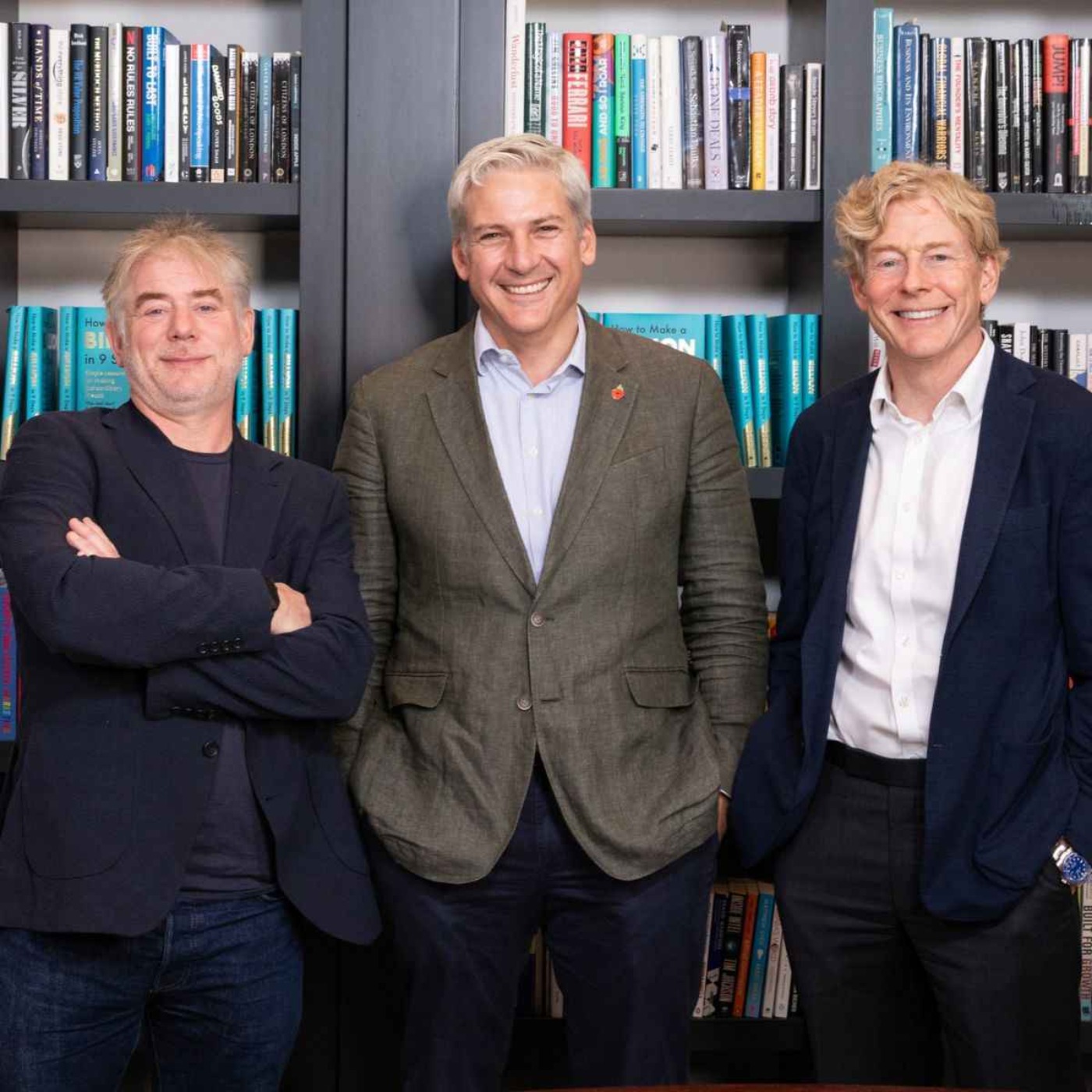
 The Business Leader Podcast with Sir Richard Harpin
30 Sep 2025 · 45m

How Thierry Garnier turned around Kingfisher, owner of B&Q and Screwfix
Thierry Garnier, Chief Executive of Kingfisher
In this episode, Graeme Ruddick speaks with Thierry Garnier, who has successfully revitalized Kingfisher, the parent company of major UK retail chains B&Q and Screwfix. Garnier shares insights on leadership, retail evolution, and the future of shopping, particularly emphasizing lessons learned from his extensive experience in China.
Written by AI. May contain mistakes.

Get the gist, explore an idea or ask about something said.
 Claude
On The Business Leader Podcast with Sir Richard Harpin, what are the key points of this episode?
Searching your listeningAutomatic transcript. May contain errors.
0:00This is Britain's growth moment. Do you want to be part of it? On 26th of March, 750 of the UK's most ambitious founders, CEOs and investors will gather in London to shape the future of mid-sized business. The company's driving our nation's success. The Business Leader Summit 2026 isn't just another conference. It's a day built around the three forces that define growth, ambition, policy and capital. And as one of our valued podcast listeners, you can be there in person. To secure a discounted ticket, visit the events section of our Business Leader website and use this code. BLPODCAST, all one word, all uppercase.
0:41We look forward to seeing you there.
0:49Hello and welcome to the Business Leader Podcast, where we look at the stories and strategies behind modern businesses. I'm Graeme Ruddick. In this episode, we're going to look at one of the biggest retailers in the UK and Europe. B &Q and Screwfix are the top DIY brands in the UK for households and for tradesmen. Brico Depot and Castorama are the same in France. These brands are all owned by one business, Kingfisher. I've been reporting on Kingfisher for more than 15 years, and it's fair to say that during that time, it's had its ups and downs. On the one hand, this is undoubtedly a big company.
1:22Kingfisher has more than 1 ,900 shops and more than 70 ,000 employees around the world. It generated annual revenues of£13 billion in its last financial year, with annual profits of more than£300 million. Kingfisher is valued on the stock market at more than£5 billion in the UK. But Kingfisher has had to battle for sales with traditional rivals like Homebase and new emerging online competition. And it's also struggled to address a fundamental issue, how to get all its different brands actually working together. In the past, there's even been a debate about whether Kingfisher makes sense as a business.
2:01Shouldn't all these retail brands be separate businesses? What do British customers actually have in common with their French counterparts anyway? But this has changed under Thierry Garnier. He became chief executive of Kingfisher in September 2019, after 20 years with Carrefour, the giant French supermarket retailer. Since then, shares in Kingfisher have risen by nearly 50%. Then Thierry Garnier has got the business motoring and working together. He's also pioneering new ways to shop, including the delivery of online orders in less than 30 minutes. I've come to Kingfish's head office in Paddington, London to hear how he's done it.
2:39I think one of the usual mistakes, even of a group CEO, is to try to do too much together as a group. So to push the synergies too far. And obviously when you have different countries, different banners, you want to have people working together and doing things together. Tech purchasing, there is, if you take big FMCG companies, there is a benefit for a retailer to purchase and to negotiate as one group versus, let's call it Coca-Cola at Unilever. But if you go too far, which is to say, let's say, in improvement, you have product A and product B, you should try to convince your UK team and the French team that they should absolutely choose the same product to buy better.
3:27Then you have high chances to lose a customer that doesn't want to buy the same hammer or the same kitchen exactly by country. And that's, I think, what's happened to Kingfisher, pushing too far the commonality, trying to do too much together for scale and purchase reason and losing the customer and then losing sales and losing market share. So I think to find the right balance in retail between scale and doing things together and agility and local adaptation is very tricky. And clearly, I think in the past, Kingfisher did not get it right. How do you find that balance? I think it's years of thinking, you know, having work in many different countries, like a country CEO, an experience group.
4:12And then you have to be relatively simple at the end. So what we said at Kingfisher is to say every customer decision should be managed by banner. So it's B &Q or customer in France decision to say what is the right loyalty program, what is my right pricing, what is the right ranging. But the group is together for technology and private label. And that's stupid to have 10 teams in charge of AI or marketplaces or to have multiple teams in charge of private labor. And that is non-negotiable. That's managed by the group and the rest. How you organize that between group and banner? That's where the details come in.
4:54But overall, to give back the agility on customer side to the banner is the key thing. So when you joined the business, what did you find? What was the mood among staff and how did it compare to your expectations? I think the mood was pretty low because indeed, I think the balance went too far on the centralization piece and doing everything together, etc. So we relatively quickly, with the team, balanced a different position, giving more agility to B &Q, to Castorama, to Skrufix, while retaining a very strong scale and grip on private table and tech. And I think very, very quickly, this way of working has been smooth and stable.
5:42And it's not a topic anymore. How many people did you meet and speak to when you joined? Was it traveling around the world? I think it's very valuable when you start to try to talk to the entire management team. So I think I talked to 120 people with one to one, probably one hour with 120 people the first three months. Then it gives you a lot of insight. Plus, you get to meet people. you need to see what are the talent in the organization and then you you you get a lot of insight so you build your intuition around what is the right plan pretty quickly how quickly did you realize what was needed and was the feedback you were getting similar across i think you you usually you know when all of us you know you have your own intuition you you you come with intuition then you you fine-tune your intuition and then through listening through talking to people and you gradually get to a clear view.
6:36I think probably after two months I had a view on where to go and then you have to do that with the team, you need to recruit people, you need to convince people. That takes a bit more, then you need to build a plan, you need to engage with your board. I remember so I arrived end of September 2019 and we had our big strategic board meeting end of February 2020. So relatively fast. And then COVID started and we were ready. One of the things that Thierry Garnier and Kingfisher have focused on is trying to develop the culture within the business. This has meant giving more power to store managers to decide what products to stock in their shops.
7:19It's also meant trying to make everything move faster within this giant company. But it's one thing for a CEO to say they want speed and another entirely to actually make it happen. So to get that speed Thierry Garnier has encouraged Kingfisher to embrace mistakes. I think overall if you want to go fast you need to empower your team and I think what I said we discussed speed with customer but that's the same for for business you you want to strive you need to go things to do things fast and you don't do things fast if you do that yourself and you want to control everything. So you have to empower your team to do things themselves.
8:00So agility in the way, for example, at Kingfisher, we have given back freedom to manage the customer in the banner and not do that centrally. And the same at store level. Or in the, let's say, B &Q organization, we empower the store manager to make some local decision so that we are more agile and more efficient. You cannot give, you cannot empower a store manager on everything. You know, let's think about pricing. You have 50 ,000 SKU. It's complex. We need software. We need AI. But still to empower a store manager to make some local decision, very important, let's say, guerrilla product when everyone is fighting on the price of cement or bricks, that's something you have to keep even in a world when you have a lot of AI and software.
8:50how do you empower a local store to buy more of this product because you discover around the store you have a catchment area that is different. So you need to bring a lot of knowledge through computer and AI but you need to keep some local flexibility given to store manager and obviously banners. Banners for us is a brand that's in the NQ and Capcom. From people from the outside, what might they be surprised about in terms of what decisions store managers and divisional heads can make? What powers do they have that might surprise people? I think it's a very different culture by country. You know, traditionally, the UK is very processed.
9:27You might ask a store director to be in charge of KPIs more than sales and profit. You say, oh, no, no, no, you know, I need to make sure this product is available, like my inventory is accurate, that my team arrive at this time, that my price accurate, but not necessarily in charge of sales and profit. While in other countries, you will have the opposite. You'll say, oh, store manager, you are already in charge with profit, sales, all the P &L, and you have more freedom. And I think you need to be in the middle. It's difficult, as you say. How a store manager can decide on a daily basis pricing on 50 ,000 SKUs.
10:11It's impossible. what is the best merchandising plan for a category this should be set centrally but if if you don't let a local team if you don't empower the local team on part of this business you lose engagement and you lose you know the local the local feeling that you have in front of you a competitor that give discount on kitchen and you can't react so we need you need to find some balance here yeah when you look back at everything you've achieved with the business so far over the last five years what are you most proud of? I think probably one, the culture, you know, how we kept the beautiful part of Kingfisher culture.
10:50You know, that's a culture that is very caring. People really take care of each other. Some are perfectionists. I speak about being Q, really focused on doing the right thing for their team, for the customer. And so when I speak about culture, I think we have brought more speed, more agility, more risk, risk-taking. When we discuss internally, we think it's never enough. You know, we should really encourage a team to take more risk and to go faster. But we have clearly introduced speed and agility in the system while keeping this initial very nice culture. I think, two, we have found relatively quickly the right balance between agility and scale for the group.
11:31That's tricky in retail, very, very difficult. And then, three, we are on good path toward the store of the future, in my view, you know, e-commerce and bringing more technology in stores and discussing the right format. I think we are doing a lot of progress here. How did you introduce that speed and agility into the business? Because this is a business, obviously, it's a big business across many countries. I think it's fair to say it wasn't particularly renowned for its speed at all before you joined. So how did you get that in? I think it's really around how do you manage the mistakes and the start from you.
12:02there's many you know many stories i could recall around how in the in the first days when a team tried to do very hard something but still it ended up with a mistake how you personally react to it and you need somehow to encourage i would even go to the point you need at the beginning to celebrate the mistakes so that people understand that it's okay and it showed you are taking some risk. Obviously you know, you don't want to encourage mistakes, you know everyone is want to do a good job and that's a purpose, but somehow when the mistake happens, how personally you manage it, set the tone for the entire organization and that's probably what I'm helpful at the beginning and that's a journey constantly to be to really be aware and look at this topic very very carefully because it can kill the trust very, very quickly.
13:03But that's, I think, the way you should do it. I come back to your question, but when we started Smaller Format in 2020, we tried three different types of things. And one of them was to create mini B &Q inside Asda stores. And I think we tried eight of them. And after 12 months, we closed the eight stores because purely was not successful. We made an acquisition of a small marketplace, service marketplace called Need Help in 2021 or 22. We really believed that marketplace around installation. So you want to have installer for your kitchen or for your flooring, and you post your job online and you receive offers.
13:51We were really convinced it was a great idea. Here we bought this marketplace. After three years, we struggled to make it work. For different reasons, we sold it back. So even at group level, you know, we are sometimes doing mistakes, but we try to do things fast and to correct the mistake fast. So as a manager, you need to start to test things and to demonstrate to yourself that you are somehow managing the mistakes well. Therefore, the team is encouraged to do things faster and to be afraid of your reaction. How do you decide when to call it quits and something and when to keep going? If you take the ASDA example, why did you make the decision after 12 months?
14:31Why not keep going? I think there is a point where everyone around the table is convinced it will never work. So at this point, you should make the decision. You need to give the project some time. You don't overreact quickly, but very often when you have a project like that, You say, oh, let's wait one more year, let's wait two more years. Well, everyone around the table is convinced that, no, we're really not convinced in the right thing to do. Then you have to push the team as well to go fast on the decision to stop. Another anecdote, when I arrived in 2019, 2020, King Fischer had more or less stopped entirely promotional event.
15:17The idea was to go for everyday low price and promotional event is a distraction. So we stopped promotional event, which for many different reasons is not a great idea when you have a very big store like B &Q Orchestra. So when I arrived, we discussed that with the team and we decided quickly to restart promotional event. And B &Q did a 3-4-2 in paint very quickly, just a few weeks after I arrived. Probably too fast, so massive success in volume that crashed on margin. so all the finance team was running around my desk saying oh you know Thierry they're there they are crazy you know they are destroying the margin of being you is to promotion doesn't work so how do you react to that so you have to say well thank you well done because you did exactly what we discussed we should do now okay maybe it was a bit too extreme in some ways we have to keep fine-tuning that but how you react to this very good intention which has the end impacted your profit but which was a very good intention so you have to encourage the team to continue and in fact after that we did another promo that was successful etc and then we had very good outcome but what is your personal reaction to that building these foundations within the culture of the business is helping kingfisher to think about the key questions of the future including the most fundamental question of them all.
16:40What does the future of shopping actually look like? Kingfish's approach at present is to develop shops that can also be used for online orders. This means that customers can get their products delivered at home in rapid time or come and collect it from the shop almost straight away. Thierry Garnier has been looking to China to understand what this future could look like. I think it's more probably help us to accelerate some of the thing, you know, and we'll probably discuss later around the past and China. One of the key things for me is how do you think about the store in the future and what can you learn from other parts of the world around what is a store in the future?
17:19And one of these points was around bringing back e-commerce in the store, so preparing e-commerce order in the store, using the store as a click and collect point, delivering to home from the store, and that's typically something you see in China. and when you speak about it in a normal situation, people will say, that's interesting. Let's test it. Let's discuss it. But when you're in the middle of COVID and you close your entire store network overnight, then start to be a real discussion. Say, all right, it's tomorrow morning. Are we ready to do store picking, store preparation, click and collect in thousands of stores?
17:59So I think COVID helped us to accelerate the views and mindset, especially for me, around the start of the future. It was a great time. You've talked something there about the story of the future. What is the story of the future? What do you think it looks like? Maybe let's speak a bit about the concept you see in other parts of the world. And for me, one of the most innovative and inspiring concepts is a concept called in English, fresh hypo. It's Roma in Chinese, so it's part of Alibaba. So in 2015, they started their first store. And I think that day, all the other food retailers of the world, so in China, you had Walmart, you had Carrefour, started to visit this concept to say, wow, that's kind of slap in your face, you know.
18:44In a world where you can be delivered home in 30 minutes for free, why you go to a store? You have to go up to there. If it's so smooth, it's free, you're delivered in 30 minutes. Why you want to go to a store? The first, you go to a store if you have some pleasure or really interest to do it. So if you have a standard product, let's call it a bottle of Coca-Cola, why you go to a store to buy a bottle of Coca-Cola? You know, you have no doubt about the quality. You have no doubt about the product. You have clarity of the price. So what is the benefit? So you see clearly you go to a store when you have first year pleasure.
19:23So let's take home improvement people. they have pleasure to be in a home improvement store and talk to colleagues in store to get advice. If you think around the Chinese situation, you know Chinese people, they are passionate about seafood. So to buy seafood is a pleasure. If you speak about French, they would say, oh, buying cheese is a pleasure. So I am able to spend maybe 10 or 15 minutes of my life to choose a cheese. And therefore, I will go to a store to do that. Or the part, if really I need to touch product, I need to make sure I buy the right kitchen with the right colors, the right materials.
19:59Or if I really need proper advice and interaction with the team, so I will go to a B &Q store, I will sit one hour to redesign my kitchen. That is a big benefit. But if you are talking about standard, pro forma, no-brainer items, you can buy them online and get delivered. So in this format in China, they will put the, if I say the no-brainer stuff in the storage room. And you have in the store only what is experience. So you'll have fresh food, food court. That's a big thing. The second thing is you are using your assets to deliver fast to a customer. So you reorganize your entire store to be able to prepare in a few minutes so that they can deliver you home in 30 minutes.
20:49And that's difficult for Amazon to compete with you because you are really leveraging your assets to do that. And you can leverage your store to do click and collect. So that's you start to build the store of the future. Probably last piece is how you use technology to reduce all the back office jobs. In this store, you don't have to check out anymore. You enter and you say, well, where does it work? That is more or less a fluid entrance and exit. Use your mobile to scan the product. You pay and you leave. So how can you go to this smooth customer path in your store? So using technology so that you really focus your entire energy and team on customer experience and not on back office.
21:37So that's how we see the start of the future, King Fisher. So for home improvement is really dedicating your team to store experience, advice, design, using technology like self-checkout or mobile to, let's say, reduce the back-office task and shifting your e-commerce proposition back to the store. Because you have, imagine you have thousands of stores, you already have your assets. If you can use them for store preparation, for e-commerce preparation, and you don't need to build fulfillment center. And you can use your local network to deliver to customers quickly. So there are a lot of consequences and that's not necessarily the standard in Europe.
22:17You know, in Europe, you have a lot of companies that believe in big distribution center. Let's take the UK and the Midlands so you can deliver the entire UK from there without relying on your store network. So that's, I think, it's a very interesting debate. How has that changed your thinking in terms of the number of shops but also their location? This is a very good question. I think you see, if you describe this model and you believe in this model, and by the way, when you look at the biggest retail in the world, you know, the Walmart, Target, Carrefour, etc., they are moving back to that direction, learning from China, meaning bringing back their e-commerce operation in stores, pushing store preparation, click and collect back today, Probably Walmart today has a higher valuation multiple than Amazon, which is impressive.
23:12And that's entirely by pushing this ecosystem and bringing back e-commerce back in the store. So you need stores. Maybe you need smaller stores for all these reasons. But you can use the space to create what we call dark store, means small storage in the store when you prepare e-commerce orders. but you need to be close to people so it it's it's really bringing back somehow the store network on the on the front not necessarily very large store but you need we need many stores how important is speed and how long did it take you to to adapt your thinking max i think when initially you were like why does anyone need anything in 20 30 minutes but why is it so important i think it's uh let's let's first speak about the customer i think the the world is going to faster processes.
24:04And our younger generation are probably even more impatient than older generation. And you see today TikTok and how many minutes we're able to focus our attention. It starts to be, I think, a topic for the education across the world. How many minutes can you really be attentive and focus your attention? And therefore, delivering fast in a few minutes becomes very important. When I was in China, one of the last conversations I had with my marketing team was, oh, I need to get delivered shampoo in a few minutes' time. I said, well, tell me why, Sean, your bathroom, why do you need shampoo in 30 minutes?
24:46Because I don't want to do a to-do list. So I'm in my bathroom, I'm lacking product, I would just call and I received my shampoo in a few minutes' time. And because I'm not ready to wait and I'm not ready to do a to-do list. So I think this is a trend you are seeing a lot. You know, a few years' time, if you say, do you believe Deliveroo or Just Eat or Scroofix Sprint will be successful in the UK? People will say, well, why do you need stuff in 30 minutes or in 20 minutes or in a few minutes' time? And that's coming. So I think it's just the beginning. Speed will become more and more important in the way we consume news.
25:26we listen to media or we buy and that's something we have embraced since 2020 working on faster click and collect faster home delivery and i think it's we will continue to to progress there how do you do it effectively and efficiently because the last mile of delivery has always been a challenge for retailers to be able to do it properly as profitable as as stores how can you I come back to my little anecdote of Fresh Hippo in China. When we discovered this concept in 2015, a relatively small store was able to prepare 5 ,000 to 10 ,000 orders per day. When I was at the Carrefour Executive Committee, it was more or less the size of Carrefour e-commerce per day for the entire store network.
26:21and therefore we say, oh, it's not feasible. It's not be a story. Let's check it. So we check it and it was true. And at Kingfisher during COVID, we gradually went to 1.5 million orders per week prepared in a store. We joined tight flexibility. We could order more, we could order less. So very, very significant. and I don't want to give a precise equivalent, but large grocery retailer in the UK were preparing$1.3 million per week at the same time. So if you really use your assets, if you use technology in your store to optimize this preparation route, you can be very efficient. And that's something everyone is rediscovering now.
27:11How are you finding it in the UK? What services are you finding? So I think today, for example, B &Q, we are offering click and collect in 50 minutes. So you order online, you can collect your product in 50 minutes. Screwfix, we are committed to a click and collect in a minute. And we are delivering home broadly around 20 minutes with Screwfix prints for 60 % of the UK. And we are applying the same methodology across the group. You know, we are doing the same in France, in Spain and in Poland. her. Thierry Garnier has looked to China to learn because he knows all too well that this is where the future of retail and business could be found.
27:49He led Carrefour's business in China before he joined Kingfisher. Thierry Garnier initially studied engineering and mathematics at the prestigious Ecole Polytechnique in France before working in the French government with Michel Barnier. However, in his early 30s, he joined Carrefour and began an illustrious career there that spanned more than 20 years. In 2012, he moved to China to become the chief executive of Carrefour's Chinese business. At that point, Carrefour was the biggest foreign food retailer in China. From 2008 to 2012, I was in charge of international businesses of Carrefour outside Europe, so South America, Asia, India, Central Europe, Middle East, etc.
28:35Based out of Paris. So I was traveling a lot, three weeks per month, and managing probably 10 or 15 countries. And after four years of that, it was probably difficult for the family. It was exhausting. And I already felt I learned enough. So I suggested to my boss to send me all in Brazil or in China to do the same, but at least not to stay in Paris. And I would live locally and learn something else. And surprisingly, after a few months, the Group CEO told me, oh, I thought about it. It's a good idea. Why don't you go to China and you manage Asia from China? So I ended up to move to Shanghai in 2012.
29:21Carrefour in China was the number one retailer at that time. It started in 1995, so very impressive, very bold move. had major reputational issues in China with boycotts against the stores, with the kind of feeling that it was colonial management. So when I arrived, probably my number one challenge was to try to recreate a bit of good mindset from all the stakeholders, starting from the Chinese government to every local government, colleagues of Carrefour toward the management of Carrefour China. And the angle I took is I will learn Chinese because it will demonstrate that one, I will stay for a while, two, that I really try hard to understand you and to respect your culture.
30:08And I think it was the right thing to do. So while learning Chinese, I have a few anecdotes there as well that it's very tough, but it really helped me very quickly after a few months to convince from the Chinese government to all the Carrefour colleagues that I was really there for Carrefour China, not for me, and really by respecting their culture, their history, and their ideas. And probably after six months, a lot of that disappeared. A lot of the issues disappeared, and we really were able to move to business and digital issues, etc. And one of the challenges I set myself is to become one of the members of what's called the China Retail Association.
30:58It was a massive government association from Alibaba to hotels, Ikea, etc. So after a few trials, I was, because to be elected part of the board of this association, you had to be elected by the member. So for a foreigner, it means you have to do a big speech in front of thousands of people, in Chinese, obviously, to say, oh, you should vote for me. So the first year I tried, I was not elected. The second year I succeeded to be elected. And I think up to now I'm still the only non-Chinese to have been vice president of this association. And it really helped me to be closer to the government, to talk to other retailers and to learn and to be gradually part of the ecosystem and to improve the reputation of Carrefour in China.
31:48So it was very interesting. When you arrived, those reputational issues that Carrefour had, fair? Or was the business being challenged by China and the government? No, I think it was fair. No, I think it was fair. It was fair, reputational issues. Then there's always stories, you know, and local media. Then there are exaggeration, but part of that was fair, I think. What did you, I mean, this is a broad question, but what did you think of it as a place to do business? that initially what sort of things stood out first of all it's a fascinating place to do business because that's it's always very bad to try to characterize people you know big french are like that or british are like that chinese are like that but there is a genuine appetite for change it's very rare to see people that are not at various degree against change we're saying oh Are those colleagues or this company relatively okay or adverse to change?
32:50That's people that are relatively, they like to change. They like new things. So their ability to go fast and to speed on decision and action are very impressive. At the point that they will sometimes not tell you if they disagree, but they will go for it. Then it was a time of massive digital transformation for retail with the rise of Alibaba, you know, large delivery platform like Metron, Tencent with WeChat, big apps, super apps. So it was really an interesting period of time. And what surprised me, let's say, versus what I know in France, is in fact the ecosystem was very open to foreign interaction.
33:38There is a massive language issue. You know, a lot of Chinese businessmen, they don't speak good English. Your colleagues in store, they don't speak good English. So to be able to interact with them if you don't speak Chinese, it's difficult. So there's a very big language barrier. But as soon as you are able to speak and interact, the ability from the Chinese ecosystem to listen to foreign voices, I was very impressed. In this retail association, I have really a lot of anecdotes where other large companies were asking me, what do you think? How would you answer to this question from a European point of view, which would never happen in France, by example.
34:20How much did you, I mean, you've talked on this quite a lot already, but how much was there to learn about technology and e-commerce? How far advanced was it at the time? And then second question, how far advanced is it today? And what things are going on there today that you think are interesting? I think they are still today, and it was very, very advanced at that time, when I left 2015. Today we speak about QR code on restaurant tables post-COVID. It was already everywhere in China in 2015. In 2015, you go to a restaurant, you ask for a waiter to come. They say, no, no, please scan your QR code on your table.
34:59You have face recognition, so we can discuss about face recognition, but you can pay large, probably 70 % of the Chinese store. You pay with your face with absolutely nothing, no wallet, no phone. The large number of parts of China, Wi-Fi is not popular anymore because the 5G is so strong that why use Wi-Fi? And everybody's reading books on their mobile phone. And that's several years ago. So the adoption of new technologies and changes is very interesting, very impressive. Not everything is applicable to our countries, but still it helps you to think, you know, why do you need a checkout in a store?
35:44Why don't you just use your mobile to scan and pay? You know, what is the role of apps in the future for payment? that's already in WeChat in China is the super app and it's used for the past 10 years. So I think it's still very advanced. It's a lot of inspiration for me in my view. What's going on there today that you think is interesting in terms of retail and consumers? I think I've been back to Shanghai last year in November. What struck me, for example, the number of electric cars in Shanghai The city is very quiet. You walk, you don't hear noises. It's a very strange feeling. That could be our cities in a few years' time when the number of electric cars will grow.
36:33And there's still this energy around changes, digital innovation. Speed is still there very much. It's a good inspiration. When the time came to leave China, were you disappointed? Yeah, it was a difficult decision to leave. I was very happy to join Kingfisher, but to leave China was a tough decision to make. Thierry Garnier has a unique perspective on what it takes to be a business leader, given his background in mathematics and engineering, and the fact he's worked around the world. Today, he's also a non-executive director at Tesco, the UK's biggest retailer. This gives him a seat at the boardroom table at another big company.
37:10So what's he learned about leadership over the years? In every culture, you know, you have your challenges. I think in China, it's very difficult to get direct feedback, but you need the feedback. Otherwise, you can do major mistakes. So you need to get the feedback in one-to-one, not in group meetings, from people that trust you. And they will tell you, you know what, I think it's a massive mistake. Don't do that. We could do that differently. Because as soon as the boss has made a decision, clearly communicated, people go for it. that's great because you know you have limited you really have a lot of energy to deliver something that the company has decided so to get the feedback ahead of that before your decision and to make sure you go to the right direction is a challenge but again the appetite for change and doing things is very interesting, very impressive it's 80-20 so really the team will be very practical we lose the 80 % that can't but sometimes it's not perfect so we need to be cautious about doing the 80 % right the speed and the pragmatism is very impressive How have you evolved as a CEO and a leader in recent years and since you started the career?
38:30Yeah I think that's a great question for me I think I was I told you I studied mathematics and I studied engineering So I was probably a very perfect perfectionist engineer 15 years ago. And probably it impacted me as a leader. I was not a good enough leader. I was controlling too much, doing too much myself because I wanted to be a perfectionist. I wanted to be perfect. And China really helped me to change that because very quickly I discovered I would not survive. I would be so slow versus competitors if I want to launch things when it's perfect. So it really obliged me to empower the team to really focus on the 80-20 and to become somehow obsessed by pragmatism, delivery, doing things, and being a bit less perfect.
39:28So it helped me a lot, I think. I would not do my job today the way I do it. I'm not sure I would be able to do what I do today if I've stayed so perfectionist. You mentioned you're curious and always looking to learn. Clearly, China is one of the places. Where else are you looking to learn? I think meeting people, you know, meeting podcasts, listening to people, meeting people, traveling. You know, in retail, you can visit stores. So going to other countries, seeing stores, taking pictures, reading media. I know you're reading news in the morning for me it's important to really stay in line with the flow into information, political situation in France, you know, budget in the UK, whatever.
40:17I think it's very important to consider this very important part of your job. Readings. It's sometimes difficult to find the time, but reading. I think I would say, I think you have a podcast that is as well very much around learning and sharing ideas and practices. What I've learned is you need to keep learning. Sometimes you believe it's too late and that's really the worst decision you could make is too late to learn. I arrived in China, I was 47. I decided to learn Chinese. It's really not simple. It was very difficult. I was struggling the first months and years, but I become fluent in Chinese and I was able to read and write Chinese after a few years.
41:10So you should never consider it's too complicated or too late to learn. And I think it gives you energy, it keeps you in tune with your colleagues in the workforce. For me, it's a very important lesson. Keep learning. How, for people interested in learning Chinese, what would you compare it to? Like how challenging is it? And today do you still need to keep refining it and keep practicing? Well, I try to keep practicing it very, very regularly. I think it's a level of difficulty of a very complex musical instrument. If you speak English or French, really the words and the grammar and the tones are, there's zero link with what you know.
41:55So it's like learning art or musical instruments. It's a different aspect of your brain. I was learning Chinese for six months. And in the summer, I don't know, 2013, I was in an hotel. I went to the swimming pool in the morning to exercise. And I can't find the lobby of the hotel. So I went to 20 different people to say in Chinese, where is the lobby? That's not China. And I did a small mistake in the tone. So 100 % of them thought I was speaking English. So as they didn't speak English, they were looking at me in an awkward way. They didn't know how to answer to me. That's after six months. So yeah, that's really tough.
42:42But still, you know, you keep learning. And I think learning is a very powerful driver and motivation and energy for me and I think can be for anyone. what's the best piece of advice you've been given about business i think today probably sorry i repeat myself but probably is really around leaving 80 20 doing things don't make it too perfect correct after test and learn when we somehow perfection is a disease and we try to ask people if there's a business book or or podcast that they would recommend is there anything that you recommend to people? I recently read a book around cultural differences called The Culture Map.
43:24I think it's a teacher from the INSEAD. It's very easy to read. You can read that like a novel. And even having walked around many countries, it was really a fantastic book. So for people that really have to manage different colleagues from different countries, I really recommend in this book. How do you do it? I mean, again, that's a broad question, but this is a business with many different nationalities based in many different countries. And what Kingfisher has learned is one size doesn't fit all, I guess. So how do you approach that challenge? I think first, nobody's perfect. So if you ask my colleagues, probably I still do a lot of mistakes.
44:09I think one, you need to be interested in people. So that's not necessarily linked to culture peace. I think if you are interested by people, you try to be in their shoes, it helps you. The second thing, sometimes, you know, I told you I have an engineer, so I like to, I like rationality. So we'd say, oh, please, could you explain me by saying what is A, then B, then C, rather than just tell me the conclusion of the process.
44:41For not obvious. You will say, okay, Thierry, that's the executive summary, and the process is under control. I say, well, all right, but in this case, I really would like to understand, so please walk me through what is the reason, the secondary reason, and the action we will use, which is not a standard UK practice because of educational reason. So that's very interesting. So that way, you have to say what I said probably after six months is to you know, I need to work with you. I need to understand the rationality. So please don't jump to the executive summary. If it's very important, help me to understand the root cause so that people understand why you ask those questions.
45:25They always say, well, you ask those questions because you don't trust me, which is terrible. So sometimes you have to explain why you are like that. So as well, help me to bridge and help me to work better together.
45:41you've been listening to the business leader podcast with me rain roddick our producer is anushka tate to get more of business leaders content please sign up for our newsletters at businessleader.co.uk forward slash newsletters
46:00the business leader summit 2026 is set to be bigger bolder and more ambitious than ever Don't just watch Britain's growth story unfold Be part of it Secure your ticket today by visiting the events section Of the Business Leader website And using the code BLPODCAST All uppercase It's your chance to join the leaders Who are shaping the future of business
Hosted on Acast. See acast.com/privacy for more information.