Ask ChatGPT
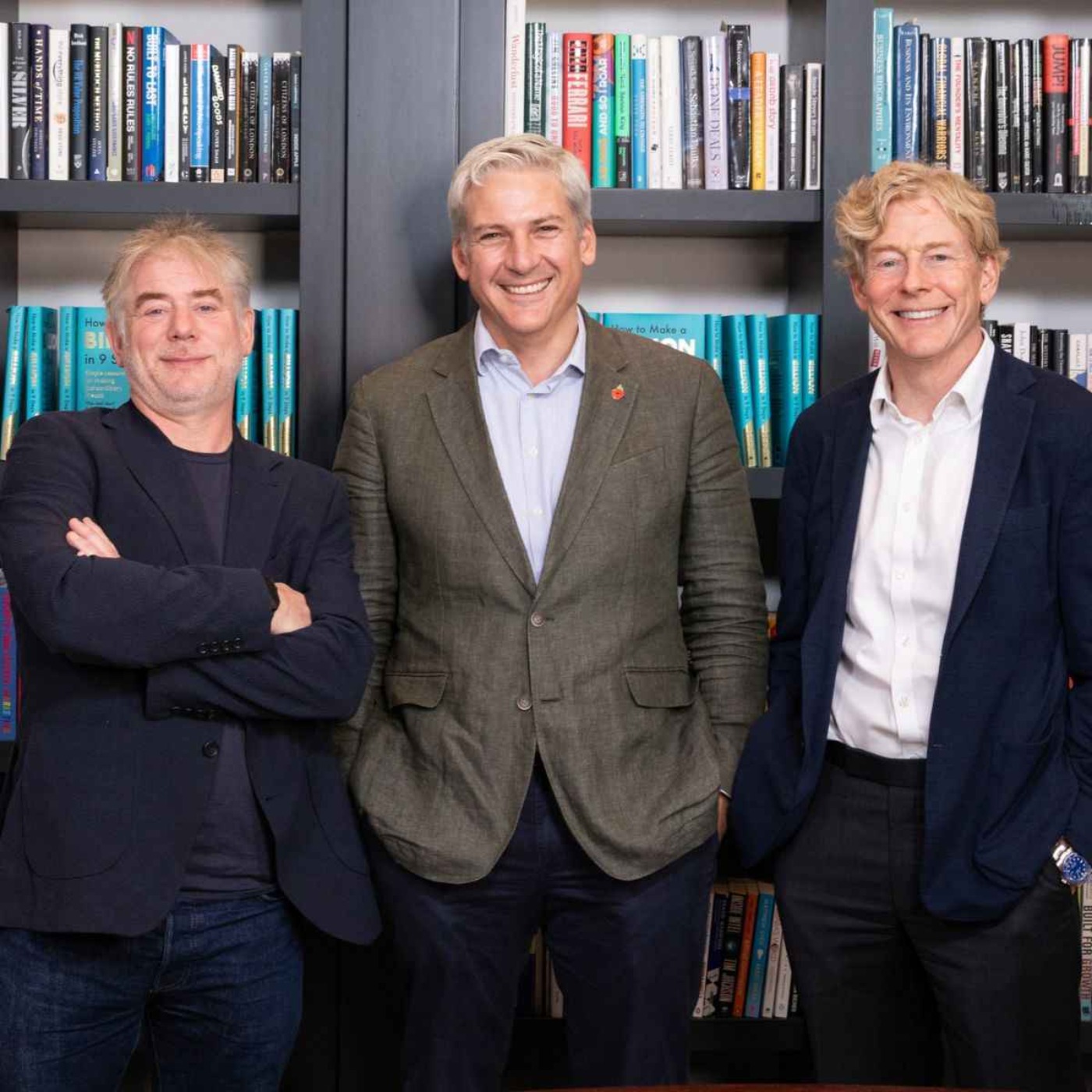
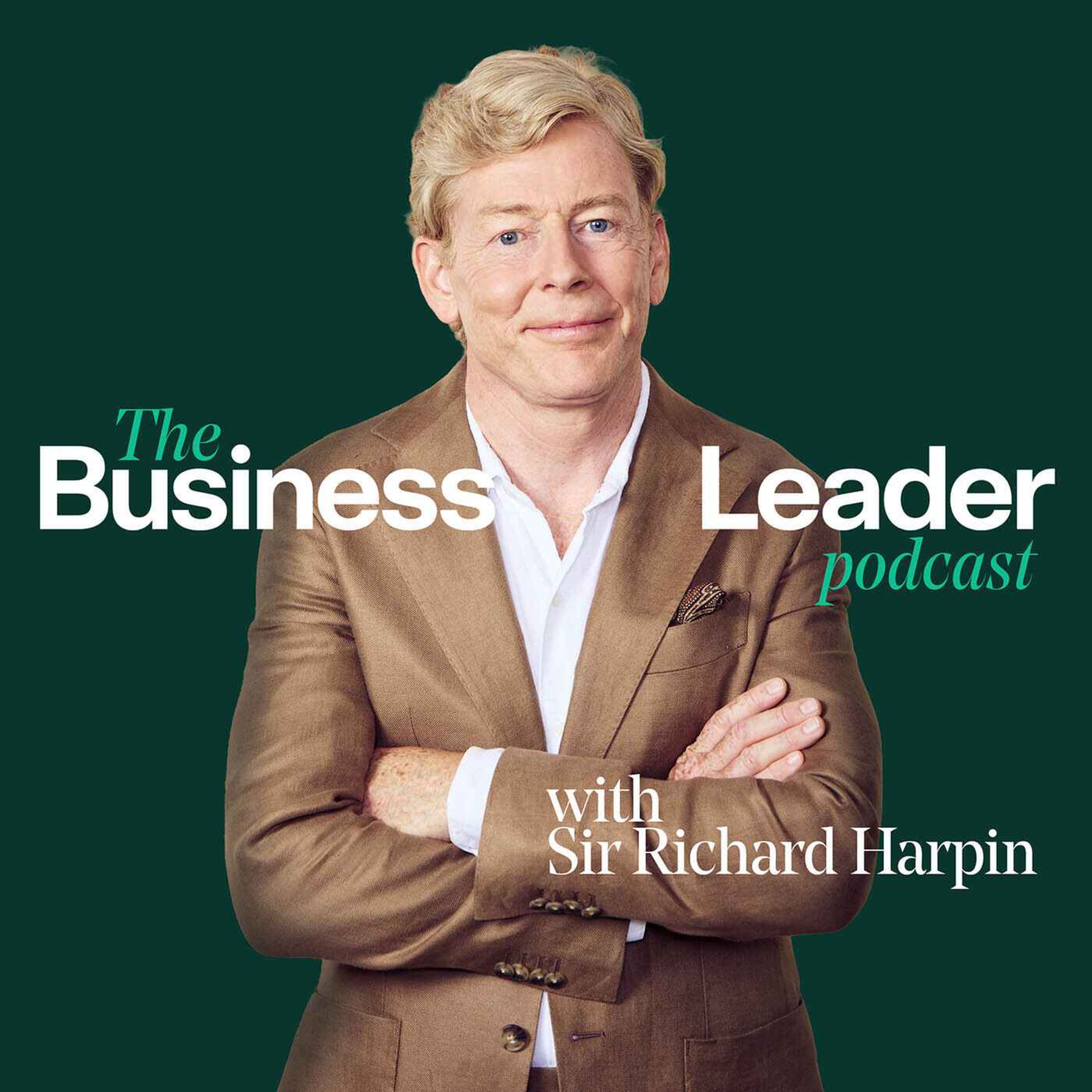
 The Business Leader Podcast with Sir Richard Harpin
4 Aug 2026 · 44m · 27 chapters
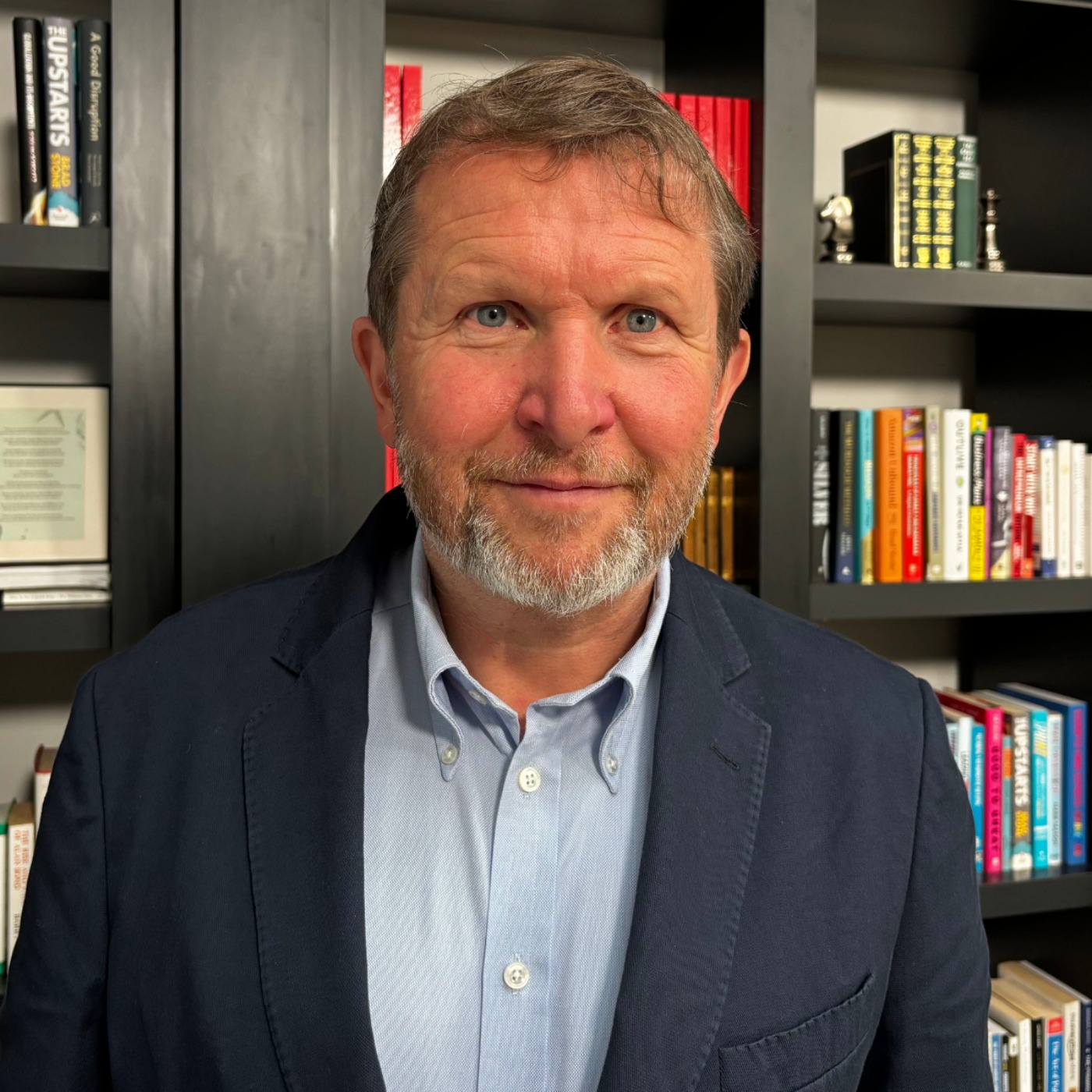
Nick Jenkins, founder of Moonpig, explains how the personalized greetings-card business survived near bankruptcy, fixed pricing, scaled marketing (especially TV), expanded products, and later sold for £120m and saw Moonpig float at ~£1.2bn.
Nick Jenkins is Moonpig’s founder (later an angel investor and Dragon’s Den investor). He previously worked in Russia after studying Russian, witnessing the Soviet collapse and learning how to build commercial teams.
Moonpig nearly failed multiple times from cash burn; raising price from £1.99 to £2.99 didn’t reduce customers but improved margins and made the business “survivable.” Growth came from testing marketing channels and scaling the cheapest customer acquisition; TV became scalable once break-even was reached. Repeat purchase mattered most; customers bought about six times per year.
Doubling TV spend from £50k/month to £1.2m/month; Australia launch worked due to similar humour/language, while the US underperformed (postal speed and cultural ribbing). Product expansion moved beyond “everything personalized” into gifting like flowers.
Written by AI. May contain mistakes.
Learn about the financial struggles Moonpig faced in its early days.
“We came close to failing several times through running out of money.”
Discover how raising prices helped Moonpig become profitable.
“and that's really what transformed the business from turning over£3 million in 2005 to turning over£45 million three years later.”
Explore how Moonpig scaled its marketing budget effectively to grow.
“So it's actually very, very hard to forget the word Moonpig.”
Hear the amusing story behind the name 'Moonpig' and its significance.
“They had to invent the concepts of companies.”
Nick Jenkins shares insights from his experiences in Russia's economic transition.
“And for a number of reasons, it was time to come back home.”
Learn how Nick Jenkins conceptualized the idea for Moonpig after returning to England.
“If you turn up at a party with a bottle of very expensive champagne in one hand and a really well-personised Moonpig card in the other, they will remember the Moonpig card.”
Nick discusses the difficulties of acquiring customers in an online business.
“I also struggled at the beginning with raising any institutional money because it was the time of Boo.com, which you probably remember went spectacularly bust.”
Explore how Moonpig's venture into TV advertising transformed their business growth.
“when I'm investing is, let's see what happens when we turn the marketing off.”
Learn about effective customer acquisition strategies and the importance of testing marketing channels.
“I think turning over 3 million in 2005 to turning over 45 million three years later.”
Discover how pricing strategies can affect profitability, including lessons from raising prices.
“If you throw that, you get to a point, even with TV, we got to a point we spent 1.2 million in a month and we found that we were throwing too much money at it and the cost of customer acquisition went up to about£11.”
Understand the intricacies of expanding a business internationally, specifically into the US market.
“So pricing is a really, really interesting one.”
Explore product development strategies and the balance between personalization and convenience.
“The other aspect is a cultural one, which is that we quite enjoy ribbing our friends.”
Learn about the process and importance of leadership transition within a growing business.
“So that also taught me a lesson that personalisation is great, but sometimes it's also a barrier to purchase because you've got to think about it more than the un-personalised.”
Gain insights on the preparation and considerations involved in selling a business.
“then there gets to a point where I think there's no more growth left in it.”
Learn about the process and considerations involved in selling a business.
“In the end, we sold to a private equity backed competitor, albeit they were much smaller than we were.”
Discover the importance of managing staff expectations when selling a business.
“And it was also useful with me being an exec chairman so I could manage that process and leave the management team to get on with the day to day.”
Explore Nick Jenkins' feelings and plans after selling his company.
“A life-changing amount of money lands in your bank account.”
Learn about Nick's charitable focus on obstetric fistula and its impacts.
“And so that's what I did immediately afterwards.”
Understand the challenges of homelessness and local charity efforts.
“So I'm working with a great homeless charity called Elaboray in Salisbury.”
Nick shares his feelings about Moonpig's success and its leadership transitions.
“To what extent do you still follow Moon Pig and look back at the company and look at what they're doing now?”
Gain insights into Nick's investment strategies and lessons from failures.
“And I think at the last count, you've got 38 investments, Nick.”
Learn what entrepreneurs need to demonstrate to attract investment.
“So there's probably a 70 % chance of complete failure.”
Explore why entrepreneurs must grasp their business finances and metrics.
“Did your MBA help either to be an entrepreneur or to be a better investor?”
Reflect on how Dragon's Den influences aspiring entrepreneurs in the UK.
“And I'm yet surprised by the number of founders who just have this almost blind spot when it comes to accounts.”
Discuss strategies to foster entrepreneurship among young people.
“But by and large, about half of them actually turn into real deals.”
Learn how self-belief and optimism are crucial for overcoming challenges.
“But what also comes with that is a lot more adversity to risk.”
Understand how AI can be leveraged for efficiency and competitive advantage.
“One of the things that isn't going away in today's environment is AI.”

Get the gist, explore an idea or ask about something said.
 Claude
On The Business Leader Podcast with Sir Richard Harpin, what are the key points of this episode?
Searching your listeningAutomatic transcript. May contain errors.
0:01We came close to failing several times through running out of money. We never got to a point where there was a positive amount in the bank account. It just dropped into the bottom of the well. And we'd struggled on for about two or three years. And one of my investor directors said, we're going to go bust really. Why don't you just put the price up to£2.99? And I thought, well, if we don't do it, we'll probably go bust. And if we do it, we might go bust. We didn't lose a single customer as a result of putting the price up. But our margin went up to the point where suddenly we were a survivable business.
0:28It's easier to start high and come down than start low and go up. TV is very scalable and so we spent£50 ,000 that month and then the next month we thought, well, let's double it. So we doubled it. So we went from£50 ,000 a month to£100 ,000 to£200 ,000 to£400 ,000 to£800 ,000 then to£1.2 million from having almost spent no money on marketing at all and that's really what transformed the business from turning over£3 million in 2005 to turning over£45 million three years later.
0:56His own investors told him to stop putting his money in. They thought it was finished. He ignored them. Moonpig went on to sell for£120 million. Nick turned the tables and became an angel investor. On Dragon's Den, he became known as the calm, considered voice in the room, rather than a fire-breathing dragon. A decade later, Moonpig floated on the stock market at a£1.2 billion valuation. situation so what does he know now that he didn't know then nick jenkins welcome to the business leader podcast your nickname i think at school was moon pig dare i ask why there was no reason for that and i in fact i was as baffled as anybody else and years later after the sunday times interviewed me and i said where did it come from i said i have no idea and i've lost track of the guy who gave me the name and he wrote into the sunday times and said and said i'm very happy to to introduce us and i'll tell him where the name came from we went for a beer and he said i just made an up that was that was it there's no story behind it um but uh but it served very well as a served very well as a domain name as a as a brand name uh and uh it wasn't that i desperately wanted to have a business named after moon pig it was that i was looking for something as few syllables as possible um and it had to be it had to be available on it had to be unique on google so you put it in nothing else comes up that was critical it had to be phonetic and it had to be something that could absorb brand values and also easily represented in a graphic and memorable.
2:25So it's actually very, very hard to forget the word Moonpig. And very hard to misspell it. And translatable into Russian because I think you studied Russian at university and then your early career was in Russia. It would be. It would be Lunis Viniets in Russian. But actually, Moonpig was very much a kind of an anglophone product. and in fact not even that even in America it didn't it it's a concept that's that is okay but it hasn't really taken off it's only in Britain and Australia so so we have yet to have a lunisvanias.com and what did you take out of your career in Russia back in the 1990s?
3:00It was a fascinating time to be there because the Soviet Union collapsed the year that I arrived there and and I watched one of the world's largest countries go from out and out communism into out-and-out capitalism within a year, which was extraordinary. They had to invent the concepts of companies. Actually, it also made me realize what makes our economy work because I watched this thing having to be formed. They had to form the concept of insurance, the concept of banking, the concept of a private company. All of those things had to be created virtually overnight. Up until the point when I arrived there, the only legal entity that you could have in Russia, in the Soviet Union, was a cooperative and you were only allowed to employ your own blood relatives.
3:41That was it. So it was fascinating to see that. And I think the other thing that I took out of it is that I learned how to build a team. I arrived there as a recent graduate and I was, because I spoke Russian, I was very lucky, desperate for people who could speak Russian, and we all got over-promoted. I was able to hire a team, build a team, and that's probably the single most important lesson I learned there is how to run a commercial team. And any reflections now, given what's going on, Russia and Ukraine and looking back at your time in Russia? It's very sad for me because I originally learned Russian in Kiev, in Ukraine.
4:16And I spent a long time there, time at university there. And then when I was working, I was working in the sugar industry and I was traveling frequently to Kiev. So I have friends on both sides of that. And for me, the idea that they could be fighting each other was extraordinary because most of the Ukrainian friends were quarter Russian, half Russian, three quarters Russian. or entirely Russian ethnic background. And there are so many Ukrainians who live in Russia. The idea that they could ever be at war is extraordinary. So it's very sad. I hope we can find some resolution to it at some point.
4:49How did you come up with Moonpig, the greetings card business in the first place? I left Russia and decided that I wanted to leave Russia and come back to England. I'd been there for 10 years. And for a number of reasons, it was time to come back home. and I had to come up with a new business. I didn't want to be in the commodity trading business anymore based in London. I'd been at the most exciting end of it in Russia. So I thought I'd break into something new. So I went off, did an MBA for a year while I could think of lots of cunning business plans. And it was around about that time that the internet was coming to the fore.
5:20So I'll do something on the internet because nobody else knows anything about the internet, even though I don't. So in the land of the blind, the one-eyed man is king. And this was the dot-com era, wasn't it? It was. It was 1999. 99. I was doing my MBA in 98, 99. I finished in 99. And I came up with a number of different ideas. But the idea behind Moonpig was really about how can I make a product that is better than the product in the shop that can't be sold in the shop for practical reasons. And personalization is one of those elements. It's quite difficult to do that in the shop. To do Moonpig in a shop would require floor space that is underutilized because a customer is sitting there for half an hour thinking of a caption and they're taking up valuable floor space and equipment and so on.
6:01So that doesn't work in a shop environment. Therefore, you can't compare the price of the thing that we sell with the price of the thing in the shop. Because the problem with the internet was that it enabled everyone to compare prices. And you can come up with an algorithm that gives you the cheapest price. And that just strips margin out of any business. So by coming up with a product that you can't offer in the shop, you can't therefore compare it with the shop product. That was the first step. And then the second thing, how much value can you add with personalization and you can put your initials on a shirt but you know that's pretty ordinary we know how that works and for me the greeting card business was it wasn't just about about slipping someone's name it's about weaving someone's name into really really good content so injecting someone's name into into a joke that that is that plays on your knowledge of them as a person and greeting cards are all about if it's about familiarity it's about being relevant and being thoughtful and what we enable customers to do was just to be much much more thoughtful and and relevant to that person and fueling their inspiration yeah and the most important thing is the the test is how many of them get thrown away and most moon pig cars never get thrown away they get stuck on a fridge and they stay there for years i i see people's fridges with them stuck on the years later so and that's you know on a three pound 39 greeting card you could create an enormous amount of value.
7:18If you turn up at a party with a bottle of very expensive champagne in one hand and a really well-personised Moonpig card in the other, they will remember the Moonpig card. And that's what it was all about, really, about how much extra value can you add through personalisation. I'm Richard Harpin, a Yorkshireman who sold my company, HomeServe, for£4 billion. And this is the Business Leader podcast, where we look at the stories and strategies behind modern businesses. I'm passionate about helping British businesses scale and succeed. I think it's the key to unlocking Britain's economic growth. Founders and CEOs of mid-sized companies can be members of the business leader community for coaching, peer-to-peer forums and exclusive learning events.
8:02So do get involved. Sign up to our weekly newsletter at businessleader.co.uk slash newsletters. It's free and it helps us grow the community.
8:18So very clever business model. You've taken paper and made it online and personalised. And did you need funding for the business? Yes, I got the business up and running. I've made a little bit of money in Russia and I got the business up and running with my own money. And then I brought in some angel investors very early on. I also struggled at the beginning with raising any institutional money because it was the time of Boo.com, which you probably remember went spectacularly bust. I think they burnt their way through£200 million and then they went bust having turned over a total of£34 ,000, at which point all the venture capitalists in Britain said, that's it, we're not doing this B2C stuff anymore.
8:58That's the point I started. In a way, it saved us because we raised a much smaller amount of money from angel investors. And it gave us more time to be able to grow the business at a reasonable pace. I think if I tried, if I'd taken the five million pounds I was looking for in the year 2000 and tried to, I would have been under pressure to spend that quickly. I don't think the market was quite ready enough for it. We probably would have burnt our way through that very quickly. And then it would have been very quickly down to zero. So that was better starting small and not burning through that money and not giving away too much of the equity.
9:32Yes, I mean, we did. We gave a bit of the equity for the angel capital, but it also made us much tighter about money because not having much money meant, I realised that when it came to testing marketing, why spend any more money than you have to spend in order to work out how much that particular channel costs you per customer? When you have large amounts of money, oh, let's spend£100 ,000 on this and£100 ,000 on that. Actually, when you work it out, sometimes you can get away with spending only a few thousand pounds to find the answer. So we were very, very careful with the cash that we had.
10:05We preserved it well and we stretched it out. And it did take us four years eventually to break even. Four rounds of funding and$2.7 million, of which$700 ,000 came from me. So I had to put more money in at every round of investment in order to keep up with the investors. And when did you know, Nick, that the business was going to be successful? And how close did you come to failing? We came close to failing several times through running out of money. We had four rounds of fundraising where every time we had to, it was, we never got to a point where there was a positive amount in the bank account.
10:38It just dropped into the bottom of the well and made the hole slightly shallower. It was when finally we broke even after about four years. And then I realized once we'd broken even, that's it. And we'd grown for over the last two years before that, we had grown about 30, 40 percent a year on the basis of almost no marketing money because we didn't have much money to spend on it. but it had grown through word of mouth. And to me, the thing that made me realize that it was going to work was that we could grow without spending any money on marketing and marketing just made that grow faster. And that's one of the things that I apply now when I'm investing is, let's see what happens when we turn the marketing off.
11:15Do the customers still stick around? The repeat business is everything. And I think it's become one of my mantras with investing everything. You can sell something once but when they come back and they buy again, that's when you know that you have something which is worth investing in. Very important lesson. And how often did those customers in the early days buy again? What sort of repeat levels were there? We're very lucky. It was a relatively small purchase and people would come back about six times in a year. So we had a lot of very measurable data. It's a lot harder if you're selling mattresses and people come back every seven years.
11:46You might not be around in seven years by the time they come back. Whereas we knew that once we got them, we'd recruit 100 customers. And it was a very mathematical model. We'd recruit 100 customers. We knew that 40 of them would try it. It's just not for them. They just couldn't get into the habit. But of the 60 that were remained and bought again, they would stay with us for a very, very long time. And Moonbig has customers that have been there for 27 years. Any other turning points in those early days in scaling the business and getting it through to profitability? One of the hardest things about any business, particularly online, is trying to find customers.
12:21If you have a shop, you have a natural footfall of people walking past, but online you don't. and recruiting customers is the single biggest challenge. And if it costs you less to get a customer, then you're going to make out of that customer, then you're in business. And if it swips the other way, you can't grow. So for us, it was very much about understanding what customers were likely to do and how quickly marketing spend would come back. And that was the key to growth. But then it's also finding a channel that you can throw money at. And I think for the first four years, if someone had said, here's 10 million pounds to grow the business, I didn't have anything that I could throw it at to make that happen until we tried television in 2005.
13:01And TV was one of the things that was just a bit too big a chunk, a bite to take initially because it was about£100 ,000 to test it. In one TV area? Actually, it was nationally, but we had to make an ad and then we had to buy a minimum of£50 ,000 worth of TV time. And altogether it was about£100 ,000, I think maybe£80 ,000. But we'd just broken even and we made£80 ,000 profit by about 2005. And I thought, I can actually risk that because if we try it and it doesn't work, then I've learned a very important lesson that that's not the answer. And if it does work, then I know that at least TV is very scalable.
13:38So we did it and it worked. And so we spent£50 ,000 that month. And then the next month we thought, well, let's double it. So we doubled it. And that was paid for out of the money that was coming back from the first ad. so we went from 50 ,000 a month to 100 to 200 to 400 to 800 then to 1.2 million rapidly from having almost spent no money on marketing at all and that's really what transformed the business from I think turning over 3 million in 2005 to turning over 45 million three years later. And so what's the learning coming out of that because you didn't have the proof that television advertising was going to work it was a courage?
14:15My message is always try every channel the first thing is you have to understand how much can you afford to spend on a customer and it's not about people talk about lifetime value i like to think of it as as one month payback first order payback one month payback two month payback three month payback six month payback that then tells you how much cash flow you need to be able to cycle your marketing money through when you talk about lifetime value well you know what's a lifetime um so that to me is a less meaningful number than a than a payback time and uh so the first thing what i work out is what are my customers doing if i recruit 100 customers how much money they're going to give me how much can i afford to spend to get a customer.
14:48Then you've got a target. And then what you want to do is work out for every channel that's available, test every single channel and then pick the cheapest one and start throwing your money at that until the price goes up. And that will happen with every channel. If you throw that, you get to a point, even with TV, we got to a point we spent 1.2 million in a month and we found that we were throwing too much money at it and the cost of customer acquisition went up to about£11. So we wound it back down to£800 ,000 a month and stayed there pretty much forevermore. So the key thing is just test everything.
15:17because you may get surprised. You may find a channel you think that was going to work and two channels that you think will be similar perform quite differently. So you try them all and then with the bare minimum that you need to spend to get a statistically significant answer and then just pick off the low-hanging fruit and go through it. And I would say never have a marketing budget. Just have a target cost of customer acquisition because if the money is coming back, why would you stop? If you're making money by marketing, why would you stop spending money? or have a finite budget for that year.
15:50One of the things that you believe in is pricing and getting the pricing right. Yes. How did you do that? Well, I got it wrong to start with. When I first started, I thought, I'd like to make a card that is better than the card in the shop. And the card in the shop is probably£1.99. So our equivalent, personalised, I thought, if I make it the same as the card in the shop, but it's better, that will work. And we'd struggled on for about two or three years. And one of my investor directors said, and I refer to them as investor directors and non-exec directors, they all put their money into the business.
16:23And one of them said, we're going to go bust, really. Why don't you just put the price up to£2.99? That had never occurred to me. And pricing, I think, is one of them. You get locked into a mentality about pricing sometimes. You think that's the right price. And I thought, well, if we don't do it, we'll probably go bust. And if we do it, we might go bust. But either way, let's give it a go. So we gave it a whirl and our unit sales remained exactly the same. We had an email from a customer who said, I think it's outrageous that you put your price up. I will still carry on buying, but I think it's outrageous.
16:55We didn't lose a single customer as a result of putting the price up. But our margin went up to the point where suddenly we were a survivable business. And the big lesson for me is why do I think$199 was the right price in the first point? So now when I think about it and if I'm advising businesses, I say, well, it's easier to start high and come down than start low and go up. And I say that because in Holland, there was a competitor that ultimately ended up being bought by Moonpig. And they'd start at€1.99. And then a whole load of other competitors had come in around them and then set the market expectation at€1.99.
17:28So it was very difficult for anyone to move. So they were all selling lots of cars, none of them making any money. And they'd kind of shot themselves in the foot. But because we changed it so early that we didn't really have any competitors, we then set the price at€2.99. And everyone else followed us. And interestingly, we did have somebody afterwards who came in and said, oh, we're going to sell them at$1.99. And our marketing team said, oh, we're going to lower our price, we're going to lower our price. No, no, we should only react to a price change, to price competition, when we can see our own sales falling as a result.
17:58If no one knows that someone out there is selling at$1.99 or they don't like what they're selling, why react to it? So pricing is a really, really interesting one. I'm sure you found the same, that it's easy to get wrong. But also the power of having the non-exec investor sitting on your board, almost a mentor coach that made that one comment that overnight transformed the profitability of the business. And I think every single one of my investor directors had made one comment or made one suggestion that saved the business. And that's all you need, really, from each of them. I think I had five of them over the time.
18:36They all did or said one thing that saved us. But the pricing one was pretty important. Then you thought about, I wonder if this business could work internationally. Inevitably. You always think that. You think, oh, America's five times bigger. Let's go and break into America. We actually started in Australia first because we had an email from somebody from 9MSN. It said, I used to live in England, loved moving big. I'd now back over in a role in 9MSN. We'd love to have this in Australia. So I made an appointment, jumped on a plane, got all the way over there, arrived in Sydney for the meeting and they said, actually, he's in Melbourne this week.
19:12He'd forgotten the meeting. I said, well, I've flown 24 ,000 miles. So by the time we did have the meeting, I think he probably felt obliged to go through with it because he did, when he came back, I stayed around for a few days and he came back. We had the meeting. Australia worked because there's quite a similar mindset, similar sense of humour, same language. In America, same language, slightly different mindset. But we thought you've got to give it a go. You've always got to try these things Because if you can crack America, it transforms your business. But I don't think you can assume that things are going to work in the same way.
19:44So all the marketing tactics that we used performed very differently in America. So we were getting a£10 cost for customer acquisition using one particular channel. Tried the same channel in America. $60. But completely unviable. We did when we launched it there. We had an American version. And I'd hired a team of Americans to go through it and say, I want this thing to feel American. So you did have some Americans on the ground then, or they were based here. Yes. So we had some Americans in, first of all, we had some Americans in the London office and we came and said, just make this, I don't want anyone, I don't want this to feel like a quirky British thing.
20:18I want to make it work in America. So it's got to look normal to you. And that means hiring Americans to do that. So they have that sort of cultural sensitivity to it. I think perhaps there are two big differences why it didn't work. First of all, the postal system in Britain is incredibly quick. So you order something, you can be very spontaneous about it. It's much slower and it's more expensive in America. So the spontaneity element isn't there. The other aspect is a cultural one, which is that we quite enjoy ribbing our friends. We quite enjoy plastering their name on a joke and taking the mickey out of them.
20:50And then that person will take that and stick it on their fridge. I think maybe people are a bit more sensitive in America. So we never really got, we've got a business over there, got it going. We have a print operation in America that we set up. But it's a fraction of the size of the UK operation. And no one has, even the very large US greeting card companies have tried and failed to make an online personalized greeting card company work. How long do you think an entrepreneur should give an individual country before they say, well, I tried that one and it's not really working. It's proving a bit difficult.
21:22Until you run out of money. if you can crack if you can crack America then it is so transformational that it's absolutely worth throwing the kitchen sink at it there's also an issue of timing of the right people and sometimes one attempt will work and we've had two proper bashes at America we had the first bash and it rumbled on a bit and then long after I sold Moon Pig they went back in for another bash to do it so sometimes a different team can try it differently make it work sometimes the timing makes it different. What else did you do, Nick, on product development and expanding the range? How was your thinking there?
22:00I started with, so when we first started, of course, digital photography wasn't really a thing. So the digital photography added quite a lot. And that was probably about three or four years in. Suddenly you could upload photographs. That became almost a better form of personalization than changing the words. So that enabled us to do quite a lot of different products. We've tried all sorts of things. We tried personalised voice messages inside cards. But then it was a question of saying, OK, well, we've got a customer through the door and they love the cards. What else can we sell them? They've got an occasion.
22:32So can we solve the problem of their gift? So we got into gifting. Initially, it was personalised things. And I had got slightly stuck on the idea of that everything we do needs to be personalised. And I was probably wrong with that because some things, if you can personalise them well, that's brilliant. But sometimes you actually just got a job to do. It's so-and-so's birthday. you need to get a card that's appropriate and you need to get a gift that's appropriate you need to tick a box add a box of chocolates or a bottle of champagne or some helium balloons or flowers and and when when originally uh ian martin who took over from me i appointed him as this as the ceo he said i'd like to do flowers i said well we can't really personalize flowers i'm not sure it's really it's really a moonpeaky thing but you i said go for it let's give it a go and and thank thank i thankfully i did because actually we turned turned into one of the largest online flower businesses in the UK.
23:21So that also taught me a lesson that personalisation is great, but sometimes it's also a barrier to purchase because you've got to think about it more than the un-personalised. And sometimes you've got some customers who absolutely want the all personalised thing. And sometimes people just want to say thank you in a simple, they just want a card, but they want the convenience of Moonpig to send it. So it was after my time, if we step back and said, actually, not everything we do has to be personalised. Just because we can do it doesn't means that we have to do it. And so that opened up another market for selling, which I think is, you know, is one of the reasons why Moonpig has grown well.
23:54You talked about Ian Martin that I think originally came in as commercial director and then ultimately became the chief exec. What was, how did that work and what was your early thinking? Well, I realised that I was probably going to, I wanted to sell the business at some point and I was going to have to ease myself out of the role of CEO. I didn't want to be the CEO at the point of selling the business. So I wanted to find someone who could come in and take it. But I didn't want to hire somebody from outside, hand them the job and not know what it was going to look like. It was still very much my baby.
24:24So for me, one of the easy ways of doing that was to hire someone in with a lot of external experience. And he came from TigerPrint, which was a very part of M &S and had a lot of good corporate training. And he came in as a commercial director. And I said to him at the beginning, look, there's potential to take over my job. But let's try it department by department. And actually a period of two years, handed over department by department, till finally I got to a point and said, I'm going away for three months. And if anything goes wrong, it's your fault. That's the ultimate test, isn't it? How many times did you speak in that three months?
25:01Well, there was a denial of service attack on us. And I was away on holiday in Italy at the time. And Ian called and said, we've had a denial of service attack. And I said, that's dreadful. Let me know how it goes. and it was and he dealt with it and that was that i mean it was um uh uh thankfully we had we had good it and it was uh we got over it but but actually that was the real test which is and i find people step up when they know that you're not marking their homework you're not standing over their shoulder people step up um think i'm on my own but he'd had the experience of being in the business and learning each department as he went yeah got the confidence to hand over so i had a lot of confidence in Hanne because I knew exactly what I was getting and it worked very well.
25:43He carried on the company long after the sale. And when did you start thinking about maybe now is the time to sell? It was two years before we started selling. The business had grown dramatically. We were very profitable, maybe throwing off quite a lot of dividends, which is quite unusual these days. People don't often pay dividends. And you need to sell a business when there's a lot more room for growth. Whoever's buying it expects growth. It's a difficult thing to get right. You want to know how far have I taken it? If you take it too far, then there gets to a point where I think there's no more growth left in it.
26:13Nobody wants to buy it. But if you don't take it far enough, then someone else takes it and triples it the next year and you think, ah, a bit too early. So anyway, I think I probably got it about right. But it was also a feeling of me having done everything that I could do with the business. I'd added everything that I could add. I'm not sure I was adding much more to it. It was time for someone else to take it and run with it. And also there's an element of thinking I had 98 % of everything I own tied up in it. That feeling that every entrepreneur has the what if it goes wrong. And sometimes they do.
26:47And I've seen friends with businesses who rose. Everybody wanted to buy them. Then nobody wanted to buy them and they crashed. So I've seen that happen several times. And I didn't want that. So that was a part of that decision. Did you appoint a corporate finance advisor to help or just talk through that two-year journey to actually selling? Yeah. So the first thing we did was we appointed a corporate finance advisor and we said, what does our business need to look like for it to be a trade? Who did you appoint? We appointed Ingenious, Ingenious Corporate Finance. And so we looked around at who we might sell to.
27:24And there's also a process, particularly with trade buyers. There's a process of courting those potential trade buyers and getting to, you might call them and say, you know, you're in this business, we're in the same business, let's get together, have a cup of coffee, have a chat, CEO to CEO. We know there's a subtext to that. But equally, they're also always on the lookout for businesses that they might acquire. So it's quite useful for them to understand who's a bit more about the other companies that are around. And so I knew most of our trade potential trade buyers before. On the flip side, the corporate financiers, they know all of the institutional buyers.
27:58So private equity was looking at it. We had about 29 private equity companies looking at it. In the end, we sold to a private equity backed competitor, albeit they were much smaller than we were. This was Photobox. It was Photobox, yeah. Photobox was actually much smaller and not profitable. But they were backed by a very large private equity fund who put the extra money in to be able to combine those two businesses and make it into a bigger business. Interestingly enough, later on, they then demerged them and Moonpig on its own, together with a Dutch company they bought, it was the one that floated and Photobox went off and did something else.
28:31So that was it was an interesting process, but it took about two years to get that right. And it was also useful with me being an exec chairman so I could manage that process and leave the management team to get on with the day to day. That's important, isn't it? Running the day to day, because if you're selling a business, you don't want to take your eye off the ball of keeping it growing. Yeah. And the other thing that's important to manage is the expectations of staff who've got share options. You don't want people getting terribly excited about the prospect of a sale, because if it doesn't happen, they can get deflated.
29:05And so then you've got that impact of the business. so we had a the Trojan horse was there are lots of people in suits coming around to look at the business because we're for a next round of fundraising for an expansion of the business they'll be asking you lots of questions and we kept to that which was which was sort of true I mean yes we were looking to expand the business and it was about investing more in it but it was in the context of a sale and then the first most people in the company heard about it was was when we knew it was going to happen and at that point everyone was delighted because I'd made sure that everybody in the company had shares.
29:37I wanted the day that we sold the company to be a day of joy for every single person in the company. Because the buyer wants a happy team on day one. They don't want a bunch of people a bit disgruntled thinking, well, it's all right for him. He's swanned off with all the money. So they were all chuffed to bits. How did it feel for you, Nick? A life-changing amount of money lands in your bank account. How are you feeling? The company had been making a lot of cash before. So I think I'd probably taken out 12 million in dividends before that. And that was sitting there not doing very much. So actually, it was a lot of money, and it was a relief to crystallise that.
30:11But it wasn't as if there was anything that I could suddenly do that I couldn't have done the year before. In a way, there was a bit of an anti-climax, rather like finishing your last A-level. You work and work and work for years and years to get to your A, and then you have your last exam, and suddenly there's a bit of a void because you have nothing in your, you have no more revision to do. And the actual, funny enough, the actual signing you imagine some sort of great ceremony no i just went into a room and i sat there for about an hour and a half signing 120 different documents um had you started planning what you were going to do next before you'd sold or did you um have some time out and then reflect and decide what you're going to do next i'd taken some of the money that we'd made out of the company before and put that into a charitable foundation so so i i wanted my next chapter was to look more philanthropy and I didn't want to start another business straight away.
31:02And so that's what I did immediately afterwards. I took a little bit of time off. I also realised, and this is an interesting one for people who sell, they think, oh, I'm going to play golf every day. The day you sell the business is probably the last day you'll ever play golf because when you can do something every day, you think I can do it tomorrow. When you don't have enough time to do things is when you do them. Can we hear a bit more, Nick, about your charitable activities and how you're planning that? And I was also very curious to understand how some of the problems that exist in the world came about and what can actually be done to sort them out.
31:36You realise fairly quickly that most problems are quite complex and there's no easy answer to them, particularly problems that exist in the UK. Because if throwing money at them could solve the problem, it would have been done a long time ago. There are some problems like drug addiction that are very, very, very hard to sort out. And I wanted to go through a fairly sort of rigorous process of thinking about what I wanted to do over time. And now it's 15 years later and I'm still learning about that and what we can do. I think one thing, I started off doing a lot of work in the poorest countries because you think that's actually where the great, you can make the biggest difference with the smallest amount of money there.
32:15and the one cause I narrowed it down on was obstetric fistula which is a particularly unpleasant condition where a lot of women, probably a million women in Africa that have an untreated obstetric fistula that usually occurs when they give birth too young they usually end up with a stillbirth and they end up being doubly incontinent and it's relatively easily fixed surgically doesn't cost that much money and you absolutely know if you fix that that that girl's life is going to be transformed forevermore And anything more you're doing closer to home? So I'm working with a great homeless charity called Elaboray in Salisbury.
32:50And that will be about providing accommodation. There's a real crisis with accommodation. Anyone who's even a graduate now realises that accommodation is ridiculously expensive, certainly compared to when we were younger. And even worse, if you're 18, 19, and you don't have a graduate job, you don't have a decent salary, and you don't have a family to live with, it's really hard to find anywhere to live. And if you haven't quite found your place in the social housing market yet, and there's always a gap, that's tricky. And it's very hard to sort out people's social problems if they haven't got a place to go to home at night and feel safe.
33:26So the housing thing is only a part of their spectrum of problems. But if you don't sort that out for them, it's very difficult to deal with the other issues that they face. To what extent do you still follow Moon Pig and look back at the company and look at what they're doing now? And the business listed in 2021 at a value of about 1.2 billion. Yeah, I feel a bit like a proud parent whose child has gone off to university and doesn't call home very often. But I'm delighted and I love watching it do well. And there was a succession of good CEOs in there. J.D. Ford did a great job. Stan Laurent did a good job.
34:01And Nicol Rathathar over the last few years, through the flotation, did an amazing job. And they all contributed to being a much bigger business than it would have been if I had stayed, I'm sure if I had stayed at the helm. So I've always been around and kept in touch with them. And I went to the 25th anniversary. How did that feel? It was wonderful. It really was wonderful. In a way, business needs to have a life of its own. You create a business and it has a life of its own to the point at which you can leave. And it still carries on going. And the customers have no idea that you've left because their allegiance is not to you.
34:34It's to the brand and the company. You've also become an investor. And I think at the last count, you've got 38 investments, Nick. Yes, yes, yes, quite a lot. I mean, over the years, I have realized that there is a there's an element of sport involved in this, I think, in that I think when you've when you've had one business, you think, gosh, I've learned a bit about it. And I can apply that knowledge to investing in other companies. You have to also go through a series of painful lessons and learning some lessons along the way about what to invest in, what not to invest in. What lessons have you learned so far?
35:05One thing I've learned is don't get involved in any business that depends entirely on government legislation for its income because it is unpredictable. And so now I only look for businesses where I absolutely know that there is a good, strong consumer demand rather than some government legislated mandate that forces someone to buy a product. I've developed a set of rules over time, I suppose One is never being too big an investor in a company Because particularly in the early stage And I've always slightly preferred the early stage companies Because for my safer money I'd invest in larger companies And let someone else do that This is very much the very risky end of the spectrum But it's kind of more fun to watch a complete outsider grow The chance of a startup growing rapidly Is much greater than the chance of a large existing company multiplying by a factor of 10.
35:55But also a higher risk of failure with those very small companies. Much higher risk of complete failure. So there's probably a 70 % chance of complete failure. And the other 30 % make up for that. There'll be one absolute outlier that hopefully pays it all back. And lots of expensive mistakes along the way. And then turning it around the other way, so taking your investment learning and applying it to an entrepreneur that is scaling the business, they need to get some investment to grow. So what are the key rules for them, do you think? Well, I think if you want to get investment, the first thing, if you can prove, if you can demonstrate, I'd like to grow this business.
36:30This is how I'm going to grow it. This is not a hypothesis. I've tested this and this is our cost of customer acquisition. We have modeled what our customers are going to do over time. That's a much more compelling thesis than someone who simply says, give me five million pounds to throw at marketing. I haven't tried anything yet. so test whatever you can test and at least come up with some indication that you've tested and have some idea what's going to happen with that investment so that's that's the first first point the other thing i look for is is making sure the person who's asking for money understands the numbers themselves because it's easy to get somebody where do these numbers come from oh i've got a friend of mine who's got a phd in economics from harvard and he wrote it great but he's not running a business you're running the business i want to know that you understand this and you're driving this model because you I think in any team you need one person who really really gets the numbers I also say with it you know even within marketing that it is a lot easier to teach a mathematician about marketing than to teach a marketing person about maths and and a lot of it particularly with online marketing and digital marketing is very mathematically driven and understanding what's going to happen over time.
37:35Did your MBA help either to be an entrepreneur or to be a better investor? I think an MBA is very useful in that it decodes a lot of what is common sense dressed up in jargon. And I found within all the areas of business, they all have their own exclusive jargon. And it gives you a bit more confidence just to decode and think, this is all quite basic. Don't make anything more complex than it needs to be. Keep it as simple as you can for as long as you can. And don't be frightened of it. And I think of management accounts is a bit like the dashboard of a car. You wouldn't drive a car if you didn't know how much fuel you've got left, how fast you're going and roughly what direction you're going.
38:16There are lots of those things on a dashboard and that's what your management accounts are for. And I'm yet surprised by the number of founders who just have this almost blind spot when it comes to accounts. And they think accounts are just something my accountant does to work out how much tax I need to pay at the end of the year as opposed to actually it's my dashboard. You're best known, Nick, as an investor on Dragon's Den. You're on there for a year. Are programmes like Dragon's Den good for business in the UK, do you think? It's very good for young people thinking about whether entrepreneurship is a suitable career for them and inspiring them maybe to think about it.
38:52Because every business that gets picked for Dragon's Den is something which is quite easily digestible. They don't pick complex businesses that are, you know, B2B enterprise software businesses that people don't get. But arbitrage trading in sort of Mongolian derivatives, you know, that's lost on the audience. So every business that comes on is relatively easy to understand. and every time you look at it the same questions come up which is uh what do you charge how much money do you make and and so on all the good essential elements for business and then um i i think i think it's they're real people with real businesses and the money that we invested um and i did i did two seasons on the money i put in was real money i mean it's not the money on the table for some bizarre historical reason um that is an anachronism that left over from when it was a japanese tv show where they actually handed over cash the money is entirely irrelevant it's never involved in the transaction.
39:41We never handed over. And only one of them is real. Just the one on the top. Of all the deals that get done in the den, some fall away because either the investor didn't want the terms or you find out that they've said something in the den that wasn't true or didn't quite turn out to be what you thought. But by and large, about half of them actually turn into real deals. And that's real money. And then you have a relationship with them for the next two, three, four, five. I mean, it's been ten years since I did it. And I've still got three of them live. But it was fun. It was great. But what I love about it is that it has inspired a lot of people to think, well, actually, I could start my own business.
40:16How difficult could that be? And I think that's very relevant now with the advent of AI making it, in some respects, making it easier, creates more competition, but also makes it easier to start things. What else can we be doing in the UK to encourage more entrepreneurship? And at what age should we be focusing on? Well, I thought there are two ways to start a business. One of them is that You go to university and you join a company, you learn a profession and you become very good at something. You develop contacts, you develop an industry knowledge. And by the time you're 35, 40, you're very, very investable.
40:49You can do it that way. You're also at a point of maximum risk. You've got a mortgage, you've got children, and it's very difficult to start your own business and quite scary. Or you start off at 18 or 19 or maybe just immediately post or while you're at university and you cut your teeth on a business, which is cash generative. and you learn a bit about marketing and a bit about how to do this and how to do that, and you hustle. And if you can live on nothing at the beginning of it, and as we all know, students can live on pot noodles, and you start with nothing, if at the end of two years you've still got nothing, what you've got is two years of experience of running a business.
41:25And it won't be the first business that is necessarily going to work, but at some point in the next few years, you do one, you learn from that, and then if you get that up and running, you might get someone to run that, and then you try something else and try something else. So I do think you can legitimately go into it with very little experience, cut your teeth just with experience and start young because you need an element of, I think, to succeed as an entrepreneur, you need an element of being able to tolerate risk. You need to be able to go to zero and not be frightened by that. And the other thing is you need some wild-eyed optimism and self-delusion, you know, because otherwise the more seasoned you get, you learn a lot.
42:04But what also comes with that is a lot more adversity to risk. And you start seeing the reasons why things are not going to work. And I find that as an investor, I have to say to some of my investees sometimes, I'll give you my advice. But, you know, you've got to filter this. sometimes I don't want to put you off because if I if I tell you 10 reasons why this isn't going to work you'll start to see those reasons too and then if you think it's not going to work you can't punch through those walls that that come up ahead of you and sometimes you just need that self-belief and really wild-eyed optimism to be able to to be able to make things happen.
42:38Finally Nick what is your top tip to any entrepreneur founder chief exec that is scaling a business in the UK right now? One of the things that isn't going away in today's environment is AI. It's here to stay. Now, there are lots of people can say it's scary and you could say that it threatens all sorts of things. It's a threat and it's a massive opportunity, but it's not going away. So the only thing that you can do if you want to scale is look at your business and say, how can we use this to make ourselves more efficient? And I don't think there's a single business owner out there who isn't thinking, how can I use this to make my business more efficient?
43:16Because it isn't about getting advantage. It's about not being at a disadvantage. And just as those businesses, when I went through the Internet revolution back in 2000 and there was a differentiator, oh, there are Internet businesses and there are other businesses. No, now they're all Internet businesses. and in three, four years' time, every single business will be incorporating AI into what they do because you just absolutely have to. And I think that will spur growth in some companies and it will see the end of others. But I think it's those companies that can use it to their advantage that will survive.
43:55Nick Jenkins, thank you so much. It's been a pleasure. Some great tips on how to perfect your business model and generate profitability, particularly around pricing strategy. Thanks for listening. Please do rate us and subscribe. And make sure to sign up to our weekly newsletter at businessleader.co.uk slash newsletters. With more people on board Business Leader, we can have better conversations and inspire the UK's next wave of business leaders.
Nick Jenkins, founder of Moonpig, former Dragons' Den investor, and now a prolific angel investor with over 38 investments to his name, talks to Sir Richard Harpin on the Business Leader Podcast about the lessons he has learned along the way. Jenkins reveals how the business nearly collapsed several times and how a single comment from an investor director (raising the price of a card from £1.99 to £2.99) turned Moonpig from a business on the brink into a survivable, scalable company — and how a bold £50k TV advertising bet snowballed into £1.2 million a month in spend, taking turnover from £3 million to £45 million in three years. Also, how the money on the table in Dragons’ Den is not all real.
Subscribe to the Business Leader Podcast and sign up to our free weekly newsletter at businessleader.co.uk/newsletters.
Business Leader is a membership community for ambitious CEOs and founders of mid-sized UK companies, designed to help them grow with purpose through strategic support, peer-to-peer learning, expert coaching, and high-impact events. Sign up for our Business Leader newsletter here.
Hosted on Acast. See acast.com/privacy for more information.