Ask ChatGPT
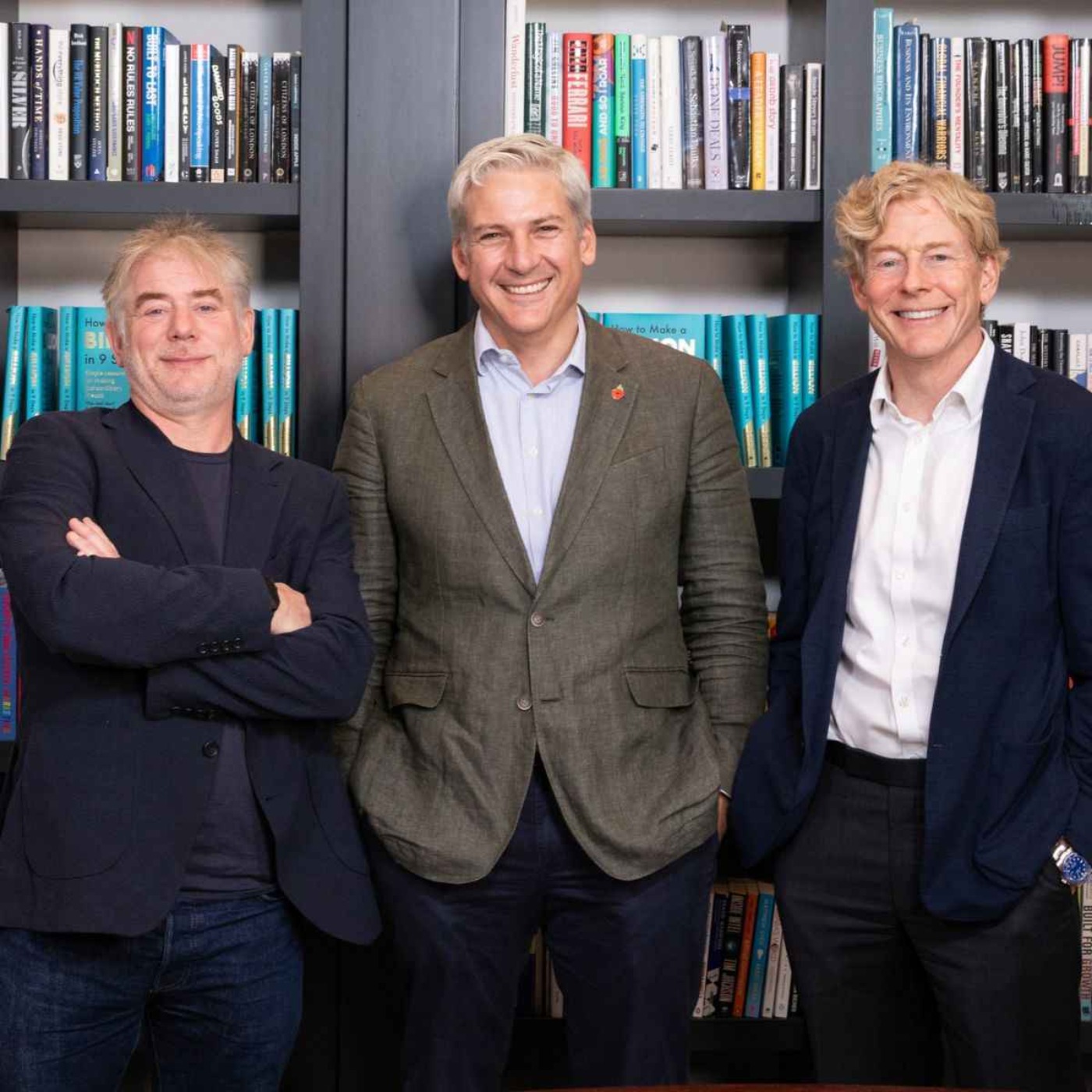
 The Business Leader Podcast with Sir Richard Harpin
27 May 2025 · 35m

Host: Richard Harpin
Interviews with entrepreneurs and business leaders, exploring the moments that shaped their success and failure, providing original advice for anyone in business.
Fergal Mullen, Co-founder of Highland Europe
Discussion on Highland Europe's vision for European businesses to compete with US tech giants, what the firm looks for in founders, and the potential for Europe's stock markets to merge.
Written by AI. May contain mistakes.

Get the gist, explore an idea or ask about something said.
 Claude
On The Business Leader Podcast with Sir Richard Harpin, what are the key points of this episode?
Searching your listeningAutomatic transcript. May contain errors.
0:00This is Britain's growth moment. Do you want to be part of it? On 26th of March, 750 of the UK's most ambitious founders, CEOs and investors will gather in London to shape the future of mid-sized business. The company's driving our nation's success. The Business Leader Summit 2026 isn't just another conference. It's a day built around the three forces that define growth, ambition, policy and capital. And as one of our valued podcast listeners, you can be there in person. To secure a discounted ticket, visit the events section of our Business Leader website and use this code. BLPODCAST, all one word, all uppercase.
0:41We look forward to seeing you there. In this episode, I'm in the streets of the West End of London to hear the story behind how one of the biggest venture capital firms in Europe was built. This is going to be fascinating because not only will we hear the story about how this business was built, But we'll hear what it looks for in the founders and promising businesses that it wants to invest in. And we'll also hear what the UK and Europe need to do to compete with Silicon Valley.
1:16I'm Graeme Ruddick and this is the Business Leader Podcast. In this episode, I'm speaking to Fergal Mullen, the co-founder of Highland Europe. Highland is one of the leading investors in promising businesses in Europe. It has approximately$3 billion of assets under management, and the businesses it has backed include Huel, WeTransfer, and Nothing, which makes smartphones. In this episode, we'll find out how to build a venture capital firm, but also what it looks for in founders. The answers may surprise you.
1:53I'm from Dublin but I built the early part of my career in the US initially because I ended up in the US for university on an athletic scholarship at Brown. After Brown I was in the tech space with an IT firm called Cambridge Technology Partners so I was a startup essentially part of a startup that scaled massively over the first 10 years of my career public of the NASDAQ in 1993. I'm aging myself and telling you that. And I had really cool roles there, but the role that was most exciting was a biz dev role where I was buying companies. And that kind of brought me to Europe initially. And it also gave me some exposure to venture capital and the investors who were investing in the European and the American ecosystem.
2:34I launched a corporate fund there in 1997. Awesome fund, like a 10X fund, but that's the best vintage of all time. So if you didn't make money in a 97 fund, you're not good at this thing. So that was the early part of my career. And then I got properly into VC with Highland in the US, a Boston-based firm that was operating East Coast primarily, but also some West Coast, Silicon Valley investments. And I moved back from Switzerland, where I was living with my wife and kids, to Boston to be part of that firm with the intention of coming back to Europe and launching Highland in Europe, which I did.
3:09I came back in 2007, five years later, launched Thailand here. And, you know, for several years, I'd say the first three years, 2007 to 2010, I was investing from a dollar denominated fund. My US colleagues were primarily early stage focused. I was very much growth stage focused. They were all US biased. I was Europe centric. And there came a point where, you know, your typical Mondays, my Mondays, at least were brutal because my day was starting later and finishing extremely late into Tuesday morning because I was trying to be a good partner and show up for my US colleagues, etc. I was traveling back and forth a lot.
3:46And I just realized it's not scalable. It's not scalable on a personal basis. And it's not scalable from a business model perspective. So I came to my colleagues and said, look, I need to raise my own fund. And we launched Highland Europe, growth stage only, tech Europe focused. And we got the brand and just launched a business. So that was, the process started in 10, the official fundraise 11 and the first close was 12. So, and it was very, very difficult because the market conditions weren't ideal at the time. We were, even though we had track record at different firms, we were still considered a first time fund.
4:25So it just took a long time, but it went really well. Ultimately, we hit the two, almost 250 million hard cap that we put on the fund. And then we were launched. We were in business. What did you learn in those early years about the US and business? Because you obviously at Harvard as well. And then you were in, you're working in Silicon Valley. Oh, I have to be honest with you. And I completely drunk the US Kool-Aid in my early years over there. I drank it because they have this infectious positivity. it's i think it's their core advantage over the rest of the world you tell a u.s kid there's a wall they say okay i'm gonna climb over i'm gonna walk right through it back then you talk to an irish kid or an english kid or european kid there's a wall they're like okay i'll stay this side of it they're very positive too bullish sometimes but it's really a big advantage in the grand scheme of things and it translates in our business and venture capital to having a higher risk appetite like if you look at the amount of money that they put to work in the u.s for an equivalent size economy to europe for the most part they're typically putting four or five times the amount of capital to work per year with much higher loss ratios they have a higher tolerance for loss and pain and that's great that's fine i'm not criticizing i think it's brilliant europe has closed the gap considerably but i learned so much in the early years coming back to your question i learned about that about the importance of positivity i learned about the discipline of selling you know people in venture i hear so many young people wanting to break into venture capital and they don't even understand what the industry is all about like i'll ask them do you know what you know what this business is all about and they think it's working numbers and financials and all this kind of stuff but private equity like and i'm like no it's not you've got to be able to sell yourself, the firm that you represent, and the strategy that we're delivering.
6:25And you've got to be helpful to a founder. So to be helpful to a founder, you've got to have done something. You've got to bring something to the table. You can't just be a college graduate, you know, with little or no experience. It's very, very hard. So I learned, it's hard to describe how much I learned in the US in the early years. But I also in that period learned that the US has a very strange way of looking at the rest of the world, including Europe. It's always through a U.S. lens. I think we're all guilty of this. You know, we Europeans look at the U.S. through our lens. But it just made me realize that you could really build something here, bringing the best of the U.S.
7:04model, the positivity, you know, the problem-solving orientation, the way you structure your funds and build your team. and I just felt you could do that because most of us here have had significant US experience. So you bring the best of the US approach with a very strong European, and I include UK in that, I just say broadly speaking, geographically Europe, approach to things with the right cultural nuances and the right commitment and you can do great in this market. Do you think today that, and this is a leading question because I think I know the answer to this, that you think the differences between the US and Europe are now overstated, that Europe is catching up?
7:47Oh, big time. It's been happening over the last, really over the last 20 years. But last 10 years, I think it accelerated dramatically. And that's evidenced by a number of things. First of all, the industry's matured dramatically. And it not just matured in terms of amount of capital, that has happened. So the gap, that five, six, seven times gap between the US and Europe narrowed during the 21 period to roughly three to one, even two and a half to one it's back out a little bit again but Europe now has a proper proper commitment to venture capital growth capital private equity was always very good in Europe because the Americans saw great opportunity here venture capital was kind of a little stepchild it's a proper asset class now with tens of billions per year being put to work in European businesses at the same time young people in Europe graduating from college have there's a significant increase in risk appetite 20 years ago the dream job was Siemens or SAP or one of the banks or whatever now there's so many are happy to jump into a start up or a scaling business or even start their own business straight out of college I mean you look at all the hot spots around Europe we don't have a as you're well aware we don't have a Silicon Valley but London's awesome UK is awesome in general UK and Ireland but if I had to pick cities you'd say London you'd say Berlin you'd say Paris and then you'd go Amsterdam and Stockholm in no particular order, Barcelona like a lovely distribution Munich of centres of innovation all over this broad geography and we go down as far as Israel as well by the way so plenty to be doing here, absolutely plenty and yeah I think the maturity of the firms themselves as well I think the American firms used to have a big advantage because they came with a kind of a certain mentality.
9:38But a lot of the European firms now who've grown up over the last 10, 15 years have pretty much adopted that same kind of approach. What does that mean for building a business in Europe and how it's changed? Does it make it easier? And how much more likely does it mean that we will start to see more 100 billion businesses here? Yeah, it definitely, easier, I'm not sure. Because you'll always hear, and it's the persistent refrain from founders and even some journalists who like to write about this, that there's, you know, we're not putting out enough capital. I always remember that phrase, the gap in the market, you know, we're missing capital from seed to early stage or from early stage to growth.
10:19There's not enough of this, there's not enough of that. My experience in the last 10 years is if you've got a good business and you're a good team and you're chasing a good market, you're getting funded by a European firm or an American firm or whatever. you're getting funded. I don't mean to be harsh but the loudest complaints tend to come from people who are struggling to raise capital and there might actually be a reason that they're struggling and they should reflect and wonder, you know, maybe it's not the capital maybe it's the business maybe it's the model maybe it's the market that I'm chasing.
10:51We should all be a bit more focused on root causes so to speak. But yeah, I think in Europe right now it's definitely a better environment. There's more capital. There's more intelligent capital. And it's good. It's really good. So we've heard there about the venture capital world and Highland Europe. Now I want to hear Fergal Mullan's insights on what Highland looks for in promising businesses. This firm has invested in well over 70 businesses since it was founded. Mullan says that Highland doesn't look at specific sectors, but it does look for specific things in founders. One of those, interestingly, is how coachable they are.
11:33I think, broadly speaking, so I'm not going to pick verticals because we're not very vertical. We're not at all vertically oriented. You could layer some themes into what we do, but honestly, we're looking for momentum. We're looking for companies that are 10 million or north of 10 million. Very high growth, very compelling unit economics. It doesn't mean they're profitable, but the unit economics indicate that the business model itself is a profitable business model. Capital efficient, probably running losses at that scale, most likely, because your overheads and your infrastructure is ahead of, you're investing ahead of your current status.
12:09We just go after businesses like that. So software for us is a big theme, SaaS in particular. And whether it's a vertical specific play or something that's more horizontal, we don't really care as long as those other conditions are best. And the founders must be really exceptional people. we tend to over index on building a proper relationship with the founder like a borderline friendship the thing I'm happiest about in my own sub portfolio within Highland and I think every one of my partners has the same dynamic we don't invest with people we don't think we're going to win whose company we don't think we're going to enjoy right because you're going to be on this journey I think average hold period is about seven years I'm guessing you're on a journey for a while and that in itself is longer than other firms I don't think so people bluff we're definitely not longer than other firms it takes time to build a great business I mean if you get something out the door in two or three years it's just luck honestly but scaling something from ten to hundreds of millions I've got a business that I've been with since sub ten million ten million GMV two and a half million net revenue and now it's close to five billion GMV and over a billion net revenue 13 years later and we're not under pressure.
13:25You know, that's, so back to, you know, it's a whole different question. Yeah, we can build big businesses here. We really can. Proper leaders and there's other firms that I'm not going to get into, but that have fantastic success in scaling massive businesses here in Europe that have tremendous values. And I think you'll see the first 100 billion business in the coming five years, is my guess. There's so many fascinating things to follow up with there, but start with looking for businesses that you enjoy. sort of broadens out the question a little bit to what you're looking for. And it's a question you must have been asked more than any other.
13:59But if you could sort of put it down, something concise, what would you say it is? So we have a little bit of a framework that we can share with the younger team members as they join so that they know what does a Highland deal look like? What does a Highland investment look like? And I mentioned the scale metric. I mentioned very high growth. I mentioned capital efficiency. And I mentioned compelling unit economics and awesome founders chasing a big mark. So these are kind of the things you can measure. You can tick that box or not take it depending on what you see in front of you. But the thing that's not measurable, it's completely soft, but it's probably the most important thing on the whole page is coachable founders.
14:43Now, we we use coachable as a catchphrase for many things. It definitely means coachable that they are good listeners. that they like to be challenged, they like to challenge us, and they like to learn. They're kind of lifelong learners, and they're good fun. So we put in a lot of things into that one box, but it basically says you're in the boat with a really awesome person. And the reason this is so important, the only thing I know for certain, or we know for certain, when we get involved with any business, is that it's not going to be everyday perfect up and to the right. There will be tough days, tough periods, tough years.
15:23So you just want to know you're in the boat with great people and that everybody's going to work really hard to make it happen. So we try to over I'm sure lots of firms will say this but we really try hard to over-index on that. So we spent a lot of personal time with founders. We tried to see them at their place rather than bringing them here for the Monday pitch and all that kind of stuff. It's much better to go have multiple visits from two or three partners rather than ten of us showing up in one go if you know what I mean and having multiple touches you pick up different signals you get to spend time in their home turf in their natural habitat and properly sell who we are what we can do you know have a beer have a nice lunch have a nice dinner meet more of the team maybe meet some of their family all sorts of stuff happens in these kinds of situations so yeah I mean that's that is there's a lot in there But I personally, I'm very proud of that last point and the relationships that we've built with founders that are with us today and founders that we've exited, whose companies have exited.
16:30We're still great friends, awesome friends. How difficult can it be for a founder to be listened and coached when potentially there's quite a lot of VCs involved as other investors? Yeah, you have to be careful. You know, board construction and having the right capital at the table, there's no perfect science in this. It's a bit more of an art than anything else. But we always advise founders to really focus on what we've just been talking about. It goes both ways, right? It's not us looking for great founders. It's also founders looking for fantastic capital, fantastic capital being relationship-oriented, helpful.
17:08There's a lot of talk about value-add in our industry, and there's a lot of bluff about it. but it's a big black box at the end of the day. But I can demystify that and tell you that value add is about being helpful. And being helpful is different things at different points in time. It can be recruitment. It can be M &A. It can be fundraising. It can be planning for the exit. It can be talking about personal stuff going on in the founder's life. So very counseling oriented. It can be all sorts of stuff. But if you don't have the time, just time available, you cannot be helpful. You cannot add value.
17:41we're here at highland europe we're on average about five companies per partner five board seats that is way below the industry average and it's quite deliberate so that we just if a founder says you know i need some time you're like yeah i'll find time for you no problem see you next week see you tomorrow so yeah i mean i'm being a bit long-winded i apologize but these are these are things that we're quite passionate about the best teams have found as you've worked with what will be examples of them being coachable i think i've heard you talk before about turning up at businesses and through you've met them the first time and they've completely changed something on the basis of what you said or as a founder who's prepared to bring in a ceo so they can focus more on products is that sort of things that you'd be yeah many i mean there are some examples um let me approach the question from a slightly different angle for us one of the really really strong indicators of coachability and open-mindedness is a founder has already gone up way above their pay grade to hire somebody from the outside and they're paying them a lot more than they're paying themselves right so they're in the market for a new cro i'm just going to use some indicative numbers not these are not salary let's say i'm the founder and i'm paying myself a hundred and they go out and they get a cro and they're paying them 300 150 base 150 bonus.
19:01That's a really good sign. That's a really good sign. It means that the founders focus on, you know, his or her equity and they just, they just care about building the best team to help them get the job done and scale. So that's a very, very important thing. And, um, we view that as a, a really, a really good signal actually. And it's just one example of coachability, you know, there's so many examples. So, you know, another would be you should get a board chair you know and some people are like nah i like being chair and others are like why would you suggest that then we'll explain the benefits of having an independent chair somebody who doesn't represent us as the investors and somebody who's not exclusively in the founder camp or whatever but you get an independent chair it can buy a founding CEO a ton of bandwidth in managing the board, in setting the agenda, in steering conversations, in bringing consensus on decisions and tough topics more quickly.
20:01But it better be a good, a really good person, you know, but the chair role can be, that's another example, just bringing in more independence to your board, upgrading your team in certain key areas as required and having that dialogue, you know, and helping founders get over the fear of making the move. And yeah, there's many, many examples of what you're asking. A different question now. If that's what Highland Europe looks for in a business, what are the red flags? One thing that concerns Vogel Mullen is a business that looks to expand overseas before it is ready. Another red flag is more straightforward.
20:41I think bad behaviour is always a red flag. Like bad behavior could be the way they treat their staff. Bad behavior could be overspending, you know, in trying to impress us in a dinner, as an example. Who cares? Like do something rational. We tend to like to pay the bill anyway. So it could be, you know, you're looking at the business and the sales force has already churned three times. You know what I mean? That there's just such high turnover that, yeah, they're able to hire, but they're not really able to retain. that's usually an indicator of something not being right in the team dynamic or the culture so it depends you know you have to keep your eyes open and listen and sense and see what's going on in a business how do you talk to businesses about looking to expand into new markets whether that's globally or product how do we talk so well one we try to understand what the nature of the opportunity is there's many companies that come in to talk to us and the first thing they pitched to us is the expansion to the US.
21:41And we often pressure test that because I want to know, I think we want to know as a firm, are they pitching us that US expansion because they think it's what we want to hear? Or are they pitching it because it's what they really believe in? You know, there's a few businesses that can get really big just within the country, but that's unusual. So I backed a business early in Highland Europe, in Germany, chasing an 80 billion market just within the German geography. And that's so rare. So we didn't need them to do any international scaling all we needed them to do was get great market share in the german market which is brilliant but unusual most of our businesses though out of the uk want to sell into the rest of europe as a starting point and eventually make the break to the u.s sometimes that is an earlier break because the u.s customers are pulling them or european customers that they've already sold to with their subsidiaries or whatever in in the u.s are pulling them over as well.
22:37And then we just try to help them and make that leap. And the biggest thing that we help with is the hiring because that's where we always make, we Europeans tend to make a mistake in that first early hire in the US. We tend to buy the bullshit a bit too much and hire the wrong person. It takes you six months to figure it out and then another six months to rectify and then another six months to bring in a new person and then you're two years lost, if you know what I mean. So we try to really focus on the early hiring. And we would counsel, for the most part, we would counsel a founder and a team here in Europe to really have one of their own, one of the founding members of the team go to the US to bring the DNA and the culture of the firm and improve the odds of that first US hire being successful.
23:29The last couple of years have been challenging for the venture capital industry. But in 2024, Highland Europe had a strong year after selling its stakes in four businesses, including TransferWise. So what next? Not just for Highland, but for the UK and Europe more broadly. How can more promising businesses emerge? And can Europe really build its own$100 billion tech companies to compete with the US? One interesting thought that Fergal Mullen has on this is what you could achieve by merging the leading stock markets in Europe. It's been dry out there for the LP community. I'm very close to a lot of our investors, and these past three years have been brutal, desert-like conditions in terms of liquidity and cash coming back.
24:18So, you know, last year for us was our second best year ever. But if I put it on a relative basis, best year was 2021. Everybody was delivering liquidity in 2021. You know, we delivered five-sevenths last year of what we did in 2021. But on a relative basis, when nobody else is distributing or distributing very little, it was a complete outperformance. And we just had, you know, really four exits delivered that value back to investors. So it was a great year for us. It was really a great year. And I think it was a measure of the maturing of those businesses, the scale of those businesses, I think they would have sold.
24:55When you focus on building high quality businesses in important areas, you know, businesses of significance that people will care about, they'll sell in good times or bad times, right? And it just happened that there was a lot of strategic interest in these businesses last year. How has the liquidity situation changed this year? And follow-up question to that is, where are with the IPO market and the City of London and its role in all this? Yeah, so I'll go with the first one, the first half of your question initially. We're in a tough spot right now. We're meaning collectively the industry. It should be, I thought coming into this year that we were going to see the new Trump administration decapitate the regulator in the US, which they did.
25:44I then thought that would release the animal instincts in the market, the capital markets, and it would properly reopen the IPO market, which would properly reopen the IPO market here. It's all a chain of events that capital flows. And I thought we'd start to see interest rates coming down. So we do that. He does that. And you're like, okay, game on. We should start to see some really interesting things happen. And then weeks later, you know, shoots himself in both feet with the tariff stuff, which was the greatest example of self-harm I've ever witnessed economically. I just can't get my head around it.
26:21No political statement here, but investors, not just us in the investment business, but the biggest investors in the world are the corporations who are deploying capital and capital expenditure, etc., toward new plants and new products and so forth in the market expansion. When they don't have certainty, they stop deploying capital. When they stop deploying capital, things slow down and stop growing. When that happens, it impacts everything our markets IPO markets a whole lot so that's kind of where we are right now I think it's calming down though as we speak significantly and I think you're going to see a substantial thawing and changing of the narrative over the coming weeks and months because there just has to be I think the signals are so obvious now coming to London maybe not what you want me what what you'd like me to say but I think we tend to be too nationalistic about capital especially in Europe and I'd love to see a merger of the big exchange like some kind of a pan-European exchange with a deep pool of capital like a properly deep pool of capital that might one day rival New York and the Nasdaq or New York Stock Exchange we don't have a hope of achieving that when we have London and Paris and Germany the Deutsche Börse and we've got sub-exchanges then smaller exchanges in the Nordic countries and in Holland and Milan and so forth.
27:46It's really hard. How do we expect to compete with, you know, the US don't, they don't have IPO markets in every state within the United States. They've got a big, big one in New York. So we need to get to that point at some stage over the next 20 years, hopefully. Do you think it's realistic? It should be. Like, we're talking about money here. We're talking about capital flows. The whole world is moving kind of to a more virtual kind of way of thinking. The whole notion of an exchange from the turn of the last century, sitting in one place, and we're in a different world now. So I don't care.
28:24And at the end of the day, we've got to take our companies public where we're going to get the best value. And that doesn't mean value at IPO. It means long-term value. Because you can get out sometimes in Europe at a very good value, but the depth of capital that can follow you persistently and the analyst market, et cetera, is really not quite as sophisticated. So over five years post-IPO, you'll typically do better in the US than you will in a European exchange. That's not a Virgo analysis, that's data. You know, the data's there. So yeah, I'd like to think, but I tend to be a bit of an optimist.
29:00So I'd like to think it is possible to get there. What do your founders and CEOs in your businesses currently think about IPO-ing? Is it something that they care less about than in the past? Is there a sort of reluctance to do it? No, I think different founders have different mentalities and different ambitions and approaches to things. Some don't want the hassle, frankly, of being a public company CEO. Completely understandable. It's not for everybody. That doesn't mean you can't build an awesome business and realize fantastic value through a private equity sale or through a sale to a strategic.
29:37Then there's a select few. and I couldn't begin to give you the proportion, but there's a select few who really dream of that. They really want it. It doesn't mean they're going to get there because it might be that they get the whopping offer from a strategic or whatever, somewhere along the journey, but they're building a company for IPO and that's their ambition, then great things happen. So we're just focused on making sure that really every company in our portfolio was building to the quality they should be building with the right infrastructure and the right processes and the right quality team, et cetera, so that they could IPO.
30:08then you have full optionality, right? Maximum number of avenues to exit, basically. I wanted to ask you about AI, but that's okay. Where, in your view, are we in the curve? It's very hype-y, right? I mean, you're well aware of the hype curve. I think we're still open, maybe cresting. We're not interested in the hype curve kinds of companies. Some of them, we just can't play that game because our typical investment is 40 to 60 million initial check, maybe a little bit more in certain cases. You're seeing some of these investments that are hundreds of millions. Some of them are billions, right?
30:47You have no influence. So you have to pick your battles and where you can win. But we're seeing fantastic companies who've kind of, they're not selling on the basis of a promise. They're actually delivering real numbers. Back to the criterion that we follow. We don't park the criterion just because there's some new hype curve coming along. and AI being the current one, we stick by the criteria. So we're looking for revenue and we're looking for growth rate and we're looking for real product and great market and fantastic founders. And we're seeing fantastic companies and we've got some fantastic new investments signed up in this area.
31:21Lots of our portfolio companies, lots are gaining acceleration and or efficiency with the use of various AI platforms and tools. So the impact has been massive really across the portfolio and the construction of the new portfolio. for fund five. So we're, we're, we're playing the, playing the game, but playing it in a way that suits our strategy. What sort of, in that wave of business you talked about that you're interested in, what sort of things are they delivering? Well, take nine fin. I mean, it's a, it's a data business at the end of the day. So it's made for AI, right? So they're just trying to deliver best data, best AI enablement to their clients who are primarily banks, law firms and issuers of debt.
32:08So there's an example. And I'm not going to describe them as an AI firm, but I'm going to describe them as a data business that is significantly leaning into AI enablement and everything that AI can offer and bring to their platform and therefore to their clients. Next thing in one of our older businesses, close to a 300 million ARR business, Pedro, the founder, actually did his PhD in AI graduating 19 or 20 years ago. So it's back to the future for him. He's got an extraordinary data set. So he's just layering everything AI all over that and significantly moving forward his product roadmap and his plans with AI enablement.
32:50It's just extraordinary to watch and see. Even companies like Get Your Guide getting massive, massive efficiency gains through the use of AI platforms and tools to allow his workforce, his team, to really do a better job and have more brain time for this kind of strategic and tactical thinking. So yeah, I mean, I don't know if that answers your question. It does, it does. Where would you say AI sits in terms of technological revolutions compared to what we've seen over the last 30 years? Oh, this is, it's a total game changer. I was in a very, very interesting briefing yesterday with one of the largest asset managers in the world, like huge.
33:36And the CEO of that asset manager mentioned that they are getting, they got last year 20 % efficiency improvement in management of the assets with the use of AI and AI enablement. And they're expecting another 20 % this year. that is just massive when you're managing trillions it's extraordinary so it's we're seeing it in our own portfolio the impact is huge i'm sure you see it in your own daily life right the various ways in which you're you're using ai to get the answer more quickly as the in the most basic case help you write something help you understand something help you make sure that what you're writing is not plagiarized as an example in any way, shape or form.
34:24There's so many use cases for AI. It's mind-blowing. I am worried about certain sectors from a societal standpoint. The impact AI might have on some low to mid-income job sectors and how we replace those jobs. What do those people do? So the case in point that I'm particularly concerned about would be the contact center call center market, where around the world is about 35 million people working in these contact centers. I think AI is going to have a huge impact on that. It is not going to. It is having a huge impact on that sector. So let's imagine a scenario in which 50 % of those jobs, and it could be more, but let's just say 50, are gone over the next 10 years.
35:08What are those people going to do? You know, these are big numbers. When you go to any given country, the US alone is 3.5 million people in contact centers and call centers. what's next for them? I don't think we know the answer yet. So that's a concern I have. It doesn't mean it's going to hold back the march of AI. Far from it, it's going to just, it's going to keep rolling ahead. But we as a society, we have to address some of these topics.
35:39You've been listening to the Business Leader Podcast with me, Graeme Ruddick. Our producer is Anushka Tate. If you enjoyed this episode, then please subscribe or follow the Business Leader podcast on Apple Podcasts, Spotify, or wherever you get your podcasts to make sure you get updates when new episodes go live.
36:17by visiting the events section of the Business Leader website and using the code BLPODCAST, all uppercase. It's your chance to join the leaders who are shaping the future of business.
Hosted on Acast. See acast.com/privacy for more information.