
 Ask ChatGPT



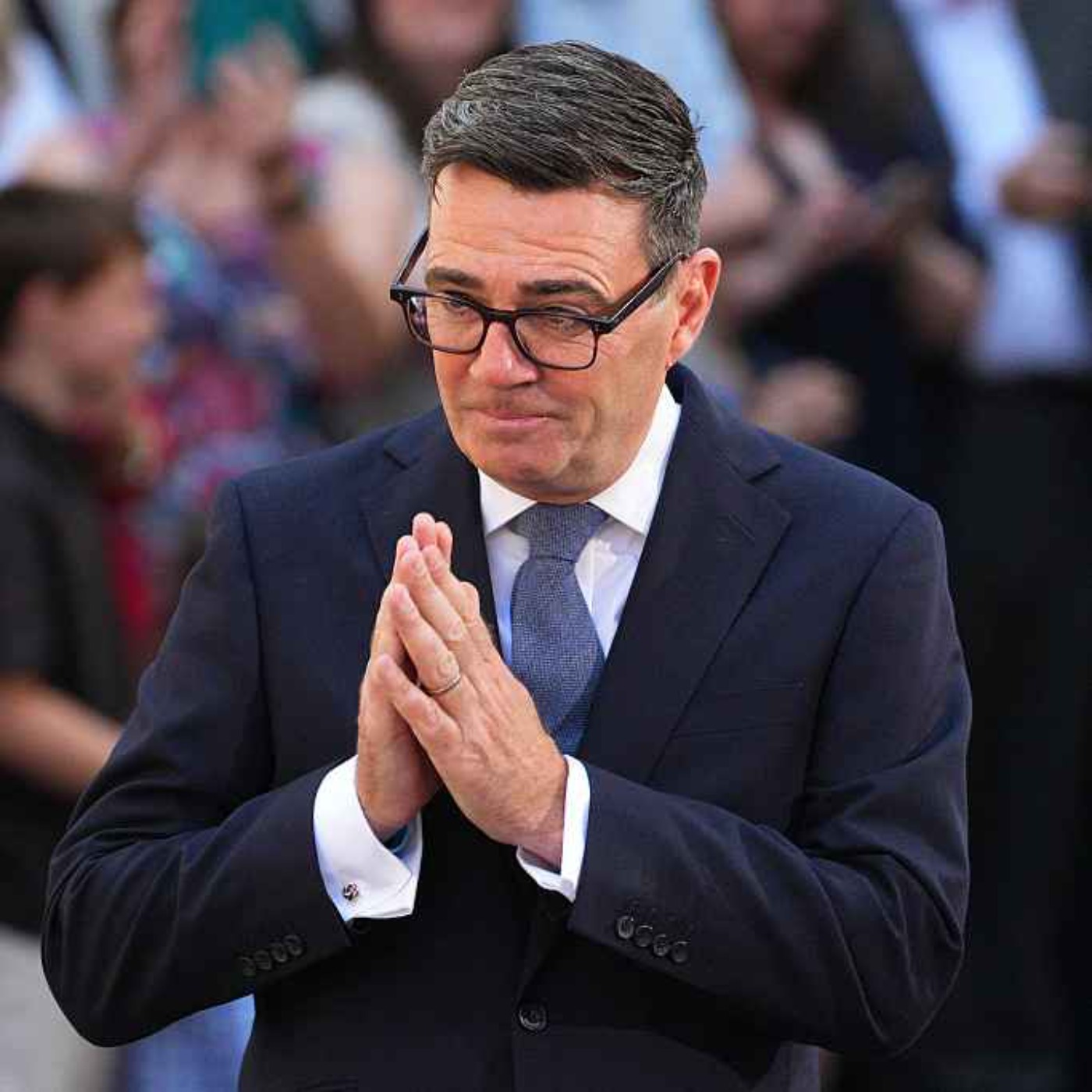
The episode discusses whether Andy Burnham could be “Britain’s first Catholic Prime Minister” and how his Catholic background may shape his politics.
Patrick Maguire, Times political correspondent, and Damien Thompson, Spectator associate editor. Both argue Burnham is a “cultural” or “tribal” Catholic: raised Catholic (Catholic schools, altar boy; mother devout; brother headmaster), but not portrayed as doctrinally observant (e.g., emphasis on values rather than church rules like Sunday Mass).
his stance on assisted dying is influenced by Catholic “sanctity of life” but framed via dignity for the sick and palliative care rather than outright opposition.
comparisons to Tony Blair’s Catholic practice; Burnham’s meeting with Pope Francis (homelessness commitment); and contrasts with American Catholic debates (e.g., Biden/communion) and with U.S. trad Catholics like J.D. Vance.
Written by AI. May contain mistakes.
Discussion on Andy Burnham's upbringing and its relation to his politics.
“The first thing I want to ask you about, Patrick, is Burnham's position on his sister dying.”
Exploration of Burnham's views on assisted dying and how they connect to his faith.
“objections to the process a couple of years ago, and this time, again, similarly talking about palliative care.”
Analysis of what being a cultural Catholic means in today's context.
“so nobody doubts that you're Jewish just because you just go to synagogue on Yom Kippur or whatever.”
Comparison of Burnham's Catholicism with Tony Blair and Boris Johnson.
“His dad is christened Protestant, but a non-believer.”
Consideration of Burnham's international relationships and Catholic identity.
“I think it might be a nice icebreaker for them, but your question, I think, gets to the heart of it.”
The discussion revolves around the implications of Andy Burnham's Catholic identity and its impact on his political decisions.
“He gave the Pope a signed football shirt.”

Get the gist, explore an idea or ask about something said.
 Claude
On Coffee House Shots, what are the key points of this episode?
Searching your listeningAutomatic transcript. May contain errors.
0:00Patrick Maguire: Hey, we're Nick and Jack, hosts of The Best One Yet. Behind every episode, there's research, email, spreadsheets, and our shared Google Doc, the Headline Hammer. With Google Workspace with Gemini, Google's AI is built right into the premium versions of tools we already use, like Gmail, Docs, and Sheets. No new tools or extra logins, just personalized AI for the way we work. That means less time on the work around the work and more time finding the stories worth talking about. Get AI tools for work. Upgrade to Google Workspace with Gemini at goo.gle slash workspace with Gemini. That's G-O-O dot G-L-E slash Workspace with Gemini.
0:40Hello and welcome to this week's Saturday Shops. I'm Lara Brown. I'm joined by Damien Thompson, Spentator Associate Editor, and Patrick McGuire, Times political correspondent, to discuss Andy Burnham, Britain's first Catholic Prime Minister. Andy Burnham has said a lot of things about his religion over the years. We know that he went to a Catholic primary and secondary school. He served as an altar boy and his brother is the headmaster of a Catholic school. He's also been very keen to stress that while he cares about the Catholic social teachings, he's not sort of overtly religious. And so I'm quite interested to hear from both Patrick and Damien about how Andy Burnham's Catholicism may shape his politics going forward, how it might underpin certain decisions or influence his politics.
1:21The first thing I want to ask you about, Patrick, is Burnham's position on his sister dying. There's been a lot of news recently about the fact that Andy Burnham seems to deviate a bit from Keir Starmer in being much more reticent about assisted dying. He wants to wait until we've solved the party of choir question before we discuss it. Do you think that could be something that comes with religious belief?
1:39Patrick Maguire: I don't think it's entirely unrelated, actually, because there is no question that Andy Burnham is in any way keen to seem influenced by his faith or his faith background. It's probably a more accurate way of putting it on questions of the sanctity of life. But if you trace his decision making throughout his career, you can see some influence from his cultural and religious background. And I think he occupies a sort of halfway house on this issue. So when this issue first raised its head of assisted dying last year or the year before, he doesn't oppose the principle of assisted dying legislation, which, you know, obviously would cut pretty sharply against Catholic theology on this matter.
2:23Patrick Maguire: But what is the emphasis he draws? Both then and the other day when he said this, he was open to a debate, but he moves immediately to his preference to talk about dignity for the weak and dignity for the sick, be it through the hospice movement, which he was talking about when he first raised objections to the process a couple of years ago, and this time, again, similarly talking about palliative care. So I think that question of emphasis is revealing of a worldview that is shaped in a slightly woolly way, and I think not a sort of doctrinal way, by a grab bag of values he picked up as a boy who was raised Catholic, even if he's not adhering to the letter or indeed the spirit of the church's teaching on these issues.
3:07And from what you know about Byrne's personal life, would you say that he's still keenly engaged with the Catholic Church in Manchester, perhaps?
3:15Patrick Maguire: Look, I think it matters to him immensely. You know, when I spoke to him the day before he became Prime Minister, I interviewed him the day before Prime Minister, we were talking about his family and he said, you know, his mother would be wearing her rosary out the next day. I think it matters. I think his mother is still a pretty devout Catholic, as lots of Liverpool women of Irish extraction of her generation were and indeed continue to be. I don't think he put it any more strongly than being an occasional mass goer and something he feels. if such a thing is indeed possible, and this has been, you know, I wrote a long essay in this in the Times and it sparked quite a lot of debate on this, you know, he would say he is a cultural Catholic.
3:55Patrick Maguire: Such a thing can be said to exist. But I think that it's about values and identity in their broader sense, as opposed to doctrine. You could say it's about, you know, in a very broad sense, sort of, it's about social teaching, it's about moral theology. But if you're expecting Andy Burnham to be going to mass at Westminster Cathedral every Sunday, or indeed going to mass back in Newtland Willows or wherever, or in Colcheth or anywhere in his part of the north-west of England. I'm not sure that's going to be happening on a regular basis, as it hasn't been. But it's something that matters to him.
4:30Patrick Maguire: I was speaking to someone during the Makefield campaign who had been in the car with him, and he mentioned that he'd realised he would be Britain's first Catholic Prime Minister. Indeed, by some definitions, anyway Britain's first Catholic Prime Minister and that's another thing we spoke about on the Sunday before he became Prime Minister that you know he was he was aware of it he'd had conversations on Waterhole about it and he answered yes when he was asked to be still professed the Roman Catholic faith as all Prime Ministers are before they take office by by officials so I think it shapes him in in ways that are are not necessarily directly related to the faith or to creed or doctrine, but it shaped the person who he is.
5:09Damien, can I ask you about this idea of a cultural Catholic? Obviously, Andy Burnham himself said that he was raised Catholic, isn't particularly religious. That might be a comment that he's making because he's nervous about running into the problems that Jacob Corsese Morgan and Tim Farron have had with their religion. Obviously, we hear about people who are culturally Jewish, but what could being culturally Catholic look like from a theological perspective? There is no equivalent of being culturally Jewish in the Catholic Church. so nobody doubts that you're Jewish just because you just go to synagogue on Yom Kippur or whatever.
5:43There is, strictly speaking, no such thing as a cultural Catholic in terms of the teaching of the Catholic Church. If you're a believing Catholic, and I'm just stating the official policy, you are required to go to Mass every Sunday on pain of mortal sin. In other words, missing Mass is a really big deal and really serious. And so somebody who says they believe the Catholic faith and profess the Catholic faith and doesn't go to Mass on Sundays, that instantly raises very serious theological questions about what his Catholicism consists of. But it's such a tricky area because you don't cease to be a Catholic just because you don't obey the rules.
6:27And in many ways, I think Andy Burnham is typical of most people born Catholic in this country who do not go to mass every Sunday. It's a fact. Whether he's the first Catholic prime minister is up for debate because Boris was born Catholic. He was confirmed into the Church of England, but then appears to have reverted in some way to Catholicism. I think the details of his marriage to Carrie more or less involved him being a Catholic at the time. And you have the very curious fact that we have had somebody who attends Catholic Mass every Sunday as Prime Minister, and that was Tony Blair, who obeyed the rules, going to Mass even on his own when his Catholic wife wasn't there at Westminster Cathedral in other parts of the country as well, but wasn't a Catholic until after he left Number 10.
7:18So it's complicated. But I agree with absolutely everything Patrick has said. I do think that his stance on his sister dying is influenced by Catholic teaching, probably. And certainly he's scored high marks from prominent Catholics, including conservative ones, for the things he said the other day. It's interesting that obviously there's this second thread uniting Andy Burnham and Tony Blair. And obviously, you know, Tony Blair wasn't necessarily a sort of committed Catholic, but he did go to mass for his wife. Do you think you see other streams of parallel in the two's politics? Well, just to be clear, he seems to have been committed Catholic in all but name in Downing Street.
8:00And even when his wife wasn't there, he went to mass on his own and went every Sunday as well. So it's a very curious situation.
8:08Patrick Maguire: It's a really interesting contrast, actually, because Burnham is a what you call, you know, he's a cradle Catholic. Right. He's born into a Catholic family in or at least his mother is Catholic. His dad is christened Protestant, but a non-believer. And, you know, it's the Catholic is his mother's Catholic face in which Burnham is raised. Altar boy, all of that pressing play on tapes of Archbishop Derek Warlock in in the church as an altar boy. and imbibing everything Warlock was saying about a new version of Catholic ministry in poverty-stricken inner cities in the 1980s. So it shapes him, but it's a Catholicism of time and place.
8:45Patrick Maguire: Blair is a convert and Blair is much more religious, but it is a different kind of Catholicism of time and place and cultural identity and class that shapes Burnham's politics. And I think the way you see the key differences, You can almost, not quite, but explain them through those two things. Because what's the language Burnham speaks? Sometimes it can sound quite Panglossian. It's about solidarity. It's about values. It's about, you know, sometimes it sounds a bit clichéd or pat. It sounds, you know, it's place first, all of that stuff. But if you consider the time and place and the formative influence on his politics, don't forget, you know, what does he say?
9:23Patrick Maguire: Why does he join the Labour Party? He says it's because he was studying the catechism. And he realised, in his words, that the enfranchisement of that on earth was the Labour Party. But it's a very sort of particular style of Catholic ministry and a very particular vision of Catholicism and that of Derek Warlock in Liverpool in the 1980s that leads him to that. Cherie Blair is actually, you know, from the same archdiocese, you know, not a million miles away from Andy Burnham, growing up in Waterloo in the Liverpool docks. but Blair comes to it later and is engaging with it in a much, much different way on a different intellectual level.
10:01Patrick Maguire: Once you understand that world in which Burnham was growing up, everything that seems sort of slightly, as I said, Panglossian and woolly about him is rooted in that time and place and that kind of caricature. Yeah, I mean, the Catholicism of Derek Ward's Liverpool was very political, very, very much orientated towards the Labour Party, as indeed was nearly every member of the Bishop's Conference of England and Wales at the time. I mean, they cancelled a trip to Rome, I think, to make sure that they could be in the country to celebrate Tony Blair's election in 1997. And I would actually say that the sort of social justice Catholicism, doctrine-light Catholicism, many, many general affections to Catholic social teaching, I would say there's continuity between Warlock and Blair and Burnham.
10:51The interesting thing is that Burnham has said something relatively controversial. He's done what Liverpool social justice Catholics were so reluctant to do so much of the time and challenged liberal orthodoxy, at least up to a point, on the subject of assisted dying, for which, as I say, he has been praised by some very socially conservative Catholics who I suspect would never vote for him in a month of suffrage, as it were. Just staying on this idea of social justice, Catholicism for a second. Obviously, Burnham is already engaging with America closely. He's already had a run in with Trump over the North Sea.
11:29There is an interesting factor at play here in which Burnham and obviously J.D. Vance share the same faith. And yet they don't seem to share sort of any aspect of their politics. Do you think that will ease Burnham's relationship with the American administration? Do you think that their conceptions of religion are so different that it will change nothing about how the two relate to each other?
11:50Patrick Maguire: I think it might be a nice icebreaker for them, but your question, I think, gets to the heart of it. I think, you know, when I wrote a long essay in the Times, my long essay in the Times about Andy Burnham, his relationship with Catholicism and how it impacted his politics, there were deluge of responses from conservative Catholic press, both in this country, but quite a bit in America too of people saying, who the hell is this guy? This isn't Catholicism. And lots of this was coming from, you know, not just the sort of your traditional Latin mass society types here, but, you know, what they call in America, the trabbed Catholic movement, you know, lots of whom, like Vance, are converts.
12:24Patrick Maguire: So they're two very different conceptions of the, not of the faith itself, which is Damien says, you know, exists, has its rules, has its doctrine. But in terms of how someone like Vance would relate to it, I think he'd be slightly, I don't know, but you can imagine your American trad Catholic convert would be slightly bewildered by the idea that someone like Andy Burnham would call themselves a Catholic at all. And I think that is the key difference between the two. Well, I think they might be puzzled by the fact that somebody who talks about professing the Catholic faith and the influence of Catholicism on him, then so casually disregards the really serious injunction to go to Mass every Sunday.
13:04And it's interesting that President Biden, whose actions flew in the face of Catholic teaching to an absolutely remarkable degree, to the extent that many Catholics and many bishops believe that you shouldn't be allowed to receive communion, never missed mass on a Sunday. And I think that may be something to do with American culture, a cultural difference between the way Americans practice their religion and the way the British do. British Anglicans were always very casual about going to church on Sundays because there is no obligation. And one of the big demographic changes is that English Catholics, British Catholics, have become casual about attending Mass on Sundays.
13:44My record isn't perfect, I have to tell you, despite the very serious theoretical consequences of missing Mass, which is to imperil your salvation according to church teaching. There's another interesting relationship, I think, possibly at play here. Andy Burnham obviously has met the Pope before, I think, most recently in Manchester in 23. He gave the Pope a signed football shirt. Is there a geopolitical consequence of this relationship, Patrick, or is it just someone that Andy Burnham admires spiritually? I think particularly of the fact that in 23, Andy Burnham, the Pope, talked about the need to end homelessness, which has now ended up as one of the primary commitments Andy Burnham has made.
14:23Patrick Maguire: It was in Rome he met Francis, actually. But yeah, he went to Rome to meet Francis and he said it was the most moving experience of his life, which I think tells you something about how deeply felt that Catholic identity is, even if he is not a particularly conscientious adherent to the requirements of the faith. I think, look, I think when he meets Leo, and I'm sure he will, I'm sure they'll get on. I'm sure Leo will much prefer him to President Trump. But will it shape British foreign policy? Not particularly. I think it will help us explain why Andy Burnham says and does the things he does.
14:59Patrick Maguire: but anyone still banging the sort of no-popery drum on the fringe of English politics in certain parts of Glasgow, and indeed Liverpool, where they might be worried about having a Catholic prime minister and what role the Pope will have in influencing him, I think can rest easy. No, it's worth saying that the Vatican, curia anyway, is still in the grip of the sort of soft left, Europhile blob. You know, many staff at the Vatican, possibly including the Pope himself, will be very comfortable with burdens, particularly world-viewed, Much more so than many Catholics are beginning to question, you know, the wisdom, for example, of mass immigration, which is something that doesn't seem to bother the Pope and the Pope doesn't seem to understand any more than his predecessor did.
15:39But ordinary Catholics increasingly are troubled by. Damien, very quickly, you mentioned discussions in the US about whether or not Biden should be able to receive communion because of some of his political views. I know that's a debate that's played out in the US a number of times. I remember it happening with bishops in 2004. Would you say that this is something that we could see discussed in the UK with relations to Andy Burnham with representatives from the Catholic Church passing judgment on decisions that he makes over sort of migration or abortion or assisted dying? Or do you think that's a very American type of argument?
16:12I think it's very unlikely to happen. First of all, as far as we know, Andy Barnum isn't a communicant member of the Catholic Church. That's another rule, is that you're supposed to receive Holy Communion once a year. Well, we don't know that he does. But on the whole, the Bishops of England and Wales trend soft left and are terrified of saying anything controversial and are, many of them, sentimentally attached to the Labour Party. And so they're extremely reluctant to upbraid a Labour prime minister on any of these subjects. So I wouldn't expect it, no. And then my final question for both of you.
16:50Being religious in British politics can at times be quite difficult. You see Catholics like Jacob Riesmog regularly asked to explain how many of their views align with the Catholic Church. Tim Farron left politics over his religion. You've also got Tony Blair facing constant scrutiny over whether or not he was a Catholic. Let me take orders from the Vatican. Do you think that this is ever going to rear its head for Andy? Could this be something his critics level against him? Or has he played this quite softly to the point that no one really views it as defining his politics?
17:19Patrick Maguire: I think that's right. I think he occupies a space where he will always have a defect. You know, what does he say throughout the Labour leadership contest in 2015? He didn't like Benedict, he liked Francis, but he disagreed with the church's teachings on LGBT issues. Right, he hasn't said, he never answers a question saying, as a Catholic. Yes, his set of values, his worldview, his cultural identity, his sense of affinity with the church. He calls himself a Catholic. He feels he is a Catholic. He's the politician he is today because he grew up in a Catholic household and went to a Catholic church in a certain time and place.
17:58Patrick Maguire: But we are not going to see him take decisions that you can trace back to any particular point of theology or doctrinal teaching beyond the broadest Christian values and Catholic social teaching. So I don't think it'll be a problem for him because he's never engaged with that faith and doesn't conceive of his faith in that way, which is why the question of whether he is really a Catholic prime minister is, I think, likelier to dog him than any criticism over his faith. That's absolutely right. First of all, you could argue that he isn't the first Catholic Prime Minister because Boris was. Or you could take a different tack and say he's not the first Catholic Prime Minister because his actions are not in line with the teaching of the Church on extremely important moral matters.
18:43or at least we have no indication that his time in Number 10 will be influenced by the teaching of the faith that he claims to profess, but there's not an awful lot of evidence to suggest that he professes it very intensely. So I think the most we can say is that Andy Burnham is Britain's first tribally Catholic prime minister, which in some ways is a big deal and in other ways not a big deal because, let's face it, in modern Britain, nobody goes to church anyway. Well, thank you so much, Patrick and Damien, for joining me this week's episode of Saturday Shots.
19:41Patrick Maguire: Hey, we're Nick and Jack, hosts of The Best One Yet. Behind every episode, there's research, email, spreadsheets, and our shared Google Doc, the headline hammer. With Google Workspace with Gemini, Google's AI is built right into the premium versions of tools we already use, like Gmail, Docs, and Sheets. No new tools or extra logins, just personalized AI for the way we work. That means less time on the work around the work and more time finding the stories worth talking about. Get AI tools for work. Upgrade to Google Workspace with Gemini at goo.gle slash workspace with Gemini. That's goo.gle slash workspace with Gemini.
Is Andy Burnham the country's first catholic Prime Minister, and how might it influence his leadership? Despite his faith drawing him to Labour, he doesn’t attend mass and rarely emphasises his religion publicly. To unpack his faith and where it might take him, Lara Brown, The Spectator's commissioning editor, is joined by the chief political commentator at The Times, Patrick Maguire, and The Spectator's religion editor, Damian Thompson.
Produced by Henry Lloyd and Ed Parker.
Become a Spectator subscriber today to access this podcast without adverts. Go to spectator.co.uk/adfree to find out more.
For more Spectator podcasts, go to spectator.co.uk/podcasts.
Contact us: [email protected]
Hosted on Acast. See acast.com/privacy for more information.


