
 Ask ChatGPT



Andy Burnham’s first foreign trip to Ukraine, where he hands Zelenskyy long-range missile blueprints (linked to the French Scalp/UK Storm Shadow), framed as a low-cost, symbolic way to keep UK/French commitments and enable Ukrainian production and deep-strike capability. Mark Gagliotti argues this is meant to create political pressure on the Kremlin rather than immediate battlefield impact.
Mark Gagliotti is a regular Coffeehouse Shots contributor and director of MIAC Consultancy.
British relevance remains via money/training/assistance; Burnham’s move “underwrites” French sharing of proprietary elements. Zelensky is both effective and increasingly vulnerable to corruption concerns, but elections are constrained by martial law. Deep strikes aim at political impact; Russia can absorb losses and is unlikely to be deterred from mobilization.
deep strikes around Moscow and St Petersburg; winter attacks on energy/water infrastructure; Russian “Wildberries”/petrol queues as a mechanism to pressure ordinary Russians; procurement delays and the risk of stockpiling obsolescent drones.
Written by AI. May contain mistakes.
Discussion on Andy Burnham's decision to provide missile blueprints to Ukraine.
“Today we've got Andy Burnham on his first foreign trip abroad, Mark, and he's gone to Ukraine.”
Analysis of Zelensky's current leadership amidst domestic challenges.
“And in some ways, that's a good thing in terms of obviously Ukrainians developing their own capacity.”
Exploration of how missile handovers impact the Russian war strategy.
“of view, all these challenges to Zelensky give them all the more reason to feel, oh, time is on our side.”
Examination of Britain's role in supporting Ukraine and the evolution of warfare technology.
“There certainly is a belief that that is the case.”

Get the gist, explore an idea or ask about something said.
 Claude
On Coffee House Shots, what are the key points of this episode?
Searching your listeningAutomatic transcript. May contain errors.
0:00Grainger knows if you're a procurement manager at an industrial manufacturing facility, you're balancing inventory and budget while sourcing critical supplies across the operation. Too much inventory? Costs climb. Too little? Production slows. Grainger's$2 billion in on-hand inventory helps you get what you need when you need it. So you can help keep budgets balanced and lines moving. Call 1-800-GRAINGER, click grainger.com or just stop by. Grainger, for the ones who get it done.
0:37Hello and welcome to Coffeehouse Shots. I'm James Heal and I'm joined today by Mark Gagliotti, one of our regular spectator contributors and director of MIAC Consultancy. Today we've got Andy Burnham on his first foreign trip abroad, Mark, and he's gone to Ukraine. Perhaps no great surprise there, but the big top line announcement is that he's handing over the blueprints to long range missiles to aid the Ukrainian war effort. Tell us why he's doing this now. Well, I mean, in some ways he's doing this because it's pretty much necessary, because the French have already said that they are willing to share the plans for this scalp missile, which in the UK we call Storm Shadow.
1:12But there are some proprietary elements of that which are in the hands of British companies. So in some ways, what Andy Burnham is just simply saying is underwriting the French commitment. But of course, that's not how it's going to be spun by number 10. But in this case, look, it's simply a reflection of two things. One is that we've moved beyond the world in which we are the providers of all the kit that the Ukrainians will use. And increasingly, it's the Ukrainians producing their own kit, but quite possibly with technologies and blueprints that we provide. But also, it's, if I'm very blunt, it's a relatively low impact way of demonstrating that you are still committed to the Ukrainian cause.
1:52It doesn't involve extra money. It doesn't involve boots on the ground or any of these other things that could be problematic. But nonetheless, symbolically, it shows that Burnham is operating within the same policy line as his predecessors. Has there been any indication thus far that Burnham will be in any way different on this? It does seem, as you say, that the British contribution is now much less than it was perhaps four or five years ago. And in some ways, that's a good thing in terms of obviously Ukrainians developing their own capacity. But I mean, how relevant really are we in this conflict going forward?
2:20I don't know. Let's be clear. We are still very relevant. We provide money. We provide training. We provide all kinds of assistance. The issue is really that up to now, Andy Burnham really hasn't shown any particular interest in foreign policy in general, Ukraine policy in particular, beyond the obligatory meeting with Zelensky, because that's essentially everyone's necessary selfie when they've come into power these days. Now, one of the interesting things is that although clearly Moscow's line is just simply that Britain is once a faded old lion, but at the same time Russia's most devious antagonist.
2:57But nonetheless, there have been some thoughts in Moscow that maybe a British prime minister who is much more committed to domestic politics, who may well be looking desperately behind the sofa cushions for some extra cash to be able to commit to those, might be a little bit more willing to perhaps change policy over Ukraine. And there has been some thought even within the British foreign policy establishment that perhaps now is a time to begin to try and build some kind of very, very tentative initial channel for discussion. The thing is, all of this will require spending political capital. It's a lot easier just to essentially continue with business as usual.
3:35So I think at the moment, that is the likelihood. It seems at the moment, we've got Zelensky has a number of domestic issues as well. You've obviously had the resignation of the defence minister, who's now calling for potentially some kind of elections and looking into alleged corruption in Ukraine. I mean, how strong is Zelensky's position now, four and a half years after the war began? I mean, in many ways, Zelensky's position is that he is unassailable and substantially weaker. I mean, the point is exactly, we are seeing all kinds of dissatisfactions beginning to emerge, sense that for all his promises, he hasn't been as effective in fighting corruption as people would like.
4:12In some places, they feel that he, or at least his people, more to the point, have actually sort of essentially acted as protectors for all sorts of dodgy rackets. But at the same time, there is no real mass view that the country needs elections. I mean, it would be not only illegal under the current constitution, given that they are under martial law, it would also be monstrously problematic practically, and also incredibly divisive. So I think at the moment, in some ways, everyone accepts that Zelensky is going to be the leader, and he has been a phenomenally effective leader, especially in terms of championing Ukraine's position abroad.
4:49But on the other hand, I think there is a growing sense that in some ways he will be Winston Churchill, that once the war is over, he will be elevated into the pantheon of national heroes, but also told, actually, we need someone else to build the peace. So I think that's really the likelihood. But of course, from Moscow's point of view, all these challenges to Zelensky give them all the more reason to feel, oh, time is on our side. We don't need to make a deal. Anyway, we're coming up to winter when we're going to hammer Ukraine's energy infrastructure, maybe also its water purification and so forth plants, and that'll put them in a quote unquote more receptive frame of mind.
5:26I'm not saying that that's likely, but I think given that Putin wants excuses to not have to change his policy, this gives him an additional excuse. The briefing around today's missile handover and the blueprints is that these are increasingly important to the Ukrainian war effort. They're enabling Kiev to strike deep around Moscow and St. Petersburg, where some of their industrial bases, how much of an impact is that having on the Russian war effort? In terms of the actual war effort on the ground, the answer is not very much. The fact of the matter is that Russia has the money, it has the industrial capacity, and at the moment, at least, it sort of has the manpower, though we might see a mobilisation of further troops after the elections which take place next month.
6:05But the point is, this is not really the goal. I mean, the goal is really to actually bring political impact and political pressure to bear on the Kremlin. The idea, and it's not at the moment particularly playing out, but the idea in Kyiv was precisely that by making ordinary Russians suffer, by making them have to queue up for hours to get petrol and not be able to get the goods that they'd ordered off wild berries, often known as the Russian Amazon and such like, that they would start to say, hang on a minute, this war isn't good for us. Because certainly Putin's social contract had more or less been, you let me have my war and I will ensure that you don't really have to feel the impact.
6:42Well, people increasingly are feeling the impact. However, this is a thuggish police state. People are not at the moment at the stage where they're going to go out on the streets and be trunched down by the riot police and dragged off to God knows what. So I think at present, yes, it might influence Putin. It might, for example, make him more leery about another mass mobilization. Certainly the last one, the only one he tried in this war was incredibly unpopular and politically disruptive. More people fled the country than ended up under arms. But it certainly is not some kind of a deal breaker for him.
7:13One of the ways in which the British have helped the Ukrainian effort has been through back channeling and formal diplomacy with the Americans as well, and ensuring that aid has kept flowing at different points throughout this conflict. Is that the role you think that the Ukrainians believe the British can play in this, that they can keep the American administration, Donald Trump, some elements of his mega coalition are a bit more sceptical, that the Brits can actually play a role in sort of the jaw-jaw as much as the war element here? There certainly is a belief that that is the case. And in some ways, there's been a strong alliance between London and the current Ukrainian ambassador to London, former General Zelushny.
7:47So there's a sense that although Zelushny has his problems with Zelensky, he is undoubtedly a very strong Ukrainian patriot, and that that forms an axis which then can bring pressure to bear on Washington. Actually, how much impact the British have, I think it's fair to say that it ebbs and flows. But from the Ukrainians' point of view, given just how mercurial American politics are at the moment, they will use any particular channel they can. And given that at present they do have the problem that they, just as the Russians don't have an ambassador in London at the moment, the Ukrainians don't have an ambassador in DC, which makes it all the more important for them to use whatever strings they can tug to try and in some ways influence Trump.
8:27In terms of where this war goes next, and we've seen a huge amount of technological development. There's been lots of talk about as the first drone warfare in a way. How are we seeing that technological progress pay out? And with these long range missiles, how high of the curve do they remain? Look, I think it's fair to say that at the moment, the foremost practitioners of what we could think of as a new form of 21st century warfare, not the only form of 21st century warfare, but a new form, undoubtedly the Ukrainians. Of course, it's worth noting that the Russians, who demonstrate a particular knack for never quite spotting the threat that is coming, but conversely, actually being pretty depressingly good at adapting to those threats, are undoubtedly the second best.
9:10And the rest of us are a very, very distant third. So, I mean, I think it is clear that although there's all sorts of debates as to whether or not what we're seeing in Ukraine is the face of the future of warfare or just simply a particular response to particular circumstances, what we are seeing is absolutely revolutionising warfare. And that causes all kinds of problems for countries like the UK and the rest of NATO, which have kind of legacy armies built for a different style of war. And we're seeing some changes and everyone will proudly claim that they developed this new drone or whatever.
9:43But in terms of the scale of change and the depth of magazines needed for these new weapon systems, we are, I'm afraid it has to be said at the moment, I wouldn't say nowhere, but a long way away from where we need to be. Because, of course, today we're handing out intellectual property to the Ukrainians, but of course the Ukrainians have taught the Brits and all Western armies a huge amount as well in terms of how the battlefield is changing and very much what warfare is going to look like in the future. Yeah, absolutely. But one of the key problems is this, though. It's precisely about the speed of change.
10:12So the Ukrainians learn something, they tweak their systems to be able to do something different. And then they come and tell us about it. And we think about it. And we think, oh, well, maybe we should do something about it. And perhaps we start some kind of procurement process, which will take years and half the time never actually end up reaching fruition. But the point is, if we, for example, today said, right, that's it, we are going to somehow, I mean, God knows where we source them, but let's say we were going to somehow, we're going to buy 200 ,000 drones to actually have in stock. That would be great if war happens within the next six months.
10:44But assuming that, please, may God ensure this, there will be no such war for years, by which point we might as well quite possibly have been accumulating crossbows and spears. So I think this is a constant challenge. If you arm at this stage at that scale, what you simply do are just simply creating warehouses full of obsolescent stock. So it's invaluable, the lessons we're learning, but unfortunately, it's applying them that is the problem. Yes, often goes back to the classic MOD issue of procurement. Well, thank you very much, Mark. And thank you for listening to Coffee Hour Shots.
11:41This is the story of the one. As a shipping manager, he's running the dock, stocking supplies, and making sure every order goes out on time. And Grainger helps him stay prepared. From shipping supplies to PPE to hand tools, he counts on Grainger to keep products moving and trucks rolling. So his operation runs smoothly no matter the shift. Call 1-800-GRAINGER, click grainger.com or just stop by. Grainger, for the ones who get it done.
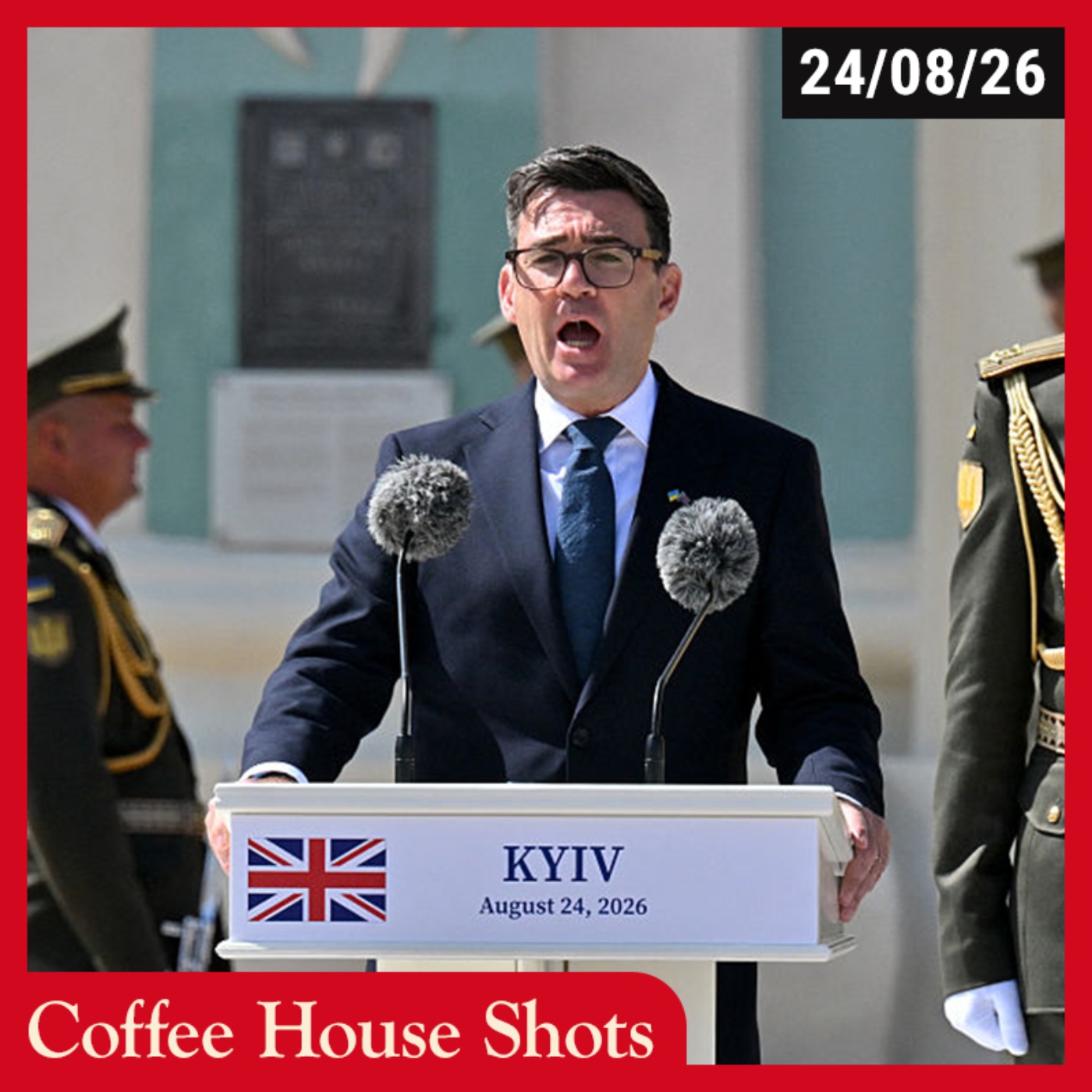
After spending his Saturday afternoon watching Everton win at home, Andy Burnham showed up in Kyiv this morning to hand a gift to President Zelenskyy in the form of missile blueprints. To dissect the PM's trip to the eastern Europe, James Heale is joined by Mark Galeotti to discuss the impact of the Storm Shadow plans, both for Kyiv, and for Moscow.
Produced by Henry Lloyd
Become a Spectator subscriber today to access this podcast without adverts. Go to spectator.co.uk/adfree to find out more.
For more Spectator podcasts, go to spectator.co.uk/podcasts.
Contact us: [email protected]
Hosted on Acast. See acast.com/privacy for more information.


