
 Ask ChatGPT



Discussion of a UK Prime Minister’s performance in PMQs, focusing on Kemi Badenoch’s questions about defence spending and welfare cuts, plus Burnham’s “big blunder” on Israel/Palestine and his “hope”/people-pleasing approach.
Nell Hoffman hosts; Isabel Hardman is a journalist/commentator; Tim Shipman is a journalist/commentator.
The PM’s line “national security cannot come at the expense of social security” was politically damaging and possibly pre-prepared. He avoided funding details (e.g., defence spending to 3% by 2030) by shifting to “togetherness.” His “underdog” framing on Israel was simplistic and domestically motivated.
Cutting housing benefit to fund defence; Israel intelligence sharing; two-state solution “on the rack”; Burnham’s repeated emphasis on “hope” without delivery; PMQs responses offering meetings to MPs.
Written by AI. May contain mistakes.
Exploration of the Prime Minister's missteps during PMQs.
“Tim, should we talk about the big blunder?”
Insights into the Prime Minister's messaging strategy and its implications.
“Well, if that's not on every single Conservative election poster come the next election, I'd be absolutely amazed.”
Discussion on the Prime Minister's views on foreign policy and domestic implications.
“And I do wonder if this Prime Minister sees both domestic and foreign policy slightly in the terms of a football match.”
Critique of the Prime Minister's handling of the Israel-Palestine situation.
“something that sounds initially to be the right thing can often be entirely counterproductive.”
Exploring the role of hope in political discourse and its consequences.
“So it's just completely pie-in-the-sky thinking.”
Discussion on the Prime Minister's focus on local issues and its impact on governance.
“Cornish MP coming in to meet him for something.”
Debate on the effectiveness of consensus politics versus opposition-driven solutions.
“There also seems to be a lack of strategy architecture around Burnham at the moment, which suggests that he genuinely believes in hope as the mechanism for getting stuff done.”
Explore the pitfalls of consensus-driven politics and the value of debate.
“Yes, I understand why Burnham does that.”

Get the gist, explore an idea or ask about something said.
 Claude
On Coffee House Shots, what are the key points of this episode?
Searching your listeningAutomatic transcript. May contain errors.
0:0098 of the top 100 U.S. accounting firms trust Bill to handle BillPay processes. Why? Because our tools are built on over a trillion dollars of secure payments. We're not just moving money. We're powering financial workflows for half a million customers. That's a level of expertise you just can't fake. Ready to talk with an expert? Visit Bill.com slash proven to get started and grab a$150 gift card as a thank you. Terms and conditions apply. See offer page for details.
0:37Noa Hoffman: Hello and welcome to Coffeehouse Shots. I'm Nell Hoffman and for this episode, looking at PMQs, I'm very pleased to be joined by Isabel Hardman and Tim Shipman. Tim, should we talk about the big blunder? Oh, we should. But just the whole thing was fascinating, I thought. I thought this was easily the most interesting PMQs for several months. Yeah, I mean, look, Kemi Baden-Ock opened up by quizzing the Prime Minister about defence spending and why he hasn't come up with the money. And she has now outlined a plan to cut welfare in order to pay for it and asked whether he would do the same. And the answer came very clearly that he would not.
1:11And he said, I've looked at your plan and cutting housing benefit will put people on the streets. But then for some reason, the guy who is a much more adept political performer than Sakaire ever was, then walked into a man trap. And weirdly, this seemed to have been a quote that he pre-prepared. He seemed very pleased with it. It felt like it was in his briefing document. And it is, I would have thought, for anyone who is roughly to the right of Gordon Brown, is an absolutely devastatingly politically damaging quote. He said, national security cannot come at the expense of social security. Well, if that's not on every single Conservative election poster come the next election, I'd be absolutely amazed.
1:49And I think the truth of this is, if he'd really been honest, he'd have said this is about job security. And it was very popular with the people behind him. And I think most of the people on the other benches sat open mouth with the incredulity that such words would pass his lips. Yeah, I mean, it sounded like the kind of title that you get for a Labour conference fringe event, doesn't it? Maybe run by like a campaign group on benefits. 38 degrees with the Guardian chairing and, you know, someone from the Resolution Foundation introducing numbers about... We've been to so many of them, haven't we, Tim, over the years?
2:18Well, I try to avoid them, to be honest. But, I mean, that's what he's thinking about at the moment. He's thinking about those fringe events at Labour conference where he doesn't want anyone to be sounding off against him. He doesn't want rows on the conference floor. The fact that he, at the end of Baden-Ock's six questions, changed the subject and started talking about Israel so that he could again give one very clearly pre-prepared speech about Britain standing up for its values shows that he's thinking all about party management. And he framed a foreign policy decision very much with a domestic locus as well.
2:50I mean, he said, Britain has to be for the underdog. We have to, you know, we've got to stamp out injustice in the world and all this. And Bernard Jenkin asked a particularly piquant question about, hang on a minute, what about our diplomatic relationships? What about our intelligence sharing with the Israelis? And Burnham basically said, well, we considered all that, but we've got to cheer for the underdog. And I do wonder if this Prime Minister sees both domestic and foreign policy slightly in the terms of a football match. It's almost like, well, we cheer on anyone. You know, I mean, I guess if you support Everton, you've got to support the underdog in most circumstances, haven't you?
3:19Noa Hoffman: But also, even if you think about, for instance, the Falklands and Britain and Argentina, Argentina could be seen as the underdog. Are you going to support their claim over the Falklands? Like that logic just can't apply in foreign policy. It's so simple and it's so ideological. And Isabel, as you said, it's playing to the galleries of Labour MPs and Labour activists. Look, he's not just somebody with a clear, simple turn of phrase. He also has a simplistic view of the world under foreign policy. And we saw that in that speech where his strengths and weaknesses were on show at the same time. His strength is being passionate, having a kind of moral purpose about politics rather than sounding bored and like he's sort of, you know, counting the stationary order like Starmer often did.
4:02But his weakness... Oh, this is outrageous. I'm shocking to hear you say that, Isabel.
4:07Noa Hoffman: Always a pleasure to have the impression. Once a podcast. But his weakness there is also that he hasn't actually moved on from... I mean, he hasn't really moved on from Andy Burnham like 20 years ago or 10 years ago, where you might think, oh, well, he was naive. He's gone backwards, hasn't he? I mean, this was like one of the leading new Labour ministers. He used to be a Blairite guy, didn't he? And he seems to be cheering on the 1970s, and that's what he says at the moment. It's just that the problem is, is to Labour Party activists, a lot of this stuff does sound really appealing. But I think one of the duties of a leader is to explain how difficult and nuanced foreign policy can and should be and how, you know, as you've written there, the implications of something that sounds initially to be the right thing can often be entirely counterproductive.
4:57He's not going to do that because that's too complicated, probably for his own framework of the world, but certainly for the Labour Party. Yeah, and I think if you look at that decision with Israel, you know, I try as a journalist to judge people by will they achieve what they want to achieve rather than having a particularly ideological view on Israel and Palestine. I do actually have a principled personal view, which is much more pro-Israeli than the prime minister's. But I think if you judge him in his own terms, he says the two-state solution is on the rack. It's dying. We've got to help it.
5:30Will this help achieve a two-state solution? I don't think it will. I think quite a lot of intelligent commentators would say that by doing this before an Israeli election, you make it much more likely that the hard right in Israel wins and that Netanyahu stays in power. You make it much less likely that a two-state solution is likely to advance. They could have waited until after those elections. And instead, they've not only alienated one part of this debate, they've made it more likely that the extreme end of it continues to hold sway in Israel because the Israelis, you know, domestically are now using this as a massive kind of stick, saying, look, everybody's out to get us.
6:08Noa Hoffman: It's also a complete denial of the reality that Palestinians don't want a two-state solution either. Like the majority of Palestinian and Israeli opinion. Both sides don't want this. The two-state solution... So it's just completely pie-in-the-sky thinking. The two-state solution is a Western liberal solution to the problem. And for a long time, it looked like it might be a relatively straightforward way of resolving this issue. But that was 25 years ago. The two-state solution was rejected by Yasser Arafat and the PLO at the Camp David talks and in what followed. And since then, the Palestinians have voted not for a two-state solution, but for a group of people who want to eliminate Israel and most Jews from the map.
6:48So I'm struggling to see who the underdog is in this particular battle, if one is to use the prime minister's framing. But the whole thing, I think this was a fascinating PMQs, not just because of the specifics of welfare and the sort of Palestinian issue. I think I watched every single question. I'll be blunt, I don't always do that after the main exchanges. every single MP who stood up can see that this Prime Minister is desperate to please them and every single person stood up and said I've got a constituency issue which I'd like to draw to your attention or I've got a bill that I'd like to draw to your attention I'd like your support for almost all of them asked for a meeting almost all of them he responds to by saying this is a terribly important issue and I totally feel what you're saying and for most of them he says yes I'm perfectly happy to meet you or a minister will meet you.
7:38Last week he agreed to virtually every Cornish MP coming in to meet him for something. The Prime Minister's diary is absolutely jam-packed with big issues. This is a guy who wants to lead a revolutionary kind of transformational government and he is shackling himself to meetings with local MPs about issues. Mr Devolution should surely be saying I'm going to devolve all these decisions so they end up to do with me. Terribly sorry. The only thing where he stood up to someone was the MP who said you know oh we don't want these data centres. Oh my God, why do we have to have data centres in our local areas?
8:10And he did at least say, it might actually be useful to the country to have some data centres. And by the way, they tend to act as clusters and attract more jobs. I've been thinking quite a lot about people pleasers recently in the context of public inquiries, because I'm very close to finishing my book, just in case my editor's listening. And a lot of the campaigners I speak to, who've been through horrendous experiences, such as those that Andy Burnham's campaigned on, say that the worst thing is when a minister says to them you've been through something awful I am going to change the law I'm going to make sure that lessons are learned so this never happens again and then they don't do anything about it so I would argue that actually a much more compassionate thing Burnham is clearly he clearly sees himself as a moral compassionate man the compassionate thing to do is actually to tell people to their faces we can't do that at the moment that's not a priority because otherwise you give people false hope and Burnham is obsessed with word hope he talked about people want to have hope that help is coming, not people want to know...
9:07Not that actual help is coming. Just that they're hopeful. I mean, we can't, you know, I feel like actually we build quite a lot in British politics on the basis of hope that something might happen and that this inquiry might be the thing that ends the vicious toxic cycle and so on. But we seem to forget that actually hope needs to lead to something. Otherwise, people are even angrier. Well, that's the thing. It's dangerous if you don't deliver on it. You know, I think it's easy for a bunch of well-off liberals in London to say that this notion of hope is daft and we're looking at the numbers and we're trying to be sort of intellectually coherent about what happens and whether it works and all the rest of it and in a lot of communities where it's bleak and they haven't had pay rises and they're angry yes i think hope is important and i think burnham is a remarkable politician in in the way that he tries to channel that but i think you're absolutely right isabel if you fail to deliver on that in a finite period of time let's give him how long let's give him two years say if he is still failing to deliver at that point they will think this is just another bloke full of blather full of words and not full of action and if things have not demonstrably improved for people whatever it is they care about the amount of money they're receiving each month whether it's the boats that they're obsessed with if these things are not better then the shattering of that hope will cause a backlash for the Labour Party um on a scale that the Tories would recognize it seems to me um and if you know So Burnham, there seems to be quite a lot of sort of general, I wouldn't call it complacency, but just sort of optimism around Downing Street at the moment that, you know, they've got the new guy in, it's all going well, everything's fine.
10:41And that the hope, you know, that they seem to have hope that everything's going to be resolved. And I've done a piece for the magazine this week on Antonio Romeo, the cabinet sector and how things are sort of working at the centre. Stuff I didn't have room for was someone sort of saying, you know, look in there. I think they're at the stage of thinking a bit hopey-changing and thinking everything's going to work itself out. But actually, the tough decisions haven't been taken yet. There might be disillusionment even within the government about what they're able to do. I suspect Burnham will feel slightly disillusioned in a month's time about what he has actually been able to do.
11:12And the public's disillusionment will be tenfold. There also seems to be a lack of strategy architecture around Burnham at the moment, which suggests that he genuinely believes in hope as the mechanism for getting stuff done. which, you know, good luck to him on that. Hope can help economically because we saw what Doom did in 2024 when Reeves and Starmer talked down the economy. It had a material effect. Maybe talking things up might be worth 0.1 % of GDP or whatever. But as you say, Shippers, hope that's unfulfilled is much worse than realism that leads you to sort of modest gains. So who was the last politician who kind of offered hope as part of their pitch?
11:50It was Boris Johnson. And actually you were talking about, you know, outside of Westminster communities where people haven't had a pay rise for a long time, where growth is non-existent, where the high street is dead. Or irrelevant to them, actually. Yeah. But I mean, you know, he offered hope to those people in the form of levelling up. And actually, one thing that was to his benefit, not that he would ever see it in this way, was that his personal shortcomings allowed him to leave before the wrath of the public on realising that he hadn't delivered on the things he'd promised caught up with him.
12:20So I think there's delayed wrath there. I can see him now sitting there thinking, oh, Kerry, bargain. I managed to get out where we did. Exactly, exactly. Gold wallpaper. But, you know, I do think that actually if you look at the one thing he offered hope on that people are angry about is the Boris wave. Because they thought take back control meant something very different to what was realised. And it's one of the problems that the Conservatives, actually, it's far more potent in my view for the Conservatives than Liz Truss.
12:46Noa Hoffman: Should we quickly discuss another phrase that kept cropping up during PMQs? And that was Andy Burnham criticising Kemi Bader-Knoch for not addressing him in the spirit of togetherness and cooperation and putting party politics aside to work together to get policy done. What are your thoughts on this? Because I was quite struck that he was using it as a rebuttal and a get out clause instead of answering the questions Bader Nock was asking. I don't know if you felt the same. Yeah, well, particularly given he didn't have answers to questions on how he was going to fund getting defence to 3 % of GDP by 2030, which he dodged even making that commitment.
13:26To me, it sounded like he was saying, you know, we need problem solving, not point scoring, because I don't know how to solve it. So could you give me some suggestions? Anyone? You know, answers in a box, please. And then you would reject the suggestions given. Not that one. You'll make everyone homeless if you do that. I mean, look, we have big national problems. If we could get a consensus on them, it would be great. and there's an argument not on things like social care, the only way it would be sustainable would be to have a national agreement on it. He says we need lower welfare spending, but his way of tackling it seems to be to be spending more on it in the short term.
13:55Look, it's great when you can agree on things, but I'm one of those cynical journalists that thinks when the whole of Westminster agrees on something, they're invariably wrong about it. And actually, the best results in British politics emerge from the creative tension between the two main parties or noises off now in the shape of reform, you know, offering more radical solutions, which have moved the Conservative Party into a more radical position on migration, for example. Yes, I understand why Burnham does that. And that's clearly his style. He thinks in Manchester it worked, but he ran a one party state in Manchester.
14:28It wasn't consensus, it was absence. Yeah, there was no opposition in Manchester of any meaningful scale. So it's just not what Andy Burnham's used to. And the more he says it, the more you think, is he a bit naive about this? Now, fine, he can say to Kemi Baden-Ottert, look, yes, we want to both cut welfare, but I can't bring my – he didn't quite say it like this, but this was what he meant – I can't bring my people to support the thing that you're supporting. So that's not the right way to go about this.
14:54Noa Hoffman: And he probably doesn't support it himself either. No, of course he doesn't. But she has the right to make a political point that's awkward for him and to propose a solution that he doesn't like. And he doesn't – you can't go around saying that's sort of unjustified. justified. I think it just shows a lack of confidence in argument as well, which I think we see across society, which is that, as you say, Tim, actually, some of the best ideas come from a clash of two competing ideas and somebody having to argue their case, rather than what often happens in British politics and why I don't really like consensus very much, which is that we have something must be done about this thing.
15:29And then somebody comes up with one idea to solve it and they think this is the only possible idea you could have nobody probes it because they're so worried about the bad thing that happened and then we end up with a terrible piece of law with dreadful consequences and I think we've had prime ministers who are particularly sort of inclined to that way of thinking Gordon Brown, Theresa May, Rishi Sunak and Keir Starmer all loved staring at a problem for hours and hours and hours until they had come up with what they thought was the perfect solution and not one of them was able to deliver their perfect solutions to a broader public and even often within their own party because they weren't terribly good at politics or argument.
16:05And they whinged when people challenged them. Oh, how dare you? I've looked at this. I know this is right. I just think, again, it's about modelling public debate, isn't it? Keir Starmer used to complain about this a lot, particularly in relation to gender issues and trans rights. He would say, you know, I don't like the debate. Well, you're a political leader. Shape the debate. Take part in it and actually try to improve it. Now, if you're a political leader and you're scared of making an argument, what hope does that give the rest of us in the country? You should actually be, in my view, delighted that you've been asked why you think something, because you can explain it because you passionately believe in it.
16:40I mean, to at least Andy Burnham and Ed Miliband agree or disagree with their position on Israel. There were lots of issues with what Ed Miliband said yesterday. I thought he argued it really well, actually. Yeah, I thought Burnham's answer to Bernard Jenkin was actually a good one. It wasn't sort of trying to fudge the issue. It was saying, I regard this as more important. I regard the underdog and, you know, fairness in the world as more important than whether we lose intelligence from the Israelis. I'm pretty sure there'll be people in spook world who will be very nervous about that. Now, you've got to hope that Mossad and MI6 have a good enough relationship that those kind of flows will continue, but regardless of what the political floth is on top.
17:21But, you know, Israelis, regardless, is absolutely existential, so it wouldn't surprise me if that suffered. And Burnham has clearly, you know, he didn't sort of say, I've not had to make that calculation. He basically admitted that he had considered all that stuff, but that this was more important. And I thought that was a refreshingly honest answer. I personally think it's appalling, but it was at least honest. He showed his working. And I think, you know, generally in this country, you know, there are broadly two approaches to things. There's the sort of status solution. There's the more individualistic approach.
17:51And I think Britain benefits when you have governments that know what they're about and get on and do things. And then you modify what they did with the other lot, not having some soggy consensus that everyone basically agrees with. And if you go back to the 1950s and 60s, you know, what people call butskillism, that kind of what they called the post-war consensus that Margaret Thatcher blew up. I think I don't think Britain prospered from having two main parties that essentially saw the world broadly the same way. I think Thatcher changed some things, more things for the better than the worse, but some things for the worse.
18:23And it needed a Labour government to come along and say, hang on, in Blair, to come along and say, look, we need to do more for the public services. And it may be that Andy Burnham is a corrective to some of the stuff that conservative governments have done. But I think it's better to have rather purer governments that move the sort of dial rather than having just this soggy agreement on everything.
18:41Noa Hoffman: Well, there we go. Everyone should go out and argue. Thank you so much, Isabel. Thank you, Tim. And thank you for listening to Coffeehouse Shots.
19:14more? Visit bill.com slash proven for a special offer.
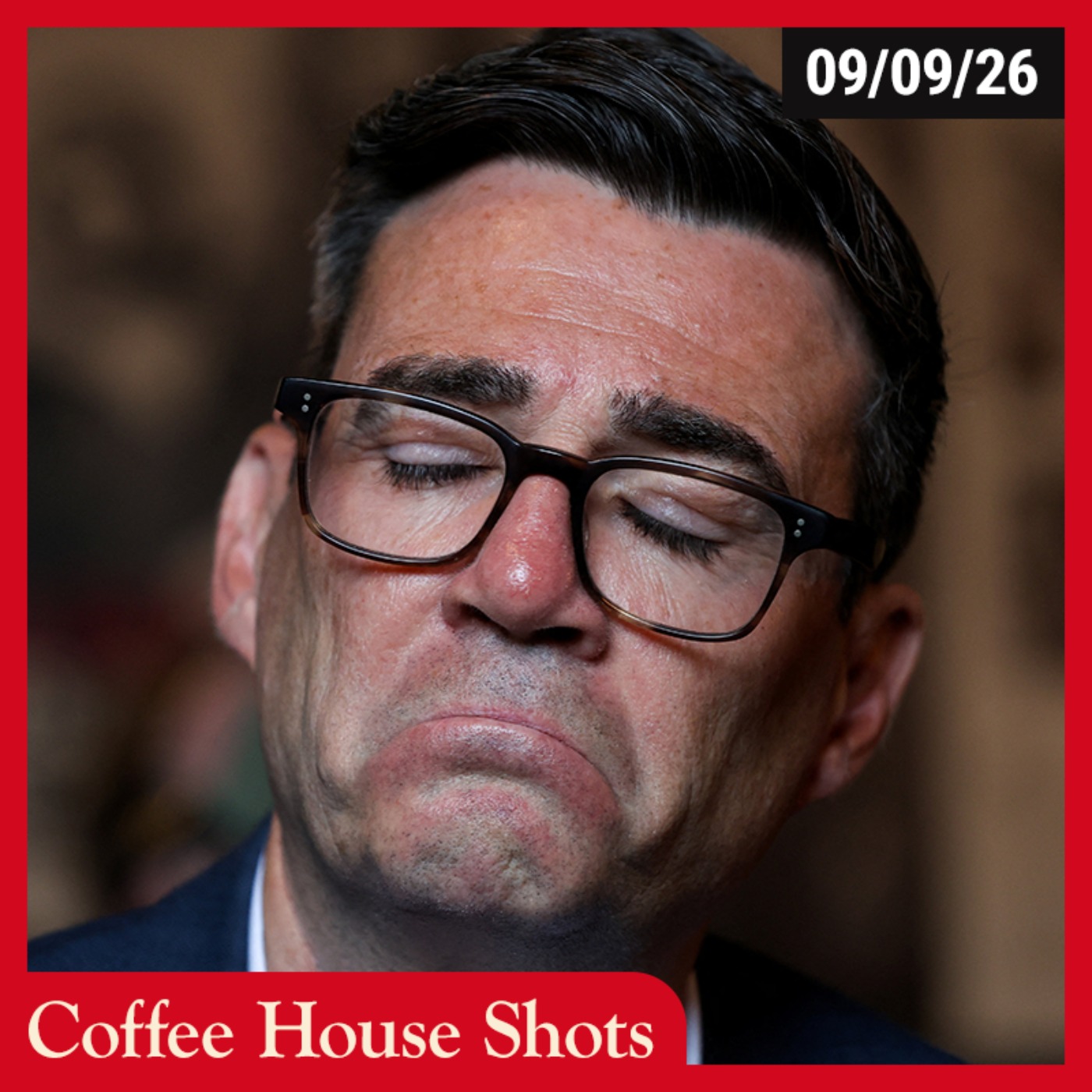
It's only Burnham's second PMQs and he's already dropped a clanger. He may have handed the Conservatives their next election slogan after declaring that ‘national security cannot come at the expense of social security’. Has the Prime Minister exposed the fault line at the heart of his government?
Noa Hoffman is joined by Isabel Hardman and Tim Shipman to discuss Burnham’s approach to welfare and defence, his increasingly ideological foreign policy – and whether his promise of hope and consensus can survive contact with political reality.
Produced by Oscar Edmondson.
Become a Spectator subscriber today to access this podcast without adverts. Go to spectator.co.uk/adfree to find out more.
For more Spectator podcasts, go to spectator.co.uk/podcasts.
Contact us: [email protected]
Hosted on Acast. See acast.com/privacy for more information.


