 Ask ChatGPT


Analysis of Labour Party conference day two in Liverpool, focusing on Chancellor John Healey’s keynote and whether Labour can “reindustrialise Britain,” plus reactions on fiscal policy, markets, and party unity.
James Heal (podcast host/commentator) and Michael Simmons (The Spectator’s economics editor).
Healey’s speech mixes nostalgia, attacks on Liz Truss, and “hard medicine” on debt/benefits, but offers “fantastical” reindustrialisation promises without addressing energy and labour costs that make manufacturing unviable. Markets likely won’t react much because fiscal rules are already expected. Labour MPs and members appear unusually united around the leadership’s “hope” message.
£6bn shipbuilding spending; restoring union learning scheme (abolished 2021); union rights and crackdown on bogus self-employment; apprenticeships via a football-scout-style talent scheme; debate over ILR migration reforms and new Afghan/Gaza routes.
Written by AI. May contain mistakes.
Discussion on the main themes of Chancellor John Healey's keynote address.
“The Chancellor John Healey has delivered his keynote speech and we can get a little flavour of that now.”
Analysis of the strengths and weaknesses in Healey's speech, including nostalgia and fiscal discipline.
“And by the bad, I would mean the first kind of 15 minutes of the speech, which was just a load of nostalgia.”
Exploration of the feasibility of Healey's re-industrialization plan amidst current economic challenges.
“I think that a lot of this speech was quite a long one.”
Discussion on how financial markets may react to Healey's speech and the Labour Party's current stance.
“So I think that's the next step that Healy needs to show you, is to be a great Chancellor.”
Debate on the government's mixed messages regarding taxes and spending as they prepare for the budget.
“but he's definitely better at striking a more upbeat tone while still being a fiscal realist.”
Exploration of the current unity among Labour Party members despite underlying tensions.
“And I think the line, for instance, about Healy talking about how he lent the tie to Gordon Brown in 1999, had one Tory MP text me and just said, Gordon's alive.”
Explore the atmosphere and key speeches at the Labour Conference.
“And that's very much reflected in the membership.”

Get the gist, explore an idea or ask about something said.
 Claude
On Coffee House Shots, what are the key points of this episode?
Searching your listeningAutomatic transcript. May contain errors.
0:00When you're running a growing business, the right systems can unlock your full sales potential and make fulfilling every order effortless. Switch to ShipStation before peak season so you're prepped and ready before the rush hits. ShipStation connects Shopify, Amazon, TikTok Shop, and over 200 more marketplaces with one platform that does it all. You can manage orders, sync inventory, track returns, all automatically. Everything your operation needs, all in one place. Upgrade your shipping operations to stress-proof your biggest sales days and capture every bit of potential revenue. Go to ShipStation.com and use code AUDIO and get 30 days free.
0:37Noa Hoffman: Hello and welcome to Coffee Half Shots, recording from day two of Labour Party conference in Liverpool. The Chancellor John Healey has delivered his keynote speech and we can get a little flavour of that now.
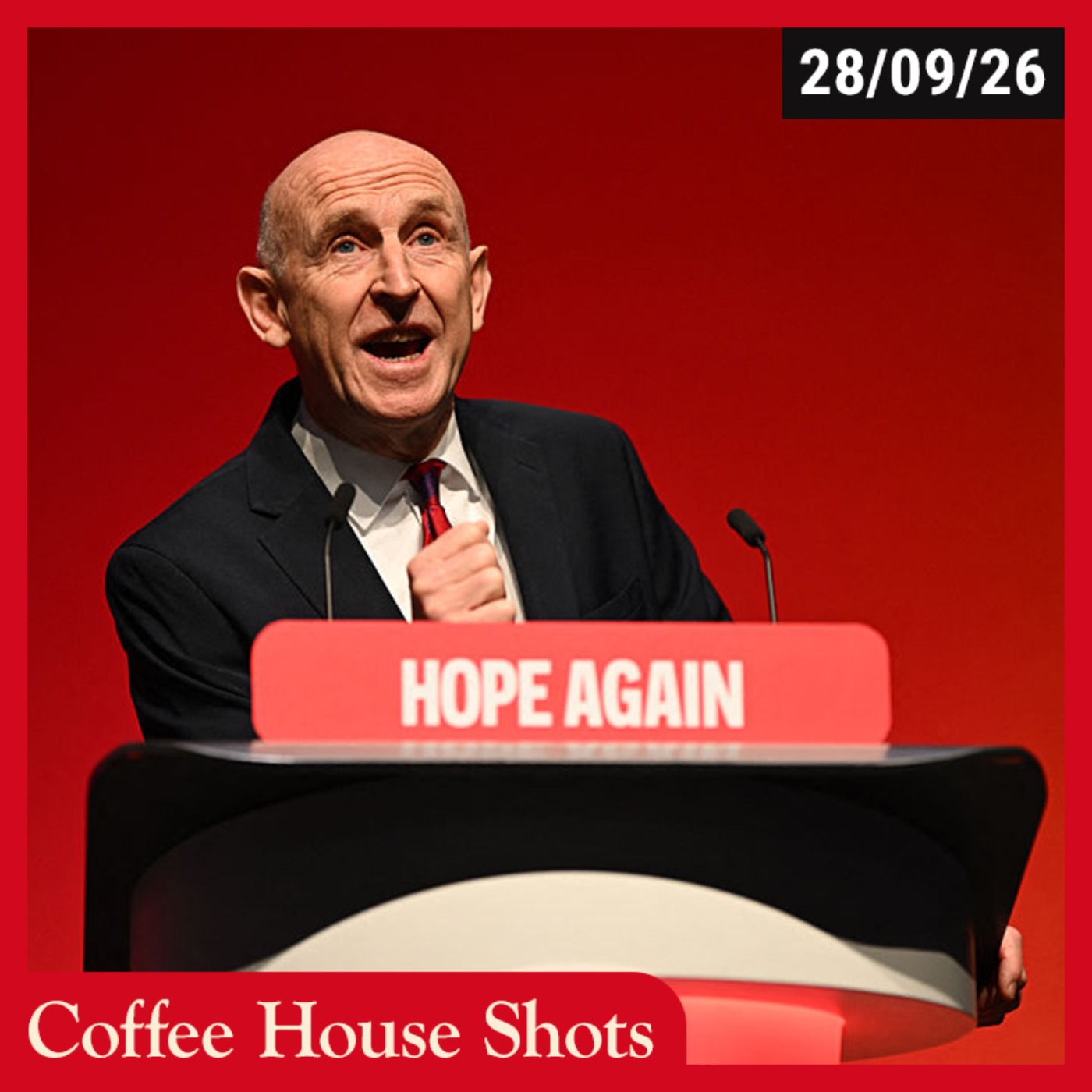
0:50John Healey: Conference, today I want to talk about the politics of hope, our belief in a better a better day. Our conviction that committed citizens can change the world. No matter how hard the task, how daunting the odds, this is our Labour politics. That hope that is earned, earned through fiscal discipline, through good work and through strong industries. So I want to tell you how we'll bring back hope. How we'll get Britain growing, with hope for our young people, with good work and good jobs and a new age of industrialisation. Because Conference, I believe in Britain and we believe in Britain.
1:37Noa Hoffman: Right, quite a bit to unpack. I am joined by James Heal and Michael Simmons to discuss it all. Michael, let's start with you as The Spectator's economics editor. What are the main takeaways from that speech? Well, I would sum the speech up, I think, as the bad, the good and the fantastical. And by the bad, I would mean the first kind of 15 minutes of the speech, which was just a load of nostalgia. You know, it was sort of like pick me, Gordon Brown. I fell asleep about the 10th Gordon Brown anecdote. There was some, you know, Liz Truss bashing, suggesting that the fact that, you know, the debt is kind of out of hand and stuff is all a result of Liz Truss and Tory mismanagement, a line that's, I think, probably getting a bit tired even for Labour supporters.
2:24There was then, I thought, you know, in fairness to the Chancellor, a really strong section where, look, clearly this speech today is a month from the budget. He was not about to say what's going to be in the budget, but he was prepared to deliver hard medicine to the Labour delegates in the room. You know, he said it's not progressive to accept a benefits bill that grows and grows and grows. He said it's not progressive to accept debt levels growing and growing and growing. And he said that whilst he was talking a lot about Gordon Brown and New Labour, he said, you know, we have to level with you delegates.
3:01We do not have the money that New Labour had. So I think that was really strong that he was kind of on prepared to give that message at an event that's all meant to be happy and clappy. Then we got on to the slightly fantastical bit, which was what was meant to be or what had been trailed to journalists as the theme of this speech this was you know a rebirth of industrialization re-industrializing Britain in which he announced six billion pounds of spending for shipbuilding which you know he said is going to be British ships built in British shipyards built by British workers and the bit of that that I think is slightly fantastical is he didn't really address the reason we don't have that anymore you know And it's not because Margaret Thatcher put a stop to it or because the Tories decided that we're going to become a financial services economy rather than an industrial workers economy.
3:54It's because of something we talk about on this podcast all the time, energy costs and labour costs. You know, it's not viable to do industrial manufacturing when we have the highest gas and electricity prices or near the highest in the world, but also some of the near highest sort of employment costs, you know, for a unit of kind of working hours. And I think unless Labour want to address that side of re-industrialisation, then any kind of re-industrialisation project is just fantasy politics. I thought it was an interesting speech. I think that a lot of this speech was quite a long one. First of all, 38 minutes was about introducing John Healy to a more general audience.
4:33And combining that introduction, he was talking about his wife who met with the Labour Party. It was also selling him as a Labour chancellor in the sense that he was not some kind of creature of the Treasury. He was talking about Gordon Brown. He was talking about his own constituency. He referenced a miner's lamp at one point. And there were the sort of, you know, compulsory references to Tony Crossland. There was talk about the sort of old Labour governments of the past. Quite telling to me, I think, that there was more talk of Labour governments 20 years ago than the one that's been elected in the past two years.
5:02But I think what he was trying to do really was deliver a hard message with plenty of sugarcoating. When you have Labour prime ministers in difficult times or Labour leaders, Labour figures, they can either go for the stark choice of telling how the facts are. And you think of Jim Callaghan 50 years ago saying, you know, in all candor, there is no money left effectively. And what Healy decided to do was trying to embrace a sort of fiscal discipline strategy and a vision in the language of Labour. So he talked in moral tones. He said that the level of national debt is, quote, a front to our values, very much suggesting that actually fiscal discipline is a Labour value, despite what some might think.
5:37As Michael says, talking about benefits in moral tones. So I think that although there was a lot of that in that speech, which was padding, kind of playing to Labour themes, ultimately, I think it was to sell a message of fiscal realism. And I think actually acting as the kind of hard-nosed truths to the kind of softer side of we've seen the Labour conference thus far. And I think economists and, you know, businesses or to be honest, anyone that's affected by the economy, a.k.a. everyone, it's kind of like, great, we've seen that you get this now. We've seen that Labour accept that, you know, welfarism has become a problem.
6:08We've seen that successive Labour chancellors and prime ministers accept that our borrowing and high debt is a problem. So in a way, that bit's not surprising. It's great that Healy wants to give that message to voters. But what people in the economy would be saying is, what are you going to do about it? Where's the action? And, you know, this is something I say a lot. Britain is probably the best country in the world at identifying our problems. But we're like almost uniquely disabled in our ability to do anything about it. So I think that's the next step that Healy needs to show you, is to be a great Chancellor.
6:40To give the case for the defence for Healy, we have got a budget in four weeks' time. He has been very clear, he doesn't want to speculate. I think the last year where, I mean, the whole budget was uploaded online has been a harrowing and scarring appearance. And a man who does things so by the book as John Healy wants to do that. And I think it was quite telling, therefore, that all the measures he announced today were rather crowd pleasing and kind of in the tens of millions rather than the kind of billions you need. So he talked about potentially getting more apprenticeships with a football scout style scheme where business go in and identify local talent.
7:08He talked about restoring the union learning scheme, which was abolished by the Tories in 2021. That's probably only got about 15 million. And I can get the kind of sense of how you build that into a political economy, which is, look, AI is going to take our jobs. What the unions need to do is train up workers and get a skilled workforce. So I think that kind of work, given the time constraints he's facing. Yeah, I think the other thing that he definitely strikes a better tone on hope than Rachel Reeves did, because I'm going to sound like I'm contradicting myself here. You know, it's right that he tried to tell Labour delegates that there's problems to solve.
7:36But he wasn't saying this is a disaster and, you know, things are going to get worse before we're going to get better. which I think many people would say is where Rachel Rees and Keir Starmer went wrong. His is more, we're in a problem now and I'm going to sort it out in a month's time. Now, whether he will or not remains to be seen and is probably unlikely, but he's definitely better at striking a more upbeat tone while still being a fiscal realist.
8:00Noa Hoffman: And Michael, how will the financial markets react, if at all, to Healey's speech today? Yeah, I don't think we're going to see massive movement here because the message that had been worrying markets, the idea that this government was not in hock to the bond markets, that's been consistently hit. They've said, we will hit the fiscal rules, we will get spending under control, we'll stay in these envelopes. So none of that's going to be surprising to markets today. To be honest, there's not going to have been bond traders sat in the City of London paying much attention to this speech, the risk of Britain's fiscal position is almost already priced in.
8:45So nothing he said was going to collapse guilt yields unless he was to announce a massive austerity programme or something to really tackle inflation. So I think this probably just won't go noticed by the City of London. I think it's quite interesting the point that Tim made on the podcast yesterday, which when he was talking about this is not a Labour Party that wants to have a hard conversation with itself in the way that Tony Blair did. This is a Labour Party that's been very bruised, coming through a battering. And therefore, the platform speeches are very much focused on what the party faithful would like to hear, with the exception of welfare reform.
9:12There wasn't a huge much there that the party couldn't really applause to. And it was quite striking, obviously, the themes that he talked about were very much traditional Labour ones, things such as they're going to have a crackdown on bogus self-employed companies to give more rights to workers. That's something Labour wants to hear. There wasn't much there, for instance, on, say, for instance, housing supply or tax reform, some of the less sexy stuff, but some of those big challenges, which aren't maybe as totemic as social care, but would be the sign of a genuinely reforming chancellor and some of the smaller things that sometimes get forgotten when we talk about Gordon Brown's legacy.
9:41Noa Hoffman: And would you say this speech was very much paving the way for this big argument that Andy Burnham will make to the country for three years if he doesn't call an early election, for less if he does, about the need for tax rises to pay for his big spending project? I think it's a little bit more muddy than that, Noah, because you look at some of the messages coming out of this government. Angela Rayner saying on the Saturday Times interview that taxes are already too high and need to come down. You look at all the briefings suggesting that this budget that's going to be coming up is not going to be a big box office event.
10:13There'll be less tax rises than Rachel Reeves' first budget and the second budget she did. The first one had the biggest tax rises since 1993 in that budget. And the second one was, I think, in the 25 or so billion increases. So we're not going to get into that thing in that budget. Maybe potentially longer term, but I think we're still hearing mixed messages from this government. I'll point to things such as the British Social Attitude Survey, suggesting that now people are much more sceptical of the level of taxation. You look, there's a very good column in The Economist last week talking about tax enough already.
10:39There are all different signs suggesting Britain's are actually a little bit sceptical about how much they're paying right now. So maybe potentially he could have that as a dividing line. But in the interim, I'm not too sure, because John Healy has multiple audiences here. He had the Labour Party conference, but he also had to, of course, appeal to the bond markets and not spook them too much. So all the talk of tax rises, I think, is maybe a bit premature, but it's obviously something that the Tories are informal to seize upon. And I think the line, for instance, about Healy talking about how he lent the tie to Gordon Brown in 1999, had one Tory MP text me and just said, Gordon's alive.
11:08A nice Brian Blessed reference for the older listeners. But of course, it does show what they want to say, which is the same old Labour, never properly changing. And on the point of tax rises, you know, potentially argued for at an election to fund social care. I think the difficulty that Burnham and whoever in his top team is when that election comes is the British tax picture is actually a lot more complicated than many people want to make out. It's certainly true that our overall tax burden, you know, as a share of the economy is the largest it's been since the war and looks like to be going to a record high.
11:41It's certainly true that businesses are being squeezed by high taxes. But if you look at taxes on the individual worker, they're actually quite low by both international standards and by British historical standards. which means if you're a prime minister and you're a chancellor saying look i want to do this national care service or i want to re-industrialize britain whatever it is and tax is going to pay for it i think the voter might look at the coverage of tax over the last few years and say great we'll squeeze more out of the banks or we'll squeeze more out of the wealthy but it's actually the only part of the economy that's left to be squeezed a little more is the average worker which is clearly the antithesis of what any labour chancellor would ever want to do and just quite i thought noticeable that he did give a shout out to the city of london financial services now maybe he's going to have some kind of new tax put on or capital gains etc but i thought that was quite striking what do you make of it because you've been obviously in the bars and the flesh pots of liverpool the past couple of days or so you know what were your sent takes on the speech and the sort of wider
12:37Noa Hoffman: mood at conference i mean what i found particularly striking is i've never seen the right and the left of the labour party so united and so content with what they're seeing from the leadership This is a pretty left-wing government. Keir Starmer really tried to bring the party back towards the centre. It's now shifted very much to the left under Burnham and the sort of soft left acolytes who's brought in around him. But there hasn't really been a backlash from the Blairite MPs. They're sort of going along with it for now. I think the jury's out as to whether that's sustainable. I know there is some discomfort with the way the migration debate is going at this conference.
13:21Noa Hoffman: A lot of MPs, particularly in seats where migration is a very, very hot topic, are concerned about the backtracking on the Shabana Mahmood ILR reforms, about, you know, the new announcements that there's going to be new migration routes for Gaza and Afghanistan, and a lot of talk about more migration when really the country in many, many areas are crying out for the opposite. it. But with that being said, there's no sort of open warfare and there's not really too much briefing either. So I think after sort of all the tumultuous episodes we've seen in the sort of final days of Starmerism, there's this sort of consensus among Labour MPs to just stick together, at least for now.
14:03Noa Hoffman: And that's very much reflected in the membership. I mean, the membership generally are more left-wing. There aren't too many Blairite Labour members, so to speak. But if we're talking about the bars, if we're talking about the people here and not the many corporate lobbyists who are very much taking up a lot of the space in said bars and restaurants, there is a real sense of happiness, a real sense of jubilation. And they're really latching onto this message of hope. I think they do genuinely feel for the first time in a long time within Labour politics hopeful. And I think it's worth talking about the other two great officers of state here, which is we had the foreign secretary speech this morning.
14:40And we're going to have Shabana Mahmood's speech this afternoon. And I think that Ed Miliband's comments when he told the Labour activists lobbying over Palestine, you were right and you were right on this issue. And effectively, Keir Starmer's leadership was wrong. Got a huge round of applause. And I think that is very much the tone and tenor of this conference, which is embracing the faithful. Contrast that this afternoon where Shabana Mahmood, I think, has a potentially quite difficult speech because she's got to sell them on her indefinite leave to remain reforms. and overnight we've had this briefing that there's going to be new routes opened up for Afghan refugees.
15:07Now, if you're sitting there and you're from reforming the Conservatives, you're thinking, hang on a sec, we haven't even controlled the small boats crisis and we're letting more people in, we're incentivising more of this. So I think Shibana Mood is in a bit of a difficult spot and I'll be interested to see how she strikes that divide between being a Home Secretary and a Labour Home Secretary.
15:23Noa Hoffman: Well, we will bring you all the analysis and updates from Labour Conference. Thank you, James. Thank you, Michael. And thank you for listening to Coffeehouse Shots. Thank you.
16:03from my desk? All from your desk. Join the 4 million businesses using Stamps.com right now with code podcast and get your free welcome gift. Stamps.com code podcast. Taxes and fees apply.
Noa Hoffman is joined from Labour conference in Liverpool by James Heale and economics editor Michael Simmons to discuss Chancellor John Healey’s keynote speech. They discuss his attempt to sell fiscal discipline in distinctly Labour language, whether the government’s reindustrialisation plans add up and what the speech tells us about the economic argument Andy Burnham wants to make.
Plus, as the bars begin to swell on day two of the conference, can Labour's united front continue for Shabana Mahmood's speech?
Produced by Patrick Gibbons.
Become a Spectator subscriber today to access this podcast without adverts. Go to spectator.co.uk/adfree to find out more.
For more Spectator podcasts, go to spectator.co.uk/podcasts.
Contact us: [email protected]
Hosted on Acast. See acast.com/privacy for more information.