
 Ask ChatGPT


 Coffee House Shots
31 Oct 2026 · 20m · 7 chapters
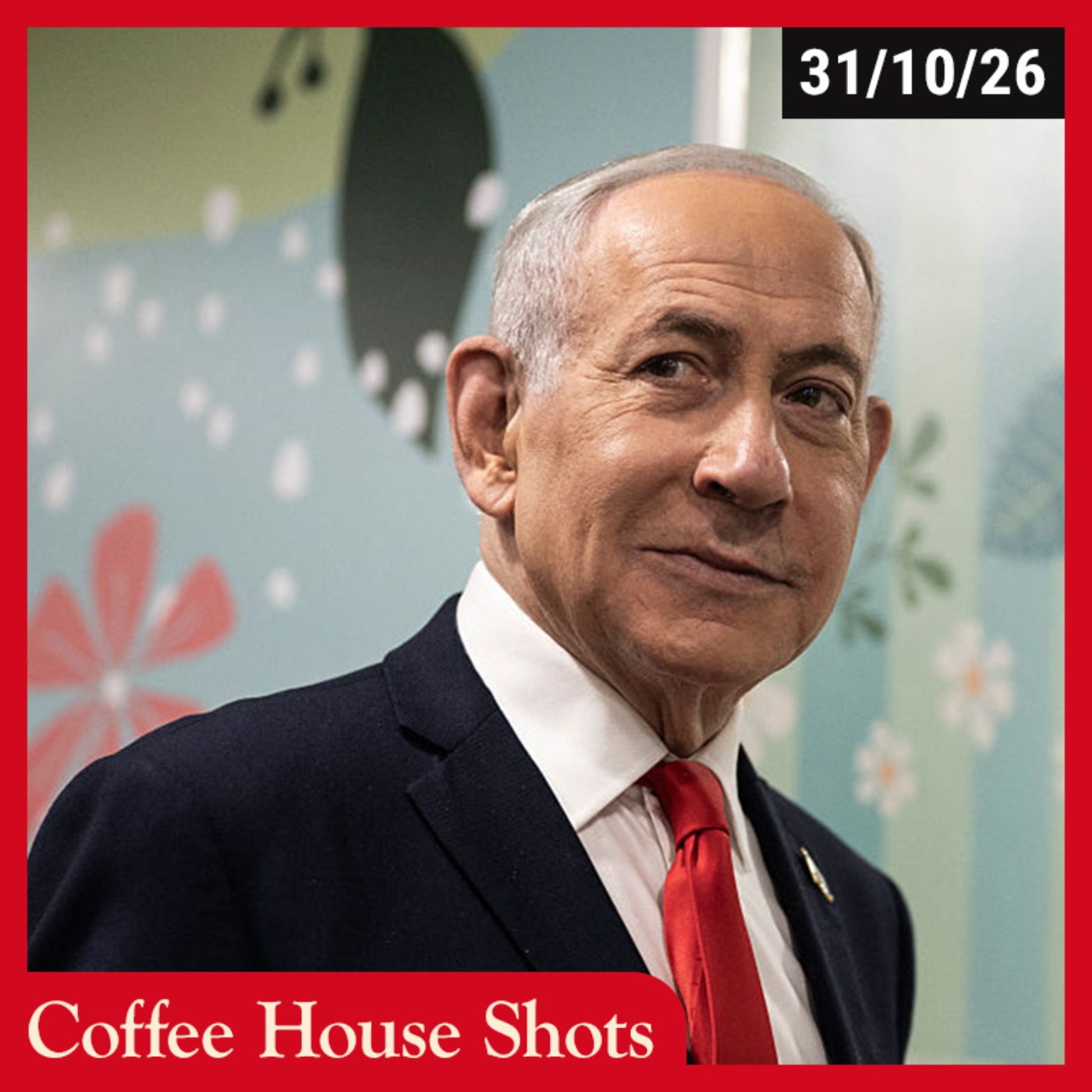
Israel’s election deadlock after Netanyahu’s Likud won the most seats but cannot form a coalition; neither can the main rival Gadi Eisenkot. The episode focuses on Arab voter turnout, the “balance of power,” and possible coalition scenarios (Netanyahu vs Eisenkot vs another election), plus the future of ultra-Orthodox (Haredi) parties and conscription.
Noah Hoffman (journalist; recently in Israel for the election, wrote about results on the ground). Ben Judah (former special advisor at the Foreign Office; analyzes inter-ethnic conflict and Israeli politics).
Arab parties won a historic number of seats (~18), potentially holding power; Netanyahu’s “Bibi block” endures via personality/demographics and security fears after Oct 7; Mizrahi Jews’ trauma and desire for “strong action” help explain continued Likud support.
Ra’am (Mansour Abbas) pitched integration and placed a hawkish Jewish former police chief as #2; Israeli Democrat Party led by Yaya Golan calls for coalition with Arab parties; scenarios include excluding far-right (Ben-Gvir/Smotrich) or ultra-Orthodox draft exemptions and sidelining Arab parties; Haredi share ~15% and could rise; Shas vs Ben Gvir’s Mizrahi shift; conscription compromise party drew almost no votes.
Written by AI. May contain mistakes.
Discussion on the complexities of the Israeli elections and current deadlock.
“That's go.gle slash workspace with Gemini.”
Analysis of the Arab voter turnout and its influence on coalition building.
“and the way that Israeli politics is means that to do that, you need to form coalitions.”
Exploration of Netanyahu's lasting political influence despite controversies.
“wondering what that means for the country's future.”
Discussion on potential coalition scenarios and the difficulties ahead.
“And I'll just disclose like very openly, I have been hoping with all my heart to see a change in government.”
Explore the complex dynamics of Israeli politics involving Netanyahu, the far right, and the Arab parties.
“When I was there that was a huge issue even for Likud voters, they're furious at the ultra-Orthodox draft half-dodging, and on the other side, sideline, the Arab parties.”
Delve into the history and demographic changes of the Orthodox Jewish community in Israel.
“When the country came into being, there were incredibly few of them demographically, and they were seen as a sort of curiosity or even as a surviving piece of what had been annihilated in the Holocaust.”
Discuss potential future scenarios for Israeli society with growing Orthodox influence and military conscription.
“There's one party that is a Mizrahi ultra-Orphodox party known as Shas.”

Get the gist, explore an idea or ask about something said.
 Claude
On Coffee House Shots, what are the key points of this episode?
Searching your listeningAutomatic transcript. May contain errors.
0:00Hey, we're Nick and Jack, hosts of The Best One Yet. Behind every episode, there's research, email, spreadsheets, and our shared Google Doc, the Headline Hammer. With Google Workspace with Gemini, Google's AI is built right into the premium versions of tools we already use, like Gmail, Docs, and Sheets. No new tools or extra logins, just personalized AI for the way we work. That means less time on the work around the work and more time finding the stories worth talking about. Get AI tools for work. Upgrade to Google Workspace with Gemini at goo.gle slash workspace with Gemini. That's go.gle slash workspace with Gemini.
0:40Hello, and welcome to this special Saturday edition of Coffeehouse Shots. I'm James Heal, and I'm joined today by Noah Hoffman, who's been out in Israel for the elections this week, and Ben Judah, former special advisor at the Foreign Office. Now, Noah, you've been out there this week. You've written for the magazine about the results. Talk us through what it was like to be on the ground there and where we are as of recording on Friday morning.
0:59Noa Hoffman: Yeah, so being on the ground there was fascinating because one just cannot understand the complexities and the melting pot that is Israel unless you are physically on the ground. It's just impossible to understand why people think the way they do and why they vote the way they do until you see it for yourself. And what we have now is a situation of complete deadlock. So Netanyahu, his party, the Likud, won the most amount of seats. But that in and of itself is in a way a bit meaningless because under the proportional representation system, you have to meet a certain threshold. and the way that Israeli politics is means that to do that, you need to form coalitions.
1:45Noa Hoffman: And as things stand, Netanyahu does not have enough seats with coalition partners to form a government. Now, at the same time, neither does Netanyahu's main rival Zionist party, which is led by a man called Gadi Eisenkot. As things stand, he's unable to form a coalition either. And that is because of one of the most fascinating parts of this election, which is the turnout of Arab voters or Israeli Muslim voters. They came out in their droves and won a historic number of seats. I think it's about 18 now as we speak. And they really do, in many respects, hold the balance of power unless the opposition party retrenches on its campaign pledge not to do a deal with Netanyahu.
2:37Noa Hoffman: So that's where we stand at the moment. And Ben, I've seen you writing online about the different sort of ethnic mix and how the parties are changing and you've likened it to Northern Ireland. I mean, tell us about that. Well, one of the things that's very interesting about inter-ethnic conflict all over the world is there is a moment in which normal people start to change their attitudes towards violence before the politicians. Even though it obviously stretches credulity to compare the complexities of Israel-Palestine to the situation in Northern Ireland in the 80s and 90s, there was a moment in the early and mid-80s in which normal people in Belfast started to hold their kids back and to have doubts and have their attitudes begin to change before the politicians caught up with them.
3:31Now, if one's looking at the election results in Israel from a British point of view and somebody who's obviously in favour of a two state solution, eventually, the glass half full is that there was absolutely nothing inevitable or even predictable about the fact that there would be such a large mobilisation in both Jewish society and Israeli Arab society in favour of some kind of of partnership, Jewish-Arab partnership, to form a new government. Now, roughly 40%, I think Noah has the details to hand and will be able to tell us from the ground, of Arab voters in Israel backed a party called Ram, which is originally an Islamist party, but which has pitched itself as one that wants integration and wants to participate in government, and even went as far as putting a sort of hawkish Jewish former police chief as the number two on its list as their potential minister in a government.
4:41And meanwhile, you have the Israeli Democrat Party, which is a relatively small party these days, but is led by a former senior general, Yaya Golan, and is, of course, the inheritor of the Israeli Labour Party that founded the state, explicitly calling for a coalition involving Arab parties. Now, there's absolutely nothing inevitable about that, given the horrors of October the 7th, the carnage that we've seen in Gaza, the terrible situation in the West Bank, and the fact that there is this astonishing generosity from a segment of society is the glass half full. Glass empty is that despite an extraordinary level of mobilisation, incredible level of mobilisation, and one of the highest turnouts that Israel has, I think the highest turnout Israel has seen in my lifetime, and I believe it's one of the highest turnouts since the 1970s, it was still not possible for Israeli secular liberals to overtake the so-called Bibi block.
5:51Now, the Bibi block is a combination of ultra-Orphodox Jewish parties, essentially settler-oriented or settler-leaning and ultra-nationalist parties, And then Netanyahu's Likud, which has become, obviously, part of the great historic pedigree and heritage, has essentially become a cult of personality around him. And even despite all of the incredible failures that Netanyahu has brought Israel over the last few years, October the 7th, the warnings about October the 7th, his corruption trial, Israel's worsening international position, the fact that he was still able to command so many voters is deeply concerning and has many people on the liberal side of divide in Israel.
6:46wondering what that means for the country's future. Is that a reflection of the country's changing demographics? What's that mean for tomorrow? Now, the politics has only just begun. And the question is, who can form a government out of this? Is it going to be Netanyahu or is it going to be Gaddy Eisenhower or are we heading to a new election?
7:08Noa Hoffman: I'll just come in quickly on what Ben is saying because I completely understand that if you're living in the UK or America, You might look to people voting for Netanyahu and think what on earth is going on in their minds. And I'll just disclose like very openly, I have been hoping with all my heart to see a change in government. I want to make that clear before I go into my next point. I really, really wanted to see and want to see Netanyahu gone. He's been a disaster. But it's very easy for people who don't understand the conflict. Ben obviously does. but for people who don't understand, particularly in the pro-Palestine movements, to think that these are all, you know, evil, terrible people who are bad human beings.
7:55Noa Hoffman: When you're on the ground, one of the most egregious cases of historical whitewashing, in my opinion, is that of the plight of Mizrahi Jews. Now, these are people who, if someone in the UK saw them walking into a mosque, they would not blink twice these people are from Tunisia Iraq Iran they look like that they are not white they are Jewish and they have deep deep deep trauma of what it's like to live as a Jew under the ironclad fist of various incarnations of Islamist governments now in the aftermath of October 7th with the threat of Hezbollah in the north Hamas in Gaza you've got all these if you're surrounded on all sides almost.
8:43Noa Hoffman: They vote for the man they think is the strong man, the man who will say, there is no way I will ever sacrifice any sort of military action at the altar of opinion from the UK or Europe. They are terrified at the prospect of having to go back to life under Islamist rule. And their only concern is security. And now, of course, I think it's misguided to think Netanyahu can guarantee that security. But what they saw in the aftermath of October 7 was strong action that they didn't believe would come from any other leader. And therefore, they put their vote, and it's not just Mizrahi Jews, by the way, but this is from the polling station I went to in a very working class Mizrahi area.
9:28Noa Hoffman: That's the kind of logic behind why a lot of people are still voting for Netanyahu. And Ben, I suppose that does lead to the question, why do we still have this endurance of the BB bloc? Because there have been, as you say, so many scandals, so many issues, massive questions about 7th October and keeping the country safe. Why is it, despite all that, Israeli liberal opinion can't seem to force him out of power? Is it as simple as the voting blocs against him or in his favour are too big? Why is it that even after this time, 30 years in office, on and off, he's still potentially going to get re-elected?
10:01I think it's a combination of personality and demographics. bb netanyahu is an astonishing political animal i think he is the most you know ferocious political animal in the western world or the middle east i think he is a phenomenon the like of which we will not see again in our lifetime the ability to manipulate things strategically pull pull politics around him is without parallel. One of his great powers is, I'm thinking of my grandmother who said this to me, who was a German Jew married to actually a Mizrahi Jew. She said that very few people are actually bilingual. A lot of people speak another language.
10:50And the amount of bilingual people is very, very, very, very small. She certainly wasn't. And when you see Netanyahu speak in Hebrew and then in English, It's like watching a DJ go between tracks. He's able to pull that charisma together. And even though we might understand that he is, in many ways, the worst diplomat that Israel has ever had, it does not look like that if you are in the places that Noha has been reporting from. And if your heritage, my grandfather's, is actually going back to Baghdad and to the tragic end of Jewish communal life in the Middle East. He really is somebody with an incredible ability to lie and manipulate and move the pieces around him.
11:36Now, you compare him, somebody who's so ruthless and devious, to Gaddy Eisencott. If Netanyahu had Eisencott's cards, coalition would be formed pretty easily. I don't think Netanyahu would have any trouble in pulling this thing together. but does Isencourt have the self-conviction, the self-belief, the political skills to do it? I mean, I want to believe. I want to be convinced, but I'm a bit doubtful. And no, I mean, on the point about what happens now, I mean, obviously we had fairly limited history in Britain about coalition talks, much more common in Israel. How do we see the next couple of days and weeks playing out now?
12:16Noa Hoffman: I mean, it's so difficult. There is a section of society as as ben was saying in israel who are ready to do a deal with the arab parties but you can only understand the trauma of the country by by being there and going to the kibbutzes that were attacked on october 7 and seeing the communities that have been under complete um threat by hezbollah and experiences rockets all the time from hezbollah so nowhere near enough of society as Ben and I would like have that will to do a deal with the Arab Israeli population now I mean I struggle to see a world in which Eisencott will have that courage because it would be so unpopular with like with sections of society outside of Tel Aviv Tel Aviv like London is its own liberal bubble but if if he did if he managed to take on and by the way it's not just Ra 'am so Ra 'am is his the leader of Ra 'am Mansour Abbas is an incredible one of the most fascinating politicians in the world right now who's really putting in an effort putting aside ideas about a two-state solution just to improve the lives of his people as they are in Israel as it is now the joint list which is the other Arab party is much more hard line and actually the party is against Israel's existence as a Jewish state so for an opposition leader to do a deal with a party that is against Israel's Jewish character in the aftermath of something like October 7 politically is so so difficult but that is one option that they could take it's hard to see how that happens there's another world in which Gaddy Eisencott, Netanyahu come together and do a deal that pushes out on one extreme the far right, Ben Gavir, Smotrich, Setsla, rabble rousers on one side and the ultra-Orthodox who refuse to join the IDF and that is a massive issue.
14:26Noa Hoffman: When I was there that was a huge issue even for Likud voters, they're furious at the ultra-Orthodox draft half-dodging, and on the other side, sideline, the Arab parties. But again, the opposition went into this campaign as entirely an anti-Netanyahu campaign. Netanyahu failed us on October 7. We have to get rid of him. So that happening as well is quite difficult to see, which then just opens up this third option of another set of elections. If there is another set of elections, it is highly unlikely that we'll see the turnout from both Arab society, but also Israelis who live in the diaspora coming back to vote again.
15:07Noa Hoffman: That's not a cheap thing to do. And it's likely that Netanyahu will receive a much stronger mandate if that happens. So these are the three different scenarios that are underpinning all the horse trading going on between the various parties and the various factions right now. And it is just too early to say which one will end up succeeding. Can I just ask us a final question, Ben? I'm fascinated by the Orthodox Jewish community, which, as Noah says there, is exempt from military service, has, I believe, exemptions around taxation as well. I mean, what is the future of this group in Israel, given their rising numbers, but also, as Noah says there, the tensions and the grievances from other people in Israeli society who feel that they're kind of trying to have all the privileges but not the responsibilities of Israel?
15:51So a little bit of history here. When the country came into being, there were incredibly few of them demographically, and they were seen as a sort of curiosity or even as a surviving piece of what had been annihilated in the Holocaust. lost and the Jewish world having lost all of its great centers of Torah study and Torah learning, a whole world, there was a collective desire in Israel to preserve that. And it was viewed as important by their rabbis that their young men should not be forced to be conscripted so they could study Jewish texts all day and keep the tradition alive. Now, this community is the highest fertility community by some metrics in the developed world.
16:46You know, they have, you know, six, seven children in Israel, which is a very, which is all of its Jewish society is very high fertility. That is a lot more than the two and a half free that Israeli secular liberals have. So the percentage of ultra-Orphodox Jews' share of Israeli society has rocketed. It's now around 15%. By some metrics, they could form a majority by later this century, and are certainly going to be a very large percentage of it. Now, as they're getting bigger, they're changing the country visibly and physically. Jerusalem today is not the Jerusalem I remember of 20 years ago, which still had a very strong liberal, secular, you know, sort of German-Jewish identity in places like Rehavia.
17:39That's very much faded away. And there is an enormous anger, as Noah was saying, that their sons do not serve in these wars, but that their parties are propping up the government that is pursuing them. So where does it go from here? There's an interesting fracture that's going on within that world right now. There's one party that is a Mizrahi ultra-Orphodox party known as Shas. This party was founded as a way for Middle Eastern Jews to assert their identity in the late 20th century. But most of its voters were actually never really ultra-Orthodox Jews. They just wanted to vote for the rabbi and vote for the rabbi's party.
18:34Now, that no longer really holds for young Mizrahi Jews. So a lot of their old vote base is flowing towards Ben Greer, who is, you know, of Mizrahi background and character and personality, shall we say. Now, in the Ashkenazi bloc, there is a very interesting sign that that party united Torah Judaism. not all of them actually want Netanyahu to continue. There may be a faction of them that would be willing not to vote against an Eisenkopf government, or they may be sending signals that they would be willing to be part of an Eisenkopf government as a way to stop this drift towards imposing a draft on them.
19:26There was a small party that received an enormous amount of funding, a sort of modern Haredi party that was going to propose some kind of compromise on conscription and Haredi integration, it received basically no votes. And I think that's quite a worrying sign. What I think is going to happen is if you remove Netanyahu from Israeli politics, just literally you just click your fingers, you would go away. There is a crushing majority in favour of some kind of centre-right approach without ultra-Orphodox parties and without Arab parties, which would start to conscript them. And once they start to be conscripted, they'll start to be integrated into Israeli society.
20:17But Israeli society will change and become much more religious than it is now and much less of the kibbutz society. Well, thank you, Noah. Thank you, Ben. And thank you for listening to Coffee Hour Shots.
20:57episode, there's research, email, spreadsheets, and our shared Google Doc, the headline hammer. With Google Workspace with Gemini, Google's AI is built right into the premium versions of tools we already use, like Gmail, Docs, and Sheets. No new tools or extra logins, just personalized AI for the way we work. That means less time on the work around the work and more time finding the stories worth talking about. Get AI tools for work. Upgrade to Google Workspace with Gemini at go.gle slash workspace with Gemini. That's go.gle slash workspace with Gemini.
In this Saturday edition of Coffee House Shots, James Heale is joined by Noa Hoffman, who has been reporting on the election from Israel, and former Foreign Office special adviser Ben Judah to unpack the results.
They discuss the historic turnout among Arab Israeli voters, the growing influence of ultra-Orthodox parties and why, despite the failures of October 7, Netanyahu continues to command support.
Plus: could an unlikely alliance between Jewish and Arab parties reshape Israeli politics?
Produced by Abigail Brierley
Become a Spectator subscriber today to access this podcast without adverts. Go to spectator.co.uk/adfree to find out more.
For more Spectator podcasts, go to spectator.co.uk/podcasts.
Contact us: [email protected]
Hosted on Acast. See acast.com/privacy for more information.


