Ask ChatGPT

 Coffee House Shots
16 Oct 2026 · 25m · 6 chapters
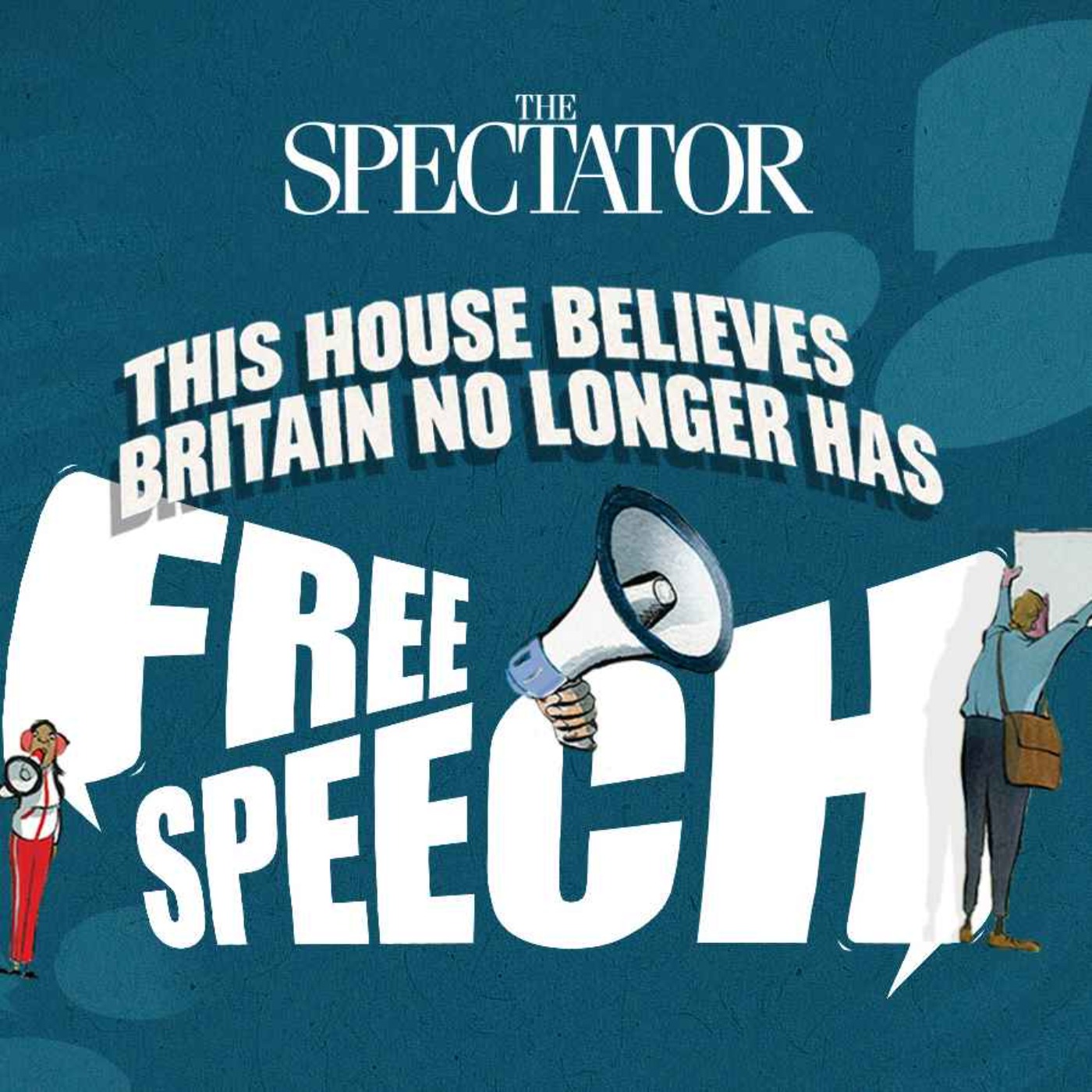
The episode is a special Spectator-hosted debate section on the motion “This House Believes Britain No Longer Has Free Speech,” chaired by Isabel Hardman. Guests arguing against the motion: Lord Jonathan Sumption (former Supreme Court Justice) and politician Ed Vasey. Guests proposing the motion: Kelvin McKenzie (former Sun editor) and women’s rights campaigner Kellie-Jay Keen. Sumption argues Britain still has free speech because the state generally doesn’t control content, only regulates how speech is exercised to prevent harm; he criticizes overzealous police and some bad judicial decisions but says appeals correct them. Keen claims free speech is shrinking in practice: she says police investigated her posts criticizing Islam and trans issues, and that ordinary people fear speaking due to state action and social consequences.
Keen’s arrests/interviews under caution; her “adult human female” billboard; bans on women wearing that t-shirt; Sumption’s examples of lawful protest vs unlawful harassment/violence.
Written by AI. May contain mistakes.
Jonathan Sumption discusses the definition and limits of free speech.
“We need to start by asking what we mean by free speech.”
Kellie-Jay Keen presents her perspective on the erosion of free speech.
“We'll move on to Kelly J now, who has seven minutes.”
Sumption and Keen engage in a spirited exchange on their views.
“And I think we all know that the machinery did not grind its gears in years gone by with sticks and stones, let alone with words will never hurt me.”
The hosts discuss the state of free speech in Britain, referencing cancel culture and police involvement.
“with a bit of prompting from me where appropriate.”
Exploration of how cancel culture affects free speech, personal experiences of the hosts, and the societal implications.
“Ed I'm afraid I'm going to upset you by denigrating an institution here.”
Discussion about media biases, personal anecdotes on being canceled, and the challenges of free speech in journalism.
“Council culture is different to a certain extent from free speech.”

Get the gist, explore an idea or ask about something said.
 Claude
On Coffee House Shots, what are the key points of this episode?
Searching your listeningAutomatic transcript. May contain errors.
0:00Isabel Hardman: This is the story of the one. As a shipping manager, he's running the dock, stocking supplies, and making sure every order goes out on time. And Grainger helps him stay prepared. From shipping supplies, to PPE, to hand tools, he counts on Grainger to keep products moving and trucks rolling. So his operation runs smoothly, no matter the shift. Call 1-800-GRAINGER, click grainger.com, or just stop by Grainger. For the ones who get it done.
0:38Ed Vaizey: Hello and welcome to this special edition of Coffeehouse Shots. This week, The Spectator hosted a debate on the motion This House Believes Britain No Longer Has Free Speech. It was chaired by our assistant editor, Isabel Hardman, and the debate saw former Sun editor Kelvin McKenzie and women's rights campaigner Kelly J. Keene propose the motion, with former Supreme Court Justice Jonathan Sumption and politician Ed Vasey argued against it. We thought we'd bring you a section of their discussion in this episode and you'll be hearing as Jonathan Sumption and Kelly J Keane set out their cases before the panel goes head-to-head on council culture, the role of the police, overzealous lawyers and the responsibility of the press.
1:20Ed Vaizey: I hope you enjoy. Here to speak against the motion is Lord Sumption and you have seven minutes as well.
1:33Isabel Hardman: We need to start by asking what we mean by free speech. What I mean by free speech is a situation where the state does not seek to control the content of what we say or write. It doesn't treat certain opinions as being off-limits. Now, freedom of speech is perfectly consistent with some controls over where and how you exercise your freedom. We are free to denounce immigration or immigrants, regardless of government policy on the point, but we are not free to incite a howling mob to burn down asylum hostels. We are free to demonstrate against Israel's conduct in Gaza, but we are not free to demonstrate by breaking the windows of banks who deal with Israeli companies.
2:22Isabel Hardman: We are free to campaign against abortions in the media or on Hyde Park Corner, but not right outside the entrance to abortion centres, where it harasses women at very difficult points of their lives. We are free to make and distribute pornography, but not to children. The media can say deeply wounding things about people. No court will injunct them if they say that they are speaking the truth. but if it later turns out that it was a pack of lies then they may have to compensate their victims for the damage that they've done. A newspaper can reveal people's private lives if there is some public interest in these things but they cannot harass and humiliate people of no importance just as a matter of entertainment.
3:13Isabel Hardman: Now these are not controls over the content of our words but over the way in which we exercise them. we can't exercise our freedoms in a way that do real harm to other people. John Stuart Mill, one of the most eloquent advocates of free speech, who ever lived, taught that the state has no right to interfere in what we do except to avoid some greater harm, and that is the principle on which Britain and indeed most liberal democracies have always approached the issue of free speech. I suggest that it draws a fair balance between the different interests involved. I am not going to pretend that everything in our garden is lovely.
4:00Isabel Hardman: Some of our laws, for example parts of the Terrorism Act and parts of the Online Safety Act, need to be looked at again in order to get a better balance between the public interest in free speech and other important public interests. Some of the authorities charged with enforcing our laws, notably the police, have shown repeatedly that they lack the judgment and sense of proportion which our law requires. And yes, there are some decisions by judges that are simply mad. Kelvin McKenzie told us that he was quite sure, having cited one of them, that that would be allowed on appeal. and that is a vindication of our system because the courts do normally quash daft decisions made by judges on free speech cases.
4:47Isabel Hardman: In one case, where the courts quashed the overzealous police action against a gender-critical tweeter, the judge memorably observed that in Britain we do not have a Cheka, a Gestapo or a Stasi. We've never lived, he said, in a Norwellian state and the law needs to recognise that. But in this hall, we also need to keep our sense of proportion alive. It is a gross distortion of the truth to take the worst things that happen in a complex society like ours and then serve them up as if they were the whole. Yet that is what the proposers of this motion invite you to do.
5:37Ed Vaizey: Jonathan, thank you for the most concise opening speech we've had at one of these. We'll move on to Kelly J now, who has seven minutes.
5:51Jonathan Sumption: Good evening. The motion tonight is that Britain no longer has free speech. And the important words are no longer. We've never had absolute free speech. We've had blasphemy laws, censorship. But freedom does not have to be absolute to be real. And it does not have to disappear completely before we're allowed to notice that we are losing it. Freedoms can expand and freedoms can contract. So here is my test. What happens when you speak? Not what the government tells you your rights are. What actually happens when you use them? I started campaigning in 2017 and since then I've had the police at my door.
6:32Jonathan Sumption: I've been arrested for speaking during lockdown when we had Black Lives Matter marching through the streets. Although obviously if you're talking about women's rights, you could still catch COVID. And I've never been interviewed. Sorry. And I've been interviewed under caution on four occasions. I spoke about a 16-year-old boy, his mother taking him to Thailand to be castrated, and I said that trans in kids was abuse. What happened? Well, the police happened. I referred to a man in a dress as Mr., and what happened? Well, the police happened. I made comments about paedophiles, and the police came to my door to say that it was not very nice of me to be untoward about paedophiles.
7:21Jonathan Sumption: Most recently, I was interviewed under caution over my criticism of Islam. For the following posts on X, and I'm going to tell you them all in their glory. The police listed offences being considered as Milicious Communications under Section 1 of the Milicious Communications Act and stirring up religious hatred under Section 29B of the Public Order Act. and I posted, we all have Muslim fatigue, the gang rapes, the terrorism, the killing of little girls who enjoy music, the hatred of women, the special courts, the anti-Semitism, the hate preachers, the marches, the violence, the call to prayer, the public prayers, the complaining about Christian preachers, the pauses in football matches just for skipping lunch, the niqabs, the school visits, the school kids visiting mosques, the Ramadan lights, the Ramadan messages on TV and by public figures.
8:14Jonathan Sumption: The cruel slaughter, the hatred of the West, the hatred of women, the barbarism, the inbreeding, the censorship, the two-tier system, the capture of our institutions. We're tired of it. Islam is a vile, woman-hating, cousin-marrying, child-raping, appeasing death cult.
8:39Jonathan Sumption: Another post read, and the scene was a load of men half naked beating their chests. There is nothing about this scene that doesn't scream backward, regressive, subnormal culture. And another, no one needs foreign money to understand the threat Islam poses to every last one of us. Then for words I spoke at the Unite the Kingdom rally, the police insisted on three offences being considered, public order, intentional harassment, alarm or distress. alarm or distress meaning according to Lord Sumption harm harassment alarm and distress under section 5 and stirring up religious hatred under section 29b my words were it's not too late to get Islam out of our classrooms it's not too late to get Islam out of that building it is not too late to get Islam out of every single official office in this country and more than not too late It is absolutely vital if we want to save this country.
9:38Jonathan Sumption: We have to remove Islam from every single place of authority. So you might think I'm rude. You might think I'm offensive. You might think I'm wrong. Good, because that's where the test of free speech begins. Argue with me, challenge me, ridicule me. That's your free speech. Freedom of speech is not a reward for good manners. and if I demand it for myself, then I must defend it for people who disagree with me too. But when the machinery of the state gets involved, everybody watches. And I think we all know that the machinery did not grind its gears in years gone by with sticks and stones, let alone with words will never hurt me.
10:24Jonathan Sumption: Can I say that? Will someone report me? Will the police come to my house? Will I lose my job? Eventually that becomes, is it worth it? You do not have to imprison everybody. You just have to make people afraid. And it reaches beyond the police. In 2010, a woman is an adult human female was an ordinary dictionary definition. Women do not have penises was an ordinary, if not bold, statement of fact. The words haven't changed. What has changed is what can happen to you for saying them. So I'm not asking you to imagine a golden age where everybody could say anything they wanted. I'm asking you to recognize that something ordinary became something that people were afraid to say.
11:10Jonathan Sumption: In 2018, I put the dictionary definition of the word woman, adult human female on a billboard. I knew it would get taken down. Or I knew rather that people would try and take it down. I think I probably thought that nobody would do it. It was removed after accusations of hate speech. The law did not come after me on that occasion. but women wearing a t-shirt with the adult human female definition were barred from pubs and clubs one was barred from standing for a political party and I have numerous letters and emails from women who told me they couldn't wear it at work a dictionary definition on a t-shirt would that have happened 20 years ago absolutely not and even if a woman eventually wins an appeal What did it cost her?
11:58Jonathan Sumption: Her money, her health, her career? What does it tell us about our climate of free speech that organisations think those words are grounds for exclusion? What did every other woman watching learn? She learned that if she raised concerns about men and women-only spaces in her work, that she had to make a calculation before speaking to HR. Not, is this true? But what happens if I say it? And if defending your rights demands money, time, and an extraordinary amount of resilience, thank you, What happens to the women who have none of those? Her silence doesn't mean she agrees. It may mean she cannot afford to disagree.
12:34Jonathan Sumption: Someone will say, but you're speaking here tonight. Yes. And what does that tell us about women being too frightened to speak at work tomorrow? A freedom has to be usable by ordinary people. It cannot depend if you have a campaign behind you, a solicitor beside you, and the strength to spend years fighting. And it is not only what we can say, It's where we can say it. Would you have been able to say these things 20 years ago? I think you would
13:14Isabel Hardman: This is the story of the one as a shipping manager He's running the dock stocking supplies and making sure every order goes out on time and And Grainger helps him stay prepared. From shipping supplies to PPE to hand tools, he counts on Grainger to keep products moving and trucks rolling. So his operation runs smoothly no matter the shift. Call 1-800-GRAINGER, click grainger.com, or just stop by Grainger for the ones who get it done.
13:47Ed Vaizey: Well, all our debaters have spoken, their cases have been made, and it's now time to allow each side to expose the weaknesses in their opponent's arguments. So they're going to go head to head as they take it in turns to debate each other across the floor with a bit of prompting from me where appropriate. I'm just going to kick off this discussion by turning to Jonathan and saying, how can you listen to Kelly J's experience and argue that we have free speech in this country?
14:20Isabel Hardman: most of what she was complaining about two things first of all there are the screaming mobs who try and silence people that they disagree with and secondly there are the overzealous policemen now it's a very striking fact that the so-called non-crime hate incidents were basically squeezed doubt by public debate. And first the Metropolitan Police and then every single police force in succession abandoned the practice of calling on people when they have not committed any crime. Now, that is a tribute to the way that our system works. It was the result of free debate on the principle and it worked.
15:02Isabel Hardman: The other problem about cancel culture, that is certainly a real problem, But every society in the world has fanatics who try and shout down opinions that they disagree with. So that if that prevents a country from having free speech, then free speech doesn't exist in any liberal democracy that you choose to name. The fact is that we have laws that make it perfectly clear that these screamers, they're entitled to free speech too. but their right to free speech stops when they start breaking the law or silencing other people by violence and that's how things should be.
15:42Ed Vaizey: Ed I'm afraid I'm going to upset you by denigrating an institution here. Is it not just the case that the police have just been a bit stupid?
15:49Jonathan Sumption: Well both gentlemen on the opposition have tried to separate free speech from cancel culture and I think free speech is integral. It's a weapon. The cancelling of people's speech, i.e. the restriction of speech, that is cancel culture. Like if I say a woman is an adult human female and that can be used against me by somebody saying that it's caused them harm and distress, which is all they have to say to the police, then I get cancelled. But how did that happen? Well, that happened by using my speech. And who did it? Well, the arm of the state. So if the police keep knocking on your door, I don't know if I have a lot of time for the idea that if we get through the courts and everyone is found innocent, isn't that great?
16:34Jonathan Sumption: For some people, that's a brush with kind of suicide ideation. That's a brush with depression, losing their job. There's far more to someone trying to criminalise your speech than whether or not you end up in the gulag for 20 years. Ed, do you accept that point?
16:59Kellie-Jay Keen: Well, I was musing on whether to break with my colleague, Jonathan. Please do. I'm not really going to break with him. But this point about overzealous policing, you know, I blame the lawyers. And one of the reasons I blame lawyers is I suspect, I mean, the real problem, and it is a lesson for politicians in terms of the endless laws that we seem to want to pass, that the average kind of police HQ probably thinks when we get these complaints in, however common sense we would react if we were discussing these complaints together, think, well, we've got to investigate it. Otherwise, we'll be told off there'll be some legal case against us that we haven't followed up on a formal complaint that someone has made that they feel that they have been harmed or assaulted by a racially aggravated comment, and we must pursue it.
17:54Kellie-Jay Keen: I would much rather see much more robust policing. And I remember when I was an MP, we got a new inspector in my area, and he said, and I paraphrase, I don't want to get him in trouble, although he's retired, I believe in police harassment. And what he meant was that he knew who the villains were in his local community, and he was going to make sure he was going to send them birthday cards and Christmas cards and pop over to see them just to check they were doing all right. So I don't shy away from robust policing or common sense policing, but I think we live in a very legalistic culture where people are absolutely terrified of what the lawyers might do and the process has trumped common sense.
18:42Kelvin MacKenzie: But what I do think is that, you know,
18:44Kellie-Jay Keen: there's a contagion that flares up and then the fever dies. And I think we are returning to a period of normality. As I say, the reason I'm on this side of the debate is I object to this absolutist notion, motion, I absolutely accept that we must be vigilant about free speech. And by and large, I think we live in a country where pretty much you can say what you like about other people. Council culture is different to a certain extent from free speech. If a gang of people decide they're going to hound someone because they object to their views, That's what they're able to do, just as they were able to do to me and my Tory boy and Tory women colleagues at university in the 1980s.
19:27Kellie-Jay Keen: They were able to hound us and try and shut us down. And sometimes, you know, the police had to be involved. And I object to that.
19:35Jonathan Sumption: But if we had free speech, then they wouldn't be able to do that, would they? If we had free speech, you couldn't hound someone out of their position, could you?
19:42Kellie-Jay Keen: Yeah, but that was... I'm talking about something that was happening 40 years ago. You asked us to return to the era...
19:46Jonathan Sumption: I think it's much, much worse now.
19:48Kellie-Jay Keen: Of 20 years ago. And I agree that social media has radically changed things. And it's changed things in both directions. People can say unbelievably offensive things that they could keep to themselves or to their mates and they can now broadcast them to the world and those have real consequences. And equally, people can organise a mob online instead of turning up at a debate or a dinner at a university and screaming out the windows.
20:14Ed Vaizey: I just think you are accepting Kelly J's premise, though, in that you've sort of blamed lawyers and social media for the thing you say is not happening. No.
20:26Kellie-Jay Keen: No, I say that cancel culture is a thing, and people get hounded on social media, but people also get, you know, massive threats of sexual violence towards female MPs happen all day, every day. Racist attacks happen all day and every day. and I don't regard that as acceptable free speech. And in terms of, you know, Jonathan, I think, alluded to regulation and you alluded to the fact that when I was a minister, to a certain extent, I oversaw that. We were beginning to debate the outlines of the Online Safety Act when I was a minister. I absolutely believe our broadcasters should be regulated. When I'm on Times Radio, I can't swear and I certainly can't libel people.
21:08Kellie-Jay Keen: and I do believe that Facebook and Twitter and all these other platforms should be held accountable by a regulator.
21:16Jonathan Sumption: Oh dear.
21:18Kelvin MacKenzie: Big fan of press regulation? I've been cancelled probably every decade for the last 60 years, right?
21:25Ed Vaizey: But you're still talking, so you're still on a platform. You haven't been fully cancelled. What's your definition of being cancelled?
21:32Kelvin MacKenzie: Well, okay, well, let me explain this to you. So I work for Rupert Murdoch. I was writing a column for The Sun, and I wrote about a footballer called Ross Barkley. He plays for Aston Villa now, but when I wrote about it, it was my chums in Liverpool. He was playing for Everton. Anyway, I said he was quite the thickest footballer I had ever seen. And the last time I'd seen anybody as dim as him was in London Zoo and was the local orangutan. Okay? Okay, this is a column in the sun. This is not spectator. There were short words.
22:15Kelvin MacKenzie: And actually the words got shorter, actually, as the column went on to keep everybody's attention. Anyway, so I say this. So what happens? The next thing that happens is that Ross Barkley's lawyers and the club and everything, they go completely mad. and the son, unbelievably, writes an apology to Ross Barkley saying he isn't the thickest footballer. Right? And so then there was a hunt to find out, well, which one was it?
22:49Kelvin MacKenzie: Anyway, if that bloke from Chelsea, it would be that today.
22:54Kellie-Jay Keen: Not Cole Parham.
22:56Kelvin MacKenzie: Yes. Now, you see, you've done it now. It's a libel now. Anyway, so my point about it is, so I get fired. But I actually get fired for this because unbeknownst to me and unbeknownst to anybody who ever followed football, of which I was a keen football supporter, right, was that he had some Nigerian blood in him through his grandfather who he had never seen. Okay. And that was enough for boom, out the door you go. Now, I didn't mind. I enjoy being fired, actually. I've become quite addicted to it over the years. In fact, I got fired by the Telegraph and I hadn't even written a column. What about that?
23:37Kelvin MacKenzie: It's hard to be this cancelled, I can tell you.
23:41Ed Vaizey: And yet you're still here. And some people would argue that actually you haven't been cancelled.
23:49Kelvin MacKenzie: No, but that's only because of my own personal talent and genius. Come on.
23:57Kellie-Jay Keen: Come on. Kelvin, you've been free to spout all sorts of nonsense in the sun for years. I mean, there are millions of people around the world who believe, to the denigration of this great country, that celebrities in this country regularly eat hamsters. Not just hamsters, but other people's hamsters.
24:17Kelvin MacKenzie: Yes, that is true, actually. That's a very good point. But at the end of it, if you're looking to the media, right, to supply the free press, you are really wasting your time right now. And the reason I say that is not because they balance up something. So the reason people like me quite understand it, don't get any work or couldn't get work in mainstream media, is because if you write about something, Islam or whatever, then the hope not hate might come in and they start cancelling the advertising. And because sales are so low, they need the advertising revenue because the circulation revenue is not there.
25:00Kelvin MacKenzie: That's the way it works, I'm afraid. Subscription has been helpful, but it doesn't fill the bucket in the same way as the ad revenues do.
25:09Ed Vaizey: Thank you so much for listening. And if you'd like to hear more about our future events, then please do visit events.spectator.com.
25:24Thank you.
25:54Ed Vaizey: Grainger's$2 billion in on-hand inventory helps you get what you need when you need it. So you can help keep budgets balanced and lines moving. Call 1-800-GRAINGER, click grainger.com, or just stop by. Grainger, for the ones who get it done.
This week, The Spectator hosted a debate on the motion: This house believes Britain no longer has free speech.
Chaired by The Spectator’s Assistant Editor Isabel Hardman, the debate saw former Sun editor Kelvin MacKenzie and women’s rights campaigner Kellie-Jay Keen propose the motion, with former Supreme Court Justice Jonathan Sumption and politician and commentator Ed Vaizey arguing against it.
In this episode, we hear Jonathan Sumption and Kellie-Jay Keen set out their cases before the panel goes head-to-head on cancel culture, the role of the police, overzealous lawyers and the responsibility of the press.
To find out more about upcoming Spectator events, visit events.spectator.co.uk.
Produced by Abigail Brierley.
Become a Spectator subscriber today to access this podcast without adverts. Go to spectator.co.uk/adfree to find out more.
For more Spectator podcasts, go to spectator.co.uk/podcasts.
Contact us: [email protected]
Hosted on Acast. See acast.com/privacy for more information.