 Ask ChatGPT


Whether UK Labour figures Andy Burnham and Ed Miliband have a coherent foreign policy, amid the Zelensky–Trump crisis and broader Middle East/Ukraine tensions.
Tim Shipman (political journalist; wrote a piece on Burnham’s “lack of foreign policy” and intelligence/defence funding issues) and James Heal (political commentator; argues conflicts can’t be siloed and criticizes ad hoc left-wing foreign-policy consequences).
Trump has reduced support for Zelensky (intelligence/targeting, diesel deal with Russia, pressure for Zelensky to resign), while Britain’s leverage is weakened by defence funding delays and underfunded intelligence. Labour’s sanctions row with Israel (West Bank products; possible shareholder/bank sanctions) risks damaging relations and helping Netanyahu politically. Lack of dialogue with Israeli left undermines nuance.
withdrawn targeting info leading to more Russian drone strikes; potential sanctions before Israeli elections; Labour Friends of Israel conference reportedly lacking cabinet ministers; Jonathan Powell (National Security Advisor) allegedly mopping up Miliband’s Israel fallout and having US contacts.
Written by AI. May contain mistakes.
The hosts discuss Andy Burnham's role in foreign policy regarding Zelensky and Trump.
“Now it's been a bit of a foreign policy heavy week this week and particularly the past few days.”
Discussion on Britain's diminishing influence in foreign policy and military support.
“And I think that one of the reasons why we've been failing to kind of have as much influence is because the investment, where do we accept influence?”
Hosts analyze the Labour Party's foreign policy strategies and internal conflicts.
“in terms of what's happening with Ukraine.”
A debate on the contrasting approaches of the left and right in foreign policy.
“And the basic rule of all politics from Bismarck, Lincoln, all those people is that LBJ did probably more social good in America in the 20th century than any other president.”
Explore the differing approaches of left and right in politics.
“And so the opposition at the moment in Israel are trying to sort of compare themselves with that fight in Hungary.”

Get the gist, explore an idea or ask about something said.
 Claude
On Coffee House Shots, what are the key points of this episode?
Searching your listeningAutomatic transcript. May contain errors.
0:00Tim Shipman: When it comes to managing money, forget the hype and look at results. Bill has a trillion dollars of secure payments powering our BillPay tools. Instead of just moving money, Bill is powering the financial operations of nearly half a million customers. So stop the guesswork and start scaling with the proven choice. Ready to talk with an expert? Visit bill.com slash proven to get started. And grab a$150 gift card as a thank you. Terms and conditions apply. See offer page for details.
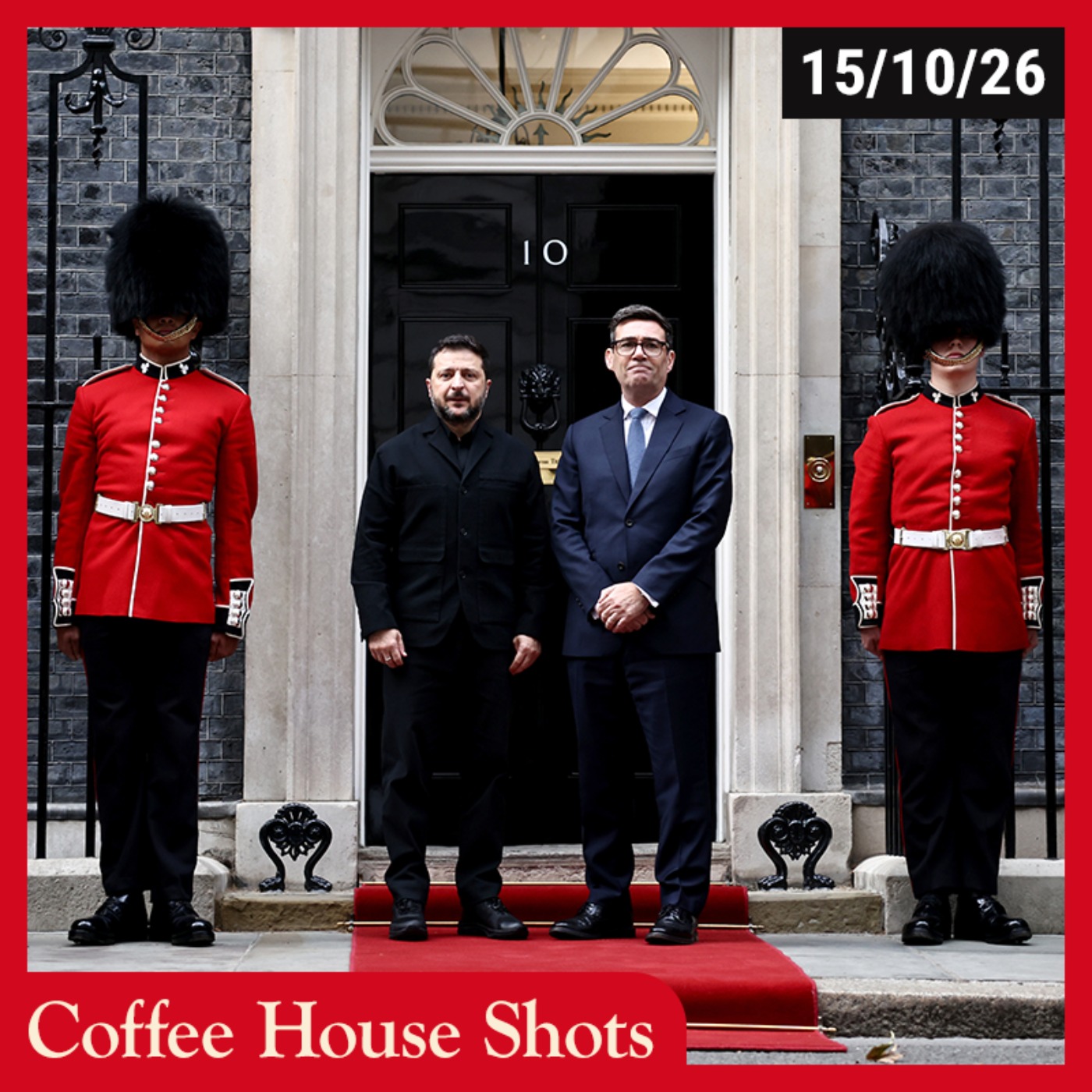
0:35Noa Hoffman: Hello and welcome to Coffeehouse Shots. I'm Noah Hoffman and today I am very pleased to be joined by Tim Shipman and James Heal. Now it's been a bit of a foreign policy heavy week this week and particularly the past few days. Zelensky has been in Downing Street amid a major fallout with Donald Trump. Andy Burnham has said he wishes to play peacemaker in this feud. Tim, what do you make of Burnham's approach to the current situation with Zelensky and Trump, particularly given that foreign affairs isn't his strong suit?
1:11James Heale: Look, I mean, we've got very used to these visits by Vladimir Zelensky. And in a sense, it's sort of less dramatic than it used to be when he turned up. But this, I think, was one of his more dramatic visits It's because it comes at a moment where, you know, America traditionally are sort of major allies, basically pulling stumps on Zelensky. Trump has said that he thinks he should resign. He's done a deal behind Zelensky's back with the Russians on diesel. And it appears he's withdrawn intelligence support. We've seen reports out of Ukraine and Zelensky has been talking about this in the interviews that he's done.
1:42James Heale: You know, they're no longer getting the targeting information they need, which is leading the Russians to have more successful drone strikes on Ukraine and made it difficult for Ukraine to strike back itself. So this is a crisis moment. The problem we've got is that whatever leverage Britain has is massively curtailed by the fact that the bulk of the effort supporting Ukraine is now coming from elsewhere in Europe. And, you know, this is a prime minister and a chancellor, who, let us remember, resigned as defence secretary because he wasn't getting the money, have decided not to fund our armed forces until at least September or October of next year in the spending review.
2:20James Heale: And if I was Donald Trump, and I took a call from Andy Burnham saying, this isn't on, Don, I'd tell him where to swing it, frankly, you know, Britain does normally bat above its sort of strength and position in world affairs, we, you know, we have traditionally been one of the more significant military powers, we've got a lot of soft power, we've got a lot of fingers and a lot of pies around the world. But, you know, our leverage is is pretty reduced. And, And, you know, as you observed, this is not Burnham's sort of natural arena. And, you know, I've written a piece for the magazine about Burnham's sort of brackets, lack of foreign policy.
2:58James Heale: But in there, there's some stuff about other fallings out with the Americans. And Ed Miliband, when he decided to sanction products emerging from the West Bank in Israel, there was a huge row with Israel, which has to a degree been calmed down now. But what my piece reveals is that there was nearly a blooming great row with the Americans. privately the State Department and others were absolutely furious about what Britain's done it looks like we're going to end up sanctioning Russian shareholders and Israeli banks that's gone down like a cup of cold sick and actually it could have been a lot worse publicly Trump who dislikes Netanyahu did not want the State Department to kick off about this before the Israeli election but people I've spoken to in Washington in London and in Israel all say that they expect this to kick off from the American end once Israeli elections out of the way so on a whole range of things, Britain is now at odds with America.
3:48James Heale: And our ability to get our way or work with allies to try and bolster Zelensky is dramatically reduced by our own failure to get our house in order.
3:57Tim Shipman: I agree with that. And I think that one of the reasons why we've been failing to kind of have as much influence is because the investment, where do we accept influence? One of the pieces is on intelligence services. Why? Because we properly fund our intelligence services. And that's been very important in the Ukraine conflict, particularly the run up to that and And there's subsequent revelations about Putin sort of manoeuvring there. But so partly it's about the defence point, which is going to be sort of an original sin for this chancellor, because obviously John Healy resigned on the issue of defence spending and everything's going to come back from the Tories.
4:23Tim Shipman: It's why aren't you spending more on defence? The other point is all these conflicts are interconnected. And often it's about fuel prices, which obviously in terms of Iran is backlashing on Donald Trump. But in conversing with that, he's trying to then intervene in Ukraine. So I think what the Labour government needs to appreciate is two things. Number one, that these can't be siloed, you know, and you might want to stand up for the Palestinians. But that potentially comes at the expense of Ukraine, to be blunt. And the second point is I'm really struck, partly it's touched on in Tim's very good piece, by how little dialogue there is between the Israeli left and the British left.
4:52Tim Shipman: One of the things that jumped out to me was that for the first time in memory, the Labour Friends of Israel conference party did not have a single cabinet minister go to that. And I think that the danger is that in their understandable, perhaps abhorrence about what Netanyahu has done, they're not fully rationalising and understanding that, for instance, Maybe it's a bad thing if you have a prime minister who's portrayed himself as a patriot standing up to foreign outsiders against Israel. If you then sort of give him an election winning issue potentially, which is the West is against us, the West is trying to get us.
5:19Tim Shipman: And if there was that kind of back channeling and dialogue between the Israeli left and saying, look, Britain, the best thing you can do is sit quiet, shut up. Maybe there'll be a change of government. That I think would have had a different nuance. And I think that's the criticism of some of the foreign policy stance. Yes, they're bold and brave seemingly, but the second order consequences are not always positive.
5:35James Heale: Yeah, and I think there were members of the Israeli Labour Party at the Labour Party conference, and Miliband's people say that he's been having conversations with them. But I think quite a few people on the left in Israel are pretty annoyed with Britain for giving Netanyahu a kind of a way to ramp up support for himself by saying, look, you know, even Britain's out to get us now. And that appears to have had an effect. And I was talking to a former cabinet minister who's close to people on the Israeli left who said, you know, they're not impressed by what we've done. So, you know, there's, and if you don't have a theory of foreign policy, and you don't have a, you know, a way you're going to approach these things, it can all, as James says, it can become siloed and ad hoc.
6:16James Heale: And the one person under Keir Starmer, who was pulling all that together, was Jonathan Powell, the National Security Advisor, you know, easily the most experienced person in the government on the political side. And he now seems to be pretty at odds with Burnham and Miliband. He opposed the sanctioning of Israel, said don't do it before the elections. And I'm told he's privately pretty furious. He's had to go and mop up Ed Miliband's mess by sorting out a deal with the Israelis where he can have a view, where they can keep some people in East Jerusalem, even though the consulate is sort of formally closed.
6:48James Heale: He's also, I'm told, one of the few people who's got contacts in America. Wyckoff, who is Trump's Middle East envoy, loves him apparently. And if, as I am told, is now distinctly likely that Jonathan Powell leaves in the next few months, it's not even impossible. And Wyckoff could hire him to go and do some sort of negotiating work as a sort of freelancer, such is the esteem in which he's held. But I'm told that a lot of people in Number 10 and MOD and Foreign Office are not nearly as engaged with the Trump administration as they used to be. And frankly, when you arrive at a moment like this, where America was doing something that, you know, most people in Britain regard as abhorrent in terms of what's happening with Ukraine.
7:28James Heale: We don't have the sort of clout anymore to go and do anything about it. And we are, don't forget, we are almost unique in the Western world in being united on left and right in support of Ukraine. In no other European country is that the case. There are big divisions and splits. And in a world where, you know, the French or Germans might be electing governments that are far more pro-Russia, Ukraine is really in a hole now and without America's support they've got big problems and you know as Owen Matthews has written in our magazine this week you know it looks like they're trying to force Zelensky effectively into a surrender.
8:01Tim Shipman: There's two quick points which I think in terms of Britain's role can be quite limited in this stuff but what we can control I was really quite struck by Tim's point in his column that they haven't done the work the new Burnham government in terms they're very much living again this is a metaphor for British foreign policy we're living off our predecessors we're living off our inheritance and that is what they're doing and they've got the best people in there, from what we can tell, seem to be those from the Stammer government who actually bothered to put the work in before the election and then the two years after that.
8:25Tim Shipman: And I know we often talk about Keir Stammer being away, but the benefit of that was that he'd had face time with his people and built up currency with them.
8:30James Heale: Well, and the other person we constantly mock is David Lammy, and there are often good reasons for mocking David Lammy, but he worked out that Trump was going to win the election and quite early went and established relations with the sort of wider MAGA world and a particularly close relationship with J.D. Vance. And there is nobody in the British government now who has anything like that.
8:49Tim Shipman: And I just heard quickly that in terms of Jonathan Powell and Ed Miliband, I wrote a column about this two months ago, talking about, you know, their books say a lot, you know, Ed Miliband is go big, change the world. And Jonathan Powell is the new Machiavelli, so the romantic and the cynic. Now, the ostensible romantic is winning out, but I think at the expense of wider issues. And it was quite striking to me that Ed Miller's decision to make Lindy Cameron, permanent secretary of the Foreign Office, rather than Karen Pierce, I think was something that was taken as a signal by a lot of the Foreign Office about which direction he wants to take it in.
9:15Tim Shipman: And I don't think it's one that people think is going to really work well in this new hard-headed Trump-minded world of ours.
9:21James Heale: And the basic rule of all politics from Bismarck, Lincoln, all those people is that LBJ did probably more social good in America in the 20th century than any other president. also the biggest political machinist shyster bastard of the 20th century you cannot do good effective progressive lovely things unless you are hard-headed realist bastards and the problem we've got that i began this piece quoting a european diplomat who i saw recently who said you know what is the foreign policy it seems like it's just sort of domestic policy on the world stage and somebody else said to me basically we've got andy's vibes and ed's conscience and frankly we need Jonathan Powell or others down and dirty political skills and if Powell is so pissed off that he's going to walk away that will be quietly an absolutely devastating blow to this government and not everything he does is something that we admire you know his obsession with the Chagos Islands is nearly as suspect as the late lamented Lord Hermes I say only late in that he's left the government I'm happy to report that he's still living breathing and a very nice man when he's not talking about human rights.
10:33James Heale: But we need pragmatic bastards.
10:36Noa Hoffman: There was a very poignant line in your piece, Tim, about Ed Miliband having a sort of messianic need to be seen as some sort of saviour, whether that's of the Palestinians or any other popular cause within the left.
10:53James Heale: Saving the planet is still a big part of it. Look, I mean, I quite like Ed Miliband personally, but he has a sort of, he's one of those intellectuals who is able to sort of rationalise anything in terms of a weird combination of heart and head, actually. He manages to sort of, he's clever enough that he can find a head explanation for things that are actually coming from his heart. And the sort of slightly poignant side of it was, obviously, Ed Miliband's leadership with the Labour Party was not a great success. He didn't cover himself in glory. There was probably too much intellectualising, not enough retail politics.
11:25James Heale: And I had an interesting conversation with someone who served with him in the Brown Cabinet, who said, look, Ed just always wanted to be, you know, the hero on the soft left. He was kind of really disappointed that Jeremy Corbyn came in and was this literal rock star. God, Ed Miliband would love to have played Glastonbury and had people cheering, you know. He has done backstage stuff at Glastonbury, yeah. Seven Nation Army to, you know, ooh, Ed Miliband and all that. It didn't happen. And now he's sort of come in, you know, his zeal on net zero, Now his zeal for, you know, kind of do-gooding foreign policy is part of the same game.
12:03James Heale: And he just wants to be sort of seen as a beloved character. Now that, in a sense, paints him as sort of a woolly-minded kind of idealist. He is more than that. And that, for people on the right, is actually the big danger. Because Ed Miliband is also a highly experienced and competent cabinet minister, one of the more effective in this government at getting what he wants. And frankly, if Andy Burnham does not devise a foreign policy, Ed Miliband is very much going to do it for him. The interesting thing is, when I was speaking to people for this piece, trying to determine, you know, okay, step back from the criticisms of sort of people on the right.
12:37James Heale: What would Ed Miliband say his foreign policy is? What is the rationale? You know, David Lammy came up with this idea of progressive realism, which is a sort of classic attempt to try and square two not wholly compliant circles. But Ed Miliband hasn't even really done that yet. I said, well, maybe he's got a speech coming up where he's going to do this. Are we still on progressive realism or is there something else? And the answer really came there none at this point. So at the moment, it seems very impulse driven. But also, you know, the one thread, as I write in this piece, that pulls all of this together is that most of what they've done is explicable from the point of view of drumming up votes on the left in British domestic politics.
13:16James Heale: There doesn't appear to be a vast amount of coherence to the position beyond that. And it's up to them, if they disagree with that, to come out and tell us what it is? What is their foreign policy?
13:28Noa Hoffman: I will just add very, very quickly, that's just your point about how Ed Miliband deals with Israeli politicians. The left in Israel is a shadow of itself. It's virtually non-existent. I think what my contacts don't understand is why the Labour government here doesn't treat the opposition on the right in the same way that we sort of saw foreign policy wonks treat Pete Magyar in Hungary as the sort of more acceptable, anti-corrupt, but similar right-wing politics version of Orban.
13:59James Heale: You don't get to pick the government or the opposition in these countries, but you have to work with what's there. Exactly, exactly.
14:04Noa Hoffman: And so the opposition at the moment in Israel are trying to sort of compare themselves with that fight in Hungary. And it doesn't make sense to a lot of people why the government here doesn't try and work with that to ultimately achieve a better end.
14:16James Heale: I think that sort of goes down to the sort of overall way that the left and right approach life, politics and everything else. The right tend to be pragmatists, sort of accept the world as it is, try to change it incrementally, try to do some, you know, iron out the stuff that's going wrong. The left approaches things from a point of view of values and all of that. And if they don't share values with people, they can't sort of emotionally bring themselves to be pragmatic about it. Whereas the right, you know, and there are some very bad examples of this, you know, there were a whole bunch of South American dictators.
14:50James Heale: And we basically said, well, these people are bastards, but they are bastards. But the right would work with left wing oppositions if it suited them, whereas the left don't seem to want to work with centre right oppositions. And I think that's sort of, you know, a kind of trend of the way those two blocks kind of approach politics and approach their sort of emotional and intellectual engagement with the world, really.
15:11Noa Hoffman: plenty more to discuss on these topics tomorrow thank you tim thank you james and thank you for listening to coffeehouse shots
15:43Tim Shipman: When it comes to managing money, forget the hype and look at results. Bill has a trillion dollars of secure payments powering our BillPay tools. Instead of just moving money, Bill is powering the financial operations of nearly half a million customers. So stop the guesswork and start scaling with the proven choice. Ready to talk with an expert? Visit bill.com slash proven to get started and grab a$150 gift card as a thank you. Terms and conditions apply. See Offer page for details.
As Andy Burnham rolls out the red carpet for Volodymyr Zelensky in Downing Street, he has publicly sided with Kyiv against the Trump administration, days after the US President called for Zelensky to be replaced. Noa Hoffman is joined by James Heale and Tim Shipman to weigh up the politics, and to ask whether Ed Miliband’s desire to be seen as a saviour over Israel-Palestine has backfired, with friends of Jonathan Powell, the National Security Adviser, now saying he is likely to quit.
Produced by Patrick Gibbons and Henry Lloyd
Become a Spectator subscriber today to access this podcast without adverts. Go to spectator.co.uk/adfree to find out more.
For more Spectator podcasts, go to spectator.co.uk/podcasts.
Contact us: [email protected]
Hosted on Acast. See acast.com/privacy for more information.