
 Ask ChatGPT



Hosts dissect Andy Burnham’s Labour conference speech, focusing on its left-wing policy agenda and political strategy, especially the “triple lock” pension change, Brexit/EU hints, national care proposals, and electoral reform. They argue the speech was bold and rhetorically strong but light on funding and international/economic detail.
Tim Shipman (journalist; has covered ~70 leaders’ speeches across major parties since 2001; 15 months total at party conferences). Michael Simmons (journalist; discusses pension mechanics and policy implications, including a call from the Department for Work and Pensions).
Pension change is still effectively a triple lock via fixing the pension-to-earnings ratio at implementation, preventing “spike years,” saving money over time. Many other proposals use “public control”/regulatory language rather than explicit nationalization to avoid huge acquisition costs. Electoral reform (alternative vote) will face union opposition and could split Labour.
National Care Service; tearing up the triple lock; return to comprehensive education; EU relationship commission; possible customs union/single market/rejoining; water “public control”; repossessing empty properties; local mayors controlling renewables; electoral reform with under-30% vote critique; emotional UK-union case referencing John Swinney.
Written by AI. May contain mistakes.
Discussion on ineffective marketing metrics and spending.
“Blowing ad budget on metrics that look great till the CFO sees them.”
Analysis of Andy Burnham's speech and its implications for the Labour Party.
“I'm Noah Hoffman and today I am delighted to be joined by Tim Shipman and Michael Simmons.”
Discussion of changes to the triple lock pension and public reaction.
“Michael, could you hear the cheers of millions of under 30s as Andy Burnham announced that he is going to change the triple lock?”
Examination of Burnham's comments on Brexit and potential reforms.
“And one other thing I would say, we've had a lot of Liz Truss at this conference.”
Discussion about proposed policies for housing and energy management.
“There was discussion of decoupling from the international gas market and making energy more localised, with mayors having greater control over how renewables are sort of built and distributed within local communities.”
An in-depth analysis of Andy Burnham's recent speech and its implications for Labour and electoral reform.
“Well, he's been honest in his own terms.”

Get the gist, explore an idea or ask about something said.
 Claude
On Coffee House Shots, what are the key points of this episode?
Searching your listeningAutomatic transcript. May contain errors.
0:00Noa Hoffman: Blowing ad budget on metrics that look great till the CFO sees them. That's bull spend. And marketers are calling it out in Dashboard Confessions. I remember telling my boss, it'll be good for the brand when leads were slow. Yeah, it wasn't. Cut the bull spend. LinkedIn lets you target by company, job title, and more. Advertise on LinkedIn. Spend$250 on your first campaign and get a$250 credit. Go to linkedin.com slash campaign. Terms and conditions apply.
0:39In 1945, we had the vision to build the peace. We had the bravery to make change. We built good homes, secure jobs, health and education for everyone. We gave Britain hope again. We made working class aspiration feel real for families like mine. We built the common good, or at least we did until the 1980s. Suddenly, the commonwealth we had created, this party, the wealth we had created for the many, was seen as an opportunity for the few. homes, water, energy, transport, care, care,
1:36broken up and sold off. The British right talk about taking back control. Never let them forget. They are the ones that gave it away in the first place.
1:54Noa Hoffman: Hello and welcome to Coffee Hash Shots. I'm Noah Hoffman and today I am delighted to be joined by Tim Shipman and Michael Simmons. We have just finished Andy Burnham's big set piece, conference speech and wow what a speech it was. Very hefty with a lot of details, slightly lighter on the funding side but definitely the broad ideas and the sort of direction Burnham wants to take the country did become much clearer today. Tim, let's start with you. What are your overall reflections on the speech? Well, I've been coming to party conferences since 2001. I've spent 15 months of my life at party conferences.
2:37I've seen probably 70 leaders' speeches across all the main parties. I'd say this is one of the handful of most significant that I've heard. The delivery was bravura. It looked like he was doing no notes. Of course, he actually had a whole bunch of screens. but it was very natural. It was Andy Burnham at his best. It was passionate. It was enthusiastic. The Labour Party loved it. And, you know, he said at the end, you lot wanted meat, you've got meat. You know, he's going to bring in a national care service. He's going to tear up how the triple lock pension deal works in order to pay for that.
3:14He wants a return to comprehensive education. He wants a national commission on what our relationship should be like with the European Union, which clearly heralds a possibility of returning to the customs union, the single market or rejoining altogether. Rather amusingly said he wanted a national consensus on that. I've got a new bridge to sell you, Prime Minister, if that was a sincere offer. and then you know it was it was extremely radical and he said at the beginning you know this is going to be a different speech and in and in a way it was a different speech uh he didn't make too many party political points apart from saying that everything for the last 40 years has been terrible as if the 1970s were this sort of wonderful house in time for for britain when we were the sick man of europe and uh and an international joke running cap in hand to the imf but no matter uh that's me making a slightly partisan point which is beneath me because that's not what Andy wants to do.
4:07He came on to All Together Now. He wants the country united. He wants to do away with all these divisions. But this was the most clear-cut left-wing prospectus that any prime minister has put forward since the days of Harold Wilson. Even Jim Callaghan didn't dare to be this potentially divisive. And very bravely, the one genuinely brave thing he did, it seems to me, is say that he wants electoral reform. That will be bitterly opposed by the trade unions who will see it as a step towards destroying the Labour Party. But it was a different speech. There was almost nothing on the economy. There was almost nothing on the major world crises facing us today.
4:46Literally no mention of Russia, China, terrorism, anything like that. This was a domestic speech directed primarily at the Labour Party and the people on the left who might come and join the Labour Party. And he said at the end, if you agree with enough of this come and get behind us and that was a very clear-cut positioning exercise where he basically said to anyone who's vaguely left of centre in this country this is your party you need to get behind us or we're going to have a reform government and that is what it was all about it was impressive it was big it was bold it was wrong in more ways than i think we have time to discuss but as a piece of oratory and as a political statement it was highly significant And, you know, those of us that sit around moaning about small scale politics and leaders who won't lead should put our hands up and say, you know, nice one.
5:34We know where we stand now, Andy.
5:36Noa Hoffman: Michael, could you hear the cheers of millions of under 30s as Andy Burnham announced that he is going to change the triple lock? That's part one of the question. And part two is what exactly are the changes? It was a bit muddled because at first it sounded like it was a double lock where the pension would only go up by either inflation or 2.5%. But then there was also this question of earnings somehow potentially catching up as well in a sort of longer scheme. So a double and a half lock. What's going on there? Sure. So the excitement from the under 30s and from, you know, haters of the triple lock, which is any sensible person, kind of erupted straight away because it had been, you know, it kind of made its way into the press last night.
6:27So people were expecting it. And I think because of the clapping, they didn't hear the sort of end of what Andy Burnham said, which is, as you say, it will go up by the floor of 2.5 percent or it will go up by inflation and will make sure it matches earnings over time. and actually while this was happening and everyone was quickly you know tweeting triple triple lock's gone we've got a double lock we've got a double lock i called it a two and a half lock for that reason number 10 have been saying that it's actually still a triple i've just had a call from the department of work and pensions literally i tweeted saying how on earth was this work one of them called me and said it's still a triple lock and effectively what they're saying is that the ratio of pension to earnings will be fixed at the point this policy comes in so assuming we have a general election in 2029 the policy will come in if Labour win that general election thereafter so in 2030 you would whatever the ratio is then between pensions and and earnings will then be fixed and going forward it will rise in the same way so it's still a triple lock but what this does is prevent those massive spike years where you had a huge kind of rise and the pension would go up effectively in a sort of ratchet step like and then it would get the best of whatever the three things were the year after and it would keep rising and rising and that has meant that pensioners relative to to earnings have begun to do much better the point is that ratio will then be fixed and this will over time save a decent sum of money but it will take time for it to it to rack up i actually i actually think you know the potential savings are maybe not massive i mean this is not going to fund the new national care service however and you know i still think this will be broadly supported by anyone who was opposed to the triple lock, even if we still say it's a triple lock, because he's done what we were told was unthinkable.
8:17He's touched the untouchable. And this opens the door, you know, for further reform and change. So whether, you know, we were too excited or people were too excited to say, oh, that's the end of the triple lock. It's now a double lock. It's a change to something that was completely unsustainable. And that's a good thing. And one other thing I would say, we've had a lot of Liz Truss at this conference. Everyone's been talking about Liz Truss is responsible for all the ills in our economy and the guilt yields and all these things. Well, I was told during the speech that this was exactly the policy reform to the triple lock that was being looked at in the Treasury when Liz Truss was the prime minister.
8:55So Liz Truss is here again.
8:57Noa Hoffman: Tim, Andy Burnham went particularly bold on Brexit. He hinted that Labour's red lines on not rejoining the customs union or the single market could potentially go altogether. He even sort of left the door open for rejoining the European Union. Are the residents of Makerfield and further beyond going to respond well to that? I mean, possibly not. I mean, look, lots of people don't think Brexit has worked very well. He said, well, we've lost control and we had control and we still opened our borders. That was our decision. It wasn't my decision. It wasn't the decision of most spectator readers, but it was the decision of the government that was in power at the time under Boris Johnson and others.
9:38So it's a bit sort of naff to say that Brexit hasn't worked. If it hasn't worked, it's because Britain hasn't made it work to a degree. But, you know, he he wants to have a commission. I mean, good luck with that. I mean, that's just a way of buying the next two or three years rather than saying in the next Labour manifesto, there will be an option to leave the European Union. The question is, really, and the pressure will now build from people who don't like the sound of that, about whether or not that would be a pledge that was accompanied with a referendum or not. Because you get the strong impression that Burnham wants to put all this in the next Labour manifesto.
10:12And if he can secure a majority, then he'll just do it. I think there'll be uproar in a wide range of quarters and not just in those sort of hardcore Brexiteers. I think there's a lot of people who think that you shouldn't overturn a referendum result without another referendum. But Burnham knows that winning such a referendum on the basis of would we be rejoining the euro? What are the terms on which we rejoin? How much money would we be putting in? But that's all one thing. That's the sort of economic side of Brexit. And, you know, lots of people think that the burdens at the border are too high and that we need to make progress, which is why everyone from Rishi Sunak onwards has been campaigning to try and lower those things at the border.
10:53The problem is that it's the issue that he didn't really talk about a great deal. You know, there was a brief bit on immigration, not much. But the second you do any of this stuff, you have to have freedom of movement back. And regardless of the fact that British governments have been throwing open the borders in an unhelpful way, as far as most voters are concerned, if you had no choice in the matter, I think that becomes a massive toxic issue again in British politics. And I think, you know, I mean, fair play to him if he wants to go and have that argument. But that seems to me one that is going to alienate quite a lot of people who might otherwise be inclined to vote Labour on some of the other stuff.
11:31Noa Hoffman: Michael, there was discussion about repossessing properties that have been empty for a while, about new standards in rental properties and councils, taking homes of bad landlords. There was discussion of decoupling from the international gas market and making energy more localised, with mayors having greater control over how renewables are sort of built and distributed within local communities. Is all this language or does it have some substance to it? And how much are all of these promises going to cost? Because policy after policy after policy sounded all well and good to a lot of people. there was very limited detail, apart from the double and a half lock paying for some of the social care service, on how any of this is going to be paid for.
12:16Noa Hoffman: Was that a glaring omission? It was a deliberate omission. And I think actually the language is not a mistake. It's very deliberate. I mean, look, that was an amazing speech, you know, as Tim was saying, in terms of its oratory. But it was a speech with a lot of socialism in it. But when the kind of socialist policies were announced, the language was very careful. I mean, let's take the example of water industries, right? He didn't say we're going to nationalize water. He said, OK, we're going to remove the ban on being able to nationalize water. And then he said, we're going to take things into public control.
12:51Public control does not necessarily mean public ownership. That could mean many things. That could mean you have a community representative on the board of a company. It could mean a minister of state has to be consulted. You know, there's all sorts of things you can do without lending or without spending lots of money. And I think that's the point on a lot of these things. You know, it's one thing lifting moratoriums on the state operating like this. It's another thing asking the bond markets to give you hundreds of more billions pounds that you would need to actually acquire and run all these assets.
13:22I thought that was one of the most fascinating parts of the speech because there were huge cheers at the start. And then he said, well, we're going to stop these wicked private companies going off with huge bonuses, huge cheers. and then he said local mayors will be able to do something about it. Gradually, as he explained the policy in all its constituent parts, the clapping got gradually less and less and less and it was all sort of slightly embarrassing by the end of it. But some of this stuff was very radical. We shouldn't be sort of saying it isn't.
13:52Noa Hoffman: And often politicians are criticised for trying to disguise their true intentions, not being honest about the challenges we face and how they want to solve them. To his credit, he's been honest. Obviously, the big question now... Well, he's been honest in his own terms. In his own terms, not yet. You know, the description is probably honest. The proscription is less so. I think, you know, he's sort of making out in a lot of these areas that, you know, things that happened, you know, went wrong in a way that's different to the way they actually went wrong. For sure. But at least, you know, he's finally saying very much with his chest, I want to undo Brexit.
14:30Noa Hoffman: I want to get rid of the triple lock in its current form. I want to have these, you know, national care services, big sweeping transformational social media. And all of that seems to me highly... I can understand that as a prospectus for the left. The bit I find absolutely baffling is this electoral reform stuff. Yeah. So basically his argument was we shouldn't have a government elected in this country, a divisive government, brackets, he means reform, elected on less than 30 % of the vote. So there, ergo, we must have electoral reform, we must have the alternative vote, whatever it is. He doesn't seem to mind if the government that's elected on less than 30 % and is massively socialistically divisive is the Labour Party.
15:13But, I mean, I've got a list here of unions who oppose electoral reform. The GMB, ASLEF, the Prison Officers Association, and Unite, the biggest union. This is going to be the thing that causes him the most internal angst. Most people in this country are very au fait with the need to vote tactically, which is essentially what something like the alternative vote is. It means you vote first for the party you love and then you vote second for the party that you'd rather see win rather than the other one. But that's what a lot of people are doing in these seats. I mean, we've seen a huge upsurge in tactical voting.
15:48It's very common on the left. It's become increasingly common on the right. We're operating in a five-party system where people are voting tactically already. We don't need electoral reform to have a sort of melange of politics that's a bit of a mess. This will destroy the Labour Party. It would split into at least three, if not five different parties. And it seems that curious things go about and have that fight when he's already trying to have a massive fight on a lot of other stuff. You know, ostensibly probably matters a great deal more to most people in this country. I just want to say another union that got a mention in the speech was the Union of England and Scotland.
16:23and that was a really like kind of barnstorming bit of the speech where he did this absolute body swipe at John Swinney who had said oh you're going to be the last Prime Minister of Great Britain and he said that on the day that Andy Burnham's dad had died so you could tell Andy was quite angry about that even though he did say that John Swinney didn't you know probably know and then he then gave this you know it's one of the most stirring parts of the speech this you know full-fronted kind of case for the United Kingdom. And that was interesting. And I'm going to sound like a hypocrite here because yesterday on the website, I was slagging off John Healy for reminiscing too much about Gordon Brown.
16:59Well, that reminded me a bit of Gordon Brown because a few days before the Scottish independence referendum, there was an Ashcroft poll that suggested that actually the yes side might win. And Gordon Brown was wheeled out and gave this kind of barnstorming speech about the positive case for the United Kingdom. And sort of in the time since then, no one really does that. We just, you know, hear the negative cases against independence. And it was it was interesting. I thought that the prime minister stood up there and did, you know, kind of big, big section on that. And not just sort of on the facts of it.
17:31It was it was the most emotional part of the speech because it was the day his dad died. I mean, there were I forget how many references to his father in this speech. I mean, literally a dozen, I would say. and that was one where he got quite emotional. There was a moment where he paused for quite some time and I was sort of sitting there thinking, what's he going to do here? Is he just deciding whether to say he's going to rejoin the EU? What the hell, I'll go for it. But actually, he lost his composure a bit. He was a bit upset about it and he came back with that really passionate thing on the union.
18:06So it was a powerful bit of work and that will, I think, is an interesting, how that plays in Scotland will be very interesting because essentially his argument to the Scots is, you know, look, I'm the kind of leader you like. I'm doing all this stuff that you essentially like. You know, Scotland is more left of centre than England is. And the union is most imperiled when you have a government in London doing things that the Scots don't like. And effectively, Burnham was putting his, you know, whilst telling John Swinney to go swing, was also putting his arm around the Scots in the same way he was putting his arm around the English working class and saying, look, I'm with you, you know, let's march forward together, come and join me.
18:47The echoing silence was, there was no mention of middle class wealth creators or people who aspire and go out to work. There was a bit of AI, but not a lot. He's going to do this stuff at a summit. But of all the sort of major things that you normally hear, even a Labour prime minister talk about, you know, you heard it from Blair, you heard it from Starmer, you know, that desire, aspiration, getting on, meritocracy, all that kind of talk. There was none of that at all. The working classes had been let down by everybody for 40 years, and I'm going to put it right. And if you're not one of them, there wasn't a great deal for you in this speech unless you care passionately about Brexit or electoral reform or think the care service is the most important thing that a government should be doing.
19:30Noa Hoffman: And Tim, another big omission, if you would like to call it that, from the speech was any name check for Nigel Farage or Kemi Badenog. It really focused on what Labour's message was and in really striking contrast to Keir Starmer avoided directly attacking the likes of the Tories and reform. Was that a smart move on Burnham's part? Yeah, I think probably so. And he made, you know, that was what he meant by saying this is going to be a different speech. It's not going to be a partisan rant. It's going to be me setting out my stall. the only reference to reform was oblique it's the one i've already mentioned about another party winning you know with a divisive party winning with under 30 of the vote basically ignored the and frankly only right at the end did he even say 1997 and blair's victory was a good thing prior to that he basically lumped in blair's government with the thatcher government and the major government as the source of everything that was wrong with this country for the last 40 years.
20:31So he, if anything, he was sort of dishing out, you know, the sort of opprobrium fairly equally between, you know, Labour and Tory predecessors. The only Labour, you know, politician he really mentioned was Clem Attlee. So that was why he was trying to draw his wellspring of inspiration and saying, you know, National Care Service, that'll be the most significant thing we've done since the NHS. But yeah, I think he wants to sort of make them irrelevant. And look, if this is a success, if he comes out of this with a bounce, if the Green and the Lib Dem vote get squeezed as a consequence and people say, oh, look, we do like electoral reform, we hate Brexit, we do think we should put more money into care, you know, this could galvanise.
21:14It's not impossible to see him getting a four or five point bounce out of this. At which point, you know, as you were observing earlier this morning, all of this sounds very like it's all got to go in a manifesto. He can't do it now. He hasn't got a mandate for it. All sounds like the kind of thing on which you might call a general election. But you can't do that with the polls where they are at the moment. So we'll have to see what the result is. And, you know, the Tories, at least from their point of view, have a chance to go next. And I suspect Kemi Badenoch will not be so decorous in ignoring other political parties.
21:46She will be saying, I suspect she will draw attention to quite a lot of what was not in Andy Burnham's speech, i.e. the economy and the fact that we're in a virtual state of war with Russia and in a sort of actual state of war with Iran in a sort of low-level fashion. So it's curious that he didn't feel the need to really kind of engage with that a little bit more. But, you know, as I say, it's hard to fault the ambition here. The detail is a different matter.
22:16Noa Hoffman: Plenty to unpack here in Liverpool. and there will be so much more to come when the Tories take centre stage at Birmingham from Sunday. But for now, we will wrap up the podcast. Thank you, Tim. Thank you, Michael. And thank you for listening to Coffeehouse Shots.
22:43This is the story of the one. As a shipping manager, he's running the dock, stocking supplies, and making sure every order goes out on time. And Grainger helps him stay prepared. From shipping supplies to PPE to hand tools, he counts on Grainger to keep products moving and trucks rolling. So his operation runs smoothly, no matter the shift. Call 1-800-GRAINGER, click grainger.com, or just stop by. Grainger, for the ones who get it done.
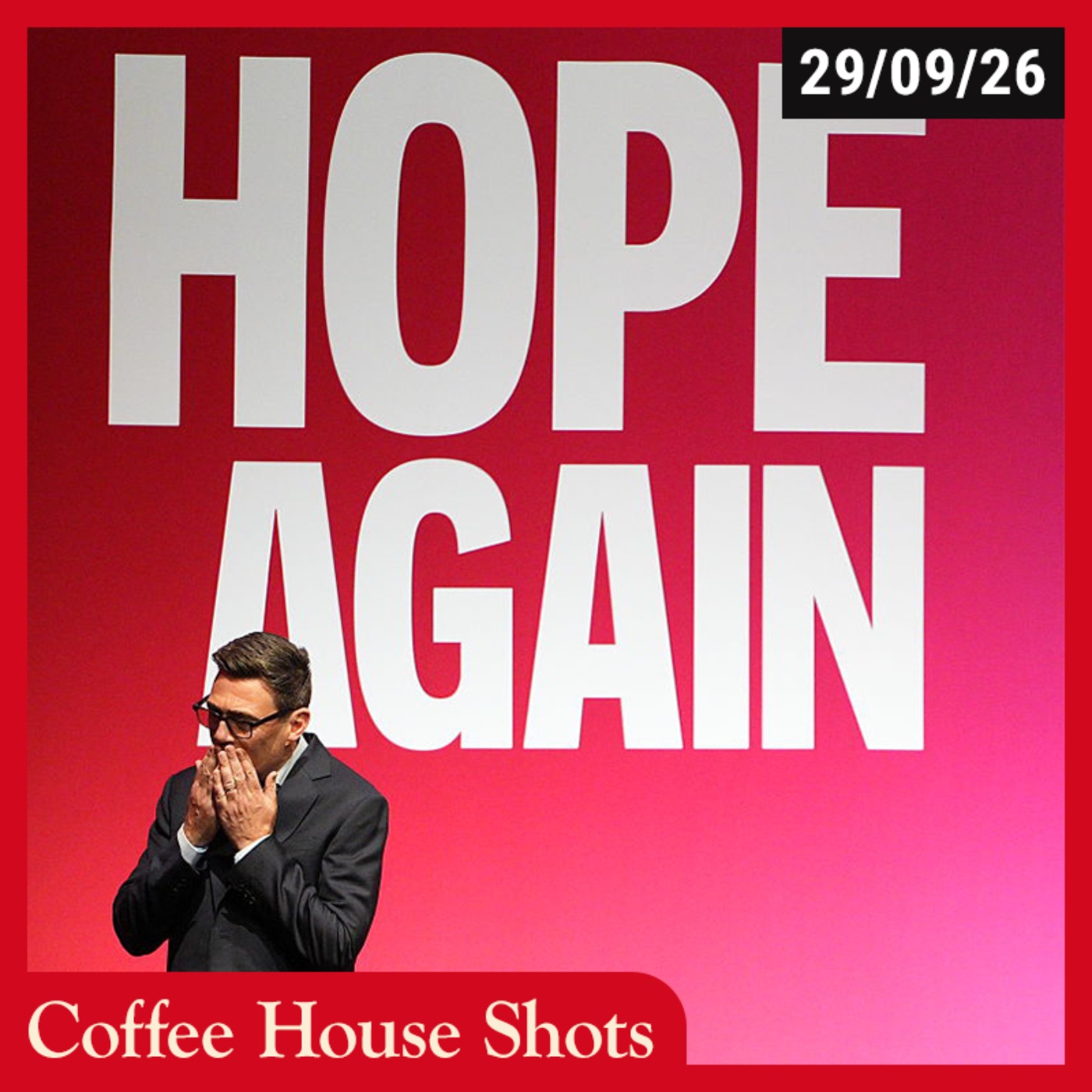
Andy Burnham has used his Labour conference speech to set out his clearest vision yet for the country and it was a strikingly ambitious one. Noa Hoffman is joined in Liverpool by Tim Shipman and Michael Simmons to unpack a speech that ranged from a new National Care Service and reform of the pension triple lock to electoral reform, water and Britain’s future relationship with the European Union.
How radical is Burnham’s programme in practice and is the ambition matched in the detail? And what was missing from the speech?
Produced by Patrick Gibbons.
Become a Spectator subscriber today to access this podcast without adverts. Go to spectator.co.uk/adfree to find out more.
For more Spectator podcasts, go to spectator.co.uk/podcasts.
Contact us: [email protected]
Hosted on Acast. See acast.com/privacy for more information.


