Ask ChatGPT
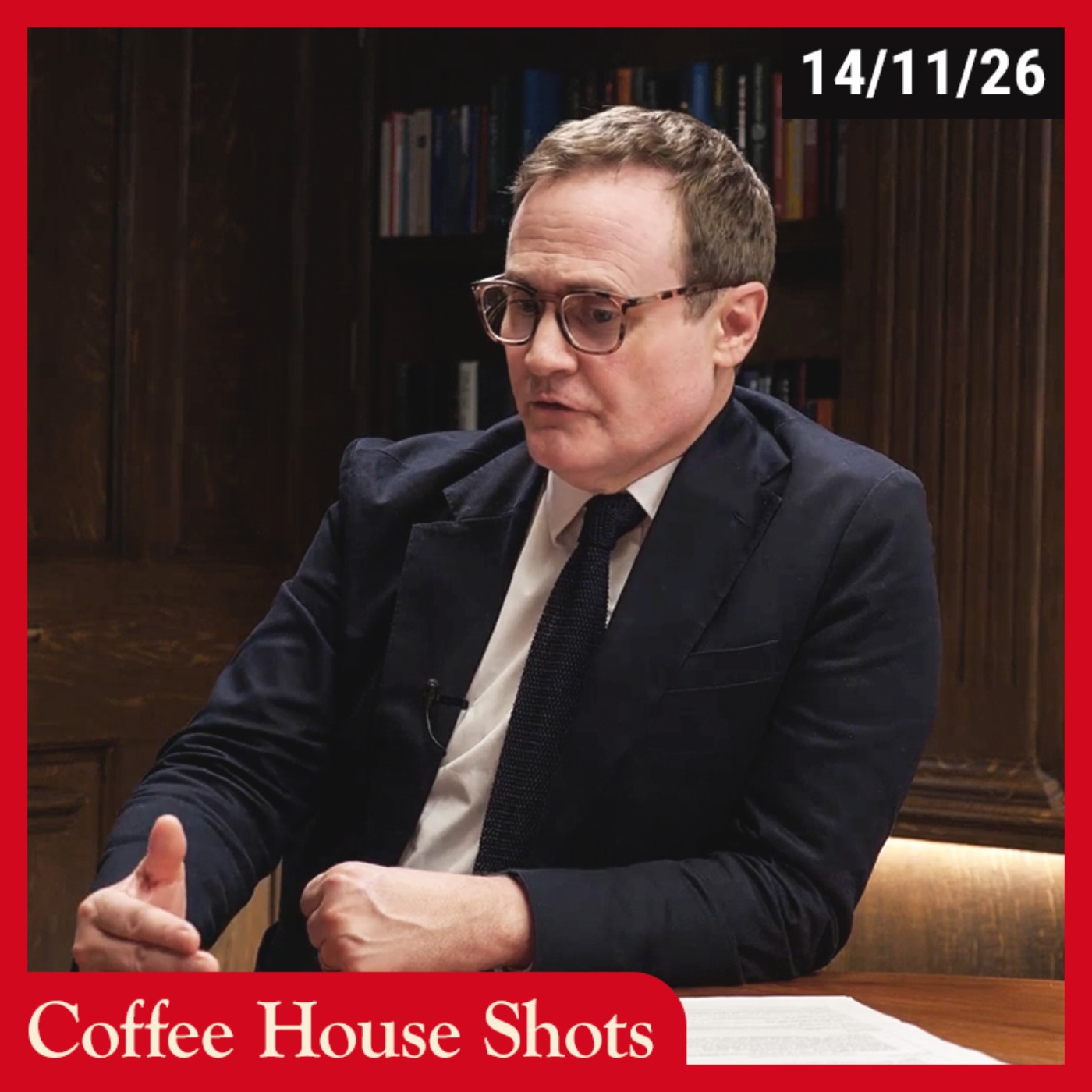

 Coffee House Shots
9 Oct 2026 · 20m · 5 chapters

A North London by-election (Holborn and St Pancras) and what it signals for Labour under Andy Burnham, the Greens under Zak Polanski, and the right-wing parties.
Tim Shipman, Spectator political editor; Luke Trill, director at More in Common.
Labour won with 45% (down 4 points from 2024), while the Greens won 33% (up 22 points, but possibly boosted by votes that previously went to independent Andrew Feinstein who endorsed Polanski). The Conservatives beat Reform in England by-election vote share (Tories 7%, Reform 6%). Greens face a “taint” after an anti-Semitism motion; Polanski’s leadership is in question. Labour’s campaign emphasized homelessness, Thames Water failures, and “Camden Way” youth opportunities.
Thames Water “burst in Maine”; comparisons to Burnham bounce and prior Gorton and Denton by-election; Newsnight exchange where Caroline Lucas avoided directly calling for Polanski’s resignation.
Written by AI. May contain mistakes.
A breakdown of the by-election results and implications for Labour and the Greens.
“Pancras by-election, defending the seat that Keir Starmer left vacant against a threat of Zak Polanski, who now faces questions about the future of his leadership.”
Discussion on the strategic implications of the by-election results for various parties.
“I think you can say it's a pretty good result for Andy Burnham.”
Exploration of the campaign strategies used by Labour and the Greens, with a focus on key issues.
“And I think the interesting thing here is, you know, there is a slight taint around the Greens now as a result of this anti-Semitism motion that was passed at their conference.”
Discussion on the internal challenges and external perceptions facing the Green Party and its leadership.
“And I think also, Tim, as well as obviously the Rolks coming in last night, it was a really interesting filleting of Polanski on Newsnight by Caroline Lucas in her own quiet way.”
Discussion on the internal conflicts within the Green Party and the Labour Party's evolving political landscape.
“well, that won't go down well with the Islamist faction.”

Get the gist, explore an idea or ask about something said.
 Claude
On Coffee House Shots, what are the key points of this episode?
Searching your listeningAutomatic transcript. May contain errors.
0:00James Heale: Hi, this is Nikaela Matthews-Oconley from SideHustle Pro. This holiday, the difference between buyers just checking things out and checking out comes down to the last few clicks. PayPal Checkout is a trusted conversion engine fueled by 400 million active PayPal and Venmo accounts. Add Pay Later and turn holiday shoppers into regulars. 96 % of Pay Later shoppers are repeat users. PayPal is built for all business. Get started at paypal.com slash business. Disclaimer, PayPal Pay Later data, eight markets, March 2025 to February 2026. Repeat users more than one Pay Later purchase in the past year.
0:43James Heale: Therefore, I hereby declare that Segal Abdiwali has been duly elected as a member of parliament for Holborn and St. Pancras.
0:51Tim Shipman: They would have won the Holborn and St. Pancras by-election, defending the seat that Keir Starmer left vacant against a threat of Zak Polanski, who now faces questions about the future of his leadership. I'll be discussing exactly what happened and the consequences with Tim Shipman, Spectator's political editor, and Luke Trill, director at More in Common. Now, Luke, firstly, over to you. Can you give us the breakdown of the results and anything that jumped out to you when the result was declared? Yeah, absolutely. So Labour took 45 % of the vote to win the seat. That is four points down off what they got at the 2024 general election, which really isn't bad for a sort of governing party in a by-election to only lose four points, although some would argue 2024 was a relative low for them in the seat.
1:37The Greens took 33 % of the vote, so 12 points behind Labour, but that was up 22 points from their general election result. But here there's a little niggle, because the main challenger to Keir Starmer's left in 2024 in the seat was an independent called Andrew Feinstein. He ran to Starmer's left. In this by-election, he endorsed Zach Polanski. So I think it's fair to assume that a big chunk of his votes would have gone to the Greens. He took 19 % in 2024. And so if you add up the 10 % the Greens got in 2024, and that 19%, you get to 29%, suddenly the increase to 33 % for the Greens doesn't look as impressive.
2:27You know, it's pretty static, and certainly it does feel like they're combined way back from the local elections. Finally, this was a by-election which was about the battle for the left, but there were some interesting results on the right of British politics in the sort of runners-up category. This was the first by-election of this parliament where the Tories beat Reform UK in England in a by-election. I think, you know, we're talking about 7 % of the vote here, so let's not get ahead of ourselves. But I think that they will be pleased with that. Reform taking 6 % and Liberal Democrats on 3 % and Restore Britain just under 3%.
3:10So again, arguably restore having an impact on reform's overall position in the polls. So that's the overall landscape. I think you can say it's a pretty good result for Andy Burnham. And I think it confirms what we've talked about before that the Burnham bounce is mostly not entirely, but is disproportionately driven by winning back disillusioned progressives, those on the left of politics who were disappointed by Keir Starmer went to parties like the Greens. They won that Gorton and Denton by-election, which was a sensational result, did very well in the local elections. Since then, Polanski's own missteps, which I'm sure we'll come on to, but also Andy Burnham's greater appeal gluttons brought them home.
3:59And it is significant that if you look at Labour's 2024 vote. At the height of Starmer's unpopularity, he was losing about 11-12 % of that vote directly to the Greens. That has now more than halved under Andy Burnham. So he is rebuilding the left-wing tent under Labour and this by-election is both confirmation of it and I suspect will add momentum to that push too. Absolutely.
4:25Tim Shipman: Tim, what does it all mean?
4:27James Heale: Well look, if you look at what we've just had, all these party conferences, what Luke says, is spot on. Everything Andy Burnham did at that party conference, electoral reform, revisiting Brexit, National Care Service, this is all stuff that's designed to attract Green and Lib Dem voters and it appears to have worked in this case. And everything the Conservative Party did was designed to say at some point we'll grab some support back, we'll get ahead of reform and then we'll be the natural party of the right. Now to draw too many conclusions about what has happened here on the right is, I mean, this is three bald blokes fighting over a single hair on a comb, isn't it?
5:04James Heale: But the Tories have grabbed that singular hair and have put it proudly upon their forehead and tried to weave it into an extravagant comb over this morning. I mean, you look at that and Restore got two and a half percent. That would have been more than enough to put reform out of the Tories. And it's a micro scale, but they'll be happier this morning than Farage Central. And it shows that the Lib Dems also can be squeezed. They dropped, you know, they only went down two and a half points, but they only got 3.4. So they've lost about 40 % of their support in this seat. When the battle is elsewhere, the Libs are going to get sort of squeezed to oblivion.
5:42James Heale: So look, I think, you know, Luke's right. The green numbers are not that impressive, actually. Polanski's putting out a statement saying, we have taken the fight to Labour in, you know, one of their safest seats. Well, that's absolutely true, but they wanted to take this seat. They thought a few months ago they could take this seat. It's slightly a mute point to say that under Keir Starmer, they would have taken the seat. But then, of course, there wouldn't have been a seat to fight because Keir Starmer would have still been prime minister. But this is bad news for Zak Polanski. And I think the interesting thing here is, you know, there is a slight taint around the Greens now as a result of this anti-Semitism motion that was passed at their conference.
6:18James Heale: He is now saying, oh, we need to revisit that. People don't really know what we meant. Well, I think, well, are you a bit anti-Semitic or very anti-Semitic? You know, we're not quite clear where Green is on that particular scale. But this is a North London seat. The Greens want to do well in London. And this is not a North London seat that has a particularly big Jewish population. You go a bit further north of here in London and there are lots of Jewish voters. And the Greens are going to really struggle. I think it puts, you know, any suggestion that the Greens might win the mayoralty to bed if this trend continues.
6:50James Heale: and, you know, again, let's not over-extrapolate from the battle on the right, but James Cleverley will be looking at that and thinking, I should probably be the challenger to Labour here and, you know, if we can achieve on a macro scale what the Tories have achieved on a tiny, tiny little scale and let's, you know, let's be absolutely clear, the scale we're talking about is smaller even than Rishi Sunak. It's that micro. But if Cleverley can repeat that, if Restore can take a chunk from reform, he's going to be the one taking on the Labour challenger come the mayoral election, I would think.
7:27Tim Shipman: Luke, let's talk about the two campaigns, because I was chatting to a Labour campaigner yesterday who made the point that the candidate campaigned on three issues, one of which was homelessness, second of which was Thames Water specifically, because there's been a burst in Maine there, which affects local residents. And finally, this sort of theme of opportunities for young people, dubbed the Camden Way. I mean, it dovetails really nicely with Andy Burnham's agenda particularly at the Labour Party conference, but also the Greens. I noticed, I don't know if you saw this as well, Luke, a bit of a shift in their campaign.
7:54Tim Shipman: They started this off saying it's a two-horse race, vote us to stop Labour. And actually, as it went on, you saw this framing, which we discussed at the Green conference, which was, well, vote Green and watch Labour move, which basically tacitly concedes that they are part of this kind of subordinate role, merely kind of trying to influence the two main parties. Yeah, absolutely. I mean, you know, this was, I think, for Labour and Sigal Abdiwali's campaign, the sort of first test of kind of, you know, burnamism in proper action. It comes hot on the heels of that conference speech. We know that Thames water is, you know, a particular bugbear for Londoners and indeed lots of people in the southeast of England.
8:35I think it's become emblematic for the left as the kind of satanic symbol of what they might call the sort of Thatcher and major privatisation eras. It's no surprise to see that. Again, homelessness and housing, actually, we found when we tested it, is one of Andy Burnham's most popular pledges. I think because for lots of people, it is a sign of broken Britain. And, you know, if we can't even find homes for our own people. And interestingly, left and right, for slightly different reasons. On the left, it tends to be more kind of compassion-based argument. For some on the right, it tends to be more of a kind of, you know, visible symbol of sort of decline, but also worries about crime and antisocial behaviour.
9:16So it spans that divide. So, you know, a very sort of bread and butter campaign for Labour, which seems to have paid off. And exactly as you say, on the green side, trying to run this message of, we've already done this to make Labour left-wing, let's keep them honest. or keep pushing them. And the problem is voters like voting for winners. In the abstract, lots of voters on the left like the idea of the Greens as a kind of pressure point on Labour. But again, when it comes to it, you don't really vote for parties in order to have an influence or to try and pull people in a particular direction unless you know, for instance, a bit like, I guess, UKIP in some of the Cameron eras, you know that there's not that much of a chance of them winning.
10:01So I think it highlights the fact that since the election, since those Polanski stumbles, the Greens and the election of Burnham, the Greens have really struggled to land on who they are and what they're about and to build that big tent. And of course, it's worth saying this comes off the back as well of, and you should never read too much into local council by-elections, but some local by-elections in rural areas that the Greens previously won off the Conservatives, they're going massively backwards. There have been a couple just in recent weeks, which again, I think is a danger for the Greeks because if they're not winning in North London and they're going backwards in those rural areas, the green tent has really become quite narrow.
10:46Tim Shipman: I think that's quite interesting. And I think also, Tim, as well as obviously the Rolks coming in last night, it was a really interesting filleting of Polanski on Newsnight by Caroline Lucas in her own quiet way. She was asked whether he would resign. She took a while to pause, a sort of stage pause, and said, we'll see what happens in the coming weeks. He's been out to stay on the media doing these interviews suggesting he will vote to.
11:04James Heale: I absolutely won't be resigning. It's like traditionally in political parties or football clubs, the chairman comes out and says we have 100 % confidence in the manager. This was the case of the manager coming out and saying he's absolutely got confidence in himself, which is one of the last things that you convey when you do that, which is confidence. I think the point Luke's made is really important about coherence because actually what Burnham said at Labour conference and what Baden-Ock said at Conservative conference were the first proper coherent expressions of what it means to be Labour and what it means to be Conservative that we've seen for a little while.
11:42James Heale: And those two philosophies are now in, you know, they're in conflict. Burnham is taking a more socialist kind of interventionist position. Baden-Ock is going back to Thatcherite economics, tax cuts, small estate, all of that stuff. And the Greens, they were a great startup, but they didn't have something to cohere around. The Farage Party knows what it's about, whatever it's called. It's about staying out of the European Union and controlling migration and crime primarily. And everybody voting for reform knows that. Restore is a sort of slightly different, slightly more extreme off cut of that.
12:21James Heale: But, you know, both those parties know what they are. The Greens just became a giant pot of you-know-what. For anybody, they were so keen to accelerate and become big that they basically are a receptacle of still the Caroline Lucas, eco-green, sandal-wearing, yoghurt-weaving, the traditional sort of green people, plus the enraged Corbynites who loathe Starmer. Maybe some of those will go back to Burnham, but a lot of them are sort of furious with the Labour Party in the same way that reform people are furious with the Conservative Party. So a lot of those people are, you know, fairly extreme left-wingers on sort of economics and that kind of thing.
13:03James Heale: And then along have come the sort of Islamist tendency as well, who were standing as independents at the general election and won a handful of seats. But a lot of those people have now joined the Greens. And you've got this, frankly. The Greens are now almost the most divided party of all the significant parties we've got. The Tories are for the first time in as long as I can remember not having a psychodrama about who should be in charge of them. The Labour Party is just relieved to have someone who can communicate and make them feel good about who they are as a Labour Party. The Greens are, frankly, in three quite disparate bunches.
13:38James Heale: And Polanski is almost not the favoured candidate of any of those three factions, frankly. He did well in terms of emerging as a character. But this was his moment. And I don't know if he did anything particularly to blow it, but they collectively have blown it. And when you don't win things that you hope you're going to win, that is when you start having arguments about the leadership, the direction of the party, what the philosophy should be. You know, you've got the leader who presided over a debate at his conference about synagogues, himself a Jewish man who changed his surname to his Jewish forebears, who is condemned within his own party because he's not anti-Zionist enough, turning around and saying, well, perhaps we're a bit too anti-Semitic and we need to change it.
14:20James Heale: well, that won't go down well with the Islamist faction. And meanwhile, as you say, Caroline Lucas, sort of, you know, on the mainstream telly, gently rolling her eyes and sighing, frankly.
14:32Tim Shipman: And reports also that potentially there could be some of the five Green MPs in Parliament splitting away. There's obviously Carla Denia, it seems to have signalled her dissatisfaction with what's going on. She's presumably going to face an internal battle in Bristol West, what's happening. It seems a real message. And traditionally, small parties have struggled more with these kind of conflicts. And the difference between them and, say, reform, for instance, is that reform is effectively Nigel Farage's party. Polanski is joining a party with really opaque democratic structures which make it hard to be a strong leader.
15:01James Heale: Yeah, no, exactly. And don't forget, the Greens were beneficiaries of all the ridiculous infighting in your party, which is where the Corbynites originally expected to land. But, you know, Zahra Sultana and Jeremy Corbyn couldn't agree on the time of day, let alone who was in charge and what the direction of the party should be. And the Greens were huge beneficiaries of that. That's why all the Corbynites rushed into the Greens. But as I say, you know, it's three different factions. I mean, the Tories have had it bad enough with, you know, One Nation types and Thatcherites for years. But, you know, this is nothing as to what's going on in the Greens at the moment.
15:32Tim Shipman: I wonder, Luke, that point about Keir Starmer, who was airbrushed out of the Labour campaign, but was front and centre of the Greens. I wonder if this is almost like the last role of the Starmer era in the sense that Keir Starmer, whether or not justly or rightly, or causation correlation, saw the rise of reform on the right, the Greens on the left, as a response to what his Labour Party was about. And now we've seen Starmer leave the political stage. The two forces that benefited most when he was prime minister are actually now receding. Do you think it is premature? Do you think these forces could come back?
16:05Tim Shipman: Or do you think that Burnham and Bettenhock have an unspoken pact, as it were, to write about the conversation, and we're going to see two-party politics back and potentially back for the foreseeable? I think it might be a bit premature to say we're back in the era of two-party politics. But I do think a couple of things. I mean, I would say it was that what we've seen in the past few weeks is bigger than just the end of the Starmer era. I think it's a move away from a particular type of politics. I know you wrote about this, James, a little bit in your conference wrap-up. But if you think about that Starmer-Sunak general election campaign, it was essentially, when it comes down to it, arguing about the details, right?
16:43You know, Labour basically adopts most of the Tory spending plans. It's not like Rishi Sunak's promising kind of full-throated Thatcherism or something like that. Fast forward to today, and perhaps in response to, you know, the minor, well, now not so minor, insurgent parties that rose up and kind of took advantage of what they saw as kind of the uni party, and have called the uni party, the two traditional mainstream party leaders have now started arguing much more from first principles, having a battle of ideology. going back to an era which seemed like it was over. But then a couple of other interesting things.
17:22One, Labour and the Conservatives seem determined to pivot the debate onto the economy, where I think they think they are stronger than their outriders on their flanks in reform and the Greens. But secondly, there is another area in the past week where both Labour and the conservatives seem to have come together and that is building on Kemi Badenock's attacks on comments from Suella Braverman around Englishness that would exclude the England football team. I thought it was really interesting firstly that Kemi Badenock did that because it's you know I think it's the most aggressive the Tory leadership have been to reform since they emerged as a political force but also that people like Wes Streeting were retweeting Kemi Badenock's comments and saying obviously disagreed with lots, but agreed with that section.
18:13And of course, you know, it's not just the Tories who've been criticised for not being robust enough on reform, there were criticisms of Labour that they weren't doing enough to take them on directly. And so, again, we're in this interesting new area, the parties locked in this battle over the economy, but perhaps more common ground on questions of identity.
18:30James Heale: Yeah, I think that's right. But I do think the Starmer era is done and Keir Starmer will be wiped from our memories very quickly. I forget how many people, I don't know how many people I spoke to at the Labour Party conference, 100, 200. But I remember even after Liz Truss, who by common consent is the most disastrous prime minister of modern times. After she'd fallen, there were still Tories who were telling me that she was right about this stuff. Her mistake was to go too fast, too hard to disregard the guardrails and the OBR and the Treasury and all of that stuff. There were still people who would say, I feel sad because she's slightly discredited the arguments I believe in.
19:09James Heale: But also she was right about a lot of this stuff. I didn't hear a breath of regret from a single person in the Labour Party, left centrist right in the Labour Party. Not one of them is sad to see the back of someone who made Rishi Sunak look like an experienced and gifted technocrat with large convictions, neither of which he was in all truth. Starmer was the most pedestrian, unpolitical, uninquisitive, uninterested, uninteresting politician that has risen to the top of our politics since Alec Douglas Hume and probably for a long time before that. And he's gone now. And I wish him well, as Vote Leave used to say, on the international stage.
19:58James Heale: But I think everybody, Nigel Farage, Kimi Baden-Ock, Andy Burnham, is quite looking forward to having a proper ding-dong about conviction politics and stuff people believe and where they differ. And I think as a result of that, we should say thank you to Keir Starmer for failing in such a spectacular fashion and for having the good grace to shuffle off as quickly as possible.
20:23Tim Shipman: Well, there you have it, folks. The end of a prime minister, the end potentially of a party leader in Zach Polanski and after the end of the age of incrementalism perhaps the age of ideology. Thank you very much to Tim, thank you to Luke and thank you for watching Coffeehouse this morning.
20:50James Heale: Hi, this is Nikayla Matthews-O 'Kome from Side Hustle Pro. This holiday, the difference between buyers just checking things out and checking out comes down to the last few clicks. PayPal Checkout is a trusted conversion engine fueled by 400 million active PayPal and Venmo accounts. Add Pay Later and turn holiday shoppers into regulars. 96 % of Pay Later shoppers are repeat users. PayPal is built for all business. Get started at paypal.com slash business. Paypal Paylater data, 8 markets, March 2025 to February 2026 repeat users more than one Paylater purchase in the past year.
Labour has held Holborn and St Pancras in the first major electoral test of the post-Starmer era – but what does the result tell us about the state of the left?
James Heale is joined by Tim Shipman and More in Common’s Luke Tryl to discuss Andy Burnham’s appeal, Zack Polanski’s problems and whether the Greens have already missed their moment. Plus: are the Conservatives beginning to squeeze Reform, and is two-party politics making a comeback?
Produced by Oscar Edmondson.
Become a Spectator subscriber today to access this podcast without adverts. Go to spectator.co.uk/adfree to find out more.
For more Spectator podcasts, go to spectator.co.uk/podcasts.
Contact us: [email protected]
Hosted on Acast. See acast.com/privacy for more information.