
 Ask ChatGPT


 Coffee House Shots
5 Nov 2026 · 18m · 5 chapters
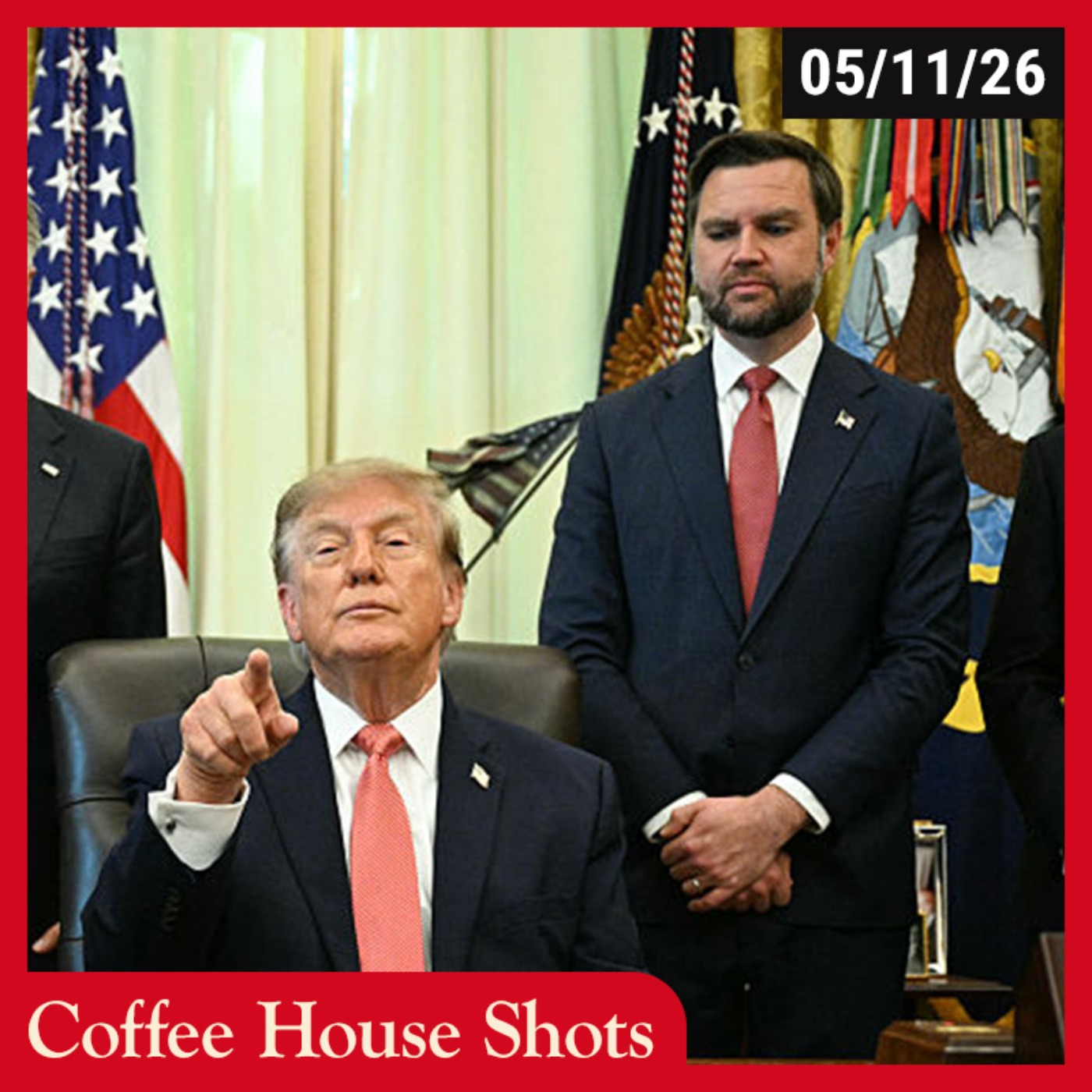
US election implications and likely next steps on Iran, including claims about Trump’s motivations and constraints, plus knock-on effects for Ukraine and UK-US relations.
Kim Darroch, Lord Darroch, former British ambassador in Washington; political editor Tim Shipman (host).
Darroch says polls underestimated Trump in swing states and Republicans held the Senate despite a “bloodbath” midterm-style result. He argues Trump was “conned by Netanyahu” into joining/accepting bombing raids on Iran with promises of regime change within four weeks; instead it has lasted 200+ days and failed. He says Trump’s Iran focus is now destroying “nuclear dust” (about 440kg of 60% enriched uranium) and reducing proxies/ballistic missiles, while Iran seeks money, asset unfreezing, and major concessions including possible sovereignty over the Strait of Hormuz and withdrawal of US forces. Democrats’ main leverage would be investigations and conditioning funding.
JD Vance’s reported opposition to attacking Iran; Netanyahu’s 2015 lobbying against the Obama nuclear deal; Trump’s 2016 obsession with the Iran deal; Putin’s unchanging demands for Ukraine (Donbass and no NATO/EU).
Written by AI. May contain mistakes.
Discussing the implications of the US election and Trump's unexpected losses.
“That's like dear old Nigel Farage losing a referendum on immigration in Clacton, isn't it?”
Exploring Trump's stance on Iran and the dynamics with Netanyahu.
“It appears like 60 % of Donald Trump's team does as well.”
Discussing Trump's strategies and demands regarding Iran's nuclear program.
“Well, you can recognize it when it's not even there as well, I would imagine.”
Examining implications for the UK and how leaders should approach relations with the Trump administration.
“And the Iranians, you know, see these big prizes out there, lots of money and maybe sovereignty over the strait.”
Learn how to navigate the complexities of US-UK relations and the political landscape.
“How would you be advising a prime minister to handle that if you were his ambassador?”

Get the gist, explore an idea or ask about something said.
 Claude
On Coffee House Shots, what are the key points of this episode?
Searching your listeningAutomatic transcript. May contain errors.
0:00This podcast is sponsored by Raymond James. In an increasingly standardised wealth management industry, Raymond James' high-touch, service-first way of working sets it apart. It puts people at the heart of everything it does. Advice that's as unique as you. That's the power of personal. Please remember, investing involves risk and you may get back less than you invested. Still waiting in line? Again? That's time you'll never get back. Save time and money with stamps.com. Over 4 million businesses have skipped the line with stamps.com. Join them to save up to 90 % off carrier rates from your computer or phone right now.
0:39Print postage for certified mail, registered mail, and packages in seconds. Then schedule a pickup right from your home or office. For a limited time, go to stamps.com and use code podcast for a free welcome gift. Taxes and fees apply.
0:59Hello and welcome to Coffeehouse Shots. I'm Tim Shipman, political editor of The Spectator, and I am delighted to be joined today by Kim Darroch, Lord Darroch, former British ambassador in Washington. And we're going to talk a little bit about the implications of the US election. Welcome aboard, Kim. What did you make of it all? I mean, Donald Trump lost Texas. That's like dear old Nigel Farage losing a referendum on immigration in Clacton, isn't it? This is pretty, is this the biggest one you can recall in terms of in recent memory? It is, Tim. It is. It is. And, you know, the polls have been predicting it.
1:30But I'm scarred by memories of the election 2016, when Hillary Clinton was consistently a couple of points ahead, yet lost on the night. And again, in 2024, polls were wrong. And there is this pattern of the polls in America understating support for Trump. And there are lots of theories, maybe people just don't like saying that they're going to support Trump. Maybe it's the sort of secret people want to keep. But anyway, given that all of the key swing races, the key swing states, the margin looked very small within the margin of error. I thought it was possible that actually the Republicans, well, I thought they were certain to lose the House, might hold the Senate.
2:17And in fact, the polls were right. In fact, as a Democrat friend to me said the night before, he said, Our figure suggests that the polls are underestimating how well we'll do in the Senate seats. And in some of the cases they did. I mean, Paxton was a terrible candidate in Texas, but he lost by seven or eight points, I think. The other thing I'd say is that if you think about the circumstances around this election, diesel over$6 a gallon, petrol over$4, inflation right at 3.6 % and rising, a war going on, an undeclared war with Iran, which more than 60 % of the American population strongly oppose.
3:01This is what you kind of expect. You'd expect an election bloodbath, but Trump has a way of sort of defying political gravity, political reality. So again, would somehow he pull some decent results out of the swamp, no matter how bad it looked? But the answer is he didn't. And so we had the bloodbath that we've seen. And it's the biggest switch. I mean, Obama was shellacked in, I think, 2010 in the midterms, and that was pretty bad. He lost a lot of seats in the House. So there are some big swings in midterms. I think it's a 13 point gap between the parties. And I think that's the biggest since the early 70s um so yeah you know in terms of the overall result someone joked to me that the democrats tried to make this about the economy and donald trump tried to make it about donald trump and they both got their way and in a sense there's that there's an element of truth in that isn't there this was basically i mean when we're looking at the implications for the rest of us and for britain in particular it felt like cost of living was vital and that's going to have the same impact on politics here potentially the war obviously has impacts on all of us and it's only really the third strand of the stool which i think was a sort of growing disillusionment with trump amongst the maga base but also you know any growing vehemence to it from everybody else a couple would i think the corruption stuff had really cut through as well and and that's what i read for the day polls yeah yeah so i mean let's look at look ahead a little bit i mean i've written this week about you know the potential of what might now happen in iran i mean you said 60 percent of the American public opposers.
4:35It appears like 60 % of Donald Trump's team does as well. I mean, a fairly extraordinary statement from J.D. Vance, the vice president, who's obviously got his own political career to protect. But J.D. Vance has been playing, I think for him, quite a dangerous game on Iran. He let it be known, not least to the authors of Regime Change, Maggie Haberman and Jonathan Swan, that he, in that crucial meeting about the decision whether to go with the Israelis in the attack on Iran, he argued strongly against it. He obviously briefed them that he'd argued strongly against it. So he let it be known in advance that he'd opposed this.
5:12And I think it was inevitable that he would then say after the event, well, I told you so. Although he says, well, of course, the president has been saying this, pretending the president's with him. And Trump won't like it. But Vance's problem, Tim, is he wants to run, I am sure, in 2028. And somehow he has to find a way of not falling into what I call the Kamala Harris trap. Remember when she was asked, what would you have done differently from Joe Biden if you've been president? She said, in effect, absolutely nothing. Well, Vance knows that Trump's ratings are crashing. And unlike Rubio, who if he runs, I think he may jump ship sometime next year because he doesn't have to stay on as Secretary of State until the end.
5:59Vance is in that job until the last day of Trump's presidency. So he has to find a way of sort of separating himself off. And this is the start of it, I think. And it's a dangerous game because Trump can recognize disloyalty from, you know, a thousand miles away. He can recognize it in space. Well, you can recognize it when it's not even there as well, I would imagine. So, I mean, as you say, it's perilous. And good luck with that as a vice president distancing yourself. I mean, Al Gore famously tried to do that from Bill Clinton. That didn't work out too well for him either. What's your sort of assessment, though, of where we are on Iran now?
6:35Because, I mean, I've written about it this week. It's very clear to me that Trump wanted to do it. And even in his extraordinary overnight kind of conversation with Politico, he sort of said, I still think it was totally the right thing to do. And if an opportunity arises, we'll do what's right for the country. And I still think it was right for the country. But clearly, you know, there are other noises off that might prevent that. There's either, you know, what I've been told is, you know, that the plan would be massive infrastructure strikes and all the rest of it. And the Israelis would try and do something to degrade the nuclear program, delay it, you know, even a few months from their point of view would be worthwhile.
7:07But if we don't get that, what does, where do we go now? Because, Tim, can I start by taking you, I promise, briefly back a bit? Trump has always been obsessed with Iran. When I was there in 2016, he was fighting his election campaign, his eventually success election campaign. His only big foreign policy theme was what a disastrous deal had been done in 2015, the Obama deal, which we were part of. And I was a national security advisor while all of this was being negotiated. I wasn't doing negotiating, but I was kind of overseeing it. And I think I would say this now looks like a historically good and sensible deal.
7:49But Trump absolutely rubbished it, particularly over what he claimed were pallet loads of cash, American cash being delivered to the Iranians, over the fact that it didn't stop the Iranian development of ballistic missiles, and that it left the Iranians with, I think, limited them for 15 years to about 300 kilograms of highly-natured. He said it was a terrible deal. He was put up to a lot of that, by the way, by Netanyahu, who remember coming to Washington to actually appeal to Congress to block this deal. So he's always been obsessed with it. And, you know, he makes it all about the Iranian nuclear program.
8:25Of course, the Iranians shouldn't be allowed to have nuclear weapons. But a great deal of it is his obsession with Obama. And he wants to do something better than Obama, than Obama's deal, whether that is a military defeat of Iran or a deal that is visibly better. And that's why he was conned by Netanyahu in that visit. When was it? Back in November. And he was conned by Netanyahu to joining the bombing attacks, bombing raids, on the promise that it would lead to regime change. They had an Israeli intelligence guy at the meeting with Trump who painted this picture of how the Iranian regime was so fragile, it would fall apart and collapse if there was an intensive bombing attack, sustained bombing attack on Iran.
9:16And that's how he got into it all. And he promised at the beginning it would be four weeks. And it's now November, 200 plus days. And it's been a disaster for him. Where does he go now? I think that he hasn't made his mind up He's covering both options. So he's sending more military hardware to the Gulf. Netanyahu clearly wants to go back into another round of bombing. And Trump may choose to join him. And even if he doesn't, he thinks sending more hardware is a kind of threatening signal to the Iranians and may make them, you know, conceive a bit more on the deal. But meanwhile, there are negotiations going on, mostly via intermediaries.
10:01and Trump is pushing for the end, the destruction of Iran's nuclear dust, which is 440 kilograms of, I think, 60 % enriched uranium. As his number one argument, his number one plea. He also wants the Iranians to stop their support for the proxies, Hamas and Hezbollah and the Houthis. He would like them to stop their ballistic missile program. He would still like regime change. But those other requirements have kind of faded a little, and it's really now all about the nuclear dust. The Iranians, for their part, they think that they have a potential of a real strategic win here. They don't care.
10:44This is an IRGC-dominated regime in Iran. They don't care about the plight of the Iranian people. They would like to end the war, obviously, but they see a big strategic prize there. I mean, what they're asking for, apart from reparations and a lot of money, much, much more money than Obama gave them, and unfreezing Iranian assets around the world, they're also asking for a withdrawal of U.S. forces from the region. And they are asking for sovereignty over the Strait of Hormuz, according to some accounts. I mean, we don't have full details because this is all being conducted in sort of secret.
11:21But it's a big, big list of Iranian demands. And it gets longer. You know, so Trump would still like a deal. He gets the nuclear dust destroyed and he kind of walks away. He would like the Strait of War was open. But in the end, he doesn't care that much about it. It's all about the nuclear dust. And the Iranians, you know, see these big prizes out there, lots of money and maybe sovereignty over the strait. So they're a long way apart. They're a long way apart. How much freedom of movement does Trump have? He clearly has more in foreign affairs than he would in domestic affairs. Are there constraints on him outside of his own inner circle, or can the Democrats push him into a position here?
12:02What they can do, Tim, what they can do, Tim, is they can launch investigation into why the war started and how it's been conducted. And they can subpoena lots of administration people to come and do public hearings on this. And that could be embarrassing and Trump wouldn't like that, but I think it's going to happen now anyway. Second, because they've got the House and the Senate, the Democrats can control the money to an extent. So if he needs new money for continuing the conflict with Iran, that has to be voted through by Congress. And they could say no, or they could set conditions on it. But remember, even if you're a Democrat, if you are effectively denying American forces overseas the weapons that they need to fight in a conflict, ammunition munitions whatever that's quite a dodgy and difficult thing to do so it would put the democrats in a difficult place if they're actually trying to block you know new money for this for this so uh maybe trump thinks you can get that that that through so they're very limited what they can do in terms of foreign policy uh so trump still has a free hand what do you think this means now kim for andy burnham's relationship with the white house and with with the sort of American body politic more generally.
13:27I mean, he came out and said this could be an opportunity to try and get fuel prices down. Not quite clear what he means by that. And to what degree do you think he would now look at developing relationships with those senior people in Congress and with potential Democratic presidential candidates for two years' time? It's obviously a bit of a dangerous game to be seen to be doing too much of that stuff. But we hear that beyond Jonathan Powell, there aren't really fantastically close relationships between Burnham's top team and the Americans at the moment. How would you be advising a prime minister to handle that if you were his ambassador?
14:06First of all, Tim, I'm glad you said it's not quite clear what the prime minister means by this, because it's not clear to me either. And when he talks about we can now all work together on bringing down costs for all of our citizens, if he thinks there is any possibility of a European seat at the table in the negotiations with Iran, forget it. Trump isn't going to do that. He's not going to have Europeans around that table. If you think, however, that maybe we can launch into a conversation with Trump, advising him, offering ideas on how he can end the conflict with Iran and get freedom of navigation and trade reformers, maybe, maybe, but again, Trump isn't massively open to advice from others on how to do this.
14:53So quite what he means by that, I don't have great expectations that's going to go anywhere. On your question about whether we should now start investing in relationships with potential candidates for 2028, whether Republican or Democrat, in terms of Republicans, everyone thinks the race is going to be primarily between Vance and Rubio. I'm not sure whether Rubio will run. But if he does, he's a more experienced, I think, a better politician in advance. Yeah, DeSantis, I think, will run again. But he is a really unimpressive campaigner. But we'll see. We'll see. And I think there will also be, because the MAGA wing is fragmenting, I think you can find a figure from outside government, outside politics, from a MAGA wing, a Laura Loomer, a Tucker Carlson, a Marjorie Taylor Greene, who knows?
15:44There'll be a candidate way out there somewhere who will come into it, I think. On the Democrat side, I think we have quite a strong field emerging from which I think the most promising candidate is one John Ossoff, the senator from Georgia, who's a deeply impressive politician, what I've seen of him. It's the nearest thing they've had to Clinton since, isn't it? Yeah, yeah. On your question, I think that it's a very dangerous game to be seen as a senior politician to be going out there and trying to guess who the next president is going to be, and kind of basically saying implicitly to the president, you're a lame duck and you're about to become part of history.
16:28Trump will not go quietly. He will want to be the center of attention until the final day of his presidency. And he will be very upset if foreign leaders appear to be ignoring him and moving on to the next generation. So I think you have to be very, very careful about that. It's really, dare I say, a job for the embassy and the ambassador to go around and meet the next generation, not for senior British politicians, because it's too visible. It looks too obvious that you're just moving on. Yeah. And one last one, Kim, before you go. Can we draw any conclusions about what Trump's setback means for Ukraine and the situation there?
17:05Yeah, it's a good question. Trump has always, Tim, as you know, he's always kind of favored Putin in this, despite the fact that Putin is the clear wrongdoer, the guy who did the invasion. And it was very striking, I thought, when Witkoff and Kushner were in Ukraine recently, but Kushner, I think it was in a press conference, were looking for a win-win here. Like, why should the Russians be winners from an invasion of a neighboring country? But that's the way this administration seems to see it. Look, I think it's difficult to see any deal emerging because the critical point here is Putin has never shown the slightest sign of making any concession.
17:51His demands from the day one have been, I want all of the Donbass, including the territory my troops haven't captured, and I want Ukraine to promise never to join NATO or the European Union. And he can never change from that. And that's simply, you know, a lot of Ukrainian blood has been lost in defending the territory they're still holding in that part in eastern Ukraine. And the war for them is about freedom of their future, about the opportunity to choose a Western direction, to join Western organizations, to join NATO, to join the EU. So he can't give that So I just don't see, however hard the Americans try to do a deal, where the material for a deal is unless Putin starts making some concessions.
18:34Very good. Well, I think the one thing we can know for certain is that Donald Trump will do something and more chaos will follow. Kim Darroch, thanks for helping us to cut through it and come and see us again soon. And thank you to all of you for listening.
19:12Cash Now, More Later from Opendoor gives you cash up front for your home, plus all the profit later. That's no chaos now, no cash left behind later. Skip the showings now, pocket extra profit later. This is so simple now. This is so awesome later. Or sell fast now and pop the champagne later. Cash now, more later. Now available nationwide. Start your offer at opendoor.com slash ACAST. Profits calculated after fees and costs, eligibility and offer price may vary.
Donald Trump’s midterm defeat has thrown fresh uncertainty over the future of his presidency – and his foreign policy.
On today’s Coffee House Shots, Tim Shipman speaks to Lord Kim Darroch, former British ambassador to Washington, about what happens next. With JD Vance already positioning himself for 2028, could the MAGA movement be starting to fracture? And how much damage has Trump’s approach to Iran done to his standing at home?
They also discuss whether Andy Burnham can turn the crisis into an opportunity for Britain, who might succeed Trump in the White House, and why a deal to end the war in Ukraine still looks a long way off.
Produced by Abigail Brierley.
This episode is brought to you by Raymond James. Combining deep insights into who you are with our financial expertise, that’s the power of personal. Investment involves risk.
Become a Spectator subscriber today to access this podcast without adverts. Go to spectator.co.uk/adfree to find out more.
For more Spectator podcasts, go to spectator.co.uk/podcasts.
Contact us: [email protected]
Hosted on Acast. See acast.com/privacy for more information.


