Ask ChatGPT

 Coffee House Shots
27 Oct 2026 · 20m · 6 chapters
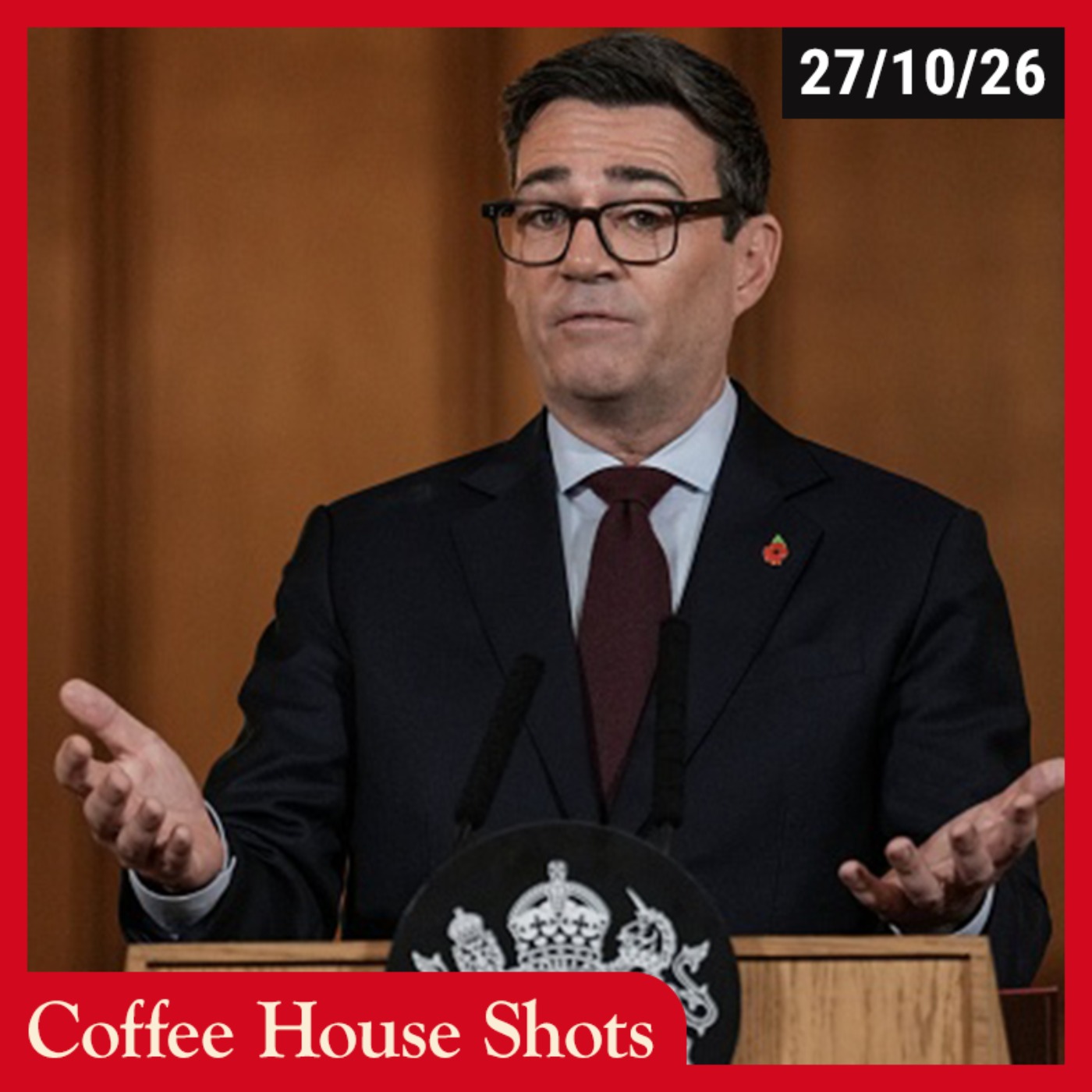
Preview and analysis of Labour’s upcoming Budget Day under Prime Minister Andy Burnham, focusing on cost-of-living measures, defence spending, market/bond risks, and whether the budget can address low growth and rising spending.
Tim Shipman, political journalist at The Spectator (described as “Blizzclare”); Kwasi Kwarteng, former Chancellor of the Exchequer.
The budget is likely “small beer” designed to avoid spooking bond markets and maintain Labour’s “good vibes” with voters. Energy-price help and possible Warm Homes Allowance changes may be outweighed by broader pressures. Defence spending may be boosted via “off the books”/investment-bank-style borrowing, but won’t truly solve the NATO 3% path. Main danger is creeping bond-yield rises, worsening the fiscal position over time.
Loss of tariffs on baked beans and gherkins; Warm Homes Allowance; 2022 bond-market targeting during Liz Truss’s mini-budget; France’s market weakness; NATO defence 3% commitment; “triple lock” and “mansion tax” backloaded to 2030.
Written by AI. May contain mistakes.
Discussion on expectations for the upcoming budget and its implications.
“It seems that we've had some more budget goodies announced in the days up to it.”
Analysis of the political backdrop influencing the budget and potential pitfalls.
“Kwasi what do you make of that and what will the conversations be like at this stage between numbers 10 and 11?”
Exploration of the dynamic between the Chancellor and the Prime Minister regarding budget decisions.
“I think the issue that we had, and looking back it was a mistake, was that we rushed everything very quickly.”
Insights into how the budget is perceived by the public and financial markets.
“And when the levers that they have are much more constrained.”
Discussion on how the Conservative Party should respond to the budget announcements.
“You know, you can't go native if you were native when you arrived.”
Explore the financial issues facing France and the UK, and the impact on political strategies.
“The situation there is that expenditure is going up.”

Get the gist, explore an idea or ask about something said.
 Claude
On Coffee House Shots, what are the key points of this episode?
Searching your listeningAutomatic transcript. May contain errors.
0:00Tim Shipman: You've got big plans for your money. You invest, you track, you plan ahead. But does your financial app actually help you decide what to do next? Quicken helps you go beyond balances and basic reports, project your cash flow, dig into your investments, and use Quicken AI to understand what matters across your finances. With Quicken, you can make sense of your options and decide what to do next. Quicken. Know what to do next. See how at Quicken.com.
0:35Tim Shipman: Hello and welcome to Coffeehouse Shots. I'm James Heal and I'm joined today by Tim Shipman, the Blizzclare to the Spectator, and Kwasi Kwasang, the former Chancellor of the Exchequer. Now, we've only got one day until he comes. It is going to be Budget Day tomorrow, Tim. What can we expect at this stage? It seems that we've had some more budget goodies announced in the days up to it.
0:52James Heale: Yeah, I mean, look, they've been doing a lot of sort of cost of living stuff, small beer we've just been you know excitingly told that we're going to lose tariffs on baked beans and gherkins part of your traditional weekly shop not in our family but not a gherkin fan myself but there's been lots of little things which have all sort of added up to not much but they're good sort of signaling from burnham and his camp about a sort of intent to help with the cost of living. I think, you know, there have been reports from the Joseph Roundtree Foundation and others in the last few days, which effectively say that, you know, energy prices and all that will more than outweigh any sort of minor amounts of help that the government has offered so far.
1:39James Heale: So I think you will see a multiple billion kind of effort to ease those energy prices in a kind of targeted way. I think we're expecting John Healy to do something with the warm homes allowance. There have been warm noises about stuff for entrepreneurs and I think you know as we wrote last week in the spectator there will be an effort to borrow off the books as it were there's various sort of non-government organizations that are allowed to borrow to invest to build stuff and I think what Healy will try to do particularly on defense spending is to get some of these sort of off the books banks and all the rest of it funds to put money into defence companies and tech and that kind of thing, which will at least give him some kind of message on encouraging growth and doing something for defence at a time when he can't actually fund the full 3 % by 2030 promise that we've made to NATO on defence spending.
2:36James Heale: And of course, all that borrowing and the spending on defence has to be government spending. So that won't actually help them towards the 3%. But Burnham has given interviews saying that they will set out the pathway essentially and we will know how and when we will get there but I think essentially this is going to be quite a small beer budget and I think the idea is to not spook the markets not upset the bond markets provide enough sort of nods winks and small moves that will show the public that this is the government that cares about them and their cost of living in the hope that that will continue a relatively encouraging trend for Labour in the opinion polls.
3:15James Heale: There's a survey this week that puts them on 30 % with a 10-point lead over reform and whisper it quietly that's the kind of terrain you need to get into if you're the Labour Party and you want to seriously think about calling a general election. So I think the purpose of this budget frankly is to not upset the apple cart and to sort of gently continue a positive direction of travel for the government in the opinion polls but there's a few pitfalls ahead and you know Burnham has identified a lot of big problems and at the moment it doesn't look like the budget is going to be the thing that solves any of them.
3:47Tim Shipman: Kwasi what do you make of that and what will the conversations be like at this stage between numbers 10 and 11? So I think that there won't be a comma in the budget which number 10 won't have read through about three or four times. I think Tim is quite right if you look at the political context the Prime Minister came in barely three months ago, I think it's July the 20th roughly, and he's enjoyed a moderate bounce, I mean it wasn't Theresa May proportion leads, but I think that the main priority for him would be to do a budget and to be able to maintain the good vibes and the modest bounce that we've already seen.
4:24So I'd be very surprised if there's anything in there that is actually going to deal with the major problems that we have. Now, the market will take a view and if they think that we can't fund the ongoing commitment to defence, the rising benefits bill, I think they'll take a view and I think the danger for the government is that interest rates keep rising, the bond yields keep rising higher, they're higher than they have been in 20, 25 years and that's a longer term problem but I think in the short term the Prime Minister number 10 will be very very focused on not upsetting the apple
5:00James Heale: cart as tim said and i think there's another point speaking to people who spend a lot of time in the city that burnham and healy have got a bit lucky here if you look at the the sort of the context the bond market tends to take a view that it will pick on the weakest link of the sort of major economies and it's very clear at the moment that the weakest link is not britain it's france where you know sort of semi-revolutionary chaos is unfolding on their streets on a on a daily basis and that that is actually quite helpful for this government because even if they do things that are kind of negative in terms of the bond markets, it's unlikely that they'll be sort of seen as the weak link that is going to be picked off.
5:40James Heale: And I think, you know, I'll be interested in Quaz's reflections on that because what happened in 2022 was that I think the bond market did pick on the British government and a point Liz Truss has been making recently about this new book that she's put out is that, you know, Burnham has had an easier ride from the Bank of England and the bond markets than you guys did. Yeah, I think that's broadly right. I think the issue that we had, and looking back it was a mistake, was that we rushed everything very quickly. I mean, I look back, we were appointed, I was appointed, I think, on the 6th of September.
6:12You know, Her Late Majesty died on the 8th of September, and we had the mini-budget on the 23rd of September. So it was a very concentrated timeline. And I'm afraid there wasn't any preparation. Whereas in subsequent budgets, they've essentially leaked almost everything to make sure that the market and people absorbed what they were going to do. This time, as Tim said, they've had a few gifts, a few scraps in various directions. Fiscally, I don't think it'll make much of an impact. But the problem they're facing is always the problem that we've had in the last few years. Growth is too low and expenditure is rising more quickly than income.
6:52And that's not a sustainable position. Now, I think they're going to do what governments often do, which is essentially sort of back load everything. So, you know, things like the triple lock, that'll be 2030. The mansion tax is kicking in in 2030. They might try and tinker around with that. But all the time, they're making sure that in the short term, nothing really dramatic happens. So that, as Tim is suggesting, I'm sure they're looking at a general election, especially if the poll's going in this direction. and that what they don't want to do is stay around for two and a half years until they have to call an action.
7:27And when the levers that they have are much more constrained. So I think that it's a tricky one, because if the markets think that they're not doing enough to pay for the defence commitments, they'll take a view. And the danger isn't that you'll see a dramatic spike like we did in 2022. The danger is that these yields just keep creeping up. and this time next year, you know, this fiscal situation is even worse than it is this year.
7:53Tim Shipman: I mean, you did not obviously get the chance to present a full budget, quasi, but you did do the growth plan in September 2022. There's been lots of reports around John Healy's personal involvement, you know, talks about flying back from, I think it was in Manila when he was coming back and he was writing with his HB pencil, the speech, etc. How much personal input would a Chancellor have in the statement of this kind? I think in this context, it's a very specific context. You've got a new prime minister. The new prime minister has gone out and made all sorts of personal commitments, he's saying.
8:20So there's no world in which the Treasury is going to be independent of what number 10 wants to do. I mean, in the old days, anecdotally, Tony Blair, what am I talking about, conflating these two figures. But Blair always used to say, he never really had any involvement in it. He'd say, tell us about the budget. And Gordon anecdotally said, well, it's on Thursday or Wednesday. I'm not sure that's true, but that gives you a flavour of the kind of independence he enjoyed. There's going to be nothing like that tomorrow. And you yourself had an experience with a new prime minister. It was very similar.
8:57It was very similar. You had a new prime minister and it's a chance for them to assert themselves. And the mistake, there were a number of mistakes, but she thought that by getting rid of me, somehow that would incubate or protect her position. And it was clearly the case. And it'll be the same tomorrow. I mean, if anything goes wrong with the budget, yes, Healy will be blamed. But the main focus of attention will be on the new prime minister. So he's got more to lose than anybody else.
9:24James Heale: What should we be looking for in terms of to know whether this is a Burnham budget or a Healy budget? I mean, the sort of scale of borrowing might be one. It feels like Healy is a more kind of fiscally conservative character. And I think he'll be shaped by his officials. I mean I think Healy has been in the in the Treasury a long time ago he was a surprise appointment as we all remember and I think that number 10 it's not as if number 10 is going to say well now you're the Chancellor you write the budget and we'll just you know look over it at the last minute and okay things I think Burnham is very much the key figure at the moment frankly Labour were looking down the barrel of a gun with Keir Starmer it looked as if they were good they want 17 18 percent they're creeping up as Tim suggested towards 30.
10:11So it's been a successful start for Burnham and the last thing he wants to do is to see a fiscal announcement like the budget tomorrow that completely undermines the progress that frankly he has made in the last few months.
10:27Tim Shipman: And I think also it shows, doesn't it Tim, that unlike, as you say, 20 years ago when Blair and Brown had a different working relationship but also the economy was growing. There wasn't any real risk from a budget But now, because this economy is obviously going to be a key factor, given our exposure to borrowing rates and how dependent we are on the kindness of strangers, no one in turn has to play a role. And we've discussed the reaction in terms of voters. We've discussed the reaction in terms of the market. How do you think Labour MPs at this stage are feeling about it, Tim, in terms of their views of Healy?
10:55Tim Shipman: Because I'm already picking up some discontent that he's not as particularly a creative chancellor as some might like them to be.
10:59James Heale: Yeah, no, I think that's fair. I think Labour MPs, you know, have embraced the Burnham project, and most of them are temperamentally more where Burnham is than where Healy is presumed to be in terms of, you know, they do think there are big problems and they think there are big, largely spending solutions to those problems. And they see the Treasury and the Chancellor as a break on that. It's always the case that when the Treasury sticks to its guns about spending and the need to, you know, not blow up the bond markets that people say, well, they're terribly unimaginative. But I think it's true in this case.
11:31James Heale: I think, you know, Healy is not a sort of dynamic political character who has shown, you know, huge deafness with, you know, intriguing solutions at any point in his career. And it's very easy to see that he's someone who is very at home in the Treasury and Treasury officials are very at home with him. You know, you can't go native if you were native when you arrived. And also, I mean, you've got to remember, he was a surprise choice to the role. He was somebody who wasn't his main advantage, it seems to me, was that he wasn't Shabana Mahmood and neither was he Ed Miliband. So he and it was and it was fought with danger because he'd already left the government.
12:08We forget this. It was only four months ago that he left the government on the basis that the Treasury, as was, wasn't spending enough on defence.
12:16James Heale: Which is why I think he will find some way to boost defence banks, even if that doesn't do anything to move us closer to the 3%. He'll be able to say, here's X billion going into defence in some form, even if that is off the books borrowing via investment banks and all the rest of it. Yeah, I think Tim's right. I mean, his personal position is very exposed because he flounced out of the government. Very public, very high profile. He made a speech. He made statements about why he'd left the government. And then within six weeks, I think it was the interval of the World Cup, he was back running the Treasury.
12:50So he's got to do something. You know, a situation where, frankly,
12:53James Heale: the international situation is more perilous than it was, even at the time that he departed. So, yes. Having never really done anything that dramatic elsewhere in his career. For months people have been telling me, why won't John Healy go and resign? Why won't you take the chiefs across the road and complain? And then finally he did. Yeah, so Tim's right about that. Burnham has made personal commitments to help with the cost of living, and he's done Gogglebox, and he's done the emotionally empathetic thing. And so anything that upsets that sort of good vibes narrative, I think could run the risk of damaging the government.
13:26Tim Shipman: How do you think the Conservatives should play this tomorrow? Okay, Baynot will be out there giving the response to the budget quasi. But if there's not that much to take aim at, and it's all fairly sensible, a lot of the stuff that has been briefed out, I can imagine a Conservative or any party really doing government. How should she approach that tomorrow? So I think the main argument, and the markets will be making this argument in their own way, is that this budget, because it's steady as she goes, isn't doing anything to address the long term problems that the country faces. And it's something that is in 2022.
13:57It's something that the Western world faces. Look at France. The situation there is that expenditure is going up. The cost of borrowing is going up. The economy is growing even more slowly than we are. And there's this huge mismatch. And that's why they're being picked on by the markets, as Tim said. There's no sustainable plan to balance the books or to get the economy growing to pay for your burgeoning welfare bill or your burgeoning public expenditure. And we're in a similar position. I'd say if you look at the debt position, the debt to GDP position, it's hovering around 100%, whichever way you cut it.
14:36And we're just borrowing more and more money. And if there isn't anything fundamentally to try and address that, and I think that's where Kemi will go. She'll say, okay, it's all very well, you know, appearing on Gogglebox, but you're not actually doing anything to address the longer term problems of the country.
14:49Tim Shipman: And I've got to ask a final question, Kwasi. Have you read Liz Truss's new book? Well, I think Ted Heath was asked about Margaret Thatcher's book. He said, I'm waiting for the paperback. I'm not quite doing that. But I know the arguments. I might read it, but it's not on top of my reading list of them. And do you plan to write anything about the Treasury at some point? I will. I mean, I just think that the main, it's very easy to write something in the short term. I think that the question, yes, 2022 was dramatic, but there's a much broader issue about how these governments, the G7, the West, if you want to call it that, is dealing with a welfare state that is frankly unaffordable.
15:35And you see it in America, Doge, I followed them very closely. They did absolutely nothing. France, you know, says its own story. And if I did write anything, and I'm very interested in doing so, it would be put in that context. I think we can relitigate the dramas of 2022 until we're blue in the face. But actually, they're broader questions that I'm more interested in.
15:54James Heale: And I do think this is an interesting moment, actually, because I agree with what Kwasi said in terms of how Kemi Baden-Ott will tackle this. But I do think it's a slightly perilous situation for the Tories because all this small ball, you know, hail fellow, well met vibe stuff does appear to be slightly working for the public. The public is sort of buying that Burnham's on their side. And even if the interventions are pretty small beer, you know, they have led to an improvement in Labour's poll position. And the Tories really have at some profound level got to, you know, they have got to relitigate a lot of the arguments of the 1980s.
16:29James Heale: I think what they don't need to do, bluntly, is to relitigate the arguments of 2022. And having Liz Trust pop up at precisely the moment that Kevin Baden-Ock needs to say, socialism doesn't work. We've got massive problems. We're overspending. We're living beyond our means. all that kind of kitchen table kind of, you know, credit card politics that Margaret Thatcher was very good at. That's precisely what Kemi Batenock needs to do. But having an argument about whether or not the Bank of England and the bond market stitched you up four years ago is the last thing. Well, she won't. No, no, she won't.
17:00James Heale: But having Liz Truss even back on, you know, back in sort of public circulation, making those arguments, I don't think is particularly helpful to the Conservative Party. It's not helpful, but I don't think it's, I think it's very much a sideshow. I mean, the book, rightly or wrongly, got some of the worst reviews I've ever read of any book. Simon Heffers and the Telegraph is quite a sight for those of you who haven't ventured there recently. And it's only about 90 pages, I think. Yeah, it's quite. Someone said it was as short as a premiership. I don't know how you measure book size. It's about two pages per day.
17:32So I think that, but there is a serious argument. I think the Tories will try and get back to that. But Tim's right. I mean, the good vibe stuff, you know, we might think it's superficial, but it's certainly working at a level. And actually, you know, he is contrasted very sharply, this prime minister, with Keir Starmer, who had no seemingly emotional intelligence, no ability to relate or connect with the electorate. So actually the prime minister appearing on a goggle box was quite effective. I mean, we might think it's trivial. It was trivial. But in terms of the mood music, I think it helps him.
18:05Tim Shipman: Yeah, someone said today, Kerry Bainock's argument is that Andy Burnham is a people pleaser. Well, people quite like being pleased. Well, I was always told, you know, politics isn't a popularity context. I thought, well, that's exactly what it is. It kind of partly is.
18:17James Heale: And, yeah, I mean, it's interesting, isn't it? Because Liz Truss and Keir Starmer's figures ended up being much the same. Roughly similar, yes. It took Starmer two years and it took Truss two months. But I think there is a perfectly respectable argument that Starmer was a worse prime minister than Truss. Well, the thing to argue in Liz's favour, I mean, he had a massive majority. And what was extraordinary, you know, historians looking back will look at Trump and the chaos with Boris and the fact that, you know, things were unstable and she'd won a very divisive and quite finely balanced leadership contest.
18:51Stammer won a majority of 170. Essentially, the day after that election, he was master of all he surveyed. And everybody assumed, every single person I spoke to thought it would probably be a two-term Labour government under his leadership. That was the general consensus. and how he squandered that in two short years, I think is going to be a subject.
19:13James Heale: It is the worst use of a large majority in certainly in the last 150 years. My knowledge doesn't go back to say of all time. That's the extraordinary thing about what happened with Starmer was that he had a massive, he'd won the Labour leadership. He'd turned things around. He'd won this, it was a shallow but very wide majority. And then within two years, effectively he was out.
19:36Tim Shipman: Well, let's see what John Healy does with Keir Stummer's majority tomorrow. Thank you, Kwasi. Thank you, Tim. And thank you for listening to Coffeehouse Shots. And if you want the definitive post-budget briefing take, then you can tune in to our event tomorrow at The Spectator in partnership with Raymond James.
20:33Tim Shipman: Thank you. Quicken. Know what to do next. See how at Quicken.com.
Former Chancellor Kwasi Kwarteng joins Tim Shipman and James Heale to discuss the challenges facing the government ahead of tomorrow’s Budget. How close is the relationship between Number 10 and Number 11? And how much influence has Andy Burnham had on the Chancellor’s plans?
How are Labour MPs feeling about a Chancellor they see as short on imagination? Plus, how should the Conservatives respond to the Budget – and what does Kwarteng make of Liz Truss’s new book?
Produced by Abigail Brierley.
Become a Spectator subscriber today to access this podcast without adverts. Go to spectator.co.uk/adfree to find out more.
For more Spectator podcasts, go to spectator.co.uk/podcasts.
Contact us: [email protected]
Hosted on Acast. See acast.com/privacy for more information.