
 Ask ChatGPT



Live reaction to Chancellor John Healey’s first Burnham Premiership budget, focusing on “breathing space,” fiscal headroom, borrowing trends, cost-of-living impacts, and market/political response.
James Heal, Spectator Deputy Political Editor, reacts in-studio with Michael Simmons (Spectator economics editor). Also later joined by pollster Scarlett Maguire (Maryland Strategy) and former Treasury advisor James Nation (Forefront Advisors).
Headroom is restored to about £15bn (down from ~£23bn under Rachel Reeves), framed as a margin-of-error buffer. Borrowing rises as % of GDP in every forecast year. OBR downgrades real household disposable income and expects no real earnings growth in 2027. Budget is “PG/12” not scary: mostly quick wins, limited dial-moving change; gilt markets barely move.
£100 energy payment for council tax bands A–D (2.6bn); VAT cut on electricity and fuel duty restraint extended to next July; Healy’s speech slip-ups; bank surcharge set at 3% (less than 8% reported).
Written by AI. May contain mistakes.
Discussion on key points from Chancellor Healy's budget and its implications.
“This winter, for 20 million households in council tax bands A to D, I'm announcing a£100 energy payment for households.”
Analysis of the budget's impact and public perception by James Heal.
“So that was some pretty good news there in terms of the kind of fiscal aggregates.”
Exploration of the economic implications of increased borrowing in the budget.
“Well, I think the real trick was in the treats he gave away.”
Discussion regarding future economic challenges and the government's strategies.
“Healy, overall, I thought the speech was underwhelming.”
Analysis of the reaction to the bank surcharge announced in the budget.
“where there is, frankly, very little in the way of breathing space.”

Get the gist, explore an idea or ask about something said.
 Claude
On Coffee House Shots, what are the key points of this episode?
Searching your listeningAutomatic transcript. May contain errors.
0:00Hey, we're Nick and Jack, hosts of The Best One Yet. Behind every episode, there's research, email, spreadsheets, and our shared Google Doc, the Headline Hammer. With Google Workspace with Gemini, Google's AI is built right into the premium versions of tools we already use, like Gmail, Docs, and Sheets. No new tools or extra logins, just personalized AI for the way we work. That means less time on the work around the work and more time finding the stories worth talking about. Get AI tools for work. Upgrade to Google Workspace with Gemini at goo.gle slash workspace with Gemini. That's go.gle slash workspace with Gemini.
0:40Hello and welcome to Coffeehouse Shots, the Spectator's daily politics podcast. I'm the Spectator's economics editor, Michael Simmons. Chancellor John Healy has just presented the budget to Parliament, and the following discussion is taken from a live conversation I had on Spectator TV with our Deputy Political Editor James Heal reacting to this first budget of the Burnham Premiership. But first, here's a clip from the Chancellor. Today I'm taking one further step. This winter, for 20 million households in council tax bands A to D, I'm announcing a£100 energy payment for households. Paid directly into people's bank accounts to deal with rising energy bills.
1:27That's a£2.6 billion scheme to take the pressure off in the coldest months and see people through to the spring. We have just sat through John Healy's first budget there. We're going to be returning to James Heal, who's still with me in the studio. But firstly, I want to share with you two numbers that have jumped out to us so far. The first one is what happened with Headroom. And if you remember Rachel Reeves' last budget, she kind of tricked us all because she did this big press conference where she said, oh, there was this black hole. It was brief that there's going to be this black hole. And actually, there wasn't.
2:05Well, this time people seem to have got things pretty bang on because as predicted, the headroom came down because of the war in Iran eating away at government borrowing costs. And John Healy has brought it back up to about 15 billion. So down from the roughly 23 billion that Rachel Reeves had left it at. He said that this is what breathing space is for. This is what a margin of error is for, to eat into when you need to and then to recover it, as he says he will, as we go into the next decade. So that was some pretty good news there in terms of the kind of fiscal aggregates. Less good news on the second number that jumped out to me, which is on the borrowing.
2:52So this is borrowing today as judged by the OBR versus what they judged it in March. And what you see is that in every single year, they say we're increasing the amount of borrowing as a share of GDP. Now, they can blame global factors for that. They did blame global factors for that. But it just kind of shows you how sort of vulnerable the IMF's judgment was about our reduction. because things are changing. And yes, that borrowing cost comes down in each year of the forecast. But we do seem to have got into this trend now where every time that OBR judges these things, between each fiscal event, we do seem to be borrowing more and more.
3:37And the question is, will a chancellor ever get on top of that? But anyway, I'm going to return to James. So James, tell us, was that budget trick or treat? Well, I think the real trick was in the treats he gave away. Ultimately, Michael, this was not a particularly scary budget. If I was a film censor, I would be giving it a PG or a 12 in terms of your Halloween sort of scary movies. But the reality is that it didn't really move the dial that much. I suspect that will be the critique we hear from Kerry Baden-Ock in the days ahead. She's saying, look, the Prime Minister promised to end 40 years of neoliberalism.
4:09Now he's taking 4p off gherkins. And I think that does show that it's really been a budget about quick wins and a budget which fundamentally doesn't really change the big facts facing the economy. Ultimately, borrowing is up. We've got growth down. But I suspect it's going to be that£100 in energy bill announcement that's going to dominate the press tomorrow. And we see this in the market reaction. Just before we went back live, I was looking at the gilt markets and they've barely moved. So the Treasury, if it did want to have this boring budget, it seems to have had that. And you mentioned one of the surprises there on energy, £100 for households that live in a council tax band A to D.
4:49Someone pointed out, I think it was Bethany Dawson from LBC, that the government's check my council tax band has already gone down as people, you know, put their postcards in to find out if they're going to get this£100. Is that the sort of thing that voters will thank the government for? I mean, is it a big enough move? I think it will be something that is appreciated by them, but obviously we don't yet know how much exactly it's going to go up with the energy price cap announcement in a few weeks' time. I think it does show, though, that it's demonstrably something the government can do. John Healy tried to paint himself as a realist in his speech.
5:22He said, look, most people in the country don't expect the government to solve all their problems, but we can give them some breathing space. And I think that theme of breathing space was very much the one being emphasised. I have to say, I mean, in that whole speech, which lasted just under an hour, I would say, there were very few surprises. There was nothing really there. I was listening to say, oh, that's a rabbit. That's a surprise. Much of that speech could have been given by whoever was in the Treasury at this time, the things about AI, I think broadly welcomed by the Conservatives. And I think that there will be some stuff that any Labour Chancellor have done, sort of tackling misogyny, etc.
5:50But overall, I was struck by how little that was surprising in that. And I think that's why you're seeing Kevin Baden-Knox's response, which is that on the one hand, you're talking big, but you're delivering little. The reason there's no surprise, this goes back to what we were talking about earlier. Is that because there's no economic or fiscal room for there to be these giveaways? Or is it because of what we were talking about before about budget and beyond, that they don't see this as a big set piece political event. It's about the 10-year plan. It's about how they present their election manifesto, wherever that election may be.
6:21It's a bit of both. I also think there's a question about ideas and how much some of this sort of intellectual supposed headway behind Burnham and Healy actually can be realised over the short to medium term. And I think that really, when you have so little money to spend, it doesn't mean you can kind of do a big splurge, such as when Boris Johnson was splashing the cash in his 29 budgets or when the new Labour ones were doing that. I think overall it does show that the government is pretty stretched, pretty thin. Healy, overall, I thought the speech was underwhelming. Well, tell us about his delivery there, because there was a few mess-ups and slip-ups, wasn't there?
6:53So it's really interesting. So Healy obviously has been a long-serving MP 30 years next year and has lived with many, many statements. But I do think the pressure of today, this is the biggest moment he's ever had, other than his resignation as Defence Secretary, did get to him. He was quite stumbling. He prepared the speech a huge amount. There was lots of briefings about Ham working on an HP pencil on his flight back from Southeast Asia in the IMF conference. But I was surprised by how often he fluffed his lines. I think at one point he referred to Aldershot with a disobliging expletive rather than the name of that great military town.
7:22And I do think it was quite halting and stumbling. And that's why the texts I've had from Tory MPs afterwards saying, was that it? This proves anyone can be Chancellor. And people saying it's fiddling while Roman burns. Yeah. And we just had the OBR's judgment. forget the spin that we get from the Chancellor. These independent forecasters look at things and this is where you find the kind of surprises that the Chancellor wanted to hide. I've just been skimming through it. Obviously, we've not had a chance to read it properly, although there will be full coverage of it on The Spectator's website later.
7:53But something that's jumped out to me straight away is they have a chart of real household disposable income per person. So how much money you've got left after your bills are paid, your taxes are paid. And that seems to have been significantly downgraded since the spring. So just in six months time, that kind of plays against the whole message of this budget. Right. It's about breathing space, giving people room. The OBR seemed to say that everyone's life is going to be worse. But absolutely. But this is the thing, Michael, is that, you know, the micro is quite positive in the sense of 100 pounds energy bill.
8:27That will dominate tomorrow's news coverage. But they want us to forget about this because ultimately the overall framework hasn't changed. The fundamentals are pretty bleak. As I say, growth is sort of dribbling along at 1 % or so for the next few years or so. They've been downcasted from the spring statement that Rachel Raves gave earlier this year. The fact that borrowing costs are still going to go up, the deficit might become an issue. That's something Andrew Griffiths talks about, making it politicised again. I think the other interesting thing, of course, the big political question is about today's statement in terms of you've got VAT cuts on electricity bills and the fuel duty restraint.
8:57Both have been extended to next July. And I think this will do nothing to dampen speculation about an early election in spring of next year. We talked about Rachel Reeves before we cut to the commons. One of the first things Healy said was he paid tribute to her for, you know, fixing the fundamentals. Was that a bit on the nose? I think he was burying her by praising her. He had to say this today. And there's nothing more that a political party likes to do than pat itself on the back and self-congratulation just after brutally knifing someone. They knifed Keir Starmer, they knifed Rachel Reeves, and now they get to lord them in their memory.
9:26And a politician you're a bit more familiar with, given that you're her biographer, Liz Truss. She got the customary, you wrecked the economy mention. What did you make of that? Well, look, there are three things, ritual on budget day. The box outside number 10, the BBC helicopter overhead, and the obligatory reference to Liz Truss come the Chancellor's speech. And ultimately, Liz Truss is going to be featured on Labour posters for many, many more years than she ever was featured on Tory ones. And that's because they can use her as this sort of warning. I think the Labour Party got about 15 or 20 years or so a Black Wednesday in the early 90s.
9:58they will have a similar amount of runtime with the Lewis Trust. And of course, the former Prime Minister, who feels she owes her former colleagues no favours, has repaid that in kind by releasing this book this week, talking about the bank job being brought down by the Bank of England. And this will be held up and waved around, much like George Osborne once held up Mao's Little Red Book, which John McDonnell had thrown at him across the dispatch box. And as you've been speaking, James, I'm delving back into the OBR's judgment. And there's another bit where they're talking about inflation and they're saying that second round effects.
10:29So this is when prices are rising, people get worried, so they ask for pay rises. So weirdly, inflation kind of drives wages, which is what we've seen over the last couple of years catching up from that COVID era round of inflation. The OBR say they don't expect that to happen this year. And a bit like the real household disposable income, they say this means we expect no real earnings growth in 2027. So there's no breathing space at all. There you have it in black and white, right? Next year, people's wages are not going to keep up with where prices are going because of things that are out of John Healy and Andy Burnham's hands.
11:09Do you think this means they're going to have to do something more drastic next year on the cost of living? Maybe this isn't problem solved. Well, look, we live in the age of asphyxiation, don't we, where there is, frankly, very little in the way of breathing space. ultimately the pressures are such in the economy where you just don't really have seen much in terms of the growth agenda and this is why i think that andy burnham could do some big bold stuff but i think that would then fundamentally change the politics next 12 18 months or so um people speaking to people in government they say that there's a real concern about doing anything that will spook the markets too much need to get some borrowing costs down um but as you say michael particularly when burnham is indulging in this very high-blown rhetoric it's hard to see how he can kind of ride both those horses it may be just that he's a politician by excellence but whether he can actually deliver on what he said and be a statesman, I think remains to be seen at this stage.
11:54And one final question to you, James. The banks got away with that a bit, didn't they? They did. And actually, I'm just talking to some people in the city right now. I think there's a sense of relief. It was when John Healy said, and now to the banks, and you could almost feel the sort of trickle of fear running down every city boy's spine in the square mile. But actually, 3 % on the bank's surcharge, less than the 8%, which was being reported by Bloomberg today. I think they'll think themselves quite happy with that. There was a lot of talk about Labour going after the villains, punishing them for 2008, I think they will stomach this.
12:21And that's why the Treasury played a good game on this in terms of spin. That was me and James Heal live on Spectator TV earlier this afternoon. I was later joined by pollster Scarlett Maguire of Maryland Strategy and former Treasury advisor James Nation of Forefront Advisors. So if you'd like more reaction to the budget, you can find that at spectator.com forward slash TV. For now, thanks to James for joining me and thanks to you for listening to Coffeehouse Shots.
12:50Thank you.
13:18the headline hammer. With Google Workspace with Gemini, Google's AI is built right into the premium versions of tools we already use, like Gmail, Docs, and Sheets. No new tools or extra logins, just personalized AI for the way we work. That means less time on the work around the work and more time finding the stories worth talking about. Get AI tools for work. Upgrade to Google Workspace with Gemini at goo.gle slash workspace with Gemini. That's goo.gle slash workspace with Gemini.
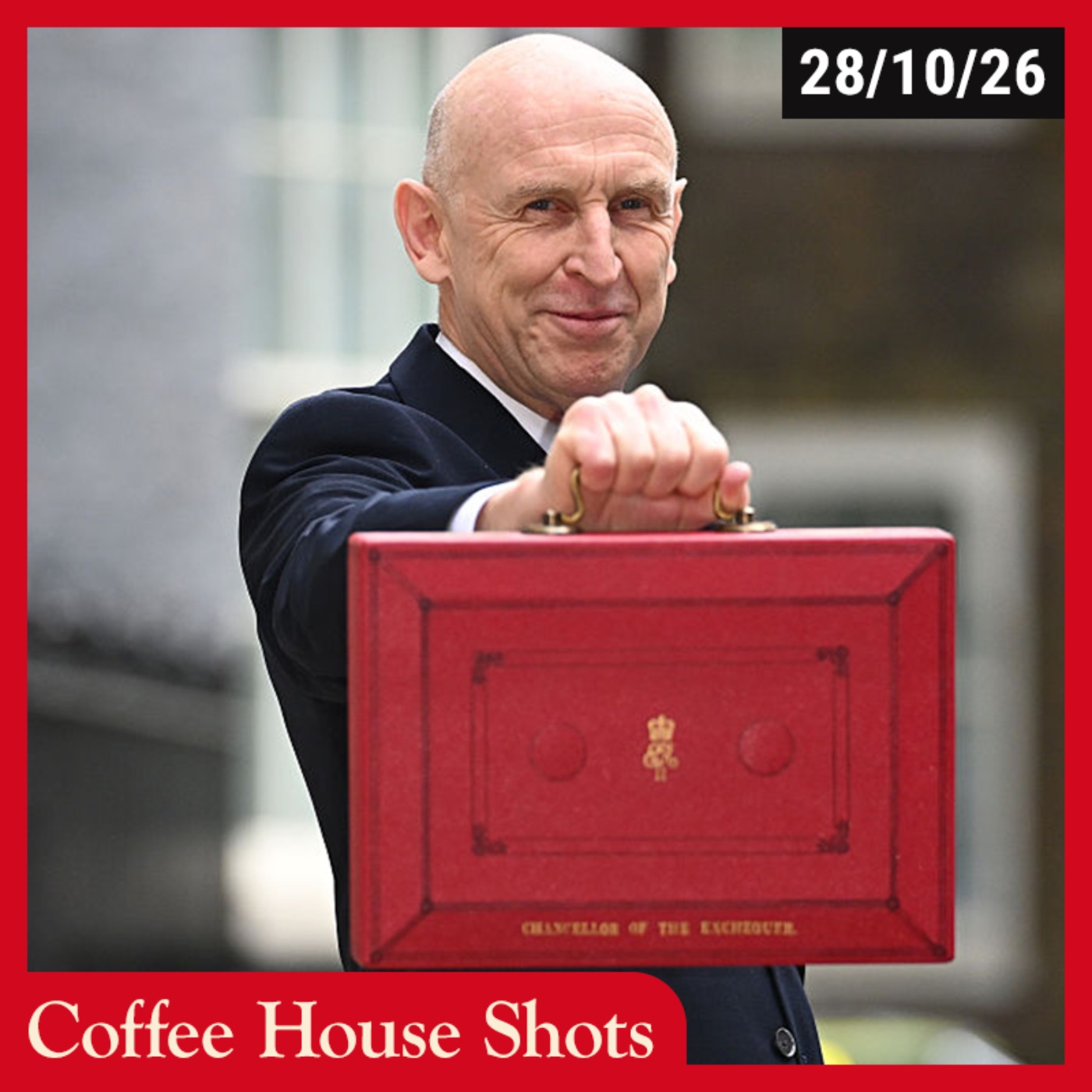
Chancellor John Healey has just delivered his first Budget of the Burnham premiership – but has he done enough to turn the economy around?
In this special edition of Coffee House Shots, Economics Editor Michael Simmons and Deputy Political Editor James Heale unpack the Budget, from £100 energy payments and downgraded growth forecasts to what this means for Britain’s banks.
But is the Chancellor offering households genuine breathing space? And with the markets barely reacting post Budget, has Labour missed its chance to make a bold economic statement?
Plus: what does the Budget mean for the prospect of an early election next spring?
Produced by Patrick Gibbons and Abigail Brierley.
Become a Spectator subscriber today to access this podcast without adverts. Go to spectator.co.uk/adfree to find out more.
For more Spectator podcasts, go to spectator.co.uk/podcasts.
Contact us: [email protected]
Hosted on Acast. See acast.com/privacy for more information.


