Ask ChatGPT



A discussion of Rachel Reeves’s time as UK Chancellor and speculation about who will replace her, focusing on economic credibility, Treasury influence, and Labour’s internal politics.
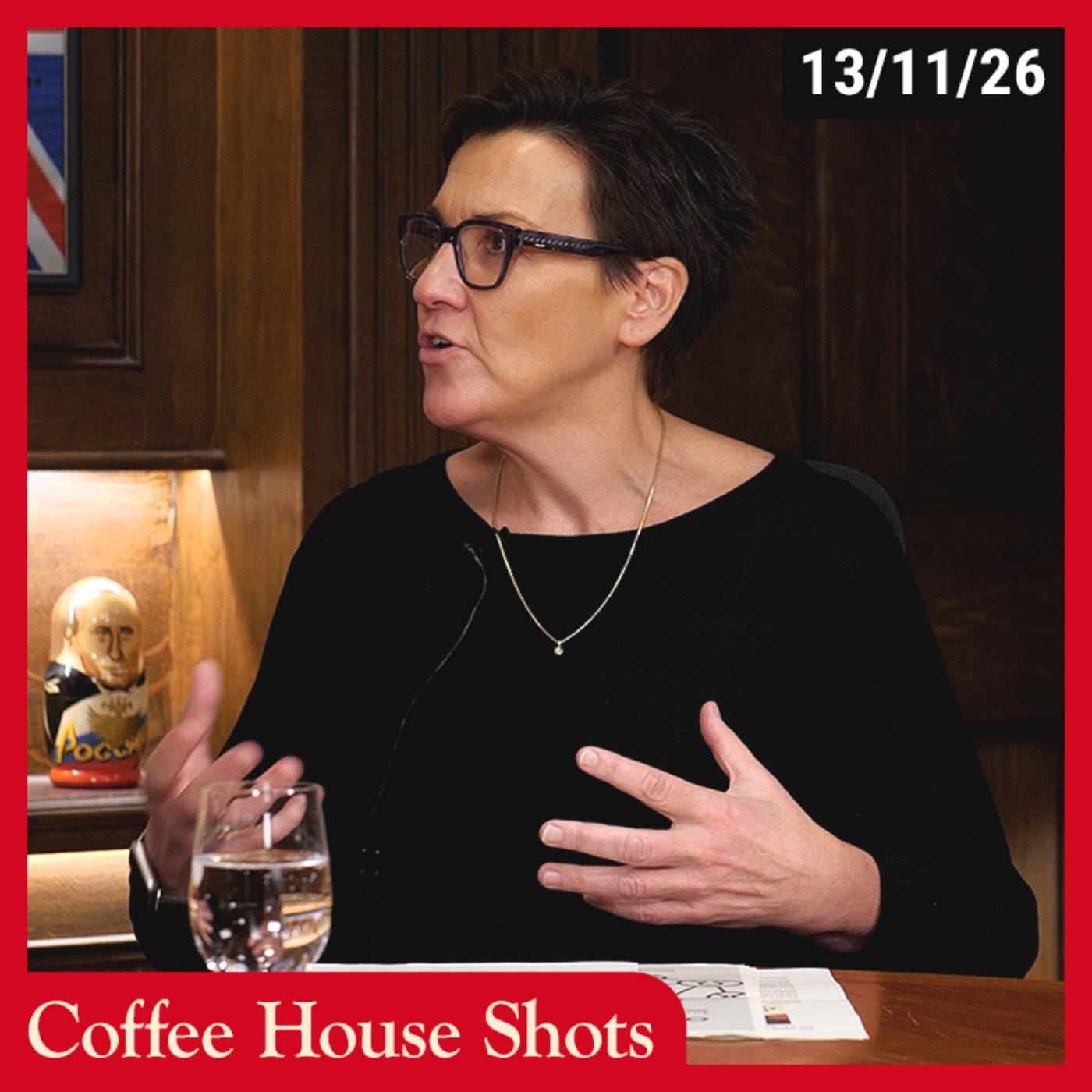
Michael Simmons, Spectator economics editor; James Heale, deputy political editor.
Reeves will rank among the least effective post-war chancellors; she was unpopular and hamstrung by Labour’s 2024 tax pledge and by Treasury orthodoxies. Criticisms include weak challenge to Treasury assumptions (e.g., “family farm tax”), limited focus on medium/long-term growth, and poor political handling of affected sectors. Defenses include avoiding currency crisis and sticking to debt-reduction rules. Her job prospects are tied to Keir Starmer.
Mansion House speech; “borrowing down” and low growth figures; “guilts/bonds on the blockchain”; 25bn employer NIC raid harming jobs; Winter Fuel; Heathrow; lobbying against Ed Miliband; ILR reforms; Davos photos with Jamie Dimon.
Written by AI. May contain mistakes.
Discussion on Rachel Reeves' impact and legacy as Chancellor.
“now today we're going to be focusing on number 11 before we move on to andy burnham's mooted Chancellor, let's start with an obituary for Rachel Reeves.”
Analyzing the challenges and public perception of Rachel Reeves' policies.
“Look, I mean, to give the case for her defence, first of all, she did take it seriously, the lesson of debt reduction.”
Speculation on Shabana Mahmood as the next Chancellor and her potential policies.
“And on that note, let's look forward to the new chancellor.”
Discussion on the influence of economic policy and leadership under the new Chancellor.
“I mean, there's photos of her at Davos, you know, smiling and grinning with Jamie Dimon of J.P.”
Learn about the complexities of government appointments and economic strategy in a new administration.
“I think, well, look, it's difficult to know the whole makeup of the government right now.”

Get the gist, explore an idea or ask about something said.
 Claude
On Coffee House Shots, what are the key points of this episode?
Searching your listeningAutomatic transcript. May contain errors.
0:00Ever notice how every new AI tool asks you to explain your business to it all over again? Google Workspace with Gemini skips that. You get Google's AI built right into the premium versions of Gmail, Docs, Sheets, and more. No new tools, no extra logins. Just one subscription that gives you personalized AI right inside your actual workflow. Make work less work. Try Google Workspace with Gemini at goo.gle slash workspace with Gemini.
0:36hello and welcome to coffeehouse shots i'm noah hoffman and today i'm delighted to be joined by michael simmons the spectators economics editor and james heel deputy political editor now today we're going to be focusing on number 11 before we move on to andy burnham's mooted Chancellor, let's start with an obituary for Rachel Reeves. Michael, you have been following Rachel Reeves's tenure in number 11 very closely. What reflections do you have? Well, look, the business community is clearly not going to miss Rachel Reeves, and that's not a unique thought. But there's one sector that I think will miss Rachel Reeves, and that is the sector of newspaper columnists because whilst Rachel Reeves has been I would say a broad negative for the British economy despite what she said about what her legacy was at the Mansion House speech she's really boosted traffic for anyone writing about the British economy and British fiscal policy and that's because of you know how unpopular she was she was the polling showed consistently that she was the least popular chancellor that we've kind of ever had certainly in modern opinion polling times and she gave this speech on Tuesday at the mansion house you know where it's all these finance bigwigs which was kind of usually you get some like announcements so last year it was about like ISA reforms and what she wanted to do with pensions this year there wasn't really anything she said something about putting guilts or bonds on the blockchain which I'm not even going to try and explain because I'm not really sure I understand it that well although to be fair I think it was received fairly well it's something the Bank of England have been keen on but the rest of it was about setting out her legacy you know she points to the fact that in the first quarter of this year we have the highest growth in the G7 I mean that's technically true but you know look at Britain over her whole tenure that growth has been beat by other countries and even when it is the best you know it's still very low there was a growth figure out this morning that she celebrated it, you know, not one of a percent.
2:44She also talked about borrowing going down last year as a share of GDP. Again, like technically true, but we're still spending over a hundred billion pounds every year on debt interest. You know, she says that her whole thing was about fixing the public finances, fixing the foundations. I don't think anyone could say that was true. However, I would say I feel a twinge of empathy, a tiny twinge of empathy for Rachel because I think that her party and the leader of her party, but I guess the party machine, set her up for total failure. And I keep going back to this point in the 2024 election when they made their tax promise that they would not raise taxes on working people, the big free income, VAT and national insurance.
3:28That was a pledge that they were bounced into making by the Tories. I don't think they needed to make it. You could argue that maybe not making it would have cost them you know 20 seats but they they still would have won and i think that really hung hangstrung them and i think if they hadn't done that and rachel's first budget was look i've inherited this black hole i've inherited this crisis i'm really sorry everyone i'm putting the basic rate of income tax up by one p we might be in a position today when rather than her almost certainly leaving office despite a slight plea at the end of her speech to leave her job that actually she'd be a bit more popular because things would have balanced out a bit better and she'd be maybe thinking about giving away some spending giveaways.
4:11So I think despite the fact she clearly was an ineffective and unpopular chancellor, she was hamstrung before she even got the keys to number 11. Yeah, I think that she'll definitely rank in the lower half of chancellors, post-war incumbents at the Treasury. Look, I mean, to give the case for her defence, first of all, she did take it seriously, the lesson of debt reduction. She has avoided any sort of run on the pound or any kind of crisis. There wasn't a mini budget or sort of big, spectacular blow up. And she was trying to stick to those rules that Michael talks about there. It was quite extraordinary.
4:46And it was one of the few successful sort of barrages, skirmishes that the Conservatives were able to launch in that otherwise pretty disastrous 2024 campaign was this three-day war, which ended with Labour committing to no increases in taxation. But I think those are the sort of things in her favour and of course the fact that Keir Starmer very much didn't choose to challenge her or any of them. So it's difficult to sort of tell where does blame or success lie in this government, where one ends and the other begins. But against that, in the negative, the charge sheet column, she failed to sufficiently challenge the Treasury on some of its assumptions and orthodoxies, most notably the family farm tax, where she came in.
5:23This was a fiendishly complicated policy which was proposed for years. Winter fuel is another example. And there's the question sometimes of missing the wood for the trees, taking kind of some classic accountancy tricks of the treasury rather than looking at actually kind of what do you want to invest your long-term capital? That's the first charge. The second charge I would potentially say is the inability to really look at kind of medium to long-term growth. There were a few things such as Heathrow you could talk about, which is really long-term. But in that kind of medium to long-term, that sense of the animal spirit potentially being damaged, that's something to look at.
5:53And I think third of all is actually inability to look at how the politics would play. You come look at different visible sectors that were annoyed by the treasure she brought. There's a famous loan from The Economist, which is never annoy a profession which is depicted in a children's picture book. And it seems sometimes, you know, the grannies, the farmers, you know, all these different sort of highly vocal, organized, publicly evocative groups. There was a failure to kind of consider the impact of those. So I think that she will be not one of Labour's great chancellors. And that's for her. The tragedy is that she will forever live in the shadow of her hero, Gordon Brown, who was very effective at dealing with the Treasury machine, albeit had very much politics on easy mode.
6:29I would just defend the Treasury ever so slightly in that, you know, one of the policies that she implemented that has clearly proved disastrous is the 25 billion raid on employer national insurance that's ended up destroying jobs that we've talked about on this podcast many times. And I remember, you know, one of the first times like some data came out showing that it had destroyed jobs. I spoke to a treasury official and they said, look, you know, this is not like our orthodoxy. This is not us not thinking about the second order consequences. This was Keir Starmer, Rachel Reeves, not telling us who the priorities are, who the people are to protect.
7:06And if you're a treasury official and the chancellor or the chancellor's spad or however it works says, raise me 25 billion pounds, then you just look at your ready reckoner and come up with that. If you're not, don't have the political leadership. But the political leader is the Chancellor. Well, this is what I'm saying. But she went along too much with the Treasury. Yeah, but the Treasury was just delivering that, right? Because she didn't offer any vision at all or any priorities about who was to be protected and who wasn't. I await to see the memoirs of Rachel Reeves, and who knows, the historian who was trailed in so many talks beforehand, she entered the Treasury, will come to the fore, and we believe that all the wonderful battles she had and the innovative things that we'll be finding out for the many, many years to come.
7:48But on the face of the evidence, there was a sufficient failure of imagination in her public statements, her policymaking. And I think to go back to that point about political leadership, she rose with Keir Starmer and she fell with Keir Starmer. And that is why, barring an unbelievable level of compromise on the hitherto undiscovered Treasury hard drive on Mandy Burnham, she is expected to be losing her job in a matter of days. And on that note, let's look forward to the new chancellor. The latest word on the street is that Ed Miliband, who was originally viewed as a shoo-in for number 11, has actually been left out in the cold and that Shabana Mahmood now is looking like the front runner.
8:29James, what's Andy Burnham thinking there? And take us sort of behind the scenes into how it all went wrong for Ed and is moving in the direction of Mahmood. Well, the case for Miliband is the case against him. There's three arguments. He's clever, he knows his own mind, he's an effective minister. And that is exactly the case against him. He's clever, he knows his mind, and he's an effective minister. What does Andy Burnham want to do with the Treasury is the key question. The Treasury has an important role in Whitehall and will be an important, perhaps, deciding factor behind the success of Andy Burnham's devolution mission.
9:05There are many people who suggest that if you want to have effective devolution, you need to have tax-raising powers given to regions. There are other people who suggest in the Labour Party the Treasury ought to be broken up. So are you going to really appoint someone who, let's be honest, is probably the most effective minister of this government to that role and potentially be a counterbalance. There are some around Danny Burnham who think that he would be a block on their ambitions, some who think that he's a classic Treasury man. It was striking today that Jane Williams, who's written about devolution for 10 years, the FT, made the point that in 10 years of outwriting about this, she has never once considered the words Ed Miliband and devolution together, despite him having a Doncaster seat.
9:39And I think that does show that he is not seen as a sort of devolver-in-chief. Indeed, of course, he was in the Treasury with Gordon Brown when they were very much centralising a lot of these powers. So that is why I think some of the arguments are going against him because he's seen as clearly such a strong minister. You're seeing this real lobbying campaign. I wrote about this in the magazine last week. There was a very much a stop Miliband campaign in the city that was going on. One bond trader had had a copy of Miliband's 2021 book delivered to his desk. They were all trying to read up on him.
10:03As a result of that, we've now had lots of lobbying against him. And what we led to believe that has led to the balance of power tipping away from him towards Shabana Mahmood. The case of Shabana Mahmood, of course, is that she's someone who may be more willing to sort of adopt a different kind of economic thinking to that of Miliband. she's seen as blue Labour crucially not Blairite but it's kind of the vibes of Shabana Mahmood are very much more in line with them or the city and there's a sense of relief there but of course that would move her moving out of the home office now I think it's worth saying that the changes she's posing on the ILR are very popular presumably to lots of people on this podcast and kind of the centre-right of British politics I've just seen a Tory MP for lunch who said you know they can't be thinking about moving Shabana out of home office but the whole point is that people like you are saying that not people in the Labour Party and so given the indefinite leave to remain reforms are not going down terribly well with parts of the Labour Party, she could have moved out of that.
10:51We don't particularly know necessarily what her view would be on kind of the Treasury. It'd be interesting. She was, of course, Shadow Chief Secretary of the Treasury from 2013 to 15, but wasn't particularly memorable in that role, very much went along with the kind of Labour thinking at the time. So I really just depend on kind of what does Burnham want? And it was quite striking, the briefing today in Playbook, which was just talking about, oh, yes, Andy Burnham will be the one that decides that, yeah, that's the whole point. He's going to be the Prime Minister. He's going to be the one to make that decision.
11:16So it really comes down to what does Andy want to do? But I think it does show the widespread recognition on all sides of the Labour Party that the Treasury is the man or woman who will make and break this premiership. The city point you make there, I think, is really interesting because I was with some city people yesterday and one of the comments they made to me, and in fact, we've done a cover of the magazine on this, is how despite the fact that Rachel Reeves was really despised by the business community, she got a relatively warm reception within the city and within big banks. I mean, there's photos of her at Davos, you know, smiling and grinning with Jamie Dimon of J.P.
11:51Morgan, who I think like genuinely actually really likes her. And the reason for that is because the Tories had all these, you know, city reforms, policies for the city, or at least restrictions on where tax was going to go, that Rachel Reeves just adopted. And actually, none of it changed at all under Rachel Reeves. And I think not only would none of that change under Shabana Mahmood, they potentially wouldn't have changed under Ed Miliband, because I think the calculation within Labour is that these sort of pro-city policies that you would think a traditional Labour voter wouldn't like actually have no cut through because they're a bit hard to understand.
12:30And so if they're like an easy win to keep the banks on side, you're just going to keep doing those. So I think that is a theme from Rachel Reeves that we'll see going through. That is whatever, you know, the CBI or whatever the Confederation of Small Businesses say about whoever the next chancellor is, you'll still get a warm reception or at least silence from the City of London. I think obviously, let's step back as well for a second, which is that we're talking about institutions on the Treasury, we're talking about domestic forces like the city. the reality is that in the Strait of Four Moons closed that potentially could be the thing that blows up the world economy that could be the mini equivalent of the COVID shocks that struck the globe inflation wave of 2022 ultimately there's only so much you can do to ameliorate that so it may well be the case of putting on a sort of lipstick on a pig a smile on a bad face and I think that that could be something the salesman is what's going to be key what was really done for Rachel Reeves as well as having an uninspiring policy and being tied politically to the face of the Prime Minister is she was a really weak economic message carrier not helped by the fact that she unfortunately broke down in parliament but also just her handling of some key issues which was quite tin-eared and even more unpopular than Keir Starmer which is quite saying something.
13:35So the person who needs to be in there next would need to be someone who is seen as having a public credibility. We in Westminster might appreciate a Miliband but of course out there in the public there are some MPs who say hey he's the guy who lost us in the election we should have won 11 years ago. Is he really going to be the person effectively running the government? So I think that would be something that gives some in Burnham a pause for thought. Do you think the next Chancellor is going to be like the least influential Chancellor ever in that economic policy will just be controlled by number 10?
14:00No, I don't. Simple answer. I think, well, look, it's difficult to know the whole makeup of the government right now. And Burnham, who was obviously Chief Secretary of the Treasury, but has a slightly different take at regime on political economy. He's not an economist himself, etc. It all depends on kind of what they want to do on day one. This is why I say it's so important at the beginning of it, how he wants to set up, because he could appoint someone and say, look, day one, you've got to go and be my Chancellor. but effectively you're going to break up your department. These are the terms and conditions because this is a moment of maximum power but after next week someone's going to be in there then suddenly it gets more difficult.
14:33We see George Brown in the 1960s with the Department of Economic Affairs. It's always more difficult once someone's in to get them out again. This is why it's really interesting to see him who he's going to appoint and why I think that Siobhan Amoud would be in my opinion at least perhaps more malleable than an Edmund Aband figure. Well there's not long to go now until all the speculation can finally come to an end and everyone, whether that's business, the city, or just the public can have some clarity. So thank you, James. Thank you, Michael. And thank you for listening to Coffeehouse Shots.
15:18Ever notice how every new AI tool asks you to explain your business to it all over again? Google Workspace with Gemini skips that. You get Google's AI built right into the premium versions of Gmail, Docs, Sheets, and more. No new tools, no extra logins. Just one subscription that gives you personalized AI right inside your actual workflow. Make work less work. Try Google Workspace with Gemini at goo.gle slash workspace with Gemini.
Rachel Reeves has delivered what is likely to be her valedictory Mansion House speech, defending her record on growth, borrowing and the public finances. But with businesses counting the cost of higher employers’ National Insurance and Labour preparing for a change of government, what will her legacy be?
Meanwhile, the race to become Andy Burnham’s chancellor appears to be shifting. Ed Miliband was once seen as the frontrunner, but some around Burnham fear that he would be too powerful – and too resistant to their plans for devolution and Treasury reform. Shabana Mahmood is now being tipped for the job, but would moving her from the Home Office prove a costly mistake?
Noa Hoffman speaks to James Heale and Michael Simmons.
Produced by Oscar Edmondson.
Become a Spectator subscriber today to access this podcast without adverts. Go to spectator.co.uk/adfree to find out more.
For more Spectator podcasts, go to spectator.co.uk/podcasts.
Contact us: [email protected]
Hosted on Acast. See acast.com/privacy for more information.