Ask ChatGPT
 Cold War Conversations
14 Nov 2026 · 59m · 22 chapters
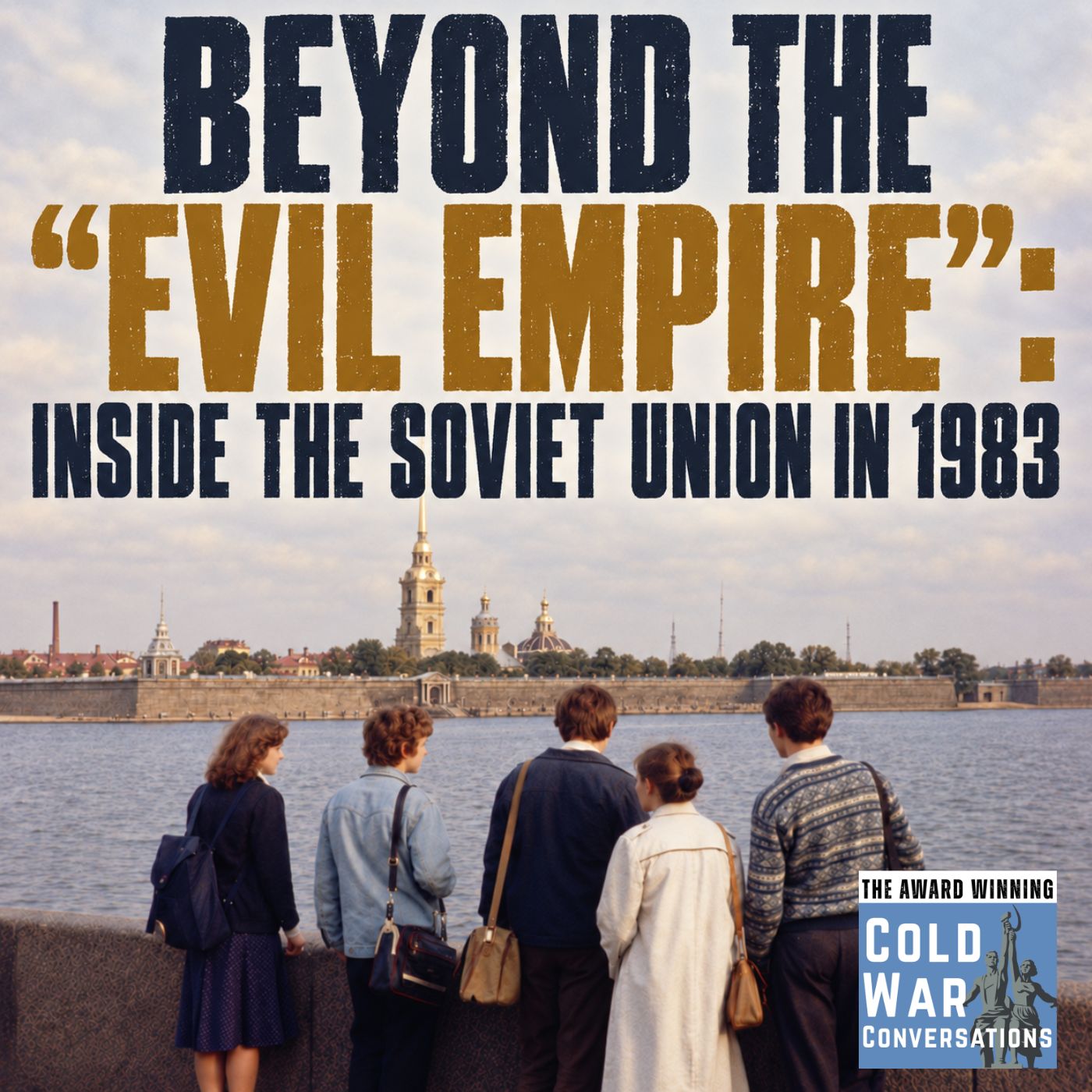
Loring Hines’ 1983 study-abroad account of the Soviet Union—especially Leningrad—contrasting Cold War propaganda (“evil empire”) with everyday life: surveillance alongside unexpected freedom, shortages alongside hard-currency access, and official narratives alongside private candor (including Soviet soldiers describing Afghanistan as unwinnable).
Loring Hines is an American who became a Russian major after a highly sought-after high-school Russian history class; he studied Russian at Leningrad State University during a SUNY-sponsored trip in June 1983. He later reflects on what he saw across Moscow, Leningrad, the Baltics (Estonia, Latvia, Lithuania), Volgograd/Stalingrad, and Tbilisi.
The USSR looked controlled yet allowed students real autonomy; citizens were proud and generous but lived with tense scarcity (long lines, empty meat stalls, weight loss). Overt KGB-style surveillance existed (e.g., identifiable men in gray suits, black Volgas). Western contact wasn’t demonized only—many young people were curious rather than fearful.
a delayed arrival after a student’s Bibles; a Soviet wedding reception where locals were generous; teenagers selling military memorabilia for hard currency; an Estonian woman spitting when spoken to in Russian; curfew/bridge timing and a free-spirited gypsy music night; a train breakdown leading to an encounter with two tank soldiers returning from Afghanistan; Moscow’s “Soviet economic achievement” exhibition with “Potemkin” displays (English-labeled keyboards hidden in a tent); and a U.S. Embassy cafeteria meal (hamburgers/hot dogs) after weeks of poor food.
Written by AI. May contain mistakes.
Discussion about Soviet soldiers' experiences in Afghanistan and an American student's visit to the Soviet Union in 1983.
“These Soviet soldiers just went into incredible detail about their experiences in Afghanistan.”
Loring Hines shares his background and motivations for visiting the USSR during the Cold War.
“So when I was a senior in high school, I took a Russian history class.”
Loring describes his arrival in Moscow and initial experiences with Soviet authority.
“Yeah, because right about this time, Ronald Reagan is coming out with his evil empire speech.”
Discussion on preparation before the trip and classroom experiences at Leningrad University.
“Had you been given any preparation before you went out there by your teacher?”
Loring reflects on his experiences in Leningrad, including interactions with local students and the city's atmosphere.
“And then we had a night train from Moscow to Leningrad.”
Loring discusses his conversations with local teenagers and the unique social dynamics in 1983 Leningrad.
“What was your day like at the university?”
Learn about the experiences of teenagers in Leningrad and their views on Soviet life.
“asking what she was standing in line for.”
Understand the significance of World War II in Russian culture and memories in Leningrad.
“This holiday, all plans, even unlimited, are just$15 a month.”
Exploration of the reception of Western broadcasts and curfew experiences.
“Did your Lithuanian friends give any indication that they were listening into Western broadcasts?”
A memorable encounter with gypsies during a late night in Leningrad.
“And the reason for that is to allow the shipping to go out into the Baltic Sea and freighters and whatever had to exit the port that night or the river that night.”
Insights on the presence and interactions with KGB agents.
“You mentioned before that you were aware you were under surveillance.”
Discussion on the influence of Western music in Soviet society.
“Western music or were they not aware of what else was out there?”
Visiting the iconic Hermitage Museum and Petrodvorets during the trip.
“Leningrad, for six weeks had a downstairs bar and they had a band that would come in every night, same band every night.”
Reflections on the contrast between pre-revolutionary and Soviet art.
“And that was the real contrast that struck all of us.”
Experiences with severe food shortages and market conditions in Leningrad.
“You mentioned before about the Lithuanian student not believing the fact that you had meat and vegetables in the shop.”
Overall impressions of the travel experience and unexpected freedoms.
“And there you could buy, it wasn't quite a supermarket.”
An exchange with soldiers returning from Afghanistan and their experiences.
“And our in-tourist guide was one of the first to get off the train and start walking.”
Discussion on the grim realities faced by Afghan soldiers during the war.
“And again, this goes back to the idea of this, how things were slightly liberalized and because I found the Russians to be very outspoken with not only general conditions, but just their opinions.”
Recollections of experiences in Moscow, including a memorable embassy visit.
“bedroom furniture and mattresses, holiday decor, and way more.”
Reflections on the overwhelming contrast between the Soviet Union and the U.S.
“I hope that's a true story because it's stuck with me all these years.”
The impact of the trip on military enlistment and patriotism.
“And I certainly realized that how fortunate we are that we live in the West compared to what it was like where I just come from.”
The speaker shares how a life-changing trip impacted their patriotism and military career.
“Not that I wanted to take on the forces of communism directly, but the idea that I wanted to give back.”

Get the gist, explore an idea or ask about something said.
 Claude
On Cold War Conversations, what are the key points of this episode?
Searching your listeningAutomatic transcript. May contain errors.
0:00Colin McPherson: Welcome to Cold War Conversations, the home of real stories of the Cold War.
0:06Loring Hinds: Carhartt's holiday gift guides were built in collaboration with the greatest gift giver of all time, Santa Claus himself. Old Saint Nick counts on Carhartt's durable gear to have his back through rain, sleet and snow on the biggest night of the year. Because when everyone's counting on you to do your job, what else would you wear to work? Tap the banner to grab a gift for every hardworking person on your holiday shopping list or head to Carhartt.com.
0:33Colin McPherson: Big news. Wayfair's Black Friday sale is here. Early. Right now at Wayfair, get up to 70 % off everything you need for the season ahead. Save on kitchen and dining, bedroom furniture and mattresses, holiday decor, and way more. Now is the time to score big. From seasonal finds to favorites you'll use all year long. Plus, with Wayfair, enjoy fast and easy shipping with delivery and time for the holidays. Save up to 70 % off early Black Friday deals. Shop now at Wayfair.com.
1:02Loring Hinds: Wayfair, every style, every home. These Soviet soldiers just went into incredible detail about their experiences in Afghanistan. It was grim.
1:12Colin McPherson: In the summer of 1983, an American student stepped behind the Iron Curtain and found a Soviet Union nothing like the enemy portrayed at home. Loring Hines recalls travelling to Moscow and Leningrad at the height of Cold War tension. Studying Russian at Leningrad State University, he encountered surveillance, empty shops, endless queues and the contradictions of a system that appeared controlled yet allowed students remarkable freedom. He describes black market encounters, an unexpected Soviet wedding, Nights exploring the city and conversations with people eager to understand life in the West.
1:51Colin McPherson: When a train breaks down outside Leningrad, Loring meets two Soviet tank soldiers returning from Afghanistan. And here's the grim truth concealed by propaganda. This vivid eyewitness account reveals the warmth, pride and generosity of citizens living within a faltering system. I'm delighted to welcome Loring Hines to our Cold War conversation.
2:16Loring Hinds: So when I was a senior in high school, I took a Russian history class. That particular teacher was one that was highly sought after. Everybody would try to sign up for his Russian history class. And so I did and attended the class, fell in love with the whole history of the country, going all the way back to Kivi and Rusk to basically, I think the class probably wrapped up around the end of World War II. But nevertheless, it just captured my imagination. The history is certainly colorful. If you go back through the czarist regimes and, you know, the various invasions that kind of shaped what I noticed to be prevalent, even when I was there, the sense of xenophobia, going back to the Mongols, the Napoleonic invasions, and finally Hitler and the Nazis.
2:56Loring Hinds: So all of that kind of came together when I actually got there. But the background is when I was in college, as I mentioned before, really enjoyed the Russian history class in high school. And then I decided to become a Russian major in college. I went to a liberal arts college and that was one of the offerings and started with language and then progressed into literature, political science, history. So really very immersive.
3:20Colin McPherson: What were your parents' background? Were they interested in history or how did you get this fascination with Russian history?
3:28Loring Hinds: It certainly didn't come from my parents. They were musicians, not professionally, but that was their background education. And they, I think, were amazed that a topic that seems completely foreign to them captured my imagination so much. As a student, I was always a good student, but not necessarily the most motivated one. But they saw that all of a sudden this passion come from within that they never saw. and I didn't know it was there either until I took those classes and then declared the major. Later on, but going into my senior year, there was a bulletin board posting for a trip to the Soviet Union, study abroad, grabbed a piece of the flyer and filled it out, sent it in.
4:06Loring Hinds: It was through the State University of New York system. They sponsored the trip and filled it out and asked my, first of all, asked my parents, would you mind if I went on this trip? They were reluctant just because of the general feeling. This is obviously the height of the Cold War in 1983. At least in my opinion, it was given what was going on. And we had a long discussion about it. They finally agreed. And the rest is history. I was able to go on the trip.
4:30Colin McPherson: Yeah, because right about this time, Ronald Reagan is coming out with his evil empire speech. That's right.
4:35Loring Hinds: About two months before I arrived, that speech had just come out. And that was on everybody's mind. And then the other piece that really struck me was how the Pershing II initiative, to put those in West Germany, that was all on the table at the time as well. And there was genuine fear on the Soviet side that we were going to attack them first preemptively. And that was a backdrop on our ride.
4:59Colin McPherson: Because the infamous Abel Archer exercise was October 83, which was reckoned to be a near miss in terms of going to war with the Soviet Union. You arrived there on the 20th of June into Moscow. What's your first impressions of the Soviet Union?
5:18Loring Hinds: So I left from JFK, so roughly a 16-hour trip, and exhausted by the time we got off the plane. And I should back up. The plane was a large, wide-body plane. I believe it was an Air France flight that got us there. And I didn't know who the rest of my group was at the time. Didn't have names, didn't have anything, but we all found each other on the flight. and we started talking and getting into our backgrounds as to how we all got on the trip. And most of them took the same path I did. So similarly, we got off the plane. We were met by members of the Soviet Army. They escorted us to a bus that was marked foreigners only, and they brought us into a terminal.
5:56Loring Hinds: And going through the passport process was interesting in the sense that I was really excited about getting a Soviet stamp on my passport. That's not what they do. They give you a little piece of paper with a stamp on it. So that was a disappointment. But then really what struck me as a first impression was one member of my group had a pair of Bibles in his luggage and the customs people found it. And that turned into a bit of a controversy. They delayed us getting on our own bus to get to, we were ultimately going to go to a hotel, spend one night and then go to Leningrad. But that was delayed substantially because this one individual was bringing in what they called Christian mythology into the country.
6:34Loring Hinds: So that was my first taste of Soviet authority.
6:39Colin McPherson: Fantastic. Fantastic. Had you been given any preparation before you went out there by your teacher? Did they brief you what to do and what not to do or anything like that?
6:50Loring Hinds: Yes. My language and literature professor, who I became very close with as a great friend, had been over there several times. And he did give me the heads up about what to do, what not to do. specifically, don't speculate. In other words, don't sell your jeans for rubles, things like that. That leads to a bad end. He did recommend places to go once there. And he actually presented me with a slideshow along with some of my classmates of his experiences there. So many of the sites that I saw, I had seen through those slides and kind of understood what I was going to see, what I had no idea was going to actually experience.
7:27Loring Hinds: We'll get into that. But I did have that baseline impression of what I was going to see when I got there.
7:34Colin McPherson: And you're going to study at Leningrad University. So how do you get there from Moscow?
7:40Loring Hinds: So we spent one night in Moscow just to acclimate and barely enough time to even go see Red Square, which we did. And then we had a night train from Moscow to Leningrad. And that was the first experience in my life of being in an overnight train. And quite honestly, the accommodations were pretty good. We traveled in first class, which I thought was ironic being a classless society and all that in theory. But we did finally arrive in Leningrad that the following morning, they went straight to the hotel, checked our bags, and they took us right to school to take placement exams based on our proficiency with the language.
8:15Loring Hinds: And then from there, the classes would run. I guess each class is maybe 40 minutes. Most of it was language. There was a little bit of history and a little bit of social studies, I guess you would call it. And This was a Monday through Friday thing. And one particular instance in the classroom that really surprised me was the professor was a young, youngish individual, probably 30 to 35 years old. Very nice guy, very clearly an experience teaching Russian as a second language to people like me. And he got into a little piece of history about pre-World War II and what the Soviet Union was going through post-Civil War, but prior to World War II.
8:55Loring Hinds: He talked about Henry Ford exporting tractors over there, and that just completely revolutionized their ability to grow their own food. They just came out of the famine, particularly in Ukraine. And he made the comment that stuck with me all these years that for many years after that, children were named Tractor, just as an homage to Henry Ford exporting tractors to the Soviet Union. I thought that was interesting.
9:19Colin McPherson: Wow, I hadn't heard that story before. Definitely not. So were you in classes with Soviet students or were you all on your own?
9:27Loring Hinds: It was just our group. There were roughly 20 or so students in my group and they kept us together. The only part where we'd break, some were more proficient in the language than others. There was one particular grad student in our group who had, this is maybe his fifth or sixth time to the Soviet Union. He spoke beautifully. At the time I arrived, I was intermediate at best, and I was placed in, I think my class probably had eight or 10 students in that particular class, and we stayed together for all five classes during each day.
9:55Colin McPherson: But you must have had some contact with the students within the university, presumably when you were going to eat or something like that.
10:02Loring Hinds: That's right. The classes, we were normally out of there before lunch, so the only time we would see Soviet students would be passing in the hallway, and they did keep us fairly isolated. I'm not saying it was a wing, but it was certainly a section of one building where it was mostly foreign students. There were, I remember seeing quite a few Europeans, Germans and French, English, that were also in their own groups doing the same things we were doing. But the Americans were pretty well cordoned off and kept our own little area.
10:31Colin McPherson: And where was the university in Leningrad? Was it in the central or was it outskirts on a campus or something like that?
10:38Loring Hinds: We were right in the center of the city.
10:41Colin McPherson: Wow. Wow. The reason I'm going wow is I know that Leningrad is a beautiful city. I've yet to visit it, even as St. Petersburg. But yeah, it certainly looks spectacular from what I've seen of it. What did you make of Leningrad when you arrived there? It sounds like you were quite well prepared for it because you'd had this slideshow. Yes. My first impressions was, remember, this is not even 40 years since the war ended.
11:08Loring Hinds: And Leningrad, of course, was devastated, the 900-day siege and all that. But you would honestly never know. The Soviets did a remarkable job rebuilding the city. And they really did keep to Peter the Great's French mode of inspiration and all that. The buildings were all in repair when I was there. Along the Niva River, which is almost like you could be, if you closed your eyes, you could be in Paris going down by the Seine. The architecture is almost identical. And there were lots of museums that would show before and after pictures of, say, 1945 after the rebuilding. And they did a remarkable job.
11:43Loring Hinds: There would be small signs of the war. You might see bullet holes on a wall somewhere on a building that wasn't completely destroyed. But overall, the city was absolutely spectacular.
11:55Colin McPherson: What was your day like at the university? Was it reasonably similar each day?
12:01Loring Hinds: It was identical each day. The one thing that left me with an impression of the actual schooling was how regimented it was. It was very precise. Every school's got their regimentation. But in this case, it was very succinct blocks. Each class that we went to had a very strict curriculum or a syllabus, and we stuck to that. And now the irony is they didn't care if we went or not. There would be days where, you know, the friends I made within the group and I would decide, let's not go to class, let's go do something else. Go to a museum, go do something. And then there was no repercussions for that at all.
12:37Loring Hinds: We were, oddly enough, we were given an amazing amount of freedom while we were there.
12:42Colin McPherson: So what were you doing in your off time?
12:48Loring Hinds: That's, it's a loaded question because the thing that struck me so much was, here's this, this artifice or this, this idea that all that, all that one would, could do would be what you were allowed to do. And what we found is that after we went to class, we would come back to the hotel, we would eat lunch. And then we, one or two things would happen, either be a planned excursion to a museum or something, something like that, or they would just turn this loose. And the N-Tourist guides didn't mind. And we would go out and explore. And we would meet people on the streets, have conversations on the streets.
13:21Loring Hinds: I remember clearly meeting a couple of teenagers, probably in their late teens. And they struck a conversation up. Their English was better than my Russian. And my roommate and I invited them up to our room. They went. There was no fear. Certainly were being surveilled. We knew that as time went on. We learned to figure that out. But they had no fear. and they went up and we ended up just sitting and talking about life in Leningrad and from an 18-year-old's perspective. The other thing that always struck me as I wandered around the city was that while it's beautiful, as I said a moment ago, the undercurrent was very tense.
13:57Loring Hinds: There were long lines everywhere to buy things. I remember walking up to a woman standing in line and asking what she was standing in line for. And she said she didn't know, but she knew she needed it. So it was a culture of opportunity. One thing that also struck me watching just the average citizens walking down the road, men in particular, they always carry a briefcase. No matter what their profession appeared to be, whether they were in some sort of an official uniform or just normal street clothes, they always had a briefcase. and every now and then i'd be riding on the metro and i would see one of those individuals open their briefcase and usually it was nothing more than a copy of prompt in their lunch they but you never knew if they or the idea being that you never knew if that there was something that they needed that was going to be ad hoc for sale and they would just have something to put whatever it is they purchased in that was why they carried the briefcases just in the event that they find something they actually needed to buy.
14:51Colin McPherson: The two teenagers, what did they tell you about being a teenager in Leningrad in 1983?
14:58Loring Hinds: I should back up and say that they were definitely black marketeers. They were interested in our money because hard currency obviously made a big difference. So the official exchange rate was, I think at the time, about$1.40 to the ruble. So they were certainly looking for money. So they had a lot of military emblems, belt buckles, hat badges, things like that. And so they were trying to sell that. We weren't terribly interested. We bought a couple of things just to more or less help them out. But what they really started to talk about was just how much the city meant to them. The Russian patriotism is a real thing.
15:32Loring Hinds: The mother of Russia really is a real thing. It's instilled in the citizens at a very young age, obviously. So despite the fact they were living on the edges of Soviet society, I would suspect they still spoke very fondly of it. They didn't seemed to know what they were missing, if that makes sense. In other words, they'd never been to the West. They didn't know what there was there, not there. The only thing they could see, they could spot us as foreigners a mile away just because of the way we were addressed. But I don't think there was a sense of envy or anything like that. I think there was just a sense of curiosity and they just wanted to know.
16:02Loring Hinds: So they would ask us lots of questions. Just what's it like living in the West? What's the United States like? What does New York look like? Just very general, simple questions. But they hung on every answer. They were really curious.
16:16Colin McPherson: Did you find Russians generally suspicious of you or were they just fascinated as to why you were there?
16:24Loring Hinds: It was a combination of both, Ian. The younger ones were not afraid. They were not at all shy about approaching us and asking us questions. The older ones certainly were. The ones that had survived Stalin in that era and that wasn't that far in the past at that time, they certainly had their suspicions and they've been conditioned to be fearful or at least suspicious of the West. Just as an aside, I remember picking up a providence one day and the editorial cartoon was a picture of Uncle Sam riding a bulldozer and on the blade of the bulldozer read the word capitalism and they were pushing people over a cliff.
16:59Loring Hinds: That was just one example of what they were constantly bombarded with. That was the messaging they were always
17:05Colin McPherson: bombarded with you mentioned earlier about the black marketeers being proud of being russian proud of their city and i think you mentioned world war ii then and i think they there's a huge cemetery i think in leningrad which is a war memorial there did you ever visit that yes you
17:27Loring Hinds: i'm sure you're referring to the one with the big hand with the torch coming out of the floor Is that the one that comes to your mind? Yes, absolutely. And we joked, not in a funny sense, but just that the idea that, of course, they don't call it World War II. It's the Great Patriotic War. And to them, it made me feel as though that the war ended yesterday, the way they talked about it. The veterans were everywhere on the streets, and even if they were in street clothes, they wore all their medals. They were very proud, obviously, of what they accomplished. Another funny sort of thing to me anyway was they never referred to the enemy as the Germans.
18:01Loring Hinds: It was always the Nazis. And I assume that's because East Germany at the time was a client state, and they didn't want to offend their client state, but it was always the Nazis. You never heard the word German in World War II in the same context.
18:14Colin McPherson: i think like if you get married one of the things you you would do is go and lay flowers at the war
18:19Loring Hinds: memorial that's right it's funny you mentioned that so when we were there there was exactly that going on the actual wedding ceremony was there there was a couple and then oddly enough the couple invited myself and two of my friends to go to their reception so we actually went to that particular wedding reception, which that was my first real exposure to just man on the street, Russians, and how absolutely generous they were. They don't have a lot to give, but what they have, they will. And I found the Russians to be absolutely the nicest, most generous people I've ever met.
18:54Colin McPherson: And I guess with your knowledge of Russian history, you were keenly aware that the US didn't win World War II single-handed.
19:01Loring Hinds: That's for sure. They did all the heavy lifting and the price they paid is incalculable. $25 million is probably a conservative estimate. And part of the trip, we did go to Volgograd or Stalingrad at the time during the war. And you really get a sense that there was just nothing left of that city after the war. And there was a few buildings they left preserved that were bombed out just to show what it all looked like. And that city had been largely rebuilt by the time I was there. But absolutely, the suffering they went through is unimaginable.
19:32Colin McPherson: Stalingrad, they've got that huge statue there on that mound.
19:36Loring Hinds: That's right. That's right. Matrasiya and Mother Russia with a sword in the air. And there was another statue not too far off, which was a kind of a Soviet Gothic styling of sculpture where the Soviet soldier's shirtless carrying a machine gun. It wasn't quite an AK-47 in those days, but I can't recall what that machine gun was called. But regardless, it was his arm going forward to follow me, kind of an infantry sort of a motif. And there was a caption underneath it that I remember clearly that read praise to the heroism of the Soviet soldier. And just, again, the war, from an atmosphere standpoint, it felt as though the war had just ended.
20:17Colin McPherson: It sounds like you got about quite a bit if you made it to Stalingrad, because that's pretty far east. Where else did you get to visit in the Soviet Union?
20:27Loring Hinds: We were fortunate. We went on three different train trips into each of the Baltic Republics. So we went to Estonia, Latvia, Lithuania, went to Volgograd, went to Tbilisi in Soviet Georgia. And then, of course, we spent, the last week we were there, we were in Moscow. As I said, at the outset, we arrived in Moscow, but went straight to Leningrad, but we did come back and spend a week in Moscow.
20:46Colin McPherson: Cold War history deserves to be remembered. And by listening to the next few adverts, you help us to do exactly that. Thank you.
20:54Loring Hinds: This holiday, all plans, even unlimited, are just$15 a month. A holiday deal this good obviously deserves an enormously expensive holiday song, like All I Want. Right. Okay, we can afford that. You know what? Forget the music budget. We're going to stick with whatever's in the public domain. Give it a try at mintmobile.com slash switch. Upfront payment of$45 for three months,$90 for six months, or$180 for a 12-month plan required,$15 per month equivalent. Taxes and fees extra. New customer offer for initial plan term only. Greater than 50 gigabytes may slow when network is busy. See terms.
21:53Loring Hinds: every style, every home.
21:56Colin McPherson: And what differences did you notice in those different locations? Because some of those had formerly been independent nations, certainly prior to 1940.
22:06Loring Hinds: Yes. In particular, the Lithuanians, and this is what strikes me all these years later, the Lithuanians and the Estonians in particular were very nationalistic, very much opposed to the Russian occupation. I'm sure they were in Latvia as well, but I just more clearly remember this in Vilnius and in Estonia. I remember speaking Russian to an Estonian woman who was selling little paintings in the old part of the city in Tallinn, and she spit at me because I spoke Russian to her. So there was a lot of animosity, and I clearly don't speak Estonian, so there was no other way to communicate, but there was tremendous animosity.
22:42Loring Hinds: The people in Vilnius were remarkably friendly. We were only there for two nights, and we ran into who turned out to be art students and broadcasts and to be broadcasters. They were going to a broadcasting school, actually in Leningrad, which leads to a whole story about the relationships that I made while I was there. These people invited us into their apartment in Vilnius and they had homemade wine and they shared what food they had. And in return, the following day, we took them to a restaurant that they likely couldn't have afforded on their own. And we were able to, because it was a hard currency situation, but they allowed them in.
23:16Loring Hinds: and that was our way to say thank you. One thing we learned very quickly is that if you always bring a present, no matter what you have or don't have, it's just their tradition.
23:27Colin McPherson: So was it in that group of students you met Osra?
23:31Loring Hinds: That's right. So she made a remarkable impression on me. He and her friends were the group that invited us to, it wasn't her apartment, but it was someone's apartment. Don't remember now who, but we struck up a conversation. Her English was worse than my Russian And so, but we did, we did very well. We managed to get our points across. And a couple of days after we returned to Leningrad, she came down because she had to take a series of exams. But for her, she was in the broadcasting school I mentioned. And she showed me around the city firsthand. She knew Leningrad very well. And she was a great tour guide, a great friend.
24:07Loring Hinds: And what struck me was another apartment visit. This was in Leningrad. If you're familiar with Co-op City, that's where all the tall, wet apartment buildings on the outskirts of Leningrad, that's where most of the people lived or places like that. And so she took me out to an apartment there with a couple of my friends and a couple of hers. And the first thing I noticed was, we all know that, not all, but certainly everybody's familiar with the metro stations in Vascon, Leningrad. They're very ornate. They're very beautiful. but as you go further and further out into the suburbs basically they become like subway stations anywhere else just very functional but that that's about it and so we noticed that change right away and then we went to one of the these tall white buildings in co-op city and went into an apartment and she introduced me to several more friends one was in one was a in a film school another was a was an art another artist of some sort but what really struck me about that was there was a couple of real hardliners their age, maybe a couple of years older than we were.
25:06Loring Hinds: I was 21 at the time. And this one woman, we called her the hardliner afterwards, but she just drilled me on more and more questions about life in the West. And she kept accusing me of being CIA. But the first question she asked me was how many cars my family had. And my parents had a car, I had a car, my sister had a car. So I told her we had four cars. And of course, I'm a liar for saying that we had four cars. Nobody has four cars. That's outrageous. And then she said, what about food? Where do you buy your food? And so I drew a diagram of a grocery store, the meat on one aisle, dairy in another.
25:38Loring Hinds: And she looked at that and goes, that's impossible. There's no place like that on earth. She just refused to accept that it went against her programming, however you want to look at it. But those are the two questions I remember clearly, but I know that conversation went on for at least 15 or 20 minutes. And Ausha and her friends finally basically pulled her off. me. Why would he lie? That kind of stuff. But it was such an eye opener because the rest of that group was, for the most part, were so open to what we had to say. And we were so open to what they had to say. It was an exchange of ideas.
26:07Loring Hinds: It was certainly, as I said before with the Black Marketeers, they were a little bit on the edge of society. They were younger. They were an artsy kind of a crowd, but they were completely unafraidy. And that's what struck me. We always wondered amongst my group, what's going to happen to these people with the interaction with us? As far as I know, there was no problems for them later, but they were absolutely open and welcoming.
26:32Colin McPherson: And did you stay in touch with any of them after you went back to the U.S.?
26:38Loring Hinds: One exchange of letters with Asherna, she gave me her address, and I did write her. And she sent me a note right before I left, with her address, of course, but more importantly, just what it meant to her that with the relationship and the friendship that we had that that i opened her eyes to the west that americans in particular are not these 10-foot monsters that want to annihilate them or not their enemy there was more common ground than different ground it was a very i don't have that letter anymore and i really regret that because the gist of the letter was
27:08Colin McPherson: that we're all the same and it was such a great message yeah yeah it must be incredible for them because within 10 years, their country becomes independent. And they probably wouldn't have foreseen that by any means.
27:25Loring Hinds: No, it was interesting, though, because things were becoming a little bit more liberalized in the Soviet Union by the time I was there, despite what was going externally. We talked about Abel Archer. We talked about the evil empire speech and those things. But internally, you could see that the grip was being lessened a little bit. Andropov was in power when I was there. Of course, he had the two-year cold and all that, but he was former KGB chief. He certainly had the history, which would be fairly autocratic, but in a contradictory sort of way, it was the opposite. I got the sense that the grip was being lessened on the people when I was there.
28:03Colin McPherson: Did your Lithuanian friends give any indication that they were listening into Western broadcasts? broadcast? Because maybe the Estonians particularly might have been able to pick up Swedish TV.
28:16Loring Hinds: They probably could. I don't recall that. But I do know that the Baltic people especially had very few biases towards the West. Their parents and grandparents knew what it was like to be independent. Things turned badly for them with the war, of course, and politically. There wasn't that innate hostility towards the West. So whether they were informed or not, I don't know. They In some cases, they may have been able to pick up Finnish TV or radio, even in Leningrad, because it's not that far away. But I never got that indication.
28:47Colin McPherson: Yeah, it'd be interesting to see whether Azra is somebody high up in Lithuanian broadcasting now. Who knows? You may listen to the podcast.
28:55Loring Hinds: I would love that.
28:58Colin McPherson: Were you able to stay out as late as you wanted to in Leningrad, or were there restrictions on how late you could be out? There was a curfew.
29:08Loring Hinds: It wasn't terribly enforced. 1130 was when foreigners were supposed to be off the streets. One thing I remember very clearly is we were out past 2 a.m. when the bridges on the Neva go up. And the reason for that is to allow the shipping to go out into the Baltic Sea and freighters and whatever had to exit the port that night or the river that night. And we were on the wrong side. So we were stuck on one side of the bridges. Our hotel was on the other side. We're already past curfew. So we're getting a little bit nervous about that. And most of our nights ended early in the morning. It was white nights.
29:43Loring Hinds: It didn't get dark and very easy to lose track of time. And so if we were in somebody's apartment or something like that, it would be four or five in the morning, often before we would leave. Anyway, so we were, we're on the wrong side of the river and the bridges are up. And all of a sudden we hear this music and we look around and there's a group of gypsies that talk about being on the margins of society. They were completely free. It's such a contrast to the average drab Soviet citizen who's just going through his day and having to just get from Monday to Tuesday. These people came out with all kinds of wine and vodka, musical instruments, violins.
30:23Loring Hinds: I remember clearly, I think there was, there might've been an accordion and they played and they danced. They invited us in. And of course, we're suspicious of the whole kind of stereotype of the gypsies pickpocketing and so forth, but they couldn't have been nicer. They walked into their little group. We danced, sang, and drank with them until the bridges finally went up at about five in the morning. And we made our way back to the hotel.
30:45Colin McPherson: Probably not in a straight line by the sound of it. No, that was a long night. You mentioned before that you were aware you were under surveillance. How much interaction did the security services have with you?
31:02Loring Hinds: Not direct interaction. It was, they were just there. And where I really noticed it for the first time was thanks to Oshir. We were in a, we were in a bar in Lithuania or possibly that restaurant that I took them to. And there were three individuals all dressed identically, kind of gray suits. One had a copy of Provden in his suit coat pocket. I remember that clearly. And they were just leaning up against the bar and Oshir leaned over to me and just, she said KGB and just pointed them out. And from there on, that became like, they were a type. You could just pick them out of any crowd the way they were supposedly not paying attention, but where you could tell.
31:38Loring Hinds: They drove around in black Volgas, which is a fairly large black sedan. Most people drove around in Ladas. And you learn by the license plate what state function that Volga belonged to. So there was a certain set of letters that denoted it being a KGB car. We'd see those everywhere. And that was purpose in my opinion they wanted us to know they were watching it was surveillance but it was overt surveillance keep us in line i think that was the trade-off for allowing us to do what we wanted when we weren't in school we could go off on our own and there were there was no no restrictions as that were obvious to us but we were certainly being watched and they made it
32:14Colin McPherson: clear that we were being watched your estonian and lithuanian friends were they in any way into Western music or were they not aware of what else was out there?
32:28Loring Hinds: No, they were. Interestingly enough, about the same time, part of the liberalization of the society, I guess, they allowed rock and roll into the country. It was a curated list. There was only certain songs that bands were allowed to play, but they were certainly aware of a big group. I think Elton John might've played there by then and some other groups. I think there were a handful of rock bands that had gone into the Soviet Union to play on or about the time I was there. One of the nights in the apartment, I had a Michael Jackson cassette and I thought I was going to play for them while we're there because they all had tape recorders.
33:02Loring Hinds: And at the end of the party, in order to thank them for what food they were able to offer us, I gave the host that copy of the Michael Jackson tape. And you would have thought I'd give him the keys to the kingdom. He couldn't have been more grateful. But so, yes, they were very attuned to a lot of the Western in music and I loved it.
33:18Colin McPherson: Yeah, because I think in the, because I interviewed, I don't know whether you've listened to the episode, but a woman called Joanna Stingray who was out in Leningrad during the 80s and met up with a lot of the Soviet rock musicians, bands like Kino and others there. I just wondered whether any of the people you met were making their own music or trying to develop their own style.
33:44Loring Hinds: I don't think recall having any real interactions or meeting many musicians. What I do remember is the hotel that we stayed in, Leningrad, for six weeks had a downstairs bar and they had a band that would come in every night, same band every night. They would play for a couple of hours. And the one song that continues to just, even all these years later, it's hard for me to listen to it today, was an old Steve Miller song, Abracadabra. And it was what struck us as so funny about it. Not only did they play it all the time, more than once each set. But they really didn't know the lyrics because it was strictly, it was a direct translation.
34:18Loring Hinds: The chorus they got, you could, you know, and the way that part was clear, but just the lyrics they really struggled with. So it was just faking their way through it. They had the melody right. They played it properly. They just couldn't get the lyrics right. So there was no, from what I could tell, there was no sheet music available to them. They had to learn to play by ear.
34:39Colin McPherson: Presumably you visited places like the Hermitage and Petrovorets.
34:44Loring Hinds: Yes. Went to the Hermitage several times. It's such a vast museum, obviously, being the old Winter Palace. The building itself, and I was actually looking at my journal, which I still have after all these years later, and even as a 20, 21-year-old, I marveled that the building itself was as much a piece of art as the contents. In my mind, that museum was very similar to the Louvre in terms of its contents. You had everything from ancient Egyptian art to Roman art, Greek art, a lot of Impressionist paintings, which I presume they got from the Nazis who took it from the French. So there was quite a lot of Western European art that was on display there, but it was absolutely stunning.
35:21Loring Hinds: Petra Dvoritz was truly amazing. By the time we got out there, this was towards the end of our visit and the weather was spectacular. Leningrad in the summer really does have great weather. So we went out on this beautiful, clear 80 degree day which is the right time because of the gold the fountains and the gold leaf everywhere but what truly struck me by Petrovorets is what happened to it during the war it was completely leveled so what we saw was the renovation and the reconstruction of it but to the soviet's credit they were very faithful to the original it's places stunning
35:50Colin McPherson: yeah my my parents went to Moscow and Leningrad which is why I am familiar with some of these locations I should dig out their slides actually because I remember Petrovorets with the gold
36:02Loring Hinds: leaf on the fountains particularly yes and petra and then the other the peter paul fortress was another landmark that's the one with the tall spire near the river and today that or not today but certainly when i was there that was a place where on a hot summer day that's where everybody would go to lie out of the sun but the history of that lenin was a prisoner there dostoevsky was a prisoner there and so it's got quite a long and scary history in terms of just its political and cultural implications going back to the czarist times in particular but but those those three in those three places were the one that ones that made the biggest impression upon me it was Petrid Ward's Hermitage and the Peter Paul Fortress the other one which isn't quite a the landmark that those three pieces are but was the museum of artillery believe it or not there is such a thing and inside it was wreckage of the of Gary Powers U2 on the wall and then underneath it was a map and all in the map was depicted the soviet union in the middle of the map itself and then there was all these arrows pointed at the arrows represented all of the nato missiles pointed at them so that kind of xenophobic sort of approach and that of course the the spy plane being shot down just get just proved their point that they were under constant attack one way or the other by the west so you had this kind of pre-tsarist or czarist beautiful works of art And then everything that was post-Soviet or post-Revolution was dark and dour and negative.
37:26Loring Hinds: And that was the real contrast that struck all of us. I'm not sure.
37:30Colin McPherson: You mentioned before about the Lithuanian student not believing the fact that you had meat and vegetables in the shop. What were you seeing when you were wandering around Leningrad as far as food shortages?
37:48Loring Hinds: There was no food to speak of. We all lost a lot of weight while we were there. And here we are, we're guests, foreign guests, they're trying to put their best foot forward. And a typical meal for me in the morning would be hard boiled egg and dark bread and tea. Lunch and dinner would be typically borscht and some form of a meat, usually a chicken dish of some sort. But for the average Russian, it was hard. They lined up for whatever that was available. Near the hotel, there was an open air market and overhead were all these different signs, It's fruits, vegetables, dairy, all this kind of stuff.
38:22And anyway, under one sign, the word was meat.
38:26Loring Hinds: And underneath it were these just empty boxes on the ground. And I walked up to one of the women that worked there and I said, where's the meat? And she laughed and said, only in magazines. So there was really severe food shortages when I was there. And what we were able to do, having foreign currency, we were able to go to what are called barioshkas, which are foreign shop, foreign currency shops. And there you could buy, it wasn't quite a supermarket. It would be the equivalent of a bodega or a convenience store today, but you could buy European chocolate or canned meat, things like that, beer, wine.
38:58Loring Hinds: In the larger tourist hotels, particularly in Moscow, those barioskas were quite large, but the average one you'd see on the street in Leningrad, for example, would be, like I said, the equivalent size of a bodega.
39:10Colin McPherson: Strange contradiction, that hard currency, you could get something, but if you were a Russian citizen, tough. Tough luck, yeah. How would you describe your overall impression of the trip?
39:23Loring Hinds: My overall impression of Leningrad, though, and I think this was my biggest takeaway, was while the intourist people that ran our trip, supervised our trip, they kept it very regimented in the morning, go to class if you can make it. As I said earlier, they weren't terribly strict about that. But the excursions were regimented. They tried to have a very set agenda for us. But the contradiction to that was how they turned us loose the rest of the day. We could do what we wanted. And that was the part that I really appreciated. That's what made the trip. I didn't make it to class one morning because we were out till 630 in the morning, which happened a few times.
40:01Loring Hinds: To me, the benefit was I was getting a much better Russian language class overnight than I was in class to begin with. But there was never any repercussions. There was never any, there was, punishment isn't the word. It's just, there was just, it just was a non-event. The one other piece, and this wasn't really Leningrad proper, but this is something I find very interesting, is going back to my points about how regimented and how precise they tried to be or at least present that artifice. On the way back from Riga, our train broke down and we were in the outskirts of Leningrad. So this perfect system of theirs, air quotes, perfect system of theirs, get the train leaves on time.
40:42Loring Hinds: It functions the way it's supposed to function. All of a sudden, it just broke down. And to me, this was a metaphor for the whole society because when the train broke down, the Americans, myself, my group, we all looked at each other. Now, what do we do? Do we just wait? And our in-tourist guide was one of the first to get off the train and start walking. And we look out the window, and that's what everybody else did too. So we followed suit. We all got off the train and started walking. And we ended up walking across this soft host, a collective farm. Didn't see a single worker out there, but it was just large expanse of fields of various crops and so forth.
41:13Loring Hinds: and we've walked along this little dirt road in between two fields. And in the distance, we could see a small town. So we walked towards a small town and we found a bus that turned out to be a commuter bus to take us back into Leningrad. And what kind of put an exclamation point on that experience was my roommate and I sat down across from these two soldiers and instead of being in kind of a clean pressed uniform, they were in fatigues that were filthy. And they asked us first, are you American? because pretty obvious we were. And we said we were, and we probably made the dumb questions or asked the dumb question, are you guys soldiers?
41:51Loring Hinds: Or something silly like that. But they came back and said, yes, we're tankers. We just came back from Afghanistan. And that was quite an exchange. They weren't afraid to talk about how bad Afghanistan was. And again, this goes back to the idea of this, how things were slightly liberalized and because I found the Russians to be very outspoken with not only general conditions, but just their opinions. They were never afraid to share their opinions unofficially. Officially, they were absolutely afraid to share their opinions. As an aside, they would occasionally bring us in with Komsomol members or others that would present their side of the story about life in the Soviet Union and ask us questions.
42:30Loring Hinds: And every response from our questions to them were pre-programmed. But once you got them off the official formatting, it was very open. And these two Afghan soldiers just went into incredible detail about their experiences in Afghanistan. It was grim.
42:47Colin McPherson: It's time for a short break. These adverts help preserve more extraordinary Cold War stories. Thanks for listening and supporting our work. Starting or growing your own business can be intimidating and lonely at times. Your to-do list may feel endless with new tasks, and lists can easily begin to overrun your life. So finding the right tool that not only helps you out, but simplifies everything as a built-in business partner can be a game changer. For millions of businesses, that tool is Shopify. Shopify is the commerce platform behind millions of businesses around the world and 10 % of all e-commerce in the U.S.
43:23Colin McPherson: From household names like Gymshark, Rare Beauty, and Heinz, to brands just getting started. Shopify has hundreds of ready-to-use templates that can help you build a beautiful online store that matches your brand's style. And you can tackle all the important tasks in one place, from inventory to payments to analytics and more. No need to save multiple websites or try to figure out what platform is hosting the tool that you need. And if people haven't heard about your brand, you can get the word out like you have a marketing team behind you with easy-to-run email and social media campaigns to reach customers wherever they're scrolling or strolling.
43:59Colin McPherson: Start your business today with the industry's best business partner, Shopify, and start hearing. Sign up for your$1 per month trial today at shopify.com slash realm. Go to shopify.com slash realm. That's shopify.com slash realm.
44:29Colin McPherson: bedroom furniture and mattresses, holiday decor, and way more. Now is the time to score big, from seasonal finds to favorites you'll use all year long. Plus, with Wayfair, enjoy fast and easy shipping with delivery and time for the holidays. Save up to 70 % off early Black Friday deals.
44:46Loring Hinds: Shop now at Wayfair.com. Wayfair, every style, every home.
44:51Colin McPherson: Can you remember any of that detail that they talked about?
44:55Loring Hinds: Just that they knew they couldn't win the war. It was an insurgency, basically, and they didn't use those words. But looking back on it, that's what they meant. But what they really struck was how many of their friends they had lost. They were being decimated. And a lot of that was being suppressed in the official news. As far as any Russian citizen was concerned, they were winning. But in fact, they were not. And these two tankers made it very clear they weren't winning.
45:22Colin McPherson: so your last week is spent in moscow that's right we had finished school with we'd taken our tests
45:30Loring Hinds: and received our grades from there it was going to be five days in in moscow and that was again a very highly curated trip they had a set agenda for us uh no school so if there was a typical excursion while we were there might have lasted two to four hours and then the rest of the time was our own. And two experiences really stand out. One is we went to Vinik, which is the exhibition for Soviet economic achievement. It's kind of the equivalent of a World's Fair sort of an environment, lots of, you know, a lot of acreage, a lot of white, large white buildings that house various technological examples, whether it be aerospace or agriculture, any number of things that was on display.
46:13Loring Hinds: And it was to show the people how far advanced the Soviet system had come or become. And we went into one building that was all computers and things like that. But what struck me was there was a little tent behind that building. Of course, we were naive enough being there that we just thought we could do what we wanted. And because there had been no repercussions to that point. So for us to go around the back and open up a tent flat meant nothing to us. We just did it. And what I found in there was interesting. There was a pile of old monitors and keyboards and all the keyboards were covered with a dot matrix paper and i pulled them back and they were all in english characters one would suspect that their keyboards would be so relic but they weren't so everything the idea was that they're putting their best foot forward with this exhibition and a lot of it was just artifice and fake just to demonstrate to the people how well the soviet union was doing but in reality they it was all the potemkin village is not just something that happened hundreds of years ago the whole country was at the potemkin's village.
47:10Colin McPherson: Yeah, that was exactly the comparison. I was going to make the Potemkin keyboard by the sound of it.
47:16Loring Hinds: That's right. Exactly. The second big experience or adventure we went on in Moscow was we decided after, at this point, roughly seven weeks of very bad food, as I mentioned earlier, we'd all lost a lot of weight. Three of my friends and I decided to go to our embassy, the U.S. Embassy in Moscow to see if we could get food. And it was so naive just to think we could walk up to the gates of the embassy and they'd let us in. But the Marines that were guarding the embassy either took pity on us or they'd seen this before, but they were, as long as we showed them our driver's licenses and they let us right in and put us in an ante room, left us there for a little while.
47:57Loring Hinds: And a couple of foreign service officers came out and said, you guys must be hungry. So they took us to a cafeteria and we ate hamburgers and hot dogs and things like that. First time in weeks that we'd had anything substantive. And that was a great experience. But that led to a really fun evening because those two same individuals invited us to their apartment and they said, come on by for dinner and we'll cook something for you. And so we did. We accepted the invitation and we went that night and they had lasagna and wine and Italian bread, all this kind of stuff that they were able to get through the commissary within the compound.
48:32Loring Hinds: and we ate great it was fun and they introduced themselves to us finally as science officers and they talked a lot about their the soviets real standing in the in terms of their technological prowess or in comparison to our own at the time and how far behind they were and the story they told me i'll never forget it and i can't vouch for it it's their story but they referring back to the Apollo-Soyuz hookup. I think that was in the mid-70s, 75 or so. And the idea was that the mission was to have, in all part of detente, was to have Apollo link up with their Soyuz craft. And the idea was for the cosmonauts and the astronauts to shake hands.
49:12Loring Hinds: And again, great PR stunt, great for detente. But the story goes, according to them, was that the telemetry for the Soyuz craft was way off from actually successfully linking up with the Apollo craft. NASA's talking to their counterparts and they're saying, look, you're going to miss us. Give us some of your data and we'll help you sort this out. And of course, the Soviets on their side were like afraid to do that and say, no, we'll sort it out ourselves. Don't just give us a moment. They don't really have a moment, said NASA. Finally, the mission controllers on the Soviet side agreed to send their data over because they knew they were going to miss the link up and that was going to be a fiasco for them.
49:55Loring Hinds: And about a minute or two later, the Soviet counterpart to NASA asked, how long is this going to take? And NASA immediately replied saying, it's already done. We're good. And they were able to do the hookup. So they couldn't fix it. They were not going to fix it. And we were able to do it in a couple of minutes as the story goes. I hope that's a true story because it's stuck with me all these years. And it just, again, illustrates that whole Potemkin village thing that everything they try to do is just a little bit out of phase. They're close, but they just never really got there. in almost everything they did.
50:26Colin McPherson: Yeah. I've got an episode on the Apollo-Soyuz mission, if anyone's interested in listening to that. Always love a Cold War space story. Thanks for sharing that. Did you get up to much else in Moscow? You're there for a week?
50:40Loring Hinds: We did. The traditional sites, we spent a lot of time in Red Square. Going into GUM was exactly what I expected after being in the country as long as I had by that time. There was nothing in it.
50:51Colin McPherson: GUM is the biggest department store in Moscow, sort of like a Soviet Harrods or Macy's.
50:58Loring Hinds: And it's funny, since the Soviet Union fell in 91, I've seen lots of pictures of Goom since, and it's unrecognizable. It looks like a real store now. But back then it was empty. About the only thing you could really find were maybe ice cream, things like that. There was really no commodities to buy other than maybe a coffee pot, maybe a bucket, maybe a mop, maybe cheap clothing. But here's this spectacular, gigantic store. and virtually nothing inside. We did line up to see Lenin. So everybody has to do that. So we did. And you stand in line for three or four hours. It's very solemn. And you go through and supposedly it's Lenin and you walk back out and you're left not with a sense as a foreigner and certainly a Soviet.
51:41Loring Hinds: You're not left with a sense of awe, but you're just wondering. That's the most bizarre thing I've ever experienced. That was the general takeaway from all of us that we all lined up to see that. But the line, as I said, the lines, It had to have been at least three or four hours long. I can't recall exactly now, but it was a long wait. And that's every single day.
52:00Colin McPherson: I'm quite amazed he's still there, actually.
52:03Loring Hinds: Yeah, isn't it amazing?
52:07Colin McPherson: So when you come back, do you find it really weird being back in the U.S.? Because being in the Soviet Union for two months is quite some time.
52:17Loring Hinds: Yes, it was interesting. So the flight back, we've been back up because it's kind of another contrast. we flew internally once on aeroflot we flew from leningrad to georgia tbilisi and that airplane on the outside looked like any other jetliner just four engines and nothing remarkable about it from the exterior but the interior was something else entirely the seats were not much more than folding chairs you'd see in an auditorium somewhere they're barely bolted to the ground and the way the pilots flew it was pretty aggressive the flight to say the least roughly a four-hour flight was an adventure.
52:52Loring Hinds: The other piece I remember is that there were flight attendants like you'd have on any airline flight. But instead of having a tray, she carried these wooden crates that were full of these big brown bottles that referred to as lemonade. It wasn't really lemonade, but that was all they would offer. And you could see that on the streets too. It was common. So now take that experience and then the trip back to the US, we went from Moscow straight to JFK direct flight on an international era flight. And that was, that flight was as nice as any domestic carrier would be. It was a, it was outfitted properly.
53:27Loring Hinds: There was a first class. There was, it was funny to, again, kind of like the experience of the trains, that there's actually a first class in the class of society. But of course it was for show. They have to show, if that flight's going to go all over the West, whether it's London or New York or wherever, they're going to put their best foot forward. And these planes were certainly designed to do that. When we finally landed in JFK, my parents eventually picked me up at the airport. My family had an apartment in New York City, so we were going to stay there for a couple of days. But what really jumped out at me was the color, the noise, the advertising.
54:02Loring Hinds: It was absolute sensory overload. There was no advertising in Leningrad or anywhere in the Soviet Union. It was all just anything you would see on a billboard or a sign on a building. It was just slogans for the party, but there was no promotion of any products. Whereas imagine going from that to Times Square or almost anywhere within the city and having that just coming at you. And I remember my parents, we were in a cab and I remember my mother or father asking, did you have fun? It was such a funny question after two months on the Soviet Union and what we'd been through. And yes, there were certainly fun elements of it.
54:39Loring Hinds: That wouldn't be the word that would come to my mind. But I just thought that was such an ironic question to ask. Did you have fun? And I think they were very surprised when I answered. And I don't recall exactly what I said. But the message was that I'm overwhelmed and I need a minute. And I think they got that finally. But it took me a couple of days to get really acclimated back into being back in the West. And I certainly realized that how fortunate we are that we live in the West compared to what it was like where I just come from.
55:10Colin McPherson: Did you have any contact with your parents while you were out there?
55:14Loring Hinds: I got one letter and it was funny. I guess I got here's one to chalk up to the Soviet mail system. My mother had written me a letter. It was strictly my name, Leningrad State University, Leningrad USSR. That was it in English characters. And somehow that got to me. So credit to them. They got me the one piece of mail. Never made phone calls back in those days. This is in the age of expensive long distance and all that. So there was no direct communication. And I did receive that one letter. And I recall mail call not being a thing at all within our group. I don't remember anybody getting much mail.
55:50Colin McPherson: When we started, you mentioned that you went into the military. Did your Russian language skills get used there?
55:58Loring Hinds: No, they didn't. But it was part of my motivation for doing so was the trip. Not that I wanted to take on the forces of communism directly, but the idea that I wanted to give back. I felt that this trip was life changing for me in many ways. But first and foremost, it made me far more patriotic than I ever thought of until that time. And I wanted to give back. So I spent several years as an armed officer, I went to officer candidate school and ended up spending most of my time with 101st Airborne Division. and had a great experience with the military, but it was my way of giving back. And I was very sincere about that at the time.
56:37Colin McPherson: So when did you join up? What year was that?
56:40Loring Hinds: Joined in 84, actually started. I graduated from college in 84, went in a few months later and stayed through 1988. So right at the end of 1988 is when I left the service. And where were you posted? Fort Campbell, Kentucky, mostly, 101st Airborne Division.
56:57Colin McPherson: so you never made it to europe or anywhere more exotic than kentucky no kentucky a couple of side
57:03Loring Hinds: trips and deployments but nothing terribly exciting and certainly not nothing i'd never participated in a reforger exercise or anything like that so i never did in fact our war plans at the time were more middle east as i recall so that would have been that would have been our
57:15Colin McPherson: area of operations yeah history goes round again yes it does with us involvement in the middle east
57:25Loring Hinds: just to wrap up I think this I think the big takeaway of the entire experience for me anyway was the friendships that I made within the group were really tight we were all in this very unusual situation all of us came from similar backgrounds all were college students at some level or not grad students undergraduates and we really bonded together and formed a group that only a common difficult experience can forge. And that translated into the relationships I made with the Russian people that I met, whether they were ethnic Russians or Lithuanians, Soviets, I guess I should say in more general terms.
58:03But those people showed me that this idea of the 10-foot monster on the other side of the Iron Curtain just isn't real.
58:12Loring Hinds: These people were, they may have been irrelevant in terms of the political scheme of things, But these were genuinely wonderful people that would give them, they would give you the shirts off their back. They absolutely cared about making a good impression, putting their countries, despite their shortcomings politically or however, as a country, as a system, which didn't really work. And they knew it. They want, they were proud of their country and they were, they were eager to show it to us and they were eager to be our friends. That was the big takeaway.
58:43Colin McPherson: Want to learn more about this episode? don't miss the extras such as curated videos, photos and other content. Just look for the link in the episode information. Special thanks to the generous efforts of our financial supporters who keep the show on the air. If you'd like to join this select band, go to coldwarconversations.com slash donate. The Cold War Conversation continues in our Facebook discussion group. Just search for Cold War Conversations on Facebook. Thanks very much for listening and see you next week.
59:44Loring Hinds: When you spend enough time around great companies, you notice that the best ones treat trust as a growth strategy, not a box to check. Vanta helps companies build and prove trust from day one. Its agentic trust platform connects compliance, risk, and trust at enterprise scale. Vanta delivers a 526 % return on investment over three years and pays for itself in just three months. Learn why over 16 ,000 of the fastest-growing companies use Vanta at Vanta.com.
1:00:38Colin McPherson: 70 % off early Black Friday deals. Shop now at Wayfair.com.
1:00:43Loring Hinds: Wayfair, every style, every home.
In the summer of 1983, an American student stepped behind
the Iron Curtain—and found a Soviet Union nothing like the enemy portrayed at home.
Loring Hinds recalls travelling to Moscow and Leningrad at the height of Cold War tension, shortly after Ronald Reagan’s “evil empire” speech. Studying Russian at Leningrad State University, he encountered surveillance, empty shops, endless queues and the contradictions of a system that appeared controlled yet allowed students remarkable freedom.
He describes black-market encounters, an unexpected Soviet
wedding, nights exploring the city, and conversations with people eager to understand life in the West. When a train breaks down outside Leningrad, Loring meets two Soviet tank soldiers returning from Afghanistan—and hears the grim truth concealed by propaganda.
This vivid eyewitness account reveals the warmth, pride and generosity of citizens living within a faltering system, and the journey that inspired Loring to become a US Army officer.
Curated episode extras https://coldwarconversations.com/episode482
Help me preserve Cold War history via a simple monthly donation,.
You’ll become part of our community, get ad-free episodes, receive a sought-after CWC coaster as a thank-you, and bask in thewarm glow of knowing you are helping to preserve Cold War history.
Just go to https://coldwarconversations.com/donate/
If a monthly contribution is not your cup of tea, we also welcome one-off tips via the same link.
Find the ideal gift for the Cold War enthusiast in your
life! Just go to https://coldwarconversations.com/store/
CONTINUE THE COLD WAR
CONVERSATION
o BlueSky https://bsky.app/profile/coldwarpod.bsky.social
o Threads https://www.threads.net/@coldwarconversations
o Twitter/X https://twitter.com/ColdWarPod
o Facebook https://www.facebook.com/groups/coldwarpod/
o Instagram https://www.instagram.com/coldwarconversations/
o Youtube https://youtube.com/@ColdWarConversations
Curated episode extras https://coldwarconversations.com/episode474
Help me preserve Cold War
history via a simple monthly donation,
You’ll become part of our community, get ad-free
episodes, receive a sought-after CWC coaster as a thank-you, and bask in the
warm glow of knowing you are helping to preserve Cold War history.
Just go to https://coldwarconversations.com/donate/
If a monthly contribution is not your cup of tea, we
also welcome one-off tips via the same link.
Find the ideal gift for the Cold War enthusiast in your
life! Just go to https://coldwarconversations.com/store/
CONTINUE THE COLD WAR
CONVERSATION
o BlueSky https://bsky.app/profile/coldwarpod.bsky.social
o Threads https://www.threads.net/@coldwarconversations
o Twitter/X https://twitter.com/ColdWarPod
o Facebook https://www.facebook.com/groups/coldwarpod/
o Instagram https://www.instagram.com/coldwarconversations/
o Youtube https://youtube.com/@ColdWarConversations
Learn more about your ad choices. Visit podcastchoices.com/adchoices