Ask ChatGPT
 Cold War Conversations
23 Oct 2026 · 1h · 16 chapters
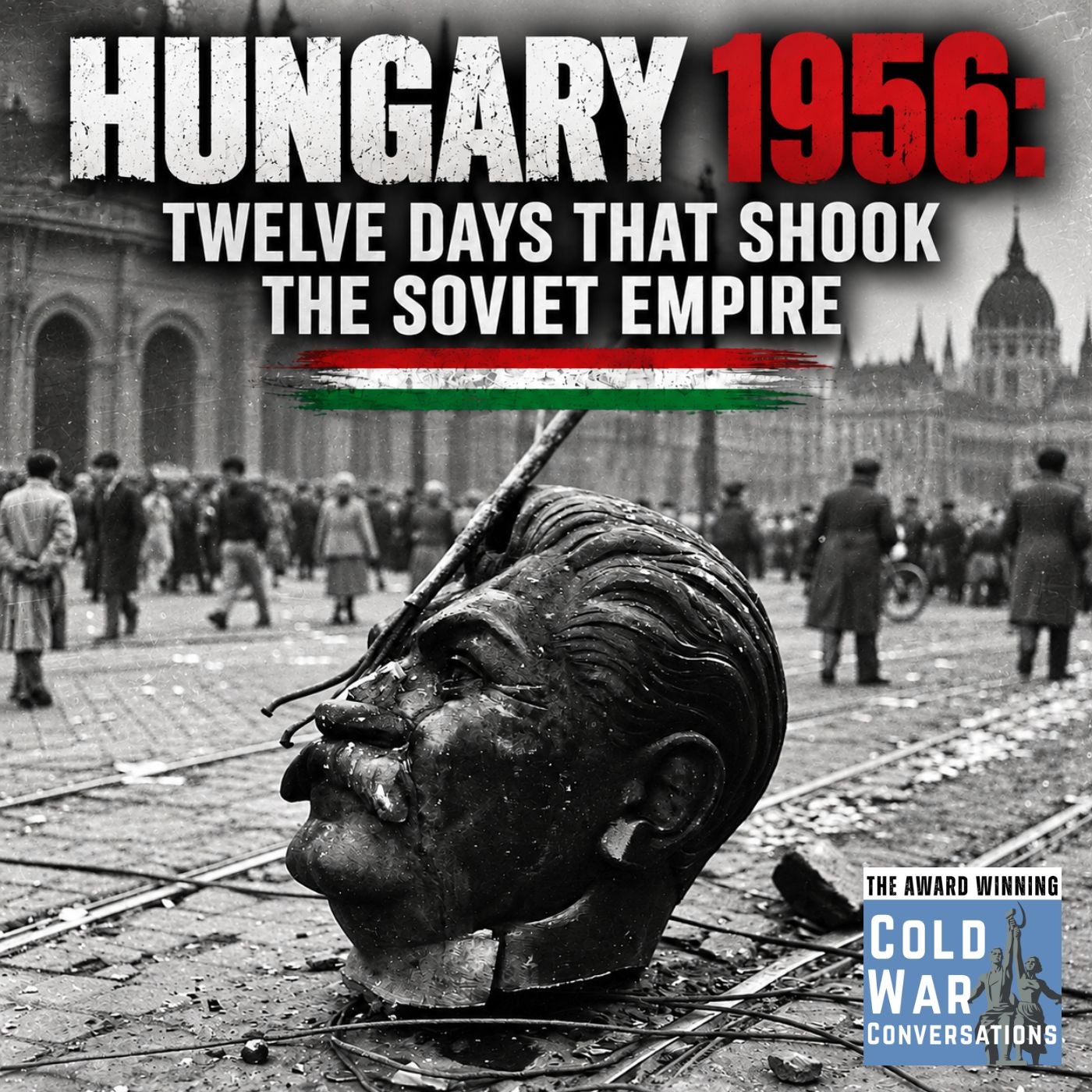
The Hungarian Revolution of 1956—how a 12-day uprising grew from student protests into a national revolt against Stalinist rule and Soviet control, why Moscow briefly considered withdrawing, and why it ultimately launched Operation Whirlwind (4 Nov 1956) to crush the revolution, followed by Soviet-backed repression and long-term political consequences.
No guest names or biographies appear in the provided transcript.
Stalinist Hungary was maintained through AVH secret-police terror, economic coercion, and show trials (e.g., László Rajk). After Stalin’s death, limited reforms under Imre Nag and Khrushchev’s “secret speech” expanded debate. The revolution’s demands combined civil liberties, workers’ councils, and national independence. Moscow reversed course due to regime collapse, fear of “contagion,” reports of killings of communists/AVH, and a favorable international distraction (Suez). Soviet deception at Tököl led to the arrest of Hungarian negotiators before the invasion.
The 23 Oct student demonstration and 16-point demands; the Stalin statue toppled; the radio station shootings; Kossuth Square massacre (25 Oct); workers’ councils; Republic Square executions (30 Oct); Imre Nag’s 4 Nov Radio Kossuth broadcast; the Korvin Passage fighting; Nag’s 1958 execution; ~200,000 refugees; János Kádár’s “goulash communism” settlement.
Written by AI. May contain mistakes.
Exploration of the Soviet assault on Budapest and the uprising's backstory.
“At approximately 4.15 on the morning of 4th November, Soviet forces launch their assault.”
Discussion of Hungary's political situation post-WWII and the rise of Stalinism.
“from political terror and secret police repression to the street battles against Soviet tanks, workers' councils and Hungary's attempt to break free from Moscow.”
Examination of how Stalinism was implemented in Hungary and its effects on society.
“In the spring of 1945, Hungary emerges from the war physically shattered and politically compromised.”
Analysis of Imre Nagy's policies and the initial efforts at reform in Hungary.
“Peasants are pressured to surrender land and produce.”
Insight into the build-up to the 1956 revolution and its relation to Eastern European dynamics.
“Authoritarian governments sometimes survive not because people support them but because people believe change is impossible.”
Learn about the student-led movement in Hungary that demanded reforms and sparked a national uprising.
“Instead it becomes a silent indictment of the regime.”
Explore the events and consequences of the Soviet intervention in Budapest during the uprising.
“The First Soviet Intervention In the early hours of the 24th of October, Soviet tanks enter Budapest.”
Explore the initial political changes in Hungary during the revolution.
“Fighting subsides, political prisoners are freed.”
Understand the factors influencing Soviet intervention in Hungary.
“On the 31st of October the Soviet presidium reverses course.”
Learn about the Soviet military strategy and deception tactics during the invasion.
“American rhetoric has encouraged the liberation of Eastern Europe and Radio Free Europe broadcasts have provided news, commentary and at times dangerously optimistic assessments.”
Witness the details of the Soviet invasion and the resistance from Hungarian fighters.
“The scale of the operation makes it clear that this is not simply an attempt to support Hungarian loyalists against insurgents, it is a military conquest of the country.”
Learn about the initial responses and dynamics during the Hungarian uprising.
“The revolutionary groups possess courage and knowledge of the local terrain.”
Explore the political repression following the uprising and its long-term effects.
“Repression The Soviet victory does not immediately produce political obedience.”
Understand the broader implications of the Hungarian Revolution on Cold War dynamics.
“In immediate terms, the answer seems bleak.”
Explore the events leading to the collapse of the Hungarian government during the uprising.
“One of the speakers is a young opposition politician named Viktor Orban, who publicly demands free elections and the withdrawal of Soviet troops.”
Encouragement for listener interaction and closing remarks on the episode.
“Power up your movie night and watch Disney and Pixar's Toy Story 5, now streaming on Disney +, rated PG.”

Get the gist, explore an idea or ask about something said.
 Claude
On Cold War Conversations, what are the key points of this episode?
Searching your listeningAutomatic transcript. May contain errors.
0:00Welcome to Cold War Conversations, the home of real stories of the Cold War. Hi there, I am fully charged and here to tell you, Toy Story 5 is now on Disney+. Woody! It's been too long, cowboy. Woody, Buzz, and Jesse are back for a brand new adventure with some seriously cool new tech. What? Holy butterscotch! You said it, Jesse! So, save your batteries and watch the global phenomenon at home. And the best part? It's perfect for the whole family. Power up your movie night and watch Disney and Pixar's Toy Story 5, now streaming on Disney Plus, rated PG. It is still dark when Operation Whirlwind begins.
0:39At approximately 4.15 on the morning of 4th November, Soviet forces launch their assault. Thousands of troops supported by tanks, artillery and armoured vehicles move against Budapest and other strategic centres. At 5.20 on the morning of 4th November 1956, Hungarian Prime Minister Imre Nagy went on the radio with a desperate announcement. Soviet forces were attacking Budapest. Within hours, tanks and artillery would crush one of the most dramatic uprisings of the Cold War. But how had a student demonstration just 12 days earlier grown into a national revolution that brought Hungary's Stalinist regime to the brink of collapse?
1:24In this episode we follow the extraordinary story of the Hungarian Revolution of 1956 from political terror and secret police repression to the street battles against Soviet tanks, workers' councils and Hungary's attempt to break free from Moscow. We also examine why the Kremlin briefly considered withdrawing its forces, why it changed its mind and why the West watched as Soviet armour returned to Budapest. For 12 extraordinary days, freedom suddenly seemed possible. In the early hours of this morning, Soviet troops launched an attack against our capital with the obvious intention of overthrowing the lawful democratic Hungarian government.
2:08Our troops are fighting. The government is in its place. That's Imre Nag, the Prime Minister of Hungary, speaking on Radio Kossuth. at 5.20 on the morning of the 4th of November 1956. The broadcast lasts barely half a minute. There's no stirring music, no theatrical flourish. Narg doesn't pretend that reinforcements are coming because they aren't. He doesn't promise victory because by then victory is almost impossible. Outside the parliament building Soviet tanks are moving into Budapest. and artillery fire is beginning to roll across the city. And yet those final words, the government is in its place, sound almost defiant.
2:55The government still exists. Hungary is still claiming the right to decide its own future. And Nag wants the world to know what is happening before Soviet troops reach the radio station and silence it. so the central question in this story is not simply why hungarians rebelled against communist rule after years of political terror economic hardship and foreign occupation that isn't terribly difficult to understand the harder question is this how did a student demonstration in budapest grow into a national revolution force the collapse of a stalinist government and persuade the Soviet leadership briefly that it might withdraw?
3:38And then, having come so close to a political settlement, why did Moscow change its mind and send in the tanks? To answer that, we need to go back, not to the dramatic mourning of the 4th of November, but to the difficult years after World War II.
3:58Part 1. Stalinism comes to Hungary. In the spring of 1945, Hungary emerges from the war physically shattered and politically compromised. The country has fought alongside Nazi Germany for much of the conflict. In March 1944, German forces occupied Hungary and later that year the fascist Arrow Cross movement seized power. Hundreds of thousands of Hungarian Jews were deported and murdered. Budapest became a battlefield, the siege of the capital, lasting from December 1944 until February 1945, left large sections of the city in ruins. The Red Army arrives as a liberator from Nazi rule. It also arrives as an occupying army.
4:48These two facts exist at the same time, and Hungarian post-war politics can't really be understood without holding both of them in mind. in November 1945 Hungary holds a relatively free parliamentary election the independent smallholders party win an absolute majority with more than 57 % of the vote the Hungarian communist party wins about 17 % now in most democracies that result would settle the question of who governs but Hungary is occupied by the Soviet Union and the Soviet authorities insist on a coalition in which communists retain control of key ministries. The most important of these is the interior ministry because it controls the police.
5:35Matthias Rakosi, the leader of the Hungarian communists, later describes the method used to eliminate his opponents as salami tactics. The political groups are isolated one after another, accused of fascism or conspiracy, then removed slice by slice. The process is gradual enough to create an appearance of legality. Politicians are arrested, blackmailed or forced into exile. Opposition parties are divided from within. Parliamentary deputies lose their seats. The secret police manufacture evidence of conspiracies. By 1949 the independent political opposition has been destroyed. Hungary is transformed into the Hungarian People's Republic, a one-party state modelled closely on Stalin's Soviet Union.
6:26Rokosi becomes the dominant figure in the country. He describes himself as Stalin's best Hungarian disciple and this is not false modesty. The political police, eventually known as the AVH, the State Protection Authority, operates through surveillance, intimidation and arbitrary arrest and torture. Its headquarters at 60 Andrasi Avenue in Budapest had previously been used by the Arrow Cross. Under communist rule the building continues to be associated with interrogation, imprisonment and fear. Political terror is not directed only at former fascists, landowners or open opponents of communism. It also reaches into the communist party itself.
7:14In 1949, Laszlo Rack, a prominent communist and former interior minister, is accused of being a Titoist and a Western agent. Titoism means alleged loyalty to Yugoslavia's communist leader Jozef Broz Tito, who is broken with Stalin. Rack confesses under interrogation and torture. He is convicted in a show trial and executed on 15 October 1949. The trial is intended to demonstrate the party's vigilance. In fact it demonstrates something else. Nobody is safe. The regime also attempts to transform Hungary's economy at extraordinary speed. Heavy industry is prioritised. Agriculture is pushed towards collectivisation.
8:04Consumer goods and living standards become a distant second. Production targets are imposed from above and regularly manipulated. Workers face demanding quotas. Peasants are pressured to surrender land and produce. Food shortages and declining real wages deepen popular resentment. Hungary is being forced to behave like a vast industrial power despite being inconveniently Hungary. The regime also wages a campaign against the churches. Cardinal Jozef Mijenski, the country's leading Catholic church man is arrested in December 1948 and sentenced to life imprisonment after a show trial. Behind the public rallies, the heroic posters and the declarations of ever-increasing production fear settles over everyday life.
8:56People learn what can be said at work and what can be said at home and what perhaps shouldn't be said at all. A careless remark can be reported by a colleague, a neighbour or even a relative. The state encourages public enthusiasm whilst creating private silence. Yet by the early 1950s the system is becoming difficult to sustain. The economy is badly distorted. The prisons are crowded. Rokosi's terror has alienated workers, peasants, intellectuals and even many communists. Then on the 5th of March 1953 Joseph Stalin dies and across eastern Europe a question begins to form. If Stalin has gone must Stalinism continue?
9:45Part 2 Imre Nag and the failed reform The new Soviet leadership want greater stability in its Eastern European satellites. That doesn't mean democracy. It means fewer disasters, fewer purges and ideally fewer economies being driven into the ground by people reporting imaginary production figures to one another. In June 1953 Moscow pressures Rakozi to surrender the premiership to Imre Nag. Nag. Nag is an unusual communist. Born into a peasant family in 1896, he spent time in the Soviet Union and joined the Communist Party, but he believes socialism needs broader public support and a less coercive economic program.
10:35His new course slows industrialization, reduces pressure on agriculture, closes some internment camps and releases political prisoners. The government promises greater legality. Living standards begin to receive more attention. For many Hungarians, the changes are modest. Hungary remains a one-party state. Soviet troops remain in the country and the AVH still exists. But after the Rokosi years, even limited reforms feel significant. It also creates expectations. That is important. Authoritarian governments sometimes survive not because people support them but because people believe change is impossible.
11:19Once the government itself demonstrates that policy can change the public begins to ask why it shouldn't change further. Rukosi works persistently to undermine Naag. By April 1955 Naag has been dismissed as Prime Minister. Later that year he's expelled from the Communist Party. For the moment Rukosi appears to have won. But then in February 1956 and the 20th Congress of the Communist Party of the Soviet Union, in a closed session the Soviet leader Nikita Khrushchev delivers the so-called secret speech, denouncing Stalin's personality cult and some of his crimes. The speech is not a rejection of communist rule.
12:03Khrushchev is trying to rescue the system while separating it from Stalin's worst excesses. Still, the political effect is explosive. If Stalin abused power, what does that say about leaders like Rokosi, who built their authority by copying him? Hungarian intellectuals begin testing the limits of permissible debate. The Potofi Circle, named after the 19th century poet Sandor Potofi, organises public discussions about economics, history, literature and political responsibility. The meetings attract increasingly large audiences. Speakers criticise censorship, economic mismanagement and the treatment of Laszlo Rack.
12:49Communist students, writers and journalists are not necessarily rejecting socialism. Many of them want what they regard as a more honest, democratic and national form of it. That distinction matters. The revolution of 1956 will contain liberals, social democrats, nationalists, workers, students, peasants, former political prisoners and reform communists. They won't all want the same thing, but what unites them is rejection of Rakosi's dictatorship and Hungary's subordination to Moscow. In July 1956, the Soviet leadership finally removes Rakosi. He's sent to the Soviet Union officially for medical treatment.
13:33Erno Gero replaces him as the leading figure in the Hungarian Communist Party. But Gero is a hardline Stalinist. Changing Rokosi for Gero is rather like responding to complaints about the suit by changing the label on the tin. On the 6th of October 1956, Laszlo Rack is formally buried in Budapest. Tens of thousands attend. the government intends the ceremony to acknowledge the mistakes of the past and restore public confidence. Instead it becomes a silent indictment of the regime. Rack was a communist executed by communists after a communist show trial. If the party murdered one of its own senior leaders what else had it lied about?
14:19And while Hungary is becoming increasingly unsettled events in neighbouring Poland demonstrate that pressure can produce political change. In June, workers in Poznań stage protests over wages, prices and conditions. Polish authorities suppress them with force, but the crisis continues. In October, Władysław Gomolka, previously removed and imprisoned by the Stalinist period, returns to power despite Soviet misgivings. Soviet troops move towards Warsaw, Khrushchev and other Soviet leaders fly to Poland. Yet after tense negotiations, Moscow accepts Gamalca's leadership because he promises to preserve communist rule and Poland's membership of the Warsaw Pact.
15:05The lesson observed in Budapest is obvious. Moscow can be confronted. The dangerous assumption is that Hungary will be allowed to follow the same path.
15:19Part 3. The Students' 16 Points. It's Monday evening the 22nd of October 1956. At the Technical University in Budapest, students gather for what begins as a meeting about their student organisation. The discussion quickly expands. They draw up a list of 16 demands. The points include the withdrawal of Soviet troops, the election of new Communist Party leaders by secret ballot, the formation of a government under Imre Nag, the investigation of Rukosi's crimes, freedom of speech and the press, a reorganisation of economic life, the removal of Stalin's statue and the restoration of Hungary's traditional coat of arms.
16:06they also demand greater political equality with the soviet union the program is a mixture of socialist reform national independence and democratic aspirations it isn't yet a detailed blueprint for dismantling the communist system but if implemented it would destroy the stalinist dictatorship the students decide to hold a demonstration the following afternoon in solidarity with reformers in Poland. The government initially bans it then shortly before it is due to begin the authorities reverse their decision. The hesitation reveals the regime's weakness. It knows repression might provoke public anger but it fears what will happen if people are allowed to gather.
16:51On Tuesday the 23rd of October crowds assemble near the statue of Josef Bem, a Polish general who fought for Hungary during the revolution of 1848-49. It's a carefully chosen symbol, Polish-Hungarian solidarity, national independence and resistance to foreign domination. Students march through the city. Office workers leave their desks. Factory workers finish their shifts and join them. Soldiers watch. Some remove the red stars from their caps. the crowd grows from thousands to tens of thousands and then larger still precise numbers vary between accounts but by evening perhaps 200 000 people are gathered outside the parliament building in kossuth square hungarian flags appear with their communist emblems cut from the center that image a trickler with a hole where the state symbol should be becomes the emblem of the revolution.
17:53It says rather a lot, with almost no graphic design budget whatsoever. The demonstrators demand that Imre Nag speak. Nag is reluctant. He's only recently been re-admitted to the party and does not control events. When he eventually peers on the parliament balcony, he begins by addressing the crowd as comrades. The response is hostile. That single word belongs to the official political language people are rejecting. Nag adjusts and addresses them as citizens. He urges calm and promises reforms but the movement has already moved beyond a carefully managed party programme. Elsewhere demonstrators gather around the enormous bronze statue of Stalin in the city park.
18:42The statue is pulled down leaving only the boots attached to the pedestal. Pieces of the monument are dragged through the streets. It's a spectacular, symbolic victory, but the decisive confrontation is developing at the Hungarian radio station on Brody Sandor Street. A student delegation enters the building, hoping to broadcast the 16 points. The AVH detains them. Outside, the crowd demand their release. Tear gas is used. Tension rises. Then gunfire begins. exactly how the first shots were fired remain disputed in detailed accounts but AVH personnel fired on demonstrators people are killed and wounded ambulances arrive Hungarian soldiers sent to control the crowds begin handing weapons to civilians or joining them the nature of the crisis changes at that moment it's no longer simply a demonstration it is an armed uprising Police stations, military depots and factories become sources of weapons.
19:48Lorries carry fighters through Budapest. Some members of the police and army ride with the revolutionaries. Others hesitate, disappear or remain loyal to the government. Gero broadcasts a speech condemning the demonstrators and describing their actions as chauvinistic and anti-Soviet. It is a disastrous intervention. Rather than calming the situation, he confirms that the leadership neither understands nor respects the movement in the streets. Late that evening, the Hungarian leadership appeals for Soviet military assistance. Soviet troops stationed outside Budapest are ordered into the capital.
20:30Cold War history deserves to be remembered, and by listening to the next few adverts, you help us to do exactly that. Thank you. Hi there, I am fully charged and here to tell you, Toy Story 5 is now on Disney+. Woody! It's been too long, cowboy. Woody, Buzz and Jesse are back for a brand new adventure with some seriously cool new tech. What? Holy butterscotch! You said it, Jesse! So, save your batteries and watch the global phenomenon at home. And the best part? It's perfect for the whole family. Power up your movie night and watch Disney and Pixar's Toy Story 5, Now streaming on Disney Plus, rated PG.
21:09Not enjoying the ads? Well, you can avoid them by going to coldwarconversations.com slash donate. By becoming a monthly or annual supporter, you'll enjoy ad-free listening, become a part of our community, receive the sought-after Cold War Conversations drinks coaster, and bask in the warm glow of knowing that you're helping to preserve Cold War history. Just go to coldwarconversations.com slash donate for more information. Part 4. The First Soviet Intervention In the early hours of the 24th of October, Soviet tanks enter Budapest. For Moscow, this initially appeared to be a limited operation. Restore order, protect key buildings and support the existing government.
21:57Soviet leaders assume the presence of armour will intimidate the demonstrators. instead it produces urban warfare. The Soviet forces are not fully prepared for the political or military situation. Some crews have inadequate maps. Some soldiers appear uncertain about why they are there. They are told they've been confronting fascists or counter-revolutionaries yet the people approaching their vehicles include workers, students and teenagers. In some places, demonstrators attempt to speak to Soviet soldiers. In others, fighting begins almost immediately. Budapest offers the insurgents a difficult but not hopeless battlefield.
22:39Tanks moving through narrow streets are vulnerable. Fighters use rifles, machine guns, grenades and petrol bombs. They attack from windows, rooftops and side streets. The most famous centres of resistance include the Korvin Passage, a cinema complex surrounded by apartment blocks near the intersection of Ulay Road and the Grand Boulevard. Its courtyards and narrow approaches provide cover for fighters. Many insurgents are remarkably young. Some are factory workers, others are students or apprentices. Their clothing is civilian and their organisation improvised. Leadership changes quickly. Groups are formed around neighbourhoods rather than a central revolutionary command.
23:24At the same time, the political leadership is frantically reorganising itself. Imre Nag becomes Prime Minister again on the 24th of October. Janos Kader replaces Giro as the First Secretary of the Communist Party the following day. Nag initially speaks within the government's existing language. He calls for order and refers to the uprising as a counter-revolutionary disturbance. He offers an amnesty to those who lay down their weapons. The appeal fails. Why? Because the demand to disarm comes while Soviet tanks are in Budapest and the AVH is still operating. The insurgents have no reason to trust the government created under Soviet pressure.
24:08If they surrender their weapons, what protects them from arrest? Nag now faces an extraordinary political problem. He's been brought back to stabilise the communist system but the population expects him to transform it. Moscow expects control. The streets demand revolution and then on the 25th of October violence reaches parliament itself. Thousands of unarmed demonstrators gather on Kossuth square. Some fraternise with Soviet tank crews. The atmosphere according to several accounts briefly seems peaceful. Then shots ring out. Fire comes from positions around the square. Panic follows. Soviet tanks and other armed personnel also open fire, although the exact sequence and responsibility for every shot remains disputed.
24:58The crowd is caught in the open. People fall across the square. Others attempt to shelter behind monuments, vehicles and one another. Estimates of those killed vary significantly. The evidence does not support a single exact figure. What is certain is that scores of civilian died and many more were wounded. The Kossuth Square massacre destroys what remains of the regime's credibility. It also intensifies public fury against the AVH. There are further shootings elsewhere in Hungary. Near the Austrian border, security forces opened fire on the 26th of October. The precise death toll is contested but the numbers killed were substantial.
25:43In this story, it's important to resist reducing the dead to competing figures. The uncertainty is real. So is the event. Unarmed civilians were shot. Families searched hospitals, mortuaries and public anger hardened into a demand for the removal of the political system responsible. By now, the revolt has spread well beyond Budapest. In towns and industrial centres across Hungary, local revolutionary committees take power. Workers establish councils in factories and mines. Prisoners are released. Communist symbols are removed. AVH offices are attacked or abandoned. The workers' councils are particularly significant.
26:26Soviet and later Qadar era propaganda will describe the entire uprising as fascist counter-revolution. But the councils arise in working class district and demand both political freedom and genuine workers' control. Many participants do not want capitalism restored. They want a democratic, independent Hungary, in which factories are not controlled by a privileged party bureaucracy. This is one reason why the uprising is so dangerous to Moscow. It isn't merely an anti-communist movement attacking socialism from outside. Part of it claimed to represent a more legitimate socialism than the ruling party itself.
27:11Part 5. The Revolution Breaks Through Between the 26th and 28th of October the government's position changes dramatically. Narg begins negotiating with insurgent representatives. He recognises that military repression has failed and that the movement possessed genuine national support. On the 28th October he announces a ceasefire. He describes the events not as counter-revolution but as a great national and democratic movement. The government agrees to dissolve the AVH, negotiate the withdrawal of Soviet forces from Budapest and create new security forces and increase wages. The old political language is collapsing.
27:56The shift is not merely rhetorical. Soviet units begin withdrawing from Budapest. Fighting subsides, political prisoners are freed. Cardinal Midsensky is released from captivity on the 30th of October. Across the country, revolutionary councils and committees assume administrative authority. Newspapers appear without the old censorship. Political parties destroyed in the late 1940s begin to reorganise, including the independent smallholders, the Social Democrats and the National Peasant Party, now renamed the Pitofi Party. For a few remarkable days Hungary possesses something approaching political freedom.
28:38It's exhilarating but it's also unstable. There is no single revolutionary program. Some demand a reformed communist state under NARG, others want parliamentary democracy, some seek neutrality while others initially imagine Hungary may remain in the Warsaw Pact under new terms. There are also revenge attacks. On the 30th of October armed insurgents attacked the Budapest Communist Party headquarters in Republic Square. The defenders include AVH personnel and party officials. After the building falls several captives are shot, beaten or lynched. their bodies are left in public view. The number killed and the precise circumstances of individual deaths vary across accounts.
29:25Contemporary Soviet and communist propaganda used the images as proof that Hungary is experiencing a fascist counter-revolution. That claim is misleading. The broader movement cannot reasonably be characterised as fascist. Its main demands concern national independence, civil liberties, free elections and the removal of Stalinist institutions. But the killings at Republic Square were real. They horrified many of the revolution's supporters and gave Moscow potent images with which to justify intervention. It is one of those moments where historical explanation requires two thoughts at once. The Soviet description of the revolution as a fascist conspiracy was false and some insurgents committed brutal acts against prisoners and suspected secret police members.
30:15Acknowledging one does not cancel the other. On the same day, 30th October, the Soviet government issues a declaration suggesting it is prepared to negotiate its military relationship with the Eastern European socialist states. Inside the Soviet leadership, withdrawal from Budapest, perhaps even from Hungary is seriously considered. Marshal Georgi Zhukov argues that Soviet troops should leave the capital and if necessary the country. Khrushchev warns that further intervention might resemble the Anglo-French attack then unfolding against Egypt. After a brief period Moscow appears willing to accept a reformed Hungarian government.
30:58This is not simply a deception from the beginning. The surviving Soviet records indicate the leadership genuinely debated its options and initially chose compromise. That makes what follows more important and more chilling. The decision to crush the revolution was a decision. It was not an unavoidable reflex. Part 6. Why Moscow changed its mind. On the 31st of October the Soviet presidium reverses course. The record does not provide one neat explanation several pressures appear to converge. First the Hungarian revolution is moving rapidly beyond the reform of the communist party. The one-party state is disintegrating.
31:46Independent parties are returning. Workers councils are challenging the control of industry. The security apparatus has collapsed. Second Soviet leaders fear contagion. If Hungary can leave Moscow's political and military system. What happens in Poland, Czechoslovakia, Romania, East Germany? The Soviet Union's East European buffer has been built through war, occupation and enormous sacrifice. Khrushchev and his colleagues are not prepared to watch it unravel country by country. Third, reports from Budapest emphasise the killings of communists and AVH personnel. The scenes from Republic Square strengthen the argument of those who claim that delay will lead to the destruction of the Hungarian party and perhaps the murder of its remaining supporters.
32:38Fourth, the international situation appears favourable for intervention. On the 29th of October, Israel attacks Egypt. Britain and France then intervene in the Suez crisis, attempting to seize control of the canal and remove Egyptian President Gamal Abdel Nasser. The crisis distracts the Western powers and undermines any moral authority Britain and France might claim in condemning Soviet action. It would be too simple to say Suez is caused by the invasion of Hungary. Soviet security concerns were decisive in their own right, but Suez absorbed international attention an exposed Western decision at precisely the moment Hungary needed an effective diplomatic response.
33:26There's also China. Mao Zedong and other Chinese leaders are involved in consultations about the crisis. The precise influence of Beijing on the final Soviet decision has been debated but Chinese support for restoring communist control reinforced the interventionist position. finally moscow fears that neutrality will transform hungary from an unreliable ally into a strategic breach in the center of eastern europe and that's exactly the issue that narg now forces on the 1st of november after discovering that fresh soviet troops are entering hungary narg announces that the country is withdrawing from the warsaw pact and declaring neutrality The Warsaw Pact created in 1955 is the Soviet-led military alliance established in response to West Germany joining NATO In practice it institutionalises Moscow's strategic control over its Eastern European allies NAG appeals to the United Nations and the four great powers to defend Hungary's neutrality It's a bold decision, it also reduces the room for compromise Why does he take it?
34:42Because Soviet troop movements suggest the earlier promise of withdrawal is false. NARG needs an international framework capable of protecting Hungarian sovereignty. Neutrality perhaps modelled on Austria's settlement in 1955 seemed to offer one. But Austria and Hungary occupy very different political positions. Austria was not governed by a communist regime. It was not a member of the Warsaw Pact. Moscow views Hungary's departure as a threat to the entire Soviet bloc. Nag hope's international opinion might restrain the Soviet Union. What evidence does he have that the West will react? Very little.
35:26American rhetoric has encouraged the liberation of Eastern Europe and Radio Free Europe broadcasts have provided news, commentary and at times dangerously optimistic assessments. Some broadcasts criticised NARG and suggested that resistance might obtain outside assistance or force further Soviet concessions. The exact impact of these programmes on a Hungarian decision making remains disputed. The uprising itself was indigenous. It was not organised by Radio Free Europe or the CIA, nor is there evidence that western broadcasts created the deep grievances driving it. But some broadcasts help sustain unrealistic expectations.
36:10They did not amount to a formal promise of western military intervention yet desperate listeners could interpret them as evidence that help might come. The Eisenhower administration however had no intention of fighting the Soviet Union in Hungary. American leaders understand the military reality. Hungary is surrounded by Soviet-aligned states and Soviet forces. Western military intervention would escalate into a European war involving nuclear weapons. NATO possesses neither a practical plan nor political agreement to liberate Hungary. The United States can protest, provide humanitarian assistance and take the matter to the United Nations.
36:52It cannot save the revolutionary government without risking a much wider war. That may explain Western restraint but it does not make the consequences any less bitter for the Hungarians. Part 7. Deception at Tokol. While publicly discussing withdrawal the Soviet military prepares a much larger operation. Fresh troops enter Hungary from the east. Soviet units secure airports, roads, bridges and communications. Commanders surround major urban and industrial areas. The invasion plan is known as Operation Whirlwind. Moscow also needs an alternative Hungarian government, one that can claim Soviet forces are responding to a legitimate request for assistance.
37:42Janosz Kadar provides it. Kadar's role is one of the most complicated in the story. He had himself been imprisoned and tortured during the Rokosi era. In the first days of the revolution he appeared to support Nag's reform program. On the 1st of November he participates in the creation of the new Hungarian Socialist Workers Party and speaks in defense of what he calls the people's glorious uprising. Then he disappears from Budapest. He is taken into Soviet custody or protection. The exact degree of coercion or willing collaboration remains debated but he travels into Soviet orbit By 4th of November he heads a new revolutionary worker-peasant government supported by Moscow Whatever pressures Kadar face, he ultimately agrees to front the regime imposed by the invading army Meanwhile the Nag government continues negotiations with Soviet representatives about troop withdrawal On the evening of 3rd November a Hungarian delegation travels to the Soviet military headquarters at Tókol near Budapest.
38:56The delegation is led by Paul Malata, the recently appointed Minister of Defence. Malata has become one of the revolution's most prominent military figures after siding with the insurgents at the Kilian barracks. The Hungarians believe they are negotiating practical details, withdrawal routes, timetables and military arrangements. During the talks Ivan Serov, chairman of the Soviet KGB, enters the room. The Hungarian delegation is arrested. It's a calculated act of deception. By seizing Malata and his colleagues, the Soviets deprive the government of senior military leadership hours before the attack.
39:36around budapest soviet forces are already in position the negotiations were never a route out of the crisis they were part of the preparations for destroying the government part eight the 4th of november it is still dark when operation whirlwind begins at approximately 4 15 on the morning of the 4th of november soviet forces launch their assault thousands of troops supported by tanks, artillery and armoured vehicles move against Budapest and other strategic centres. The scale of the operation makes it clear that this is not simply an attempt to support Hungarian loyalists against insurgents, it is a military conquest of the country.
40:20At 5.20, Narg makes the broadcast we heard at the beginning. Our troops are fighting. The government is in its place. the statement is factually and politically precise soviet forces are attacking the recognized hungarian government narg will not describe the invasion as internal assistance because it isn't shortly after kardar announces the creation of his rival government from the eastern city of solnok or through a broadcast presented as originating there he declares that counter-revolutionary forces threaten socialism and calls for Soviet help. In Budapest, the revolutionary government is rapidly isolated.
41:01The parliament building is surrounded. Imre Nag, along with several colleagues and family members, seek refuge in the Yugoslav embassy. Istvan Bibo, a political theorist and minister of state, remains inside the parliament after most of the government has departed. Alone, he writes a proclamation appealing to Hungarians not to recognize the Soviet-imposed administration and urging the world to defend the country's freedom. Outside, resistance continues. Soviet forces capture major government buildings, railway stations, bridges and radio facilities. Radio Kossuth ceases broadcasting shortly after eight in the morning, but organized resistance does not simply evaporate.
41:47At the Korvin passage in Josef Varos and Ferenk Varos and in the industrial district of Sepol, Hungarian fighters oppose Soviet armour. Resistance also continues at Petsch, Duna Pateli then officially called Stalinyaros and other centres. The revolutionary groups possess courage and knowledge of the local terrain. What they do not possess is a unified command, secure communication, sufficient heavy weapons or any realistic prospect of reinforcement. Soviet tanks advance cautiously through streets where the first intervention demonstrated their vulnerability. Artillery fire strikes buildings thought to contain resistance positions.
42:34Civilian neighbourhoods become battlefields. Some Hungarian soldiers fight, some surrender, others abandon their units. The army does not mount a coordinated national defence because its leadership has been decapitated, its units are divided and Soviet forces control the main communications network. The fighting is most intense in the working class districts. Again, that fact sits awkwardly with the official Soviet claim that this is a fascist rising. Many of the people continuing to resist are industrial workers, supposedly the social class in whose name communist rule exists. Free radio stations appeal repeatedly for Western assistance.
43:15No military help comes. It's tempting to imagine that one dramatic Western intervention might have changed everything. But we need to be honest about the alternatives available to decision makers in Washington, London and Paris. A direct military operation would have required forces to fly over hostile territory and confront the Soviet army within its own security zone. It might have triggered a war between NATO and the Warsaw Pact. In 1956, both the United States and the Soviet Union possessed nuclear weapons. That does not excuse years of Western rhetoric, implying that the captive nations of Eastern Europe might be liberated.
43:57It does explain why, when Hungarians acted as if liberation were possible, the West stopped at condemnation. President Dwight Eisenhower's administration had encouraged political pressure on Soviet control. it has never intended to launch a war to break that control. For the fighters in Budapest that distinction is academic. By the 10th or 11th of November the major centres of armed resistance have been defeated although isolated strikes and protests continue. Workers councils attempt to preserve political demands through industrial action. The revolution is over as a military struggle, but it is not yet over as a social movement.
44:41And this is why Cardar's new government still faces a serious challenge. It's time for a short break. These adverts help preserve more extraordinary Cold War stories. Thanks for listening and supporting our work. Hi there, I am fully charged and here to tell you, Toy Story 5 is now on Disney Play. Woody! It's been too long, cowboy. Woody, Buzz, and Jesse are back for a brand new adventure with some seriously cool new tech. What? Holy butterscotch! You said it, Jesse. So, save your batteries and watch the global phenomenon at home. And the best part? It's perfect for the whole family. Power up your movie night and watch Disney and Pixar's Toy Story 5, now streaming on Disney Plus, rated PG.
45:26Hello, I'm Craig Donald from Aberdeen, and I support Cold War Conversations with a monthly donation because it marries interesting historical content with fantastic storytelling. Ian is a great gift as an interviewer. He knows his subjects so that the conversations are meaningful, but he also allows guests to tell their own story. Cold War Conversations is part of my weekly routine and I would urge you to make it part of yours. Want to be like Craig and help to preserve these incredible stories of the Cold War? As a monthly or annual supporter, you'll become one of our community, get a sought-after Cold War Conversations drinks coaster as a thank you, and you'll bask in the warm glow of knowing that you're helping to preserve Cold War history.
46:09Just go to coldwarconversations.com slash donate to find out more. Part 9. Repression The Soviet victory does not immediately produce political obedience. Workers' councils remain active. Their members demand the withdrawal of Soviet troops, the return of NAARG and the recognition of the revolution's aims. Kardar initially uses promises as well as force. His government suggests that some reforms will survive and that participants who end resistance may avoid punishment. But the room for independent organisations steadily closes. Demonstrations are dispersed. council leaders are arrested. Emergency regulations permit imprisonment and execution.
46:57The government rebuilds the security apparatus under new names and with new personnel, though it avoids restoring the hated AVH exactly as it was. On 22nd of November, Nag and his companions leave the Yugoslav embassy after receiving assurances of safe conduct. They are immediately seized by Soviet security forces and transported to Romania. The assurance was worthless. Nag is held in isolation and pressured to resign and legitimise the Cardinal government. He refuses. Eventually he's returned to Hungary and subjected to a secret trial. On the 16th of June 1958 Imre Nagy, Paul Malata and journalist Miklos Gimes are executed.
47:45Nag's body is buried in an unmarked grave. The secrecy serves a purpose. The government wants to eliminate him without creating a public martyr. It succeeds in the first aim and fails completely in the second. Across Hungary reprisals continue for years. The exact statistical totals differ according to definitions and sources but more than 200 people were executed for offences connected with the revolution. Thousands received prison sentences and many more were detained or turned. Some trials involved people who'd committed violent offences, others were plainly political acts intended to destroy armed resistance and impose retrospective obedience.
48:28Teenage participants could be kept alive until reaching an age at which a death sentence could be carried out. One of the most famous cases was Petter Mansfield, arrested after the uprising and executed in 1959 shortly after his 18th birthday. The violence of the reprisal should not be confused with the chaotic fighting in October and November. This is calculated state punishment conducted after the government has regained control. The authorities possess time to investigate, choose defendants and decide sentences. The executions are therefore not acts of panic, they are policy. The human cost of the revolution is substantial.
49:11Approximately 2 ,500 to 3 ,000 Hungarians were killed, although totals vary. Around 20 ,000 were wounded. Soviet military losses were roughly 700 dead and 1 ,500 wounded. Budapest suffered most heavily. Apartment buildings were scarred by shells and gunfire. Families lost relatives. Hospitals treated casualties with limited supplies. Then comes the exodus. Around 200 ,000 Hungarians leave the country, most crossing into Austria and a smaller number into Yugoslavia. Many are young, among them are students, skilled workers, professionals, families and former fighters. The Austrian government and international relief organisations confront a vast humanitarian emergency.
49:58Refugees are housed in camps before being resettled across Europe, North America, Australia and elsewhere. For Hungary it's an enormous loss of people and talent. For the receiving countries the crisis becomes one of the most defining refugee movements of the early Cold War. The revolutionaries have been defeated but their experiences now travel with them. They carry memories of the demonstrations, the fighting, the radio appeals and the moment when freedom seemed not merely desirable but possible. Part 9. Kadar's Compromise. Janusz Kadar will govern Hungary, directly or indirectly, for more than three decades.
50:42His initial authority rests on Soviet tanks and repression. That fact cannot be removed from the story of what comes later. But Kadar understands that permanent rule by terror alone will produce permanent instability. Once resistance has been crushed he gradually seeks a different form of political settlement. By the 1960s Hungary develops a more permissive and economically flexible system than many other Soviet bloc states. Private activity is tolerated in limited forms. Consumer goods become more available. Cultural controls ease, though censorship and political boundaries remain. The unofficial bargain is often summarised through Qadar's phrase, those who are not against us are with us.
51:29That reverses the early Stalinist principle under which anybody not actively demonstrating loyalty might be treated as an enemy. The resulting system is sometimes called goulash communism. It offers relative material comfort and personal latitude in exchange for political passivity. It is not democracy. Hungary remains in the Warsaw Pact. Soviet troops remain. Independent opposition is constrained. The official interpretations describe 1956 as a counter-revolution orchestrated by reactionaries and foreign enemies. Public memory is controlled. Families remember privately. Refugees commemorate the uprising abroad.
52:12Within Hungary, people learn when silence is safer. Cardar's achievement, if that is the word, is to make the system tolerable enough for many people to accommodate themselves to it. His failure is that the compromise can never acquire moral legitimacy. At the foundation of his government lies November 1956. Foreign invasion, broken promises, secret trials and executions. That buried history remains politically radioactive. Part 11. What did the revolution achieve? In immediate terms, the answer seems bleak. Hungary did not leave the Warsaw Pact. Soviet troops remained until 1991. The communist monopoly of power survived for more than three decades.
53:02Narg and the other leaders were executed Thousands were imprisoned, hundreds of thousands fled Yet the revolution changed the Cold War First, it destroyed much of the remaining credibility of Soviet claims that Eastern Europe consisted of voluntary socialist allies The invasion demonstrated that when communist rule lost popular support Moscow was prepared to preserve it by military force second it shattered the faith of many western communists the images from budapest soviet tanks destroyed buildings and dead civilians forced party members and sympathetic intellectuals to confront the nature of soviet power some resigned from communist parties others attempted to defend the intervention and damage their own credibility in doing so third the revolution exposed the limitations of Western liberation rhetoric.
54:00The United States condemned Soviet action but accepted in practice that Hungary lay within Moscow's military sphere. The West might support resistance politically and emotionally but it would not risk world war to rescue it. Fourth, Hungary demonstrated that communist rule could be challenged simultaneously from several directions, students demanding intellectual freedom, workers demanding control of their workplace, reformed communists attacking Stalinism and nationalists demanding sovereignty. This was not a simple restoration movement, it was an improvised attempt to build something new from political traditions that did not always fit neatly together.
54:43And finally the events of 1956 remained as a warning to every later reform movement in Eastern Europe. When Alexander Dubček attempted to create socialism with a human face in Czechoslovakia in 1968, the memory of Hungary stood behind the debate. When Polish workers created solidarity in 1980, leaders considered how to challenge the party without provoking Soviet invasion. The lesson was not that resistance was pointless, it was that the boundaries of Soviet tolerance had to be judged with extraordinary care. Part 10. The Return of Imre Nag. On the 16th of June 1989, exactly 31 years after his execution, Imre Nag is reburied in Budapest.
55:36This time there is no secret grave. A vast public ceremony takes place in Heroes Square. Naag and his executed colleagues are honoured as national figures rather than condemned as traitors. An empty coffin represents those revolutionaries whose remains are unknown. Hundreds of thousands attend or watch. The communist system still formally exists but its authority is draining away. One of the speakers is a young opposition politician named Viktor Orban, who publicly demands free elections and the withdrawal of Soviet troops. Later that year, on the 23rd of October, the anniversary of the revolution, the Republic of Hungary is proclaimed.
56:21The official lie that 1956 was merely a fascist counter-revolution can no longer be sustained. And perhaps that gives us the clearest answer to our central question. The uprising grew so rapidly because the Hungarian state possessed enormous coercive power but very little genuine legitimacy Once students created a space in which people could gather workers, soldiers, writers and ordinary citizens discovered that their private grievances were shared The regime collapsed because many of those expected to defend it no longer believed in it Moscow hesitated because the Soviet leadership understood the costs of intervention and briefly hoped to reform communist Hungary would remain within its alliance system.
57:11It invaded because Nagy's government moved beyond the limits Moscow was prepared to accept towards multi-party politics, neutrality and withdrawal from the Warsaw Pact. From the Soviet perspective, allowing Hungary to leave risked a political unravelling of Eastern Europe. From the Hungarian perspective, remaining meant that national sovereignty was not sovereignty at all. These positions could not be reconciled. The Soviet Union possessed the tanks, Hungary possessed the argument. In 1956, the tanks won, but only for a time. Let us return to the 4th of November. The radio is still broadcasting from Budapest.
57:54Soviet armor is moving through the streets. At parliament, the government is disintegrating. Across the city, young fighters are preparing to confront an army they cannot realistically defeat. Narz steps towards the microphone. He doesn't know that within hours he'll be seeking refuge in the Yugoslav embassy. He cannot know that he will be abducted, held in Romania, tried in secret and hanged. He cannot know that 31 years later his remains will be placed in a coffin and carried before a vast crowd as communist rule begins to collapse. He knows only what's happening outside. The Soviet army is attacking, Hungarian troops are fighting and whilst the transmitter remains on air the government is still in its place.
58:39And then the broadcast ends, the signal disappears and Budapest is left with the sound of artillery. This is Hungary calling. This is Hungary calling. The last remaining station. We are requesting you to send us immediate aid in the form of our parachute troops over the Trans-Denubian provinces. For the sake of God, then treat us and of Hungary.
59:42We'll be right back. and here to tell you, Toy Story 5 is now on Disney+. Woody! It's been too long, cowboy. Woody, Buzz, and Jesse are back for a brand new adventure with some seriously cool new tech. What? Holy butterscotch! You said it, Jesse. So, save your batteries and watch the global phenomenon at home. And the best part? It's perfect for the whole family. Power up your movie night and watch Disney and Pixar's Toy Story 5, now streaming on Disney +, rated PG. Now, if you've listened this far, you must be enjoying the show. At least I hope you are. The reason I say this is on the Spotify app, you can now leave comments on individual episodes.
1:00:26So do me a favour and hit that pause button and leave a comment. It'd be great to hear from you, and your interactions help push Cold War conversations up the Spotify rankings. Whatever you do, thanks very much for listening, and now back to your episode.
At 5:20 on the morning of 4 November 1956, Hungarian Prime Minister Imre Nagy went on the radio with a desperate announcement: Soviet forces were attacking Budapest. Within hours, tanks and artillery would crush one of the most dramatic uprisings of the Cold War.
But how had a student demonstration just twelve days earlier grown into a national revolution that brought Hungary’s Stalinist regime to the brink of collapse?
In this episode, we follow the extraordinary story of the Hungarian Revolution of 1956: from political terror and secret police repression to the demonstrations of 23 October, street battles against Soviet tanks, workers’ councils, Imre Nagy’s remarkable return to power and Hungary’s attempt to break free from Moscow.
We also examine why the Kremlin briefly considered withdrawing its forces, why it changed its mind, and why the West watched as Soviet armour returned to Budapest.
For twelve extraordinary days, freedom suddenly seemed possible.
Curated episode extras https://coldwarconversations.com/episode479
Listen to our episode “A freedom fighter in the 1956 Hungarian Revolution” here https://coldwarconversations.com/episode159/
Help me preserve Cold War history via a simple monthly donation.
You’ll become part of our community, get ad-free episodes, receive a sought-after CWC coaster as a thank-you, and bask in the warm glow of knowing you are helping to preserve Cold War history.
Just go to https://coldwarconversations.com/donate/
If a monthly contribution is not your cup of tea, we also welcome one-off tips via the same link.
Find the ideal gift for the Cold War enthusiast in your life! Just go to https://coldwarconversations.com/store/
CONTINUE THE COLD WAR CONVERSATION
o BlueSky https://bsky.app/profile/coldwarpod.bsky.social
o Threads https://www.threads.net/@coldwarconversations
o Twitter/X https://twitter.com/ColdWarPod
o Facebook https://www.facebook.com/groups/coldwarpod/
o Instagram https://www.instagram.com/coldwarconversations/
o Youtube https://youtube.com/@ColdWarConversations
Curated episode extras https://coldwarconversations.com/episode474
Learn more about your ad choices. Visit podcastchoices.com/adchoices