Ask ChatGPT
 Cold War Conversations
7 Nov 2026 · 55m · 18 chapters
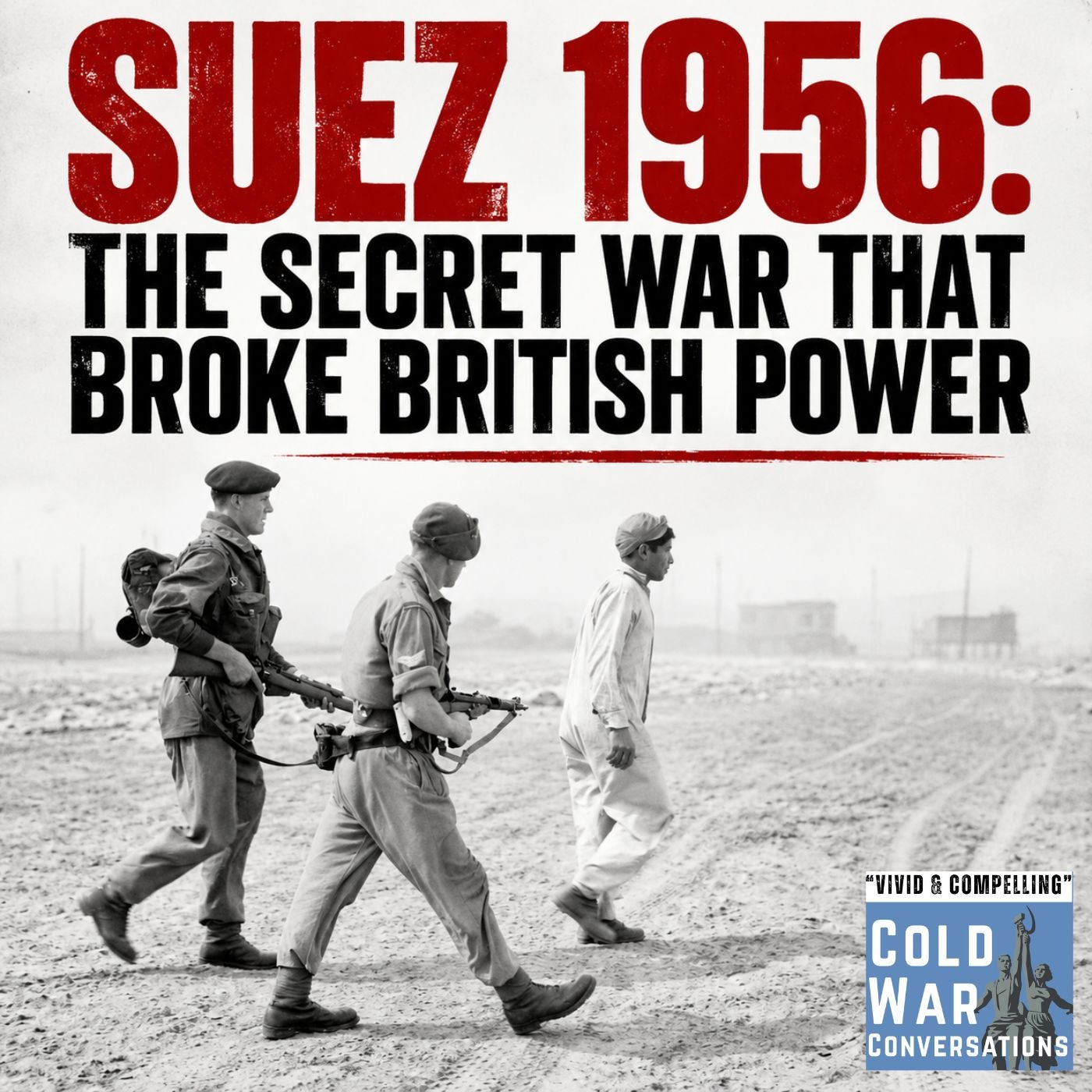
The 1956 Suez Crisis—how Egypt’s Gamal Abdel Nasser nationalized the Suez Canal, Britain and France secretly coordinated with Israel to invade, and how military success turned into political failure due to U.S. pressure, UN intervention, and economic collapse.
No named guests appear in the transcript; it’s a single-host narrative episode.
Written by AI. May contain mistakes.
An introduction to the Suez Crisis and its geopolitical implications.
“Britain and France condemn Soviet interference in Hungary while simultaneously invading Egypt.”
Explores Gamal Abdel Nasser's rise and his nationalization of the Suez Canal.
“Britain and France secretly joined Israel in a plan to invade Egypt, seize the canal and destroy NASA's influence.”
Analysis of the interconnected crises leading to the Suez invasion.
“So said Gamal Abdel Nasser at Alexandria on the 26th of July 1956.”
Historical context of British control over the Suez Canal and its impact.
“foreign policy failures of the 20th century.”
Discussion on Anthony Eden's perspective on Nasser and the resulting British military response.
“He's part of what becomes the non-aligned movement, countries trying with varying degrees of success to navigate between the two Cold War blocks and that independence causes problems.”
Explore the strategic worries surrounding the Suez Crisis and the military preparations made by Britain.
“all of its Middle Eastern assets, including access to Kuwaiti oil.”
Understand the secret meetings and agreements between Britain, France, and Israel leading up to the invasion.
“The atmosphere was secretive because it had to be.”
Dive into the invasion of Sinai, the battles fought, and the complexities faced by Israeli forces.
“Now the deception gives way to real war.”
Learn about the initiation of British and French military actions in Egypt.
“access to the canal zone only months after the last British troops departed.”
Explore the military strategies, international reactions, and the complexities of the crisis.
“How could a militarily powerful Anglo-French force achieve victory in battle while simultaneously losing the crisis virtually by the hour?”
Understand the simultaneous Soviet actions and the diplomatic absurdities during the crisis.
“People are dying on the streets and thousands are fleeing westward and this creates perhaps one of the most absurd diplomatic convergence of events during the entire crisis.”
Examine the economic pressures on Britain and the domestic political divides during the war.
“He was never told about the Severo Accord.”
Analyze the ceasefire's impact on British and French military objectives and the broader crisis.
“Contemporary estimates vary between 20 ,000 and 30 ,000.”
Learn how the Suez Crisis led to the establishment of UN peacekeeping mechanisms.
“The United Nations and a New Kind of Force Can the United Nations create a mechanism for ending the war without simply replacing British and French occupation with another foreign occupation?”
Learn about the political ramifications of the Suez Crisis and its impact on peacekeeping.
“Pressure from the US continues and eventually Israel withdraws from Sinai and Gaza by March 1957.”
Explore who truly won the Suez Crisis and its implications for Egypt and the West.
“Now the shooting has stopped, the battle of words begin.”
Understand the changes in international relations post-Suez.
“However, something fundamental has been revealed.”
Analyze the long-term effects of the Suez Crisis on international diplomacy.
“new Middle Eastern order where Washington and Moscow increasingly played central roles.”

Get the gist, explore an idea or ask about something said.
 Claude
On Cold War Conversations, what are the key points of this episode?
Searching your listeningAutomatic transcript. May contain errors.
0:00Welcome to Cold War Conversations, the home of real stories of the Cold War. T 'was many nights before Christmas, and one woman knew she needed a tree, so to Wayfair she flew. She found more decor and added to cart. Merry Christmas to all. Get your Wayfair head start. For holiday decor you can count on, Wayfair delivers. You know that friend you only call when you need something? HomeServe's here for you. Got a burst pipe, HVAC outage, or electrical issue? HomeServe has your back for regular use, where basic homeowners insurance typically won't help. With a protection plan from HomeServe in place before disaster strikes, just call us.
0:37We'll send a qualified contractor and help you avoid unexpected expenses. Maybe we're the last ones you want to call, but we're happy to hear from you. Go to homeserve.com slash audio for 50 % less your first year. Save as compared to renewal price void in Florida. Britain and France condemn Soviet interference in Hungary while simultaneously invading Egypt. Moscow condemns imperialist aggression in Egypt while suppressing Hungary. Everyone has suddenly discovered a profound commitment to national sovereignty, providing it occurs in the other bloc. In 1956, Britain and France launched a secret war to bring down Egypt's President Nasser.
1:20Instead, they exposed the limits of their power. When Gamal Abdel Nasser nationalised the Suez Canal, Britain and France secretly joined Israel in a plan to invade Egypt, seize the canal and destroy NASA's influence. On the battlefield the operation was succeeding. Politically it became a catastrophe. This episode tells the dramatic story of the Suez crisis, the secret protocol of Seir, Israel's invasion of Sinai, British and French attacks on Egypt, brutal fighting around Portside and the extraordinary pressure from President Eisenhower that forced the invasion to stop. It's a story of Cold War rivalry, collapsing empires, deception, nationalism and civilians caught in the fighting.
2:06And the moment Britain discovered that military power no longer guaranteed political power. We will build with our own hands. We will build a strong Egypt. So said Gamal Abdel Nasser at Alexandria on the 26th of July 1956. A sentence about building a dam is about to become a declaration of war, or at least that's how some people in London and Paris will hear it. It's Thursday evening, we're in Alexandria, Egypt's big Mediterranean port. It's hot. Thousands of people are in Manchira Square to listen to their president speak. Gamal Abdel Nasser is 38 years old. He has only been president for a little over a month, but he has been pretty much in charge of Egypt for longer.
2:59And he's not happy. One week before, on the 19th of July, the US pulled out of helping to pay for the Aswan High Dam, a huge project Nasser thinks is vital to making Egypt modern. Britain also pulls out. But Washington, this is part of a bad relationship with a leader who has bought weapons from the Soviet bloc, recognised communist China and refused to fit in with the Western alliance. For Nasser, it's a slap in the face. So tonight he hits back. His speech lasts for more than two hours. He blasts colonialism. He speaks about Egyptian independence. He remembers when outsiders ran Egypt. And then he brings up a Frenchman.
3:44Ferdinand de Lesseps. De Lesseps. de Lesseps he uses the name over and over again now to most people in the square it's just a part of the story de Lesseps was a French diplomat and businessman who helped to build the Suez Canal but to a few Egyptian officials waiting somewhere else it's a code word when they hear it they move Egyptian teams go into the offices of the Suez Canal company the telephone exchanges are locked down, documents are taken, officials are told that the company has been nationalised. NASA then tells everyone the Suez Canal Company, which was controlled by France and Britain and operated one of the most important waterways on earth, now belongs to Egypt.
4:34The American diplomatic records show that even while NASA was still talking, Egyptian officials were already taking control of the company's operations. the shareholders were going to get paid based on what their shares were worth on the parish stock exchange yesterday and the crowd goes wild now here's our question how does the nationalization of a canal company lead to Britain France and Israel invading Egypt less than three months later and how does a military operation that is successful turn into one of Britain's worst foreign policy failures of the 20th century. That's because Suez isn't really one crisis.
5:15It's several crises crashing into each other. It's a dying European empire. It's Arab nationalism. It's the Arab-Israeli war. It's oil. It's the Cold War. It's British Prime Minister Anthony Eden's memories of appeasement in the 1930s. It's France's increasingly violent war in Algeria. It's Israel's fear of being surrounded. It's NASA's desire to make Egypt truly independent. And looming above all of them are the United States and the Soviet Union. The old powers think they are still running the world. The new superpowers are about to remind them that they are not. Part 1. Before Suez. The Canal, Empire and NASA.
6:03if we sit while nasa solidifies his position he can destroy us so said sir yvonne kirkpatrick permanent undersecretary at the foreign office in september 1956 now that's quite a sentence and it tells us something important about suez british leaders aren't just worried about who gets the canal money they are afraid that a whole strategic system is falling apart So our question here is why does NASA seem like an existential threat to both Britain and France in the Middle East rather than just a troublesome Egyptian leader? The canal opens in November 1869. It runs through the Isthmus of Suez linking the Mediterranean to the Red Sea and changing the way international trade works.
6:51For Britain, the reason for wanting it is obvious. Instead of sailing around Africa, ships going to India and Asia can go through Egypt. In 1875, Egypt's leader, Khediv Ismail, needed cash badly and sold off the Egyptian government's shares in the Suez Canal Company. Britain bought them, and then in 1882, Britain invaded Egypt. Officially, Egypt remained part of the Ottoman Empire for a while. unofficially Britain controlled Egypt and Suez became a major route for British imperial power troops traveled through it goods traveled through it oil started traveling through it and by the 20th century Suez was more than just a canal it was part of the infrastructure of empire but and this is quite important it was in Egypt and Egyptians increasingly wondered something pretty obvious.
7:45Why should an Egyptian waterway remain a symbol of European control? After World War II that question became harder to ignore. Britain won the war but it was broke. India became independent in 1947. Nationalist movements were growing across Asia, Africa and the Middle East. Egypt was officially independent but thousands of British soldiers stayed in the Canal Zone and more and more Egyptians saw them as occupiers not protectors. In October 1951 the Egyptian government cancelled the Anglo-Egyptian Treaty of 1936. Violence got worse and then on the 25th of January 1952 at Ismailia British troops surrounded an Egyptian auxiliary police barracks after the Egyptians refused to give up their guns.
8:35There was fighting. 41 Egyptians died. The next day Cairo blew up. Buildings burned. Foreign-owned stores, cinemas, hotels and clubs were attacked. People died. King Farouk's government was losing control. Six months later, overnight on the 22nd to the 23rd of July 1952, a group of Egyptian army officers moved. they called themselves the free officers colonel gamal abdul nasser was one of them king farouk had to step down and go into exile the monarchy was abolished in 1953 and nasser eventually became the main man behind the revolution now sometimes nasser is portrayed as just anti-west and that's too simple his main goal is egyptian independence he doesn't want london controlling egypt but he doesn't want moscow controlling it either.
9:31He's part of what becomes the non-aligned movement, countries trying with varying degrees of success to navigate between the two Cold War blocks and that independence causes problems. In 1954 Britain agrees to pull its troops out of the canal zone, the last British combat troops left in March 1956. Four months later NASA nationalises the Canal Company and four months after that British troops are back. It's almost like a cruel joke but Nasser has another problem, Israel. On the 28th of February 1955 Israeli forces attacked Egyptian positions in Gaza. Egyptian military weakness was clearly demonstrated and Nasser wants modern weapons.
10:15The West won't give them to him on terms he likes so in September 1955 Egypt announces a massive arms deal with Czechoslovakia which was actually Soviet bloc weapons. MiG fighters, Ilyushin bombers, T-34 tanks, artillery. Israel sees this as a threat. Washington sees it as a sign of Soviet expansion in the Middle East. Nasser sees it another way to show his independence. He's also against the Baghdad Pact, a western-backed alliance aimed at stopping Soviet influence in the region. More and more Arab nationalists started seeing him as the man fighting back against old colonial power. Then came Aswan.
10:59The proposed high dam on the Nile is supposed to create electricity, control flooding and provide water for irrigation. Nasser wants Western funding. Washington and London initially agreed to fund it. Then they backed out. And Nasser's reaction is Suez. He claims that the canal's company's profits will pay for the dam. The American intelligence assessment five days later says that nationalisation has boosted Nasser at home and made him an even stronger symbol of Arab nationalism. And this is where everyone starts looking at things differently. To many Egyptians, nationalisation is decolonisation.
11:38To Anthony Eden, the British Prime Minister, it's blackmail. To France, it's part of Nasser's fight against European influence. And to Israel, it's just another step in the growth of a strong enemy. The same event, four totally different interpretations and that's the trigger. Part two, Eden and the shadow of Munich. The government is not willing to engage in a policy of weak appeasement. That's Anthony Eden in the House of Commons on the 12th of September 1956. There's the word appeasement. Once that word is in the discussion it becomes much harder to find common ground. So the question for this section is how much did Anthony Eden's understanding of the 1930s cloud his judgment in 1956?
12:31Eden is not some clueless novice. He's actually one of the most experienced foreign policy leaders to ever enter Downing Street. He has been foreign secretary three times. He resigned from Neville Chamberlain's government in 1938. He worked alongside Churchill during World War II. He has dealt with Stalin, Roosevelt, Truman, Eisenhower and has a telephone book full of foreign ministers. But Suez touches on one of his deepest political fears, dictators, aggression, appeasement, Munich. Eden is seeing NASA more and more through that lens and there's good reason for that psychologically. The lesson Eden learned from the 1930s is that aggressive dictators need to be stopped early.
13:18The problem with using history as a guide is that it simplifies things. Nasser is definitely an authoritarian leader but Egypt in 1956 is not Nazi Germany. Taking control of an Egyptian company is not the same as invading Czechoslovakia and NASA's nationalisation of the canal hasn't stopped ships using it. These differences are important. However there's a genuine concern within the British government that if they let NASA succeed British influence across the Middle East will fall apart. Harold Macmillan then Chancellor of the Exchequer told American Secretary of State John Foster Dulles on the 1st of August that if they don't respond strongly Britain could lose all of its Middle Eastern assets, including access to Kuwaiti oil.
14:08So this isn't just about Eden's personal feelings. These are real strategic worries. Oil, sterling, alliances, prestige. But prestige is one of those words that can get a little slippery. You can spend a lot of real power trying to protect the idea of power. On the 27th of July, one day after nationalisation, Britain started getting ready for potential military action. 20 ,000 British reservists were called up on the 2nd of August. Eventually the planned Anglo-French force grew to about 80 ,000 soldiers. But there were issues. There weren't enough landing craft. There weren't enough ships. Logistics were tricky.
14:52At one point there wasn't enough military tank transportation so commercial removal companies had to help move tanks to the embarkation points. Now that's a great British imperial image isn't it? We're getting ready to overthrow Colonel Nasser. Sure thing sir, is Pickford's available on Tuesday? But logistic problems were serious. The initial plan went through many revisions. The early British plan was to take the canal, then Alexandria, then destroy Egypt's air force, then Port Said. Military planning of political goals don't always line up. What does victory mean exactly? Taking the canal? Getting rid of NASA?
15:32Destroying his army? Putting the canal back under international control? All of the above. That lack of clarity is a big problem. Meanwhile Eisenhower is telling Eden not to rush. On the 31st of July the American president wrote to him after hearing that Britain was thinking about using force right away. Eisenhower understands how important the canal is but he wants to try every peaceful option before resorting to war. This is an early warning of the major disagreement between Britain and America. Eden believes NASA needs to be stopped. Eisenhower believes the crisis needs to be contained. The Americans have another worry, colonialism.
16:17The US has its own complicated history with developing countries, obviously. But Washington knows that publicly supporting a British and French attack on an Arab nation would give Moscow a huge propaganda win. The Cold War is increasingly being fought for influencing countries that are no longer colonies. Bombing Egypt to show that the West is against Soviet imperialism is, let's just say, it's not a very smooth communication strategy. So diplomacy begins. Part three, the summer of diplomacy. American public opinion would be outraged unless all peaceful routes had been exhausted. That's President Eisenhower's warning to Anthony Eden in 1956.
17:06And the question is, was war unavoidable after nationalisation, or did Britain and France choose war even though they were real diplomatic alternatives. In August 1956, 22 countries met in London to discuss the canal. Most supported some form of international control. Egypt did not participate. A five-nation committee led by Australian Prime Minister Robert Menzies was sent to Cairo. Menzies met Nasser in September. The proposal recognised Egypt's sovereignty but called for international management of the canal. NASA refused. From his perspective he just nationalized an Egyptian company to stop foreign control.
17:51Agreeing immediately to a new international authority would have looked exactly like giving it back with extra paperwork. The Menzies mission failed. Dulles then suggested creating the Suez Canal Users Association. The idea was that the main users of the canal could work together on shipping and payments. Britain and France were very sceptical. However, diplomacy continued at the United Nations. On the 13th of October, the Security Council agreed on six principles for a solution. These included free and open transit, respect for Egyptian sovereignty, keeping the canal separate from the politics of individual countries, fair tolls and development agreements.
18:37So the diplomatic process is not dead and that point is important. There's a tendency to tell the story of Suez as if nationalisation on the 26th July automatically led to invasion on the 29th of October. It didn't. Three months passed between those dates, choices were made and behind the diplomacy Britain and France were getting ready for war. France had its own reasons. The Algerian war had been going on since 1954. Nasser was providing political and material support to the Algerian National Liberation Front. More and more French leaders saw Cairo as the source of the problem. They thought that if they got rid of Nasser, maybe the Algerian rebellion would weaken.
19:22That turned out to be way too optimistic. Israel also had reasons to act. The situation on the border was getting more and more violent. Palestinian Fedayeen were attacking Israel, sometimes from Egyptian-controlled land. Israel was responding with bigger and bigger military strikes. Egypt was restricting Israeli shipping and maintaining a blockade of the Straits of Tehran, which limited Israel's access to the Gulf of Aqaba and the Red Sea and the Czechoslovak arms deal had shifted or seemed about to shift the military balance once Egypt absorbed the new equipment. Then in October 1956 Egypt, Syria and Jordan moved closer to military cooperation.
20:09David Ben-Gurion the Prime Minister of Israel believed the strategic situation was getting worse. On the 28th of October the day before the Israeli attack, Eisenhower publicly stated that he had received disturbing reports of Israeli mobilisation and urged no country to take actions that could lead to war. But by then, the real decisions had already been made. Not in London, not in Cairo, not in New York, but in a villa outside Paris. Cold War history deserves to be remembered, and by listening to the next few adverts, you help us to do exactly that. Thank you.
21:13dot com slash Spotify. Outdoor Deterrence plans start at$49.99 a month. Visit simplysafe.com slash licenses for alarm license information. You know that friend you only call when you need something? HomeServe's here for you. Got a burst pipe, HVAC outage, or electrical issue? HomeServe has your back for regular use where basic homeowners insurance typically won't help. With a protection plan from HomeServe in place before disaster strikes, just call us. We'll send a qualified contractor and help you avoid unexpected expenses. Maybe we're the last ones you want to call, but we're happy to hear from you go to homeserve.com slash audio for 50 % less your first year savings compared to renewal price point in florida part four sevra the secret deal now we get to the really crazy part and here our question is really simple how could britain say it was trying to separate two fighting countries when it had secretly helped set up the fight well from 22nd to the 24th of October, representatives from Britain, France and Israel met secretly at Sevres just outside Paris.
22:19The atmosphere was secretive because it had to be. The Israelis wanted written guarantees, the British were extremely cautious about leaving any paper trail, Anthony Eden himself didn't attend, Britain was represented by Foreign Secretary Selwyn Lloyd and later by diplomat Patrick Dean. France was represented by Prime Minister Guy Mollet and Foreign Minister Christian Pino. Israel sent Ben-Gurion, Defence Minister Shimon Peres and Chief of Staff Moshe Dayan. They came up with a surprisingly straightforward plan. On the 29th of October, Israel would invade Egypt across the Sinai. Britain and France would then give an ultimatum to both sides stop fighting get away from the suez canal let britain and france temporarily occupy key parts of the canal and here's the catch egyptian forces are already in egypt they can't follow the ultimatum without leaving their own country israel's army however had been ordered to move toward the canal so the ultimatum gives britain and france a reason to intervene.
23:31If NASA says no, which everyone expects, Britain and France will step in. The document signed on the 24th of October clearly lays out the sequence of events. This is important because it disproves the later claim that Britain and France were just reacting to a sudden Israeli-Egyptian war. The war was part of the plan, now the three governments still had different goals. Israel wanted Sinai and free passage through the Straits of Tehran, and it wanted to destroy Fedayeen bases and weaken Egypt's army. France wanted NASA removed and Britain wanted to undo the canal crisis and eliminate NASA's political power.
24:12They agreed on an operation. They didn't necessarily agree on what would happen after they won. That's usually the problem with conspiracies. It's easier to get everybody in the room than to get everybody to agree on what happens after they've won. There's another issue. The Americans suspect that something's going on. Israeli mobilization is becoming more and more obvious. Eisenhower sends messages to Ben-Gurion. Israeli officials insist their mobilization is defensive. In fact, on the 29th of October, Israeli representatives are still telling American diplomats that their actions are defensive.
24:48Then that afternoon, Israeli planes appear above Sinai, paratroops start jumping and Operation Kadesh has begun. Part 5. War in Sinai. Now the deception gives way to real war. The question changes. Can Israel defeat Egypt quickly enough to create the conditions Britain and France need without starting a bigger war? On the afternoon of Monday, October 29th, Israeli paratroopers jump near the Mitla Pass. The Mitla is located deep in Sinai, relatively close to the Suez Canal. Therefore, the landing provides Britain and France with the justification they need. Supposedly, Israeli forces are threatening the canal.
25:36However, the Israeli operation is far greater than just a parachute drop. Armoured and infantry columns cross the border. Objectives include Abu Agayla in northern Sinai, Gaza and far in the south Sharm el-Sheikh overlooking the Straits of Tehran Imagine Sinai, vast expanses of desert, few roads, long supply lines, columns of vehicles kicking up dust Navigation is critical, fuel is also critical and most importantly air power The Egyptian army has large forces in Sinai, but command and communications are inconsistent. There is intense fighting at Abu Agayla. Ultimately, Israeli forces break through.
26:21At the Mitla Pass, events take a particularly bloody turn. Colonel Ariel Sharon commands the Israeli 202nd Paratroop Brigade. His orders were interpreted as requiring him to hold positions near the eastern entrance to the pass rather than fighting through it. However, reconnaissance develops into a major battle. Israeli troops enter the narrow pass. Egyptian forces are positioned amongst the rocks waiting for them. The fighting is intense and costly. Reports indicate that 38 Israeli soldiers were killed and approximately 260 Egyptian casualties. Meanwhile, something terrible happens within Israel itself.
27:04On the evening of October 29th, Arab residents of Kafir Qasim return home from work. A curfew has been imposed earlier than expected. Many are unaware of this change. Israeli border police fire upon civilians violating the curfew. 48 Arab civilians are killed. Some reports include an unborn child as the 49th victim. These individuals are merely returning home. The massacre later becomes a significant issue in Israeli law regarding the obligation to refuse patently unlawful orders. Back in Sinai, Egyptian commanders are now facing an additional challenge. On October 30th, Britain and France issue their ultimatum.
27:48Egypt and Israel are commanded to cease hostilities and withdraw their forces 10 miles from the canal. Of course NASA declines. The demand would comply Egypt to relinquish territory within Egypt and permit British and French forces access to the canal zone only months after the last British troops departed. Consequently the second phase commences. On October 31st British and French aircraft commence attacks against Egypt. Operation Musketeer has begun. Part 6. Musketeer, Britain and France Go to War Knowing what we know now about Sevres, it is challenging to interpret it in precisely the manner that its authors intended.
28:37How could a militarily powerful Anglo-French force achieve victory in battle while simultaneously losing the crisis virtually by the hour? British and French aircraft commence attacks on Egyptian airfields on October 31st. The Egyptian Air Force comprises of MiG-15 fighters, Ilyushin-28 bombers and British-built aircraft from an earlier era. However, many are vulnerable while on the ground and Anglo-French air superiority is rapidly established. It is estimated that approximately 200 Egyptian aircraft are destroyed by nightfall on November 1st, and Nasser responds by withdrawing much of his army from Sinai.
29:21This action preserves a considerable number of Egyptian forces from annihilation. However, militarily speaking, Sinai is disintegrating. Israeli columns continue to advance. By November 5th, Israeli forces have arrived at Sharm el-Sheikh, located on the the most tip of Sinai. The blockade of the Straits of Tehran has essentially been breached. However, Britain and France have delayed their response, and this delay is critical. Their military strategy necessitates air superiority prior to executing airborne and amphibious landings. From an operational perspective, there exists logic in this approach.
30:02From a political perspective, it affords the remainder of the world nearly one week to react and react it does. On November the 2nd the United Nations General Assembly call for an immediate ceasefire and withdrawal. Britain and France persist. On November the 4th Soviet forces initiate a massive intervention in Hungary. The Hungarian uprising is being crushed. People are dying on the streets and thousands are fleeing westward and this creates perhaps one of the most absurd diplomatic convergence of events during the entire crisis. Britain and France condemn Soviet interference in Hungary while simultaneously invading Egypt.
30:46Moscow condemns imperialist aggression in Egypt while suppressing Hungary. Everyone has suddenly discovered a profound commitment to national sovereignty providing it occurs in the other bloc then on November the 5th Soviet Foreign Minister Dmitry Shepilov transmits and then on November the 5th Soviet Foreign Minister Dmitry Shepilov transmits a cable to the United Nations accusing Britain France and Israel of aggression and referring to civilian casualties resulting from Anglo-French bombardment additional threatening Soviet cables continue. There are indications that rockets could be employed against Britain and France.
31:29The possibility of Soviet intervention cannot simply be disregarded. Nevertheless, we must differentiate between fear and cause. Soviet threats contribute to the pressure. However, they are not solely responsible for terminating the operation because another nation possesses far greater immediate influence over Britain, the United States, and Eisenhower is enraged. He was never told about the Severo Accord. He is days away from a presidential election. He is attempting to condemn Moscow for its actions in Hungary, and two of America's closest NATO allies have recently initiated what appears to Washington to be a colonial war.
32:14Meanwhile, the military operations transition into its next phase. It's dawn November the 5th and British paratroopers are approaching Portside. Part 7 Portside Now the crisis assumes a very tangible form and the question becomes what occurs when a meticulously planned expeditionary operation reaches an actual city that contains soldiers and civilians. Port Said is situated at the northern terminus of the Suez Canal. At dawn on November 5th aircraft cross the coastline. British paratroopers of 3rd Battalion the Parachute Regiment land near El Gamil Airfield west of the city. French paratroopers descend near Port Faud and Rasmus.
33:03Egyptian defenders are firing. The British troops secure El Gamil and commence advancing eastwards towards Port Side. Intemporary reports say that four British paratroopers were killed and 32 wounded during that initial encounter. French forces achieve rapid advance on the eastern flank and Egyptian resistance varies. Some regular units have previously withdrawn. Other units continue to engage in combat. Police, militia and armed civilians participate in defence efforts and once combat transitions into urbanised areas the advantages of modern air power diminish considerably. You have to clear streets, structures, junctions.
33:48Snipers fire their weapons from concealed positions. Then, prior to dawn on November 6th, the amphibious assault commences. Royal Marines from 40 and 42 commando land. French armour lands near Port Ford and a 45 commando Royal Marines is airlifted into combat via helicopter. This is noteworthy. Helicopters have been utilised previously of course but this represents one of the earliest examples of a large-scale helicopter-borne assault. The amphibious assault commences at approximately 4.30am. Errors occur also. British aircraft inadvertently attack British positions. A Royal Marine is killed and others sustain injuries.
34:35Urban warfare persists. Egyptians deploy snipers and small units. British and French forces continue their movements south. Contemporary reports detail that Royal Marine casualties during the portside landings were nine fatalities and 60 wounded. For Egyptian military personnel and civilians alike, casualty rates are considerably higher. However, exact totals encompassing the entire crisis remain subject to dispute. Estimates vary considerably depending on source, definition and time frame considered. What is indisputable is that portside experiences severe damage. Structures are damaged, homes are ablaze and civilians are killed.
35:17People flee. While troops fight street by street, something almost surreal transpires at the upper echelon of command. generals on the ground believe they are progressing towards their objectives lieutenant general Hugh Stockwell and French general Andre Beaufort spend much of November 6th in Port Syne they are so isolated from political news that they only learn late in the day that a ceasefire has been accepted so just envision that scenario you command an invasion your forces are advancing and then somebody informs you that politically speaking the war is over why not because your army has been defeated not because port side has fallen not because egypt has compelled britain to retreat because sterling is collapsing art 8 washington sterling and the ceasefire occasionally history hinges not on tanks or rifles but on whether someone in washington will support your currency now why could britain not proceed without american support Britain in 1956 remains a significant military power.
36:23It possesses nuclear weapons. It maintains military personnel globally. It holds a permanent position on the UN Security Council. It continues to govern colonies and maintain military installations across numerous continents. However, all of this entails expense and Britain's fiscal health is delicate. The pound sterling is pressured downwards. Foreign exchange reserves are declining, oil supplies are disrupted, the canal itself is rendered inoperable due to Egypt sinking vessels in its waters. Pipelines originating from the Middle East have also been disrupted. Consequently, the very conflict initiated partly to safeguard the oil route contributes to an oil scarcity.
37:09History continues to be unsubtle once again. Britain seeks financial assistance through the International Monetary Fund. However, Americans refuse to facilitate assistance whilst Britain continues its military operation. Additionally, Americans possess means to intensify pressure on sterling. Now, there's been some quite extensive debate concerning precisely how financial pressure functioned and which threat proved decisive. Britain requires American cooperation. Eisenhower does not extend cooperation as long as hostilities persist and Eden's government does not possess a viable financial strategy for a protracted confrontation with the United States.
37:54This is the predicament. Britain possesses military capability to continue combating Egypt. Britain does not possess economic capability to combat Egypt while concurrently combating American financial pressure. These are the disparate considerations. Then there is domestic politics. Britain is profoundly divided. On November the 4th, a anti-war demonstration congregates on Trafalgar Square. Contemporary estimates vary between 20 ,000 and 30 ,000. It's prudent to note this disparity. Erin Bevan addresses demonstrators. The cry rises, Eden must resign. Police obstruct demonstrators attempting to march down Whitehall towards Downing Street.
38:39Clashes ensue. However, Britain is not universally opposed to the war either. Public opinion polling is inconsistent and fluctuates throughout the crisis. Conservative constituency associations frequently support Eden. Correspondence addressed to members of parliament demonstrates considerable opposition. Labour organises protests Parliament becomes exceptionally contentious Consequently this is not a straightforward narrative depicting a government engaged in unpopular warfare against a unified populace Britain is divided What the government cannot overcome is international isolation compounded by economic vulnerability On November 6th pressure becomes irresistible Britain and France accept a ceasefire it enters into effect at approximately midnight on November 6th to 7th.
39:33British troops have advanced only several miles north of El Cap and then halt. The invasion has progressed approximately 20 miles down the canal zone. Its broader objectives remain unattained, NASA remains in power, the canal is closed and British and French troops will have to withdraw. Part 9. The United Nations and a New Kind of Force Can the United Nations create a mechanism for ending the war without simply replacing British and French occupation with another foreign occupation? The idea is strongly promoted by Canada's External Affairs Minister Lester Pearson. A United Nations force could move into the area, not to conquer Egypt, not to administer the canal, but to supervise the ceasefire and separate the forces.
40:28Initially, Secretary General Dag Hammarskjöld has doubts, and you can see why. The UN doesn't have an army sitting in a warehouse somewhere waiting for somebody to hit the peacekeeping button. A multinational force has to be created virtually from scratch. Which country provides troops? Who commands them? Where can they be deployed? What happens if someone refuses to cooperate? and most importantly whose side is it on? Hammerskjöld comes to realise that the force must be independent of the political goals of the combatants. On November the 4th the General Assembly asks him to prepare a plan. On November the 5th Resolution 1000 establishes a UN command for an emergency force.
41:12Subsequent agreements follow and this becomes the United Nations emergency force UNEF. The concepts developed here will later become central to peacekeeping, consent, impartiality, limited use of force. It is not perfect. It doesn't solve the Arab-Israeli conflict. It doesn't create a lasting peace agreement. But it creates a mechanism for foreign troops to leave without simply restarting the fighting. The first contingents arrive in Egypt in November. By December 22nd, British and French forces have gone completely. Israel remains longer. Ben-Gurion informs Eisenhower on November 8th that Israel intends to retain Sinai, but requires security arrangements before withdrawing.
42:01Pressure from the US continues and eventually Israel withdraws from Sinai and Gaza by March 1957. Younef is positioned along Egypt's side of the border and around Sharm el-Sheikh. For 10 years it maintains an uneasy quiet and then in May 1967 Egypt demands its removal. This leads to one of the steps towards the Six Day War. But that is another story. At present Suez creates one of the essential tools of post-war international diplomacy, modern United Nations peacekeeping. In 1957, Pearson receives the Nobel Peace Prize. Surprisingly, a secret Anglo-French Israeli invasion helps create the Blue Helmet Peacekeeper.
42:49It's time for a short break. These adverts help preserve more extraordinary Cold War stories. Thanks for listening and supporting our work. This holiday, all plans, even unlimited, are just$15 a month. A holiday deal this good obviously deserves an enormously expensive holiday song, like all I want. Right. Okay, we can't afford that. You know what? Forget the music budget. We're going to stick with whatever's in the public domain. Give it a try at mintmobile.com slash switch. Upfront payment of$45 for three months,$90 for six months, or$180 for 12-month plan required. $15 per month equivalent.
43:22Taxes and fees extra. New customer offer for initial plan term only. Greater than 50 gigabytes may slow when network is busy. See terms. Twas many nights before Christmas, and one woman knew she needed a Christmas tree, so to Wayfair she flew. Finding just the right one, and for years it will last. Wayfair shipping was free, and remarkably fast. What's this? Garland? A wreath? Essentials to host? Good thing she celebrates way longer than most. As her cart filled with magic and decor from the heart, Merry Christmas to all. Get your Wayfair head start. For holiday decor you can count on year after year, Wayfair delivers.
43:58Part 10. Who won Suez? Now the shooting has stopped, the battle of words begin. And this argument has continued ever since. Who really won? First of all, we need to distinguish between military victory and political history. From a military standpoint, Israel performed extremely well on the battlefield. They rapidly crossed Sinai. Egyptian positions were quickly defeated. The Fedayeen network in Gaza was severely damaged. And after the final withdrawal arrangements were completed, the Straits of Tehran were once again open to Israeli shipping. From Israel's immediately military standpoint many important objectives were met.
44:40Britain and France also showed significant military capability. They destroyed much of Egypt's air power, established air superiority, performed successful airborne and amphibious landings, captured port Said and port Ford. their forces were advancing when the ceasefire occurred so if we ask did Egypt defeat the Anglo at French invasion militarily absolutely not but that is not all the same as winning the crisis Britain and France had greater political goals they wanted NASA weakened or overthrown NASA survived they wanted to reverse NASA's nationalization of the canal the canal remained nationalized.
45:23They wanted to show European strength. Instead, they demonstrated its limitations. Nasser suffered several military defeats but emerged politically stronger. That seems paradoxical unless you consider what the Arab world perceives. The Egyptian leader nationalized the canal. Britain, France and Israel attacked him. He survived. The invaders left. Egypt retained control of the canal. Nasser became a hero throughout much of the Arab world. The military defeats disappeared beneath the political triumph. That doesn't mean all Arab governments embraced him, quite the opposite. Many conservative monarchies viewed Nasserism as a threat.
46:06However, mass popular Arab nationalism received a major boost. The canal remained blocked for months. Salvage teams spent months clearing wrecked vessels. In April 1957 the canal finally reopened for shipping under Egyptian administration. Therefore Nasser's gamble paid off politically. However there was a dark side to Egypt's victory. Non-citizens were expelled or forced out of Egypt. Property was confiscated. Egypt's Jewish community suffered particularly badly. thousands fled. Egypt successfully resisted an imperial invasion and innocent people within Egypt suffered from retaliatory actions.
46:49Part 11 Eden Falls Did Suez end Anthony Eden's premiership and did it signal the end of Britain's status as a great power? Well Eden's health was truly poor. In 1953 he underwent a poorly performed gallbladder operation followed by another operation. During the Suez crisis he was under extreme stress. However we should avoid using ill health as a simple explanation for his actions. Suez was a political decision made by a government not a medical condition. Eden travelled to Jamaica in November to recover. He returned but his authority had been completely destroyed. Next there is the matter of collusion.
47:35For weeks the government denied that Britain coordinated with Israel's attack. Yet the pattern of events is hard to explain otherwise. Israel attacks, Britain and France immediately issue an ultimatum and then Britain and France attack Egypt. The secret Severa protocol illustrates that this sequence was premeditated. The official assertion that Britain and France were simply acting as neutral police officers cannot withstand scrutiny based on the available evidence and on january the 9th 1957 eden resigned harold macmillan succeeded him as prime minister now does suez represent the end of britain as a great power is that accurate both yes and no britain did not cease being a great power on november the 7th 1956 it still possessed a worldwide diplomatic network possessed armed forces abroad possessed nuclear weapons retained its status as a permanent member of the Security Council, maintained one of the largest economies in the world, enjoyed a vital intelligence relationship with the United States, Britain will continue to employ military overseas.
48:47Therefore, the notion that Britain ceased existing as an empire at Suez is too simplistic. However, something fundamental has been revealed. Britain cannot undertake large-scale international military operations against determined American opposition when its economic survival relies heavily on American cooperation. And the lesson is learned. The link between military strength and financial strength has clearly been demonstrated. You can own aircraft carriers, you can own bombers, you can own paratroops, you can even own your own nuclear weapons. However, if your currency is weak and your main ally controls access to financial aid you rely on for survival your capacity for independent action will be restricted.
49:34Suez did not create these restrictions it demonstrated them and arguably that is more significant. Art 12 France America and the aftershocks neither nation learned the same lesson therefore our final question is what changed after Suez and what did not change. Britain's reaction was ultimately to mend its relationship with America. As early as March 1957 Anglo-American relations had improved under Macmillan. Britain increasingly came to recognise that its global role would typically occur alongside America rather than independent of it. France reacted differently. Many French officials felt betrayed twice, first by Washington which opposed their operation, second by Britain which accepted a ceasefire whilst French forces continued to advance.
50:26These betrayals reinforced France's strong argument for strategic autonomy. While Suez was far from solely responsible for France's decision to develop their own nuclear deterrent capability, it certainly became part of the political landscape contributing to France's decision. France tested its first atomic bomb in 1960. Later under Charles de Gaulle, France withdrew from NATO's unified military command structure in 1966. Next comes Algeria. French leaders had hoped that weakening NASA would aid them in defeating the Algerian National Liberation Front. Instead, the Algerian war continued. It contributed to the collapse of France's fourth republic in 1958.
51:12Algeria achieved independence in 1962. Again Suez did not stop decolonization rather it sped up perceptions that the old order was unsustainable. For America Suez presented different challenges. Eisenhower had opposed his European allies however Washington did not desire a vacuum created by their retreat to be filled by Moscow. Therefore in January 1957 Eisenhower asked Congress to approve what became known as the Eisenhower Doctrine. Under this doctrine America would provide economic and where necessary military aid to Middle Eastern nations threatened by international communism. In essence Britain and France pulled back, America stepped forward and that's why Suez fit so neatly within the Cold War.
52:00It is not merely the last gasp of 19th century imperialism, it is also part of creating a new Middle Eastern order where Washington and Moscow increasingly played central roles. The Soviet Union achieved a propaganda victory from this crisis. However again let's be cautious Moscow did not defeat Britain and France. American pressure, British financial weakness, United Nations intervention and international opposition played major roles in securing a ceasefire. Soviet threats exacerbated the crisis however believing that Khrushchev simply threatened in London with nuclear annihilation and Eden immediately surrendered is far too simplistic.
52:43Additionally, Soviet moral victory was severely undermined by the obvious fact that Soviet tanks were simultaneously crushing Hungary. There were no clean hands here. Want to learn more about this episode? Don't miss the extras such as curated videos, photos and other content. Just look for the link in the episode information. Special thanks to the generous efforts of our financial supporters who keep the show on the air. If you'd like to join this select band, go to coldwarconversations.com slash donate. The Cold War Conversation continues in our Facebook discussion group. Just search for Cold War Conversations on Facebook.
53:25Thanks very much for listening and see you next week.
54:01Transcription by CastingWords Not a box to check. Vanta helps companies build and prove trust from day one. Its agentic trust platform connects compliance, risk, and trust at enterprise scale. Vanta delivers a 526 % return on investment over three years and pays for itself in just three months. Learn why over 16 ,000 of the fastest growing companies use Vanta at Vanta.com. T 'was many nights before Christmas and one woman knew she needed a tree so to Wayfair she flew. She found more decor and added to cart. Merry Christmas to all. Get your Wayfair head start. For holiday decor you can count on, Wayfair delivers.
In 1956, Britain and France launched a secret war to bring down Egypt’s President Nasser. Instead, they exposed the limits of their own power.
When Gamal Abdel Nasser nationalised the Suez Canal, Britain and France secretly joined Israel in a plan to invade Egypt, seize the canal and destroy Nasser’s influence. On the battlefield, the operation was succeeding. Politically, it became a catastrophe.
This episode tells the dramatic story of the Suez Crisis: the secret Protocol of Sèvres, Israel’s invasion of Sinai, British and French attacks on Egypt, brutal fighting around Port Said, and the extraordinary pressure from President Eisenhower that forced the invasion to stop.
It’s a story of Cold War rivalry, collapsing empires, deception, nationalism and civilians caught in the fighting — and the moment Britain discovered that military power no longer guaranteed political power.
Curated episode extras https://coldwarconversations.com/episode481/
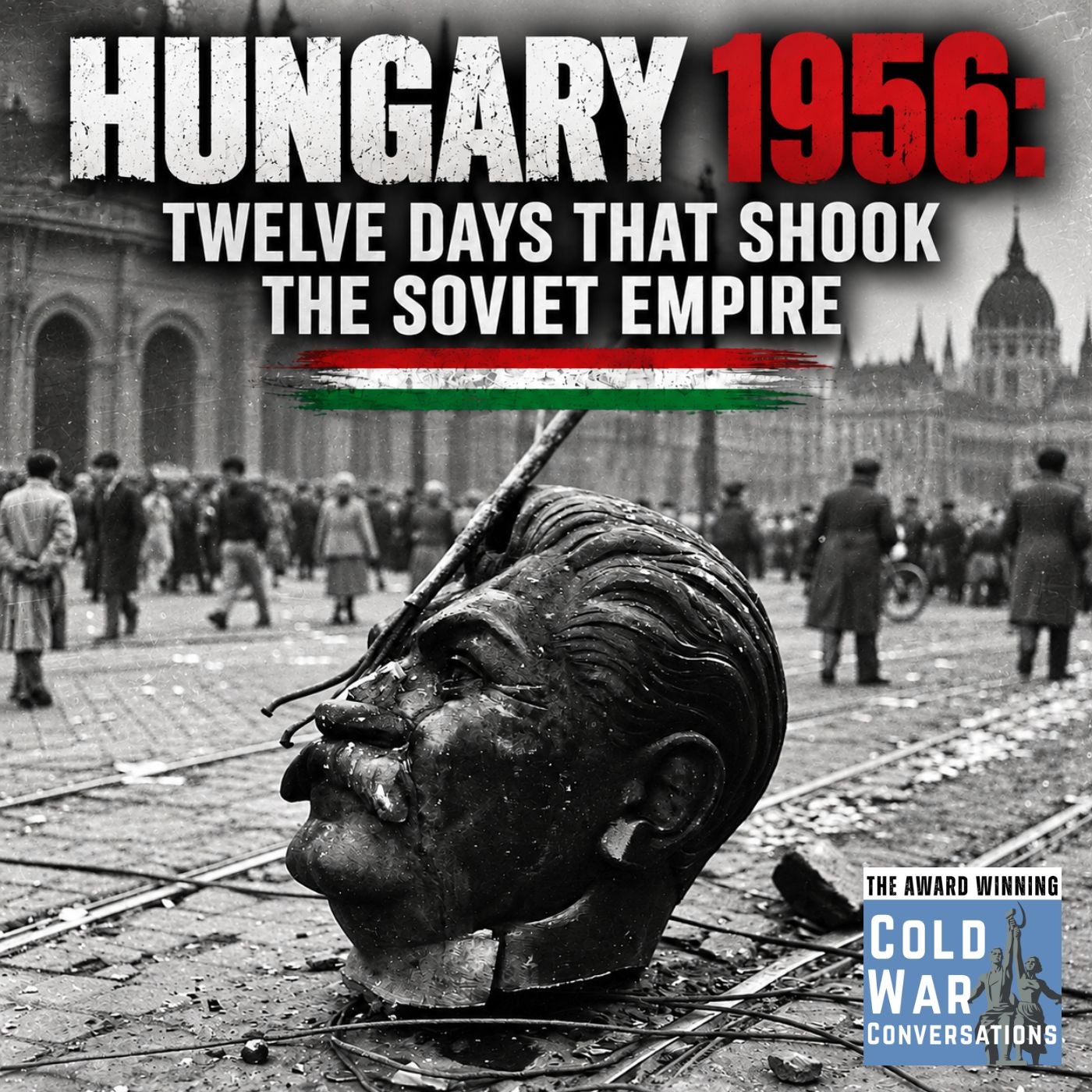
Listen to our episode "Hungary 1956: Twelve Days That Shook the Soviet Empire" here https://coldwarconversations.com/episode479
The fight to preserve Cold War history continues, and with a simple monthly donation, you will give me the ammunition to keep it alive. You’ll become part of our community, get ad-free episodes, a sought-after CWC coaster as a thank-you, and bask in the warm glow of knowing you are helping to preserve Cold War history.
Just go to https://coldwarconversations.com/donate/
If a monthly contribution is not your cup of tea, we also welcome one-off donations via the same link
Find the ideal gift for the Cold War enthusiast in your life! Just go to https://coldwarconversations.com/store/
Support the project! https://coldwarconversations.com/donate/
Follow us on Twitter https://twitter.com/ColdWarPod
Facebook https://www.facebook.com/groups/coldwarpod/
Instagram https://www.instagram.com/coldwarconversations/
Youtube https://youtube.com/@ColdWarConversations
Love history? Join Intohistory https://intohistory.com/coldwarpod
Learn more about your ad choices. Visit podcastchoices.com/adchoices