Ask ChatGPT
 Cold War Conversations
31 Oct 2026 · 1h 4m · 20 chapters
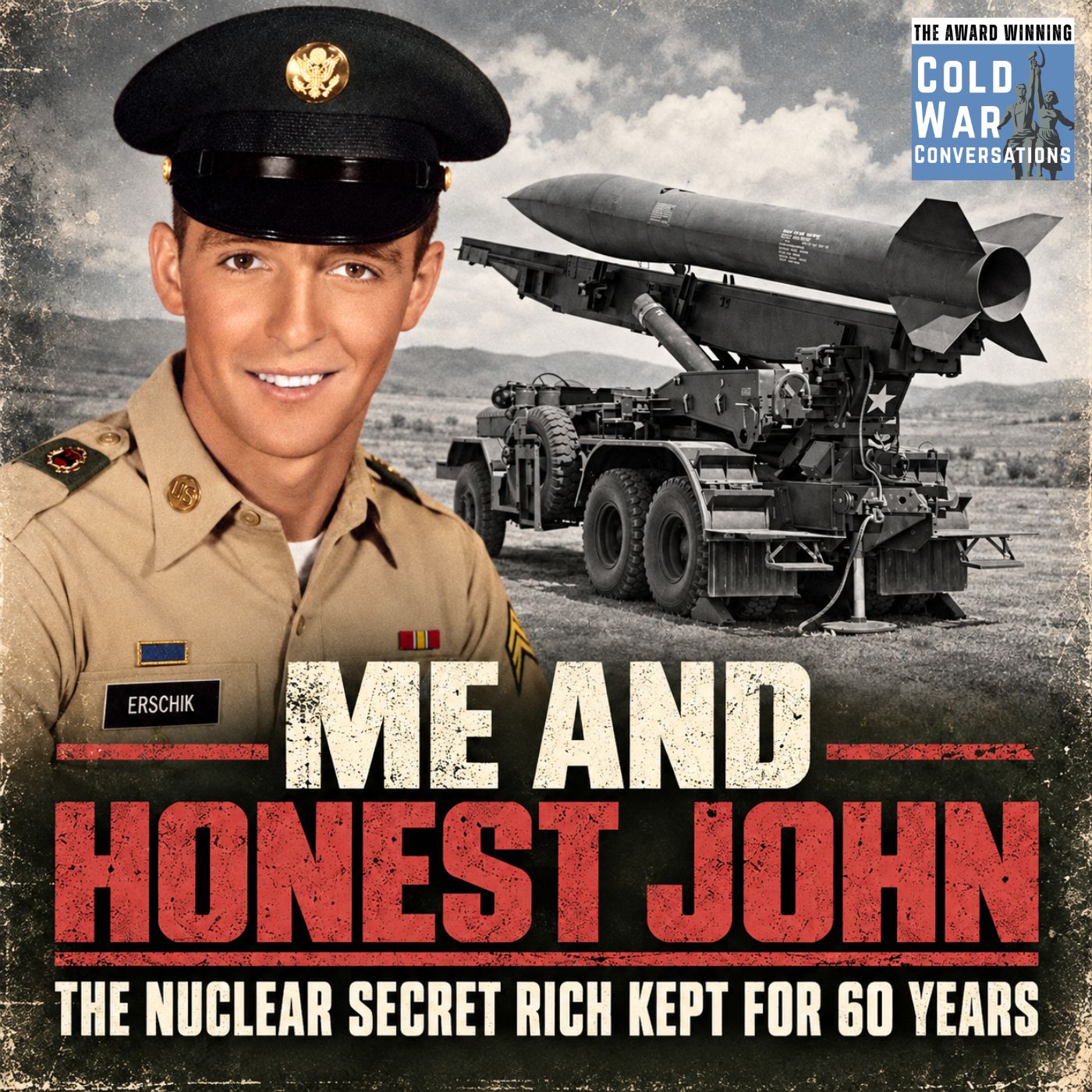
Richard Urshick, a Cold War artilleryman, recounts being drafted in 1966 and later working as a senior assembly specialist for the unguided Honest John rocket—eventually nuclear-capable—while keeping the details secret for nearly 60 years.
Richard Urshick (born 1945 in Chicago near Wrigley Field) was drafted from civilian life and became an NCO quickly (sergeant E-5 in 16 months). He later worked at Victor Adding Machine, then became an author (18 books) and a veterans advocate via veteranvisitor.com. He also volunteered as a tour guide at the Nike Missile Base in the Everglades.
Honest John’s nuclear warhead yield was described as ~20 kilotons (vs. Hiroshima ~15). He says only a small group (about nine) had clearance to be near the warhead. He describes a misfire where a wire came loose; he personally reconnected it and the rocket fired after.
his induction at 615 E. Van Buren Street; training at Fort Knox and Fort Hood; a neighboring 50th Infantry unit reportedly deployed to Vietnam overnight; and a live-fire misfire during extreme Texas heat (117°F).
Written by AI. May contain mistakes.
Rich recounts his surprise at being drafted and the context of the Vietnam War.
“and explains why the stories of Cold War veterans must be preserved.”
Rich vividly describes the moment he received his draft notice and its impact on his family.
“And it was, I was doing all the things kids do.”
Rich explains the strained relationship with his father and the emotional weight of the draft notice.
“And I was just one of them from the Midwest who was called.”
Rich shares his experience on induction day and the emotions felt by his family.
“And at the time, he didn't know what it was either.”
Rich recounts the bus ride to Fort Knox and the camaraderie he found with fellow draftees.
“Remember it was Chicago and it was in the late October so it was cold but we all got out of the car.”
Rich describes the chaotic introduction to military life upon arriving at Fort Knox.
“In fact, the bus broke down in the middle of the trip.”
Learn about the author's intense introduction to military life at Fort Knox, including the indoctrination and challenges faced.
“I tried not to in the book, but they had a strange way of introducing us to the military, and it began while we were on the bus.”
Discover the author's transition from Fort Knox to Fort Hood, highlighting the differences in training facilities and experiences.
“He enters his vehicle information on Carvana, an offer appears in minutes.”
Explore the author's experiences in basic training and how he unexpectedly became a platoon leader, along with his promotion.
“It's interesting, too, because we all wondered.”
Learn about the author's shocking introduction to nuclear weapons while working with the Honest John rocket and the responsibilities involved.
“And how were you told that you were going to be working on nuclear weapons?”
Explores the specifications and implications of the Honest John nuclear rocket.
“and what really resonated with me because after i heard that i did a little bit of research and the bomb that we dropped over hiroshima during world war ii was about 15 kilitlin and the honest john warhead is 20.”
Learn about the mindset of soldiers waiting for deployment orders during the Cold War.
“And our weapon would have been the weapon to end it.”
Discover the sudden deployment of the 50th Infantry and its impact on nearby units.
“The potential of that is really brought home to you at Fort Hood with the 50th Infantry.”
Explore the tough decisions faced by soldiers regarding reenlistment and deployment risks.
“Now, as you get towards the end of your draft, the end of the two years, a recruiter from the Army makes you an offer.”
Understand the challenges veterans face when reintegrating into civilian society post-war.
“So you returned to your job at the Victor Adding Machine.”
Learn about the secrets of the Honest John Rocket and the author's decision to write about it.
“I think that was all ginned up or stirred up by the media.”
Find out about the initiative to honor veterans and bring them together for recognition.
“And And, you know, I particularly enjoyed the section where you're talking about the, you know, the challenge of keeping this secret inside you for so long and your decision that it was time to tell your story.”
Learn how personal connections can honor and uplift veterans' stories.
“All of them were in their late eighties, early nineties.”
Explore the complex feelings around military service and its lasting impact.
“Yeah, it's great work that you've done there and continue to.”
Discover the importance of preserving personal stories and oral histories.
“Yeah, and if people aren't confident enough to write it as a book or anything like that, then they can always contact me.”

Get the gist, explore an idea or ask about something said.
 Claude
On Cold War Conversations, what are the key points of this episode?
Searching your listeningAutomatic transcript. May contain errors.
0:00Welcome to Cold War Conversations, the home of real stories of the Cold War. the holidays are busy enough getting your home ready shouldn't be from the perfect tree and twinkling lights to festive decor for inside and out wayfair has everything you need to get your home holiday ready find furniture hosting essentials festive serveware and more all in one place so you can spend less time getting ready and more time enjoying the season with the people who make it special shop wayfair.com today to make holiday magic at home Way fair, every style, every home. Ryan Reynolds here from Mint Mobile. I don't know if you knew this, but anyone can get the same premium wireless for$15 a month plan that I've been enjoying.
0:44It's not just for celebrities. So do like I did and have one of your assistant's assistants switch you to Mint Mobile today. I'm told it's super easy to do at mintmobile.com slash switch. Upfront payment of$45 for three-month plan equivalent to$15 per month required. Intro rate first three months only, then full price plan options available. Taxes and fees extra. See full terms at mintmobile.com. And it was my job to walk back out to that unfired rocket and determine what happened. I can laugh about it now, but I wasn't laughing then. I remember walking those 75 yards and hearing the grass punching under my shoes.
1:21And in my mind, I'm thinking, Jesus, they could go any time. At 21, Rich was trusted with a nuclear-capable rocket, but forbidden to tell even his family what he did. Drafted from Chicago into the US Army as the Vietnam War escalates, Rich is transformed from a civilian into a sergeant entrusted with a formidable Cold War weapon. He recalls training, gaining secret clearance, and discovering that the unguided Honest John rocket could carry a nuclear warhead more powerful than the Hiroshima bomb. Rich also describes watching an entire neighbouring unit vanish overnight for Vietnam, concealing his secret work from his family and returning home to hostility rather than gratitude.
2:10Nearly six decades later, he reveals the fear, responsibility and memories he kept silent and explains why the stories of Cold War veterans must be preserved. I'm delighted to welcome Richard Urshick. to our Cold War conversation. The stories from this episode are from Richard's book, Me and Honest John, A Cold War Soldier's Story. You can purchase the book via the link in the episode information and help to support the podcast. I was born in 1945 in the heart of the city of Chicago on the near north side. For reference of anyone from the states that might be listening, I was born very close to Wrigley Field.
2:54In my immediate family was my dad. I had an older sister. She passed about three years ago. As I mentioned in the book, my mother passed two years before I was drafted into the military. And as I've so often said, the fact that I got drafted would have probably killed her anyway. So I lost her two years early, so she You didn't have to go through that situation of me being drafted. Were you expecting to be drafted? You knew that this was going to happen at some point. Yeah, in the States, they had something called the lottery. And to put all of this in perspective, I can't forget that I was just a 20-year-old kid when all of this was going on.
3:40A young adult, and I still say a kid compared to my age today. So everyone was talking about the lottery and it had to do with a sequence of numbers. And the lower your number was in the lottery, the more apt you were to get drafted into the army. And it was, I was doing all the things kids do. I was driving cars and dating girls and drinking beer underage. And I didn't pay too much attention to the lottery until the numbers started dropping. And my friends were saying things like, hey, Rich, what's your number? And first they'd have to remind me what number they were referring. When they said, what's your grant number?
4:20What's your lottery number? I said, I don't know, 260, 270, whatever. So I didn't pay much attention to it. So to basically answer your question, and I really, I had an aimling this was coming, but I thought it would be coming for everybody else, not for me. Until, as I said in that book. That envelope arrived on September, I think, 25th or 27th and changed my life. So this was at the same time as the big troop deployments to Vietnam. I look back at this, all the things that happened during that time that I really didn't appreciate at the time, But it was right at the beginning of President Johnson's 240 ,000-man call for Vietnam.
5:11It was during that big push for Vietnam. President Kennedy was killed two years earlier. President Johnson took over. There was all kinds of displeasure with the fact that the war was going on and the draft was taking all the young people. So it was right during that time. And I was just one of them from the Midwest who was called. I've actually written two books, and the second book is named Greeting, G-R-E-E-T-I-N-G, not plural, not greetings, but greeting, because in that letter, first of all, and I, if I take a minute, I can put myself back in the kitchen of the house. When my dad handed me that letter, he went to the envelope and got the mail, and he brought it in, and he handed me this letter, and I remember seeing U.S.
5:56Department of Defense on the upper left-hand corner, I saw the logo. I didn't know it was my graph notice, to be perfectly honest with you, until I opened it. And I took it out, and I unfolded it. It was in a number 10 envelope, and it was folded three times. And I opened the first flat first, and I saw that word greeting. And then it was followed by, you are hereby inducted into the armed forces of the United States of America, and you are to return at 615 East Van Buren Street on the morning of Buck, October 24th. I was 65 or some years later, I still remember the wording. But to say I was shocked was unbelievable.
6:38That line recall, Ian, it was only an initial shock because after I read it, I thought, oh, this is the letter that all my friends are chipping. And now I finally got it. I didn't realize the ramifications or all the details that were going to be associated with my appearance at 615 East Gamburen. But I remember that day when I opened that letter, and I still look back today, and I laugh because it wasn't greetings. It didn't say greetings. There weren't more than one. It was just one greeting. What was the reaction of your father and your sister to this news? My father and I, I'm not going to say we had a bad relationship, but it was a little was a little strained at that time because he wanted me to become a baseball player, a National League baseball player, because I was a good player.
7:27And at the time this showed up, it was following one of our disagreements about what I wanted to do with my life versus what he wanted me to do. So he handed it to me. And at the time, he didn't know what it was either. But I called him back in the room after I read it. And I said, hey, dad, look at this. and he only looked at it for 30 seconds or so and I could just I could see the impact it had on his whole demeanor change my sister was five years older she didn't recognize the magnitude of it but my dad did he just he lost his wife two years earlier he lost his father in the same year he lost his wife and then with everything that was going on in Vietnam everybody thought that if you're going to Vietnam I can remember the look in his face when I called him back in I said hey dad, look at this.
8:16It was a shock to him. Yeah, I can imagine that must have been really tough for him. And I guess it would have been tough for him at the recruiting center because he drops you off there, doesn't he? Yeah, that 615 East Van Buren in Chicago was the military induction center. And he drove me there. And as I said in the book, he drove a truck all of his life and he knew the streets of downtown Chicago like the back of his hand and he didn't need a map to get us there. He drove us right up in front and it was cold. Remember it was Chicago and it was in the late October so it was cold but we all got out of the car.
8:58My sister came along, my dad drove, I rode passenger and my sister sat in the back. We all got out of the car and I had my little bag with me and I had no idea what was coming and neither did they but they knew I wasn't getting back in the car so i remember the tears in my dad's eyes he gave me a hug and just squeezed me didn't say anything my sister just said good luck have fun and that was it when i walked into those big doors i remember it and flipped doors onto that aisle floor and yet it kind of started it all and so so what happens next yeah after i went inside There were four lines. Remember, there's a lot of people down here at this time.
9:41There's a lot of people my age who also got called on that same day. So there were, I'm going to say there were hundreds of us. And there were four lines for the branches of the military, Navy, Air Force, Army, Marines. And I found my line for the Army, and I was standing in that line. And I wasn't standing on my toes. I'm six foot three at the time. So I'm standing on my toes looking ahead of the line, seeing what's happening. I can see the guy in the front of the line pointing in different directions. They would ask you a couple of questions. They asked me basically if I was in good health. And I said yes.
10:16And he asked me a couple of questions if I had major surgeries or whatever. So they were weeding out the prospects. And they just pointed to the line where you continue. If you had said something like you're 4F or you're not eligible, they would turn you around and you'd go back home. But I kept aggressively going through these stations. to the point where we went through some basic testing. The old wrap your drawers and clutch, that was part of it. And as soon as they realized that we were well and that I was well, they put us into a room and we're probably close to a hundred of us in that room.
10:53These are people have been accepted and we're all mulling around. Nobody knew what was going on. Everybody's making small talk. You see a lot of guys were scared. A lot of them were just bewildered and wondering what was going to happen next. I just took it in stride. I didn't have anybody else in my immediate family that was in the military. My uncle was. He was in the Navy for a while, but I had no one to tell me what to expect. So everything on that day was new to me. And as I said, I ended up in this room with about 75 or 100 other people. And that's where he took our oaths, where we were sworn in.
11:30And after we raised our hand and they read the oaths and we said, we do, that was it. Now we're part of the military. And then we were bused from that point, from Chicago. We were bused to Fort Knox, Kentucky. There were three buses to take that whole room full of army draftees to Fort Knox. How far is that? I have no idea the distance. It was a few hundred miles. In fact, the bus broke down in the middle of the trip. We had to get a second bus. One of the three buses broke down. The bus that I was on broke down. We had to get a replacement bus halfway there. So it was an overnight ride. I certainly didn't sleep too well that night, first of all, with all the apprehension of being drafted.
12:18And then the bus ride, again, I'm 6 '3". I didn't sit very well in the seat, so it wasn't very comfortable for me. But that's when I met, as I mentioned in the book, I met that fellow named Wayne, who was my neighbor. I don't know if you read that part in the book, but I could tell you that story if you'd like. Yeah. Go ahead. Yeah. For small talk, I ended up sitting next to a guy and I just, during the ride, we were bumping around up in the road and I said, hey, where are you from? And he said, to the north side of Chicago. I said, oh God, that's amazing. So I said, we're on the north side. He said, near the intersection of Irving Park and Western Avenue.
13:03I said, you gotta be kidding me. I said, that's where I'm from. I said, what street did you live on? He said, Bell Avenue. And I said, Bell Avenue, I live on Oakley. I said, what's your address? And he said, it was like 4013. And I said, I'm at 4047. In fact, Ian, our backyards almost met up with each other. But I never met the guy before until this bus ride. And then coincidentally, and I say this even today because I still talk to him, we served every day of our military service together. Everywhere I went, he went. And every unit I was sent to, he was sent to. So we served our entire military together.
13:46And we remained good friends until this day. Wow, that must have been always welcome to have a friendly face wherever you were posted. It really was, yeah. Yes, it really was. So you arrive at Fort Knox. What's the greeting like there? I certainly can't use the language. I tried not to in the book, but they had a strange way of introducing us to the military, and it began while we were on the bus. And the drill instructors, who we later knew to be DIs, they came on the bus and under no uncertain terms told us that we were to get off the bus and sort of line up and then run to this particular building.
14:34and it was probably 30 minutes from the time the bus stopped until the time we got to the building they wanted us to get to. And during that time, they were screaming at us and calling us all kinds of names. And some of the people, some of the guys that were, they couldn't take it. They'd never been yelled at like that. They weren't physical. They didn't touch us at all, but they just screamed at us and started indoctrinating us to what was coming. Push-ups were a big thing at the time. They analyzed or made people do push-ups when we didn't or the guys didn't go along with what they said. Needless to say, we did a lot of push-ups.
15:13And as I look back at it today, it was all indoctrination. It was abuse at the time I was going through it, but it was indoctrination to get us to forget our civilian life and get used to what was coming. But Fort Knox was a very old military sort. Remember, it had wooden floors. It had wooden lockers. Lockers. It was old. I'll never say deteriorated because part of the military regiment is to keep everything clean, new looking. So even though it was old, it was very shiny, very clean. I had no idea what some of the inspections were going to be like. But when I say clean, I mean, you have to eat off everything.
15:53It was. That's one of the things relating to military service. You just kept your area and your equipment clean. If I can continue, we spent the night at Fort Knox in Pots. Most of us had never slept in Pots before. We were assigned our green blankets and our striped cellos, and we spent the night. Some slept, some didn't. I remember I did for a couple of hours because I was exhausted. I didn't sleep well on the bus. And the next morning, they literally, the DIs literally took the ends of the bunk beds or the bunks on the line of the guys and dropped it. Said they were screaming at us again, get up, you're going to go to the chow hall, you're going to have breakfast and we want you out in formation.
16:41It all started, all the regiment things started. And that was my introduction to Fort Knox, which didn't last long because as I mentioned, we overloaded Fort Knox. There were so many basic crannies there. They couldn't even handle us. So they shipped us out. We all got our first bit of orders to report to Fort Hood, Texas. So I thought, my God, Texas is a lot farther than Kentucky. From Illinois, I thought if this was going to be another bus ride, it'll take a week. They told us, this time we're flying you there. And I had never been on an airplane before in my life. So this would be my first airplane flight.
17:22But they flew us to Fort Hood, Texas. And unlike Fort Knox, where we were overloading their basic grading capabilities at Fort Hood, Texas, we were the first basic trainees there ever. So they had brand new drill instructors who, I guess, took lessons from those in Fort Knox. But they screamed at us the same way. As soon as we got off the airplane, we got on the bus. And in fact, we landed at Love Field in Dallas, Texas. And that was where President Kennedy landed two years earlier before he was assassinated. So that was ironic and historic. I landed at the same airport President Kennedy did. Then they bused us to Fort Hood, Texas, which is near Austin.
18:08The roll instructor screamed at us again, get off the bus, get inside. These are going to be your barracks. And when we walked into these barracks, they were all cement. The windows were all shaded and clean. And it was, I guess we went from a motel in Fort Knox to Four Seasons in Fort Hood, Texas. So it was quite the difference in that regard. Was it at Fort Hood that you got your first promotion courtesy of one of your teachers? Yeah. In fact, I was assigned up to the Toome Leader. That was another funny story. In our first formation, I remember our sergeant, his name was Sergeant Martinez. There was about 40 of us in a group.
18:50And he asked us if any of us had any outside training that might be applicable to the military. And I don't know why I even thought of it, but I had a gym teacher in high school. His name was Mr. Krenzlinger. He taught us facing movements because he was a Marine and he remembered all the facing movements. Left face, right face, about face. He remembered marching. He remembered cadence during marching. I raised my hand. I said, yeah, I do. I know the facing movements. And he said, okay, you're our platoon leader. Jeez, all of a sudden I'm responsible for 40 people because I had a skill that nobody else had.
19:30That was fun. It's a great story. That's a great story. And I guess at Fort Hood, you're also introduced to live firing and weapons and that sort of aspect. Yeah. Basic training is a six-week training course that's really hands-on. It's really where you learn self-protection, I guess I could call it. After basic training, you take another six weeks of something called AIT or advanced individual training. But the end of basic training is where you literally, with all of your equipment on and carrying your M14 rifle, which is nine and a half pounds by itself, You would rifle thrall under live machine gun fire that was 30 inches over your head with tracer rounds.
20:20And I remember I did mine at about 730 at night. So as I was crawling in the mud and the sand, I could remember the red tracer rounds flashing over my head. And you can actually, you can hear a machine gun bullet going past you. It makes a sound that's quite memorable. So that was our first real introduction to life, like, and then it just progressed from there. Cold War history deserves to be remembered, and by listening to the next few adverts, you help us to do exactly that. Thank you. Observe. The North American Dad. 50s. Great polo collection. He enters his vehicle information on Carvana, an offer appears in minutes.
21:04Remarkable. He squints, reads it again, smiles and says, Dang, that's a good offer. The highest form of approval. No haggling. No hassle. No one called him boss. He's still on the couch. Astonishing. Sell your car today on Carvana.com. Pickup fees may apply. Hey, Ryan Reynolds here for Mint Mobile. Now, I don't know if you've heard, but Mint's premium wireless is$15 a month. But I'd like to offer one other perk. we have no stores that means no small talk crazy weather we're having no it's not it's just weather it is an introvert's dream give it a try at mintmobile.com slash switch a front payment of 45 for three month plan 15 per month equivalent required new customer offer first three months only then full price plan options available taxes and fees extra see mintmobile.com and at the end of that training do you know where you're going to be posted or what your specialism's going to be No, not really, Ian.
22:04It's interesting, too, because we all wondered. In six weeks, coming from a family environment to a military environment where you don't know anybody, after six weeks, you make acquaintances with people that you become quite close to. Everybody wondered, where the hell is Bill going to go? Or where am I going to go? And am I ever going to see him again? Or them? Or what's in store for us? Everybody expected to be perfectly honest with you. Everybody expected orders for Vietnam as soon as we got out of basic training because they needed people over there. We trained quite heavily in the art of hand-to-hand combat and self-protection, bayonet training.
22:45There was no, this wasn't a game. This was all for real, and they made you realize that it was for real. So everybody expected orders for Vietnam. And me personally and Wayne, who I mentioned before, we got orders for the 1st Battalion, the 3rd Artillery, which is a, any veterans will recognize this. It was an 8-inch howitzer that was towed, so it was called a towed howitzer. And we, both Wayne and I, got assigned to this unit, and that's where we took our AIT, our Advanced Individual Training. So I trained for six weeks on an 8-inch howitzer before I ever got orders for the Clintus John assignment.
23:31So I had a good taste of what artillery was and what artillery fire was. And 8-inch howitzers are the largest. There's a 105, a 155, and a 175. Those are smaller diameter shells. The 8-inch is described. It's 8 inches and carries a lot of firepower. So for six weeks, I learned all about toad howitzers. And it was there when I got my first military promotion to private first class. It's the first stripe that you get to put on your uniform. So, yeah, that was a progression. That was six weeks after basic reading. And how were you told that you were going to be working on nuclear weapons? When I was assigned, everything has to do with orders.
24:19Orders come down from the commanding officer and from offices high above where we were. But everybody would get orders and you'd open up your orders and read them. And I read that I was being transferred from the 1st Battalion, 3rd Artillery to the 16th, 1st Battalion, 16th Artillery, which was the Honest John Rocket Unit. And nuclear was never mentioned. We didn't know anything about nuclear weapons until we were security cleared and we got to know what these things were. And all of a sudden they introduced us to the fact that one of these warheads on this giant rocket is nuclear. So that was all progressively introduced to us.
25:02I spent probably two or three months working with that weapon before I knew it was nuclear capable.
25:10and you're just as you said earlier like 20 years old and your role is assembling warheads and potentially assembling nuclear warheads i mean that must have blown your mind that the level of responsibility that you were being handed at that point it was but again at 21 years old it was just taking in progression. It was just another set of orders. It was just another thing we were assigned to do. By this time, remember, I was drafted in October. By the time I really got into the Honest John rocket was about April or May. And in April, I turned 21. I had my 21st birthday in the Army. And in fact, we were out in the field and I woke up in a tent.
25:58And I said to my sergey sergey i said i'm 21 today and he yelled over from his tent he said hey congratulations here have your first drink on me and he threw me his plastic canteen with water in it and i'll never forget that but it was during those types of trainings when we were in the field we were assembling my orders that came down ian to answer your question i was assigned i was called a 13 Delta Shorty, which is a senior assembly specialist. And I wasn't just assembling the warhead. I was assembling the entire rocket unit, which consists of the warhead, the main body, which is the power plant, if you will.
26:41It was solid rocket fuel. And then the back of the rocket had four stabilizer fins. So I was a senior assembly specialist for the entire rocket, The warhead, the motor, and the four fins. And it was during that time when we learned that there's a dummy warhead, there's a high explosive warhead, and then we were introduced to nuclear. And that's when we were all assigned security clearances. Some, strangely enough, were not assigned a clearance because during their background check, they must have found something on some of the people. So they were not allowed near or part of the weapon. But I think, as I mentioned in the book, the military went so far as to contact my neighbors in my neighborhood back in Chicago to get credibility references on me.
27:36What kind of person was I? What did I do to contribute to the community in any way? So they went pretty deep in checking my background before they gave me my clearance. But after they gave us our clearance, which strangely enough, I still have a copy of, and that will lead to my story about why I finally decided to tell this 59 years later. I had these orders and assignments with a top secret clearance, and we were all taken into a special ring where we were introduced to the fact that Giannis John carries a nuclear forehead, if necessary. and what really resonated with me because after i heard that i did a little bit of research and the bomb that we dropped over hiroshima during world war ii was about 15 kilitlin and the honest john warhead is 20.
28:28so it put firepower in perspective when i finally realized what kind of weapon we were working with here and as i've said a lot of times it was the largest weapon system in the military at the time. It was the biggest thing they had. It would have worked nuclear war. There's some pretty broad devastation there. Did you ever think about that if it was fired in anger, the level of devastation it would cause on its target and potential collateral damage? That was the topic of conversation. Every time we rolled a rocket out into the field to fire it, because if we ever had to fire a nuclear weapon, we would have been killed along with everybody else in England because we were only 35 miles away from impact zone.
29:15The rocket only went 35 miles. And if it's carrying a nuclear warhead, the fallout and blasted area from a nuclear weapon is far greater than 35 miles. So we would have been part of the devastation. So it was on our minds all the time. Yeah, sure. Sure. And the honest, John, wasn't guided. either. It was completely unguided once it was fired. So whose responsibility was it to get those targeting parameters correct? On your own work, I commend you. Yeah, I realize that the word rocket has to do with unstable. Missiles are guided. Rockets are not guided. This was a rocket. So we had three teams.
29:59We had the firing team. We had the assembly and transport team. And then we had the meteorologists who they flew a balloon and determined the barometric pressure and all of the wind directions. And we used all of the data from that antiquated equipment. Now remember I said we flew a balloon. We literally blew up a balloon and let it go up in the air to give us those readings. So it was that team that gave us the coordinates of the impact area and we entered the impact area into our a guidance system on the rocket launcher. So after the assembly team put the rocket together and gave it to the launch team, put it on the truck launcher, and the launcher was positioned based on the information we got from the guidance team.
30:51So that's where it all came from. We just depended on the information that we got from them. And once that rocket left the end of the rail, it was doing over two times the speed of sound. And it was downrange in no time. So we were totally dependent on the information they gave us as guidance. I've interviewed people who have worked with Pershing, which is completely different technology, but it is a missile that's deployed out in the field in a semi-tactical sense. Did you have security teams with you to protect the missile and protect you? No, there were none because we never fired a nuclear weapon.
31:38If we had a nuclear weapon in our arsenal to take out to an impact zone, we would certainly have protection. But in our case, the biggest one we fired was a high-explosive weapon. And we didn't require security, so no. And security would require more people, and the idea is to be as stealth as we can in the field. So more people is more potentially being recognized or noticed. Working with a weapon like this and your security clearance must have made it quite challenging in terms of communicating with home about what you were doing every day. Yeah, I'm going to send you something after this interview that you might want to put into this.
32:25But yeah, we couldn't talk about what we were doing. All of my correspondence back home to my dad, to my sister, to friends, it was about working and it was about the weather and it was questions about how are the Chicago Cubs doing. And I've only got another six months and all. We could never talk about what I was doing. Could never mention that. So that's another reason I kept this so quiet for almost six decades. That secret clearance, when we had a secret clearance and they were told, the level of responsibility that we had, it was something you just didn't know. Even amongst each other. We all knew it.
33:09There were, if I were to think, there were probably nine of us in my battalion that had a secret clearance to get anywhere near the warhead. And the nine of us, it was not a topic of conversation. We all knew the level of responsibility, but it wasn't something we talked about. yeah understood in the book you talk about a hand crank that you had to use was that to change the yield of the warhead or did that have some other purpose it had another purpose it was the hand crank in fact i thought we'd be on video today i just picked one up i have one in my hand right now almost 70 years later 60 years later it was the crank that armed the rocket motor that pushed the warhead to the target.
33:54So I have in my hand, I would probably say the last crank in existence, the last crank handle in existence. But yeah, that was the hand push, and it was to harm the solid fuel rocket motor and push the warhead to the target. You talk about in the book one occasion where someone presses the button to launch the rocket and nothing happens. That was the real reason for writing the book 60 years later. If you can imagine, and if your listeners can imagine, every time we fired a rocket, it was over$100 ,000 in expense. And this was in the 1960s, so$100 ,000 back then was probably a million today. So we didn't just nilly-willy take these rockets out of the arsenal and go out and fire them downrange.
34:46We had to have reason or purpose. We had to have dignitaries with us that we were maybe impressing. And we would let them push the button. Firing a rocket was a big thing. Practicing to fire the rocket was our standard everyday procedure. But actually firing one, it was a big thing. And I don't know if I mentioned, but we took these rockets on trade a lot. We would paint these rockets up in shiny OD olive green paint with the Army logo. and we would drive these things around all over in parades. So we were quite proud of this weapon. But when it was fired, we normally had a dignitary with us. I have a picture that I'll send you, or it's in the book too.
35:30Stanley Reeser at the time was the Secretary of the Army. He was on one of our firing missions, and he was a person to push the button. But the misfire that you're referring to happened when we had General Kelly on the grounds with us. And we were doing a live fire. And it was even to the point where it was in the summer. It was in April. It was in Texas. It was 117 degrees. I remember I actually brought an extra fatigue shirt with me that was starched. So after we did all of our grunt and grind and sweat work, I was going to change clothes. So when we actually pushed the button, we would look like soldiers instead of rats that would run around in all the muck.
36:17But anyway, to your point, we got to the point the weapon was set up, but it was pointed down range. The coordinates were entered into the launcher. I remember getting the alarm to clear the launcher. We all ran back to the trailer. And I made sure it was my job to make sure there was nobody near the launcher. we came back to the trailer and the button was pushed and nothing happened. The rocket didn't fire. And everybody kind of looked at each other. Did you push the button? And yes, and Captain Hans Dollhausen was our commanding officer. He was standing there and he was bewildered because he knows nothing happened.
37:00And personally, I was looking from the other end of the trailer at the button box. and I didn't know personally if it actually was pushed, but everybody said, yeah, it's a misfire. And the last thing you do is you don't push the button again. You just confirm that it was pushed. And everybody said it was pushed, and then everybody looks at me because I was the high-ranking assembly specialist. I was at the rocket site on the launcher, and I watched the wires being connected to the pillars and the posts, and I remember them being connected before I gave the all clear and we left. And it was my job to walk back out to that unfired rocket and determine what happened.
37:48And I can laugh about it now, but I wasn't laughing then. I remember walking those 75 yards and hearing the grass punching under my shoes. I was the only person walking out to this rocket to see what happened. And in my mind, I'm thinking, Jesus, this thing could go any time. And when it fires, when these things fire, it actually burns all the paint off the truck. There's an explosion behind these things, a big ball of fire. And I'm thinking, if I get 10 feet from this truck and this thing goes off, I'm going to get fried back here. So I remember walking out there. It felt like about three days before I got there.
38:27But I was about five feet away from the back of the rocket launcher where the firing wires were connected to the control box. And I saw that one of the wires was hanging off of the post. I don't know what happened. I know it was connected when I left the launcher, but somebody may have tripped over it. Somebody may have pulled them off. Somebody may have not have tightened the screw that holds the wire to the post. But somehow, some way, that wire was pulled from that post. and I thought, oh my God, thank God it's something this simple. So I climbed up on the back of the launcher. I wrapped the wire around the post.
39:05I tightened it. I walked back a little faster than I walked out there. I like the colds where a commanding officer, I said, it's ready to fire. And sure enough, we went through the countdown again, pushed the button, and it left. But yeah, that was one of the stories I never told for a long time. It's one of the reasons I wrote the book. Wow. I'd always been told never return to a firework that hasn't gone at all. Yeah, that went through my mind too. This one's a firework. Were you not fearful that when you attached that wire, that might have made the connection that then made it go? No. Never crossed my mind.
39:42No. It was a rarity when we fired these rockets, but in my two years at Fort Hood, Texas, we fired 11 of them. we actually fired 11 live rockets. One was an explosive warhead because they wanted to demonstrate exactly what this warhead would do. And if anybody Googles Manish John rocket, there's about a 15-minute video that shows the entire process that I'm referring to from the time you arrive on the setup area to where you transfer the rocket to the launcher truck and then you drive the truck to the firing line. It's all in an interesting video. we've had to fire 11 of you over a million dollars worth of military hardware up in smoke yeah yeah literally i remember we went to fort sill texas and there was a firepower demonstration and at the beginning of the firepower demonstration is a soldier firing a 45 caliber handgun and the last weapon that was fired was our honest john rocket and to watch that progression of weapons going off down that lane until it got to the Honest John.
40:53It was pretty impressive. Now, that would be a good video. I wonder whether we can find that. I'll include that setup and deployment of the Honest John in the episode information. Were you thinking to yourself, because I'm working on this weapon, I'm not going to get deployed to Vietnam, I should be okay? Or were you still concerned that there may be a deployment to Vietnam? When I was in the military in 1966 and 67, when Vietnam was really heating up, we didn't get to hear too much about all of the protesting that was going on outside. Because we were inside and we didn't have access to a lot of that news.
41:39So it's still surprising to me today to see news clips of all of the testing of the Vietnam War, because we didn't know all of that was going on. But what we thought, Ian, to answer your question, is that someday, somehow, somebody is going to want to end this war. And our weapon would have been the weapon to end it. Or to certainly slow it down. So every time orders came down, we expected to be going to be a nod. We weren't relieved that we weren't going. We thought someday they're going to need this thing. So the fact that we were working on the Honest John Rocket wasn't to get out of jail free, so that we weren't going to be going.
42:26We all thought we were. And I still talk to the six of the guys from our unit. I still talk to them. In fact, I just talked to them a couple days ago. We often bring that up, that we all were just waiting for those orders to go to Vietnam with this weapon. It's time for a short break. These adverts help preserve more extraordinary Cold War stories. Thanks for listening and supporting our work.
43:04and trust at enterprise scale. Vanta delivers a 526 % return on investment over three years and pays for itself in just three months. Learn why over 16 ,000 of the fastest growing companies use Vanta at vanta.com. The holidays are busy enough. Getting your home ready shouldn't be. From the perfect tree and twinkling lights to festive decor for inside and out, Wayfair has everything you need to get your home holiday ready. Find furniture, hosting essentials, best of serveware and more all in one place. So you can spend less time getting ready and more time enjoying the season with the people who make it special.
43:45Shop Wayfair.com today to make holiday magic at home. Wayfair, every style, every home. The potential of that is really brought home to you at Fort Hood with the 50th Infantry. Can you just describe what happens to them almost overnight? Yeah, in fact, it was overnight. And amazing to remember that and brought that up. I still remember that we were, again, I have to remind you, at this time we're 21-year-old kids. We know where the mess hall is. We know where all the beer is being served. There were times when we were off duty, when we were having a good time. We met a lot. And then the barracks building next to us was the 50th Infantry.
44:27And artillery wears red. The color is red. Our braid on our uniforms is red. Our scarf is red and our dress uniforms. In the artillery, it's blue. And the 50th infantry was next door to us. And I remember the blue logo outside of their building. And we knew a lot of those people because we played baseball with them in the yard. On our off days, our buildings faced each other. In fact, I could send you a picture of that, too. We'd play with these guys and we'd ask, hey, where are you from? What are you doing? We'd get to know some of these people. and we had absolutely no idea that they were being served orders to go to Vietnam.
45:09And we didn't know that it was going to be their entire unit. So everybody in that building next to us was deployed overnight, bag and baggage. They were awakened at about eight or nine o 'clock at night. They were given orders to be ready by four o 'clock in the morning. and they were gone with bag and baggage at 4 o 'clock. That building was empty. We watched that entire unit go to Vietnam. And I wasn't close enough to anyone there to know who came back or where they went or what happened. They just disappeared. But that really told us about the vulnerability of us and the set of orders that could change our lives overnight.
45:54So we just never knew. Wow. Now, as you get towards the end of your draft, the end of the two years, a recruiter from the Army makes you an offer. Yeah. The veterans that are listening to this, especially the Vietnam veterans, will appreciate this. I made Sergeant E-5 in 16 months. I was a NCO, non-commissioned officer, three-stripe sergeant in 16 months. that's unheard of. And along the way, I developed skills that were very valuable to the Army. Post-quarter combat, the bayonet training, certainly the Honest John training, and the fact that I had rank, I had skills for training, I was respected in my unit.
46:49The Army didn't want to let me go. So when I came up on my ETS, which is expired term of service time, they told all of the non-commissioned officers like myself to a building. And at this building, this was about, I'd say, two to three weeks before we got out. And the recruiters came in, and I think I described that recruiter pretty well, the way he was dressed. But the recruiters come in and they, for lack of a better description, they try to talk you into staying in the army rather than leaving because you're leading with skill sets that they can really use. So they made, they made all kinds of offers.
47:39As I say in the book, it was like procedural. We'd go in one room, somebody would talk to us, they would send us to another room, that person would talk to us. the number of people would be dwindled down as we went to each room. So I got into the last room by myself across the desk from a recruiter who was my last line of defense or offense. And I decided to leave. And the last offer was another stripe, which would have been an E6, a staff sergeant stripe, which is totally unheard of. That would have been in 25 months. And I made that. And they offered me$6 ,000. and that's enough to buy a brand new car or buy two at the time.
48:22So it was not an easy decision to leave. I did know then that the Honest John rocket was going to be obsoleted and superseded by something missile-like, something guided, something more advanced. So I knew that my skill set for the Honest John wasn't transferable. anything guided. So I knew that they wanted me more for control and more for training. And I thought that my odds were the greatest of being deployed to Vietnam if I decided to re-enlist. And I didn't want to go there. I learned of some of my friends who never came back. And I learned from a lot of people who did share, but we saw come back.
49:13So I wanted no part of that. And I ended up declining all of these offers, and I got out. I didn't pick home. So you returned to your job at the Victor Adding Machine. What is that transition like after serving for two years and going back to civilian life, particularly with the shadow of the Vietnam War over the country? Yeah. The Victor Adding Machine, wow. You must know that I was working at Victor when I was drafted, and they gave me a military deferment, and I could come back to my job if I wanted to after the Army. So, yes, in fact, I did go back to Victor, and they gave me my old job back, making the same amount of money, doing the same thing.
50:03But as I mentioned again in my book, I hate to keep referring to it, but I had to hide my uniform when I came back because the protests were so bad. And we were baby killers and we weren't doing anything to stop the Vietnam War and we were part of the problem. And I wasn't looked at or welcomed back by too many other people. I just fit back into the vacancy that I left. There wasn't a lot of fanfare. There certainly were no congratulations. I get more recognition today for having been a veteran than I did when I was one or when I first got out. So it was an uncomfortable transition coming back into civilian life.
50:44All my friends were still there. That was easy to go back into, but there was no recognition for service. We were part of the problem when we got out. I think that was all ginned up or stirred up by the media. Because naturally, we certainly didn't do anything but defend our country, and that's what we were inducted into. You still have to hold on to or bottle up what you were actually doing in your service, not just because of the Vietnam War protests, but because you signed this oath of secrecy. Why, after 59 years, did you decide that it was time to actually tell this story?
51:30if we were on video I could hold up this I know I have all of my military records I still have them I don't know how many military veterans keep every piece of paper that they were given in the army but I still have mine and I still have a document about my secret clearance that stresses the importance of not pitching this to anybody there's a statute of limitations for the secrecy as the weapons go out of date. What I used to do so secretively with the Honest John Rocket, you can now watch on YouTube. They actually do it. The little door that was on the side of the rocket motor that we used to open to get inside the arm and the warhead, that was so secret.
52:17You couldn't have anybody on that launcher. When I went up on that launcher to do that, you couldn't have anybody within 50 feet of the launch truck. I could not be the only one up there. Now it's on YouTube. You can see somebody opening that door. So I started thinking about not only the secret clearance, and I was quite proud of the fact that I maintained that secrecy and I didn't see anything, and it was part of my military oath. Then I started thinking about the Honest John Rocket because I live today in South Florida, and for about 70 years I was a volunteer in the Everglades at the Nike Missile Base.
52:52the Nike Hercules missile was also nuclear. And I was a tour guide for seven years and I told the story about the Nike Hercules missile and I kept the Honest John quiet because again, the Honest John was from the 60s. The Nike Hercules is from the 70s and 80s. So it was like talking about Model T Fords to people who drive Corvettes. So I checked it all to myself until I started writing. I somehow in my life became an author. I've written 18 books, which have to do with the military. And I thought, the first book I'm going to write is about that word breeding on my draft notice. And I told my whole story about getting drafted and the old things we've talked about here.
53:39Then just six months or so ago, I thought nobody knows I walked out to that rocket that misflared. Nobody knows I had a secret clearance where people actually went to my neighborhood and asked my neighbors about me. Nobody knows any of that story. And in this pile of papers that I just referred to that I brought home, I saw this document that says that if there's a statute of limitations at an X point in your life, this isn't going to be as important as it was. So I thought, why the hell don't I just tell this story? So that's really why I wrote the book. And that's where all of this came back to me.
54:14I'm 81, but I have a memory of all of this. like yesterday. And when we get out of the call with these six people that I still talk to, it's like we're still there. We can still smell the merits. We can still see the target clock hanging on the windows for our curtains. We can see the shiny floors that we've fluffed with. This stuff stays with you. And I thought, well, it might be time to tell the story about The Honest John. And then I wrote the book. It's a great book. I very much enjoyed it. And And, you know, I particularly enjoyed the section where you're talking about the, you know, the challenge of keeping this secret inside you for so long and your decision that it was time to tell your story.
55:04And what I was really pleased to see is, you know, you work now with veterans. You have a website called veteranvisitor.com. Can you just tell me about that? Yeah, 13 years ago, I remember like it was yesterday. I was on a committee where the Chamber of Commerce in Homestead, Florida, the committee was called the Military Affairs Committee. And our social group got together with the idea that we would invite World War II and Korean War veterans to a dinner in Homestead, Florida, which is right next to Homestead Air Reserve Base. we would invite any veterans in the area to come to a dinner and we would recognize them.
55:54So 92 Korean and World War II veterans showed up. All of them were in their late eighties, early nineties. Many had very difficult time walking. Son didn't see as well as they used to. They couldn't hear as well, but they proudly accepted our invitation and they showed up at this this dinner. And during the course of the dinner, I'm outspoken. I looked to a couple of the tables and I sat down with, there was an empty seat. There were four people at the table, one empty seat. Three of them were veterans. They all had veteran hats on. I sat down, looked across the table and this gentleman's name was Frank.
56:40And I knew he was an army veteran by the name thing he was wearing. And I said, Frank, how's the chow? And he stopped eating and Parkinson's. He could barely get his food to his mouth. But I said, hey, Frank, how's the chow? And he remembered that word chow. And he hesitated a bit. And he looked at me. It's the first time we made eye contact. I said, pretty good, huh? I said, it's better than C-rations. And I said, hey, the good news is you've got TP when you finish here. and everybody in the military knows what KP is, including Frank. And he looked at me and he cracked a smile and I said, the bad news is you've got pots and pans.
57:24And any veteran can relate to those terms. First of all, chow is the food you're eating. KP is kitchen police where you clean up the mess from everybody else and pots and pans is when you spend hours trying to get the grease off of all that stuff. And by this time, Frank was smiling at me. and we started talking about motor police and about jeeps. And I saw, and then the two gentlemen next to him, they chimed in. And I realized at that moment, Ian, that nobody is recognizing these veterans. So I put together the veteran visitor group. And for about four years, I had my entire military army blue uniform, my dress uniform remade.
58:07and I would go to hospitals and nursing homes and retirement facilities and I would just talk to all these veterans and engage them in conversation and I would give them a challenge coin and a certificate in recognition for their service. And it was very heartwarming. So I did that for about three years until I got to the age where I really, I can't make all the personal visitation I used to, but I still do it with the website. If anybody listening would want to go to veteranvisitor.com and just fill out the simple form. I'd be glad to list you on that website for free. Put your picture up there with a little story about your service.
58:45You can read some of the stories of the people who are there today. And I will gladly send you a challenge coin and a certificate for your service. And just in appreciation what you've done, because I can relate to it. I've been there. Yeah, it's great work that you've done there and continue to. I think there's a general feeling that it wasn't a proper war, which frustrates me immensely. Because without their service, it could very well have been a very hot war. They gave years of their life and also lots of service people were lost during training exercises. It wasn't a casualty-less war. And obviously with the U.S.
59:35experience, you've got Vietnam, the British experience is Korea, Malaya, and other locations as well. It certainly wasn't a bloodless war. So, you know, all power to you, Richard. It's a great level of pride associated with military service. And you don't appreciate it as much when you're going through it, especially us as draftees. I think maybe if you join the military, it's a different story. when you're dragged into it, as everybody describes it, and you're forced to contribute. It's a little different. But as I look back at it now, there's a great deal of pride of having surge in the country, for one, and being amongst a bunch of other people who were just like me.
1:00:20The designations during that time, we had military service numbers. My number was US 55837218. Take that number when I bring with me. anybody who would join the military, their service number started with the letters R-A. So it was R-A and then their service number. Ours was U.S. service numbers. You could always tell the draftees from the enlistees. That was something we joked about all through our military service. But yeah, there's something proud to have served. And I look back at this and I thought, by the hell when I tell my story, maybe reading my book is going to encourage somebody else to write theirs because they all have the same book in them that I do.
1:01:02You just have to write it. You just have to get it down and tell the story. People are interested in it. I had no idea someone like you, Ian, would be interested in this story enough to do this interview, for which I'm really grateful. I hope there are people out there today who think of documenting their own story. Yeah, and if people aren't confident enough to write it as a book or anything like that, then they can always contact me. I'm always looking to preserve these stories as oral histories on Cold War conversations. I want to give anybody my contact information after this. You're welcome to.
1:01:41I will do. I'll make sure that we've got a link to your website in the episode information so they will be able to get directly in contact with you. Is there anything else you want to add, Richard? No, I think you've pretty well covered it. I'm just eternally grateful to have met you. I've read a lot about you since we did connect a couple of months ago. You should be commended for what you're doing, too. I really appreciated this interview today. I appreciate the service of everybody who might be listening to this at some point in time. And thank you. From the bottom of my heart, I appreciated this opportunity.
1:02:17No problem at all, Richard. No problem at all. the stories from this episode are from richard's book me and honest john a cold war soldier's story you can purchase the book via the link in the episode information and help to support the podcast want to learn more about this episode don't miss the extras such as curated videos photos and other content just look for the link in the episode information special thanks to the generous efforts of our financial supporters who keep the show on the air if you'd like to join this select band go to coldwarconversations.com slash donate the cold war conversation continues in our facebook discussion group just search for cold war conversations on facebook thanks very much for listening and see you next week
1:03:39We'll see you next time.
1:03:46a month. Of course, if you enjoy overpaying, no judgments, but that's weird. Okay, one judgment. Anyway, give it a try at mintmobile.com slash switch. Upfront payment of$45 for three-month plan, equivalent to$15 per month required. Intro rate first three months only. Then full price plan options available. Taxes and fees extra. See full terms at mintmobile.com. The holidays are busy enough. Getting your home ready shouldn't be. From the perfect tree and twinkling lights to festive decor for inside and out. Wayfair has everything you need to get your home holiday ready. Find furniture, hosting essentials, festive serveware, and more all in one place.
1:04:23So you can spend less time getting ready and more time enjoying the season with the people who make it special. Shop wayfair.com today to make holiday magic at home. Wayfair, every style, every home.
At twenty-one, Rich was trusted with a nuclear-capable rocket—but forbidden to tell even his family what he did. Then one failed to launch, and he was ordered to approach it alone.
Drafted from Chicago into the US Army as the Vietnam War escalates, Rich is transformed from a civilian into a sergeant entrusted with a formidable Cold War weapon. He recalls training, gaining a secret clearance and discovering that the unguided Honest John rocket could carry a nuclear warhead more powerful than the Hiroshima bomb.
Rich also describes watching an entire neighbouring unit vanish overnight for Vietnam, concealing his secret work from his family and returning home to hostility rather than gratitude. Nearly six decades later, he reveals the fear, responsibility, and memories he kept silent and explains why Cold War veterans' stories must be preserved.
Rich's veterans website https://veteranvisitor.com/
Buy the book and support the podcast here https://link.amazon/B06BUgIlm
Curated episode extras https://coldwarconversations.com/episode480
Help me preserve Cold War history via a simple monthly donation.
You’ll join our community, get ad-free episodes, receive a sought-after CWC coaster as a thank-you, and bask in the warm glow of helping preserve Cold War history.
Just go to https://coldwarconversations.com/donate/
If a monthly contribution is not your cup of tea, we also welcome one-off tips via the same link.
Find the ideal gift for the Cold War enthusiast in your
life! Just go to https://coldwarconversations.com/store/
CONTINUE THE COLD WAR
CONVERSATION
o BlueSky https://bsky.app/profile/coldwarpod.bsky.social
o Threads https://www.threads.net/@coldwarconversations
o Twitter/X https://twitter.com/ColdWarPod
o Facebook https://www.facebook.com/groups/coldwarpod/
o Instagram https://www.instagram.com/coldwarconversations/
o Youtube https://youtube.com/@ColdWarConversations
Learn more about your ad choices. Visit podcastchoices.com/adchoices