
 Ask ChatGPT

- Podcasts
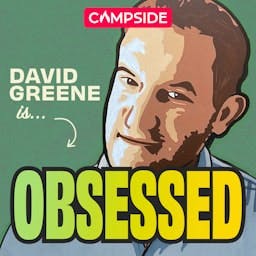
- David Greene is Obsessed
- Stefan Fatsis is obsessed with words
In short
Main points
- Description: A weekly show where David Greene discusses various obsessions with different guests, exploring the significance and implications of these interests.
- Episode Description: Journalist Stefan Fatsis, a lexicographer in training at Merriam-Webster, discusses his passion for words, their definitions, and the process of lexicography.
Written by AI. May contain mistakes.
Chapters
0:46
Exploring the Obsession with Words
David introduces his guest Stefan Fatsis and his obsession with dictionaries.
“The word fuck was in the proofs for Merriam's unabridged dictionary in 1961.”
2:19
Stefan's Unique Style of Obsession
Stefan discusses his approach to journalism and obsession through immersive experiences.
“and I'm going to bring in a guest who obsesses about a lot of things.”
4:26
The Journey into Merriam-Webster
Stefan narrates his visit to the Merriam-Webster headquarters and its history.
“Yeah, I mean, that's what makes you distinct.”
6:07
Inside the Merriam-Webster Archives
Stefan describes the archival system and the importance of physical records in language.
“You discovered that you really liked words and that they were going to be part of your life.”
8:15
Preserving the History of Language
Stefan reflects on the need to preserve the Merriam-Webster archive and the future of dictionaries.
“So then you decide recently that you're going to immerse yourself literally inside the headquarters of Merriam-Webster.”
14:02
The Importance of Digitizing Language Archives
Learn about the significance of preserving historical language resources.
“do this, that let me embed and become a lexicographer.”
15:12
Becoming a Lexicographer: A Personal Journey
Explore the journey of Stefan Fatsis as he becomes a lexicographer at Merriam-Webster.
“because you weren't just embedding for fun, like to witness.”
17:25
The Craft of Writing Definitions
Understand the complexities involved in writing clear and concise dictionary definitions.
“The goal is to be as clear and concise as you possibly can be.”
18:38
A Humorous Look at 'Dutch Oven'
Discover the funny and complex definition of the term 'Dutch oven' explored by Fatsis.
“Someone who writes definitions for the dictionary.”
20:55
Defining Offensive Terms: The N-Word
Learn about the challenges of defining sensitive and offensive terms in dictionaries.
“I think Brett Favre, the former NFL quarterback, somehow got involved.”
Show all 17 chapters
22:31
Cultural Shifts in Language Definitions
Explore how cultural attitudes influence the definitions of slurs and offensive terms over time.
“And I'm curious, God, I have so many questions about it.”
26:41
Lexicographers and Political Pressures
Discuss the impact of political pressures on dictionary definitions and editorial choices.
“But I did stop at trying to define the actual slur, which Merriam defines as the worst slur in English language, do not use this word, because I didn't feel equipped to do that, both professionally and personally.”
28:06
The Evolution of Words and Their Meanings
Explore how political discourse influences language and dictionary definitions.
“President Trump, of course, has been lobbying for the Washington sports team to go for the Washington commanders to go back to that name.”
34:48
Irregardless: The Debate on Language Norms
Delve into the word 'irregardless' and its contested place in language.
“And it feels like a really special community that we don't ever want to see extinct.”
42:06
The Fascination of Antedating in Lexicography
Learn about the concept of antedating and its significance in lexicography.
“Lexicographers like to do this thing called antedating.”
43:36
Exploring Personal Obsessions: Scrabble and Backgammon
Discover Stefan's journey through his various obsessions including Scrabble and backgammon.
“And I wanted to write a book about music and illness.”
45:38
Artistic Approaches to Crossword Puzzles
Stefan shares his artistic endeavor with the New York Times crossword puzzles.
“Call me if you do the saxophone, because I would love to.”

Ask about this episode
Get the gist, explore an idea or ask about something said.
 Claude
On David Greene is Obsessed, what are the key points of this episode?
Searching your listeningTranscript
Automatic transcript. May contain errors.
0:00Stefan Fatsis: If you'd like to join the Obsessed community, head over to joincampsite.com. We'll give you updates on episodes, some behind-the-scenes access, and a whole lot more. That's joincampsite.com. Hope to see you there.
0:15Stefan Fatsis: Campsite Media.
0:21Stefan Fatsis: Welcome to David Greene is Obsessed, everybody. You know, this is the show where we really go wherever guests want to go. Like, say, exploring whether certain words should be in the dictionary.
0:35David Greene: My favorite story, and I tell this in the book, is about the word fuck. And we can say fuck on this show, I think.
0:44Stefan Fatsis: We can. We can. We actually enjoy it. I strongly encourage it. Excellent.
0:49David Greene: The word fuck was in the proofs for Merriam's unabridged dictionary in 1961. and it was taken out by the publisher of Merriam-Webster. It was the only word that was removed over the objections of the editor, Philip Gove. And I tell the story of how this happened in the book through letters and other documents that other researchers, word people, have discovered over the years.
1:17Stefan Fatsis: So that is Stefan Fatsis, and he's actually the perfect guest for David Green is Obsessed. He's an author, he's a journalist, and he is just a super obsessive human being. He wrote a book on competitive Scrabble that he obsessed over. He also wrote a book about his own tryout for the NFL. Yeah, he was briefly a Denver Bronco. You should definitely read that. And his latest obsession is words and dictionaries and how words either do or don't make it into dictionaries. So the book is called Unabridged, the thrill of and threat to the modern dictionary. And I learned so many things in my conversation with Stefan, including that maybe I'm being an asshole when people pronounce espresso by saying expresso.
2:08Stefan Fatsis: Maybe we shouldn't judge them. Okay, my conversation with Stefan is coming up next.
2:17Stefan Fatsis: All right, we're back with David Green is Obsessed and I'm going to bring in a guest who obsesses about a lot of things. Stefan Fatsis is an old friend of mine. He's a sports journalist. He is an author, including of a new book called Unabridged, The Thrill of and Threat to the Modern Dictionary. Stefan, it's great to see you as always.
2:37David Greene: Great to see you again, David, too. Thanks for having me.
2:40Stefan Fatsis: I think it's safe to say you have a special style of obsession. I mean, I don't know if it's better to call it immersion. you have gotten interested in the Scrabble community. You've written a book about the National Football League where you felt it required to actually become an NFL kicker and try out for the Denver Broncos. I mean, what is your particular style of obsession? I feel like it is different than what we generally understand.
3:06David Greene: I think there are definitely gradations to that term obsession. I mean, you could say that part of what I do is, or what I do is just journalism. It's participatory journalism in the style of Paul Gallico in the 1920s, who decided to box against a heavyweight champion in the style of George Plimpton, the literary writer from the 50s, 60s, 70s, 80s, 90s, who became most famous for playing quarterback for the Detroit Lions in training camp, which was the inspiration for my book, A Few Seconds of Panic, but also did basketball and hockey and baseball. So there's definitely a professional goal here, which is that I think it's more fun to report when you dive into the subject and become part of it.
3:54David Greene: Obsession then can certainly be defined as having a commercial purpose or a professional purpose. I like to become obsessed with these things either organically, which is what happened in the case of my book about the world of competitive Scrabble, or with a very direct purpose, which was kicking a football. Like, it wasn't like, oh, I kicked footballs when I was in high school. I wasn't on the football team. I had never really kicked a football until I was 42 years old and decided to try to get an NFL team to let me go to training camp.
4:26Stefan Fatsis: Yeah, I mean, that's what makes you distinct. This is not the way most people carry out the field of journalism, by actually becoming an NFL kicker to cover sports.
4:33David Greene: David, it's just more fun. I just discovered when I did Word Freak, the Scrabble book, that, wow, this is cool. And it's also a way to get people to trust you. If you do what they do and you show a genuine commitment to what they do and to learning about what makes them interesting and great and obsessive, they are more likely to accept you into their world. And that happened with all the books that I've written about.
4:57Stefan Fatsis: I think about the amount of times I'd be making an absolute fool of myself if I tried to become involved in everything I was covering. I mean, there's a humility that has to be involved in this, I would assume.
5:09David Greene: There's absolutely a humility. But if you're looking at it also with an end goal, failure makes for good storytelling. True. And struggle makes for good storytelling. If I was good enough to kick in the NFL, my book about the NFL wouldn't have been that interesting. I would have just been another NFL player, right? I mean, amazingly what they do, like one of the greatest athletes like in the country, but ultimately, yeah, just another kicker who's expected to make every kick on Sunday. The struggle, the journey, as it were, is what makes, I think, the writing more accessible for people. It makes a reader want to root for you in diving down these rabbit holes.
5:54Stefan Fatsis: Yeah. Okay, so let's talk about this journey. I don't know whether to call this an obsession with words or with the dictionary. How do you frame this obsession?
6:04David Greene: I think it's mostly with words. And it's something that, you know, I'm sure you experienced the same thing when you were a kid. You discovered that you really liked words and that they were going to be part of your life. I mean, I, as I write in Unabridged, this sort of began for me on my 11th birthday when my mother gave me a Webster's New World dictionary. It had pages of color drawings. It had this bright blue undercover and this multicolored front cover in glossy paper. And I read that thing until the bindings, Frayed. I can walk over there and pull it off the shelf and show you if you want.
6:42Stefan Fatsis: I would love it. Do it. Yeah, do it. The way you described it, I mean, the description, it almost became a character, I think, in the book. Okay, Stephan is walking over to his bookshelf.
6:53David Greene: All right. So here it is. Webster's New World Dictionary of the American Language.
6:58Stefan Fatsis: I love the worn binding. I mean, that thing has been opened thousands of times.
7:03David Greene: And that's tape on top of it. That's packing tape, covering it up. And I did this like multiple times, yeah.
7:10Stefan Fatsis: Yeah. But why did that just capture your imagination at the age of 11?
7:15David Greene: I don't know, because I was kind of a dork, I guess. I mean, I just liked the way it looked. I loved the cutouts on the side, you know, to go to each letter. The different letter, yeah. I loved these color drawings inside, right? It's like, these were so cool.
7:32Stefan Fatsis: So those are airplanes. That's like near the definition for airplanes?
7:36David Greene: Aircraft page, yeah.
7:37Stefan Fatsis: Aircraft, okay.
7:38David Greene: And then the cover featured, which I love, the Twin Towers. And there was like a woman in go-go boots straddling the Twin Towers. It was very 70s. The drawings were very 70s and the references were very 70s. And the full circle moment for me was like watching the World Trade Center collapse. And like I actually thought about, oh, my God, yeah, I remember that dictionary. And it was this sort of of its time reference to the Twin Towers right there on the cover. So anyway, this was my dictionary, high school, college and into the beginning of my career as a reporter.
8:15Stefan Fatsis: I love that. And that's what got you into it. So then you decide recently that you're going to immerse yourself literally inside the headquarters of Merriam-Webster. Take me there. Like this is an old building in western Massachusetts. Is that right?
8:28David Greene: Central Massachusetts. It's in Springfield. The building opened in 1940. The Merriam brothers, George and Charles, had moved to Springfield in the mid-1800s. They were publishers. They had small trade presses and they printed Bibles and pamphlets. And they realized after Noah Webster, the American father of lexicography, of dictionary making, died in 1842, 3, they heard that the page proofs of his monumental 1828, an American dictionary of the English language, was available. and one brother was at a trade show in New York and the other brother was in Massachusetts and he heard about it, that the guy that owned the rights to the dictionary was gonna be there and he sent off this letter to his brother, the guy in New York, the brother in New York wrote to his brother in Massachusetts and said, this is gonna be available, this could be worth more to us than anything we will ever do in our lifetimes and he is heading back to Massachusetts and we've got to get him to stop in Springfield and negotiate the rights to acquire the dictionary.
9:43Stefan Fatsis: Oh, that's amazing. And so the rest is history, so to speak. Well, take me into this building. I mean, I'm imagining, I'm having images of my college library, like being in the basement among the stacks on like a dusty wooden table, studying for an exam late on a Sunday night. Is that close?
10:00David Greene: Yeah, it's close. I mean, the way I've described it is the building itself looks like an elementary school, A brick, rectangular elementary school. But inside, the charm of Merriam is that it didn't go through some giant gut renovation in the 80s or 90s or 2000s. It's very much the way it was when the doors opened in 1940. Carpet's a little drab. The paint on the walls is a little bit sort of, you know, sanitarium yellow. the cubicles when I was there were very much early 90s vintage. But to me, that sort of enhances the real purpose of this place, which is that it is this archive of American language.
10:45David Greene: On the editorial floor, which is on the second floor, the most distinguishing feature are these rows of metal filing cabinets, brick red, tan, that basically occupy about half of the floor. And in those filing cabinets are 16 million slips of paper. Those are called citations. And those citations are little cards, three by five, on which Merriam editors for almost 100 years, recorded examples of words in usage in newspapers, magazines, cereal boxes, whatever, or draft definitions of words or etymologies of words. Every slip of paper had a distinct purpose.
11:33Stefan Fatsis: And there's 16 million of them, like in what must seem like the largest card catalog that a human has ever seen. I mean, is that essentially what it looks like?
11:43David Greene: Yeah, it looks like a card catalog, except that, you know, you think of those old library card catalogs that had wooden drawers. These are metal drawers. And there was a reason these are metal drawers, because wood would burn in a fire. Metal, theoretically, would not. And there's a reason that Merriam-Webster doesn't have sprinklers on this floor because water would do more damage in a fire than fire would. At least that was the belief. But these slips of paper are an archive of American English. And Merriam kept them. The files date to the early 20th century when Merriam moved its operations, essentially from New Haven, Connecticut, where the dictionaries in the early years after the Merriams acquired Noah's book were published by a bunch of Yale professors largely.
12:30David Greene: And through the 19, into the 1990s, when things started to go digital. So the files are called the consolidated files. And you just go in, and this is what I would do because it was so much fun. I would go in, like I find a word that I was interested in defining. And if it was an older word, not some new word, there would inevitably be a stack of cards. And I would just pull out a quarter inch or more of cards, bring them back to my desk in usually an old cigar box or a pencil box, and start going through them one by one. And the thing about the cards and the paper is that, yeah, it's a super contrast to the world we live in now, where almost all of this work is done digitally, of course.
13:16David Greene: The databases are so complete, and the ability to find citations, examples of words is instantaneous. But the cards just evoke every era in American printing, publishing, handwriting. It's from photostats from the 1950s with the white on black paper, the shiny paper, and then the early computer printouts that didn't have tails on the GY Q, etc.
13:47Stefan Fatsis: And this stuff has not been digitized. I mean, this is only preserved on these like handwritten or typed cards that you find in this massive file.
13:55David Greene: Yeah. And I actually talked about this with the publisher, the then publisher of Merriam-Webster, John Morse, the guy that let me do this, that let me embed and become a lexicographer. And John said, we'd love to do it. It's just super expensive. I mean, at one point I tried to connect him with someone at Google who said we could design a machine. It wouldn't be that hard, but it never got anywhere. And the fear is that these won't ever get digitized. And they should be digitized because they are, like I said, this archive of the history of American language. I get sort of anxious thinking about the fact that someday Merriam-Webster is going to move out of this building and they're going to have to do something with this stuff.
14:37David Greene: Send a few boxes to the Smithsonian. Maybe there's some philanthropist that wants to create an American dictionary museum and house it in that building. But they are worth preserving. And the cards that were used for other dictionaries, like Random House and other companies that are no longer in the dictionary business, some of those have been completely lost and some of them are buried in, you know, the Iron Mountain storage facilities and are inaccessible to researchers and others that are interested in the history of language and lexicography.
15:08Stefan Fatsis: Well, and I want to understand what you were actually doing with all of this stuff because you weren't just embedding for fun, like to witness. I mean, you were actively kind of studying words, going back through all of these cards and seeing like how different employees of Merriam-Webster, you know, were sort of wrestling with what a word meant and what its place was in American language. And you were going through the process. I mean, say more about what you were actually doing and accomplishing?
15:40David Greene: Well, my first day at Merriam-Webster, I went upstairs and met the guy with the best title in, I don't know, anywhere. His title is Director of Defining. His name was Steve Perot.
15:51Stefan Fatsis: Yeah. I laughed out loud when I read that. It's like, who has a
15:55David Greene: better title than that? What a great title. And Steve said, well, what do you want to do? Because I had met Steve - You want to be the Director of Defining is what you want to do, ultimately, right? I'm coming for your job, dude. I had met Steve before because I had written a magazine story about Merriam's revision of its 1961 unabridged dictionary, this fat, four inch thick, 13 and a half pound, half a million words. This book hadn't been revised since it was published. And Merriam was going to do this online. And I did a long story for Slate about that. And that's when I approached John Morris, the publisher.
16:32David Greene: And I said, look, I'd like to write a book about this, but I want to become a lexicographer. I want to be someone that is writing definitions and trying to get them in the dictionary. So when I got there that first day, Steve said, so what do you want to do? And I said, write definitions. And he said, definitions that get in the dictionary? And I said, yeah. And he said, yeah, we'll see about that.
16:49Stefan Fatsis: If you'll let me. We'll see about that. Yeah. We'll see about that. Maybe, Stephen, maybe.
16:53David Greene: Maybe. And so I got right to work. They set me up with my own cubicle and my own dictionaries and my own passwords. I had a key to the back door. It was like I was on staff. And Steve was a teacher, a mentor, incredibly generous with his time, like letting this reporter who was just mucking up the works in this project that was estimated would take like three decades to complete. But they were incredibly welcoming and taught me how to do this. And it's more complicated than it looks. It's really hard to take a stack of cards or a file that has like 100 example sentences that you have culled from newspapers.com or Nexus or whatever database, and then turn it into something that is easy to digest, easy to understand, simple in its style, no flourishes, no frills.
17:52David Greene: The goal is to be as clear and concise as you possibly can be.
17:56Stefan Fatsis: He wrote that the best definition of a word is one that seems obvious. Like someone reads it and is like, of course that's what that means. Like there's just no uncertainty left.
18:04David Greene: And the idea is to sort of mask that it was written by anybody, right? It's so obvious that it looks like it was just handed down on a tablet. But the work that goes into every one of these is monumental. Like for me, an amateur, it was like, I think I write in the book, like flipping over a Volkswagen. To the professional lexicographers at Merriam, they would crank out five or 10 or more definitions a week, and I would struggle to get one done in three or four weeks.
18:31Stefan Fatsis: We should establish one very important definition, lexicographer. How exactly do you define that now that you are one?
18:40David Greene: Someone who writes definitions for the dictionary.
18:43Stefan Fatsis: Okay, it's that simple.
18:45David Greene: From the Greek, lexico, meaning words, and grafos, to write. Yeah. So lexicographer. Yeah.
18:51Stefan Fatsis: I love it. Well, one of the phrases that you were studying and considering, I think considering for inclusion in the dictionary that made me literally laugh out loud was Dutch oven.
19:03David Greene: Yes.
19:06Stefan Fatsis: Let's talk about Dutch oven. How do you define it for our listeners? Because I think we all would have a good time trying to explain it.
19:16David Greene: Okay, so the backstory is that when I got to Merriam, one of the first things that Steve Perrault told me to do was read the front matter to the collegiate dictionary and to the unabridged dictionary. And the front matter is that sort of 20 pages of text in the front of a book, in front of a dictionary that explains the format. It explains language and grammar. But mostly it gives examples on what everything means, like what's a transitive verb and what different kinds of nouns are there. So I was reading this front matter. And one of the examples that was given for, I think it was a compound noun, was Dutch oven.
19:59David Greene: And I started laughing because it's like, okay, really? That Dutch oven? And I went and I looked it up online in Merriam. And the only definition was like the crock pot on the stove.
20:10Stefan Fatsis: That's all they had at that point.
20:12David Greene: That's all that was in there. And that's still all that's in there, spoiler alert. But I was like, all right, I got to try to define Dutch oven in the modern sense. And here's what I wrote. I ended up doing lots of research, like days of research, trying to find good example sentences for the use of this term. And here's what I ended up with, David. Slang, an enclosed area, usually beneath bed covers, in which a person forcibly traps another person after farting.
20:43Stefan Fatsis: That's perfect. It's concise. It's clear. Thank you. It seems to be accurate. Thank you. I guess the funniest part for me was that you actually get into kind of a back and forth over whether a Dutch oven is a place or whether it is a thing that you do to someone. You like Dutch oven them. I think Brett Favre, the former NFL quarterback, somehow got involved.
21:07David Greene: Brett Favre makes an appearance. Because I like, so Steve Perrault and I have this back and forth in which he explains that the way I've defined it might not be exactly accurate. It's more of an idiom. Like he gave someone the Dutch oven. And he said like, you know, I'm not sure this is ready for the dictionary. There might not be enough citations. And literally like the next day, Steve walks in. He's holding a copy of Sports Illustrated. He comes over to my cubicle and he shows me this profile of Brett Favre that included this paragraph. Favre grew up in Green Bay or tried to. He jumped on the backs of so many teammates after touchdowns that Holmgren, the coach, threatened to fine him$5 ,000 for his next leap.
21:52David Greene: He babysat Steve Mariucci's children, but after a while, they didn't want that anymore, Mariucci says. he kept giving them the Dutch oven.
22:03Stefan Fatsis: Which speaks to the complexity here. It's not necessarily a place, a location. It's something that someone's giving you.
22:12David Greene: Giving you, giving you. So it's very complicated. So I wrote a definition and I edited it and I submitted it. But it's not in there? And it didn't make it in. So in the end, during my years at Merriam-Webster, I defined about 90 words. And I'm proud to say that more than a dozen have actually been entered into merriam-webster.com.
22:29Stefan Fatsis: One of the words that you did get in is much more serious, and that's the N-word. Yes. And I'm curious, God, I have so many questions about it. Like, if you looked up in Merriam-Webster now, does it say the N-word or it actually uses the full term?
22:46David Greene: No, it is a separate term. I mean, the full term is in there because obscenities are part of the language and they are in dictionaries. And the inclusion of the full term has created issues for Merriam periodically through the years. There was a giant public, very public, media-driven, multi-week story about a campaign to get Merriam to change the definition of the N-word and other obscenities. and it kind of worked because Merriam ultimately sort of didn't change the way that didn't change the inclusion of words like the N-word in the dictionary, but they changed the way that they are referenced in the dictionary.
23:33David Greene: So instead of sort of trying to define the word for what it is, the definition now, if you look up words like the N-word is the fact that it is an offensive term. It's less about what the term means than more of the fact that it is this offensive term. So, for instance, I mentioned the, if you look up the word, it says offensive, used as an insulting and contemptuous term for a black person, as opposed to a synonym. And then that's for the full N word. Now, if you look up what I wrote.
24:06Stefan Fatsis: So, your entry was literally N-word. I mean, you were saying that that is used so often in our language today that she has its own entry point in the Merring-Webster dictionary. Okay.
24:16David Greene: Yeah, and that's the standard for all words, all terms, lexical units, because words are not necessarily just one word. They can be two words or hyphenated words, hyphenated terms. So the entry for N-word that I wrote is used euphemistically to refer to the word. And then the alternate spellings are the N-word, capital N-word, and the N-word, lowercase N-word.
24:43Stefan Fatsis: And why was that one of the words that you felt so motivated to get into the dictionary?
24:50David Greene: Well, it wasn't in there, first of all. And again, as a reporter, the history of profanity and offensive terms is fascinating and complicated. And what I discovered in researching the N-word and other slurs I write about the former name of the Washington football team, for instance, is that you mentioned this back and forth that editors would have. And those are all preserved on these slips in the consolidated files. And watching the sort of the way that American culture and the way these editors process how words are considered and defined is this really interesting historical thing. thing. There were decades-long conversations on these slips that I was able to suss out by going through these long stacks of little tiny pieces of paper, explicating how these words were accepted, how they were described, defined, and how those definitions changed over time.
26:06David Greene: And what you see with both of the terms I just mentioned is this shift in attitude among editors, which reflect a shift in attitude in culture, where words, slurs like these are first sort of noted, then they are sort of listed as kind of derogatory. And then that sort of increases over time as culture processes them. And I just think that that history is worth exploring. and nobody had really done that kind of deep dive on these slurs. And it felt like, you know, why not give it a shot? But I did stop at trying to define the actual slur, which Merriam defines as the worst slur in English language, do not use this word, because I didn't feel equipped to do that, both professionally and personally.
26:57Stefan Fatsis: We're talking about the N-word.
26:59David Greene: Yeah, talking about the N-word, yeah.
27:00Stefan Fatsis: You stopped at wanting to be involved in that definition you're saying?
27:04David Greene: Yeah, I thought about trying to, because the definition is inadequate. If you go to slang dictionaries or other places, the definition of the N-word is much more expansive, including particularly the evolution of its use in music and in other parts of culture over the last 40 years. Merriam's definition in its online dictionary is pretty thin comparatively, partly for professional, for corporate political reasons. Every time you step on the third rail of sensitive words, you are risking public criticism and write-in campaigns and just general anger, particularly, obviously, in the internet age.
27:45David Greene: Merriam used to permit comments beneath entries in the dictionary online. And the vituperation and the bile in the comment section were sort of sadly, you know, predictable and sadly reflective of what we are as a society.
28:07Stefan Fatsis: Well, yeah. I mean, especially I think about this political moment and our, you know, culture wars today and the word you used or you referred to, and I'll say it, even though many consider it a slur, just so people know what we're talking about, the former name of the Washington football team is the Washington Redskins, which a lot of people think is a racist slur. President Trump, of course, has been lobbying for the Washington sports team to go for the Washington commanders to go back to that name. Do you think if he starts getting more and more support for that, that, you know, a dictionary like Mary might be under pressure to kind of change the way it handles a word like that?
28:44David Greene: I don't. And the reason is that lexicographers are looking at language from 40 stories up. They are looking at every usage and trying to see the sort of the totality of use. So the standard for inclusion in a dictionary, in a commercial dictionary like Merriam-Webster or Oxford, the Oxford English Dictionary or other commercial dictionaries is consistent usage over time in professionally edited publications. So there's a dispassionate, descriptive approach that is the grounding for American lexicography and English lexicography generally. So Donald Trump's use of the word or just him saying, oh, we should use this doesn't mean that it's not a slur.
29:40David Greene: It just means that Donald Trump is saying we should use a slur because it is dictionary-defined offensive now. And in the book, in Unabridged, I sort of walk through the century-long evolution of the definition of this word.
29:59Stefan Fatsis: Which was the kind of journey that you could do with any word, looking back through all of those slips of paper, which I think was, you made me want to get in there with you. But I guess that that speaks to something. Like you're saying that lexicographers, the last thing they want to be is referees in some sort of political debate. Because I feel like, you know, you write about how there are people who would rush to the dictionary to see if a word is in there and how it is defined, like to either validate their own points of view or to get angry and be able to have a reaction and be mad at Merriam-Webster.
30:35Stefan Fatsis: Are the stakes high for the publisher in some ways when people are looking at going to the dictionary for those purposes?
30:44David Greene: Stakes are incredibly high. Corey Stamper, a writer, former Merriam-Webster editor, wrote a lovely memoir called Word by Word a few years ago in which she talked about the threats that she received after a definition that Merriam had written six years earlier of a change in the definition of the word marriage, which Stephen Colbert picked up and did a segment on. And that went viral. And Merriam and she personally were receiving threats. More recently, somebody was convicted of federal charges for sending threats to Merriam-Webster over its definitions of woman. So yes, words are volatile. And we see that every day in these political times.
31:34David Greene: Words are weaponized quite deliberately.
31:38Stefan Fatsis: So lexicographers, I guess to kind of bring us home in a way, they embrace the idea of being the quiet referee. I mean, they don't want attention. They don't want to look like they're obviously taking sides ever. But if they are the great arbiter of what a word should mean, based not on your politics and not on your own points of view, but based on a science, lexicography, that's a role that they want to play.
32:01David Greene: Absolutely. I mean, good luck persuading partisan voices that that is the role that they play, but that is the role that they play. And one of the perils, you know, the threat in the title of my book is that there are fewer and fewer people doing this work because of the decline in the commercial dictionary business this in the last 30 years in North America. And the threat from Google putting its own definitions at the top of searches and now putting its AI previews at the top of the search of searches. And those have the net effect of preventing people from scrolling down and clicking on Merriam-Webster's definition.
32:43David Greene: And fewer clicks means fewer eyes means lower advertising rates. Right. So the struggle for a place like Merriam-Webster is to find ways to get people to come to the website. It's like any media company. And that to me is sad because you think of the dictionary as this authority, but the age of authority has passed us, right? Right. Dictionaries were once, and this is how Merriam advertised the dictionary to the public in the late 1800s and early 1900s, that you must have this to become a citizen of the world. That it's essential if you want to be an educated American. And we don't view this that way because I can just type in a word into a search bar and I'll get something.
33:26David Greene: You know, it might be someone else, some rando definition. It might be a professional definition. It might be an AI agglomeration.
33:35Stefan Fatsis: So what is the future of dictionaries, do you think, given everything you just said? I mean, that we don't need them as much as we used to because we can feel like at least that we can just Google a word or jump online.
33:46David Greene: Well, what the internet has allowed is effectively for anyone to be a lexicographer. Because I can find example sentences and usage for any word just by going online. In four seconds.
33:59Stefan Fatsis: Yeah.
33:59David Greene: I don't need to spend a week combing through these citation slips and then doing extensive database work to get enough. Or AI will just produce one for me. And I have a chapter about AI in the book where I actually have AI write definitions for words that I defined. Like I defined microaggression and I had AI do that. And it kind of plagiarized me because it clearly had scraped Merriam-Webster's data.
34:26Stefan Fatsis: That's amazing. AI was literally plagiarizing you because you You had done the definition for microaggression in Merriam-Webster. Awesome. Yeah.
34:33David Greene: So what's the risk to companies like Merriam-Webster is how do you stay relevant?
34:38Stefan Fatsis: Yeah.
34:38David Greene: How do you generate enough revenue to have a staff of editors who are still doing the nuts and bolts work of defining? But it's sad. We've gone from about 200 full-time working lexicographers in America 20 years ago to probably 30 or so.
34:54Stefan Fatsis: And it feels like a really special community that we don't ever want to see extinct. I mean, what are lexicographers like? I knew nothing about this community until I was reading about them in your book.
35:06David Greene: There's really smart people who love language, but the work is really monastic. I mean, the one feature of the Merriam editorial floor is that there's really no talking. Talking is sort of unofficially banned on the editorial floor. You got to whisper.
35:27Stefan Fatsis: Wow, it's like a library. The people who are at work don't bug them.
35:31David Greene: And they work the shift. You have your half hour break for lunch and you are focused the rest of the time, writing definitions, writing blog posts, writing other content. And even to the point when I was there a few years ago, and most of my years there were before the pandemic, but the way that editors communicate with each other on the floor is using those little citation slips. There's still these slips of paper all over Merriam's editorial floor. And so if I wanted to ask you to go to lunch, David, I would write down on a white slip, David, let's grab lunch at 1215. And I would put it in a little box and you would look at it and you would write back on the same slip, okay.
36:15David Greene: And then we'd meet at 1215 and go to lunch.
36:16Stefan Fatsis: Just passing notes. God, that's so archaic and nostalgic and lovely. Yeah, there's something beautiful about that. I think I wanted to see if I could get you to read it. Towards the end of the book, you were talking about. One of the ways that Merriam-Webster is surviving in this modern era is they have a little bit of an edge and personality in their social media.
36:38David Greene: Yeah.
36:38Stefan Fatsis: And there was one post that you talked about from 2024.
36:45David Greene: Yes. I love this. This was sort of a classic. So during the first Trump era, Merriam's social media feed became very sort of pointed and got a lot of attention and grew exponentially because it was really smart assy toward Trump and the administration, you know, tweeting about, you know, words like bigly and covfefe and unprecedented. And they sort of toned that down after that. And now it's sort of it's smart, but not quite as pointed. And I think this post exemplifies that. And I'm going to read it now. This was the post. And it was a multicolor image, just like one of those yard signs. On social media.
37:30David Greene: On social media. In this house, we believe, literally can be used to mean virtually. Conversate has been a word for 200 years. While nonstandard, irregardless, is a real word. It can be pronounced either espresso or expresso. out. You can end a sentence with a preposition. Embiggen is a perfectly cromulent word.
37:52Stefan Fatsis: Cromulent. You got to define that for all of us.
37:54David Greene: Yeah. Cromulent means fine. It's from the Simpsons as is Embiggen. I talked to one of the Simpsons writers who came up with Embiggen. Amazing. For an episode. Yes. Lisa the Iconoclast was the episode. And that episode included Embiggen and Cromulent written by two different people. But I interviewed one of the guys, Dan Greeney, who came up with Embigin.
38:13Stefan Fatsis: So Embigin is okay. And I think I've corrected people sometimes who say expresso, but now I'm not going to be able to do that. I need to let them say it. And also, irregardless is really okay.
38:24David Greene: Irregardless is fine.
38:25Stefan Fatsis: What's the difference between irregardless and regardless?
38:28David Greene: Well, this is interesting. I learned a lot of this from going through all of those slips in the consolidated files. Because if you want to know what happened, like how words changed and how the editors came to perceive them. On these slips, there would be like conversations that would occur over decades. Like someone would write a note in like 1937 and then someone would reply in like 1954.
38:56Stefan Fatsis: It's incredible. It's like conversations that never end. Yeah.
39:00David Greene: That never ever end. Across space and time.
39:02Stefan Fatsis: Yeah. It's really cool.
39:03David Greene: So, irregardless, goes back to at least 1847, according to Merriam-Webster. Nice. And Merriam then described it as popularized in dialectical speech in the early 1900s. But fuss budgets started saying it wasn't a word in the 1920s.
39:25Stefan Fatsis: Fuss budgets, I really love that too. I am one, so thank you.
39:28David Greene: But the word has been in Merriam's Dictionary for generations. And Corey Stamper, the linguist who I mentioned earlier, she has been someone who has sort of promoted the idea that there's nothing wrong with you regardless. Part of the reason being that it's not just a bastardized form of regardless, but rather it is a word that is an intensified form. And I'm reading now from my book, an intensified form of the root word that enjoyed a dialectical minute in the South in the late 19th century. And Stamper reported that the IR, which normally expresses negation, indicating that it would be the opposite, in this case appears to function as an intensifier.
40:15David Greene: And this is in an edit in a little etymological note attached to the word irregardless in Merriam-Webster. And she found other words that were rare but exist, irremedieless for remediless, irresistless for resistless, and irrelentlessly for relentlessly. And then I went into the files and found these like long conversations about, about irregardless and how Miriam should, should label it. Is it non-standard? Is it substandard? Is it dialectical? Is it humorous? But ultimately Miriam never took it out of the book.
40:51Stefan Fatsis: So it's emphasis. It's, it is, it is very regardless. It's like adding, adding emphasis. It's super, super regardless. Well, Stefan, irregardless of whether you are game for this or not, we're going to come back in a second and do a little lightning round of your obsessions. Excellent. We'll be right back with more David Green is Obsessed.
41:15Stefan Fatsis: All right, welcome back to David Green is Obsessed. I am with sports journalist and author Stefan Fatsis, whose new book is called Unabridged, The Thrill of and Threat to the Modern Dictionary. This is the part of the show that I call Stefan Fatsis is Obsessed. before we leave words and dictionaries. What do you think this obsession with lexicography says about you?
41:40David Greene: It says that I'm kind of, you know, partly it's just being a writer and a reporter, David. I'm curious about like where words come from and how they fit into language. Etymology is fascinating. I mean, the one thing that I think I grew most interested in doing over the course of reporting this book was learning how to better find citations. Lexicographers like to do this thing called antedating. You find an antedate noun. An antedate is like an earlier first usage of a word. So you'll see in any dictionary entry, particularly the OED, which is a historical dictionary, which wants to, as best as possible, identify the very first usage in print of every word.
42:33David Greene: And Merriam will also include a date of first usage. I was so gratified when I found an antedating for a word, an earlier usage for a word. There was one time I actually got the OED to change a date because of one of my discoveries.
42:51Stefan Fatsis: Oh, wow. So it's not just words. You're finding just facts on the ground from going through all these files. Totally. Totally.
42:58David Greene: And you're like, it becomes very obsessive because you don't know when the first use of a word might have been, right? There might be another example lurking out there one day or one month or one year or 10 years or 100 years earlier. It's really like, it's this challenge. Can I find the first usage? And some people are way better at it than I am, believe me and merriam even had for years and still has someone whose job it is and the title
43:26Stefan Fatsis: was dater dater to find the first date of okay so if they found that like you know in jamestown they were taught using dutch oven um i mean that would be a very important discovery like yes if it goes back that far okay next obsession that will become a book is well i'm i don't know it's
43:45David Greene: become a book but i've been playing scrabble for 25 years right more um but i've always i've always thought i'm better at backgammon and i've been avoiding i've been playing i played backgammon as a kid i played backgammon like my my father was greek we would go to greece in the summer i would play backgammon when i was like nine years old sitting in a cafe with these old greek men
44:04Stefan Fatsis: so i learned how to play backgammon pretty well and i was recently watching the backgammon world
44:09David Greene: championship because you know that's what you do you watch the live stream of the backgammon world championship of course we of course every weekend every weekend um and i'm watching the i'm watching the finals and i'm like man i could do this i'm like i'm really good at backgammon i i should like start studying and so there's like there's something is pulling me to do this but i'm avoiding it for now i'm avoiding this tug for now um you know for a while i thought my obsession was going to be trying to become a great saxophone player i was an okay sax player when i was in high school. And I wanted to write a book about music and illness.
44:49David Greene: My brother has Parkinson's disease, and my brother was a great sax player in high school and college as an adult, and he lost the ability to play. And I started taking lessons for a while and played in a little ensemble for a while. And I thought that might be an obsession too. But the problem with these obsessions, David yeah is that it's fun to do them and then it becomes frustrating when you can't become great um and like Scrabble 25 years later I'm good but I never got great my daughter got great because she put in more work than I did studying kicking a football I was pretty good for a 43 year old that had never kicked a football before but not great not great yeah no didn't make the team
45:38Stefan Fatsis: Yeah. Yeah. I can understand that. Call me if you do the saxophone, because I would love to. I played saxophone in high school, and I've totally lost it. So if you go back and start taking lessons to get better, I might be your editorial assistant or something.
45:51David Greene: Or we can form our own band.
45:53Stefan Fatsis: Yeah, we could totally do that. What's an obsession you've never told anyone about, not even your wife?
46:01David Greene: How do you hide an obsession, David? I don't know that that's possible.
46:05Stefan Fatsis: This is the trap. This is why I love questions like this.
46:07David Greene: I don't have any obsessions like that. Mine are all very public facing. I want to turn them into books.
46:13Stefan Fatsis: There you go. And in addition, like you're so transparent with your spouse, like there would never be something to hide. I mean, that's the beautiful answer that I know you were about to say. Okay, an obsession that would shock your friends.
46:29David Greene: All right. Last year for an art project, I did the New York Times crossword puzzle every day in a different color pen corresponding with each day of the week.
46:42Stefan Fatsis: It's not enough to do the crossword every day. You have to make it an art project. Yes. Okay. Yeah. Why did you do that? Just for fun?
46:51David Greene: I have a friend that makes collages, and I thought it might be cool to document my love of the New York Times crossword puzzle, which I do on paper every day because I prefer doing it on paper than doing it online. And we've only got one subscription and my daughter insists on doing it online. And I just thought like, if I'm going to do it every day, I already do it every day. I'm going to turn it into an art project. So I had a different color for every day of the week and the pens were, okay, this is a little obsessive. The pens are in a little jar downstairs and I had them in a circle. So, but I knew that Sunday was red and Monday was blue and Tuesday was pink and Wednesday was purple.
47:24David Greene: Sorry. That's amazing.
47:25Stefan Fatsis: I am so happy I asked you about that. Stephan Fatsis is a sports journalist and author. His latest book is Unabridged, The Thrill of and Threat to the Modern Dictionary. Stephan, best of luck with the book. It's awesome. And see you again soon.
47:39David Greene: Thank you so much, David. It's been a pleasure.
47:47Stefan Fatsis: David Green is Obsessed as a production of Campside Media. It is hosted by me, David Green. Our senior producer is Lane Rose. We are mixed by Ewan Leitrimuen. The executive producers of Campside Media are Vanessa Gregoriadis, Matt Scherr, and Josh Dean. Special thanks to our operations team, Ashley Warren and Sabina Mara. If you have an obsession you would like to share, hope you do, you can send us an email. The address is obsessed at campsidemedia.com. That's obsessed at campsidemedia.com. And hey, if you enjoyed the show, please rate and review the show wherever you get your podcasts. Really appreciate you listening.
48:27Stefan Fatsis: Moms and Mysteries is the podcast where two Florida friends uncover chilling cases with humor and heart. Hey guys, I'm Mandy. And I'm Melissa. And we're the moms behind the mics taking you on a roller coaster of true crime stories while adding our own brand of humor into the mix. Respectfully.
48:43David Greene: Join us every Tuesday for Moms and Mysteries, your gateway to gripping, well-researched true crime stories. We're your go-to podcast for mysteries with a motherly touch. Subscribe now to Moms and Mysteries wherever you get your podcasts and never miss a Tuesday.
From the publisher
Journalist Stefan Fatsis loves words so much, he started training as a lexicographer at Merriam-Webster and then wrote a book about it. He joins David to elaborates on his obsession with the words and their definitions.
To connect with the team and gain access to behind the scenes content, join our community at joincampside.com. You can also find us on Instagram, TikTok & Youtube. Email us your latest obsessions at [email protected]!
More from David Greene is Obsessed
All episodesWe use cookies.They keep VO running smoothly and help us improve it. Privacy policy