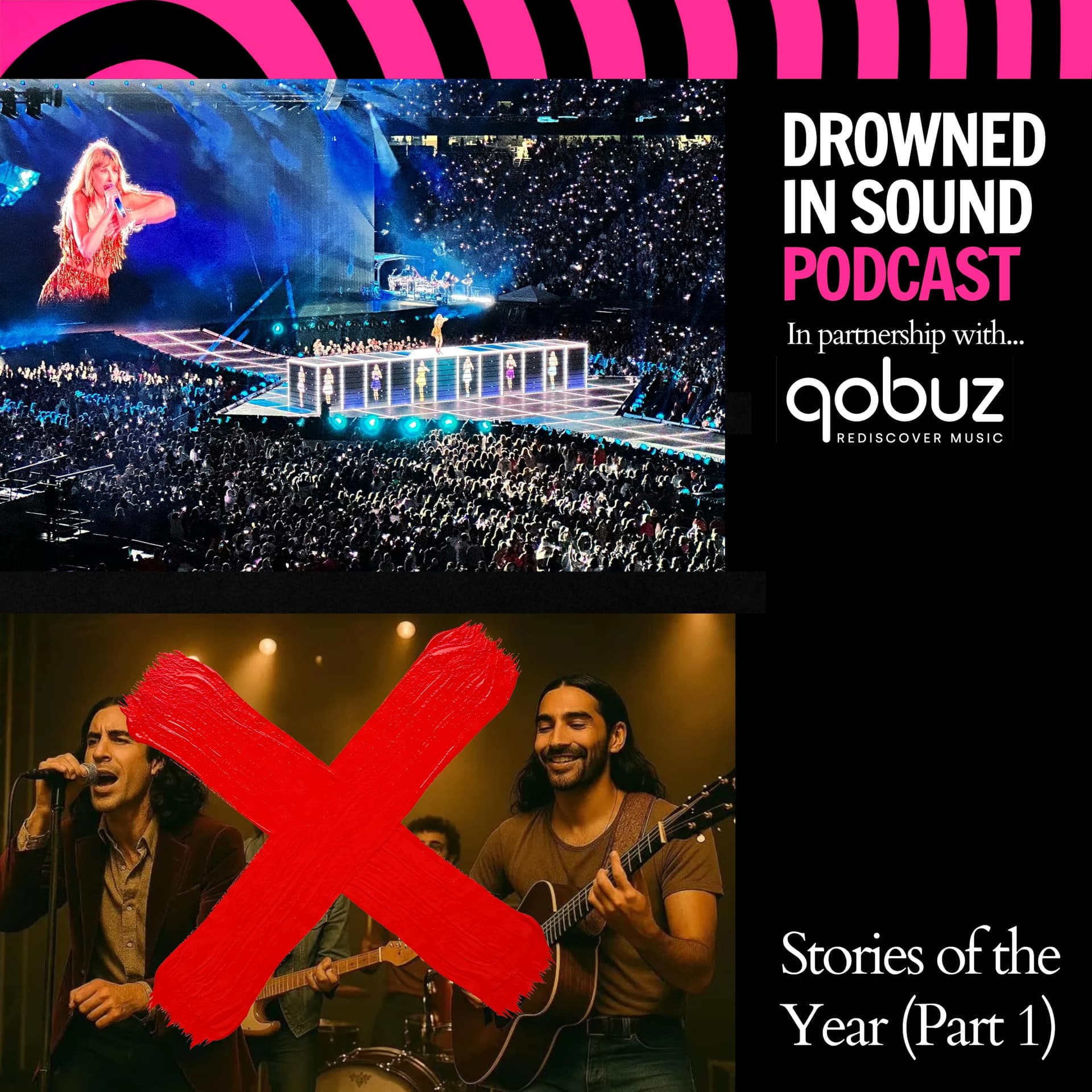
In short
Drowning Sound’s “Stories of 2025 – Part 1” (themes countdown). Focuses on mega gigs vs grassroots venues, and then AI “slop” in music—how AI-generated acts, disinformation risks, and unclear training/consent are reshaping the industry.
Guests
Emma Wilkes (co-host; wrote about “mega gigs,” discusses BBC Sound of… and grassroots levy). Sean Adams (host; co-leads the countdown; mentions editing and recording).
Key claims
- Mega gigs (stadium/park festivals with corporate presence) reflect inequality and corporate power; grassroots venues struggle financially and need support (e.g., Music Venues Trust levy).
- AI music is spreading via algorithms and curiosity, but raises consent/copyright concerns and enables disinformation/social manipulation.
Notable examples
- Taylor Swift’s wealth/“endless editions.”
- Sam Fender donating Mercury Prize winnings to venues trust.
- Little Simz, FKA twigs, Rachel Chinouriri, Garbage cancelling US tours.
- Chappell Roan’s Reading headline; Lambrini Girls topping “Sound of 2025.”
- Velvet Sundown (AI band), Boomy (millions of awful tracks).
Written by AI. May contain mistakes. Listen to the episode to check what was said.
Chapters
Tap a time to open that second in VOOverview of 2025 Music Themes
0:45 to 1:44
Discussion on the biggest themes and stories in music for 2025.
Defining Mega Gigs
1:44 to 3:44
Emma defines mega gigs and contrasts them with grassroots music.
Economic Impact of Gigs
3:44 to 6:00
Discussion on the economics of mega gigs versus grassroots venues and their implications.
Wealth Disparities in Music
6:00 to 7:28
Exploration of wealth inequality in the music industry and society at large.
“You might be leaking information that's not in the public domain.”
Grassroots Venues and Future Artists
7:28 to 11:28
Discussion on the importance of grassroots venues for nurturing future music talent.
Reflections on Recent Gigs
12:30 to 14:03
Discussion on recent mega gigs attended and the state of grassroots concerts.
“I'm not sure I necessarily went to any park festivals.”
Understanding BBC's Sound of Polls
14:03 to 17:00
Explore the history and impact of the BBC's Sound of polls in predicting music trends.
Understanding BBC's Sound of Polls
17:12 to 17:57
Explore the history and impact of the BBC's Sound of polls in predicting music trends.
“And I really like the fact that you can really hear the difference.”
The Evolution of Music Topics
18:21 to 19:29
Discuss various significant topics in the music industry, including AI and accountability.
AI's Impact on the Music Scene
19:35 to 24:50
Analyze how artificial intelligence is infiltrating the music industry and its implications.
Show all 17 chapters
Social Dynamics in Tech and AI
24:53 to 28:00
Examine the relationship between technology, social isolation, and the influence of male-led companies.
“And I wonder if being able to make technology subservient in a way that's human feels not like slavery, because that feels quite an extreme framing of it.”
The Role of Social Skills in Tech
28:00 to 28:54
Exploration of how the social skills of tech founders influence their creations.
“That was the note I made when I when I saved this clip.”
Consequences of Digital Isolation
28:54 to 30:02
Discussion on the repercussions of social isolation exacerbated by technology.
“These founders don't actually know how to socialize.”
AI as a Tool of Control
30:02 to 31:43
Insights on AI being utilized to reinforce existing societal structures.
“And these free platforms actually cost us the most expensive things that we have, which is our time, our attention, our sense of truth, and even our perception of reality itself.”
Human Rights and AI
31:43 to 33:19
Examining the intersection of AI with human rights and workers' rights.
Business Practices and Social Media
33:19 to 34:28
Analyzing how harmful business practices affect mental health through social media.
“It's not the AI they should be afraid of and concerned with.”
Will.i.am and Tech Innovations
34:28 to 35:18
A look into Will.i.am's ventures and their implications in technology.
“It was kind of cooler than the Dyson one, but it didn't quite take off.”
Transcript
Automatic transcript. May contain errors.0:00It's the end of the year and this is a little bit of a different podcast, Drowning Sound. Emma Wilkes and I sat down in the lovely Shaw Studios to talk through some of the biggest stories of the year. In part one of this two-part five points, is that enough numbers for you to start off? We've split into two parts because basically we yapped a lot to use a word that Emma uses quite a bit. we talk through some of the big topics of the year the big news stories and some of the big trends we kick off talking about mega gigs versus the grassroots and how this sort of reflects what's happening in society you can try and guess what's going to make the rest of the list this is the drowndingsound podcast brought to you in association with kobuzz and if you head to drowninsound.org forward slash playlists you can find a playlist featuring songs by artists related to this episode and now let's get into the podcast
1:13what were the biggest themes of 2025 in music that is the big question for today i think that we've agreed on a top five and the audience can tell us if we've got the order wrong and they can tell us if there were stories we missed because i think there's some really big stories this year which surprised me and made me feel a little bit like hang on a minute all these things are happening over here and all these things happening over here so should we start with story number five which was mega gigs versus grassroots music and i think that the duality of these two things mirror what's happening in society but before we begin emma can you define a mega gig because you've written a piece about it previously yes i did one of my i think was the second ever newsletter i wrote after coming on the on board to drowned in sound was um the title was have we reached peak mega gig and i defined mega gig as a large scale usually outdoor concerts we're talking stadium shows we're talking park festivals usually they take place in the summer and massive draw um from with the bands that are like bands with a huge fan base um we're talking eras tour that's a mega gig the oasis tour this year park festivals like fontaines at things we park deftones at crystal palace though i would all class those as mega gigs so when is a gig a mega gig and when is it a festival um i think it's when i think a mega gig places more emphasis on the artist um and just to add to that definition as well you can probably gather from the size of this that this largely kind of involves some form of corporate sponsorship or some big corporate presence as well it's the opposite end of the scale from grassroots venues um and i think that definitely sort of changes kind of the tone of the gig a little bit usually it'll have and obviously there'll be a big artist build who is at this particular venue rather than it being like under a certain sometimes it is under a certain banner because i think all points east for example that's very that's very artist focused yeah you could say i'm going to all points east but you're probably likelier to say i'm going to see i mean seeing as they're playing next year i'm going to see deftones at all points east i'm going to see cmat at lido festival which happens in a similar place yeah okay so we've defined what they are why why is there this big story so like uk music in the previous episode of the podcast talked about how the music industry was worth eight billion pounds the uk economy they talked about growth in the industry but in the grassroots as we've been reporting on all year um people having to buy venues to save them people like sam fender is donating his mercury prize winnings to music venues trust um we're seeing artists cancelling tours like was it this year little sims cancelled a u.s tour because you didn't have quite enough like the budget just didn't work i think was i think they came out with that that's happened to quite a few artists little sims was one of them it also happened to fka twigs it happened to rachel Chinneriri as well I think off the top of my head which is a really concerning thing and to add to that as well you know it you know this is gonna this is a shocking development when a band like Garbage who have been around for years and years and years say we can't really afford to do this anymore.
4:34Well they said that they couldn't afford to tour America like they are currently yeah and which makes a lot of sense because middle America like there are a lot of the flyover states as they're often called and but whereas in LA and New York I bet they can continue to sell out really big venues for a long time to come but I imagine doing New Orleans on a Tuesday night if you're a rock band this night might not be it might not be as big as to be at the level to cover the costs justify having all that crew and people out on the road and the kind of the live show as artists would want it at that level because to make the 50 to 150 to 300 pound ticket valuable putting on a stage show with good lights good sound like those big venues you have to bring your own pa in and all those kinds of things it's like which to me is still crazy that an artist goes on tour with like 20 trucks or something or probably garbage is level probably like five trucks but like but they are doing a big tour next year with skunking nancy i was just about to bring this up um because i'm really excited about that and i would love to go because i've not seen either of those bands live yet and definitely got to get in there while i have the chance um especially is like both of them have such been important voices for various different causes over the years and that's a really really exciting thing um funnily enough i mean that that also that also could very much fit in them fit into the sort of mega gig category because obviously it is a tour but they are it is all like outdoor shows as part of like summer sessions they have at various venues like cardiff castle for example i think they have summer sessions in um southampton and i think they I think they might be doing the Peace Hall in Halifax as well, but don't quote me on that.
6:15You might be leaking information that's not in the public domain. I'm not kidding. So we can see at one end of the spectrum, Taylor Swift became a billionaire. I think that was just before this year. And her wealth just keeps increasing with endless 12 editions of albums and live albums screened in cinemas for like 20 quid or something to go watch the film in the cinema. that was something that happened this year at the era's talk yeah everything is a money-making opportunity like millions and millions of vinyl reprints with some sort of there's probably only some little detail to make the absolute obsessives go and spend a load of money and collect them all um but yeah and there's something there's something about taylor swift having like the level of like almost monopoly like power that she does that just makes me sort of think it's not actually that communal it's all sort of really corporate do we think that much like i don't know tesla and facebook and all these big companies growing the impact that has on the economy showing growth in the economy when really it's like the very the super rich and billionaires getting wealthier oh yeah it's only the tip of the iceberg and it doesn't that it's not actually particularly representative of how well society is doing how well even when it comes to the music industry how well the music industry is going because as i sort of wrote about in that very newsletter i suppose gigs like that are a huge contributor to the economy certainly the local economy benefits the country's economy benefits massively as well and um and i think employment is at an all-time high as well but there's 220 000 people now working in the music industry which some of those roles i think when you dig into the details some of it is bar staff yeah and some of it is heads of a and some of it is artist managers some of it's tour managers and like there's a lot of people that work in music um and there's like i always talk about the village of a live show or the village of an album campaign it's like a magazine is an extended village of photo editors and all these different people across a kind of proper magazine unlike our magazine which is me and you and tom who outs us out and josh who edits the podcast that's not exactly a village i mean it could be a very small hamlet yeah i was just gonna say it is a hamlet but it's one of those hamlets where it exists on slack a virtual hamlet yeah no like they used to talk about twitter as the virtual town square this is our virtual hamlet um but anyway i think the thing that is that is concerning as well is obviously you've got so much growth that the quote-unquote top but then at the other end of the scale when it comes to the grassroots venues that are going to produce the artists of the future or like the artists of now and that's mainly where they live because there will be some artists who just exist in those grassroots venues and aren't necessarily destined to go to arenas and that is okay that is valid they are doing their thing and that's their home i thought one thing was interesting the music venues trust definition of a grassroots venue was up to like the royal albert hall and brixton academy on one of the definitions um and which to me those are quite big venues and the royal albert hall for instance is one of the first venues to contribute to the grassroots levy like every ticket to the royal albert hall contributes a pound to grassroots music and we're hoping to get James from Royal Albert Hall to come on the podcast to talk about why they've done that the initiatives they're doing with Grenfell and things like that so hopefully that's something that we'll have coming up at some point soon um but I think that for me I've seen the inequality in society accentuate is that the right word where it's like the imbalance of how much like I think there was all those graphs around COVID to show how the wealthiest in society got wealthier and everyone else kind of like struggled oh yeah like we see inflation being driven by the kind of super super ultra wealthy there's also been all those baffling news stories of the rich are going to leave if you tax them and when you actually look it's like 0.3 percent of millionaires and a millionaire can be someone who bought a house for 300 grand 20 years ago and it's now worth a million quid and it's just a flat in some out of some like commuter town and it's like and they've moved to spain it's like and that is millionaires are leaving the uk when actually it's the super super super wealthy like someone that's got a million pound house and buys a 700 000 pound house yeah it's not exactly someone that's like in the same leagues obviously most people can't even afford to get on the housing ladder and when we're having conversations about two child benefit caps and things and you've got elon musk about to become a trillionaire there's something broken in america in the same week that trump's rebuilding the ballroom like knocking down parts of the white house to make this opulent kind of dubai kind of like mar-a-lago at the white house which probably won't even exist when he's out of office and then you've got people not being able to get their food benefits because the u.s government was shut down like that is the world we're living in and um we'll get into some of that disparity in some of the rest of this list but i guess before we finish number five in our top five countdown of the biggest news stories and themes of the year what were some of the mega gigs that you went to and you thought were amazing and what were some of the grassroots gigs that you turned up to and you're like why is it not full like i've found recently i'm able to go on dice and like i can go to gigs where i'm like what there's still tickets left for that like that's one of the big things for me that's been really surprising.
11:57Hi there, it's Emma here. I'm gatecrashing the podcast to quickly tell you about the Drowned in Sound newsletter. Every Wednesday, I invite myself into your inbox, with permission, of course, to share opinion writing and resources, tell you about cool things that you should be involved in within the world of music, activism, etc. I also bring track of the week and a little bit of hopeful news for you because we all know that the news cycle can be grim at the best of times. Drowned in Sound newsletter every Wednesday in your inbox. Sign up now.
12:37Do you go to any great mega gigs? Oh, it depends. That's the thing. I'm not sure I necessarily went to any park festivals. I almost went to Corn at Garnersbury Park last year but I wasn't able to make it and that was really sad. But obviously there were big festivals. Obviously we were at Reading. Obviously I was at Download again. I'm pretty much always at Download every single year and I think it's a really, really special place and I had a great time there seeing Green Day headline on the Friday. It was a great line of headliners. It was Green Day, Sleep Token and Korn. And obviously you wrote about how amazing Chapel Rome was at Reading.
13:11Yes, I did. She was absolutely incredible and I think that was... Could we interrupt you? Sorry. because like one of the big things at the start of this year was the sound of pole was topped by chapel roan and that to me shows a crisis in new music that it was one of the reasons we started the sound of 2025 which was topped by the brilliant lambrini girls because usually those kind of tip lists start of the year lists don't have an artist that's booked a headline reading on it yeah exactly when you've got something like that going on like there was such a change to I think the criteria of the sound of 2025 and it almost seemed to make it redundant what is the point of something like that when it's going to recognize artists who have already become massive in their own right um it really felt like that was something missing and I think I ended up didn't I then I made my own I think quite a few people ended up making their own sound of 2025 lists for artists they thought they were going to do really well this year and I think that was very I think that was very needed because when you take apart you take away that sort of little bit of infrastructure that actually gives somebody a leg up and it's actually historically been a really good barometer of who's ended up being successful then what are you doing i guess for anyone doesn't know the class the class of no what's the bbc one bbc one sound of sound of sound of class of is ours um the sound of is something the bbc have done for about 15 years i think and i think it's 280 industry experts i'd say experts in air quotes because i was one of them until about 10 years ago when they when i was too much in the industry and not on the kind of tipping side of things and it's people like the music editor at apple music like presenters across radio one and six music um journalists from different magazines like it's actually like when you go through the list it's like oh they're all but i know most of the people are on those lists and they do not agree about very much so from from my experience of putting polls together the crossover of the five to ten people that agree on something can make all the difference of a list and you can end up with like 300 names for one vote um which is the great thing about people with a kind of broad swathe of tests tastes but i think now that there's more artists than ever before there should be second and third rounds of voting on these things because i don't think they're not as reflective of group think so much as people that accidentally vote for the same thing um so the bbc have done it for years and like adele topped the list one year like when i was working with the kaiser chiefs like they ended up on the list block party i think like a year after john and sam was raving about them were on the list um but they've been quite good at like predicting like jesse j became huge um she ends up on like bbc breakfast when she tops the sound of poll and stuff like that so like the bbc for all of the criticisms of it and as someone that worked there i am both a critic and a lover of public broadcasting and what the bbc does i think that there's there's a real need for how collectively we understand what the kind of wisdom is the crowd is and i wonder whether we need to rethink some of these projects and because i thought the class of was quite good we got 800 grassroots venues to nominate artists which created a short list of 15 acts and i asked the music um the association of music editors to vote on that list of 15 acts um so it ended up with lambrini girls getting tons and tons of votes um and topping the list by quite some way and then like english teacher and um was maruja on that list as well because maruja have had a massive year they they were an artist i would have really loved to have seen on the actual sound of 2025 list and um i always thought Lambrini Girls were snubbed for that as well I think they would have been I think they would have been a perfect addition and they've had an absolutely massive year so
17:12this episode of the Drowning Sound podcast is presented in partnership with Cobus the platform that pays artists four times more than the industry standard that has high quality audio that has human curation, which as a human curator is something that I truly value over the kind of algo slop that you get on some platforms. And I really like the fact that you can really hear the difference. I know lots of places talk about the audio qualities. And as soon as I moved across, it sort of felt like I was rediscovering music, which is one of the platform slogans. If you're worried about your playlists, you can use Soundiz.
17:51It's a really good tool that's part of the sign up process when you join Cobuzz. It just transfers everything across. If you'd like a free trial of this platform that's independently owned and made for music enthusiasts, head to drownedinsound.org forward slash playlists, where you can hear not only our playlists, but get a free trial. you can also find these details in the show notes to this episode and now back to this episode of the dronin sound podcast brought to you in partnership with kobuzz
18:26my podcast planning was at 4 a.m one morning just scribbling down all the things in my head about all these different topics oh yeah and all the stuff didn't make the list like there's some quite big things and meaty things in here that are not going to be in the top five like i thought it was really interesting that like justin hawkins from the darkness rick beeto and anthony fantano were all talking about how youtube had stopped them being able to put music on their channels but it's not like one of the five biggest stories of the year i've also got in here like there was a great article about the post naive era um which i'll link to in the kind of show notes and the if you're on youtube it'd be in the bit below um and it was uh from the mozilla foundation and they were just talking about how the internet's maturing um which had nothing to do with the return of the kooks whose biggest song was called naive the worst pun that i wrote down um and also like accountability was something that we're not gonna uh potentially fit as much into this which is a topic we've covered a lot on the podcast this year with on wednesdays we wear black and the cheer up love episodes so at number four AI
19:38well artificial intelligence yes no it is gradually it was maybe always going to happen because that's sort of been obviously technology moves on it's developed so fast and obviously there's been so much investment in it which has actually been quite a concerning thing but it is starting to encroach into music more and more and there was a report by billboard recently that i think off the top of my head there were six different artists who have actually cracked the billboard 200 um we've obviously there's been lots about the velvet sundown people sort of getting invested into their music and then realizing that they were a completely nai generated band it is here and i'm almost not sure if it's been driven by this is just what people have been fed in their playlist they've listened to it and then they've gone back and realized they're listening to ai whether it's just been something they've stumbled upon or whether this is actually something people are very conscious of trying to find i'm not entirely convinced i think people want to go search for it velvet sundown it was a news story which then led a load of people to go is this any good and i think it then kicked in the algorithm of thousands of people going to listen to an ai band to see whether the music was any good yeah i get the curiosity for sure but it's a car crash though isn't it and it's yeah but i think the thing that's worrying is that some artists are seeing acts that have made ai versions of their music appearing on their profile and other people getting money there's a really good video by um uh forgotten his name off the top of my head but we'll put it on screen um you should go watch and there's there's definitely some things happening with ai that i mean we touched on it in the uk music episode with tom keel as well around the kind of what the governments are and aren't doing and the kind of consent level of where these databases are trained because i think that most people would understand that to have this like super intelligence it needs to inhale information it needs to be trained and none of the systems are clear on where that's coming from and to me that's as bad as piracy was like the fact it was probably worse because they're creating a commercial product at least with piracy the only people profiting were like click click farms and things like tim was it kim mega download made a load had um made loads of money out of just like bad adverts on his website um but like people you weren't individually profiting when you downloaded a song from someone else whereas with ai music the training data is being used by people who are then putting music out this they don't own the recordings they don't own the songwriting and the lyrics because it's all being generated by machines and some of it's so bad like there was a site called boomy with tons of o's and it they'd said they put out something like 20 million tracks it'd all been not just made on the platform but distributed to the streaming platforms and the music was awful i'm just like you wouldn't you wouldn't get this on a b-side of a warp compilation album or something oh you absolutely wouldn't i think the one comfort i do have though is that actually with the standard that it's at the human created music genuinely human created music i would like to believe always wins out but there's also so much more infrastructure we're going to need in terms of that copy to copyright and definitely in terms of transparency as well i think they're starting to become they're starting to be more and more tools out there to be able to to be able to identify ai generated music ai generated artists the level of ai involvement as well because it could be just anything from assistance to just asking something to asking ai to spit you out some beats or something like that and I think it will actually factor into music videos as well because I think I mentioned to you earlier this week for the first time I saw a video on YouTube and there was a disclaimer in the description that the video did not use AI in any way shape or form and I think I saw that and thought this is definitely going to be something that's probably going to become the new industry standard I think it is in academia as well I think I had a friend who finished his PhD earlier this year and he had to um he had to declare on the front of the the front on the front page that he didn't use any generative AI in putting that document together which I guess is a bit like Rosalia like we can drop the clip in of her just talking about how intentionally human her record was and it's one of the biggest records of the year like it's one of the most talked about records of the last few weeks before we recorded this and I think it just speaks volumes that an artist went viral for talking about just making music in an age of AI.
24:31And anyway, watch the clip. You'll see what we mean. AI at all. It's a human album. I wanted that it was acoustic instruments. Everything it feels, I think it feels like that human wood. You have the sense, the feeling that there's a human in there. There's humans in there. One of the other things that I've found interesting around the discussions around AI is how much of it ties in with the kind of rise of fascism and authoritarianism. Absolutely. And I wonder if being able to make technology subservient in a way that's human feels not like slavery, because that feels quite an extreme framing of it.
25:18But it's not not like that. to be able to talk to a device and shout at it and like i'm always really polite because i think i've got this idea that one day the robots might remember that i'm not one of the people to kill um i'm sure it won't um they're probably thinking why did you waste your time being polite to us um but i think if you watch enough kind of sci-fi movies you're like at least the machines might know i'm not one of the bad ones um but we're seeing all these stories around like the kind of like the the sex side of things like there was laura bates from everyday sexism um had a really great book out this year and i listened to quite a few different interviews she did around that and like that's very much about the manosphere and misogyny and kind of really extreme misogyny and ai technology and obviously there were deep fakes of taylor swift and 404 media did some great coverage on that which like i think one because ai is quite a big broad topic i think the way it encroaches on music is not always directly on the creation of music because i think that we all want human connections to music i think a lot of in the commercial space is gaming the algorithm for instance like if you can figure out what's going to work on autoplay that's going to be pleasing enough for 30 seconds to generate enough plays in the spotify algorithm or the slop that's going out on instagram to cut through into the feeds the the ways in which machines can speak to machines i think is very different to i mean all of that creates noise makes it harder for artists to cut through makes it harder for humans to reach the audience they want to reach and i think that what i'm most concerned about isn't music making like Library music is obviously in crisis because you can put a prompt in and get more or less the music you wanted for a podcast or the music that you wanted for a corporate presentation that's going to be seen by 100 people, which previously you would have to buy a license for.
27:29And I can see how that is functional and fulfilling a use. my bigger concern with ai is actually where the lines of disinformation and truth the ways in which you could have a war start off the back or like a protest start or a riot start off the back of something that's not real because it feels real and it feels just about right like i'm not suggesting if taylor swift suddenly said start an insurrection on the white house that people would go do it but you could end up in with a moment with something like that happening that's like people being crushed at shows or anything like that like i just think a lot about those small moments of like was it social engineering that people talk about or like hacking the way in which we're responding to things there was a really good video that i I just want to drop a little bit in on which was talking about AI and social isolation, power and control and lonely social awkward men.
28:40That was the note I made when I when I saved this clip. But I think it really speaks to this moment in time. So interesting that our social fabric is being designed by people who do not have social skills themselves. These founders don't actually know how to socialize. And it does matter that the majority of these companies are male-led because across cultures, men are not socialized to nurture and foster intimate human connections. The system is not broken. It is working perfectly fine for the select few that the technology is designed for. People who are maybe antisocial or socially awkward, people who want control over an environment that they otherwise would not be able to dominate in real life.
29:19And when you look at the specific outcomes, like rising suicide rates among teenage girls, the increase of online misogyny, racism, xenophobia, all of this vitriol, it's like, of course, if you can't dominate women in real life, why not just digitize a reality where you can? But if you don't understand these dynamics in the real world and are only operating in fear, of course you're going to have horrible outcomes. It's like investing billions of dollars into a man who's never been on a date to build the world's biggest dating app. Like, what are we doing? Well, we're left living in tech that reflects the social anxieties of its creators, leaving everyone else to navigate this dystopia that nobody asked for.
29:56Isolation is sold to us as self-sufficiency. The democratization of information is just a Trojan horse for surveillance. And these free platforms actually cost us the most expensive things that we have, which is our time, our attention, our sense of truth, and even our perception of reality itself. I don't think it's actually over. I think we are actually waking up. I think that there's a generation of people who do still feel something when they look at the world. And maybe that is a part of the resistance. Food for that. And I could always quote Deaf Heaven's new album title, Lonely People with Power.
30:26I think that says a lot. But I think something that's dawning on me as well is that it definitely feels like AI is going to end up being used. And it maybe is already being used as a tool of the establishment to prop up an order that might otherwise be failing. because firstly it's making a lot of rich people richer there's a lot of investment in it from the super rich but then also i can definitely see the idea that i've sort of heard being said of it being a tool of fascism because it creates art that removes the ability to it kind of divorces the idea of questioning structures or critique because there's that commentary that sort of thing is woven into how we make art and it removes all that it removes any sort of critical process of critical thinking from what it produces and it makes something and generates things that are so two-dimensional and you sort of look at that and you kind of think that it could very much be manipulated for nefarious games in that way too just as you've already outlined so ai is going to continue to be a big thing my hope is that we rebranded augmented intelligence we stopped generating things with it and start using it in ways that are useful like there was a massive story about billions that meta are making in scam ads if you can't use ai to stop people being scammed what on earth are you building this intelligence for like my granddad was scammed this year and it was just again it's like social engineering someone called him up it seemed believable before he knew it's like someone had taken thousands of pounds and it's like there should be ways of interfering and protecting people like he should be able to press a button going is this legit and it can listen in like i don't know it just feels like there's so many more useful things oh exactly i would recommend if anyone wants to go a bit deeper on kind of ai's role that like there was a really good episode i did with hayley bosher in the first season of this podcast she's a professor she specialized in intellectual property might sound a little bit dry but it really helped me understand the value of human creation and what we should be protecting like i really really like um there's a company called sysac which bjorn from ab is involved in and they talk about ai as being a human rights issue and i think increasingly that is like workers rights human rights and copyright are kind of the same thing and we should have governments that are protecting that so i also spoke to sherry hugh um that interview was from a little while ago but put it out this year sherry runs water and music she's one of the sharpest minds on technology and she had some really interesting thoughts on that um there was a big deal with universal and udio i don't think we need to go into it because it's quite complicated but basically they were suing a company which i think they've now partnered with i think was the short of it um but i just want to leave this section this is william from black eyepies who has an ai company and i actually just thought like this is kind of like a good way of us shifting this conversation into a different space.
33:49It's not the AI they should be afraid of and concerned with. It's the business practices by the companies that deploy the AI. So social media is great. Social media is also horrible because the business practices of the folks that put out these platforms and these products. A filter is awesome, but a filter used wrong can cause a lot of damage in the psychological makeup of the youth. So you're seeing a lot of depression, a lot of suicides because of the business practice of the filter and so when you have companies that put out these awesome technologies that are stealing your data and selling your data to other companies or sometimes foreign nations it's the practice and the business practice that's bad i don't know what it is about will i am maybe it's a slight sort of futuristic veneer he took on with his music especially when he was like trying to put more solo music out for some reason this feels like it's something in his wheelhouse like i could see him doing this i don't know why i'd like he's one of those people i'd love to interview he's such a sharp mind yeah and he's always where the um zeitgeist is and it's rare to actually have someone who's like he could be very out of touch and yeah he created a um face mask that was like a ventilator during covid that I think had headphones and stuff built into it.
35:14It was kind of cooler than the Dyson one, but it didn't quite take off. We are about halfway through our top five countdown.
35:28I think that's the most complimentary I've ever been about Will.i.am. Well, that was a rundown, part one of two parts of our review of the stories of the year. make sure you're subscribed else you might miss part two if you want to tune into that you can subscribe to us on apple or wherever you get your podcasts we'll also be putting out some clips from this episode on youtube sometimes we put out full episodes but uh this was our first time recording at shore studios and i didn't set up the camera that was uh pointed at me very well so we've decided to uh not run full clips just look very strange but we are learning and there'll be lots more episodes coming from Shaw Studios over the coming weeks.
36:12As I mentioned at the start of this podcast, this episode is brought to you in partnership with Kobuzz, the ethical music streaming platform where you can listen to music in very high quality. And if you want to check it out, you can head to dranninsound.org forward slash playlists. That's dranninsound.org forward slash playlists. And on that page, you will find not just a playlist associated with this show and the albums of the year, but also a free trial to check out the platform for 30 days. So you can hear music the way that lots of the artists intended you to. So this episode doesn't really need much of an outro, does it?
36:51But I will say one thing, which is if you've been enjoying the podcast this year, please consider just sending it to the one music loving friend that you have that you think will enjoy this podcast. if you've got a social presence please maybe give us a little mention we don't have the big billion dollar backing that lots of media organizations have I own Drowning Sound it's completely independent organization and any support you can give is much appreciated so we'll be back with part two very soon I've been Sean Adams you've been you this has been the Drowning Sound Podcast. Thank you to Emma Wilkes for joining me and thank you to Josh Craggs for editing this episode.
37:33I will see you next time.
From the publisher
What were the biggest stories in music this year? No, not the releases or the hype cycles but the forces reshaping how music is made, played, toured, and valued.
In Part 1 of Drowned in Sound’s Stories of the Year, Sean Adams and Emma Wilkes count down stories #5 and #4, starting with a contradiction that defined 2025: record-breaking mega-gigs and billion-pound industry headlines on one side, and a grassroots ecosystem under existential pressure on the other.
They talk through the “mega gig” (stadium shows, park festivals, corporate-backed cultural events) and also ask what their success is hiding. Taylor Swift-level touring power continues to drive economic growth but artists at every other level are cancelling tours. What is the purpose of growth if the foundations are cracking?
From there, the conversation turns to AI. A now present-day force that is reshaping music. This is the year artificial intelligence stopped being theoretical and started demanding political, legal, and cultural responses.
Stay tuned for Part 2 of the countdown.
The Drowned in Sound podcast is presented in partnership with Qobuz, the pioneering high-quality music streaming and download platform for music enthusiasts and audiophiles. Each week we curate playlists on Qobuz, featuring our favourite records, artists, and the themes we explore on the show.
Visit https://drownedinsound.org/playlists/ to discover new music in rich Hi-Res lossless quality and start your 30-day free trial of Qobuz at https://qobuz.com/dis.
Edited by:
Josh Craggs at Dubble Audio
Chapters
00:00 - Introduction
01:15 - Story #5 begins: mega gigs vs grassroots
02:10 - What defines a “mega gig” now?
04:11 - £8bn industry headlines vs lived reality
06:26 - Taylor Swift, scale, and monopoly economics
07:18 - Employment figures and the invisible labour of music
08:43 - Grassroots venues as cultural homes
09:32 - Inequality, wealth concentration, and responsibility
13:22 - How the industry decides who gets tipped
16:01 - Why discovery systems feel broken
19:30 - Story #4 begins: artificial intelligence enters music
23:19 - Consent, transparency, and “human-made” music
28:30 - Power, control, and social isolation
35:30 - Outro
Continue the Conversation:
Head to the Drowned in Sound community to chat about the topics in this episode.
Subscribe:
Get weekly essays, interviews, and insights from the Drowned in Sound newsletter - exploring music, culture, and resistance.
Links & Resources:
- UK Music – This Is Music Report (Industry Growth Context)
- Competition & Markets Authority – Secondary Ticketing Investigations
- BBC – Ticket Scams and Secondary Resale Issues
- Fan-Led Review of Music – UK Parliament
- Music Fans Voice – Fan Campaigning for Fair Ticketing
- Independent Venue Community
- Music Venue Trust
- Youth Music – Rescue the Roots Campaign
- AI-Generated Music Appearing on Artist Profiles
- Oneohtrix Point Never is searching for soul in the slop (Dazed)
- UK Music on AI Training Data and Copyright


