In short
The Economist’s “The Intelligence” covers (1) a new US-EU trade accord after Trump and Ursula von der Leyen meet, (2) why Britain’s Midlands deserves a stronger identity, and (3) Fauja Singh’s marathon legacy and death.
Guests
Christian Odendahl, The Economist’s European economics editor; Joel Budd, The Economist’s social affairs editor; Anne Rowe, obituaries editor (speaking about Fauja Singh).
Key claims
The deal’s core is a 15% tariff on most goods, a short list of zero-tariff items (e.g., semiconductor equipment, some chemicals), and EU commitments to buy about $750B of US energy plus roughly $600B in investment. Europe sees “worst case” tariff threats averted; remaining uncertainties include steel quotas and possible pharma tariffs.
Notable examples
Car tariffs; Russian energy still flowing to Europe; Fauja Singh ran marathons starting at 88 (best ~5:40 in Toronto) but Guinness rejected his records for lack of an authentic birth certificate.
Written by AI. May contain mistakes. Listen to the episode to check what was said.
Chapters
Tap a time to open that second in VOOverview of the Episode
1:11 to 2:10
Jason Palmer introduces key topics about the EU and trade deals.
“The Economist Hello and welcome to The Intelligence from The Economist.”
Trump's Trade Deal with the EU
2:17 to 4:12
Discussion on the details and implications of Trump's trade deal with the EU.
“Anyone who is waiting for Donald Trump's promised flurry of 90 trade deals in 90 days will have been gravely disappointed.”
Impact on European Economy and Tariffs
4:23 to 8:19
Analysis of tariff increases and their effect on the European economy.
“In part, I guess, because there are some carve outs, some zero tariff goods.”
Future of Trade Negotiations
8:26 to 8:45
Speculation on how this trade deal affects future negotiations with other nations.
“And with Canada, Mexico, the Rio Grande talks with China coming up, I think it will probably embolden Trump in his negotiations in the next couple of weeks.”
Redressing the Balance of the Midlands
14:00 to 16:18
Discussion on the identity, pride, and potential of the Midlands region in the UK.
“British people often make fun of that accent.”
The Extraordinary Life of Fauja Singh
16:19 to 21:35
The story of Fauja Singh, an extraordinary marathon runner, and his journey through life.
“Fowjer Singh was obviously very old indeed.”
Transcript
Automatic transcript. May contain errors.0:00This is Will Friedel from Podmeets World. Let's be honest, the 90s gave us some great things. The music? Totally rad. The fashion? So fly. Home decor? It's a different story. In HGTV's new competitive series Totally 90s House, two teams of iconic TV stars take on two homes frozen in time. Paired with HGTV experts, they'll turn dated spaces into fresh modern homes and compete for the ultimate bragging rights. Goodbye, honey oak cabinets. Hello, 21st century. Totally 90s House. Special Series premiere starts August 26th at 9, 8 Central on HGTV. With no fees or minimums on checking accounts, it's no wonder the Capital One bank guy is so passionate about banking with Capital One.
0:43If he were here, he wouldn't just tell you about no fees or minimums. He'd also talk about how most Capital One cafes are open seven days a week to assist with your banking needs. Yep, even on weekends, it's pretty much all he talks about. In a good way. What's in your wallet? Terms apply. See CapitalOne.com slash bank. Capital One N.A. Member FDIC.
1:11The Economist
1:18Hello and welcome to The Intelligence from The Economist. I'm your host, Jason Palmer. Every weekday, we provide a fresh perspective on the events shaping your world.
1:32England is one of those countries with sharp historical and economic divides between North and South. But what about in between? Our correspondent considers the overlooked region of the Midlands and how it can at last seize its own strong identity.
1:50And most people can hardly imagine running a marathon at all. How about running your first at age 88? Our obituaries editor remembers Fauja Singh and explains why he never got the Guinness record he probably deserved.
2:09First up, though.
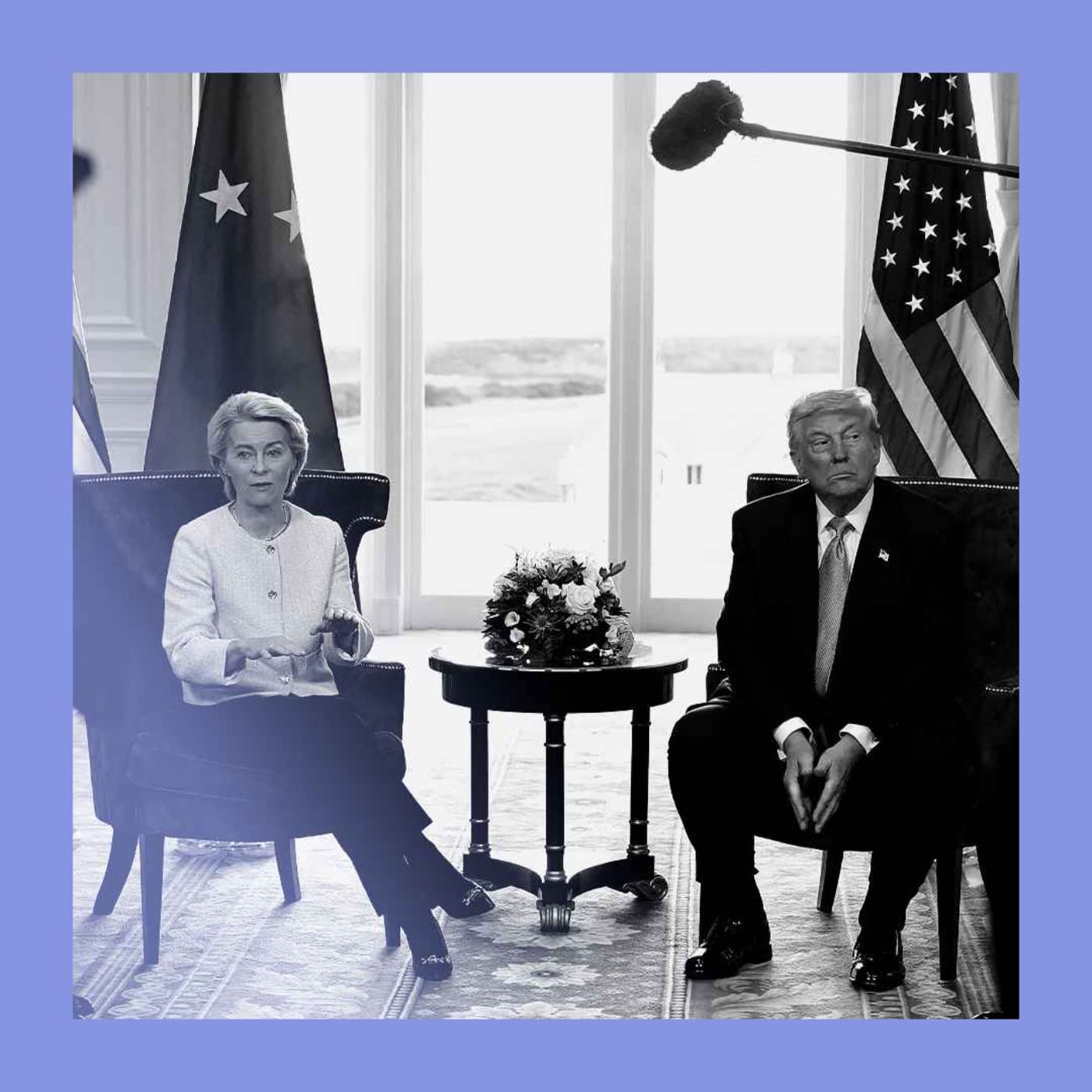
2:17So we have good news. Anyone who is waiting for Donald Trump's promised flurry of 90 trade deals in 90 days will have been gravely disappointed. Trade deals, we keep saying, are hard. When it's the biggest trading relationship in the world, harder. This weekend, Mr. Trump held court at his golf course in Scotland and struck an accord with Ursula von der Leyen, the president of the European Commission. And she knew how to characterize it. It's a big deal. It's a huge deal. It will bring stability. It will bring predictability. That's very important for our businesses on both sides of the Atlantic.
2:56Big, huge deal. Mr. Trump can sell it as a win at home. The EU can be relieved it escaped the big, scary tariff numbers that he had threatened. But what's the substance of it? And is it the end of at least one part of the tariff saga? The details have still to be hammered out. Christian Odendahl is our European economics editor. But the three main elements are a 15 % tariff across the board, most European exports to America, a list of goods for which there's zero tariff between the two, and a promise by the EU to buy lots of American stuff, fuel, AI chips, so forth, and invest in America. So let's go through those things one by one here.
3:3715 % tariff on most goods is, well, is more than no tariff, still kind of chunky. It is a lot more than the one and a half percent average tariff that was there before for European goods going to America. But I think the worst case scenario has been averted. And I think this is why this deal is okay for the European economy. And in particular, it includes cars for which there was a threat of a much higher tariff and cars matter to the European economy, particularly the German one quite a bit. So overall, it is a chunky increase. It's bad for the American consumer. But I think the European economy can probably live with it.
4:12And just this morning, we can see that European stocks are up. And just looking at the screen, it's a 1 % jump in European stocks. So that is a sign that this deal is not too bad. In part, I guess, because there are some carve outs, some zero tariff goods. Yeah, that list is relatively short for now. It contains stuff like semiconductor equipment and some chemicals. It is a bit of a win for the EU because the EU has always wanted a zero for zero tariff on goods. And it is a list that the EU wants to build on. And it is also potentially an off-ramp for Trump to put things on that list that the American economy desperately needs from Europe.
4:52So I think that is a neat little win for the EU. And the commitment to buy American, what's in there? So these commitments of big numbers, I think are always part of a deal with Donald Trump. The first bid is$750 billion in American energy, mostly oil and gas. The EU thinks this is an achievable number. The practicalities of these are still very difficult. But I think for the EU, that's fine because it gives those in the EU more leverage who've always wanted all of Europe to ditch Russian oil and gas for good. There's still quite a bit of Russian energy products coming into Europe. And the same is true to some extent to the$600 billion of additional investment by European firms in America.
5:39Again, it's a big number. Europe overall currently invests about 200 billion a year in the US. That includes Britain and Switzerland. It is, again, a big number that may still fall by the wayside at some point, as long as some big deals can be announced. So I think Europe agreed to these big numbers in the hope that they can fulfill part of it and part of it will fall by the wayside. So all in all, you're kind of painting it as either Europe can pull this off or it's a bit of a win, on balance, you would say the EU side should be happy about this? It depends on where you start from, right? I think it became clear that Donald Trump desperately wants tariffs and he wants tariffs above 10%.
6:22And in Europe, the situation with Russia and Ukraine always means that somewhere in the background is the threat of American withdrawal from Europe when it comes to security. So there was always the fear of letting this escalate. If you put those two together, then the deal will involve tariffs and it will not involve many wins for the EU. But I think given that and this tricky balance, I think this deal is okay. And to your mind, does this put the issue to bed for the EU? We can have different tariff discussions about different regions and jurisdictions, or is there more to come, do you think?
6:56So I guess with Trump, you never know, right? His love of tariffs and his tendency to pull out the tariff card whenever he's displeased with something, I think will remain. But I think the EU really wanted to find a deal that is good enough for Trump so he may stick with it. The remaining issue is how to solve steel. The two sides agreed to go back to quotas from the current relatively high tariffs in the US. How exactly that plays out is still to be seen. And the same is true for pharmaceuticals, where Donald Trump has not yet decided on whether he wants to impose sectoral tariffs on pharmaceuticals globally.
7:35And that does matter for Europe in particular, for Ireland and Denmark, who are big pharmaceutical exporters. But for now, the 15 % also cover pharmaceuticals. So let's see. And does any of this give a kind of blueprint for other countries who are still in the midst of heated negotiations with America? So I think all countries look at each other of how they deal with Donald Trump. I think the EU looked at the UK and at Japan in particular, who had struck deals before. So I'm sure that other countries will have a look at what the EU has achieved and how it has achieved it. But the EU and China and India are probably standing out a bit from the rest because they are just very, very big and potentially have something to retaliate with.
8:17I'm not sure whether you want to be the last country in the queue if he has settled on many things with the big blocks. then he may be willing to put more pressure on countries that follow it in the queue. And with Canada, Mexico, the Rio Grande talks with China coming up, I think it will probably embolden Trump in his negotiations in the next couple of weeks. Thanks very much for your time, Christian. Thanks for having me, Jason.
9:24We'll see you next time. CapitalOne.com slash bank. Capital One N.A. Member FDIC.
9:37Welcome to the English Midlands, Britain's best-kept secret. Joel Budd is our social affairs editor. Stretching all the way from Wales to the coast of Lincolnshire, from the Peak District to the northern fringes of the Cotswolds, It is stuffed with pretty villages and fast-changing cities. The Midlands contains one of Britain's very finest post-war buildings in Coventry Cathedral. It is the birthplace of some of the country's greatest writers and of heavy metal music.
10:14Best of all, wherever you are in England or Wales, the Midlands is really easy to get to. So, what are you waiting for? Or the advert could run something like that, because goodness knows the region does need a booster. Why is it in such a need of a rebrand, do you remind? Well, the Midlands is a really large, really populous, really important part of Britain. It's got 11 million inhabitants. It's got the great city of Birmingham, the second biggest city in the UK. and some very important smaller cities, including Nottingham, Derby, Coventry, Northampton, and so on. It's politically absolutely crucial.
11:00The very, very simple rule of British politics is that if you win the Midlands, then you form the government. But as a region, it tends to be overlooked. Politicians and think tanks and journalists tend to either talk about the Midlands in conjunction with talking about the north of England. So they say the north and the Midlands need more infrastructure. Or they simply talk about the north and forget the Midlands entirely. So the Midlands has a problem not so dissimilar from that of what are dismissively called the flyover states of America, for example. Yes, in some ways it's similar to flyover country.
11:38It's the area that you would go through if you were going from the rich bit of Britain to the really gorgeous, sublime bit of Britain. But it's different from America's flyover country in that there is very little local regional pride in the Midlands. So people in Kansas or Ohio will talk about how very proud they are to be from Kansas or Ohio. People from the Midlands do not particularly express pride in being from the Midlands. But you assert in our burgeoning ad campaign here that they have a lot to be proud of. Yes, they do. It's an enormously culturally rich region. Many of Britain's greatest writers came from the Midlands.
12:23So Shakespeare came from the Midlands. George Eliot came from the Midlands. J.R.R. Tolkien came from the Midlands. So Mordor is thought to be the urban Western Midlands belching smoke. With the exception of Shakespeare, the Midlands has, to a large extent, forgotten these people. So George Eliot is celebrated much, much less in the Midlands than the Bronte sisters are in the north of England, or Jane Austen is in the south of England, even though she grew up near Coventry and she wrote about the Midlands. I'm troubled in the cultural discussion about the Midlands that we haven't yet mentioned Black Sabbath.
13:01Yes, so of course heavy metal is called heavy metal because it's related to the metal bashing industry, which was the great Midlands industry in the mid-20th century. They are a little bit of an exception to the rule. I think the Midlanders or West Midlanders are aware of Black Sabbath. Other great musicians from the area like Steve Winwood are spoken about less. But people in the Midlands must know to some degree that they are being overlooked and perhaps looked down on by the rest of the country as Britain's answer to flyover states and what have you. Is that not itself a unifying factor that would bring them together to unite against the forces of dismissiveness?
13:38No, that's the strange thing about the Midlands, is that people don't seem to react against criticism. The West Midlands, and especially Birmingham, has a famous accent which is often ridiculed in Britain. It's most famous as the accent of Ozzy Osbourne. The fans really are what it's all about. The fans make it all work for me. It's just crazy what people do. British people often make fun of that accent. And when they do so, people from the West Midlands tend to just laugh. They go along with the joke. Midlanders are not particularly defensive about the Midlands. Very few of them will say that they live in the greatest part of the country.
14:27People in the Southwest are highly likely to say that. Even people in the Northeast, which is a very, very, very poor part of the UK, people will tend to say, I'm very proud to be from this part of the country. People from the Midlands just don't say that. And it is unified by this attitude of not boasting about itself. And it's also unified by having a combination of northern levels of poverty and a southern attitude to itself in the sense that Midlanders are ironic and self-deprecating and so on. Okay, so you're here to redress the balance. We are coming up with an ad campaign. We've got the art department drawing up travel posters.
15:07What should the Midlands do to become the place that reflects its strong points? Well, I think the first thing it should do is it should really push its strongest brand, which is Birmingham. There's a thing called a combined authority, which is essentially like a metropolitan government that covers the area, including Birmingham. but it refuses to call itself Greater Birmingham. Instead, it calls itself the West Midlands region. That's really daft. I think it should stop doing that. I think the East Midlands could reclaim Robin Hood, who is largely an East Midlands figure, but has somehow been captured by Yorkshire.
15:49Robin Hood's Bay is in Yorkshire. Perhaps the East Midlands could go and get Robin Hood back. And the Midlands has some great advantages. It is a huge advantage to simply be in the centre of the country. And the Midlands is so politically crucial that it ought to have more weight than it does. I think if it got its act together, it could demand much more of central government than it is at the moment. It just needs to find its voice, really, as a collective. We'll wait till these travel posters come out. Joel, thanks very much for joining us. Thank you.
16:33Fowjer Singh was obviously very old indeed. He had a long, thin, wrinkled face and very long, white beard. Anne Rowe is The Economist's obituaries editor. But on the other hand, he was never sure exactly how old he was. His passport said that he'd been born in April 1911. But at the time he was born, there were no birth certificates issued in British India. He could never be totally sure. So there was always a slight question mark over his age, but it was generally given as 114. And what was rather more frustrating was that when he became a marathon runner in extremely old age, his records couldn't be recognized by the Guinness World of Records.
17:27because they wanted an authentic birth certificate and he could not produce one. He started in his first marathon in 2000 when he was 88, the London Marathon which he ran in 6 hours 54 minutes. But he got better and in 2003 he ran it in pretty much 6 hours flat. His very best performance was in the Toronto Waterfront Marathon in 2003, and he ran that in 5 hours 40 minutes. So this was quite extraordinary in a man of his age. All this running was in a way rather miraculous, because when he was born, his legs were so weak and frail that it took him a very long time to learn to walk. He didn't walk until he was five.
18:19he couldn't walk a mile until he was 15, and this severely curtailed his schooling. He fairly soon started to work instead on the family farm, and gradually after some rather awful treatments, giving him strong medicine binding his legs with bandages, they began to get better, and he actually did take up running as a young man. In fact, in his village of Deaspind in Punjab, the elderly people remember that he used to dash around from place to place. However, in his mid-30s, he gave that up. But the very fact that he could run at all was a miracle. He partly attributed it to a very strict regime, which meant that he was training by running 10 to 15 miles a day.
19:11He was also strictly watching his diet. He met a good many elderly people who were running too, and he formed a club with them. They put him on to a coach, and together they began to create this wonderful marathon runner. He rediscovered all the strength and purpose that he'd had as a young man. he discovered that not only could he find tremendous joy in the act of running but he could also help other people by raising money for charity he became very famous as a result of this not least because he always ran marathons and some other races in his marigold yellow turban full seek turban he could have run in the patka, the rather simpler headgear for Sikhs.
20:09In fact, when he ran in the London Marathon for the first time, they demanded that he did wear that, but he absolutely insisted. He was a very strong believer and he wanted to give his full respect to God.
20:26Loving the attention made it very difficult for him to stop and gradually he could feel that his body was getting a bit tired. He absolutely refused, though, to accept old age. And he thought that people would no longer love him. They'd simply forget him if he didn't run. So he tried to keep in retirement the same strict regime he had kept before. He had moved back to Punjab. And there in the village, he kept his strict diet. He made sure he got plenty of exercise and walking. and he was just about to set off on his daily exercise in the afternoon, 3.30, when a speeding SUV came along the road and hit him.
21:17The driver didn't stop and all his family and friends thought rather sadly that probably Fauja Singh would not have stopped either but gone on for years, except for that dreadful accident.
21:36Anne Rowe on Fauja Singh, who's died probably aged 114.
21:58That's all for this episode of The Intelligence. We'll see you back here tomorrow.
22:11Thank you.
22:40Yep. Even on weekends, it's pretty much all he talks about in a good way. What's in your wallet? Terms apply. See CapitalOne.com slash bank. Capital One N.A. Member FDIC.
From the publisher
The European Union will swallow 15% tariffs in exchange for promises to buy American. We examine the accord and ask what will stick. The English region of the Midlands is unjustly overlooked, our correspondent says; how can it get its due? And Fauja Singh ran his first marathon aged 88—or thereabouts. Our obituaries editor reflects on his relationship with running.
Get a world of insights by subscribing to Economist Podcasts+. For more information about how to access Economist Podcasts+, please visit our FAQs page or watch our video explaining how to link your account.
Hosted on Acast. See acast.com/privacy for more information.