
In short
Podcast Summary: Economist Podcasts - "Flagging carriers: war shuffles the Gulf-airline flight deck"
Episode Overview In this episode, the hosts Rosie Bloor and Jason Palmer, along with industry experts, delve into the multifaceted impact of the ongoing war in Iran on the airline industry, the declining fortunes of the fake-meat sector, and the future of the PDF file format in the age of AI.
Key Guests
- Simon Wright, Industry Editor
- Hollie Berman, News Editor
- Shera Avi-Yonah, Business Writer
- Rosie Blau, Co-host of “The Intelligence”
- Jason Palmer, Co-host of “The Intelligence”
---
Section 1
Impact of War on the Airline Industry
Main Points
- Current Events: The episode begins with a report on recent military actions involving the U.S. targeting missile sites in Iran, leading to increased turbulence in the Gulf region.
- Airline Operations:
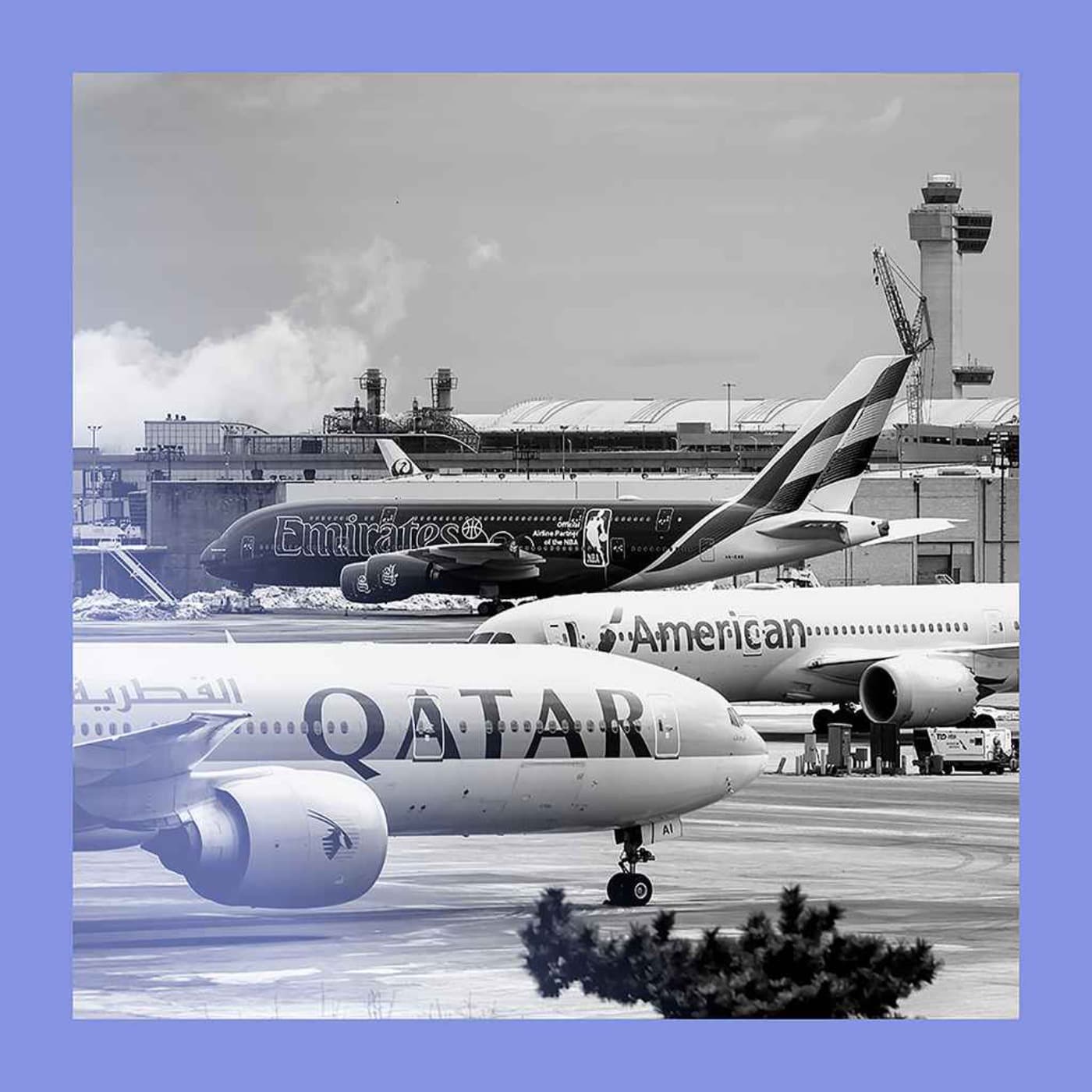
- The Middle East has become a crucial hub for global aviation, hosting major airlines like Emirates, Etihad, and Qatar, known as "super connectors."
- The war is causing significant disruptions, with airspace closures leading to longer flight paths and rising operational costs.
Implications
- Fuel Prices:
- Jet fuel prices have surged due to decreased supply through the Strait of Hormuz, affecting airlines globally. The episode notes that the cost burden is heavier on low-cost carriers.
- Future of Gulf Airlines:
- There’s uncertainty about the recovery of Gulf airlines post-conflict and how long it will take for the industry to stabilize.
- Potential for aggressive fare discounts to attract back customers after the war ends.
---
Section 2
The Fake Meat Industry's Decline
Overview
- The episode discusses the rise and fall of the fake-meat industry, which promised to revolutionize dietary habits but is now facing significant challenges.
Key Points
- Initial Attraction:
- Fake meat products gained popularity due to their environmental benefits and appeal to health-conscious consumers.
- Current Challenges:
- Sales have plummeted as consumer interest wanes, attributed to high competition and mixed product quality.
- Cultural Factors:
- An emerging culture war around food choices, with polarizing views on plant-based versus traditional meat, complicates the industry's landscape.
Industry Response
- Companies are pivoting strategies by targeting "flexitarians" and exploring new product expansions, including partnerships with protein-rich food producers.
---
Section 3
The Future of PDFs in the Age of AI
Key Discussions
- PDF Format's Longevity:
- The PDF has been a dominant file type for over 30 years but faces new challenges due to AI's difficulties in interpreting its structure.
Issues Identified
- Technical Difficulties:
- Large language models struggle with PDF semantics, leading to misinterpretations and data loss during processing.
- Debate on Relevance:
- There is a split opinion on whether the PDF format is the problem or if the issue lies in the tools used to process them.
Potential Solutions
- Experts discuss the need to either improve AI capabilities for parsing PDFs or consider newer file formats better suited for AI interaction.
---
Conclusion The episode highlights the interconnectedness of global events and their impact on various industries, specifically aviation and food production. It also underscores the challenges posed by technological advancements on traditional file formats, prompting a reevaluation of how these sectors operate in a rapidly changing world.
Key Takeaways
- The airline industry's future will be heavily influenced by geopolitical factors and fluctuating fuel prices.
- The fake meat industry's struggle illustrates the volatility and complexities of consumer preferences in food.
- The PDF’s relevance hangs in the balance as AI continues to evolve, presenting both challenges and opportunities for digital document management.
For further insights, consider subscribing to Economist Podcasts+ for exclusive content.
Written by AI. May contain mistakes. Listen to the episode to check what was said.
Chapters
Tap a time to open that second in VOThe Aviation Hub of the Middle East
0:58 to 2:23
Discussion on the strategic importance of the Middle East for global airlines.
“They were apparently all set to eat into the profits of the real meat market.”
Impact of Conflict on Airlines
2:23 to 4:12
Exploration of how the current conflict affects airlines worldwide.
“Pictures of stranded passengers in the tens of thousands in recent weeks shows how important the region has become as a hub for the global airline industry.”
Fuel Prices and Their Consequences
4:12 to 6:06
Analysis of rising fuel costs and their impact on air travel.
“First of all, other airlines flying over the area have to switch routes.”
Future of Gulf Airlines and Travel
6:06 to 7:56
Predictions on how Gulf airlines will adapt post-conflict.
“So it's more of a burden on low-cost carriers.”
The Rise and Fall of Fake Meat
8:50 to 14:05
Examining the journey of fake meat products and their market struggles.
“Around a decade ago, a bunch of imitation meat products began to hit restaurant menus and supermarket shelves.”
The Promise of Lab-Grown Meat
14:05 to 15:50
Learn about the potential and challenges of lab-grown meat in the food industry.
“To explain what lab-grown meat is, it's grown from the cells of an animal.”
The PDF: Past Triumphs and Current Challenges
15:51 to 19:27
Explore the evolution of the PDF format and the challenges it faces today.
“When Adobe first introduced the PDF file format in 1993, Someone with whom they spoke described it as the dumbest idea they'd ever heard in their life.”
Transcript
Automatic transcript. May contain errors.0:00With no fees or minimums on checking accounts, it's no wonder the Capital One bank guy is so passionate about banking with Capital One. If he were here, he wouldn't just tell you about no fees or minimums. He'd also talk about how most Capital One cafes are open seven days a week to assist with your banking needs. Yep, even on weekends, it's pretty much all he talks about. In a good way. What's in your wallet? Terms apply. See CapitalOne.com slash bank. Capital One N.A. Member FDIC.
0:35Shera Avi-Yonah:The Economist
0:42Rosie Blau:Hello and welcome to The Intelligence from The Economist. I'm Rosie Bloor.
0:47Shera Avi-Yonah:And I'm Jason Palmer. Every weekday we provide a fresh perspective on the events shaping your world.
0:57Rosie Blau:A decade ago, an array of fake meat products appeared on our supermarket shelves. They were apparently all set to eat into the profits of the real meat market. The stakes were high, and the carnivores may have won.
1:12Shera Avi-Yonah:And the PDF file has always had its detractors, but you can't deny their popularity. There's something like 2.5 trillion of them floating around. The problem is AI has trouble reading them, and that may at last be the file format's undoing.
1:34Shera Avi-Yonah:First up, though.
1:42Shera Avi-Yonah:America said last night that it had used bunker-busting bombs to target missile sites on the Iranian coast, trying to ungum the Strait of Hormuz. Meanwhile, Iran continued its assaults on the Gulf states. Qatar, Kuwait, the United Arab Emirates, Saudi Arabia, all said that they had intercepted inbound missiles. We've talked endlessly about how this conflict has affected the oil industry, but there's far more turmoil going on. From fertilizer to critical minerals no longer passing by sea, to another industry disrupted in the air.
2:22The events in the Middle East are a reminder that the region is not only crucial for global supplies of oil and gas coming through the Strait of Hormuz, but it's a vital conduit for the world's airline passengers.
2:37Pictures of stranded passengers in the tens of thousands in recent weeks shows how important the region has become as a hub for the global airline industry. But not only that, the impact on airlines, not just in the region, but worldwide, may well persist well after the war ends.
2:58Shera Avi-Yonah:So the biggest, the most immediate effect is that the Middle East is just a big aviation hub for the world today. Well, that's right. Over the last couple of decades, the Middle East plays a much more central role in aviation. And that's mostly because of the Gulf carriers, the super connectors, as they're known, Emirates, Etihad and Qatar. The location in the Middle East in the middle of three continents makes it a very useful hub for long-haul passengers flying into the cavernous hub airports and then flying onto their destinations via two long-haul legs. And that's become very popular because the airlines have been invested in very heavily by the state.
3:38They're very good airlines and also the fares are very reasonable. That now looks under threat. I think there's two things going on here. The connecting flyers, they're probably going to come back once the war ends, not least because there's bound to be very, very good deals on offer from the Gulf carriers to bring them back. Whether Dubai remains a tourist destination, on how many tourists are prepared to come back, having seen what's gone on there, I think that might take longer.
4:07Shera Avi-Yonah:But you hinted that it's not just the big Gulf carriers or these Gulf destinations that are imperiled by what's going on now. No, by all means not. First of all, other airlines flying over the area have to switch routes. Airspace around the Gulf has been closed of traffic. Already, many more airlines were using that route because carriers, especially Western carriers, have had to avoid Russian airspace since the war in Ukraine. they're now having to take more circuitous routes around the Middle East transit route, the popular alternative. And that in itself is adding more time to the journeys and also burning more fuel.
4:47And it is fuel that's going to have the main effect on airlines worldwide. Jet fuel has become considerably more expensive. And the impact is actually more severe for airlines because the crack spread, as it's known in the trade, the price difference between jet fuel and the crude oil that it's refined from has surged, particularly for a couple of main reasons. One is that a lot of jet fuel actually comes through the Strait of Hormuz where shipping is at a standstill, something like 20 % of the world's supply. The other reason is that refining has shifted from Europe where refineries are closed down to Asia.
5:22Those Asian refineries rely on oil from the Gulf much more than other refineries. Like an oil well, you can't close a refinery. It's very, very expensive to restart a refinery once you've done that, and it takes a lot of time. So the supplies of crude oil they have, they're conserving, so they're refining much more slowly out there. So the supply of fuel is just not what it once was.
5:48Shera Avi-Yonah:So really all of this will impact kind of all the airlines, even the ones that don't even fly to, through, or over the region? Yes, absolutely, but the impact will be uneven. First of all, for low-cost carriers, fuel accounts are around a third of their costs, but for the legacy network full-service carriers, it's more like a fifth of their costs. So it's more of a burden on low-cost carriers. Having said that, airlines carry various levels of protection. Some are well hedged against near-term price rises, Ryanair, IAG, the parent company BA and others, and Qantas, for example. But America's big carriers and Chinese big carriers typically don't carry hedges.
6:27they stopped doing so because they thought they were costly and overcomplicated. And that could cost them tens of billions of dollars if fuel prices remain high throughout the year. Other airlines are reacting by starting to ground aircraft in response to the high fuel costs. For example, Air New Zealand has grounded over 1 ,000 flights from now until May.
6:46Shera Avi-Yonah:And you also said that for all this, that the impacts that do occur may last long beyond the war itself. absolutely it really sort of depends on how quickly the oil production can get back up and how quickly jet fuel prices can come down but also it depends how quickly the gulf airlines can get back into action there's actually an opportunity for some carriers with the gulf carriers out of action they're putting on extra flights and they're jacking up their fares to destinations between europe and say asia that they fly germany's lufthansa reported a jump in bookings to Asia in March, for example.
7:25Overall, demand for air travel may suffer in the short term, especially if surging energy prices drag down economic growth and people are deterred from travelling. But in the past, it's tended to bounce back pretty quickly from these sort of disruptions. I suppose another question is what happens with the Gulf Airlines. They'll want to win back some customers and they'll be up for the fight. And I think you'll see some very, very heavy discounting both for travel via the Gulf and also for holidays to Dubai in the near future.
7:55Shera Avi-Yonah:Simon, thanks very much for your time. Thank you, Jason.
8:12With no fees or minimums on checking accounts, it's no wonder the Capital One bank guy is so passionate about banking with Capital One. If he were here, he wouldn't just tell you about no fees or minimums. He'd also talk about how most Capital One cafes are open seven days a week to assist with your banking needs. Yep, even on weekends, it's pretty much all he talks about. In a good way. What's in your wallet? Terms apply. See CapitalOne.com slash bank. Capital One N.A. Member FDIC.
8:50Hollie Berman:Around a decade ago, a bunch of imitation meat products began to hit restaurant menus and supermarket shelves. Holly Berman is a news editor in New York. They arrived at a perfect time for consumers who were becoming pickier about production methods, animal welfare standards and environmental concerns. The novelty of them was also intriguing. Most high-tech offerings could make their burgers bleed just like a real burger. Even some carnivores were convinced by their meaty textures. It looks like a beef burger. It certainly smells like a beef burger and it chews like meat. The companies behind these products saw their valuations soar as fake meat went almost mainstream.
9:30Hollie Berman:Countless more startups tried to join the party. But now sales revenues and profits have slumped and meat substitutes have quietly vanished from many menus and shopping trolleys.
9:41Rosie Blau:Holly, you're right. These products were all over the place. what problem were they trying to solve? Why were they so popular?
9:49Hollie Berman:Well, I think the first thing they were trying to solve was offer vegetarian products that actually tasted good. And I can say this as someone that doesn't eat meat. So for someone like me, it was interesting to see if they could actually create a good veggie burger. And a lot of these things did taste pretty good. Not all of them were great, but some of them were. And then there was also this idea that by eating these products, by integrating them into your diet, you could be doing something for the environment. You're reducing your carbon footprint, you're not contributing to cruel farming practices.
10:20Hollie Berman:And so you've got this idea that maybe you're eating something that tastes good, but you're also helping the world in some kind of way. All of that sounds very good. What went wrong? I think the big thing is that in the excitement of this market, a lot of companies tried to rush to it at the same time. And the result of that was that you did have some things that were great and it tasted good. But then some bosses of these companies even admitted to me that a lot of the products taste pretty bad. And so if you're a flexitarian and you decide to try a veggie burger, just see what it tastes like, and you try one of these products that isn't quite up to scratch, that can be enough to put you off for life potentially.
10:53Hollie Berman:So it's high stakes for these companies that are trying to make an impression in the market. The other thing that's emerging more recently is this idea of eating well and not eating foods that are highly processed or ultra-processed foods. So in America, there's a bit of a culture war around fake meat. One side of the spectrum, you've got these influencers that are touting raw meat diets. You've got Robert F. Kennedy Jr. that's encouraging people to eat real steak and eat real chicken. And the unfortunate issue for a lot of these products is that they are technically classified as ultra-processed foods.
11:25Hollie Berman:So long ingredient lists, production processes, people are worried about sodium content, fat content in these products. And proponents of these artificial meat products will tell you that yes, they might technically be classified as ultra-processed foods, but that's not the same as eating a bag of potato chips or eating loads of Oreos. It's different, has different nutritional values.
11:47Rosie Blau:And is that right that these products do actually have additional nutritional benefits and they aren't the same as eating a bag of crisps or something?
11:54Hollie Berman:A big thing that people talk about with alternative meat is sodium content. And so you have one company, Impossible, which acknowledges that some of its products do have more sodium than raw, unseasoned meat. But it says that that's not a fair comparison because few people will eat real meat unseasoned. So there's that side of it. There's another side of this debate where a lot of these companies are trying to emphasize that they do have a lot of protein in their products. So especially now where protein is this huge food trend that people are mindful of how much they're consuming and want to consume more, these companies are trying to position themselves as an efficient way to increase your protein uptake.
12:34Rosie Blau:So as you say, we thought this was going to be a huge business. What's actually happened to the companies producing fake meat?
12:41Hollie Berman:We could take Beyond Meat as probably the most famous example of this. So they went public in 2019. At the time, they were valued at nearly$4 billion. In 2020, US sales of meat alternatives increased by 45 % to$1.4 billion. You look at Beyond Meat's trajectory since then, and their valuation has since dropped well below$400 million. Its revenue has declined so far throughout 2025. And according to polling by The Economist and YouGov, the share of American adults regularly eating these products remains in the single digits over recent years. So I think the problem is that a lot of these companies were excited by the hype, but it hasn't quite landed where they expected it to today.
13:21Hollie Berman:So does that mean fake meat is over? Depends who you ask. But I would say that a lot of these companies are aware of what's going on. They're leaning into flexitarians, this idea that you don't have to be a militant vegetarian to eat alternative meat. You can integrate it in your diet and still enjoy meat. And then you've also got interesting sideways expansions by some of these companies. Impossible has partnered with makers of protein-dense breads. You've got Beyond, which is trying to expand into protein drinks.
13:52Rosie Blau:And what's happened to the idea of lab-grown meat?
13:55Hollie Berman:Lab-grown meat has been ticking along in the background. So from what I've heard, it's taken a hit from the trajectory of plant-based meat. It's made some investors a little bit more cautious, but speaking to people within the industry, they're excited by it. To explain what lab-grown meat is, it's grown from the cells of an animal. So the appeal of this stuff, these companies say, is that you can still have a diet that's good for you, good for the planet. you can still enjoy the taste of meat and the benefits of meat without hurting an animal. There's a few companies in the US and Singapore attempting to bring their products to market, but the issue right now is that they need to scale and they need to navigate the regulatory environment.
14:37Hollie Berman:So in the US, some states have proposed or passed bans that limit these companies from selling or processing lab-grown meat. But speaking to insiders in this space, they're pretty optimistic at a federal level that this will not be an issue. And even in Britain, lab-grown meat has been cleared as pet food. So it's something that is not going to immediately emerge out of this landscape. They're learning lessons from what plant-based meat has done. They're not going to move as quickly as a lot of these companies have done in the past. One, because they need to be able to scale their businesses, but also they've learned from the mistakes perhaps of doing too much too quickly.
15:16Hollie Berman:Also, it might have a different fate in the supermarket than these alternative meat companies. Some people I spoke to think that it could end up in the meat aisle in a way that other plant-based meat hasn't been able to do so. And that's harder to call those things fake as it comes from animal cells and might well be next to a real burger.
15:33Rosie Blau:And where do you stand on all of this, Holly, as a veggie? Are you going to eat plant-based, lab-grown meat or what?
15:39Hollie Berman:I'd be open to trying lab-grown meat. I wish I got to try it while I was working on this story. I mean, I enjoy a plant-based burger, I'll say it, but I understand why it's facing the challenges that it is.
15:50Rosie Blau:Holly, thank you so much for talking to me. Thank you, Rosie.
Read the full transcript
16:11When Adobe first introduced the PDF file format in 1993, Someone with whom they spoke described it as the dumbest idea they'd ever heard in their life. Shira Aviona writes about business.
16:27Back in the early days of the World Wide Web, users would have to wait for the megabyte-sized files to download very slowly over their dial-up internet, and then wait some more for their personal computers to render them. But the PDF project eventually triumphed over its haters, because sharing digital files quickly became essential in the following decades, especially after America's tax authority began using the file type exclusively for Americans who wanted to fill out digital tax forms. But after more than 30 years of dominance, the PDF is in peril.
17:03People have always had complaints about PDFs. They're kind of difficult to view on mobile. Copying data from one to another is a bit fiddly. And they've had issues in the past with accessibility for people that use screen readers. They've also been a vehicle for many cyber attacks. About a fifth of email-based cyber attacks are hidden within PDF attachments, according to one cybersecurity firm. But lately, a new source of criticism has emerged.
17:35Large language models behind Generative AI are often very confused by PDFs. They don't understand the difference, for example, between text that's set in vertical columns and text that should be read horizontally across the page. They also have a hard time distinguishing between captions, headings, image descriptions, and other things. So this general category of document semantics is something that LLMs find very difficult. And because a lot of important information is contained within PDFs, this is a major source of large language models hallucinations. Some startups are actually trying to solve this problem, not by creating AI tools that are good at parsing document semantics, but rather by saying that we need to move on finally from the PDF.
18:20But some people argue that the problem with the PDF is not in the file, but in the way that we use it.
18:30PDF defenders say there's no issue with PDF. It's working perfectly well. We just need to build AI tools that can deal with it properly. So, for example, Adobe, which doesn't manage the PDF anymore, but is still a really important protector of the file format, has made an AI assistant for Acrobat that's good at doing things like parsing document semantics. And Google has also rolled out a tool for developers that use its Gemini models that makes ingesting PDFs a lot easier. So there's this debate. are these issues between AI and the PDF fundamental, or are they things that can easily be solved by tweaking models?
19:07Really, only time will tell if the great reign of the PDF is over.
19:27Rosie Blau:That's all for this episode of The Intelligence. See you back here tomorrow.
19:40Thank you.
20:10Hollie Berman:Proof for financing and estimate trade in value. Advanced, intuitive and deployed. That's how they stack. That's technology at Capital One.
From the publisher
Cancelled flights, longer routes, higher prices: the war in Iran is taking its toll on the airline industry. The conflict may force lasting change on the big Gulf carriers. We ask why the once-frothy fake-meat industry is losing its bite. And why PDFs, one of technology’s most pervasive file types, may meet their end thanks to AI.
Guests and hosts:
- Simon Wright, industry editor
- Hollie Berman, news editor
- Shera Avi-Yonah, business writer
- Rosie Blau, co-host of “The Intelligence”
- Jason Palmer, co-host of “The Intelligence”
Topics covered:
- airline industry, Iran war
- meat substitutes, plant-based meats
- PDFs, AI
Get a world of insights by subscribing to Economist Podcasts+. For more information about how to access Economist Podcasts+, please visit our FAQs page or watch our video explaining how to link your account.
Hosted on Acast. See acast.com/privacy for more information.