
In short
The episode is about Mexico’s violent-crime fight under President Claudia Sheinbaum, plus a separate Japan political-violence trial and an obituary. Mexico segment: protests followed the assassination of Carlos Manzo, a Urapan mayor known for cracking down on drug gangs. Key claim: early evidence suggests Sheinbaum’s security team is reducing violence—Mexico’s government cites a 32% murder-rate drop in her first year (Oct 2024 start), while The Economist’s analysis finds about 14% for murders and ~6% for broader violent-crime categories (including disappearances, femicides, and manslaughter).
Notable examples
Zacatecas shows a steeper murder decline, purging corrupt police, hiring new officers, unified command, and special forces; Culiacán (Sinaloa) remains a “narco-pandemic” nightmare with cartel infighting and heavy federal troop presence.
Guest
Sarah Burke, Economist Mexico/Central America/Caribbean bureau chief. Japan segment: trial of Yamagami Tetsuya for assassinating former PM Shinzo Abe with an Amazon-assembled homemade gun; facts include psychiatric evaluations, long pre-trial negotiations, and a sentence dispute over whether the device legally counts as a gun and whether his troubled Unification Church-linked upbringing warrants leniency.
Guest
Moe Kaida, Economist East Asia reporter. Obituary segment: bomb-disposal expert Peter Gurney (IRA/IED defusing, George Medal) with Anne Rowe, obituary editor.
Written by AI. May contain mistakes. Listen to the episode to check what was said.
Chapters
Tap a time to open that second in VORecent Protests in Mexico City
1:30 to 3:00
Discussion about protests against violent crime in Mexico City.
“Three years ago, former Prime Minister Abe Shinzo was killed in Japan by an assassin with a homemade gun.”
Claudia Sheinbaum's Security Efforts
3:00 to 4:52
Analyzing Claudia Sheinbaum's strategies to reduce crime in Mexico.
“Yet Sheinbaum has made cutting crime a priority, and unlike predecessors who promised the same, she's actually getting some results.”
Violent Crime Statistics and Trends
4:52 to 7:20
Reviewing crime statistics and the effectiveness of Sheinbaum's policies.
“I mean, starting with the fact that she's put a good security minister in.”
Comparing Different Regions in Mexico
7:20 to 8:00
Exploring crime rates and safety perceptions in various Mexican states.
“This is one of the things with Mexico is when you look at it as a country, it's a patchwork.”
Challenges Facing Sheinbaum's Administration
8:00 to 9:00
Discussing the obstacles and political context of Sheinbaum's governance.
“But the government really can't get a handle on it.”
International Relations and Security
9:00 to 10:39
Examining the implications of U.S.-Mexico relations on security policies.
“Sarah, we've talked on the show before about how Shane Baum has been remarkably deft at dealing with Donald Trump.”
International Relations and Security
10:55 to 11:19
Examining the implications of U.S.-Mexico relations on security policies.
“offers a simple way to add consistent nutritional support to your day, wherever the morning begins.”
The Yamagami Case: Background and Sentencing
14:01 to 20:05
Explore the details surrounding Yamagami's trial and his troubled background.
“So we're nearly three weeks into the hearing now.”
Peter Gurney: A Life in Bomb Disposal
20:33 to 26:52
Learn about Peter Gurney's experiences in bomb disposal during his career.
“Anne Rowe is The Economist's obituary's editor.”
Peter Gurney: A Life in Bomb Disposal
27:50 to 28:04
Learn about Peter Gurney's experiences in bomb disposal during his career.
Transcript
Automatic transcript. May contain errors.0:00To grow beyond limits and even beyond your aspirations, you need the London Business School MBA. Ranked fourth in the world by the Financial Times, the programme delivers academic excellence and unlocks access to leading global businesses and a network of over 58 ,000 professionals. 86 % of the most recent class accepted a role within three months of graduating, and the returns continue beyond today. Search Discover London Business School MBA to find out more. This Economist podcast is sponsored by Bill, the intelligent finance platform that helps businesses and accounting firms scale with proven results.
0:40With AI-powered automation, Bill isn't just moving money. They're simplifying financial operations for nearly half a million customers. Bill has securely processed over a trillion dollars in transactions. That's proven infrastructure. Ready to talk with an expert? Visit bill.com slash proven and get a$150 gift card as a thank you. That's bill.com slash proven. Terms and conditions apply. See offer page for details.
1:09The Economist.
1:16Hello and welcome to The Intelligence from The Economist. I'm your host, Rosie Bloor. Every weekday, we provide a fresh perspective on the event shaping your world.
1:30Three years ago, former Prime Minister Abe Shinzo was killed in Japan by an assassin with a homemade gun. Now the shooter's trial is underway, our correspondent explains what this case tells us about the state of the country today. And grenades and mortars were okay. Terrorist devices, with their unpredictable wiring and explosives, were trickier. Peter Gurney spent decades defusing bombs all over the world. Our obituaries editor marks his peaceful passing.
2:08But first...
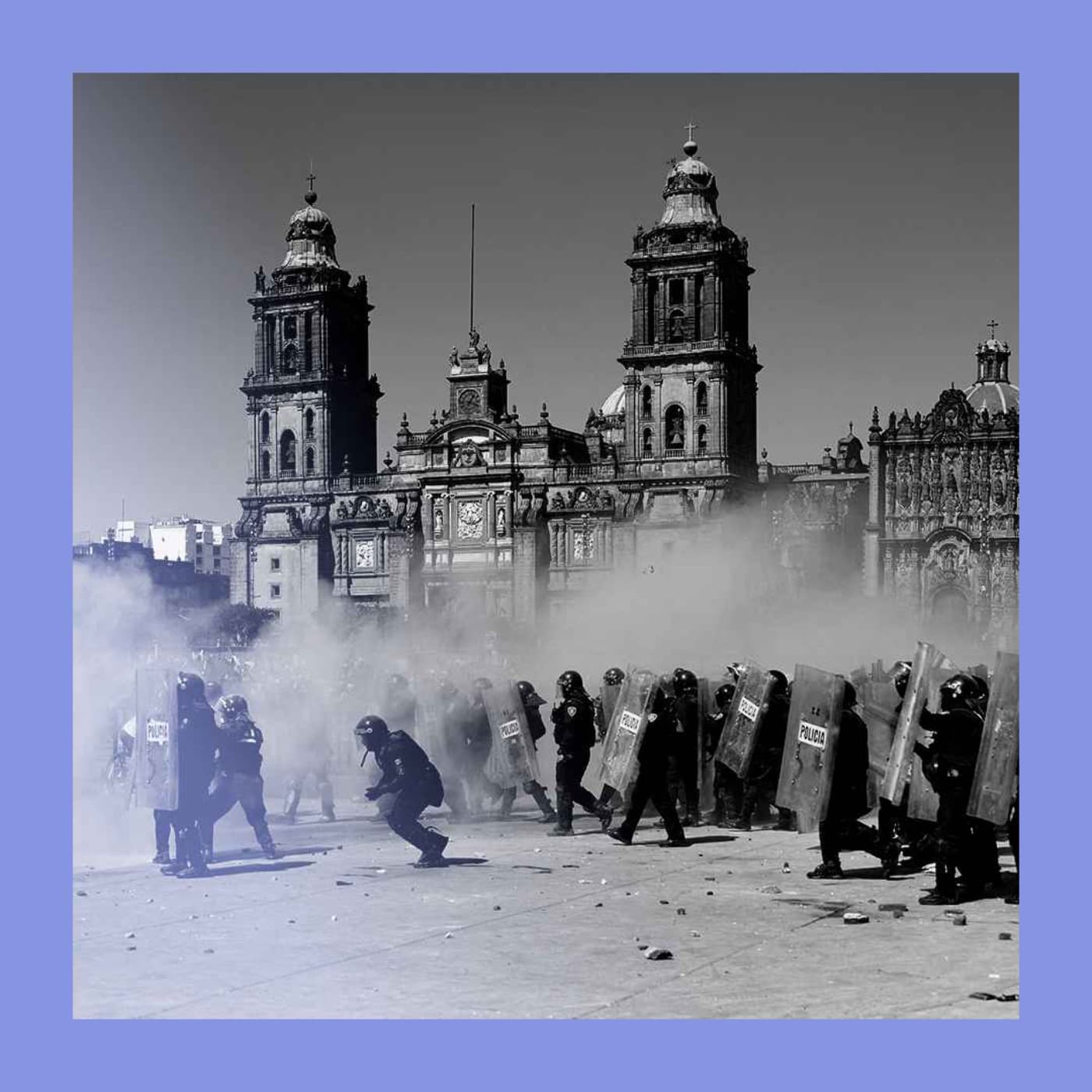
2:17This weekend, thousands of people took to the streets in Mexico City, protesting about violent crime. Masked demonstrators tore down fencing around the National Palace Home to President Claudia Sheinbaum Police say at least 120 people were injured in the clashes The protests follow weeks of rising anger after the assassination of Carlos Manzo Popular mayor of Urapan Who was known for cracking down on drug gangs
2:53Many Mexicans see Manzor's killing as an emblem of the government's wider failure to control these cartels. Yet Sheinbaum has made cutting crime a priority, and unlike predecessors who promised the same, she's actually getting some results. Early evidence after the first year of Claudia Sheinbaum's time in power suggests that she and her security minister Omar Hafush are actually doing a fairly good job. Sarah Burke is our bureau chief for Mexico, Central America, and the Caribbean. Violent crime has fallen somewhat, but they still face a humongous task. So Sarah, you say that violent crime has fallen.
3:38Can you put some numbers on that for me? It's really important to look at the numbers, Rosie, because Shane Baum's government says that Mexico's murder rate has come down by 32 % in the year since she took office and she took office in October 2024. Now, we did some in-house analysis of that and our analysis suggests that it's fallen by a significantly smaller margin of 14%, but that is still significant. Also, you can't really just count murders alone in Mexico because it misses thousands of people who are probably dead, who are counted as disappeared people. And it also misses, for example, femicides and manslaughter, which can be things like a car crash, but it can also be things that are essentially more close to murder in the way that we'd imagine it.
4:21So we took proportions of all of those and we found a more modest decline of violent crime overall of 6 % in Claudia Sheinbaum's first year. But you know, that is something. Mexico is on track this year for 24 ,300-ish murders, which is horrifically high, especially if you're listening to this in the UK or other places, but is well below the recent annual average, which has been over 30 ,000 murders a year. This is one of the first governments where you feel like things are pushing in the right direction. So how has she managed that? I mean, starting with the fact that she's put a good security minister in.
4:57I was looking back at all the past security ministers that the country has had, and a lot of them are politicians. They're not people who are specialised. So she's put in Omar Hafush, who was her security minister when she was mayor of Mexico City. And he is a former policeman. He's very smart. He's very young. He's 43. He's very data driven. And she's given him powers over coordination and intelligence. Now, Mexico has militarized under the previous president a lot. So you don't really have good civilian police forces. So she's been handed this bad lot. But within that, she's trying to give him more powers over these things.
5:34and also to try and build and reinforce the police that do still exist. And he's got allies put in charge of key institutions as well, such as the Financial Intelligence Unit, which is actually very competent and very powerful in Mexico. It traces dirty money and that can also trace you to politicians. So that gives political power to Shane Baum and Harfish as well. And so what we're seeing is arrests at record levels and they're more targeted and firearm seizures have more than doubled under Shane Baum. And are people really feeling this difference on the ground? So I went to Zacatecas exactly to answer that question.
6:11This in 2021 was Mexico's most violent state and it still has that reputation. Every Mexican I told I was going said, oh, why are you going there? But it actually offers a hopeful tale. Over the past year in particular, the murder rate has fallen more steeply than any other state. and it's been doing this quiet, methodical work that now is going on at a national level and it's obviously been boosted in the past year by the national level, purging corrupt police officers, hiring new ones, especially from other parts of Mexico. So these police officers aren't afraid that the gangs will be able to easily trace and go after their families.
6:45It's created two new special forces units, there's unified command over the most violent municipalities because obviously in Mexico it's extremely complicated, you have states, you have new municipalities, You have the federal level and they all have different roles within security. And what you're seeing is, at least in Zacatecas, the claim is that confidence is up. And the police I talked to there said that citizens have started reporting crimes again because they trust the police more than before. Sarah, I've just listened to your very excellent but absolutely terrifying episode of The Weekend Intelligence in which you went to Sinaloa.
7:19And that sounded like a very different story with an enormous crime rate. This is one of the things with Mexico is when you look at it as a country, it's a patchwork. So you have some states that are very safe. You have other ones that are a nightmare. Culiacan in Sinaloa is in the latter category. It is a nightmare. It's always been a place that's had the Sinaloa drug gang in control. But since last year, 2024, it's had this internecine war within the cartel. And you've just had this horrifically high murder rate. The government has sent over 11 ,000 federal troops. And when I was there, you saw armored convoys, there are drones, there are all sorts of things.
8:00But the government really can't get a handle on it. It's securing the roads, you see checkpoints, it's securing key infrastructure. But there's this tick, tick, tick of murders that happen all the time. And the lives for the people there have completely changed. People talk about this as a narco-pandemic. I don't want to go outside unless I need to. I don't want to talk to people unless I need to. I don't answer new phones. I don't make new friends because I don't know what they're involved in. I stick to what I know. It's a good illustration of the huge obstacles that Shane Baum inherited. Her predecessor militarized everything.
8:36He also took this very hands-off policy towards criminal gangs. And so what you had is six years in which these gangs just expanded their reach in Mexico. Two-thirds of Mexico's murders are linked to organized crime groups. And it's not just the murders. There's extortion, there's highway robbery, etc. And again, those different crimes, we see some falling due in large parts of the new security policy, but some rising. The issue really with the lack of local police and no federal police is a big problem. Sarah, we've talked on the show before about how Shane Baum has been remarkably deft at dealing with Donald Trump.
9:13Security is a real point of tension between the two of them. Do you think that cooperation can hold? It's hard to tell because it really depends on the whim of Donald Trump. And I understand that the Mexicans are doing a pretty good job of communicating what they're doing. Omar Harfouche has open doors, lots of fans in Washington, D.C., and that's the same at home. Their policy is not sexy, and so they need to keep communicating about what's going on. But also, Shane Baum needs to go harder and further on what she's doing. She's made a good start, but there needs to be a lot more funding, for example.
9:43If you look that Mexico is only putting less than 1 % of GDP into security spending, and in fact, the budget for 2026 cuts the security ministry's funding, then that looks indefensible and like you're not serious about what you're doing. And the other thing is really going after these corrupt politicians who are either working with the gangs or protecting them. This is something that Trump cares about. He's talked about this intolerable alliance that there is. And he's not entirely wrong about that. And I think Shane Baum needs to do a lot more at going after these people, including potentially some high-level ones.
10:15You can see what might go wrong here if Trump is not convinced. He's already striking boats in the South Caribbean and is talking about doing more things inside Venezuelan territory. And this is something that many MAGA people would like to repeat on Mexican territory. So really, to keep him at bay, Shane Bell needs to keep doing what she's doing and push harder and put more money behind it. Sarah, thank you so much for talking to me. Thanks, Rosie.
10:54We'll see you next time.
11:14offers a simple way to add consistent nutritional support to your day, wherever the morning begins. Visit drinkag1.com slash theintelligence to get a free morning person hat and a free AG1 sampler in your welcome kit with your first AG1 subscription, an$82 value. That's drinkag1.com slash theintelligence. This Economist podcast is sponsored by Bill, the intelligent finance platform that helps businesses and accounting firms scale with proven results. With AI-powered automation, Bill isn't just moving money. They're simplifying financial operations for nearly half a million customers. Bill has securely processed over a trillion dollars in transactions.
11:56That's proven infrastructure. Ready to talk with an expert? Visit bill.com slash proven and get a $150 gift card as a thank you. That's bill.com slash proven. Terms and conditions apply. See offer page for details.
12:16Recently, I visited a court in Nara in western Japan, where I joined hundreds of people standing outside of the court. These people had come to witness the beginning of the trial of Yamagami Tetsuya, the man who assassinated former Prime Minister Abe Shinzo. Moe Kaida is our East Asia reporter. On July 8, 2022, Abe was giving a campaign speech ahead of an election. Yamagami approached him with a handmade gun and shot him twice.
12:52Horrifying footage of Abe collapsing after the gunshot was played over and over again on the news. The incident was very shocking in Japan, a country where gun violence is almost unheard of. and the political aftershocks have continued to reverberate. Now, more than three years later, Yamagami is finally being brought to justice. Moeka, why has it taken three years to bring him to justice? Many people have wondered how on earth did it take so long for such an important trial to even begin. And I basically think it's the testament to how socially and politically fraught this case has become. So first of all, Yamagami had to undergo psychiatric evaluations to prove that he's fit to stand trial in the first place.
13:41But then there were these very long pre-trial negotiations between the court and the prosecution and the defense team. And these were basically negotiations between these different parties over which witnesses to bring to the trial and also what evidence to use. So it was this negotiation about how to frame the trial. So we're nearly three weeks into the hearing now. How's it going? So at the beginning of the trial, I heard the prosecutors read out this very long and detailed account of what happened on July 8th, 2022. And after hearing that, Yamagami responded in a quiet voice for very clearly, everything is true.
14:23I did it. So basically at the trial, the defense and prosecution are not contesting the facts. And the question is mainly how heavy Yamagami's sentence should be. And this revolves around two questions. The first one is somewhat technical, and it's about this bizarre homemade weapon that Yamagami used for the crime. So Yamagami didn't possess a proper gun, and he built one himself. And he ordered materials and components online from Amazon and places like that. and he assembled these metal pipes and wrapped them around with duct tape. And in Japan, possessing and firing a gun carries a very heavy sentence, but the defense is arguing that this device that Yamagami used doesn't legally qualify as a gun.
15:11So if it doesn't legally qualify, that would reduce his sentence. And then the second point is about Yamagami's personal background and this idea that Yamagami might deserve leniency. So in theory, he could face the death penalty. Japan has capital punishment or he could face life imprisonment. But many people I spoke to believe that his sentence will probably be lighter because of all the sympathy surrounding his personal story. So what have we found out about his personal story then? So Yamagami is now 45 years old and we know that he had a very troubled upbringing. His life story is filled with hardship.
15:48So when he was a child, his father took his own life and his older brother had a severe illness and later took his own life as well. And these tragedies had a big toll on Yamagami's mother, who eventually fell under the sway of this group called the Unification Church. It's a religious group, which many people call a cult that originated in South Korea. But they found a very big following in Japan. And they're very notorious for things like deceptive recruitment tactics and pressuring members to make huge donations. And this group managed to become so successful in Japan, partly because of its deep ties with the political establishment and especially the ruling Liberal Democratic Party.
16:33And Yamagami's mother allegedly donated a huge amount of money that led his family to go bankrupt. So Yamagami couldn't go to university. He struggled economically. And his anger towards the church grew. At some point, he started thinking about revenge. Initially, he actually wanted to kill the leader of the unification church, Han Hak-ja, but he found her inaccessible. And then later, he decided to set his sights on Abe because he saw Abe send a video message to the church. He also said at some point, I don't personally hate Abe, but he happens to be one of the most influential unification church sympathizers.
17:13So he is my enemy. And disturbingly, in the aftermath of the assassination, a lot of people sympathize with Yamagami. Even with that troubled background, sympathy seems quite a stretch. Yes, it is surprising just how much sympathy there was towards him. After he was arrested, apparently there were a lot of gifts and letters and even donations that were sent to his prison. I do think in the case of Japan, it reflects just how divisive Abe was as a politician. So internationally, he's seen as this great statesman. But domestically, a lot of Japanese people didn't like his nationalism and right-leaning politics.
17:50And also in Japan, there's a very strong anti-cult sentiment. People are very uncomfortable with groups like the Unification Church and the idea that politicians like Abe are friendly with them. I spoke to one woman whose mother is also a member of the Unification Church.
18:09She called Yamagami a hero and a saviour.
18:16She really related to Yamagami's personal background and felt like her life was similarly ruined by the church. So Mewaka, what does this case tell us about what's going on more generally, the social climate in Japan? So I think the case reveals something quite unsettling about Japan. of first of all just how many people there are who are willing to empathize with a murderer or someone who committed political violence. But I also think it showed just how alienated a big part of society feels. So Yamagami fits this profile of what people call the lost generation or the employment ice age generation in Japan.
18:56So these are people who are now in their 40s or 50s who came of age at a time when Japan's economy collapsed in the 1990s and they have struggled to find stable employment ever since. And the Yamagami incident sparked discussions about what people call lone wolf or lone offender attacks. So these are done by individuals who are usually socially and economically marginalized and they hold grudges against society. And when these individuals are suffering from this sense of powerlessness or hopelessness and they feel like they can't change things through democratic means, they resort to violence.
19:33So there was also a telling incident back in 2021, where a man dressed as the Joker went on Tokyo's train and stabbed 17 people. And interestingly, Yamagami also posted about watching the Joker film as well. Although Japan has very low crime, it's generally a very safe society. People have become wary of these kinds of attacks and the police even created a new unit focused on lone offender violence. So I would say the Yamagami incident exposed this very dark undercurrent of Japanese society. and although the incident happened three years ago, Japanese society is still grappling with the consequences.
20:08Mueka, thank you very much. Thank you so much for having me, Rosie.
20:32In February 1991, Peter Gurney found himself in the middle of a snowstorm in the garden at Number 10 Downing Street.
20:46Anne Rowe is The Economist's obituary's editor. He was sitting astride a mortar which had just been fired from a van parked in Whitehall. It was one of the IRA bomb attempts in their campaign of that decade. And he found that his backside was getting hotter and hotter. He hadn't expected this when he came in. The mortar seemed to be lying peacefully. But as he sat there, he realised that actually it was cooking out its own explosive. So though it looked peaceful, it was heating up the casing until it was absolutely red hot. and at one point he just had to leap off with a scream and went over to a snowdrift in the corner.
21:35Luckily, there was enough snow. Gathered it, unzipped his trousers and plunged the snow in and hoped that it didn't mean frostbite.
Read the full transcript
21:47He had had a very illustrious career, however, in bomb disposal and nothing should have fazed him. He'd been working as a bomb disposal officer for 40 years, first in the army, then in the Metropolitan Police in London. He'd cleared enormous quantities of unexploded munitions, first in post-war Germany, where he'd made safe bombs that were hidden in the rubble or out in open fields, often buried quite a bit down. He'd also gone to Abu Sultan near Suez in 1955 to make sure that the fuses in hundreds of thousands of mines were set correctly to the unarmed position, because it seemed that a few of them might not be.
22:35This was the sort of work he was involved in for quite a long time until really the very end of the 1960s, when, in contrast to these sorts of munitions, Suddenly he was dealing with a completely new sort of bomb, the IEDs, or improvised explosive devices, that were being left by Palestinian terrorists in London, but principally by the IRA. These bombs were quite a different category. They often looked incredibly amateur, and some of them were. They were just wires attached to an alarm clock. once he had ducked through the police cordons and was doing what he called the longest walk to approach the bomb and try to defuse it when it might go off at any minute.
23:25When he was making that walk, it was as if a switch went off in his head and he no longer thought about the world around him. He said it was essential to have a certain measure of fear and that if you had no fear at all in that situation, you were a bloody fool and you were going to die. You had to respect a bomb. And as soon as he drew very close to the bomb and was on top of it, then it was just him and the bomb. He thought of nothing but that. Here was the enemy. It was either kill the bomb by defusing it or be killed yourself. The most difficult time for him was in 1981 in October when bombs were set off in Oxford Street and he was called to a wimpy bar just after the bomb had exploded.
24:20The bomb had been set in the toilets. There was the most disgraceful smell and rubble and ruin everywhere but he went down to the basement to see if he could find forensic clues and he was there feeling his way in the dark when he came across a body. And he realised that body was of Ken Haworth, his best friend and a colleague who'd arrived on the scene first. It would have had to be a terrible bomb indeed to catch Ken out because he was experienced, as experienced as Peter Gurney was. and he could only truly identify him by a scrap of his cardigan, which was a dreadful old thing he used to wear around the office.
25:05The emotions threatened to come thick and fast, but it was an absolute imperative of his job that he did not show what he felt. He had to get as many forensic clues as he could because he knew there were secondary devices planted in nearby shops, and especially there was one in Debenham's department store. And having gathered what knowledge he could as fast as he could and not thinking about his friend, he then raced off to Debenhams and defused the bomb there only about an hour after it had been set. And for this extraordinary act of bravery, he won the George Medal. It was actually his second George Medal because he won his first in Belfast, where he defused more than 100 bombs in a six-month tour of duty.
25:55He felt, first of all, a huge anger and a wish to revenge himself on the people who had set the bombs. Every time now that he defused one, he felt the most tremendous sense of satisfaction. He thought that, in fact, that satisfaction was completely unmatched in any other job he could think of. the lives he had potentially saved and the skill that he had managed to summon to beat that bomb and to beat the mind of the bomber. And this was the reason, above all others, that he thought his job the best in the world. Anne Rowe on Peter Gurney, who has died aged 93.
26:52Thank you.
27:22This Economist podcast is sponsored by Bill, the intelligent finance platform that helps businesses and accounting firms scale with proven results. With AI-powered automation, Bill isn't just moving money. They're simplifying financial operations for nearly half a million customers. Bill has securely processed over a trillion dollars in transactions. That's proven infrastructure. Ready to talk with an expert? Visit bill.com slash proven and get a$150 gift card as a thank you. That's bill.com slash proven. Terms and conditions apply. See offer page for details. To grow beyond limits and even beyond your aspirations, you need the London Business School MBA.
28:05Ranked fourth in the world by the Financial Times, the program delivers academic excellence and unlocks access to leading global businesses and a network of over 58 ,000 professionals. 86 % of the most recent class accepted a role within three months of graduating and the returns continue beyond today. Search Discover London Business School MBA to find out more.
From the publisher
This weekend, thousands of people protested in Mexico City about violent crime. But our correspondent notes that the government has had some success in confronting drug gangs and cutting homicides. Three years ago Japan’s former prime minister Abe Shinzo was assassinated. Now his killer is on trial. And celebrating the life of the bomb-disposal mastermind Peter Gurney.
For “The Weekend Intelligence”, our Mexico bureau chief Sarah Birke recently visited the Mexican city of Culiacán, capital of Sinaloa state, which is suffering a brutal “narco-pandemic”. Subscribers can listen here.
Listen to what matters most, from global politics and business to science and technology—Subscribe to Economist Podcasts+
For more information about how to access Economist Podcasts+, please visit our FAQs page or watch our video explaining how to link your account.
Hosted on Acast. See acast.com/privacy for more information.