In short
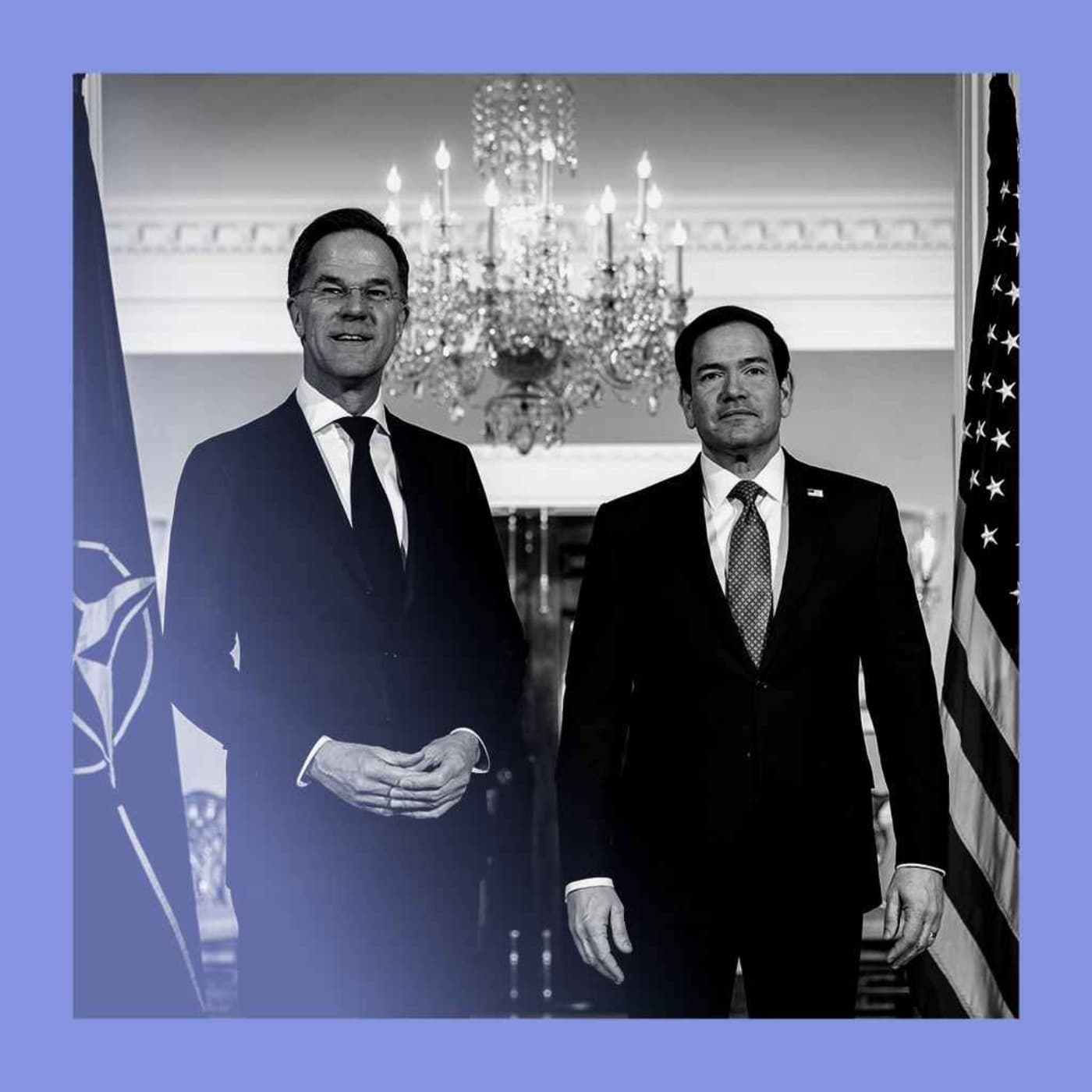
The episode covers three segments. First, NATO’s “dialogues” with Donald Trump amid the Iran war: Europeans are accused of not opening bases/airspace enough and not helping reopen the Strait of Hormuz. Mark Rutte (NATO chief) met Trump and argued Europe quietly enabled U.S. operations and even praised Trump’s Iran actions; Trump avoided joint press and implied he may not commit.
Key claims
Trump’s hostility, Greenland dispute, and Marco Rubio’s shift (“we defend them”) make NATO divorce more plausible; even without formal withdrawal, the U.S. could cripple NATO via funding/troops/command changes.
Notable examples
Spain denies landing/overflight; Britain plans Strait of Hormuz talks and possible naval escort; France favors autonomy and excluding overt U.S. Second, emigration: Callum Williams finds ~4 million emigrated from 31 Western countries in 2024 (+20% vs pre-pandemic), driven by post-2022 immigration unwinding, deportation fears, taxes, slow growth, and “politics is broken.” Most movers go to other Western countries (e.g., U.S., Netherlands, likely UK). Third, World Cup culture preview: Spain’s tiki-taka, El Clásico rivalry (including 2002 pig’s head incident), Catalan division, and Spain’s 2010 success.
Guests
Anton LaGuardia (diplomatic editor), Callum Williams (senior economics writer), John Fasman (senior culture correspondent).
Written by AI. May contain mistakes. Listen to the episode to check what was said.
Chapters
Tap a time to open that second in VONATO's Challenges with Trump
1:24 to 2:06
Discussion on NATO's tensions under Trump's presidency and recent meetings.
“From the Suez Crisis to the Vietnam War to the invasion of Iraq, non-European wars have a way of tugging at the fabric of NATO.”
Mark Rutte's Diplomatic Efforts
2:06 to 3:22
Exploration of Dutch PM Mark Rutte's strategies in dealing with Trump and NATO.
“And then he headed to CNN to chat about it.”
The Impact of the Iran War on NATO
3:22 to 4:36
Analysis of how the Iran war is influencing NATO dynamics and Trump's stance.
“And he made the case that the Europeans had, in fact, quietly let American forces operate.”
Changing Opinions on NATO
4:36 to 5:50
Examination of shifts in NATO allies' views in light of Trump's actions.
“Trump has been denigrating NATO, threatening to leave NATO since his first term.”
Potential NATO Divorce Scenarios
5:50 to 6:46
Imagining the consequences of a potential US withdrawal from NATO.
“But in the past, until quite recently, he's been the one person the Europeans felt they could talk to and the one person who managed to help avert some of the worst outcomes in Europe's dealings with the United States.”
European Responses to the Iran Conflict
6:46 to 7:58
How different European nations are reacting to the Iran conflict and their NATO commitments.
“happen to NATO without a formal declaration of divorce.”
The Role of Britain and Spain in NATO
7:58 to 9:10
Britain and Spain's strategies in dealing with the Iran war and Trump.
“Would you describe what partners like Britain and Spain and others are doing as a means to placate Mr.”
Europe's Defense Autonomy vs. US Alliance
9:10 to 10:24
Debate on European autonomy in defense and the necessity of US support.
“Given the way some of the European leaders have reacted here, this discussion has always been about whether Trump has at last had enough with NATO.”
Record Emigration from Western Countries
11:21 to 12:40
Insight into rising emigration numbers among Western nations and reasons behind it.
“When it comes to migration in the West, immigration gets all the headlines.”
Factors Driving Emigration Trends
12:40 to 13:40
Exploration of the causes behind the recent surge in emigration from Western nations.
“and that's about 20 % more than just before the pandemic.”
Show all 14 chapters
Destination Countries for Western Expats
13:40 to 14:01
Analysis of where Western expats are relocating and trends observed.
“In part, this is the unwinding of a huge immigration boom that happened in 2022 and 2023.”
Understanding Western Expat Movement
14:01 to 16:58
Explore the factors driving Western expats to relocate within Western countries.
“maybe students or they were on temporary work visas.”
Impact of Emigration on Home Countries
16:59 to 18:00
Discuss the implications of emigration for the economy and society of home countries.
“That's the crucial question, a very interesting one.”
Spanish Football and Its Global Influence
18:22 to 21:42
Examine Spain's football history, culture, and its impact on the upcoming World Cup.
“It begins at Azteca Stadium in Mexico City, but anticipation has been building for years.”
Transcript
Automatic transcript. May contain errors.0:00You don't need a passport to taste the world's most luxurious beef. Just head to Benihana. Introducing the Wagyu of the World menu. From the rich flavor of American masami ribeye to the bold Australian New York strip to the legendary melt-in-your-mouth A5 Japanese Wagyu, this is the finest beef on the planet, expertly grilled right at your table. Why settle for an ordinary steak dinner when you can taste the world in one bite? Only at Benihana. Book your table at benihana.com.
0:35The Economist
0:42Hello and welcome to The Intelligence from The Economist. I'm Rosie Bloor. And I'm Jason Palmer. Every weekday we provide a fresh perspective on the events shaping your world.
0:58Immigration is frequently in the headlines, but people spend far less time thinking about its reverse, emigration. Now our correspondents have done the number crunching on that, with some surprising results. And our culture correspondent is looking ahead to the World Cup, and will in the weeks until then be profiling 10 of the countries in the tournament, from perennial top contenders to those on a first appearance. Today, we're going to Spain.
1:35But first...
1:42From the Suez Crisis to the Vietnam War to the invasion of Iraq, non-European wars have a way of tugging at the fabric of NATO. Given President Donald Trump's long-standing animus towards the alliance and perhaps a misunderstanding of what its charter actually stipulates about mutual aid, this time it may be torn apart. Mark Rutte, NATO's chief, attended a closed-door meeting yesterday with Mr. Trump, presumably to smooth, ruffled feathers. And then he headed to CNN to chat about it. Let me be absolutely clear. He is clearly disappointed with many NATO allies. And I can see his point. But at the same time, I was also able to point to the fact that the large majority of European nations has been helpful.
2:28That might not be enough. Member states may have upped their defense spending in response to Mr. Trump's first-term threats to leave the alliance. But there's more than their failure to uniformly do his bidding this time that gives today's threats more weight. The war in Iran has really brought things to the boil for Donald Trump for two reasons, I think. Anton LaGuardia is our diplomatic editor. One is that Europeans have not totally opened their bases and their airspace to American operations in Iran. And the second is that they have not participated in any effort to reopen the Strait of Hormuz for as long as the fighting has been going on.
3:09So in his view, they were cowards. And as regards his relationship with NATO, that's why Mark Rutte paid a visit. How did he try to make his case with Mr. Trump last night? Mark Rutte is the great Trump whisperer of Europe. And he made the case that the Europeans had, in fact, quietly let American forces operate. They had been the platform from which the United States could project power into the Middle East. and that they have, in fact, quietly praised Donald Trump for his ability to destroy Iran's nuclear facilities, his ballistic missile capabilities, and made Europe safer. He says, I support the president, which is not something you hear from a lot of European leaders.
3:57And how did that go down with Mr. Trump? That seems to be the kind of message he likes to hear. Well, it's worked a treat in the past, but I think less well this time. Mr. Trump, after the meeting, did not hold a joint press conference with Mark Rutter, and they were not really seen together. Then he posted on his Truth Social platform that nature was not there and will not be in future, with the implication that he's not terribly committed to it, although he didn't say it. So I think the best that can be said for Rutter is that he did not effect a reconciliation, but maybe he's averted a divorce, at least for now.
4:35But to be fair, Mr. Trump has been denigrating NATO, threatening to leave NATO since his first term. This is, in a sense, an old story, an old threat. Is there a reason to take it any more seriously this time? There are three reasons to take it more seriously. First of all, is just the sheer intensity of his hostility to NATO. Second is the fact that having convinced NATO to spend a lot more on defense and casting himself as a champion of NATO rather than a foe of the alliance, He began to change his tune earlier this year when he revived his demand that the United States should take over Greenland, something which caused huge resentment in Europe because Greenland is a territory of Denmark.
5:16And then now with the war in Iran, he felt they just weren't there for him. The third reason is that Marco Rubio, his Secretary of State, has abruptly changed tune on NATO. He had been a defender of the Transatlantic Alliance. as a senator, he sponsored what is now a law requiring Donald Trump to secure a two-thirds majority of the Senate to permit the withdrawal from NATO. But now, as Secretary of State, he says it is a one-way street. We defend them. They don't help us. So after this war is over, we must reconsider our relationship. Now, he is echoing his master's voice. But in the past, until quite recently, he's been the one person the Europeans felt they could talk to and the one person who managed to help avert some of the worst outcomes in Europe's dealings with the United States.
6:08As you say, there is a law now preventing Mr. Trump from unilaterally withdrawing from NATO. It doesn't sound like he could even if he wanted to, or at least not easily. It would certainly be politically costly. The law is on the books, but has not been tested constitutionally and there are lots of people who think it may not be constitutional. And in any case, he can do a lot of things to damage and cripple NATO without necessarily formally leaving the alliance. He could deny funds, he could withdraw American troops, he could withdraw the American commander of NATO, who is also the head of European command.
6:44So lots of bad things can happen to NATO without a formal declaration of divorce. But with the threat of divorce looming, NATO partners have had to do something about the war in Iran. How are they reacting in the face of this conflict at least? There's a range of responses from the Spanish prime minister, for example, who is making a point of being against the war and critical of it and denying America landing and overflight rights, to the British at the other end who are trying to soothe relations to show that even if they do not regard the war as theirs, they're willing to be helpful in the post-war context.
7:24For example, Sir Keir Starmer, the British Prime Minister, is currently in the Gulf trying to discuss ways of reopening the Strait of Hormuz. His government has hosted preparatory meetings in London of foreign ministers and of military officials for how this might be done under what conditions that might happen. So if the ceasefire holds, you can probably expect to see some kind of European naval presence helping out with escorting ships in and out of the strait. But there are disagreements over what precisely those conditions would be. Would you describe what partners like Britain and Spain and others are doing as a means to placate Mr.
8:06Trump or as a means to, without America, assert itself in this conflict? Inevitably, there is a range of views on this. The French will be at the autonomy end. They seem to want to lead any such mission when the time comes. And according to diplomats who've spoken to us, they also want to exclude an overt role for the United States, whereas the British want to do it in conjunction with the United States, not least because they think the Iranians will not voluntarily relinquish control of the Strait of Hormuz, and therefore some kind of staring them down, and possibly of military action to protect ships, may become necessary.
8:43And for that, they want the Americans to be there. But there is a dimension of trying to placate Donald Trump, of saying, here we are, we are good allies. And there's another dimension of self-interest, which is ultimately they know that they, first of all, need the United States as part of NATO, But they also know that they depend on the Strait of Hormuz more than the Americans do as a source of actual fuel and supplies. Although, of course, any shortage in the global market will be felt everywhere, including in the United States. Given the way some of the European leaders have reacted here, this discussion has always been about whether Trump has at last had enough with NATO.
9:20Is there a chance that NATO has maybe had enough of Mr. Trump? Well, if you look at opinion polls, views on Mr. Trump and the alliance are very negative. And I think that the war in Iran, particularly that rather genocidal talk of ending the Iranian civilization, has really horrified a lot of Europeans. So you see some leaders, such as the Spanish Prime Minister Pedro Sanchez, take opposition to American policy as a moral action. But I think that most leaders are in the world of realpolitik trying to balance the hostility of public opinion against the knowledge that they still need the Americans as deeply and for as long as they can keep them in and are willing to take some degree of being insulted by the president.
10:10But the things that are being said will be hard to unsay. So I think everyone here is on very thin ice. But suppose the ice breaks altogether. Could NATO meaningfully carry out its role without America? Look, it would be very difficult, and it would depend on the manner and the timing of an American withdrawal. The ideal scenario is that there's a gradual and collaborative transition where over a period of years, Americans reduce their presence, let the Europeans take over more and more, and maintain a residual presence in the background, a kind of backstop situation, particularly on the nuclear side.
10:48The bad scenario is that the Americans suddenly one day decide they've had enough and they're pulling out, perhaps because of some other row that comes up and leave in a chaotic and disorganized fashion. And frankly, the Europeans need to get on with the job of boosting their own defenses quickly because their one hope of keeping the Americans in is to show that they're strong allies and capable, but also because they need to be ready for this potential divorce that could come at any moment. Anton, thanks very much for joining us. Thank you, Jason.
11:40When it comes to migration in the West, immigration gets all the headlines. Less noticed are the number of people leaving. There's a good reason for that. The statistics on emigration are really bad. Callum Williams, our senior economics writer, is based in San Francisco. Over time, tracking has improved, and that has allowed us at The Economist to produce the first comprehensive measure of gross emigration from the West. So Callum, what did you find? Well, it turns out that people are leaving Western countries in record numbers. We looked at data from 31 countries, including Australia, Britain, Canada, France, and Germany.
12:22We didn't include America because the data are still too unreliable. And we basically tracked comings and goings on a permanent or semi-permanent basis. So not tourists or business travelers, but people who say they're going to move their country on a long-term basis. And what we found is that roughly 4 million people emigrated from those 31 countries in 2024. and that's about 20 % more than just before the pandemic. So how did those results vary across the different countries that you looked at? So most places have seen big increases in emigration. There are some exceptions. One big one is Greece, where emigration, as you might expect, has fallen very significantly over the past few years as it has recovered from financial crisis.
13:06And in fact, the economy is now growing pretty strongly. But look at countries like Canada. Their immigration is about 24 % higher than it was in 2019. In Sweden, it's more than 60 % higher. There have been notices issued by the Italian statistical office recently that point to a boom in immigration. Iceland is seeing the highest level of immigration on record. And then there have been some estimates to look at immigration from the US. And there's a paper that came out recently from Brookings, a think tank, which estimates that up to 3 million people left America in 2025 compared to about 2 million in 2021.
13:42So what's going on? Why are all these people leaving? In part, this is the unwinding of a huge immigration boom that happened in 2022 and 2023. So in those years, Western countries admitted very large numbers of newcomers, many of whom never intended to stay permanently. They were maybe students or they were on temporary work visas. And so it was kind of inevitable that you would see a big increase in immigration a few years after the big increase in immigration. There are other factors though, including Donald Trump's deportation efforts, which may be provoking many hundreds of thousands of people to leave the country.
14:20But then also other things, economic factors to do with high taxes and slow economic growth, and also a sense among many people in many Western countries that politics is no longer working and they'd rather live somewhere else. So we've got an expat economy emerging and a huge movement of people, but where are they all going? Some Western expats move to non-Western countries. In Britain, for example, it's become a kind of meme that lots of people are moving to Dubai, or at least they were moving to Dubai until recent events in the Middle East. In fact, though, what our analysis suggests is that most people who leave a Western country are moving to another Western country.
15:01Our analysis suggests that since 2019, the number of people who were born in a Western country living in another Western country has grown by about 2 million. A lot of those people have gone to places like the US, the Netherlands, and probably the UK as well, although data here are actually too poor to analyse properly. So why are Westerners moving to just a different Western country? So I think there's three big factors. The pandemic is one, taxes are the other, and then politics is the last one. So the pandemic basically normalised the idea of what you could call geographical arbitrage, the idea that you can live and work in different places.
15:45So obviously, a lot more people work from home now than they did before the pandemic. And once you kind of cross that threshold, it doesn't seem insane that you could live in a different country and continue to work for your current employer. So for example, if you look at American multinationals in high value services like management, scientific and technical consultancy, they now actually employ about a third more people abroad than they did in 2019. So work from home is one factor. The second is taxes. What's happened in recent years is that many Western governments have, in a big way, raised taxes on the richest.
16:19And that has encouraged some people to look elsewhere for lower tax places to live. So for example, a lot of rich people are moving to Portugal and Italy because those governments have worked quite hard to say that we're not taxing you as much as you might get taxed elsewhere. And then the third thing I think is politics. So really, wherever you go these days, people will say, my country's politics are broken and I want to live somewhere else. So you hear this all the time in the UK, you hear this all the time in the US, of course, you hear this all the time in Canada, in France, and so on. And so what you've got is political refugees, as it were, who've decided to live somewhere else to escape the awful politics at home.
16:56So if Western countries are effectively swapping people, does it matter? That's the crucial question, a very interesting one. I think there's a sort of popular belief that emigration is bad. It's seen as a judgment on the country if someone decides that they want to leave. I think there's other ways of looking at it, though. I mean, I think the crucial factor to bear in mind, and there's some good analysis from New Zealand on this, where there's high emigration at the moment, which is that emigrants are quite likely to return at some point. So a lot of people who move abroad, people who've gone to university and are earning quite well, a lot of those people do tend to move back.
17:35So in the short run, the country does take a hit because they're not paying taxes there anymore. They're not contributing to society anymore. But in the long run, I think it's a bit less clear because they develop networks abroad. They will be exposed to new ideas, new people, and they'll bring those ideas and networks back when they come home. So on balance, I think emigration actually isn't necessarily a bad thing at all. Callum, thank you very much Thanks Rosie
18:21The 23rd Men's FIFA World Cup is just nine weeks away It begins at Azteca Stadium in Mexico City, but anticipation has been building for years. John Fasman is our senior culture correspondent. It's the first World Cup to have three hosts, Mexico, Canada, and the United States. It's also the first to have 48 countries competing, up from 32 last time. And in the shadow of Donald Trump's unpredictable presidency, it's probably the most politically charged World Cup ever. In the coming weeks and months, I'll be profiling 10 of the countries competing. Some are past champions, some are perpetual bridesmaids, and some are making their first appearance.
19:05We'll explore their paths to the tournament and what makes them interesting on and off the pitch. We're starting this series with Spain. Many bookmakers give them the best odds to win the whole tournament this year, albeit narrowly over England and France. If you've ever been to Spain or lived there, you know the country takes its football very seriously. Spanish football tends to be quick and tactically proficient. They played a style that became known as tiki-taka, which is characterized by frequent short passes and possessional dominance. Now, this style of play can be, frankly, a bit boring.
19:40To a spectator, it often just looks like skilled players kicking the ball around midfield. But the results speak for themselves.
19:51Three teams dominate domestic Spanish football. Real Madrid, an Atlético Madrid in the country's capital, and Barcelona, the biggest city in Catalonia in the country's northeast. Matches between Real and Barca are called El Clásico. There was an infamous moment in 2002 during one of those matches where litter was thrown in Luis Figo's direction. He had joined Real Madrid from Barcelona a few years earlier. Among the litter and debris was a whole pig's head. The rivalry between the two teams can be seen as symbolizing a deeper division in Spain, between Spanish speakers and speakers of Catalan from the region around Barcelona.
20:33Many have long demanded an independent Catalan state, though polls taken by regional governments suggest support for independence in the region has fallen in recent years.
20:50Spain last won the World Cup in 2010. That came in a historic run. They won European championships in 2008 and 2012. Their success defied expectations. The national team at that time had a core of Barcelona players. But the coach of Spain's national team, Vicente del Bosque, spent almost his entire career as a player with Real Madrid. That was not, perhaps, a recipe for success on paper. But Del Bosque had a plan. He said in an interview that he wanted, quote, to make Catalans and Basques feel good about supporting the Spanish side, which, of course, historically, they did not. Del Bosque said the thought of using football to unite was something that makes him happy.
21:31The style of play he encouraged, the tiki-taka style, required the team to act as a team. It was an almost superstar-proof system, and it worked. Can the Spanish squad of 2026 pull off a similar united success?
21:56That's all for this episode of The Intelligence. We'll see you back here tomorrow.
22:20When do the images we see online become too much for us to handle? Job at Writers Theatre is an intense psychological thriller that skewers the insidiousness of the internet, the meaning of work, and the ramifications of a secret revealed. The off-Broadway sensation and edge-of-your-seat thriller about big tech and even bigger secrets is on stage at Writers Theatre April 9th through June 14th. You don't need a passport to taste the world's most luxurious beef. Just head to Benihana. Introducing the Wagyu of the World menu. From the rich flavor of American masami ribeye to the bold Australian New York strip to the legendary melt-in-your-mouth A5 Japanese Wagyu, This is the finest beef on the planet, expertly grilled right at your table.
23:11Why settle for an ordinary steak dinner when you can taste the world in one bite? Only at Benihana. Book your table at benihana.com.
From the publisher
President Donald Trump has long threatened to pull America out of the alliance. We examine why the Iran war has made this time look significantly more serious. Westerners are fleeing their countries in record numbers—with economic consequences for their origins and destinations. And our series profiling the countries contesting the World Cup starts with Spain.
Guests and host:
- Anton La Guardia, diplomatic editor
- Callum Williams, senior economics writer
- Jon Fasman, senior culture correspondent
- Rosie Blau, co-host of “The Intelligence”
- Jason Palmer, co-host of “The Intelligence”
Topics covered:
- NATO, war in Iran, Donald Trump, Mark Rutte
- expats, emigration, economics
- World Cup, Spain
Get a world of insights by subscribing to Economist Podcasts+. For more information about how to access Economist Podcasts+, please visit our FAQs page or watch our video explaining how to link your account.
Hosted on Acast. See acast.com/privacy for more information.