In short
Escape’s reported $157M insolvency and pivot after 125 days under new CEO Frank Britt; why the original Robots-as-a-Service go-to-market failed, and how a “platform-powered robot” model plus falling hardware costs, zero in-house labor, and “recovery intelligence” could make recovery robotics scale.
Guests
Frank Britt, CEO of Aescape/Escape Recovery Inc. Background includes chief strategy/transformation at Starbucks, CEO of Penn Foster, senior advisor at Valor Equity Partners, and leadership roles at IBM, Bain, and Valor; previously worked across enterprise transformation, consumer tech, workforce optimization, and PE education.
Key claims
Headlines lacked context; the core issue was misalignment between early-stage capital structure and financing customers for 4 years. Mindset shift from R&D to performance/execution. Pricing and model changed: robot purchase (with optional third-party financing), explicit uptime/support commitments, and monthly service.
Notable examples
GPS/doorbell/Spotify adoption pattern; Tesla-like software improvements every 2–4 weeks; cost curve analogy to plasma TVs; EV-network analogy. Mentions Equinox expansion (up to 60 locations) and 12,000 sessions in April; “recovery score” akin to Whoop/Oura Ring.
Written by AI. May contain mistakes. Listen to the episode to check what was said.
Chapters
Tap a time to open that second in VOThe Context of Recovery Tech
0:00 to 1:12
Explore the evolving landscape of recovery technology and its market potential.
“So one of the things I find so interesting, again, I have one benefit over everybody else, which is I don't know much, but I find interesting people talk about this business in such a past tense kind of way.”
The Challenges Facing Escape
2:26 to 4:14
Discuss the recent insolvency of Escape and the implications for the brand.
“Escape recently entered insolvency proceedings with reports citing a$157 million shortfall.”
Understanding the Business Model
4:14 to 6:24
Delve into the complexities of Escape's unit economics and operating model.
“So Frank, we are so excited to have you on.”
Shifting Perspectives on Robotics
6:24 to 8:28
Learn about the pivotal changes in Escape’s strategy and market approach.
“in an AI economy than they've ever been.”
Navigating the Robots as a Service Model
8:28 to 10:40
Unpack the pitfalls of the 'robots as a service' model in the recovery tech space.
“Yeah, I think that, you know, we say oftentimes that context is worth 50 IQ points.”
The Future of Escape in the Industry
10:40 to 14:05
Discuss the new direction of Escape under Frank Britt and future market strategies.
“Now you might say, you've often heard in business, you know, don't ship your org chart to the customer.”
Understanding the Business Model
14:05 to 16:40
Learn about the challenges and opportunities in recovery tech businesses.
“So, Frank, I just want to go back slightly because maybe you just boil this down to, again, a lot of people that are in businesses.”
Superpower of Belief vs. Performance
16:40 to 19:10
Explore the importance of belief and performance in business success.
“And so the arc of the story is an arc that says the company built a world-class product.”
Market Dynamics and Customer Value
19:10 to 22:30
Discuss how market dynamics affect customer expectations and value.
“So from the B2B customer perspective, you are right.”
Consumer Tech Adoption Patterns
22:30 to 25:50
Understand consumer tech adoption and its implications for recovery solutions.
“escape in some cases, or members of facilities that also offer them.”
Show all 18 chapters
Pricing and Labor Trends in Recovery Tech
25:50 to 28:00
Analyze pricing strategies and labor trends affecting recovery tech.
“So the first, another pattern of all industries, particularly ones that involve silicon and software, is that their patterns are always the same.”
Labor Market Challenges in Recovery Therapy
28:00 to 28:50
Learn about the acute labor imbalance in the recovery therapy sector and its implications.
“You do the compounding math of 3.4%, the average person today who's a therapist makes$55 ,000 a year.”
Transforming Real Estate for Higher Value
28:51 to 29:50
Discover how turning low-value real estate into high-value spaces can enhance profitability.
“That's why I go back to the unit economics from the from our perspective.”
Consumer Trends and Market Potential
29:51 to 30:51
Explore current consumer trends and the potential for market growth in recovery services.
“So both levers of the business that matter, reuse of product and value for consumer at a price point of$45, not$60, by the way.”
The Essence of Starbucks and Human Connection
30:52 to 32:18
Understand Starbucks' brand philosophy and its relevance to human connection in business.
“as I'm part of it, is a lot of the investment that goes into other products.”
Innovations in Recovery and Health Intelligence
32:19 to 34:33
Learn about innovations in recovery technology and the need for health intelligence.
“great brands are not just brands that people love.”
Future of Health and Wellness in Recovery
34:34 to 36:58
Gain insights into the future of health and wellness, and the role of recovery in it.
“which arguably might be the most important thing, which is the intelligence layer in the business.”
Navigating Challenges and Metrics for Success
36:59 to 39:58
Discover the importance of metrics and strategic growth in business operations.
“and that's what we're getting better at each week.”
Transcript
Automatic transcript. May contain errors.0:00So one of the things I find so interesting, again, I have one benefit over everybody else, which is I don't know much, but I find interesting people talk about this business in such a past tense kind of way. This is the business that's inflecting and is growing at the epicenter of a growth market, at the confluence of fundamental shifts in how consumers view their own bodies and self-diagnostics and the use of AI and tactile hardware. this is not a business that is a phoenix rising this is just the next chapter of what happens i wouldn't say i've underestimated the challenges of the business i think i underappreciated the size of the opportunity and i'm more persuaded after 125 days on the ground that the confluence of all the mega trends that you folks talk about on your show make this moment even more significant to the category that's emerging and forming around a new notion and concept of recovery.
1:01And in specific terms for our firm, we're in the right place at the right time. We couldn't be better positioned.
1:11Matthew Januszek:So we're live. Welcome to this week's episode of Lifts. I'm Matthew Januszek, and I'm here with my co-host Mohamed Iqbal for an episode that Mo and I have been very excited to have for quite some time. So Mo, I'll hand over to you to introduce our guest today. Yeah, look, we're excited. We're joined by a newcomer to the industry, Frank Brett, who is the CEO of Escape. Most of you listening have heard of Escape, the robotic massage company, but you might not have heard of Frank Brett. So I want to do a quick intro of Frank and I've had the privilege of looking at his bio before and incredibly impressed by his background.
1:49So Frank has a pretty unique operating background compared to people we've had on the show. He's worked across enterprise transformation, consumer technology, workforce optimization, PE education, and now wellness robotics. He was the chief strategy and transformation officer at Starbucks, longtime CEO of Penn Foster, senior advisor at Valor Equity Partner, and so on. He's also had leadership roles across IBM, Bain, and Valor. This conversation comes at a particularly important moment as it relates to his new appointment as CEO of Escape. Escape recently entered insolvency proceedings with reports citing a$157 million shortfall.
2:35At the same time, Escape continues to operate through a new vehicle, Escape Recovery Inc., after the assets were acquired early this year. This headline is obviously significant, but what I do not want today's conversation to become is a simplistic post-mortem because Escape was not an unserious company. It raised significant capital and attracted serious investors. It partnered with some of the strongest brands in fitness, hospitality, and wellness. In March 2025, Escape announced an$83 million strategic funding round, bringing its total funding to$128 million, and announced an expansion with Equinox to as many as 60 locations nationwide.
3:21And the product overall, we've talked about it a lot on this podcast, really sits at the center of several major trends, recovery, AI, robotics, personalization, luxury wellness, and also what we'll call labor light service delivery. And it's an idea that recovery is becoming core of the wellness experience. So the real question is not simply what happened to Escape, and we want to dig into that, but it's really about what does this teach us about a business that needs to scale? And look, we've, as I mentioned, talked about Escape a lot. I've had a chance to know its founder. I know the founding team.
4:02But I've always questioned just the unit economics of the product, the fit within the industry, and its ability to scale into the broader ecosystem. So Frank, we are so excited to have you on. You're new to the industry. It's your birthday today. We have a lot of appreciation for you making the time to come to Lyft. Thank you for joining us today. My pleasure. Thank you for having me.
4:29Matthew Januszek:Well, Frank, as you mentioned before we turned the camera on, 125 days in the industry, so quite a new sector. And I'm sure you're still learning a lot about the space. But probably just from my opening question, you've had a huge amount of experience in businesses in general, as Mo mentioned, a number of different sectors and a number of very prominent businesses. And I guess, you know, we talked to a lot of founders and entrepreneurs who listen to this podcast. And I guess just from your perspective, as an individual that's been involved in many different areas of the industry, what would you say was one of the things that you understood later about this business that maybe you could have done earlier?
5:19Matthew Januszek:And I'm not saying about maybe what the market necessarily misunderstood about Escape, but was there anything that you could say that you personally underestimated about the business when you got into it compared to where you are today? I wouldn't say I underestimated the challenges of the business. I think I underappreciated the size of the opportunity. And I'm more persuaded after 125 days on the ground that the confluence of all the megatrends that you folks talk about on your show make this moment even more significant to the category that's emerging and forming around a new notion and concept of recovery.
6:02And in specific terms for our firm, we're in the right place at the right time. We couldn't be better positioned. and I'll unpack why I think that's true and perhaps most importantly, how we expect to seize that opportunity and do so in a way with our very important partners we have across the country and continue to grow while we continue to build a world-class brand. You know, brands are no less important today in an AI economy than they've ever been. In fact, arguably they're more important. I have a lot of experience in working with and being privileged to be a part of some of the greatest brands in the world, like IBM, like Starbucks.
6:37And I think I know what brands mean and why they matter. And we fully expect to be the leading brand in the category of personalization as it relates to recovery and build a business model that delivers tremendous economic value to our B2B partners. And in the process, add significant value to their guest experience, their member experience, or whatever the persona is of the ultimate consumers they serve. Well, Frank, let's go ahead and start with the moment that the company is in today. There were many reports stating that ESCAPE entered insolvency proceedings with a reported$157 million shortfall and that substantially all the assets were acquired by a new entity, ESCAPE Recovery, which continues to function.
7:22And from what I understand, that's the entity that you are now a part of. First, I want to approach this with a lot of empathy because I think every company has a team of people behind it that work incredibly hard to bring the product to market. So I definitely understand that and have a lot of respect and value for them. But I'm curious if you could shed some light. So after I did a LinkedIn post when this came out, I read a lot of articles about it. And my perspective all along, and I've been very open about this around Escape, is I struggled to understand the unit economics behind it, everything from the COGS to the$7 ,000 a month leasing model to the ability for a consumer to pay 60 plus dollars for a session when you can, especially at the brands that you're in, such as the Four Seasons, Equinox, Lifetime, and others where consumers have the ability to pay more to have a human come in.
8:16But just first, what was the articles that were out and the reportings, was it misleading? Was it inaccurate? Speak a bit about where the company is today and kind of what happened over the last few months. Yeah, I think that, you know, we say oftentimes that context is worth 50 IQ points. And I think the through line of all of the materials I've read is that not that they're fundamentally inaccurate, they just lack context. There's no dimensionality to the story. So maybe I can help unpack what I've concluded is the actual story, not just the headlines that, you know, people like to write about.
8:57If you study businesses that are robots, businesses, and you think about the economics of early stage companies, what I think is often missed, and you hear a lot about this if you spend a little bit of time in the SaaS world, and now the robots as a service world, what that is all about is the idea that a company builds a world-class product that has meaningful relevance to its target customer, in our case, premium hospitality, premium spas, and premium health clubs. And the premise is that we go build that product, and then under the original model of how the company went to market, which is not uncommon, they went to market and went to show on as a robots as a service model, which on one level makes a lot of sense.
9:42It mirrors the SaaS model and hardware as a service that is the megatrend that we are all familiar with. where that is a fundamental mistake, I think is a fair way to say it, is it ignores the capital structure of the early stage company. And so when you are building and investing substantial dollars in R &D and frontier technologies, as we did, and then you have a go-to-market model that once you actually have commercial viability to the product, you actually finance the product for four years, that makes you a bank. And we don't want to be a bank. our cost of capital is 50 to 100 % higher than every single one of our customers.
10:21So why would you go to market in a model where we not only had to build and invest tremendous amount of money in building the product and innovating to make it viable, consumer relevant, aesthetically compelling, and all the other components that you've affirmed in the show many times. But it's not wise to then also finance the product for the customer. Now you might say, you've often heard in business, you know, don't ship your org chart to the customer. And the principle applies, don't ship your cap table to the customer either. However, in this particular case, it turns out the double bottom line winning formula is not that formula of robots as a service.
11:01It's a different model of go to market, which is a platform powered robot model where you go and do the innovative work and R &D work that is required to build a frontier your product, which we've done, and then you sell the equipment to your end customer because their cost of capital is 90 % less than yours. And in so doing, you have several positive things. For your company, it allows you to then be de-burdened of that ongoing cost because you actually capture their value earlier. And in so doing, it allows you to then take those dollars, reinvest in innovation scale. From the customer perspective, it's actually a winning formula twice.
11:39First of of all, the psychology of ownership is inherently different. When you own something, you treat it differently than when you rent it. And you get to depreciate the asset, and you have a residual value. So what we've done, our fundamental pivot in the last 125 days, is we've learned, perhaps the hard way, as many do, who are early stage robotics companies, that while robots as a service is a good concept, it is not a concept that connects the cap structure to the go-to-market model and our pivot is we have a cap structure that we have we'll talk more about that which is we are an early stage company that's a well-established fact but we've pivoted to go to market model so we can better align our interests with the customers and the customers interest with ours and so we are not aspiring to be a bank we're aspiring to be a robotics company that has a world-class brand that delivers demonstrative b2b value which we're going to also unpack in a few minutes as well as of course a compelling experience for the consumer so when someone asks in the elevator, why did escape not work?
12:40My conclusion with not having been there, so with all the humility that comes with not actually knowing, there are two fundamental reasons. One is mindset and the other is business model. The mindset challenge was the skills it takes to build a world-class product the way they did. And you know, those folks more, it's better than I do is a very distinctive competency that I admire enormously. And I'm proud of the people whose shoulders we stand on. However, that's an R &D mindset. And we're not an R &D company. We're a performance and execution business with a tier one brand that has to deliver value and have the momentum that comes with that.
13:17I know a lot about execution. At Starbucks, we had 40 ,000 stores and 100 million customers a week. I think I have a pretty good idea of what execution excellence looks like at scale. And we were not that. So we are pivoting the mindset. And I don't say the DNA, but the orientation of the company towards we're a performance company, not an R &D company, although we still do some obvious R &D and innovation. And then more fundamentally to the business economics, to your core question, we're pivoting away from the robots as a service model to what we call a platform powered robot, which means we should provide you the robot and you should buy the robot.
13:56We've lined up third party financing if you want to finance it. We radically changed the pricing, which is another thing I've heard that's not well understood in the market. We can talk specifics if you'd like. And then our job going forward is to continue to offer you a platform of services from technical support to improvements in the software, improvements in the reliability, advice on pricing, in-house marketing support, and wrap a customer support team around you so you can maximize the value of that asset for you, whether you're a hospitality company, a premium health club, or a spa.
14:29Matthew Januszek:So, Frank, I just want to go back slightly because maybe you just boil this down to, again, a lot of people that are in businesses. And what you've discussed is really the understanding of the business model. And it sounds, and I'm going to dumb this down into my language, but it sounds like a great idea. Certainly, you identified a problem from what I've understood from being in the space for a long time. Just the challenges of getting staff and a lot of the things even around humans doing this particular service is a challenge for many operators in itself, as well as I'm sure other things that I'm not aware of.
15:06Matthew Januszek:So clearly defined a problem that I'm sure is a lot bigger than most of us have understood. Clearly, some really smart people, as you say, from the design and development and the capability around robotics and AI, that seemed to be world class. But it seems from what I'm hearing is you've had a huge amount of experience, including companies like Bain that probably really understand many different businesses to a very, very deep level, as well as you mentioned some of your experience of scaling companies like Starbucks. And you've joined the company six months ago then. So if you were to explain this in simple terms, then, so great idea, great product, found a huge problem to solve.
15:48Matthew Januszek:But would you say then that when you came in, it's just really applying some business fundamentals in order how to take a great idea and to solve a problem, but making it in a way where it could be successful? And I'm talking for small people that have got an idea for an app that they're trying to build or someone to a gym like, you know, just relate those to any startup business person that may be listening today. I think that the company, my first day I had a company meeting and I had met with several people before the meeting at all levels of the company. And I said, I'd like to make an assertion today that we should discuss as a company.
16:26And we have about 50 employees. I said, every company has a superpower. Our superpower is the power of belief. And I admire that. But you can't win on belief alone. You have to compound belief into confidence, and confidence comes from performance and results. And so the arc of the story is an arc that says the company built a world-class product. It built a very distinctive brand that I think we can continue to elevate, but it didn't build the go-to-market model that was calibrated to the cap structure of the business and also the way customers wanted to buy. Customers want to own the equipment.
17:01They want to depreciate the asset. They want to know there's a residual value. They want to know that the product will be explicitly, not implicitly, with a set of explicit commitments to make sure it's uptime's right and make sure it has all the right support that it needs to continue to improve. And very much like a Tesla, you buy a Tesla, the car is not static. It perpetually improves. Every two to four weeks, our product is improving. And if you think about it from an LLM-speak perspective, we have more training data than any company in the country. We did 12 ,000 sessions alone just in April, alone.
17:33So one of the things I find so interesting, again, I have one benefit over everybody else, which is I don't know much. But I find interesting people talk about this business in such a past tense kind of way. This is the business that's inflecting and is growing at the epicenter of a growth market, at the confluence of fundamental shifts in how consumers view their own bodies and self-diagnostics and the use of AI and tactile hardware. This is not a business that is a phoenix rising. This is just the next chapter of what happens. And if you look at the through line of entrepreneurs from every conceivable industry, it's a very common dynamic where the business does its best work with its best thinking, with its best available information.
18:18Good, earnest people make the best choices they can with the information they have. It's rarely the right answer. You could interview Howard Schultz in this and he could tell you thousands of stories of how Starbucks didn't get it right. But the definition of great entrepreneurs is not whether they get it right. It's how fast they learn and how quickly they can pivot. And so we're building a DNA that we expect the world to become more uncertain. We don't expect things to be more stable. We're embracing uncertainty. We are a pro-entropic company. Pro-entropic company gets stronger through uncertainty and disruption.
18:51They're not weakened by it. They grow from it. They're not just resilient. They actually get better because of the disruption. We are getting better every week and every month because the market we serve is evolving. And that evolution, the best I can tell, structurally is changing in our favor on many dimensions, including, let's go right to the core question of affordability from both the consumer perspective and from the B2B customer perspective. So from the B2B customer perspective, you are right. Once upon a time, the product costs about$7 ,000 a month. If you were to purchase that product today, and this is available to all of our current customers, we have over 100 deployments in the wild today.
19:33That product is roughly$100 ,000 to$125 ,000. So there's been a 40 % reduction in the cost. If you translate that into CFO speak, we are going to be able to consistently deliver north of a 35 % fully loaded ROIC. And if you do the ROIC math across all the different sectors we serve, that is a consistently superior return on invested capital at$125 ,000 plus we have a monthly service fee. So if the argument is, well, it's too expensive to acquire for the B2B customers, that may have once been true. It is actually the opposite. It's incredibly compelling as measured by ROI. If you looked at it, oftentimes you hear people talk about revenue per square foot.
20:18You know, I come out of a retail background. Revenue per square foot for the average retailer in the United States is about$325. The average big box gym,$125. But that's not the right question. The question isn't what is the revenue per square foot. It's what's the profit per square foot. Because our business, in contrast to retailing, when you add growth in retailing, you have to add merchandise, you have to add labor, and you typically have more shrinkage. When we grow revenue, there's no marginal cost of delivery. So what happens is we're not percentages better, we're multiples better in terms of profit per square foot compared to any other format and any other product I've seen across big box gyms and you can go through the list.
21:00And so I don't say that with bravado. I've just done the unit economic math. And the unit economic math shows that the ROIC in this product at$125 ,000, given current utilization, whether you finance it or whether you buy it outright, is an overwhelming, compelling answer with a cash payback within 18 months with a profit per square foot that is double to triple the current value per square foot in almost all of the formats that we serve. Well, there's a couple of things that I can agree on with that. The first one is that you're right. Recovery as an amenity is moving to the center. And a lot of wellness brands, starting with the premium, going down to the value, are focusing recovery on the center of the entire fitness and wellness experience.
21:48is. And I think also you're right. I mean, consumers are demanding the product. I think operators are looking for a way to maximize profitability and to your point, revenue per square foot. I think the big assumption that a lot of the fundamentals you talked about rely on is the consumer. And I would put a couple of anchors there that I'm still struggling to fully understand. One is, will the consumer pay$60 to$65 per 30 minutes, which is what I've paid when I've used Escape at four seasons, right? I mean, both Matthew and I, when we vacation or travel in business, we like to stay at wellness-focused properties that have spas and have escape in some cases, or members of facilities that also offer them.
22:38But I still opt more for having a human therapist there, even though I have to do a little more. So I think when you're looking at the cohort that you're targeting, you're looking at the placements of where you've put the product. You're also looking at a consumer that will spend anywhere from 150 to 450 for an hour to 90 minute session. How do you address that? Because I've always taught, and I've talked about this a couple of weeks because it relates to escape is, I do think robots are the future in many, many areas. And I think you are leading the pathway there as it relates to massage therapy.
23:16But the cost per session has to come down. And looking at your ROI that you've talked about, that still assumes a$60 per 30 minute session. but I think a lot of us think that it needs to be 30 or less. Okay, well, there's a lot of things you just said. So let me just try to attack them in piece parts. So you pointed out that I'm new to the industry. And if you ask, well, how do you learn about different industries at a rapid rate? Because I can't make up for time. I look for patterns. And so let me share with you the pattern I've observed across countless consumer tech adoptions. And I'll give you the example of GPS.
23:5410 years ago when you bought your GPS you put in your car today every device you have in your life is aware of where they are and you would assume in all cases it would be incomprehensible if your phone didn't have it if your car didn't know where it was it just makes sure to who you are you would never have bought a doorbell with a camera in it five years ago that seems kind of crazy and now if you had any house you would always have a camera in your doorbell so why do I say that? There is a consistent through line of consumer tech adoption with consumers, and it goes like this. It starts as novelty.
24:32Then it becomes a bolt-on because you're still holding on to your old mental model. And then you start to integrate it into your life. And then at some point it becomes just invisible. It's just ambient to the environment you're in. Just like the examples I cited, just like when you use Spotify, you used to buy music. Now it's a different phenomenon. So the first thing to just know is don't worry about our industry. Just study every other consumer tech product that you already use in your own life and go back three years, five years, and 10 years, and you'll see the pattern is consistent. So what's going to happen here is this is going to become natural.
25:07It's going to be part of the environment. You will expect to walk into a gym today, walk into a hotel today and have a gym. In three years, you'll expect to find a recovery solution. If they don't have it, it won't make any sense because you're just assuming that's the way it works. So this isn't an elite product for the elite few. This is the democratization of body work for the mainstream consumer in the United States. This is a mainstream consumer phenomenon and self-diagnostics is at the core of it. As far as pricing goes, why are prices for any product what they are? So let's just take an example.
25:41In 2005, if you had bought a 50-inch plasma TV, it would have cost you$5 ,000. If you buy a 50-inch plasma TV today with a 4K smart feature, it's$250. So the first, another pattern of all industries, particularly ones that involve silicon and software, is that their patterns are always the same. The price of production comes down. Now, you could argue, if you wanted to be a contrary and say, well, it's not exactly fair because this category is both computation and physical hardware. Okay. That's a fair argument. But if you look at those two cost curves, it is, uh, it is inevitable and has been seen countless times that the cost curves will continue to come down.
26:29It is the case that they might come down a little bit faster for computation than for hardware. But if you were to buy a robotic arm five years ago, it's a hundred thousand dollars. You buy robotic arms today, it's twenty thousand dollars. So cost curves are coming down. That's important because it goes to your core point of the consumer. I don't expect the price point of this product for the consumer to be the same price as it is today. By the way, it's not averaging sixty dollars. It's averaging forty five dollars. If you look at the national average of massages across Natchez, SF and New York and Miami, it's about eighty to a hundred So we're still demonstrably less expensive today as it exists.
Read the full transcript
27:07And the prices over time will come down because the cost of producing the product will come down because it always comes down because that's the nature of computational and hardware related products with TVs as exhibit A. So if you and I didn't talk for three years and we got back on this podcast and you said, how are things going? And we traced back to what you guys said. The cost of the product for the B2B customer, which is already down 40 % in the last three to six months, would have continued to go down. And correspondingly, the consumer price would likely have to continue to go down. At the same time, just this important point, and this is something I do know a little bit about, is labor costs are trending in the other direction.
27:53The average retail labor cost in the United States in the last five years, and we had 225 ,000 baristas at Starbucks, has gone up 3.4%. You do the compounding math of 3.4%, the average person today who's a therapist makes$55 ,000 a year. There are already 25 ,000 unfilled positions. Turnover rates are 50 to 60 percent. And that's ultimately what that tells you is labor doesn't scale. There aren't enough people. And you just read today legislation where they're going to start to limit the number of schools that take Title IV money for physical for this kind of therapist. So what you have is an acute labor imbalance.
28:34Demand, by the way, for consumers only going to grow. So one of two things has to happen. Either there has to be a new type of labor injected or the prices are going to go up for traditional recovery massage because labor costs are going up and labor costs are 50 to 60 percent of the operating costs of these formats. That's why I go back to the unit economics from the from our perspective. What makes this business unique, if you were to type into Claude all the features of our business and say, what business is it like? What you would find is the most common corollary are actually EV networks.
29:07Because what did an EV network do? It took low-value dead real estate, it created revenues for the operators, and it created utility for the consumer. That's exactly what we do. We turn low value real estate in hospitality, retail or spas into high value real estate with no marginal cost of labor, which is the primary driver of the unit economics of profit per square foot. And that's why more and more customers are buying. We had our best month in the history of the company in April selling. And we also had our best month in history in terms of usage where we continue to compound usage. Why? Because we have more training data.
29:48The product keeps getting better. Consumer awareness continues to grow. So both levers of the business that matter, reuse of product and value for consumer at a price point of$45, not$60, by the way. And in terms of the unit economics as measured by the B2B customer and ROIC, profit per square foot, cash on cash returns, whatever metric you want, all of those metrics are driven by labor costs and our labor costs are zero.
30:14Matthew Januszek:well i'm i'm sold i think i'm going to open a chain of um of your escape massage tables because i could do one locally actually at that sort of price but um we can talk but look as as we as we wrap up like i i take on your point like i've read some examples similar to what you said about a lot of technology years ago things like hi-fives that people used to have in their homes and then tvs as you mentioned and even a lot of the the technology on vehicles like some of the mercedes stuff that they release on their premium models. And it just, it almost goes as standard. So I kind of see that happening.
30:48Matthew Januszek:The other thing that I recognize in clubs and gyms and things like that, as I'm part of it, is a lot of the investment that goes into other products. Let's say things like treadmills, where people are paying up to 20 ,000 per unit. How often are they used? What's the return on the investment on those? I know they're needed, but are you going to get the same value by taking out a few of those? I'm not sure, but there could be an opportunity in that as well. But I suppose what I wanted to ask you whilst I've got the opportunity is where do you see this evolving to? With everything you said about the cost coming down and this being a lot more affordable, what would your prediction be in terms of what it means for the health and wellness sector?
31:28Matthew Januszek:And then a bonus question on the end, the fact that you've been involved in the coffee business before. I was just curious, are we going to see robotic baristas as well in Starbucks in the not too distant future? Well, I of course don't work at Starbucks anymore, but I would tend to doubt that you would see that. But let me just comment. So what is Starbucks? It's not a coffee company. It's a human connection company that uses coffee as the medium of exchange. The third place concept that you're all familiar with that Howard Schultz invented said, there's a place you go in your life for five minutes, for half a day, to meet friends, to do work.
32:06It's your third place in your life. But the insight was, of course, premium coffee, period, the end. But the real insight was that Starbucks is a human connection company. And if you double-click on that, and this is the exact same narrative you will hear from us over time, great brands are not just brands that people love. They're brands that, by virtue of using the product, you think a little bit differently about yourself. Now, that sounds like a very bold ambition. So if you're at a Starbucks and you buy a cup of coffee, as I did today, to give myself some grace for 10 minutes, I spent 10 minutes connecting with myself.
32:45And it was actually a revitalizing. I appreciated all the blessings I have in my life. And for that 10 minutes, that brand delivered to me not just a great product, not just a great environment, but a chance to connect with myself. That is the exact arc of the narrative of escape, which is we have a product that when you use it, you have a little bit of opportunity to better connect with yourself on all dimensions. You're in a quiet place that's safe. The acoustics work for you. You're getting a physical experience that's personalized, which is not a subject we've discussed, but probably deserves in conversation.
33:25We also haven't discussed the fact that over time it gets to know you. so you have an anatomical capability to understand each person uniquely so you can actually scale personalization by the way no physical traditional massage quote-unquote can obviously do that unless you happen to have the same masseuse each and every time although we don't even think of ourselves as a massage company we think ourselves as a recovery company because massages are indulgences and recovery is a routine so firstly as a rice to starbucks they're a human connection company I highly doubt they're going to have a new barista that's going to be humanoid.
34:00They could use some automation in the back room. They could have machines as they are that would make the ability to produce the product more efficient. But as far as the connections, it's always going to be human at Starbucks. That's the through line of the brand. As far as what I see happening in this category broadly, there are many, many quality, compelling alternatives therapeutically for help people to recover. Red light therapy, cold plunge, as the list goes on, and you folks know more than I do. I think what will separate, though, over time, the winners, will be what we haven't discussed, which arguably might be the most important thing, which is the intelligence layer in the business.
34:39So what's happening is that consumers need self-diagnostics. That's why Whoop is worth$10 billion. That's why Oura Ring is worth$10 billion. If you look at the arc of their stories, they started as diagnostics companies and now they are becoming services companies. Escape has started as a service company and will become a diagnostics company. So we believe, one, that health and wellness and particular recovery is a pillar for the future. But we also believe that health intelligence is sought after by consumers and there are no standards today for body work. It's the missing link in all of your other health-related data, whether it be your HIV score, your nutritional information, your Dexcom 7, your functional health biomarkers, all very important.
35:30Nobody has body work to an N of 1 level anatomically that they can produce for you. So what you should expect from us in the next three to six months is the first generation of a recovery score around body work. And when that starts to happen, that's the different conversation. Because now what's happening is the reason it becomes a routine is because the closed loop learning is so tight. You will know stiffness and flexibility when you walk in. You'll know stiffness and flexibility when you come back. And you'll be able to monitor that over time. And so we think the future is intelligence. All devices, our devices and other winning devices, will have intelligence built in because that's what the consumer needs.
36:12That's what the consumer wants. And that includes in hospitality settings, destination hospitality settings that are health and wellness focused. Intelligence will be the through line of all these. We have the first generation of the ability to measure the impact of body work, which after 3000 years of body work has never existed. We are about to launch that and we have the data anatomically to do that. And when you couple that with a competitive price point, a brand that people love, that evolves how they think about themselves, and a compelling ROI for the B2B customers, I step back and say, this isn't a company that is being disrupted.
36:51This is a company that's about to step on the accelerator. And all of the tailwinds are back. All we have to do, and it's not a simple thing, is we have to continue to learn how to execute and drive performance on a compounding basis. and that's what we're getting better at each week. And we got a long way to go, but I'm proud of the team's progress in the first 125 days. Well, Frank, we really appreciate you joining us today, especially on your birthday. I really, there's a lot to unpack on your last point. I do agree with the analogy of Whoop and Aura. I'd also say that they're also being priced really in between a consumer wearable company and a healthcare company.
37:30When you look at where Whoop's recent valuation came at, at the roughly pricing a member at about 4 ,000 per member, whereas a company like UnitedHealthcare is about 7 ,000 per member. And I agree with you that that is the close, that is where you want to scale up to. I'm really intrigued by the idea of having a recovery score for your therapy and for the practice. I think that that is a phenomenal shift in where you should go because it creates the loop, it creates retention, and I think it provides directional, prescription to how you want to treat recovery. And I think in recovery, we've talked about this in the podcast a lot, recovery is moving to the center, but right now there is no prescription towards it.
38:13So companies are offering it as an amenity. It's kind of just there. It's offered at either, it's either included or offered at a premium tier of membership, but there's no prescription to it. But if you compare that with the rest of our facilities, whether it is nutrition or strength or cardio, you go in with the program. You know that you just can't go in and jump on the treadmill and do anything you want and expect to see results. I think the same is true for recovery, and we are about to see that happen. I'm so glad to hear you say that because that was something that was missing in the product roadmap of ESCAPE when I spoke to them about a year ago.
38:48But again, I just want to thank you for joining us, Matthew. Any last comments? Yeah, I'll just say, by the way, I think you're right about there are new protocols that are going to emerge as there are in all aspects of health and wellness. And I would expect when you start to bring a data-driven perspective that's objective, not subjective, to precision body work tailored to each individual, that starts to become a qualification to be part of protocols. And that's why if you go to the future of ESCAPE, it's not just in the venues you're in. You could imagine rehabilitation. You could imagine chiropractic.
39:24Any place that body work is an important part of enhancing the experience or helping people in the longevity context, we think we will become eligible over time. And I just want to close by saying, we are proud of what we have. We have a tremendous amount of work ahead, and it's going to take a village to get there. We absolutely both respect and value and need to learn from our partners. Our brand still has significant headroom to grow, and we have to learn to be a better version of ourselves. But that said, the arc of the narratives that I've read in the last two weeks suggests there's a company that's somehow in decline and is somehow, I guess, going out of business when in fact the opposite is true.
40:07Every metric that you would look at as a barometer is rising. Sales, usage, satisfaction, those are the things that any company would want to see. And we think there's a lot of headroom against all those levers. and we just have to earn the trust of consumers and continue to earn the trust of our partners and be good allocators of capital, right? That's where this conversation started. Good allocators of capital and have business models that reflect the right usage of those dollars in service of the consumer and our customer. And we believe that the new architecture of the company puts us in a pole position to continue to do that and inevitably continue to evolve, which is the definition at its essence of entrepreneurship.
40:46it.
40:47Matthew Januszek:Well, Frank, thank you for joining us today. As Mo said on your birthday, there's just so much to cover. I think Mo and I, we need to do a breakdown of this because we've covered so many things from business models to the future of the fitness industry and your unique approach on it, which I think sounds extremely exciting. So thank you very much for joining us today. If you've listened to this podcast and got anything out of it, we'd love to hear your your views, because as I said, there's a number of things we've discussed here. So you can go over to the Lyft's LinkedIn page and leave your thoughts and comments on that.
41:24Matthew Januszek:Or if you're watching this on YouTube, then in the comment section below, please tell us what you think. And if you did get any value, then share this with a few people so that we can have great conversations like this that we've had today with Frank. So thank you very much for listening and I hope you enjoyed this episode.
41:46Thank you.
From the publisher
Welcome to the latest episode of LIFTS, your bite-sized dose of the latest fitness industry trends and stories.
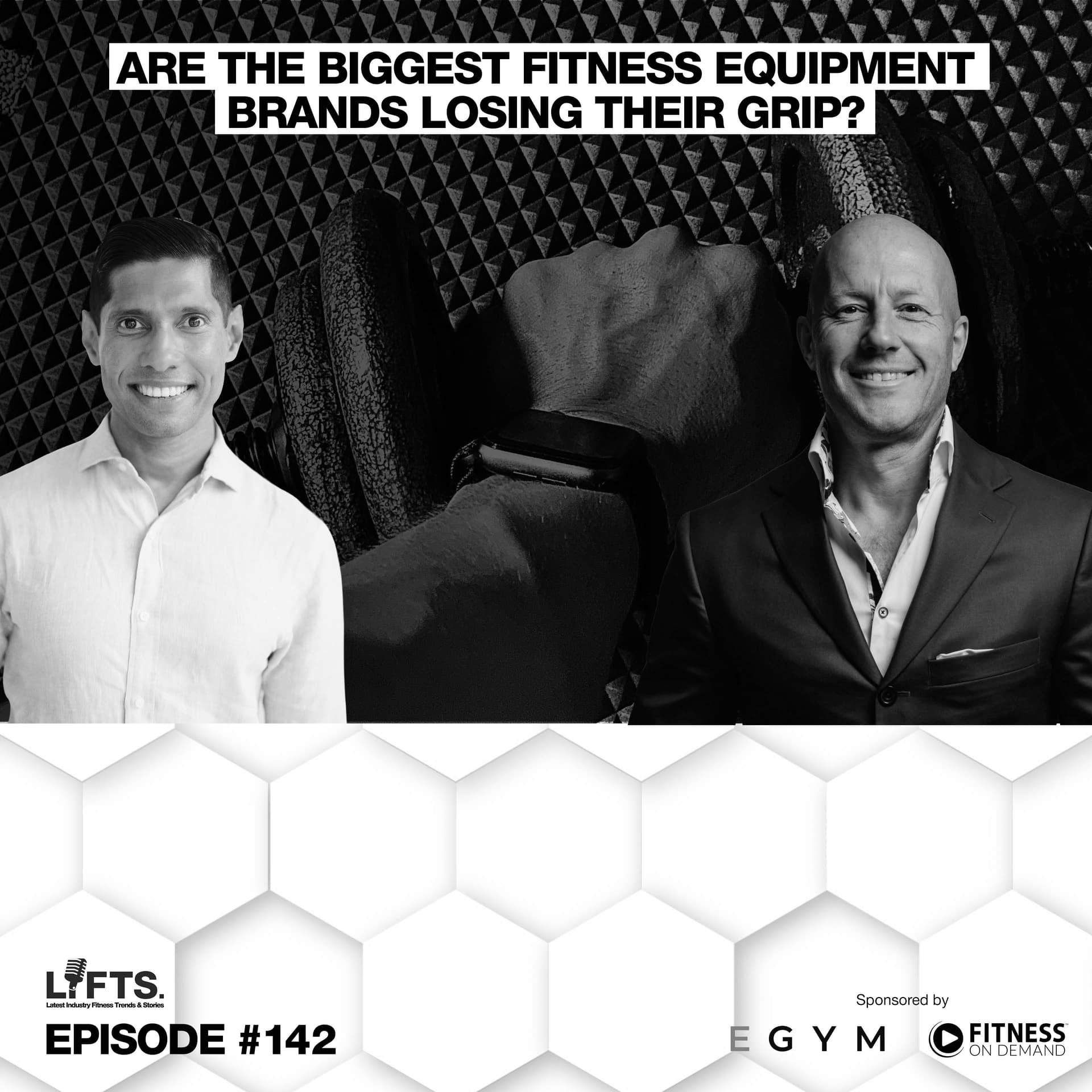
In this episode, hosts Matthew Januszek and Mohammed Iqbal are joined by Frank Britt, CEO of Aescape, for a deep dive into one of the most talked-about stories in wellness technology this year.
After reports emerged that Aescape entered insolvency proceedings following a reported $157 million shortfall, the conversation around recovery robotics quickly shifted from innovation to survival. But according to Frank Britt, the real story is far more nuanced and far from over.
This episode explores what actually happened behind the scenes at Aescape, why the original business model failed, and how the company is now attempting to rebuild around a completely different approach.
Frank shares why "robots as a service" created major challenges for the company's economics, how the business is restructuring around equipment ownership and platform services, and why he believes recovery robotics is still positioned at the centre of several long-term wellness trends including AI, personalisation, diagnostics, and labour shortages.
The discussion also examines the broader future of recovery within fitness and hospitality. As recovery moves from luxury amenity to everyday infrastructure, operators are beginning to rethink how bodywork, data, and personalised wellness experiences fit into the future member journey.
The episode also dives into the parallels between recovery technology and the adoption curves of other consumer technologies from GPS and streaming to wearables and connected health devices and why Frank believes recovery intelligence could eventually become as mainstream as strength or cardio tracking.
In this episode, we cover:
- Why Aescape collapsed despite raising $128 million
- The business model mistake behind "robots as a service"
- How Aescape plans to rebuild and scale
- Why recovery is moving to the centre of wellness
- The future of AI-driven recovery and personalisation
👉 To learn more about Frank Britt, click here: https://www.linkedin.com/in/fbritt/
👉 To learn more about our sponsor EGYM, click here: https://bit.ly/3JzsosR
Support fitness industry news by sponsoring future LIFTS episodes. Contact us at wendy@liftspodcast.com for advertising opportunities.
Subscribe to our YouTube channel and turn on notifications so you never miss a new video when it's published: https://www.youtube.com/user/EscapeFitness
Or if you prefer, you can receive the latest news direct to your inbox, subscribe here:
https://www.liftspodcast.com/newsletter
Join the conversation at LIFTS LinkedIn: https://www.linkedin.com/company/liftspod
Timestamps
0:00 Introduction
5:58 What Really Happened at Aescape
11:07 The Pivot Away From "Robots as a Service"
17:59 Why Recovery Is Moving to the Centre of Wellness
33:28 The Future of AI-Driven Recovery & Diagnostics