
In short
Leadership lessons from fitness/longevity transformations, centered on “recovery” as the next generation of health measurement and performance, plus how CEOs rebuild companies through disruption and compliance.
Guests (backgrounds)
- Philip (EGYM/Wellpass/Playlist): built major fitness networks in Europe; merged EGYM and Wellpass with Playlist; B2B aggregation plus connected front-office/back-office software.
- Frank Britt (Escape Fitness): multi-time CEO; led strategy at Starbucks; overcame leukemia with bone marrow transplant; now CEO of Escape’s AI/robotic percussion recovery platform.
- Brandon (10x Health): growth/scaling expert; built retail healthcare to 77x EBITDA; scaled IV therapy business; founded 10X Health; operates in 47 countries.
Key claims
- Recovery needs evidence-based, anatomically measured “recovery scores” (Escape’s tissue-level data; “FICO score for the human body”).
- Longevity should shift from sick-care to prevention.
- Robotics/hardware costs should fall, expanding access.
Notable examples
- Peloton acquired Scope (connected Pilates product story).
- Escape’s shift from “robots-as-a-service” to selling equipment; ROI framing (profit per square foot vs Escape room).
- EGYM/Wellpass + Glasspass/Mindbody network consolidation; 8-month deal cycle.
Written by AI. May contain mistakes. Listen to the episode to check what was said.
Chapters
Tap a time to open that second in VOThe Future of Human Optimization
0:00 to 1:12
Exploring the potential of human optimization and its significance in healthcare.
“I believe there's an opportunity to unify the world because everyone's different, every human's different.”
Networking Events and Transformative Stories
1:54 to 3:05
Discussion on networking events that foster connections and share transformative stories.
“Four years ago, I was at an event in LA and I met a young entrepreneur developing a Pilates product and it was a connected Pilates product.”
Philip's Journey with EGYM and Playlist
3:05 to 9:00
Philip shares insights on his merger journey with EGYM and Playlist.
“Your merger with Playlist and EGEM was recently completed and I know that that was an exciting journey.”
Brandon's Leadership Insights and 10X Health
9:00 to 14:00
Brandon discusses his leadership experience and the evolution of 10X Health.
“So I'm very excited about this and excited about some of the announcements we're going to be making around the world.”
Transforming Escape's Business Model
14:00 to 15:53
Learn about the strategies used to turn around Escape's business model.
“company because your cost of capital is as high as it can be and your customer's cost of capital is quite low.”
Setbacks as Catalysts for Growth
15:53 to 17:48
Discover how major setbacks can lead to personal and business growth.
“And what were some of the steps that you took personally to, I suppose, get out or get through some of those challenges to get back on the path of being successful again?”
Navigating Industry Challenges
17:48 to 20:58
Understand how industry leaders tackle compliance and regulatory challenges.
“On the other hand, you've got the healthcare industry that you are up against.”
Proentropic Leadership Philosophy
20:58 to 23:06
Explore the concept of proentropic leadership and its benefits.
“You know, I think resilience is actually the wrong notion.”
Effective Communication During Crisis
23:06 to 27:09
Learn the importance of transparency and communication in leading a team.
“wake up and realize the rate limiting differentiator and strategic advantage is the ability to bust through and get to the top instead of giving up or being pulled down because you're distracted by the problems.”
Empowering Company Culture
27:09 to 28:00
Find out how to empower employees by tapping into their insights and trust.
“And after a week on the ground, started July, January 4th, I went in front of our company and said, I believe that two things are true.”
Show all 15 chapters
Empowering Voices in the Company
28:00 to 29:24
Learn how authentic communication and inclusion can transform company culture.
“conversation where every person in the company was asked to send me a note about what they think the superpower of the company is.”
Aligning Employee Goals for Success
29:24 to 31:02
Discover the importance of aligning employee goals with company objectives.
“But six months in, we have stabilized the team and we are continuing to attract and retain world-class talent.”
Innovations in Health and Prevention
31:02 to 32:59
Explore the potential for innovation in healthcare, focusing on prevention.
“And in most cases, we talk about controlling things that you can control and not getting too worried about the things that you can't control.”
The Future of Recovery and Consumer Needs
32:59 to 35:14
Understand the emerging trends in recovery and consumer demand for evidence-based solutions.
“excited to start spending significant money on it, like the clinical study we're doing this year to kind of for workouts to complement GLP-1 and stuff like that.”
Leveraging Technology for Entrepreneurial Growth
35:14 to 37:09
Learn how technology can drive entrepreneurial success and problem-solving.
“So for us, a couple of things, we're, we're a teaching institution for entrepreneurs.”
Transcript
Automatic transcript. May contain errors.0:00I believe there's an opportunity to unify the world because everyone's different, every human's different. Our healthcare system is broken. We need a different system that's not healthcare. And that's where this longevity, human optimization, and human performance opportunity exists for everybody. And I see it as the biggest global change for human beings that's existed. besides the invention of modern medicine. Importantly, from a perspective of the future, we collect one-of-a-kind data anatomically at the tissue level, and we will soon be able to produce effectively a recovery score. So it will be the first FICO score for the human body.
0:43And it's odd in all of the data we have in HRV scores and all the other tools that many of us use, VEXCOM 7, there is no body score. No one can identify explicitly evidence-based what your stiffness and flexibility is, And you certainly can't do it pre-post if you go get a treatment. So our thesis is that recovery is the next generation of health and wellness, that you need evidence-based approaches that can measure anatomically to N of one at very advanced frontier level robotics and AI. And we have that.
1:17Welcome, everyone. Thank you to Connected and thank you to Lyfts. I've got a little Connected story, but first I want to introduce myself. My name is Muhammad Iqbal. I'm the Chief Strategy Officer of ABC Fitness. I'm also the founder and chairman of Swetworks and co-host of this podcast, which started as a little side project three years ago with my co-host, Matthew. I'm Matthew Januzek. I'm the president and co-founder of Escape Fitness and also co-host of the Lyfts podcast. Enjoying or looking forward to our conversation this evening. And these events are meaningful. So I've got a great connected health and fitness story to tell you.
1:54Four years ago, I was at an event in LA and I met a young entrepreneur developing a Pilates product and it was a connected Pilates product. And four years later, Peloton acquired that company called Scope. So congratulations. And they're actually in the room here. And Dion didn't even know that that was the first kind of phase that we worked on. So these dinners, these events are incredibly important. Today, we're doing something special. We have a podcast that's a weekly 30 minute podcast that we've been doing for three years. We started taking the event on the road. We started having these networking dinners where we brought thought leaders and industry executives together.
2:29And we thought, why not have our podcast live? So I am excited to have three incredible leaders today. Our theme is leading through transformation. So we're going to have a 30-minute or so recorded session. We're then going to close the recording. If you want to ask Q &A, you're welcome to do that. But I'm going to do quick intros of each one, and I can also pose the first question to you. But we've got Philip, who is the founder and CEO of EGEM, and also chairman of Playlist, and we'll come into that here shortly. We have Frank Britt, who is the CEO of Escape, and Brandon, the CEO of 10x Health.
3:04Philip, I'm going to start with you first. Your merger with Playlist and EGEM was recently completed and I know that that was an exciting journey. You and I were frequently talking about that. I'm excited for you. Congrats on that. Walk us through that process. What was that process like? What led up to it and how has that been? Yeah, first of all, thanks for having me here. I'm an avid listener to the Lyft podcast and excited to be here. Yeah, so I've built the biggest fitness network in Europe and Fritz built the biggest fitness network in the US and Asia and we basically do B2B aggregation with Egym Wellpass and then connected hardware and software for the front office of gyms for the customer experience and he was doing B2C aggregation with Glasspass and back office software for fitness studios with MindBody and basically the idea first was couldn't we make like a commercial deal where we basically have the two leading fitness networks join forces and then offer all these different products to these fitness networks.
4:06And that conversation became more and more complicated. And at some point, we just thought about, why don't we just merge the companies? Because we also started to really like each other a lot. And then, yeah, we just had to convince all the investors that this is a good idea, especially with my special governance needs. But yeah, then actually, I think one from starting on the deal to to getting it signed it was probably something like eight months so not too bad Okay, great. We're just pretty quick. Yeah Um, so I like like to ask a question Brandon I get to see you quite a lot online You do a great job on YouTube and a lot of experience in business and your founder of 10x health I'd like you to give us a bit of an overview of 10x health and then a question really to you personally rather than about the business.
4:55But what leadership habit has made the biggest difference in scaling your company and companies that you've been involved with? Thank you for asking. It's great to be here with everybody. That's what I am, is a growth and scaling expert. I'm on my fifth business. I sold my last business in 2016 in specialty retail healthcare, a business I started using a different format. I created for 77 times EBITDA to a billion dollar company, integrated in eight countries and groomed to four and a half billion in 36 months before launching this business in partnership with Grant Cardone and my wife, Natalie.
5:30And in six years, we went from startup, no invest capital, no debt. We did a quarter of a billion dollars last year in revenue with about 60 million of EBITDA. So that's my specialty. And I do that. I bring 1.5 billion a month of businesses through our Cardone Mentors Training Academy, where I teach them how to do the things that I've been able to do and studied and created research and science around. four years ago when COVID hit, I needed to keep my team healthy. And so I found a service provider in both Miami and Scottsdale while we were still running our events and our trainings to get IVs and things.
6:03And I started talking to those entrepreneurs about their 2 ,000, 2 ,200 square foot locations, three and a half million in revenue, 33 % margins. And I was like, sounds like a great business. And, and so we launched, I bought a$1.5 million dollar IV business that was owned by Sage Workinger and Gary Brecka. And I gave him$250 ,000 and in three years took it to$125 million using our social network that my partner Grant Cardone has 28 million social media followers between he, my wife, and I. We get billions of views a month. And then we showed Gary how to do that and built the brand up. 10X Health, though, needed to evolve because I saw the demand and because I came out of retail and because I had a public company, My first company, I raised capital and took it public at 29 years old here in New York.
6:50And I want to build things that are legal, moral, ethical, compliant, and they have to make money. Those are my five rules for building a business. And we were selling a lot of things at 10X Health, but I didn't feel good about it. And so that created friction in the relationship. And so I was willing to sacrifice some of the revenue for actually legal, moral, ethical, compliant revenue. And that meant I had to retool the business to match the market opportunity. And so in the last two years, I've spent$50 million off my balance sheet and acquired assets all over the world. And we're now operational in 47 countries.
7:22We've passed the equivalent of the FDA for human optimization and performance. And we're the only company in the world that has precision nutrition that's mapped the human genome around the world to 110 symptoms, diseases, and disorders based on micronutrient requirements to optimize the human body. And now we're adding peptides and radicillator therapies. We signed an announcement or we made an announcement in November after two years of due diligence that we are the exclusive partner in Abu Dhabi with their human genome population, Emirati, 1.1 million people. And we're making our big announcement in October.
8:00And so who is Tenex Health? What do we do? We could look like any other company that's in the longevity space right now. But what we're deploying is the power for human being in their hand to be able to understand all the way from decision making in real time, all the way through enhancements, what they need and in which order they need to optimize themselves as human beings through nutrition, peptide, cellular therapies and other behavioral changes. changes. And so I believe there's an opportunity to unify the world because everyone's different. Every human's different. Our healthcare system is broken.
8:38We needed a different system that's not healthcare. And that's where this longevity, human optimization, and human performance opportunity exists for everybody. And I see it as the biggest global change for human beings that's existed. So besides the invention of modern medicine, when there was no medicine. So I'm very excited about this and excited about some of the announcements we're going to be making around the world. But that's who 10x health, people perceive us as being a company that does genetics, supplements, and peptides. But what they didn't see is the 50 million in the three years of global consolidation under a different brand that's called now 10X Revive.
9:21And we're releasing our global brand in October at the Abu Dhabi Health Show and empowered by the Department of Health, Mubadala, a trillion-dollar family office, their sovereign wealth fund, and M42. Thank you. Frank, on to you next. You've got an interesting journey and story. It's easy to talk about when so when you are scaled companies. It's very easy to do it, not that it's easy to scale a company, nor is it easy to lead through transformation. However, you came in to escape at a point where they had declared insolvency and you had to navigate and you're continuing to navigate escape through that.
9:58But you've got an interesting story. So if you could speak a bit about your background and what kind of led you through this transformation. Yeah, thanks for having me. My background is a multi-time CEO. I worked in private equity at Valor and Bing Capital. I was the global head of strategy and transformation for Starbucks. I worked very closely with Howard when he came back for his third stint. And then the story that is always a little difficult to communicate was that in the, I guess it was September 23rd or 24, the phone rang. And it was one of those seven in the morning anonymous calls. Sometimes you pick up just because your instincts are to pick up.
10:36And the hematologist said you have leukemia. So I fought through leukemia in the fall of 24. with just modern medicine, radiation, chemo, and immunotherapy. But unfortunately, they said, well, you've eradicated the cancer, it's going to come back, and it's not going to be a good outcome. So in the early part of 25, approximately 510 days ago, I went through all the prep work and eradicated my immune system and white blood count. You have 8 ,000 to 10 ,000 white blood cells. I had zero on purpose and got a bone marrow transplant. And so on the 23rd of January 25, which was 510 days ago, I got a bone marrow transplant.
11:17And we kind of said, let's hope it works out. So I've been battling that since, fully eradicated in terms of cancer. I've gained back 40 pounds. My cognition is plus 90%. My wife debates that, but it's in that zone. And you wouldn't know much of the difference. But of course, I'm a very different person as a result of that. The importance of that story is that when I was recovering, I'd lost 50 pounds. When you're in a hospital room for 40 days in a room that no one else is allowed to access and all the air blows out, you atrophy like you're a 90-year-old man. So I was a 90-year-old man in a 58-year-old body, and I had to kind of rebuild myself.
11:57And I found this product, which I'm now the CEO of the company, as it turns out, which believes that several things are true. One, that performance innovation and health requires recovery. And recovery needs as much energy and innovation as the actual performance itself. And I think we have lots of innovation around how to do different fitness, but we don't have very much innovation around how to recover. And recovery is the alpha of the fitness. So this product that we have is, I think it's fair to say, the most advanced physical AI and robotics platform in the world for effectively percussion on the body.
12:34So this is the only robot that is designed to collide with humans, not avoid humans. And what it does is it empowers you with agency to precisely identify what part of your body you want care and feeding for with a duration that you set in a quiet setting. And in so doing, you get to set the pressure. So you finish that experience revitalized in whatever dimensions are important to you, whether it's your lower back or calves. Importantly, from a perspective of the future, we collect one-of-a-kind data anatomically at the tissue level, and we will soon be able to produce effectively a recovery score.
13:11So it will be the first FICO score for the human body. And it's odd in all of the data we have in HRV scores and all the other tools that many of us use, Dexcom 7, there is no body score. No one can identify explicitly evidence-based what your stiffness and flexibility is. And you certainly can't do it pre-post if you go get a treatment. So our thesis is that recovery is the next generation of health and wellness, that you need evidence-based approaches that can measure anatomically to N of one at very advanced frontier level robotics and AI. And we have that. And so we are in the process of scaling.
13:45Now, when you build a business like this that is frontier tech, it's very expensive. The company had raised over$100 million. And one of the insights that many of you I'm sure know is that while SaaS makes sense, robotics as a service, as a concept, is not the right way to build an early stage robotics company because your cost of capital is as high as it can be and your customer's cost of capital is quite low. And unless you want to become a bank, which I don't want to be a bank, you should not finance durable assets on behalf of customers who have lower cost of capital than you. That was fundamentally why Escape ran out of money.
14:19That's why we decided to not, the company itself is fine. The balance sheet was broken. So I came in, I have a lot of experience in doing turnarounds, and we basically put the company through what's known for those who are wonky like me and Article 9, UCC Article 9 foreclosure process, which eventually means you can eradicate any prior obligations, take all the assets you want, and off you go. And so we continued to run the business through January and February. We ran an auction process, and we sold the business to private equity firms and recapped the business. So we are off and running. Most importantly, we changed the go-to-market model where we moved from the robots approach as a service to you sell equipment.
14:57And that has massively disrupted the business. Our sales have compounded twice every month. And basically what we're selling is ROI. If you look at a plan of fitness, their profit per square foot might be$30 to$40. If you put an escape product in a nine by 12 room, you'll probably have$400 to$500 per square foot. So we're in 50 Equinoxes, Four Seasons, St. Regis, Lifetime Fitness, you name it. And we're growing every month, both in terms of deployments to the largest commercial deployment of physical AI robotics in the world for percussion-based interaction. And most importantly, the consumer continues to use the product.
15:32So we're seeing a compounding of usage month to month, and we feel like we're in the bottom of the second inning of really a next generation concept around the idea of recovery and performance as alpha in the human body with recovery score that each of you will have an N of 1 to your unique anatomical profiles. I'd like to move on to the next subject, which is challenges. for most people in this room I'm sure that you know running a business or being involved in businesses there seems to be more things or more challenges to overcome than there is success looking at the three of you it seems like three huge success stories but I'm sure there's other parts behind that that you know not openly promoted and so I'd like to ask this first question to you Philip what would you say is a major setback that potentially became a catalyst for some of your greatest ideas or growth?
16:30And what were some of the steps that you took personally to, I suppose, get out or get through some of those challenges to get back on the path of being successful again? Well, I would say for me definitely, the way I always described my company's success was, well, the first 10 years were super tough, followed by two years of lockdown. And then things got really great. But my personality also is just everything is always cup is half full. And for example, one moment I had was like during 2020, when I wasn't sure whether I would lose everything after basically spending all hours available for a decade on this, I would end up having absolutely nothing.
17:19and I asked myself whether I would now basically then regret what I'd done. And I came to this beautiful realization that I really enjoy so much what I'm doing that I would have done the exact same thing again even if I lost everything. And so then basically in the toughest moment of our company's history, I actually refound my love for it and I'm now much more appreciative of what I have and I just even more enjoy every day going to work. and so like even in the worst times sometimes it's just um like a good moment for reflection and and sometimes good conclusions and that's something that i think as as entrepreneurs which we all are we've gone through sometimes the hardest times the darkest moments is really where the where the light comes through and brandon i just want to move to you for a minute and on 10x help there are so many challenges and options you could see on one hand you've got the biggest ham in the world, which is every single human being who could leverage better consumer-focused healthcare.
18:21On the other hand, you've got the healthcare industry that you are up against. How do you navigate national compliance or regulations when you're up against a big industry like that? Well, that was the first four years of my life. I had a partner that would just open mic everything on social channels, and then I'd be having lawyers call me every day about about FTC, FDA, false claims. And so it's very difficult because you want to promote this new market. And if you guys remember, the government, because of COVID, opened up doctors could do things across lines. And then all of a sudden they changed that, had to go by state.
19:04And then some states changed it where something was different. And then they said, no, we're just kidding, had fake, you can go back. And so I think I became McDermott's highest valued client for three years, auditing every single thing we did, trying to check that with my partner and try to bring some uniformity to the madness. But now we put it on steroids because now we've passed the equivalent of the FDA in 47 countries. And it really prepared us. you asked me about leadership and thinking. That experience, despite everything else I had done, I guess gave me that leadership position of everything's broke.
19:45Everything's going to be broken. Everyone's going to have a different opinion. You just need to do the best job you can as fast as you can and become a compliant as fast as you can and try to communicate with your team as fast as you can and you can't stop it because the world's going to evolve and change super fast and everybody's going to change everything around you. And if you can just embrace the madness for a moment, then it becomes, okay, so what now it's, what are we going to do about it? And, and how do we best measure it? And how do we get in front of it? And that set the tone for the global expansion because now we roll in and say, okay, here's what we're scoping against.
20:21And we find the gray areas, the black areas, the red areas, and we start chipping away at them. so it's it's the resilience i believe and and being okay with testing yourself and everyone around you and i think if you if you can do that and embrace it because i think i mean this guy i'm like listening to the things i've done i'm like shit i didn't almost die and i have to heal myself and think to myself am i going to make it like that stress and that pressure when you actually think and then the resilience to just battle that back and then go build a business on it because it's like I'm also going to do something bigger.
20:56Can I come out of that? Yes. You know, I think resilience is actually the wrong notion. I think that if you look at the Egyptian pyramids, their resiliency is incredible, but they don't grow. And I think the most important thing for the leader is to establish what the mindset is that you want to personally embrace and then want others to embrace. And that language for me is what I call proentropic. A proentropic system is one that actually gets stronger because of the adversity and the uncertainty. And so I love uncertainty. I think that's the opportunity. And so I try to approach my life since obviously nothing can happen to me that could be any worse than what's happened.
21:33So for me, every day is upside. Like I don't have any bad days. I just have bad hours. And I've great many more great hours. But I think the idea of leadership to me is the CEO is the chief storyteller. You have to tell a story of your company that allows the market to see who you are and where you're going and let each one of the individuals who works your company see their own narrative in the context of the larger narrative. And for us, the sort of the arrow that we point is the proentropic. Uncertainty is the opportunity and it's alpha. So resiliency is an element, but resiliency is a static notion.
22:02We don't want to be static. We want to be compounded and advantaged by the uncertainty. So the whole story of Escape, particularly some of the media in the last 60, 90 days, is so misguided and so not on point because in fact, it's the entrepreneurial journey. This gentleman's story is he grinded for 10 years and then world changed and then now the days ahead are even better. So I don't view us as being set back. I just think it's the next phase of the entrepreneurial journey. What defines the success of most of you in this room, I assume, is you are pro-entropic. You have turbulence constantly.
22:33You've managed uncertainty consistently. You've overcome it. You're stronger and better for it. And you lead organizations with that same first principle. So that's why I believe pro and tropic leadership is the future, not resilient leadership. Yeah. And I, and so where I was going to is there's two things you need to build a business and he just framed it better than I would have. You need context and contrast. If you get bogged down because, and that resilient piece, if you get bogged down in what's wrong, you're just going to find more of what's wrong. If you take his perspective and say, so what, what's next and create that culture, then you embrace that because you actually wake up and realize the rate limiting differentiator and strategic advantage is the ability to bust through and get to the top instead of giving up or being pulled down because you're distracted by the problems.
23:22And I think once you embrace that, you're like, so what? What's next? And then you move to, I don't even know what word you use. Pro traffic. Pro. See, this is a Bain guy. I'm a 2.4 GPA, barely got out of high school. But this is what I love about entrepreneurialism is I get to sit next to super smart people and learn from them and grind with them. And I think that's what I love about what you guys are doing is putting people in the room so other people and all of you have your stories, which is beautiful. And look, as leaders, we've all been to those dark places. We have built that muscle. We've got hopefully mentors.
23:58I mean, Philip, I call you at random hours talking about things. But then how we communicate that to our employees, to our teams, even to the market. But I want to come back to the employees and teams for a minute. let's start with you when you are going through that period of uncertainty it's one thing for you as the founder to understand the vision and you've got faith in your capabilities and you could see the light but it's another thing to communicate that to your team and I think all of you can relate to that so would love to start from you in those days in 2020 what was it like how did you motivate the team yeah I mean uh like in my view one of the most important things uh as a leader is to be authentic.
24:38And every time I like everyone joining our company, they'll have like an introduction meeting with me and I'll talk about our habits. This is everyone. Yeah. Even now. Yeah. Like in groups. And basically I'll give them always an instruction to how to operate in an environment with me. And basically the way I operate is I always say what I think and I always do what I say I do. but I'm not always right. But basically you never have to second guess. Like if I tell you we're going to make it, I actually think we're going to make it. If I tell you that I don't know how we make it, then I really don't know how we make it.
25:21And what I've found is basically this is really trust building. And at times it's also painful to be with me in one room because sometimes my opinion is tough to deal with or so, but what I've found is actually it's incredibly powerful. if nobody ever feels like I have to second guess. And that really got us through that difficult time, I would say, basically. We just knew, like, hey, we have to now, like, take tough decisions and we have, like, a clear strategy. Our strategy, for example, was we did, like, immediately March 30th, like, when the first lockdown was announced, we took, like, a 20 % FTE riff and 25 % OPEX cut.
26:05but then also said like we tried to not furloughing because we felt like it's just like not great for people to sit at home and don't know what to do and what we decided to do is basically hey like we we tried to add still value during those times for operators HR leaders and and employers to find out ways like how we can be supportive we waived our roadmap and with the remaining 80 percent we just kept developing stuff that may be helpful and and and then what we actually did was like the magic happened and we were able to keep our revenues in 2020 and 2021 on the same level as 2019 um despite basically our industry being locked down because but we always found ways to to support everyone but but basically then also the team was monitoring really closely our revenues because they knew like this is like no fun right now um and and if we don't hit our revenues well we don't have to follow um and so like everyone knew it we did a weekly uh all hands um with like people were able to ask any question and we discussed it and um yeah so that that's how we do it yes i would say communication is is is critical and key and transparency as well frank just moving on to you next um you've i can't imagine the conversation you had on day one yeah i i think every company has a superpower and i think you should really reflect on what that is.
Read the full transcript
27:29And after a week on the ground, started July, January 4th, I went in front of our company and said, I believe that two things are true. We have a deficit of trust with you, which we have to re-earn. And we're going to ask for your grace and give us time to prove that this is the right place for you to spend your time and talent and energy. But the second thing I said is, I think the superpower of our company is the power of belief. And I explained why. And I said, but I surely have no monopoly on genius. I'm the rookie in the room. I want to know what you think our superpower is. And what that began was a conversation where every person in the company was asked to send me a note about what they think the superpower of the company is.
28:05And so what happened is I don't think companies run anymore top down. I think they're emergent. I think they're bottoms up. And so I want to be the curator of how the company operates, but I am not going to be the one who defines how all things work because firstly, I don't know the most. And second of all, the power of the people is from the bottom to the top, not from the top to the bottom. And so the conversation we continue to have at our town halls every two weeks, we haven't missed one, is what is the superpower of the company? Because they're very different views. Some people said it's our proprietary capability and AI.
28:35Some people said the power is the data. Some people just said we just attract world-class talent, by the way, all of which are true. And so I guess what I would just say is that people seek and look for authenticity. And they have been trained in this society to not de facto trust. And that includes leaders of companies and leaders of government and leaders of all different types and sizes. So we need to prove authenticity. And the way you do that is you invite them into the discussion. And I always say that we seek to make this the most transformational job you've ever had. And we view ourselves as working with you.
29:07We do things not to you, but for you and with you. And the aspiration is that everyone can get ready for their next best job by doing this job at a world-class level. And that's the stewardship we have in the new social compact we try to honor. and over time we have to prove it. And we have a long ways to go to continue to compound that trust with our teams. But six months in, we have stabilized the team and we are continuing to attract and retain world-class talent. And we think that's the arc of how the best companies work in the 21st century. I think from our standpoint, we've created a process in 2005 that I've used in all our companies and we train clients to do it.
29:43It's our personal, professional, financial planning with employees that we revisit and teach leadership every 90 days. so they have a one three and five year in personal professional financial target the job of our leadership and they're actually incentivized is to make sure the employees understand through what we call the employee maturity model process how to attain those goals because that's really the equity in a small business is the alignment of the teams with the job functions to get to the results and if you try top down it's not going to work so you got to inspire from the bottom up and they got to have some bigger picture to fight for and most have never been invited into that conversation.
30:18So I think what both these guys said, that transparency and then involvement, if you look at the Gallup poll studies for 30 years, two thirds of employees have been disengaged, 18 % actively disengaged out of 100 million every year. This year it went to 80-20. 20 % are engaged, 80 % are disengaged or actively disengaged. An average business has 10 to 20 employees and you're getting drowned by inactivity and sabotage. But that's because people aren't aligned. And so So you can either be mad at them or you can figure out a system to align the ones that want to be aligned and create a system for the ones that don't want to leave.
30:53So I'd like to start to look into the future now. As entrepreneurs, we make bets on what's going to happen in the future. And in most cases, we talk about controlling things that you can control and not getting too worried about the things that you can't control. However, many of each of you are betting on technologies that in some respect are going to be impacted by compute power, the acceleration of things like robotics, the price of certain technologies coming down, certain consumer behavior. So what I'd like to ask, we'll probably ask each one of you really starting with Philip, but what are some of the things that you're working on within your business or thinking about within your business, but you're banking on something happening externally that's likely to accelerate things that are going to happen on the consumer side?
31:46yeah i mean like there's basically one thing that is happening right now which is ai is changing the jobs of every single person at playlist um and like we are spending 70 of our tokens for r &d but 30 of the tokens are actually you know provided to the rest of the team and i want every single department head to um change the way how they work and we have hired a separate department with ai engineers helping every single department head to like change their jobs using AI so that's like something that's happening right now and I hope this will accelerate us more to our big vision on something that does not happen yet but this is what gets me excited every day to go to work which is biggest market in the world is healthcare and like this is all sick care and there's really no prevention and I feel like our industry has an amazing opportunity to drive prevention because more than 50 % of money spent in healthcare is chronic conditions and we could have like more impact in any other industry but right now there's absolutely nothing happening in that space like in terms of actual healthcare dollars spent on prevention instead of repair and but that's really something very exciting and and now that we have the scale I'm also really excited to start spending significant money on it, like the clinical study we're doing this year to kind of for workouts to complement GLP-1 and stuff like that.
33:12Frank, same question to you, please. I mean, I think we're betting on a few things, that there's a new category that's emerging or forming around recovery, but not, how do we say it, voodoo recovery, but like empirically-based, evidence-based, empirical recovery. So we have a thesis that consumers want that. If you just look massage and we don't like to think of ourselves as a massage company because we're not but just to give you a sense of scale you got 20 uh 20 billion dollars a year in massage in the united states only one in five americans only one in five americans gets a massage so the unmet need for the non-user is orders of magnitude larger than user and they have an unmet need that they don't know about the example i often cite that i think some of you heard me say is that no one knew they needed a camera in their doorbell but no one would buy a doorbell today without a camera So what's happened is consumers have unarticulated needs and innovators and entrepreneurs identify the unmet need or something called the pain and step into that gap or that void.
34:10That's what we're seeking to do. So our thesis is the new category will form. The consumers have an unmet need. And then on the compute and the hardware side, those costs will continue to go down. And that will allow us to lower prices over time, which will mean that more of our B2B customers can afford to purchase the equipment, which will create more access, which will then lower the price of the consumer, while the traditional model will continue to get more expensive because labor costs always compound. And so a value is quality over price. Our qualities only get better as we get more training data.
34:40And the price is only to come down over time. And consumers will always seek the highest source of value. so we believe that if we are met in three years that the recovery market if you know it would be three to five times larger you would be just as surprised in three years to walk into a premium hotel or health club that didn't have a recovery platform as you would if they didn't have a gym and that's the total ubiquity that we expect to see in the coming years and i don't think it's far-fetched i think it's frankly inevitable it's just a question of who's going to win and on what basis and we think they're going to win on efficacy and evidence and that's where we hope to really distinguish ourselves.
35:13And then Brandon. Yeah. So for us, a couple of things, we're, we're a teaching institution for entrepreneurs. So we have the AI essentials program that we launched. We bring in hundreds of entrepreneurs every month, but we also created incentives to the personal professional financial goal planning for all of our teams to come up with a concept of how to use AI. And we set$150 ,000 a month budget within the organization for tokens. And then we were running competitions within the workflows of our employees, but also we've been able to expedite our consumer app for taking our genetics, epigenetics, mitochondria function, gut health, and blood labs and drive instantaneous real-time map to food tables in 47 countries.
35:57And all this work is being expedited from the advancement of technology. And so what we believe is that by deploying the technology and by harnessing the horsepower of our teams who are handling real problems with inbound calls from clients and patients, we can super harness and increase horsepower and solutions so that we can be more instantaneous for the people we serve. And our teams are more excited. They're coming in on weekends and they're having these challenges to solve problems and they're listening to customers like, I have an idea. And then they run it through Claude or something and then they go and they prove it out with their team and then they present it to management.
36:39And so we're coming up with hyper solutions in real time. And I think that's the thing I'm excited about. And it's directing us to invest even more in technology because I believe real money doesn't go to the best promoter. Real money doesn't go to the people with the biggest degrees. Real money goes to the people who solve the biggest problems using promotion and skillset to do it based on education. And the speed in which you can do that is going to differentiate those that succeed versus those that fail. So I think tech's giving you that advantage if you know how to harness it. And certainly, you know, we didn't expect to wake up and get a$350 ,000 token bill.
37:16And we're like, whoa, everyone's too excited. Slow it down. So, you know, you have to have governance and guidance, but I'm super excited about where this is all going. Well, join me in thanking our incredible panels. And thank you all for joining us this evening. Thank you. Thank you, guys.
From the publisher
Welcome to a special edition of LIFTS x Connected Health & Fitness, brought to you by Cascadia, where we explore the future of fitness, wellness, and human performance.
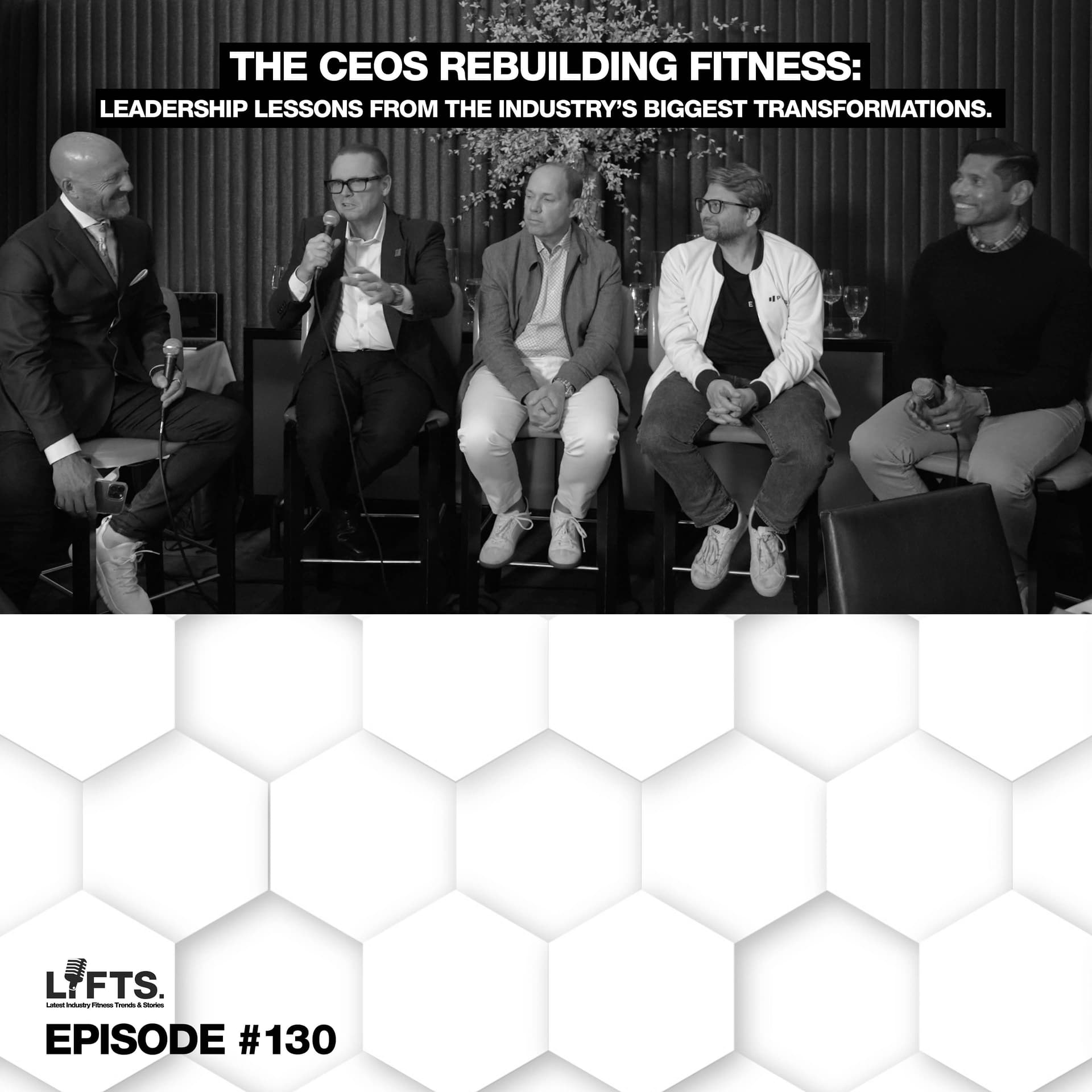
Recorded live during an exclusive CEO Leadership Dinner at the Connected Health & Fitness Summit in New York, hosts Matthew Januszek and Mohammed Iqbal are joined by three industry leaders to discuss what it takes to lead through transformation in one of the world's fastest-evolving industries.
As fitness, healthcare, AI, longevity, and consumer expectations continue to converge, today's leaders are navigating unprecedented opportunities and challenges. This conversation explores how CEOs are scaling global businesses, embracing emerging technologies, building resilient cultures, and preparing their organisations for the future.
Joining the discussion are Philipp Roesch-Schlanderer, CEO & Co-Founder of EGYM and Co-Chairman & Co-Founder of Playlist; Brandon Dawson, Chairman & CEO of 10X Health System; and Frank Britt, CEO of Aescape.
Philipp shares the story behind the EGYM and Wellpass merger, explains how AI is transforming every function within the organisation, and why the fitness industry has an opportunity to shift healthcare from treatment to prevention.
Brandon discusses the future of human optimisation, personalised healthcare, and AI, while sharing the leadership principles that have helped him build and scale multiple high-growth businesses.
Frank reflects on his personal battle with leukemia, the turnaround of Aescape, and why recovery, robotics, and evidence-based innovation are creating an entirely new category within health and wellness.
Together, they explore one of the defining leadership challenges of our time: how to build organisations that thrive through uncertainty rather than simply survive it.
For founders, operators, investors, executives, and anyone leading through change, this episode offers practical lessons on leadership, innovation, resilience, and the future direction of the health and fitness industry.
In this episode, we cover:
- Leadership lessons from scaling and transforming global businesses
- The EGYM × Wellpass merger and the future of connected fitness
- Why AI is changing the way organisations operate
- Human optimisation, longevity, and preventative healthcare
- Why recovery may become fitness's next major growth category
- Building trust, culture, and resilient teams during periods of uncertainty
- The future of health, fitness, and human performance
👉 Connect with Philipp Roesch-Schlanderer:
https://www.linkedin.com/in/philipp-roesch-schlanderer-bb33137/
https://www.linkedin.com/company/playlisttechnologies/
👉 Connect with Brandon Dawson:
https://www.linkedin.com/in/brandonmdawson/
https://www.linkedin.com/company/10x-health-system/
👉 Connect with Frank Britt:
https://www.linkedin.com/in/fbritt/
https://www.linkedin.com/company/aescape/
Support fitness industry news by sponsoring future LIFTS episodes.
Contact us at wendy@liftspodcast.com for advertising opportunities.
Subscribe to our YouTube channel and turn on notifications so you never miss a new video when it's published: https://www.youtube.com/user/EscapeFitness
Or if you prefer, you can receive the latest news direct to your inbox by subscribing here: https://www.liftspodcast.com/newsletter
Join the conversation at LIFTS:
https://www.linkedin.com/company/liftspod
https://www.instagram.com/lifts.podcast/
Timestamps
0:00 Why Healthcare Needs Reinvention
1:17 Welcome to LIFTS x Connected Health & Fitness
3:06 Inside the EGYM × Wellpass Merger
4:38 Building a Global Longevity Business
9:36 The CEO Who Rebuilt His Life—and a Company
15:52 What Every Leader Learns Through Crisis
24:08 The Trust Formula Behind Great Companies
31:01 Why AI Will Change Fitness Forever
33:12 The Next Billion-Dollar Opportunity: Recovery
35:15 How CEOs Are Using AI Today
37:26 Final Leadership Lessons