
In short
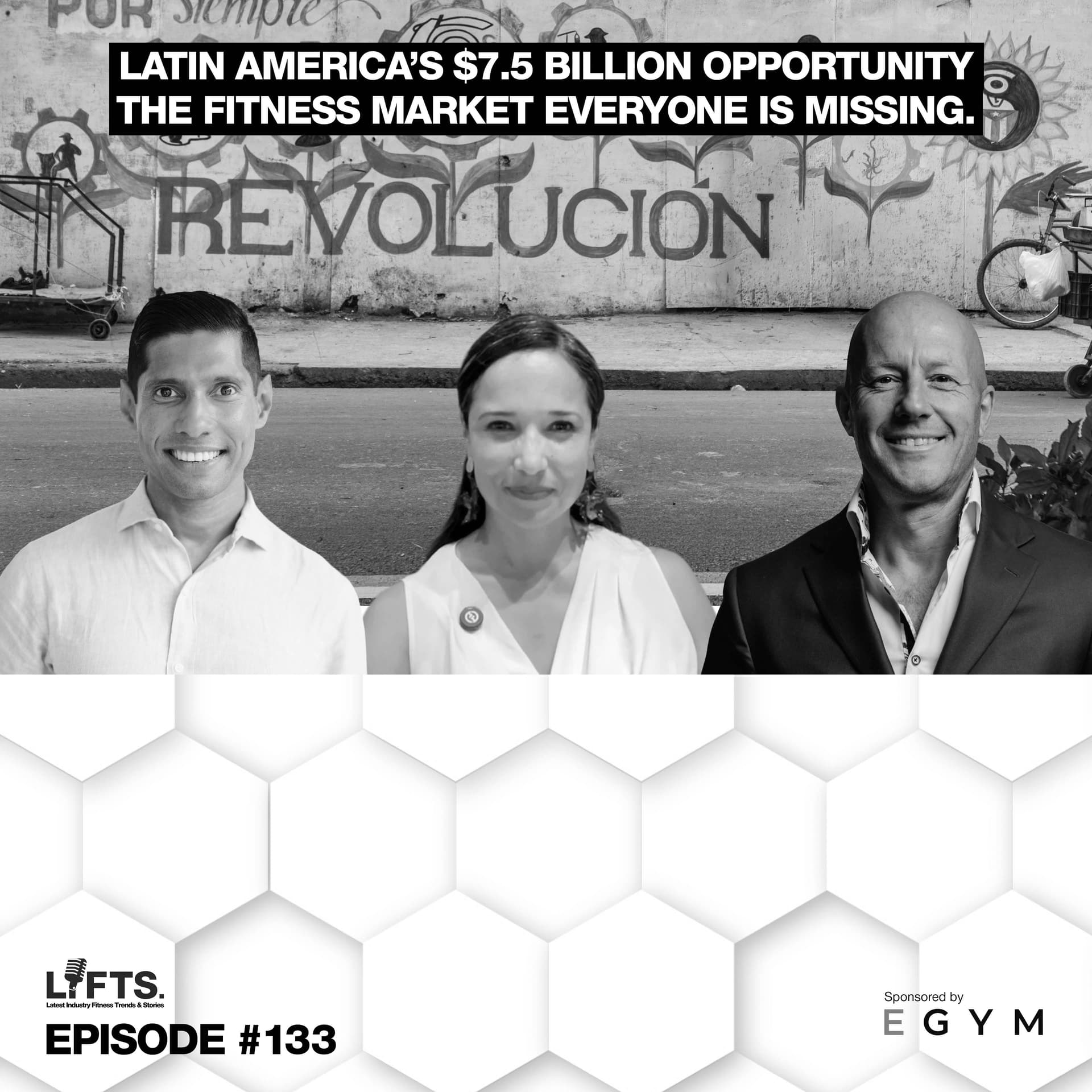
Latin America’s fitness growth opportunity (penetration 2.15% vs North America >20%), projected market expansion ($4.6B in 2024 to $7.5B by 2029), and what U.S. clubs can learn—especially community-driven, music-and-movement programming. Guests discuss low-cost/high-volume models (SmartFit’s scale) alongside premium experiences, plus competition from outdoor/free activities (e.g., dance and outdoor training) and how gyms can convert that energy into memberships.
Guest backgrounds
Maria Gonzales, Colombian-born lifelong competitive athlete (swimming/water polo national level), moved to the U.S. in 1998, rose from lifeguard/swim instructor to CEO (2019) of Club Fitness in Greensboro, NC; also sits on HFA’s board. Hosts: Matthew Januzek (LIFTS) and Mo (industry operator/distributor perspective).
Key claims
Latin America is “emerging,” not weak; consumers are ready (78% urban LatAm exercise monthly; health is top motivation). Community is the biggest retention tool. Innovation shows up in lighting/sound/space and inclusive classes.
Notable examples
Zumba/Beto’s inclusion; High Rocks’ accessible community model; “ciclovia” street-closure events; Maria’s “Noches Latinas” (first Fridays) aiming to include “all the left feet.” SmartFit: founded 2009 Sao Paulo; 2,000+ gyms, 5.3M members, 300+ openings last year.
Written by AI. May contain mistakes. Listen to the episode to check what was said.
Chapters
Tap a time to open that second in VOMarket Overview and Insights
0:46 to 3:22
Matthew shares insights from recent industry travels and the current fitness market trends.
“I went back to New York the following week and we met with Advantage that's one of our larger distributors on the east coast and they had a huge event over 100 people.”
Latin America's Fitness Growth Potential
3:23 to 7:19
Discussion on the enormous growth opportunity in Latin America's fitness market.
“What have you been seeing over the last few weeks?”
Guest Introduction: Maria Gonzales
7:20 to 10:00
Introduction of Maria Gonzales, highlighting her background and achievements in fitness.
“There are a couple of companies that we hear a lot about, which we'll talk about in this episode.”
Cultural Differences in Fitness
10:01 to 14:59
Maria discusses the unique aspects of fitness culture in South America compared to the U.S.
“And I want to say, you know, back to the immigrant story, I'm an immigrant to this country as well.”
Opportunities in the Latin American Fitness Market
14:59 to 17:39
Discuss the current state and emerging opportunities in Latin America's fitness market.
“People wanted it to be together with others.”
Innovation in Brazilian Gyms
17:40 to 19:53
Examine the innovative practices in Brazilian gyms and their unique offerings.
“I want to come on to, you mentioned innovation there.”
Innovation in Brazilian Gyms
20:01 to 20:30
Examine the innovative practices in Brazilian gyms and their unique offerings.
“They've built a full ecosystem that gives gyms and health clubs the tools to deliver personalized data-driven workouts to every member automatically.”
Creative Gym Environments in Latin America
20:31 to 22:22
Discover how Latin American gyms create unique environments and experiences.
“I think, you know, like a lot of times we find that, you know, like maybe just looking in the States and what are the big brands doing.”
Independents vs. Big Brands in Latin Fitness
22:23 to 24:12
Analyze the impact of independent gyms on the fitness market in Latin America.
“I was reading that a big percentage of the market is independents.”
Medellín: A Wellness Hub
24:13 to 28:00
Investigate how Medellín has transformed into a wellness hub and its implications.
“One with South America on the Swartwick side, I think we opened up our first technology office in Buenos Aires in 2014, then moved to Montevideo.”
Show all 19 chapters
Market Dynamics in Latin America
28:00 to 29:10
Discussing the high-volume low-price market dynamics and brand competition.
“And you just see that it's always these learning mode, just seeing what is being offered there so he can bring it back.”
The Rise of Independent Brands
29:10 to 31:20
Exploring the growth of independent brands and their unique offerings in fitness.
“awareness, giving people access when maybe, you know, like the price is going to be there, that wall that is going to be put into the consumer and the offer.”
Challenges of Member Acquisition
31:20 to 34:20
Analyzing the competition between gyms and free outdoor fitness activities in Latin America.
“What are your thoughts on whether that is a trend that we're likely to see more of or less, which is similar to where we've come from?”
Community Engagement in Fitness
34:20 to 36:50
The importance of community in engaging members and promoting fitness programs.
“So how do you bring people in from, one, you want to encourage them from doing all the good things outside, but how has the shift of gym culture been?”
The Evolution of Fitness Trends
36:50 to 40:00
Examining the evolution of fitness trends like Zumba and their impact on culture.
“So I think when you talk about excitement and we talk about Brazil, you know, maybe we haven't even touched Mexico yet.”
Inclusivity in Fitness
40:00 to 42:00
Highlighting the importance of inclusivity in fitness programs and events.
“And one thing that I have to say, I became a Zumba instructor because I said, I want to go to one of their events and see where is the magic?”
Exploring Inclusivity in Fitness Events
42:00 to 44:16
Learn about the efforts to make fitness events more inclusive for diverse communities.
“you know, at a high level when you not only instructing, but I think it was very inclusive.”
Key Takeaways from the Latin American Fitness Market
44:16 to 45:20
Discover essential insights and takeaways regarding opportunities in the Latin American fitness market.
“So if I can say anything about dancing, it's almost like how can we create what Latin America has done with dancing, family ways, community ways that everybody's included, that we can be part of.”
Challenges and Innovations in Fitness
45:20 to 49:20
Discuss the challenges in the fitness industry and how innovation can create new opportunities.
“I know this episode seemed like it went through really quickly.”
Transcript
Automatic transcript. May contain errors.0:00So it's funny when you talk about Beto and Zumba. I mean, gosh, like if you think about Zumba and stay in and continue to be relevant, you know, in so many countries, it's incredible the work that Zumba and Beto, or all the three Betos, because there were like three of them, did. And one thing that I have to say, I became a Zumba instructor because I said I want to go to one of their events and see where is the magic. Why are people so like me? Like I grew up, you know, like going to the gym. I was a high performance athlete and, you know, the gym has been part of my life. So we did something that we call a Roomba, which it was aerobics with Latin music.
0:44So everything that we did was with Latin music. everything was a party so we did step aerobics and we were shaking our shoulders we were like bumping and well we're live welcome to this week's episode of lifts i'm matthew januzek
1:03Matthew Januszek:uh it's three weeks since i've been sat here in the office three weeks on the road covered a lot of ground i was in athlotech where i saw both of you a few weeks ago met with many operators across the country. I went back to New York the following week and we met with Advantage that's one of our larger distributors on the east coast and they had a huge event over 100 people. They focus on the vertical markets and for those of you that are not familiar those are markets education, multi-family, corporate wellness, hospitality so had a had a chance to catch up with people to see what's happening in that space.
1:42Matthew Januszek:And then this past week, I was in Wisconsin. So we went over to our new head office and we've moved our warehouse. We've moved all of the manufacturing to the US. And we met with one of our biggest partners in the Midwest, understanding about where their business was. So it's quite interesting. My big takeaway is the market is thriving, that's for sure. It looks like also the sophistication of a lot of the fitness facilities is rising, whereas before I think it was a little bit of a race to the bottom. There's definitely an emergence of people just searching out higher quality vendors, higher quality products, and looking to differentiate themselves through a much better experience.
2:26Matthew Januszek:And although I read, and we were going to talk about this at some point, Mo, But although I read in the news that there's a slowdown in new memberships in the U.S. for, I guess, the first half of the year, probably. I'll get you to correct me on that one if I'm wrong, Mo. But what I do see is that there's, I guess, rather than the competition being other gym brands, there seems to be a lot of competition from outside of the industry. And when I look at some of these developers that are putting fitness facilities in apartments, the facilities are getting bigger. So they're allocating more and more space to fitness.
3:00Matthew Januszek:The quality of some of these fitness experiences is phenomenal. They would definitely challenge any gym that I've ever seen in terms of the equipment, the experience. They're including things like recovery and massage. And so I'd be interested to see how this is tracked. But certainly I see the market growing, but it's growing outside of what I would see as traditional fitness clubs. So that's my overview. Mo, good to see you. What have you been seeing over the last few weeks? I was in Madrid last week at Beyond Active, and it was my first time in Madrid. And I have to tell you, it's an incredible city.
3:36The food, the culture, the people, I mean, the event was fantastic. The event was in central Madrid, so I ran around a park called El Retiro, I believe. I'm probably not saying the name correctly, but it was an incredible park, a really nice, just under four miles. I love you, you would have enjoyed it because I know that's kind of about what you'd like to run. There were some hills in that though. So we had a lot of fun doing that. Then I came back to DC and now we are out East in Long Island where it just feels something about being out here on the Eastern end of Long Island in New York in the summertime.
4:14The air feels different. It definitely feels a lot more relaxed but I fully recognize the people out here live in a bubble for sure, but we're gonna enjoy it. So the family's having fun. I'm out here recording an exciting podcast today with our guests. So I want to get right to it. First, we constantly, just being at so many events and traveling and meeting people, the question that we get asked a lot about is where does growth from this industry come from? And of course, we're talking about things like GLP-1. We're talking about AI. But something that we don't really talk about is new regions.
4:52I'm really excited to talk about the South American region today. A few talking points to help frame the conversation. In the U.S., we just hit a record of 81 million gym members. And Matthew, you talked about a slowdown at the start of the year, and I think there was some truth to that, especially in the first six weeks, but a lot of the major brands recovered shortly after that. But we have about 26 % of our population that are participating in the health and wellness sector, which is an all-time high. That equates to about$60 billion of projected spend this year. So our market is maturing well.
5:30And back to equipment, I think consumers are driving the quality issue. So they want to join clubs. They want to enjoy experiences that truly feel experiential. I think that's why you're seeing a bit more of an upmarket request with some of the hardware. But where is the white space? We talk about Europe a lot. We do an event at FIBO and HFF every year, so we understand that. But I don't really think that the answer is sitting in our own hemisphere. And a lot of the industry is just not paying enough attention to it. Here's the number that is going to frame our episode today. And that number is 2.15%.
6:07That is the average gym member penetration across Latin America as a region. So just let that sink in for a minute. In North America, we are north of 20%. Latin America as a region is at 2%. That's a major, major gap. And I would love our guests here to validate these numbers to read, but from looking at the research that we did prior to this episode, Argentina leads the region at about 6 % or maybe close to 7%. After that, you have Brazil, then you have, and Brazil is around, I think, just under 5%. Mexico is around 3%. Colombia is around 2%. Now, some people look at those numbers and think that the market is weak.
6:52I look at those numbers and see the biggest growth opportunity in fitness. And that gap is not weakness. That gap, too, needs the opportunity. And the market is proving it. The South American fitness market hit roughly$4.6 billion in 2024 and is projected to reach $7.5 billion by 2029. That is double-digit growth. And chains are growing at nearly 12 % a year and personal training is growing really quickly as well. There are a couple of companies that we hear a lot about, which we'll talk about in this episode. Smart Fit being one of them, founded in Sao Paulo in 2009. Today they have over 2 ,000 gyms across 16 countries, 5.3 million members.
7:35Last year alone they opened over 300 clubs. I mean, this chain is just completely exploding. And I've had a chance to speak with their CEO. The part that gets me most excited about this region is that the consumer is ready. A lot of times for those of us who travel to South America, you know that the consumer is really starving for health and fitness. is 78 % of urban Latin Americans exercise at least several times per month. And when you ask them why, the top answer is health. Right behind it is mental and emotional well-being, which is at 42%. That's the exact same competition that we're having in the US right now.
8:12So Latin America isn't really a different market. It's the same market just a little bit earlier than where we are today. today. So a few questions which I'm going to ask our guest about today is around the low cost model and how would it increase penetration. But before that, I'm really excited to have our special guest on the list today, Maria Gonzales. And Maria, I learned some really interesting things about you and I've known you for some time but I didn't know about these things about you. So I want to share this with the audience. First, you are from Colombia and you grew up in Colombia.
8:47You have been a lifelong competitive athlete participating in swimming and water polo at the national team level. In 1998, you moved to the U.S. and you didn't speak English. I don't know if you knew about this or not. But three years after moving here in 2001, she took a job at a health club in Greensboro, North Carolina as a lifeguard and swim instructor. Then she became an aquatics director, bank club manager, then executive director, and in 2019 became the CEO. That is incredible. I'm an immigrant as well, but that is an incredible success for you, Maria. I just want to congratulate you on that.
9:33And today you run Club Fitness in Greensboro, North Carolina, which is two full-service clubs. I want to get into that and have you speak to your clubs. You also sit on HFA's board of directors. And you just always seem really involved in not only addressing the needs of fitness here in the U.S., but also in Latin America as well. So we are incredibly excited to have you on. And I want to say, you know, back to the immigrant story, I'm an immigrant to this country as well. But I came here speaking English. I came here with understanding kind of Western culture a little bit. I just want to give you some incredible kudos for all that you've achieved.
10:16I did not know all that about you, and I feel like I have even more respect for you. So welcome to LIFTS. Thank you. Thanks for the invite.
10:25Matthew Januszek:So, Maria, I thought a good place to start was maybe giving us an understanding of the, I would say, the health, wellness, and lifestyle space within South America. because similar to my, it sounds like royal immigrants here, I've come from Europe like seven or eight years ago. And definitely when you look at the European market compared to the US, and not to be sort of negative, but within Europe, I guess, there's a lot more history, whether that's in music, in fashion, in design. And when you go into gyms and look at whether it's programs or concepts over there, I would say the best way to describe it is there's more flavor, there's more color, there's a little bit more energy.
11:12Matthew Januszek:And when I look at many of the U.S. brands, they're extremely functional, operationally excellent. But in some cases, they're a little bit vanilla. And so I've been out to – I went to Ursa in Brazil in the past. I've been to Mexico. Those are probably the only two South American places that I've been. But when I go out there, I definitely see there's a lot of music and movement. If you look at brands like Zumba, I've spent quite a bit of time involved with their organization years ago, and we developed some product together. So there's just this energy that you see from Latin America that you probably don't see within the U.S.
11:55Matthew Januszek:fitness market. So maybe give us a bit of an overview in relation to what do you think the South American market can teach or bring or help club owners and brands in America that we're probably not seeing here? And, you know, be free to be very open in how you describe that. Sure. I love the vanilla coloring. So, you know, it's interesting, Matthew, as you mentioned that I do think that there is something to learn about every industry around the world. And there are things that will make us extremely unique. I would say as a person who grew up in Latin America, as a Latina who has been in the States for the last 28 years, one thing that I would say like, you know, like the special sauce that we bring is community.
12:50I think you brought up the brand of Zumba. And I think Zumba has been so successful because they have built community. And I think when you think about resilience, maybe at times, you know, a larger group of people that cannot afford to belong to gyms, but they're active in the parks or they're active in the schools. They belong to sports, you know, in a very, I don't know, like local way, not as structured, you know, as it is here in the U.S. that has become like this business side of things. you have a culture of activity movement, but also like the sense of community around anything and everything that we do.
13:40You know, I think one of the things that I've heard when, when I was going to move to the States, it was like, people work all the time. Like you're gonna, you're gonna be missing, like getting together with your friends, right? Like, you know, and, and, and there is the sense for us that that is like meeting with your friends, you know, on the weekends or getting together with your family, like those are things that we always do. It's not because it's a holiday. It's not because it's Thanksgiving. It's not because it's Easter, you know, like you just do it. Or at least that's what I remember doing when I was growing up.
14:17Like that's what we did all the time. When I go to Fitness Brazil, for example, I see that sense of happiness, music, Like, I don't know, dancing. People want to hug each other. You're more comfortable. Like, you know, like there is not this sense of like, oh, hi, or, you know, and I'm not saying that it's right or wrong. I think it's cultural, right? Like, you know, and I have learned to embrace people where they are and who they are, and then just meet them where they are. But as a Latina, I have to say that that is one of the things that I see the culture that brings from Latin America is they warm the community.
14:59People wanted it to be together with others. And I think that's why we're looking here. Right. Like, how do we build community? We have everything. We have the infrastructure. We have people can pay. You know, then how do you build community where people love each other, that they need each other, that they're just going to be meeting with each other when they come to the gym or when they come to our spaces. Well, I think community is one of the biggest retention tools that we're all, to your point, we're all trying to build. And I have to put a note, too. I mean, a good friend, Paolo with ABC Evo, I've heard, does the absolute best parties and best event in Fitness Brazil.
15:35So I've got to find a way to make it that. I was going to make it this year. I don't think my schedule is going to work with that. But I agree. I think it's just always a good time to Matthew's sentiment is always positive. So I'm curious, you run a very large two-club operation in Greensboro. But at the same time, the gym penetration rate, as I mentioned at the top of the show, is relatively low in Latin America as a whole. How would you describe the current state of the Latin or South American market today? So I will describe it as emerging. I will describe it as, and I think you said it earlier, is like the moment where the opportunities arise in, you know, like my conversations with the people in Latin America, they said the bigger cities are having challenges to find real estate space, just because it is very limited.
16:33And when things are coming available, there's pretty much a line of people waiting for those spaces. So there is some growth almost like going outside of the cities, finding the education of the staff. It's, you know, like another thing that we're that we're finding that it is an opportunity and it is a challenge. But on the other hand, I also find that there is this thirst of learning and then there is this thirst of seeing what the mature markets are doing. So you see people from Latin America coming to the HFA show. You're seeing people going to FIBO. You're seeing people going to other events.
17:15So they're not only like feeding themselves from what they're seeing. They're also going, they're traveling, they're educating themselves. So I do find that now we're more connected than ever. And it is very cool to see that innovation will not only come from the mature markets. I think we can learn what are the things that have been done. But I find that each region, it's finding their own identity to create or recreate themselves.
17:45Matthew Januszek:I want to come on to, you mentioned innovation there. And again, it's been some time since I went to Brazil. But one of the things that I was very impressed by, well, there's a couple of things that I remember. One is that the price to get into a gym in Brazil was extremely high. Like it was unbelievably expensive. But everybody seemed to, it was almost like the investment they were prepared to make to go into the gym was, you know, they were sacrificing other things to do that. People of all ages. The innovation in some of the gyms, even the more basic gyms, was extremely impressive. The group exercise, as you say, I think the way that that seems to be part of the culture where they have the music, the energy, the instructors, was definitely infectious and very impressive in what they did in those areas.
18:38Matthew Januszek:I think we can certainly attribute a lot of the trends that we see in North America in terms of the glute training. Like I went out there and there was women in the free weights areas doing heavy free weight training and training the glutes a long time before it really hit in North America. The fashion that is spawned as a result of that. So the gym athletic wear market, a lot of things in the early days, you know, what we're seeing here in terms of some of the women's fitness outfits are still relatively new here. I noticed that stuff happening out there a very, very long time ago. So I think we're really influenced by some of the things that are happening.
19:21And to be honest, if I was opening a gym chain in America, I would definitely go out there and you'd come up with a huge amount of ideas.
19:30Matthew Januszek:So as it's been a while since I've been out there, I'd just be curious in terms of your perspective when you compare what you're doing and seeing in some of the gyms from a design and a programming perspective or even a complete offering. What are some of the things that you see out there that are probably worth mentioning that would give value to anyone that's listening today? This episode of the Lyfts podcast is sponsored by eGym, the company behind some of the smartest strength equipment on the market. eGym is more than just machines. They've built a full ecosystem that gives gyms and health clubs the tools to deliver personalized data-driven workouts to every member automatically.
20:10Matthew Januszek:Their WorldCast platform is also helping companies worldwide improve employee health by providing access to top fitness and wellness providers via a single subscription. It's all part of eGym's mission to transform healthcare through exercise by making fitness smarter, more connected, and more impactful. Check them out at eGym.com. I think, Matthew, you mentioned it earlier. I think, you know, like a lot of times we find that, you know, like maybe just looking in the States and what are the big brands doing. But I think the innovation and the not being afraid to bring colors and lighting and playing with new things, it's something that we see in Latin America.
20:53I think, you know, I see people pushing the boundaries and almost like finding what are those spaces creating, making it dark, making it bright, making it clear. So almost like creating different environments depends on the brand. And a lot of times I do find that when people are very resilient and then they work with limited resources or with abundant resources, sometimes you do things maybe more restricted. I think when you have to be more creative because maybe the resources are not there, it just pushes people to be more innovative. And I do find in Latin America, you see a lot of that. There is a lot of talent.
21:39There is a lot of like, you know, engineering, not only with lighting, with with sound. But, you know, you were talking about clothing. It is fashion, you know, like in Colombia, in Brazil, like, you know, like we do not only like many of the clothes that we were here in the United States, you know, are made in Latin America, Central America, South America. Great quality and great fashion that is also coming from there. So I do think that the uniqueness on the things that they are creating, I feel that we're going to be seeing that influence that is going to be just spreading out across.
22:23Matthew Januszek:Just one other quick follow up on that. I was reading that a big percentage of the market is independents. One of the reports I was reading is about 68 % of independents hold the share of the South American market. So what are you, I'm just wondering, do you think because of that, rather than it being controlled predominantly by big brands over here, where you almost get this, once they've got a model, it's rinse and repeat and everything is the same. What are your thoughts on how that independence shapes the market? Because I think it's similar, again, in other markets like Italy as well, where you have a lot of these sort of smaller individual gyms that have their own spin on things.
23:04I think it has been like the natural evolution of this industry. I would say like that's kind of like how we started it here. You had people that they were very passionate about exercise. They started a small studio. They started their gyms. That's how some of the brands have grown. And, you know, like they become more established. And now you see even here in the United States, big brands buying the little brands because, you know, like there is this big influence. I think in Latin America, you still see, you see some brands, you see, actually, what I'm hearing is that there is local chains that they are kind of like growing people acquiring some other gyms, some brands growing, but you still have a lot of independent small gyms or small studios being led by people that just love the industry, which I think at times, you know, we've seen it all across, that there are people who love the industry, but maybe there are people who love the industry.
24:00not really good business people. And I'm not saying that is all, but I think just because you have a passion for something not necessarily means and is going to translate into the business side. Yeah, we see that here as well. One with South America on the Swartwick side, I think we opened up our first technology office in Buenos Aires in 2014, then moved to Montevideo. And now where we have an office in Monteguado, Argentina, and Colombia. So I've had an opportunity to visit some of these incredible countries. And Maria, in Colombia, I was in Medellin a year and a half ago, and I was really surprised to see that it's become this wellness hub for longevity.
24:45So Matthew, we think about Miami or New York and LA or Newark, Newport beaches being these meccas for longevity. but I'm telling you Medellin in Colombia is there's some incredible things for that. Just speak about what's going on in Medellin specifically, because I certainly wasn't aware about how this has really become this wellness hub. So I really don't know what happened and what is sparked, you know, like Medellin to become like this hub. I know we have been, you know, from technology side, there has been a lot of talent that has been developed throughout the time. you know, a very resilient city.
25:25I, you know, very proud to say that I am from that beautiful town. But on the other hand, you know, like we come with, you know, like tough, tough history. You know, like it was a city that at one point in our lives, when I was there, it was considered the most dangerous city in the world. And to see what it has become now, it's incredible. So one thing that I have to say, Mo, is big influence of beauty, big influence of maybe affordability in comparison to the cost of wellness and longevity elsewhere. So I think when you see people traveling to places outside of United States to have these treatments is because you can afford to travel to the place and afford to be seen by very high qualified doctors, nurses.
26:20and you are getting, I mean, of course, there's clinics that probably, you know, like are doing things that they should not be doing. But I think, you know, in general, you're going to see just, you know, like high end, top notch, lots of investment. There is lots of brands coming in. I mean, I'm getting calls, you know, like for club fitness, just people offering services. And the funniest time is when I receive calls and they're like, oh, yes, our headquarters is based in medellin and i'm like you are calling me in greensboro but then you're based in my hometown that's funny and i think as a follow-up question so samantha talked about the premium side of his time in brazil and how much people are spending in clubs at the same time hdlp really led by smart fit has just completely exploded um two questions for you number one do you see the hdlp market growing, continuing to grow in Latin America?
Read the full transcript
27:21And then second, do the modalities, what's in the U.S. versus Pilates is really growing fast in the U.S. Are you seeing that same shift happening in South America as well, where they follow the trends here in the U.S.? So going to the first question, SmartFid, you know, Edgar Corona was the one who started that brand. I think it's one of those prides of Latin America. He has done an incredible job and has put a Latin brand, you know, from Brazil worldwide. So has done an incredible job there. So as I said earlier, you know, I see Edgar in many of the events that we cross path. And you just see that it's always these learning mode, just seeing what is being offered there so he can bring it back.
28:14there is a space for for high volume low price everywhere I think when you think about countries like Latin America you're gonna see lots of volume you're gonna see a lot of people that probably just because of for ability and it's even here in United States I think we're seeing some of the brands that they're just bringing more volume just because of the price but that doesn't mean that you know you don't have space for the other brands no it's almost like they're thinking about is Starbucks. Starbucks didn't knock off, you know, all the local coffee shops. I think, you know, at times when we think about Starbucks and coffee, I mean, like, I always look for local coffee shops.
28:54I mean, like, if my last resource will be to go to a chain, like, I want you, you know, I like my, you know, happy cow milk. I'm like, I have my things that I'm looking for. So it is, it is that, that thing that, you know, I think just bringing awareness, giving people access when maybe, you know, like the price is going to be there, that wall that is going to be put into the consumer and the offer. But there is room for everybody.
29:26Matthew Januszek:It's interesting you say that because I was, you know, as I was preparing for this, I was thinking through some of the comments I made as I opened around about some of the shifts in the market, the move to premium. And whenever I speak to people, you mentioned Starbucks and coffee, you know, that's a good example. And I'm sure that there's some sort of generational split, which affects some of those brand choices. But I can't help thinking that when I look at the fitness industry now, and if you look at the manufacturers, and you look at some of the brands, and I'm only at the moment, I'm kind of talking about North America, and maybe the UK, because those are the markets I'm a little bit more familiar with.
30:04Matthew Januszek:But there seems to be this almost kickback against this big monolithic brands that are everywhere. And it almost seems as though it's a time for the independent. You mentioned coffee. I love going to independent coffee shops. I love supporting them. They do great coffee. I feel it's better. I feel the quality of the product's better. In some cases, the quality of the service is better. the offering of the drinks and and and whether it's uh food and everything is better because it's not standardized and when you look at the equipment brands you i've been speaking to people and it's almost like yeah you know there's the major brands that do the same stuff but there's no innovation coming from those anymore um everybody has it it's in your local leisure center um we want something a little bit different we want we want to see who these new unique boutique brands of equipment are and there's there's many of these that that are popping up on instagram now because they can make a business out of it and and the same is almost going for some of these gym brands and and there's there's a lot of really cool independent brands that have got two or three facilities the service is great the innovation is great you can't get it anywhere else and and so i'm just wondering again i kind of coming back to my to my last point but what do you what over the next few years, whether that's in South America or even North America, the market you're operating on, do you see that there's likely to be an increase in these smaller specialized brands, whether those are people that are making fitness equipment, strength equipment, free weights, gyms, personal training studios, boutiques?
31:44Matthew Januszek:What are your thoughts on whether that is a trend that we're likely to see more of or less, which is similar to where we've come from? I do think, Matthew, that there is going to be space for that uniqueness. I think, you know, like, I mean, I said I am not only for local coffee shops, but I always look for local stuff, things that I cannot find anywhere else. I personally like unique. And I do think that there is a large group of people that look for that. And I think, you know, like when I can just like get the same thing and then even though it's consistency in experience, in the layout of things, and for some people, that's what they like.
32:27Having a unique product that distinguish you from everybody else will allow just to craft your service in a way that other people will not do. And I think, you know, like to your point, equipment, then so let's say that everybody has the same brands. Everybody has the same, I don't know, recovery, you know, like all the layouts are the same. I mean, so you charge$10 or charge$40 and you charge$100. But at the end, everything is the same. What is going to make you unique from everybody else? If I can pay$10 for the same equipment or I can pay$30 or I can pay$90. So I think it's going to be that community is going to be that connection is going to be that service.
33:16And then if you can even like put that hint of something unique that I will be the only one who can give it to you. I mean, like that will be my special sauce. So I do think that there is going to be an opportunity for all of us, regardless of the region that you're in, to craft your skill, your service, your programming, and just be unique. Yeah, and speaking of that, I believe this number is correct, but independent gyms in Latin America still hold about a 68 % market share. So the market share is really dominated by independence. I just want to shift into member acquisition. So something that I read about Latin America is that you're also competing with free and outdoor training sessions.
34:05So for example, when I'm running out, whether it's in Argentina or Colombia or Uruguay, Brazil, outdoor training is at about 43.6%, dance is at 22.3%. So gyms in Latin really compete with free cultural, social movement activities, something that U.S. chains rarely face. So how do you bring people in from, one, you want to encourage them from doing all the good things outside, but how has the shift of gym culture been? What is bringing people from the outdoors where they can get something for free? Because the weather typically is mild all year round in most parts of Latin America into the gym.
34:46I think that's a good question, Mo. I think there is, you know, once again, I think that's the, because the communities are born with movement, you know, they're born with dance and activities that they part. we're seeing a younger a younger move and a younger generation that it's being probably more educated or having more access of the importance of the structure fitness which is going to be the the gyms and I think that is going to play into the benefit into getting more people into gyms and organized fitness programs which I'm not saying that they're not doing it at the parks because I mean like I grew up you know like just going to swim practice and then people exercising outdoors um or going to you know like on Sunday they will close main streets and we will have something that is called ciclovia which is wonderful because it will bring families and people and activity and music and then you know like the main roads are closed and everybody's out well not everybody but you know a large portion of the of the communities out exercising so i do think that they blend beautifully i think you know like education is going to play a very important part because there are some things that we cannot get outside in the gym i mean like that you cannot get it unless you come to the gym and you have you know your strength equipment and in some of the things that we know that we will benefit from it.
36:24Yeah. And I was speaking with High Rocks earlier this week. They told me that their event in Brazil was just out of this world. And High Rocks, maybe because of the community aspect, one, they're growing all over the world, but they feel very strongly about growth in Latin America. And people love, like in Latin America, people love that community space. And I think if you can win it, you are in the hub where you wanted it to be. So I think when you talk about excitement and we talk about Brazil, you know, maybe we haven't even touched Mexico yet. But Mexico, it's another market right there that has a lot of potential.
37:05So, you know, like HFA started doing a show in partnership with a group from Mexico. Last year was our first year. We have been in partnership with Fitness Brazil for the last 26 years. So just seeing the potential, you know, and the projection that Latin America has, you know, we're seeing that working with these different markets is going to be extremely important for us too.
37:31Matthew Januszek:I was just you mentioned high rocks and I was as I was looking through my notes one of the things I found quite interesting or similarity between high rocks is if you look at back in the 1990s Beto who created Zumba he it seemed as though he basically took a lot of these Latin rhythms salsa and created a program which was similar to what high rocks have done or some of the the reasons that people say they're like high rocks, which is anyone can do it. Whenever I talk to anyone about high rocks, we even went to Athlitech and Eddie opened up his, one of the sessions saying about he did a high rocks.
38:12Matthew Januszek:He never did any training. He was addicted. He loved the community. He walked around, but he liked it because it was very accessible. And I think prior to that, Zumba had created almost like a global phenomenon really by pulling off this, anybody could do it. we're in the gym, we're moving. And I, you know, just, just sort of curious what, whether, you know, what, what's, what's next after high rocks, you know, is there, could there be anything again, or is there anything emerging in that area that could almost be something that just brings everybody into movement? And, and I, and I think that's really, we, we, we constantly talk about that, that there's a lot of talk about the latest peptide and, and all these different types of very expensive therapies when Mo and I certainly speak to lots of people and they say, yeah, all of that stuff is icing on the cake.
39:04Matthew Januszek:But what you've really got to do is you've got to start moving. You've got to get into a habit of having a more healthy lifestyle, layer on some pretty good food and sleep and you're 80 % of the way there. So I'd be interested to see whether there is anything likely to develop over that, particularly, and this is one to you, I don't know whether you know about this maria but i was i was i found that there was some interesting things on social media with is it called reggaeton and funk karaoke and and dem dem bow is that is that how you pronounce it matthew you're embarrassing us yeah you could you could comment so i know that reggaeton the other one i i like the way you say reggaeton that's that's it so you do not know what reggaeton is well well i do now i'm i'm kind of i'm educating myself but but it was almost like could that be you know could could like like uh beto did years ago you know like could there be this thing for younger people which which could be the next thing that that we've not spotted yet maria what help me out so i'm gonna tell you what i think you know i don't know where you take this maria i'm gonna take it right so so it's funny when you when you talk about beto and zoom Zumba, I mean, gosh, like if you think about Zumba and stay in and continue to be relevant, you know, in so many countries, it's incredible the work that Zumba and Beto, well, all the three Betos, because there were like three of them, did.
40:33And one thing that I have to say, I became a Zumba instructor because I said, I want to go to one of their events and see where is the magic? Why are people so like me like I grew up you know like going to the gym I was a you know a high performance athlete and you know the gym has been part of my life so we did something that we call a rumba which it was aerobics with latin music so everything that we did was with latin music everything was a party so we did step aerobics and we were shaking our shoulders we were like bump in and everything. So when the big thing came with Zumba, I was just like, okay, I will come to like the gym and I will go to a Latin class.
41:17And then people were so like stiff and I'm like, ready to dance. And people were like, why are you moving like that? Like, that's kind of like a little bit too much. Right. And Zumba came. And then I think it just allowed people just to kind of like chill and then you can move and then you can feel comfortable with yourself. So that was one. And I think just going to some of their events, it was just seeing that inclusion. It didn't matter. It didn't matter if you were someone with a six pack and look beautiful. It didn't matter if you were just brand new to an exercise and you even went to the certification and then everybody became an instructor, which, you know, I think, you know, there is like always that balance on how do you keep everything.
42:01you know, at a high level when you not only instructing, but I think it was very inclusive. And that was something that they did extremely well with high rocks. I do think, you know, like when we think about CrossFit and high rocks, high rocks, it's a lower entry than a CrossFit, but it's still, I think there is even maybe a lower entry level that we're still missing. I think high rocks still can be a little intimidating for some people who don't exercise. And the reason why I'm bringing this up is because I have been leading a program or an event here in Greensboro. It's called Noches Latinas, which is a Latin night.
42:42And I do it on first Fridays. And I'm a dancer. I've learned all the Latin dancing options here in the United States, which you have like the New York style, the LA style, the Cuban style, and then everything else that we brought from Latin America. But then those communities are kind of like very inclusive and also exclusive. So if you're not that good, you kind of like, you know, it's hard to break through. Like, you know, like if I don't know how to do all your turns and your flicks and then your thing, it's just like not everybody will be very welcoming. So when I created the event, my idea was to be welcoming to everybody, all the left feet, all the right feet, people who spoke Spanish, people who didn't speak Spanish, people.
43:37So to the point of reggaeton, reggaeton, it was kind of like for the older people now, that's just too much or like the lyrics are just too explicit. Well, I have, you know, older people, grandparents dancing reggaeton at Enoches Latinas. I have people singing in Spanish who don't speak Spanish. I'm like, you guys remind me of myself when I was in Latin America. So I do think that this industry, as much as Mo is talking about, like this 26%, this 25%, there is this big piece of the pie that we have not cracked that code. So if I can say anything about dancing, it's almost like how can we create what Latin America has done with dancing, family ways, community ways that everybody's included, that we can be part of.
44:31And I think, Matthew, that is where I'm seeing that the opportunity lies for us, that it can be bigger than any fitness event, you know, like from High Rocks. and I'm not challenging them. You know, I'm just going to say, like, you know, Greensboro, it's a city of 300 ,000 people. They said that at the Loches Latinas last month, we could have had at least over 2 ,000 people coming. Oh, wow. Well, you know, I think we need a plan, Maria, is you leading a class, a reggaeton class at Loches Latinos, and we should have Matthew there doing the reggaeton workout. Hey, I'm up for that. We will get another thousand people added to that.
45:18But look, we're almost at time. And one of the things that we'd like to wrap up with is our key takeaways. So, Matthew, I'll start with you. I know this episode seemed like it went through really quickly. There's so much to cover in the Latin American market. You clearly picked up a few new things, right? But tell them to be one of them. Any key takeaways for you?
45:41Matthew Januszek:yeah i think uh like like one of the things we we like to do on this podcast is is kind of bring in new ideas and and and shake shake things up shake the mold and it's very easy i i even found it myself it's very easy to become insulated particularly when you you live in the u.s and i know we've got many people that listen to this around the world and the same goes for them but it's even more the case here is that that you kind of look around and as as maria said um everyone's recovery is the same everyone's fitness is the same we we differentiate a lot on price but it's like what what's different and and for those that are a little bit more adventurous there's there's so many opportunities for really smart innovation that you could bring into your facility and have something that no one else has got and I I think we are guilty of whether it's making equipment or coming up with a concept it's it's very easy to kind of look at what someone's done and and do a slightly different variation instead of thinking out the box and and those brands that really do stand out and make a difference are the ones that that think out the box because they're so much different and they get so much attention and and if you execute really really well which sounds like what maria's done with her event which seems to be growing then then it takes off and and so so for me it's just kind of almost like note to self make sure you don't get too stuck and get out of the office and start exploring new things.
47:02Matthew Januszek:Maria, what would you say would be your takeaway from today? That we cannot be just one color. You know, I think we just have to bring, see who we're serving, see all the tools that we have. I think, you know, like just like finding that there's so much like growth that we still need to do. I don't think we can just like sit still, even when we think about mature markets. There is a large group of people that we are not serving. There is a large group of people that need our help, need our leadership. And I think, you know, like we just keep like giving ourselves this pat on the shoulder saying, oh, we went from 20 to 22 to 24.
47:51I mean, we can't. I mean, like if we really want to make a difference and we want to make a healthier world, I think we have to challenge ourselves a lot and be uncomfortable. Mo, what are your thoughts? I think I really like that. It's just being a bit more open-minded. I think a lot of America has really built an entire ecosystem. So I'll give an example. We have ClassPass, they have PhotoPass. Digital, they are so far ahead because I think the population could be inaccessible to fitness. So they've done a really good job on digital. You've got big breadth, Al Catterton invested in a big gym team in Columbia as well.
48:32So there is action that's happening down there, but there's so much for us to learn because wellness has been in the very fabric of Latin American, South American culture. Movement is a very natural part of just how they operate. And I think the key takeaway to me has really been community. A community has been ingrained. We're going to figure that out. And we know the community is a great retention tool. That's very much native to the language of South America. So I think the question is, how can fitness brands bring the things that matter most to them, the music, the community, and something that has really served them well over the many decades, but now bring in a more kind of prescriptive but non-broad form of fitness in them?
49:20Maybe it is through dance. Maybe it is through events. But I still think there's a lot for us to figure out.
49:26Matthew Januszek:Well, that's it for this week's episode. Maria, thank you very much for joining us. It's had a very interesting conversation. I hope you've enjoyed the conversation today. If you have, then you can help us to continue to do more of these conversations like we've had, Maria, by sharing it with a couple of people. We'd love to know your thoughts so you can engage with us on the Lyft's LinkedIn page. or if you're on our YouTube channel, then please leave a comment, give us a like and thank you very much for listening to this week's episode of Lyfts.
From the publisher
Welcome to LIFTS (Latest Industry Fitness Trends & Stories), where we explore the future of fitness, wellness and human performance.
While much of the fitness industry's attention remains focused on North America and Europe, one of the world's biggest growth opportunities is emerging across Latin America.
In this episode, hosts Matthew Januszek and Mohammed Iqbal are joined by Maria Gonzalez, CEO of ClubFitness and Board Member of the Health & Fitness Association (HFA), to explore why Latin America is becoming one of the most exciting fitness markets in the world.
With gym penetration averaging just 2.15% and the market forecast to reach $7.5 billion by 2029, Maria explains why the region offers enormous potential for operators, investors and entrepreneurs. From the rise of Smart Fit and the HVLP model to the enduring strength of independent gyms, she shares the unique characteristics driving growth across Latin America.
The conversation also explores why community remains the industry's greatest competitive advantage, how innovation often emerges from constrained markets, and what fitness businesses around the world can learn from the entrepreneurial spirit shaping the region.
Together, they discuss why the future of fitness may not be where most people are looking.
In this episode, we cover:
- Why Latin America is fitness's biggest growth opportunity
- What 2.15% gym penetration really means
- Why community is the industry's greatest advantage
- Lessons from Smart Fit's remarkable growth
- Why independent gyms continue to thrive
- Could the next global fitness trend come from Latin America?
- What every fitness operator can learn from the region
👉 Connect with Maria Gonzalez https://www.linkedin.com/in/mjpaisa/
Support fitness industry news by sponsoring future LIFTS episodes. Contact wendy@liftspodcast.com for advertising opportunities.
Subscribe to our YouTube channel and turn on notifications so you never miss a new video when it's published: https://www.youtube.com/user/EscapeFitness
Or if you prefer, you can receive the latest news direct to your inbox by subscribing here: https://www.liftspodcast.com/newsletter
Join the conversation at LIFTS: https://www.linkedin.com/company/liftspod or https://www.instagram.com/lifts.podcast/
Timestamps
0:00 Why Latin America Is Fitness's Biggest Opportunity
10:23 Community: Latin America's Competitive Advantage
23:05 Why Independent Gyms Continue to Thrive
27:07 The Rise of Smart Fit & HVLP
33:42 Can Gyms Compete with Free Fitness?
37:31 Could the Next Zumba Come from Latin America?
45:20 What the Global Fitness Industry Can Learn