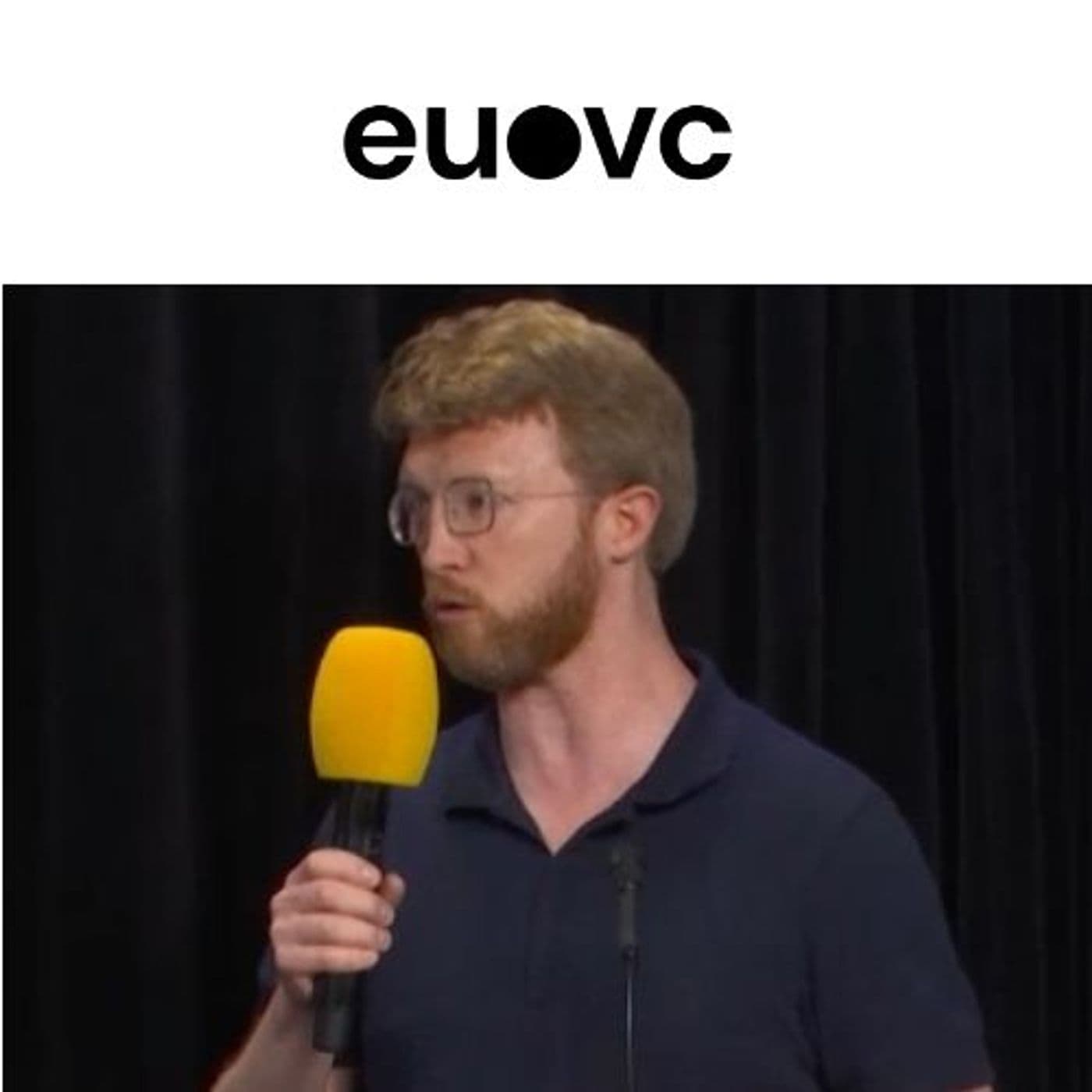

In short
EUVC Podcast Episode Notes
Episode Information
- Title: E542 | William McQuillan, Frontline Ventures: Europe & the US: Not Rivals—Partners in Building
- Description: Discusses the importance of collaboration between Europe and the US in building global companies, emphasizing that they should not be viewed as rivals but as partners.
Key Concepts and Themes
- The Importance of Ecosystem Builders
- Robin Klein Recognition:
- Honored as a Hall of Fame inductee at the EUVC Summit 2025.
- Acknowledged for his significant influence across European tech as most influential by peers.
- Emphasizes that successful investing is about building a supportive ecosystem, not just funding startups.
- Europe vs. US Narrative
- Challenging Perceptions:
- The common narrative of rivalry is misleading and detrimental.
- Data-Backed Insights:
- 45% of global internet traffic flows through 17 transatlantic cables daily.
- 75% of global consumer tech spending is from Europe and the US combined.
- Collaboration Over Isolationism
- Call to Action:
- Investors should direct founders to think globally, encouraging expansion into the US market instead of adopting an isolationist mindset.
- Highlighting successful global partnerships, such as those in the development of mRNA vaccines, underscores the necessity of cross-border collaboration.
- The Data Speaks
- Revenue Insights:
- European B2B companies derive over 40% of their IPO revenues from the US.
- Conversely, US B2B companies also rely significantly on European markets for 30% to 40% of their revenues.
- This interdependence suggests that both regions are crucial to each other’s success.
- Media Influence
- Perceptions Influenced by Media:
- Despite negative headlines, data shows that media sentiment in both Europe and the US is largely positive about each other’s tech ecosystems.
- Awareness of the skewed perception caused by the louder negative voices in media is crucial for maintaining a balanced view.
- Historical Collaboration
- Examples of Cross-Continental Achievements:
- The modern internet’s evolution through collaboration between US and European scientists.
- Innovations stemming from partnerships, like the development of COVID-19 vaccines, reinforce the importance of a unified approach in science and technology.
Key Takeaways
- Think Big and Global: Investors and founders should aim for international expansion as a strategy for success.
- Ecosystem Investment: The focus should shift from just funding individual companies to nurturing an entire ecosystem.
- Data-Driven Perspective: Leveraging data to counter narratives of rivalry can help foster a more collaborative environment.
- Historical Collaboration: Recognizing the historical interdependence can guide current and future investment strategies.
Concluding Thoughts
- The episode emphasizes that Europe and the US should not be viewed as competing entities but rather as partners in innovation and economic growth. By embracing this perspective, the European VC community can foster a more sustainable and globally-minded approach to building successful companies.
Acknowledgments
- Thanks to the partners who supported the EUVC Summit, including HSBC Innovation Banking, Google Cloud, Ace Alternatives, and others for their contributions to the event and the overall ecosystem.
---
This markdown document serves as a comprehensive summary and analysis of the podcast episode, presenting the insights and key themes discussed by William McQuillan, enhancing understanding of the collaborative potential between Europe and the US in the venture capital landscape.
Written by AI. May contain mistakes. Listen to the episode to check what was said.
Transcript
Automatic transcript. May contain errors.0:00William McQuillan, founding partner at Frontline Ventures believes that the Europe vs US rivalry misses the point entirely Having risen to become one of Europe's leading firms, Frontline has proven that investing in both markets as a European firm delivers a true competitive edge. In his talk, William challenges prevailing competitive narratives, emphasizing that thinking big means thinking globally, even for VCs building firms out of Europe. Border wars don't build big companies, collaboration and relentless execution across borders do. Thank you very much, everybody. I think following Robin is a hard act to follow, but I'll maybe start with a quick anecdote about Robin, actually.
0:46So a few years ago, we hired a new partner. We were hiring a new partner into Frontline. And when we were hiring that partner, when we got it down to the final five people, they were all incredible people. And one of the questions we asked was, who has been the most helpful and influential to you in the European ecosystem? And four of the five people mentioned Robin Klein. And I think the thing we need to remember about building an ecosystem as investors, is it's not just about being an investor, but it's also about building a fund and building an ecosystem. I think people like Robin very much deserve an award like today, because he really does build an ecosystem beyond just his own fund.
1:19So congratulations, Robin.
1:26What's interesting today, moving on to maybe the talk at hand, but what's interesting today when I look at the summit agenda is that almost 40 or a little over 40 % of the talks today are in some way talking about the issues Europe is facing because of a changing US agenda, or in some cases even going further and talking about how Europe needs to be more isolationist, protective, or just more Europe focused on Europe. And I think for me, that does miss the point a little bit. I think we need to be careful as long term investors not to become too isolationist in our own thinking and to continue to think globally.
1:56And for me at Frontline, that's something that's very important. Our fund is built on international expansion. Our early stage fund helps European companies expand into the US. And our growth stage fund helps US companies expand into Europe. For us, we try to be experts in transatlantic expansion, but more importantly than that, transatlantic collaboration. And so one of the things I love to show when talking about how much our two regions work together, without even realizing it, is the map in front of you is a map of all the undersea fiber optic cables around the world. There's a little over 500 of them.
2:32And what's interesting is a lot of people People think that a lot of data is going through satellites every day, but actually 97 % to 99 % of all the internet, global internet traffic, is going through those fiber optic cables. If you look at Europe and the US as two regions, actually only 3 % of those cables are connecting Europe and the US. So you could say that doesn't sound like two ecosystems that collaborate very much. But when you look at the data going across those 17 cables, it's actually a little over 45 % of all the world's global internet data every single day is crossing those 17 cables.
3:03The two ecosystems are incredibly well connected and collaborating on a data level every single day. So if we are so connected, why is it then that we're seeing so many people talking more and more about more region-focused isolationist views? Well, from a European perspective, I think I can get it. You have the Vice President of the United States and the Secretary of Defense talking about hating and loathing Europe in messages. You have Donald Trump frequently putting messages out, critiquing Europe, and I would say actually very frequently. and it's not just it's not just you know the senior US officials putting messages out like this, the media often feels like when I look at my social media I often feel like I'm looking at articles that are combating the two against each other, Europe versus the US and sometimes even just being negative about each other and again these are just all articles that came up in the last few months in my news feed when I opened it up in the morning looking at LinkedIn or Twitter but in Frontline we like to look at the data and so So for us, one of our portfolio companies, a company called Signal AI, they analyze all the world's news in about 150 languages every day.
4:08They're able to do sentiment analysis across the news. We look to try and understand the truth. Is the media really trying to pit us against each other? Is it speaking very negatively about opposite ecosystems? So we looked at all the U.S. reporting on European tech, European venture capital ecosystems over the last number of six months. For every one negative article that's in the media, there's almost 15 articles speaking positively in the U.S. about the European VC ecosystem. And in Europe, you might say, well, Europe's a little bit attacked because so much of the U.S. policy changes have changed negatively for us.
4:39But again, in European media, for every one negative article on U.S. ecosystem, there's 13 positive articles. The media on both sides of the Atlantic is overwhelmingly positive about the other side. And I think what we as a group need to be careful about is negative voices often feel louder than the positive ones. And when you're looking at social media, unfortunately, they get more enhanced and more shared. And so in our kind of echo chambers, whether it's LinkedIn or Twitter, we can feel like things are more negative than they are. But the data in this case is very clear. Both sides of the Atlantic media is overwhelmingly positive.
5:14Well, so most of us are investors in the room. How important is the ecosystem to each other? So if we looked at the data, in Frontline we invest in B2B companies, and we looked at the B2B tech IPO data. So when European companies are IPO-ing, what percentage of their revenues are coming from the US? You might have an idea or guess in your head. Well, the answer is unsurprisingly a lot. Over 40 % on average, when a European B2B company is IPO-ing, revenue is coming from the US. That is an enormous amount of their revenue to be coming from the US. And I think for us, we need to be remembering, as we're advising our companies, again, not to be too isolationist, The U.S.
5:51is a huge market, and we shouldn't be advising our companies to focus too much on Europe and forget about the rest of the world. The U.S. is a huge market, and when you want to build global companies in Europe, you still need to be thinking internationally as well. Now, some of you might say, okay, well, that's easy. That's an example of Europe being too dependent on the U.S. We should be building our companies more at home. But what about the opposite direction? So when we look at the same data for B2B IPOs in the US, what percentage of their revenues do you think are coming from Europe when then IPO?
6:20What's interesting is when we ask most funds and entrepreneurs, they'll usually tell us somewhere between 5 % and 10%. And I asked a few of you earlier as well, and I didn't get higher than 10%. The actual number is 30 % to 40%. So the reality is this isn't a one-way dependence. If you want to have a successful IPO, build a successful B2B tech company in the US, you also need to win the European market. And what's interesting as well, again, I don't have all the data here, but if you dive into that data, the companies that are closer to the 40 % mark have far more successful IPO outcomes as well.
6:52Europe and the U.S. are very intertwined. And when you're building and advising our companies, it's important not to forget that. And this is B2B data, but again, if you look at the kind of consumer spend data, almost 75 % of consumer tech spend is between Europe and the U.S. So for us, and we're focusing on these ecosystems, we should make sure that we're advising our companies to think big and think globally. But what's interesting is, you know, we're talking about ecosystem building here. You know, I know many of these investors in the room, and I know many of you think bigger than just building big companies.
7:21Part of the reason you do your jobs is because you want to be involved in world-changing technologies, world-advancing sciences. That's part of why it gets us excited when we meet those entrepreneurs really trying to change things. And one of the things I'd like to put forward is actually so many of the world's most incredible advancements over the last hundred years have been through direct collaboration across that Atlantic. Just to go through a few very quick ones. The first is the foundation of the modern internet. Originally started in DARPA in the US with Bob Kan and Vince Cerf, creating ARPANET and TCP IP protocols.
7:51But it wouldn't be the modern internet that we know today if it hadn't been their collaboration with CERN, with Tim Berners-Lee and Robert Calhue, creating HTTP and HTML. But that's maybe a slightly aging example. One much more recently, Dr. Kadi Karikou and Dr. Drew Weissman, the two scientists that founded the effect or created the baseline science behind almost every single COVID-19 vaccine, a European and a U.S., both winning the Nobel Prize. The first companies or vaccines that came to market, BioNTech and Pfizer, a joint venture between a European and U.S. company. The next was Moderna. The next was AstraZeneca, a European and U.S.
8:27company. And even if you look at the two U.S. companies that were first to get drugs to market, they're both led by European CEOs. These ecosystems are so incredibly intertwined. It's important we don't forget that. And it's easy to pick two examples, but if I had more time, I could give you the exact same slides on the International Space Station, the Human Dino Project, the Large Hadron Collider, and the same with those cables I talked about going under the sea. Those wouldn't have happened if it hadn't been for investors and engineers on both sides of the Atlantic over 150 years ago. And again, you can keep going.
8:58So what I would love for you to take away today for my talk is the media and even sometimes the politicians and policy changes can make it feel like it's Europe versus the US. But actually, for those building companies and trying to make advancements in general for humanity, we should be thinking about Europe and the US in the way we advise our companies. And yes, it is definitely harder now to build a more globalized company, but that's up to us as investors to help our companies get past that and to continue to build global companies because that's what builds big companies and changes things.
9:33Thank you very much for your time. Before you go, I just want to give a massive shout out to the partners who made the EUVC Summit and Awards possible. So please do not tune out. We're partnered with these firms because they're great people with offerings that we know from our friends in the ecosystem are truly world class. First up, I want to give a big thanks to HSBC Innovation Banking. They helped us incept the awards in the very beginning. and truly they are the leading bank for anyone in European venture. There's a reason why everyone knows them. Google Cloud, they were our venue hosted the summit.
10:06What a team, what a big effort they put on to help us. We're hugely grateful. Make sure to reach out to Arabella or Oksana at the Google Cloud team to hear how they can help you as well as your portfolio. Massive credits goes to them. Ace Alternatives, we have so many friends in the Berlin ecosystem partnered with these guys. just the best fund ops team around. And as with any good restaurant, where the locals are is also where you get the best service. And now they're expanding across Europe, so they're definitely someone to talk to. Hainspoon, they're longtime partners of ours in both our own legal work.
10:41They're great supporters of us here at EUEC, and I definitely think that they are one of the go-to legal teams to have in your corner. CW Communications, our dear friends who helped us secure CNBC, Bloomberg, Financial Times, and many more for this summer. It's a joy working with Dan and Kathy and the team. Fundcraft, Digital Native, Full Suite, Lux Headquarter, and a great partner as you grow your firm out of Luxembourg. Definitely a fund admin to consider in your stack. I can only say that the team are incredible to work with. I'm very thankful that I've gotten to know them. I think they're one of the up and coming fund admins that you want to be thinking about.
11:20Portfolio IQ by Synaptic. You may know them for the Discover tool, which is branded on a Synaptic, but Portfolio IQ is absolutely a product you should know because there's no one that understands intelligence better than this team. And finally, Goodwin. They are a truly world-class legal partner you can trust. They're hands-on, business-oriented, and expert in everything and anything transatlantic. So those were our partners for the summit and awards. I know this This might have been a bit long and boring, but really, if you have these guys on your side, I don't think your firm could be in any better hands.
11:54And also they're helping us do what we're doing every day for you.
From the publisher
At the EUVC Summit 2025,
of
delivered a data-backed reminder: If we’re serious about building global companies from Europe, we need to stop treating the US as a rival—and start treating it like the deeply connected partner it already is.
Robin Klein & the Power of Ecosystem BuildersThe session opened with a heartfelt nod to Robin Klein, this year’s Hall of Fame inductee. When Frontline asked leading investors across the continent “Who has been most influential in your journey in European tech?”—four out of five said Robin.
“Building an ecosystem isn’t just about investing. It’s about building a fund, a culture, and a movement. Robin has done all three.”
His recognition is a signal to us all: the best investors aren’t just backing startups—they’re laying foundations for the entire ecosystem to thrive.
Europe vs. US? The Data Tells a Different Story
You might think Europe and the US operate as separate tech spheres. The media often frames it that way. Politicians like Trump make it seem that way. But the data tells a different story:
- 45% of the world’s internet traffic flows through just 17 transatlantic cables—every single day.
- In consumer tech, nearly 75% of global spend comes from Europe + the US combined.
- Signal AI, a Frontline portfolio company, analyzes global news in 150+ languages—yet a major share of its revenue comes from the US.
“We’re already collaborating—just not always intentionally.”
Think Big. Think Global.William’s message to investors was crystal clear:
“We shouldn’t be advising founders to go small or to ignore the US. Europe and America are economically and digitally intertwined—and always have been.
”He cited the powerful example of Dr. Katalin Karikó (Europe) and Dr. Drew Weissman (US)—the Nobel-winning team behind mRNA vaccines. Global breakthroughs, enabled by global collaboration.
Yes, it’s harder today to build across borders. But that’s where investors need to step up—not retreat.
Let’s not let political headlines shape our investment strategies.
Let’s help our companies build globally, because that’s how we build lasting, category-defining businesses.
And let’s take a page from Robin Klein’s book: invest in the ecosystem, not just the deal.


