
In short
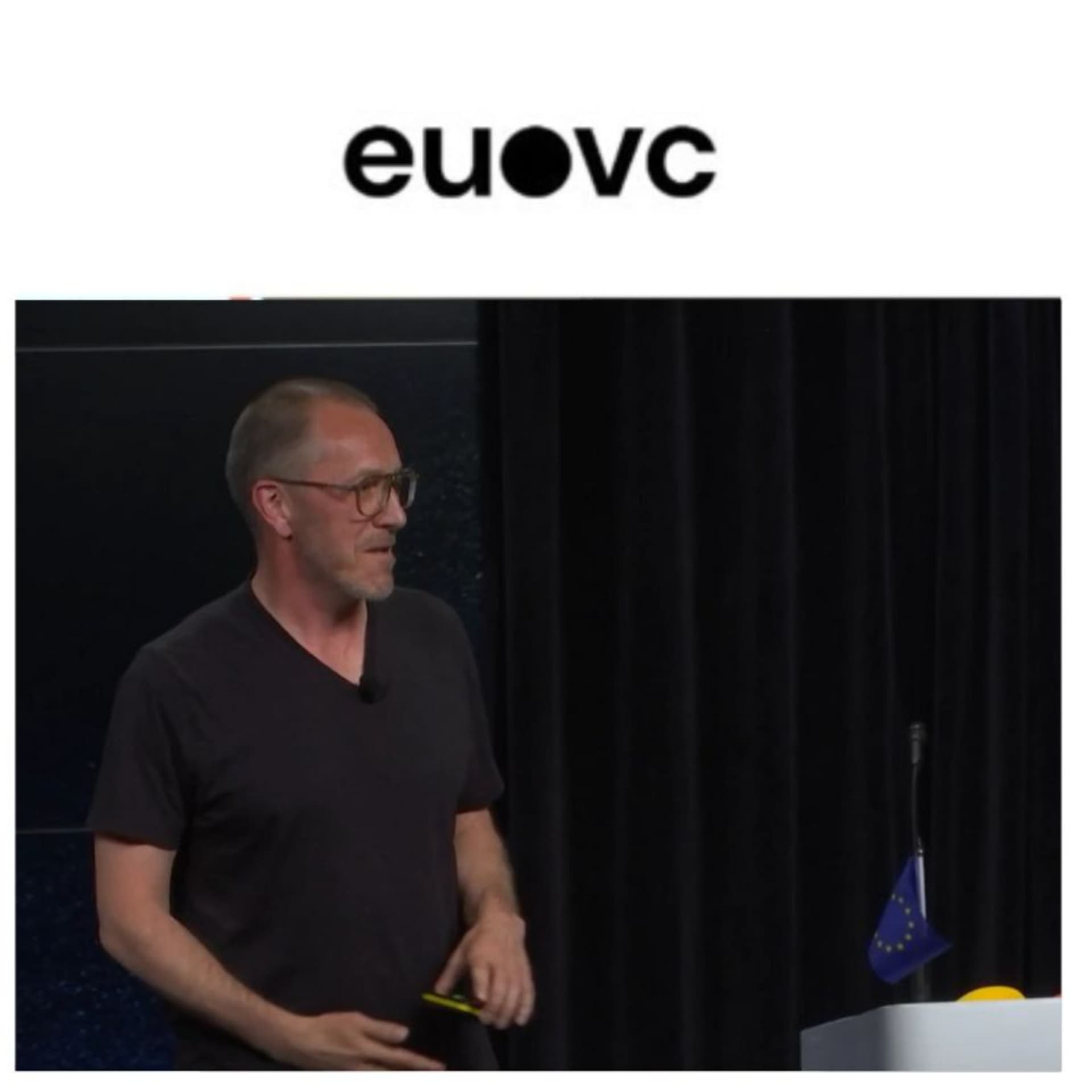
EUVC Podcast Episode Summary: E593 | EUVC Summit 2025 | Fred Destin, Stride: Living a Meaningful Life in Tech
Overview In this episode of the EUVC podcast, Fred Destin, founder of Stride, presents a thought-provoking talk at the EUVC Summit 2025. He emphasizes truth, technology, and the profound impact of venture capital on shaping the future. Destin's reflections focus on the human aspect of venture capital and the moral implications of technology in today’s society.
Key Themes
- Venture Capital as a Human Craft
- Human Flourishing: Destin stresses that progress is inherently tied to human well-being. He views venture capital as a means to help founders create companies that contribute to the future.
- Cockpit Perspective: Investors are in a unique position to guide founders in shaping the future, emphasizing collaboration over mere financial transactions.
- The Dark Side of Social Media and Technology
- Attention Wars: Destin critiques social media’s impact on societal progress, labeling it as a "war for attention" that has led to moral confusion and outrage.
- Outrage vs. Truth: He warns that while truth is a costly pursuit, outrage is readily available, and technology often amplifies this dynamic.
- The Future Shaped by AI
- Potential for Both Good and Evil: AI can lead to abundance by solving critical issues (e.g., health, climate) or it can lead to domination and potential extinction.
- Monetization of Inner Life: Destin raises concerns about the commodification of personal experiences, even in spaces meant for contemplation and meditation.
- Stewardship Over Fear
- Stewardship Framework: He proposes three areas of stewardship:
- Self: Awareness of personal attachments and aversions.
- Conversation: Quality of dialogues with oneself and with others.
- Capital: Ensuring investments create a desirable future.
- The Role of Narratives
- Importance of Shared Narratives: Destin emphasizes that narratives unite societies, companies, and funds. When these narratives collapse, social cohesion deteriorates.
- Critical Theory and Truth: He discusses how contemporary critical theory has deconstructed truth, leading to a nihilistic worldview that prioritizes power dynamics over shared truths.
Caution and Inspiration for Venture Capitalists
- Destin calls on VCs to recognize their influence in shaping narratives and futures. He urges them to support companies that align with values contributing positively to society, rather than merely pursuing self-serving goals.
Conclusion Fred Destin’s talk at the EUVC Summit 2025 challenges venture capitalists to go beyond financial returns and engage in the deeper narratives that shape society. His emphasis on stewardship, the cost of truth, and the moral implications of technology serves as a call to action for investors to become architects of a more meaningful and truthful future.
---
Quotes
- “Maybe don’t tell your LPs you’re doing this. But be intentional. Back companies that are shaping the future you’d be proud to live in.”
- “What are we telling the world? Not what is self-serving. But what is true. What is a contribution.”
Reflection Questions
- What narratives are we supporting with our investments?
- How can we ensure that our conversations contribute to truth rather than outrage?
- In what ways can we practice stewardship in our roles as investors?
This episode serves as a profound reminder of the responsibilities that come with capital and influence in a rapidly evolving technological landscape.
Written by AI. May contain mistakes. Listen to the episode to check what was said.
Transcript
Automatic transcript. May contain errors.0:00We now have Fred coming up. Fred, we made a movie for it, but it didn't feel right. Because you saw the style of our movies, maybe they weren't exactly humble, down to earth, sincere, honest. But that's what this, whatever this is, is going to be. Because I don't know, we gave Fred free reigns. Do whatever you want when you come up here. We trust you. Let me just say why I love Fred as much as I do. There is an ecosystem point here to be made. We've all been to thousands of events. Every single time the same thing happens. End of the night, the best talks arise. Typically someone is almost on the brink of crying because you end up talking about what's going on at home.
0:54You end up talking about the stuff you've had to do, the things you have founders go through, the things you can't solve. it's a tough world out there.
1:06So for that reason, we at EUVC, you know, it dawned on me, oh my God, why are we keep, we put on these posturing events? We've got to do something. Part of what we do is our tracks. You saw that movie earlier. It's really about connecting. It's about getting into nature with other people that do and go through all the same things as you do. we also do deep work retreats where you know it gets to a point I was at it I cried for four days great experience I try like I say to everyone and anyone first and foremost the work for yourself that you can get done in four days you cannot imagine second part even if you're not ready to do that work I would say go and do it because you'll never see anything more beautiful like you You could not go and see the pyramids or the Great Wall.
1:59Anything that's as beautiful as seeing people dealing with their shit and getting to terms with it. Yeah, so even as a tourist at a retreat, I think it's pretty cool. So yeah, we've done one of those retreats with Fred as well, and that's why I've gotten to know Fred on a level that sometimes feels closer than even my closest friends, because we've spoken about our shit. And then my closing words here are, I know some people, so we always talk about founders turned VC. With Fred, I tend to say it's VC turned guru. And people smile, people laugh, they may be cheeky, what's this fucking thing, existential crisis.
2:49honestly listen to what the man has to say now whatever he gets us to do if he gets us to do something do it and try and feel it and let it happen okay if anybody ever says they're a guru please throw them out of the room on their ass I'm just going to verbalize how this feels it is a little bit strange to stand in front of my industry and my peers and to talk about what I'm about to talk about. I'm going to try and go into meaning. And what I'd like for you to do maybe is to tune into the agency that you have in the world. You understand the mechanics of the world. You have capital. You have the smarts.
3:33You have the network. So we stand collectively in quite a unique position with the way in which we are able to influence what's about to happen in the coming 50 to 100 years. I don't know about you, but since I was a kid, I always thought of progress as something intimately related to human flourishing, whether it's health and eradicating disease or science and technology. In fact, if you ask me why I do the job of venture, it's because I think there's something profoundly human about creating. And in our age, the way in which we create, if you leave art aside, is by helping founders create companies.
4:17And so we are in the cockpit alongside them, helping them create the future. And I always had, I'm not naive enough to think of technology as inherently moral, but I always felt like progress as sort of a positive arc towards human flourishing. Now, that sort of started to get tainted maybe around 2007, 2009, and I think it's when we invented the like and the share and the retweet button. And we started getting into this debacle called social media, which was the war for our attention, et cetera. I just want to check, by the way, how much time do I have? This timer runs on seven minutes. OK. OK.
5:02And the valence of progress started to change a little bit. And I'm like, what exactly is going on? And if you think about the poster child that was Twitter, I always thought Twitter was a tool for freedom. The Arab Spring, better democracy, better knowledge. And then, of course, that turned into a sort of cesspit of outrage. Now, for me, the Hinge event was October 7th. And I'm not telling you how to feel about October 7th. For me, I think I was at home for three days crying. Not even Jewish, right? So it's not like it's my pain to carry. But it sort of somehow landed very deep in my system. And it's the moment when I thought, OK, wow, about what is going on here.
5:54The Jewish question, by the way, is always sort of the tip of the spear. Every time you run into really highly troubled moments, it always hinges somehow around the Jewish question. So again, I'm not trying to tell you what you think about Israel or Palestine. I'm just saying, for me, that landed very deeply. What I got really curious about, though, was the moral confusion around it. You know, we have a group that takes their beloved gay brothers under their arms kindly and then pushes them off the top of buildings. We have a group that goes into a peace festival and shoots people in the face and the genitals for fun.
6:38We have a group that uses their own children and mothers as shields. And I'm like, without judgment, it's like, why the moral confusion? where does that come from? And then how does that relate to technology? Historically, we had common narratives. These common narratives would be driven by things like, if you wanted truth, you could go to religion. They had a convenient set of truth and rules. In the age of enlightenment, scientific principles of inquiry. And then, of course, wisdom through the philosophers back in the day, pre-Heidegger, when philosophy is actually something you could use in your everyday life, which I think is why the Stoics are so back in fashion.
7:24But in that, there was something that resembled truth. Maybe your favorite philosopher is Immanuel Kant. Mathematics has an element of truth. I mean, arguably quantum physics and physics as well. But there was something there we could hang on to. And I'm like, OK, besides the fact that these are all white males representing something about systems of power here, where do we start going wrong in terms of shared narratives? And I want to introduce, I don't think we can think about the world we live in without thinking about critical theory. So some of you may know this well, but Derrida, Foucault, Deleuze is the French contingent of the critical theorists.
8:07It's always the fault of the French. As a Belgian, I can say that. We're an oppressed minority anyway. Sorry.
8:16So they had something useful to say about the world. And what they had to say about the world is what constitutes truth and knowledge is often the outcome or the production of structures of power. And that's a useful contribution for us to understand. The problem is they didn't stop there. They deconstructed truth completely. They're like, there is nothing that exists outside of subjective truth. and your lived experience. And hence, everything is an expression of power between human groups that are vying for control. And so these guys landed us in a sort of nihilistic landscape where we can only think of the interrelationship between human groups as relationships of power, and it looks like this.
9:06Right? Now, it may in your mind have started with the woke movement, which was again a positive development that kind of went sideways. If you think about the fact that we said 2 plus 2 equals 5 because math is an element of oppression of the minorities, that's when you know you've probably veered a little bit off-center. term. But this was not limited to the left. I mean, the right, so in critical theory thinking, there is no such thing as truth, right? So a conspiracy theory is simply a narrative that is not consensus. Alternative facts are simply facts that are not recognized by the majority.
9:53So you can kind of claim anything you want and kind of create tribes around these alternative facts. So we are left in environments that start to look more and more amoral and where all we have is a raw expression of power. It's worth talking for a minute about truth here because truth is important and information and truth, you might think more information which of course we generate and distribute through technology leads to more truth, but the opposite is true. So truth is costly to acquire. If you think about investigative journalism, you have to go interview 1 ,500 people. You have to make sure you're not going to get sued.
10:39You have to make sure your facts are correct. And then after six months of painstaking work, you push out an article. That's what it takes to produce truth. It's incredibly easy to destroy. All you have to do is assume bad intent on the side of the journalists who did investigative journalism. Information, by contrast, is a great way to flood the truth. If we bring technology into this, the problem we have is algorithmic optimization is going to lead... We're not asking the machine to optimize for outcomes, so the only two outcomes you end up with is completely binary, either ecstasy or outrage.
11:20And maybe it's the ecstasy of going viral for 15 minutes with your TikTok, or your morning routine goes viral and you go like, wow. And outrage is everything else, right? We can express outrage in four seconds flat by just writing a tweet that goes on to destroy someone's life because it's smart and quippy. So algorithmic optimization was phase one. Now, what happens when you bring in AI? AI is amazing. It's like our companion for creativity and productivity, and we do so much with it, and we're all running projects on it, and it's making us think smarter and challenge the way we write and think and code and so forth.
11:58What a beautiful tool. We're also kind of staring at it like a cobra or the sun, kind of going, wow, this thing's amazing. Is it intelligent? We don't know if it's intelligent or a stochastic parrot. I mean, more likely a stochastic parrot. Does it have agency? I mean, it's agentic. So maybe it's got agency. Is it conscious? And whilst we're staring at it, this thing is algorithmically optimizing around us constantly. And if you look at what the mechanistic interpretability team, for example, at Anthropica, are doing, they don't fucking understand how this thing works. It's evolving biologically faster than we are able to grok it.
12:40So we created a fast-evolving new life that's based on silicon that's evolving faster than we understand what it's doing. So whilst we're staring at it, trying to get it, being fascinated by it, it is gradually kind of occupying our field with sort of algorithmic optimization all around us, right? Imagine what happens when perplexity buys Chrome, and now you have your friendly AI chatbot knows where you've been, who you've been to dinner with, and where you'd like to travel to. I mean, hello? So it's interesting to think about.
13:18Once you have tech, you can weaponize tech. So in 2015, Stephen Bannon became Trump's campaign manager. And he had an explicit strategy. It was called flood the zone with shit. It's verbatim. If I send enough information towards voters at high speed, continuously, they won't know what's going on. The Chinese Communist Party does the same. If you look at how they do censorship these days and propaganda, it's actually a very light touch. What they do is they make it really hard to get to the truth. So the friction is extremely high. You know nothing about their secret prisons. We don't understand how the premier thinks anyway because he never gives interviews.
14:04We know nothing about what's happening in the Uyghur camps. and it's really hard to get to even a single picture. So we're making friction extremely high when it comes to getting to the truth. And then they're deciding what kind of narratives they want and they flood the zone with it, right? So now, you know, how do you think we're supposed to get back to anything resembling what's actually happening? We have a particularly strong tool in this, which is memetic warfare. There is a whole set of memes around it, which are very good. The thing about mimetic warfare is we, as a species and a society, are very badly equipped to deal with it.
14:51The other thing is there is no anti-mimetics division. So whilst this is happening, we're not actually seeing what's really happening. In fact, we might even forget that there is an enemy. We're laughing at the meme thing, forgetting that it's the Chinese Communist Party who is playing propaganda. The anti-memetics division does not exist.
15:15Looking at what Elon does is also interesting, because what he's doing is he's constantly testing the boundaries of what's acceptable. So was it that kind of salute? Was it not? We don't know. So he's playing on the ambiguity. From there, like, let's see what I can get away with. The answer is a lot. And so he's expanding the space of freedom of what's acceptable in terms of discourse. So now we're breaking down norms gradually. Again, this is not limited to the right. How many times, how many times can we see a father laying down dead children on a sidewalk before our empathy machine is destroyed.
16:02You're either going to end up in apathy and disconnection or outrage. It is not humanly possible to resist the onslaught of messaging. By the way, who's interested in the truth is an interesting question because when you're signaling outrage, maybe you're generally outraged. Maybe you're signaling within your tribe that you are a person who cares and dares to speak up. So maybe you're seeking status without even realizing it. So you can also come from places of genuine concern, but actually be playing social games that you're not even aware you're playing. And you might be weaponized by the other side, because these narratives are very shifty.
16:52If you want to normalize a Nazi salute, the best way to normalize it is to shout really loudly at Elon Musk that is doing a Nazi salute, which we don't know. Because then the other side goes, great, are you calling this a Nazi salute? Let me show you a Nazi salute, which is exactly what happened, right? I'm concerned that we have moved beyond. So this is not some kind of political game. we are in a place where the narrative collapses completely. And narratives are how we stick together. It's true inside a company. A company has a mission. It's got culture and values. It's got a certain way of doing business.
17:34Each of you in your funds, you have a narrative around how you show up in the world and what you stand for. When these narratives start collapsing at scale, what holds us together as a society, it becomes harder and harder. And then we start having the wrong myth and the wrong stories and the wrong heroes, right? So it's like we're trying to make sense of the world in 2015. And it's so complicated that even coming to some form of diagnostic is hard. So we got a bunch of people together on a couple of occasions in my office, which is like, how does it feel? And do we understand what's happening?
18:12And we're like, oh, this is really kind of hyper object. It feels like a fractal. Like, we don't quite know what it is. And one of the guys who were there, Gabe, works in AI safety. And he said, you know what? It feels like a Lovecraftian horror, if any of you are into H.P. Lovecraft. And we came up with this idea of like this, like, Cthulhu. Cthulhu is this awful godlike creature that moves on the ground. And it just fills everybody with a sense of dread. And we're like, OK, you know, technology taken collectively feels a bit like an adaptive fabric. Like, whatever narrative you think you've got, the narrative's going to shift.
18:51Whenever you get upset, it gets recuperated. Your words get taken out of context. They get republished. You're kind of, it's like it's covering you. And it could be positive or negative, right? It could be ecstasy or outrage. OK, then we go into like, well, whose fault is it anyway? And most people point the finger at Trump and go, wow, it's Trump, you know, a bad person. Is Trump responsible, or is he an artifact of what's going on? Is he the leader that came into this chaos that we live in? And then we're like, OK, what's a good analog, or what's a good story? And the good one, the one I like, is Moloch.
19:34If any of you used to read Slate Star Codex, Scott Alexander's legendary blog, Moloch is like this Etruscan god, and he used to be fed the children of the community by the community because that's how you kept the beast at bay. And in a way, this constant optimization and hustle and let's go win and let's crush and let's destroy, by the way, all this nice, very masculine language around winning and crushing and destroying, is us consuming ourselves. because there is almost no place left that is not a place where we fight for dominance or occupation or some kind of monetization or something. My favorite example is to ask people, hey, do you meditate?
20:21People go, yeah, I meditate. Do you use a guided meditation app? And 80 % of people go, yes. So even your meditation space is being occupied by technology and monetization and optimization. So these are trying to think to what extent we contribute to what's going on, to what extent we are part of a system that seems to be gradually denying us our humanity to a certain level. Again, this is not some kind of anti-AI speech. That's not the point. If you look at the theories around what AI might produce, you know, the core one that a lot of people within tech believe is abundance. You know, we have to go all out on artificial intelligence because it will help us solve the polycrisis, so climate, soil, nutrition, health, blah, blah, blah.
21:16And if we only accelerate on AI, you know, this will help us generate the solutions that we need on this biosphere that we're in to get out of the trouble that we're in. And it would usher an age of abundance. And sure, we might go through an episode of job destruction that looks like the closure of the mind. But on the other side of this, we will have beautiful, interesting jobs for everybody that don't involve accounting or claims processing or whatever, whatever the job you don't like is. On the extreme end of this is the transhumanists. And so I'm sure a lot of you are well aware of transhumanism.
21:49But their idea is that biology is some kind of annoyance that we need to transcend. So the manifest destiny of mankind may be to take our knowledge and to expand it across the globe, that we are destined to spread intelligence across the globe. And what stands in the way is our own biology. So if only we can upload ourselves to the cloud. So the mimicry crowd thinks we just need to resemble human intelligence, but on this different substrate, on the silicon substrate. And then we can go travel across space and time. Amazing. And then the biology crowd says, no, no, no, you can't deny biology. We're just going to gradually understand our biology and replace ourselves with machines.
22:36But they're sort of both trending towards the same outcome. Now, a lot of people think it's unlikely that the systems will be stable. Hence, you have the domination theory. The domination theory is say some nation state or corporation nation state merged entity will achieve escape velocity around something that resembles AGI. And it's unlikely that the systems are politically stable. And then you have a bunch of smart people who believe in the extinction part, which I didn't put on the slide to not depress anybody too much. But Tristan Harris and Schmachtenberger, et cetera, believe that inherently we're creating a monster.
23:15You can then assign your own probabilities to these outcomes. I'm not a futurist. I'm not in the business of making predictions. Cool, okay, so what do we do? Image of a still lake in the face of this chaos, where do we stand? I like to think of an internal horizon, what's happening inside of you, an external horizon, which is how do we show up in the world. In Total Horizon, if you can recreate some space for your overclocked brain, your brain is being constantly stimulated so you can't really think or feel, if you can recreate a little bit of room for thinking, the first question is what game is being played?
23:54How are you getting caught? And I want to introduce a framework from Buddhism. Buddhism is very interested in suffering and human suffering. And three of the key causes of suffering are attachment, aversion, and ignorance. So you can think of most of the thing that's happening to us under attachment. I need a car. I need status. I need to keep up with the Joneses on Instagram. Aversion, aversion to pain. I will numb my pain by working too hard. I will numb my pain by being on TikTok. And then ignorance is, let's just make sure you don't understand what's going on. Right? So if you're capable of going back and looking at when are these things being triggered against me, then you can rise above, get beyond suffering, and start to see things more clearly.
24:44And as for the Buddha, the path is one of intelligence and discernment. We just need to relearn to see clearly what's going on. The worst pitch is the pitch of Buddhism and the pitch I want to make to you, which is the only thing we have to do is to sit with the things we don't want to sit with. Looking at the impact we have in the world, feeling how we feel when we feel lonely, understanding what's going on when we try and numb ourselves through TikTok. The way out of the pain is through the pain. And all the great wisdom traditions say the same thing. Now, the good news is once you've offloaded your backpack and you reconnect with your loved ones and with the beauty of the world, is like, oh, I have blood coursing through my veins.
25:30That's amazing. We are sitting together as a community. That's amazing. There is a light hitting the wall. That's amazing. And then you find suddenly beauty everywhere. I think that's where we can land collectively, if we just relearn to look at the present as it is. So my favorite quote by David White, beauty is the harvest of presence. When we are present, we will recognize I said beauty is absolutely everywhere. External horizon. How do we show up in the world? And I'll finish on this. I think a lot of our job is about asking powerful questions. It's actually the best way to be with our founders.
26:10It's not to give them advice, but it's to ask powerful questions. So I think a good question is, what is the quality of the conversation we're having? Could be conversation with ourselves. Could be conversations with others online. Are we contributing to outrage? Are we contributing to truth? And then importantly, in the companies that we back, what's the quality of the conversation we're having with our customers and our clients? Are we really contributing to a future that we would like to see manifest? And I would say, maybe don't tell your LPs are doing this, but be intentional about making sure the companies you back are generating and creating the kind of future that we want to see.
26:50and they're doing this in a way that you can stand behind. I'm joking about not putting it in your investment bag, but impact isn't self that well, so I kind of do it by self. And finally, I was trying to think about, okay, what can I leave people with a little bit? I think we have capital, we have agency, we have the power to influence the world, and we've just been given this incredibly powerful set of technology tools called artificial intelligence. So there's a real question of what we do with it, and hence the idea of stewardship. This is the most powerful tool ever invented by mankind. What the fuck are we doing with it?
27:35And really sit with the question. This is not a rehearsal. It's not a game. And then the other thing I think is interesting is we're quite in a unique position of actually understanding what's going on. And the world around us is very anxious. This is bringing a lot of change very quickly. It's breaking the rules of the game. People are going to lose their jobs. And there's a lot of anxiety in the field. And because we sit inside the vortex, we have a capacity to articulate what narratives are correct, what narratives are just around this, so we can help other people try and make sense of this revolution we're going through.
Read the full transcript
28:11So the second aspect of stewardship is what are we telling the world? You know, not something that's self-serving, but something that's true, something that's a contribution. Thank you.
28:45the awards in the very beginning and truly they are the leading bank for anyone in European venture there's a reason why everyone knows them Google Cloud they were our venue hosted the summit what a team what a big effort they put on to help us we're hugely grateful make sure to reach out to Arabella or Oksana at the Google Cloud team to hear how they can help you as well as your portfolio massive credits goes to them Ace Alternatives we have so many friends in the Berlin ecosystem and partner with these guys. Just the best fund ops team around. And as with any good restaurant, where the locals are is also where you get the best service.
29:23And now they're expanding across Europe, so they're definitely someone to talk to. Hainspoon, they're longtime partners of ours in both our own legal work. They're great supporters of us here at EUEC, and I definitely think that they are one of the go-to legal teams to have in your corner. CW Communications, our dear friends who helped us secure CNBC, Bloomberg, Financial Times, and many more for this summer. It's a joy working with Dan and Kathy and the team. Fundcraft, Digital Native, Full Suite, Lux Headquarter, and a great partner as you grow your firm out of Luxembourg. Definitely a fund admin to consider in your stack.
29:59I can only say that the team are incredible to work with. I'm very thankful that I've gotten to know them. I think they're one of the up-and-coming fund admins that you want to be thinking about. Portfolio IQ by Synaptic. You may know them for the Discover tool, which is branded on a Synaptic, but Portfolio IQ is absolutely a product you should know because there's no one that understands intelligence better than this team. And finally, Goodwin. They are a truly world-class legal partner you can trust. They're hands-on, business-oriented, and expert in everything and anything transatlantic. So those were our partners for the summit and awards.
30:36I know this This might have been a bit long and boring, but really, if you have these guys on your side, I don't think your firm could be in any better hands. And also, they're helping us do what we're doing every day for you.
From the publisher
At EUVC Summit 2025, Fred Destin, founder of Stride, didn’t give us a movie, or a polished pitch. He gave us something rarer—an unfiltered meditation on truth, technology, and the role of venture capital in shaping the next 50–100 years.
Not Just Capital. Not Just Companies.
Fred framed venture not simply as a financial craft, but as something profoundly human:
“Since I was a kid, I always thought of progress as being intimately related to human flourishing. In our age, the way in which we create—outside of art—is by helping founders build companies. We are in the cockpit with them, creating the future.”
But that future is clouded. Social media, born of “likes” and “shares,” bent the arc of progress into something darker: an attention war.
And now, with AI at full speed, the stakes have never been higher.
Truth Under Siege
Destin warned: truth is costly, outrage is cheap. Investigative journalism may take months, but outrage takes seconds. Algorithms optimized for speed have already shifted the field—and AI could supercharge it.
He asked the room to imagine:
A future where your AI knows who you dined with, where you’ve been, and what you’ll buy next.
A landscape where ambiguity is exploited, narratives collapse, and “heroes” are manufactured.
A world where our meditation spaces, even our inner lives, are monetized and optimized.
“Narratives are how we hold together—companies, funds, societies. When they collapse, what’s left to unite us?”
Stewardship in an Age of Anxiety
Fred’s answer wasn’t fear, but stewardship.
Stewardship of self: noticing when we’re trapped in attachment, aversion, or ignorance (as Buddhism teaches).
Stewardship of conversation: asking what quality of dialogue we are having—with ourselves, with founders, with society.
Stewardship of capital: ensuring the companies we back create a future we can stand behind.
“Maybe don’t tell your LPs you’re doing this. But be intentional. Back companies that are shaping the future you’d be proud to live in.”
The Call to VCs
Fred’s message landed as both caution and inspiration:
AI can bring abundance—solving crises of climate, soil, nutrition, and health.
But it can also bring domination—by nation states, corporations, or worse.
Or, if unchecked, extinction.
The choice isn’t abstract. It’s in the hands of those who sit “inside the vortex”—founders, investors, and stewards of capital.
Leadership That Speaks Truth
Fred Destin reminded EUVC Summit 2025 that venture capital isn’t just about returns. It’s about narrative, stewardship, and shaping futures in an age of anxiety.
“What are we telling the world? Not what is self-serving. But what is true. What is a contribution.”
Congratulations to Fred Destin, Stride, for a Summit Talk that challenged us not just to invest in companies—but to invest in the truth.


