In short
Expert Intelligence Podcast Notes
Episode Title
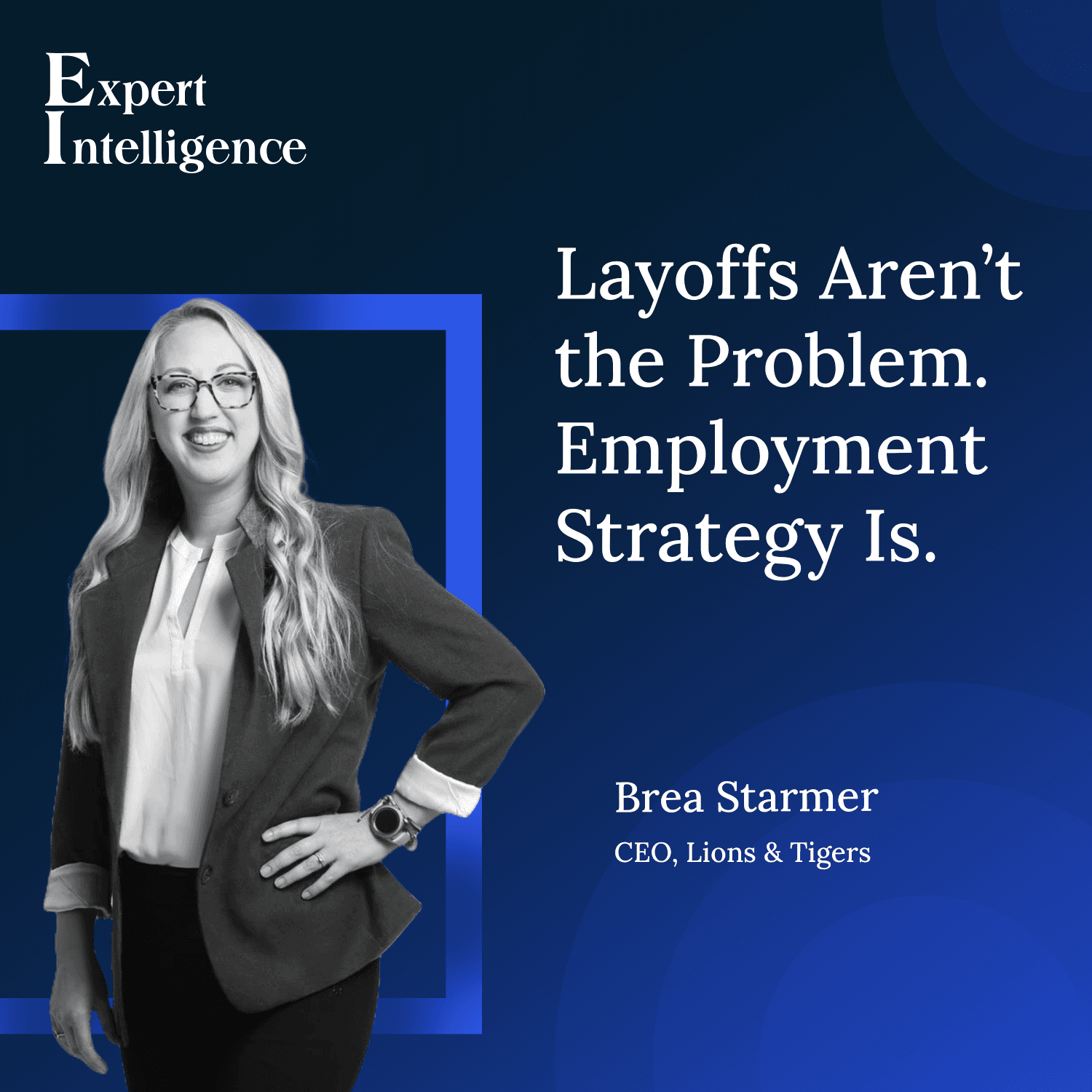
Layoffs Aren't the Problem. Employment Strategy Is. — with Brea Starmer
Episode Overview In this episode of "Expert Intelligence," host Paul Estes speaks with Brea Starmer, founder of Lions and Tigers, a company dedicated to unlocking economic opportunities for independent workers, especially women managing caregiving responsibilities. Brea shares her personal story of navigating workplace discrimination during her pregnancy and how that experience fueled her desire to create a more flexible employment model.
Key Themes
- Personal Journey to Entrepreneurship
- Brea was laid off while seven months pregnant, facing discrimination and the challenge of balancing her career with family obligations.
- The traditional employment system failed to accommodate her needs, leading her to build a company that promotes the flexibility of independent work.
- The Vision of "No More Layoffs"
- Brea advocates for blended teams of employees and independent workers as a strategy to build resilient organizations.
- The approach aims to mitigate the human costs often associated with layoffs, focusing on adaptability in the workforce.
Insights from the Discussion
- Workplace Discrimination and its Impact
- Discrimination faced by pregnant women can lead to significant career setbacks and a lack of supportive workplace structures.
- Brea's experience highlights the necessity for more inclusive policies in the workplace.
- The Rise of Independent Work
- The independent workforce is growing, with current estimates indicating they make up about 40% of the U.S. workforce.
- Changes in societal needs, particularly after the pandemic, have accelerated the shift toward gig and independent work.
- Transitioning from Employment to Independent Work
- Brea urges individuals considering the leap into independent work to ask themselves who they want to serve.
- Networking and reaching out for support plays a crucial role in transitioning successfully into independent roles.
- Fear and Uncertainty in Career Transitions
- Many individuals face fear when leaving traditional employment structures, especially during economic uncertainty.
- A clear sense of purpose and understanding of one’s values can help guide individuals through this transition.
- Change Management in Organizations
- Organizations are struggling to adapt to rapid changes in workforce dynamics.
- A blended team approach allows companies to leverage a wider array of skills and resources, leading to more effective project execution.
Actionable Takeaways
- Build Relationships: Professionals should actively engage with their networks to explore new opportunities and support systems.
- Embrace a Project Mindset: Viewing every job as a project can provide more security and flexibility than traditional employment models.
- Understand Your Worth: Identifying what you can offer and articulating your value to potential clients or employers is vital in navigating the job market.
Closing Thoughts The conversation emphasizes the importance of rethinking traditional employment structures in favor of more adaptable, human-centered approaches to work. Brea Starmer’s vision for the future of work aims to create systems that support individuals balancing career ambitions with personal responsibilities, ultimately challenging the status quo of employment.
Subscribe to "Expert Intelligence" for Future Discussions To stay informed about the evolving landscape of work and gain insights from industry leaders, subscribe to the "Expert Intelligence" podcast.
Written by AI. May contain mistakes. Listen to the episode to check what was said.
Transcript
Automatic transcript. May contain errors.0:28I was seven months pregnant. is the founder of Lions and Tigers, a company that is unlocking millions of dollars in economic opportunity for independent workers, a majority of whom are women. Born out of necessity, vision, and refusal to accept the rules of work, this is not just a company, but a blueprint for what is possible. Welcome to the show. Thanks, Paul. I'm so excited to be here. Huge fan, first-time caller. Long-time listener. Yeah, long-time listener. Thanks so much. First of all, thanks for taking the time, I want to start with your origin story, like how you got here. Because that was one of the things that was the most fascinating because it resonates with sort of my journey and I think the thing that people are experiencing.
1:09And so let me take you back. You're pregnant, you're interviewing for jobs, you're the breadwinner for the family, and you start to realize, hey man, this system wasn't built for people like me, which is strange because you're a budding mother who has a long professional career and really impressive resume. What was that moment like? Yeah, I mean, you have to imagine I was seven months pregnant. I had just been laid off from an IPO bound startup, you know, as part of a reduction in force, they let go of 20 % of the company. And I was I had all these spreadsheets, I had these plans for what it was going to look like when my kid was born, you know, I had prepared the nursery, you know, I had all these things that were underway.
1:47And then And all of a sudden, I was out of the workforce. And I faced a lot of discrimination at that time. People made a lot of judgments about my ability to do both things well. And so as I went into these interviews, it felt like I had two choices. All in at work and potentially sacrificing this very precious time with my son or all out. And as the breadwinner in my family, that really wasn't an option. And I just found that untenable, that there's nothing in the middle that would allow me to flex my ambition and my expertise while also centering flexibility. And I felt like we were leaving out a lot of folks that potentially need this option in the middle.
2:31And so I built what I couldn't find. When you talk to people who are in today's environment, sort of dealing with the same sort of thing, they might be in the same, I'm in the sandwich generation. You know, I've got parents and young kids. And I remember when my dad got sick and the company really didn't have the mechanism. This was before the pandemic, before remote work was kind of a thing. And the company just didn't have the mechanics to say, hey, you go take care of your family and work remote. And it was a binary choice of, hey, if you want to take care of your aging parents, this place isn't for you.
3:01When you see other people dealing with those sort of decisions, what advice do you give them? Yeah, I think I struggle with the struggle on behalf of HR and managers who are trying to keep folks in, sort of desperately trying to hold on to this very skilled talent who are, you know, writing our go -to-market frameworks that are trying to build products, that are trying to empathize with our customers, and they also are trying to care-give at home. So I empathize with that struggle. And also, they're not really able to keep up in our traditional workforces. They just, to your point, those models aren't built within the HR toolbox.
3:39And so what we've seen has been tremendous shift towards this independent workforce as a go-to strategy for how to stay in and own some agency around what that structure could look like. I think, Paul, you know, you were one of the first to really talk about gig mindset and how we think about that as a tool for not just individuals, but for the workforce and how we use that as a measurement of inclusion, because there aren't those options within the employee traditional handbook. And so I've been really encouraged by the hundreds, thousands of people I've talked to that have to make that choice.
4:16And it's now a much more tenable and viable option to be able to stay in, to be able to do really interesting work while these pressures at home really seem to get more intense, especially as we get older. I mean, not me, but other people. You know what I mean? Yeah. You know, when you started Lions and Tigers seven years ago, even when I first started, I'm an independent worker. I do consulting work. It was a lifeline for you and many others. And now it's a movement. The numbers have doubled. Independent workers make up, I think, 40 % of the U.S. workforce. You go talk about Google and Microsoft and others.
4:54Like, they always talk about their full-time employees. But the real numbers are almost double that. The people that are supporting the missions of the companies that are independent workers and not full-time employees. What do you think has led to that significant increase? Such a good question. And you're exactly right. There is, some people call them a shadow workforce, or I think of it as a blended team. So I've got a sort of unique point of view on that, that I think highly optimized blended teams are the way in which we will build our workforces moving forward. It's already a big part of how these organizations are working, a big part of what Lions and Tigers does in our work is building those teams.
5:29But I would say the major shift that we saw came post-pandemic. I mean, this was already happening. You already spotted this years ago that this trend was increasing. But there's been a few things that have really accelerated this. Pandemic happened, and we had a motherhood recession that we haven't seen in a long, long time. We saw women dropping out of the workforce at a rate that my grandma wouldn't even be able to understand. So we saw folks stepping back and out of their careers. Now we have seen a resurgence of, especially this is my lens as a working mom. I now have three kids, Paul. So this is my lens is that I see many of my peers participating now in the workforce because we all have to.
6:06I mean, it's just a very expensive place to live. It's a dual income household is usually what we need to pay for childcare, pay for some of the benefits that we need to run these families. And so getting back into the workforce has been the challenge and staying in. So one of the major challenges I think we've seen is just this caregiving crisis. The lack of infrastructure and support for it has been a big accelerant. But I think the rise and access of entrepreneurship has become much more available. You know, with the rise of technology and AI, we can get into solopreneurship and entrepreneurship much faster than even when I started this company seven years ago.
6:40You know, have some of these tools. I was still DIYing so much of it. And now our access is just much faster. And so I think we're seeing this rise in solopreneurship as a result. Also, we see in some industries fewer workers. And so we're seeing a shrinking labor force in tech, for example. I know you and I spend a lot of time there. And so there's just a shift in demand for full-time employees. So there's just a number of trends that have contributed to the rise of the moment that we're in that I think we can credit to this major shift that we're all trying to reconcile. It's interesting when I look at my LinkedIn messages box, I posted something to say, if anybody has been laid off, let's have coffee or have drinks or lunch.
7:23And the amount of people reaching out, one, they're going through this, you know, seven stages of grief of, hey, I identified with this job and now I don't have it. It's a super scary place to be on that sort of first day when you don't badge in, you don't have email. The Slack notifications are quiet and you're just in this quiet place and you can feel a sense of panic. And I'm sure a lot of people reach out to you in the same, given the work that you do. Yep. There's a big jump from I was an employee to now I'm a, call it a solopreneur. Hey, I hung a shingle as a consultant and I'm ready to start working in a different way because it is very different.
7:59It comes with a lot of uncertainty, also with a lot of benefit. But what are the things that you tell people who maybe the only thing they've ever known is full-time work. Yeah, I had four or five of those conversations last week, so I can reference a number of those stories. But I think the first thing that people come to me with is fear, for sure. It's the fear of the unknown. It's the release of identity. It's the release of a mindset of security too. And that is really shifting for everyone now. I think before it felt like an othering, like other people get laid off, other people get riffed.
8:34And now that just feels a lot closer to everybody. And you're right. There is this like detoxing that happens after you lose your corporate domain to think about who am I as an agent in the world, as an independent agent in the world. What do I stand for? What are my values? When you've been reading them from somebody else for so long, when this happened to me, I've been in entrepreneurship for a while. You know, I started my career at Microsoft right out of college, but I felt very pulled towards entrepreneurship pretty early on. And so I went and ran a number of businesses and I made a few dudes really rich for a while.
9:09And truly what happened for me is that motherhood really changed, of course, my perspective on the world, but it also informed for me a purpose that I didn't know that I needed. And that purpose really unfolded all of the entrepreneurship steps behind it. And so I think when people are starting to make this transition, that's the question that tends to show up for them and is unexpected. What am I working for? And so a question I often pose to them as they're in this transition is I ask them to sit with the question of who do they want to serve? And that for me was a really clarifying question because I hadn't really stopped to think about that.
9:51I had thought about growing businesses for the sake of growth. I had thought about helping and supporting egos for the sake of keeping folks going. And when I really stopped to question this in a different way, the answer was unexpected. It wasn't what I knew that I needed, and it gave me an entire now almost decades worth of work that I hadn't anticipated doing that's much, much more fulfilling than anything else in the previous chapters. So I start there. There are many resources for how to form an LLC and what taxes look like and the solopreneur life. And I think that there's lots of that that you can get into once you start practicing how to be a practitioner.
10:30But that really first step around purpose is helpful, I think, for people in transition. The interesting thing when I talk to folks is like, hey, how long have you been working? I'm like, oh, 15 years, maybe 20 years. I'm like, you've worked with a lot of people. You have a good network. You said a couple of things that really resonated. You've been taking your sort of mission and who do you serve from another person And a lot of these people haven't ever asked their network for anything. Yes. They haven't gone out and looked at LinkedIn or whatever it is. And what I found is almost 100 % of the time when you reach out to your network, it goes back to your you're not alone thing.
11:06100 % of the time when you reach out to your network and say, hey, I just want to chat. People will say yes, because we have this sort of loneliness epidemic where everybody thinks everybody else is busy and we're not connecting. And so I think the idea that you've built equity in your professional relationships is something that people forget when they lose that corporate identity. Fine, you don't work for the corporation, but all of those human connections and lunches and happy hours and travel experiences or whatever it might be still exist. When I first started this podcast, I interviewed a woman.
11:38She had a TEDx talk. In fact, it was one of the reasons I got back into podcasting. And she said, everyone's in the gig economy. Every job's a gig. I mean, this idea of security, like my dad literally retired with a Rolex watch and has a pension, right? And so that was the experience I had. That's what I thought I was going to live until I looked at my resume and like, hey, every two years, I kind of have a new job. Like there isn't this sort of stability. You said something in one of your writings about everything's a project. Tell me a little bit more about that. Yeah, I think it's a really healthy mindset for us to all take right now because things feel unstable just in general.
12:15I want to normalize the fact that it feels unstable. Just for context, you know, I've been laid off twice. I have executed three layoffs, at least, probably more in my consulting world. But I've never lost a contract. And so the idea of stability, I would question itself. Tell me more about the contract part. Well, when I've been freelancing in the past, it's all been, again, through my network or people I've wanted to serve, folks I really want to see succeed. And so I'm able to go and scope that work with them really in service of their career, how they show up. And so those relationships can be very long lasting.
12:51They can be very fulfilling, but also they can be seasonal. And there's a beauty in that, too. And so I really want to reemphasize the point that you made about going back to the folks that you have worked with before. You know, when I was laid off pregnant, I had 13 weeks until my baby was born and no maternity leave. Washington State had no paid leave at that time. So I had 13 weeks to make enough money to self-fund a maternity leave. And so I called everybody I knew. And instead, I changed my script from saying, hey, I'm looking for a leadership role on your team to, I have 13 weeks available to drive your business forward.
13:27And here's an idea for what I could do for you because I know the challenge you're facing. And I got three yeses and I build 60 hours a week for 13 weeks to save enough money for my own maternity leave. And when I emerged from that 11 weeks with my brand new baby, I said, you know what? I only want to work 25 hours. Just that's all the capacity I have right now. And so I went back to just one of those clients and said, let me stay on with you. Let me just stick with you so I can get you through this next promotion. And we were together for two years. And those relationships, I mean, that is the kind of empowerment I want people to feel is that they can own much more of this career, the throttling of what they say yes and no to on this side of the fence than I could previously when I was a bit of a victim to the system.
14:13You said something that I think you may underestimate how brave it is, but you were honest in what you were looking for. You know, even when I had leadership positions, people would come to me for career advice. And the question I'd ask is, well, what do you want? It goes back to your earlier comment. And that was the hardest question for anyone to ask. And I'm like, well, if you're going to network and you're going to get out there, even if you can look for a job and you can't articulate what you want, it's really hard for someone to help you. Being laid off happens to tons of people, but the ability to go out and just be honest about what you need or where you think your value is or what you think you can do versus just saying, hey, I need a job.
14:52It's night and day of what like the tools that the person has to help you solve that problem. Yeah, I think that that's well said because also too, a lot of people need a job. So that actually isn't special. And I don't mean that in a harsh way. I just mean that the reality is there are now business leaders who are being asked to do more with less. They have super high bars that they need to match. They're being pressured. They have less budget. And so when you enter into a conversation with one of those potential clients, buyers, managers, you have to be really empathetic to what they're trying to achieve.
15:28And those that I'm seeing get ahead now, and we've done some research recently to share with you to talk about that, these leaders are open to building these blended teams that include your voice. And so I think that that's what's really interesting is how we actually scope in the folks that want to enter into the independent workforce, want to move into the gig economy and do these projects, and the relationship they have with the enterprise leaders who are trying to draft together the right team for their next project ahead. And if we really put our mindset into that space where we're thinking about a start and a stop and an end goal, we all will be better off.
16:04We'll all be better positioned for whatever the market is going to be looking like next. We would just have a lot better defense of our own performance when we think about a start and an end to it. When you look at your clients, Fortune 500 mid-market companies, I've been advocating for this way of working the blended team concept and finding expertise wherever it is, drafting the right people, project-based work, which may sound not secure, but in a lot of ways provides a lot of security. Because one of the statistics that was always interesting to me was the re-skilling efficiency of freelancers versus people inside companies.
16:39and one of the things that I felt very acutely when I would go sit through like hours of meetings in this town hall and that town hall is that my skills were literally atrophying not only was I getting older but I was becoming like less relevant and I'd read a blog about like all these skills people had I'm like where can I get those oh after my 15th town hall meeting and this staff meeting and that staff meeting and so when you look at leaders inside these companies trying to embrace change, what tends to work? Because that's where I struggled. I saw this world. I was all excited and used my energy.
17:12And hey, we should think about engaging freelancers, even disrupting a little bit of the staffing, traditional staffing model to try to be more flexible in how we engage talent. How do you change hearts and minds inside a company? I think we're in the biggest set of change management we've ever been in. Like, I mean, this is the time at which change management practitioners should be very busy. Because not only are we seeing a big shift in culture within enterprises and within people, but also the pressure is changing and the pace is changing in a way that we wouldn't have ever seen before. Not only that, we're expecting all of these folks to sit through town halls and then also be scaling on the weekends around AI and moving faster and defending their turf and territory.
17:58So there's just so many pressures for these employees right now. And I think each employee becomes much more precious. The return on investment of each employee has to go up now. That's the expectation of shareholders. And we are change management practitioners. We've been doing this work at Lions and Tigers for years to try to understand how cultures move in light of pace and changes that are sort of outside of their control, that sort of show up on their desk and that they now need to adopt. The reason that I think blended teams are an effective strategy for how you get through that change management motion is that there are truly capacity and skills constraints with who you have on your team.
18:36It's just the reality of it. You know, I'll tell you a story. I was working at a digital marketing agency and I used to sell our services to clients, build a website, create graphic design, et cetera. I had 30 people, 30 people I could work with. I had knew the edges of their skillset. And anytime I sold outside of the edges of those skillset, we got fired, like inevitably. And now I think what's interesting for leaders who are thinking about what they need to manage up, the promises that they need to make, the edges are actually much, much broader because we have access to so many more skilled workers and at fractions that we could bring them in.
19:11So you can make bigger promises, bigger bets, bigger tests than you had before, while also being respectful of the folks that you're trying to not burn out. And the gig economy and the independent workforce really is that capacity and lever that was missing from these past, even traditional staffing models, where you still had to think about a full-time worker coming in, a tightly scoped project, and hoping that that unicorn employee could do all of those things. Now you can turn that into fractions and really blend together the exact right capacity that you need. You said something that was interesting around reskilling on the weekends.
19:45We both live here in Washington State. We're not short on Fortune 500 companies, so we all have friends and former colleagues and stuff that work at these companies. And the one thing that I'm seeing across all of them, when I go and advocate for AI or even try to help do some AI literacy, isn't their lack of desire to want to learn about AI or their lack of knowledge that it's actually a transformational technology. They literally do not have the time to sit and learn or sit and experiment. And part of it is time that they don't have because they're in meetings all day if you go look at their calendars, but it's also they don't feel safe.
20:19I mean, using this technology is experimental. It's a messy sort of space where AI is right now. And if you don't feel safe, going to experiment with an experimental technology in a job where, hey, I'm not really sure if I'll be here tomorrow, minus the time kind of leaves people in that way I felt in 2018 of, hey, if I don't find new skills, I'm not going to crank out another 10 years or 15 years of this thing called work. I think you're hitting on a really key fear. And I hear this often. On Friday night, I was at a big gala for women in cloud, awarding a number of women entrepreneurs and folks that have come before me, shoulders that I certainly stand on.
20:58And there was a buzz in the room with that exact same tension. The fact that people feel like they're falling behind already. And if you follow AI influencers, you certainly feel like you're behind already. If we're not like agentic to agentic already, like you're way behind. But yes, there is the reality. You mentioned you're a caregiver in the sandwich generation. There are very practical, like hands-on things you need to do with your life and your time. And so, yes, that tension is very true. And also, the folks that are between gigs and the independent workforce have the time to skill up potentially between projects.
21:33And that's a risk. That is a risk for employers and for employees who are trying to stay active and stay abreast of these trends. And that could be a gap that continues to widen. That's one of the things I'm seeing more and more. You know, the hype cycle is real. I kind of have to put down the algorithms. I mean, the algorithms are a little over their skis when it comes to the AI stuff. I'm not saying agents aren't a thing and that they're not going to be impactful. I'm not saying AIs. But when you actually try to build this stuff into production, you take a hype influencer and you say, okay, I'm going to take exactly what that person did.
22:07I'm going to build the exact same thing. And then you hit, you know, run. It's a very different output that you get and you start to realize where the cracks are in the hype cycle. You said something in one of your writings that your dream is no more layoffs. I too was, I was a chief of staff. And so I have experience with looking at those lists and trying to write size of business when the business changes and you have to go through those. What do you mean by that? So when I was laid off pregnant, Paul, you know, it wasn't necessarily the layoff and all of the disruption that that caused in my life that I was concerned with.
22:41It was the fact that I was there as an employee in the first place. You know, I was on an experimental product. We did not have product market fit, much less we were way ahead of that. I mean, we didn't even have a customer. We didn't have it. I mean, we were way over our skis and there were 60 of us. Can you imagine putting 60 employees at our level out on an experimental product that had no revenue, no line of sight to revenue for years, and just hoping that it was going to work out. I mean, that's a wild misuse of resources, I think. And I would have a dream, you know, this is my idealistic world, where we as leaders have the technology, insights, and intuition that we would invest in employees where it makes the most sense, and we would test and plan with the independent workforce where it doesn't, and we don't yet have certainty.
23:31I do that in my business. I run Lions and Tigers this way. We are a blended team. I'm currently testing a new business development strategy. I don't know if it's going to work out, but I'm going to take a swing at it and I'm doing it with a 12-month contractor. And I'm doing that so that she has expectations. I've got expectations. I know my costs and my risk. And if it works out, amazing. Perhaps I'll convert her or I'll find the right person to take that role as we invest in it 12 months from now. But I think that's just a mini example of how we as leaders need to be shepherds, stewards of the resources that are given to us on behalf of the shareholders that are entrusting us.
24:04And if we're really mindful about workforce planning, we'll do it in a way that we use the independent workforce for good. Bree, thank you for your time. It was great to be connected to you through our mutual friend. Bree reminds us that the future of work is about orchestrating humans and AI is something more powerful than some of its parts. Her vision challenges us to think beyond traditional employment models towards something more flexible. inclusive, and human. Bria, thank you for this conversation. And until next time, everyone, stay curious. Thanks, Paul.
From the publisher
Brea Starmer helped build the future of work out of necessity. As founder of Lions and Tigers, she's unlocking millions in economic opportunity for independent workers, particularly women navigating caregiving responsibilities. When Brea was laid off seven months pregnant, facing workplace discrimination, and having to choose between career ambition and family flexibility, she discovered that the traditional employment system simply wasn't designed for people like her.
What started as personal survival—self-funding her own maternity leave by billing 60 hours a week for 13 weeks—evolved into a movement reshaping how enterprises think about workforce planning. Brea's vision of "no more layoffs" is a practical blueprint for using blended teams of employees and independent workers to build more resilient, flexible organizations that can adapt to rapid change without devastating human costs.
You'll Learn:- How workplace discrimination during pregnancy led to building a multi-million dollar company serving independent workers
- Why an "everything's a project" mindset creates more security than traditional employment in today's economy
- The critical first question to ask when transitioning from employee to independent work: "Who do you want to serve?"
- Why enterprises are struggling with change management
- How to leverage your existing network when making the leap to independent work
Subscribe to the Expert Intelligence podcast today so you don't miss future conversations with industry leaders at the forefront of technological transformation.