
In short
Expert Intelligence Podcast Episode Notes
Episode Title
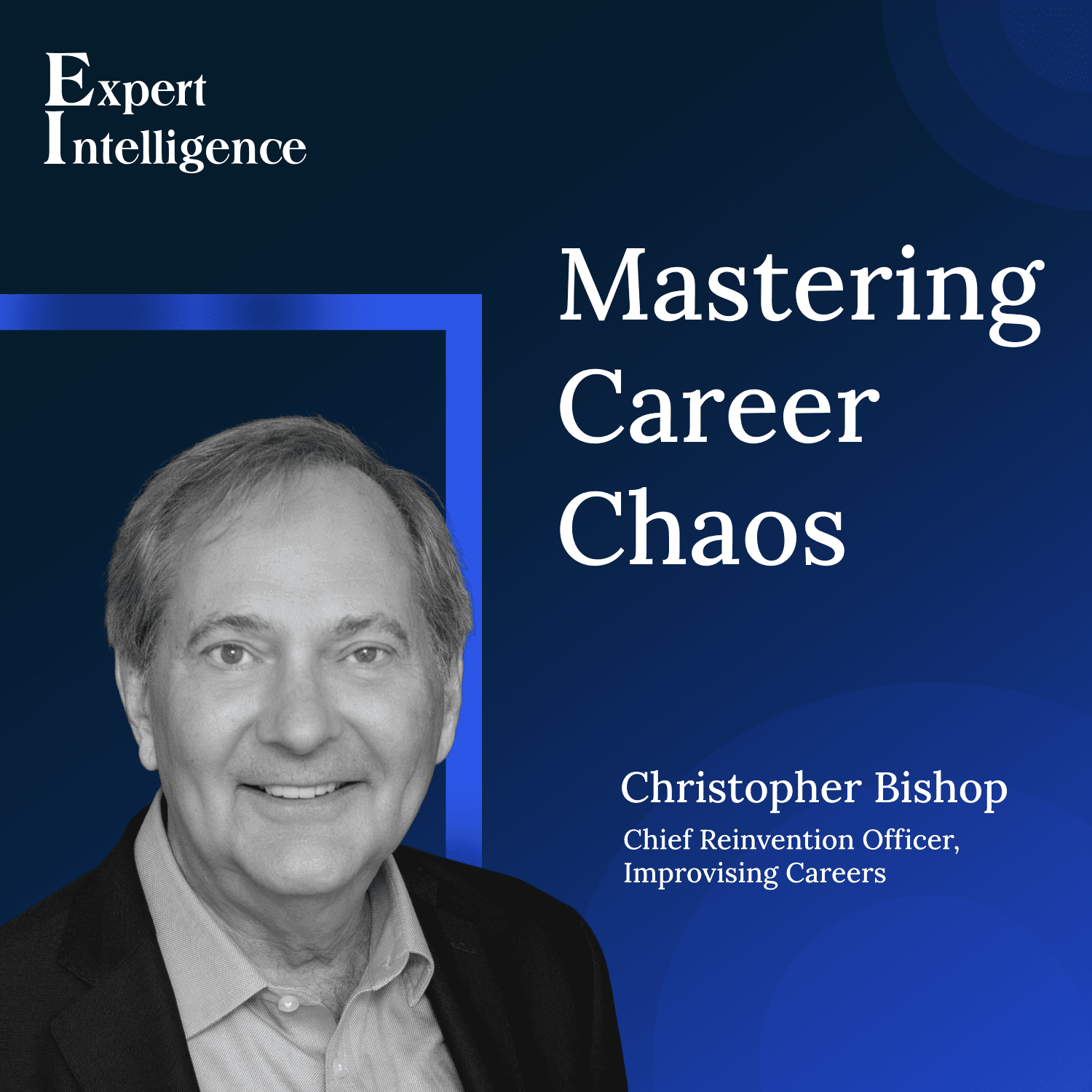
Mastering Career Chaos with Christopher Bishop
Overview In this episode, Paul Estes interviews Christopher Bishop, a self-described "nonlinear multimodal careerist" who has successfully navigated eight different careers. Bishop shares insights from his new book, *Improvising Careers: Succeed in Jobs That Don't Exist Yet*, explaining how to thrive in an evolving job market where the average person may hold 8-10 jobs by age 38.
Key Themes and Concepts
- Chasing the Maelstrom
- Emphasizes the importance of pursuing fields where business models are being transformed by emerging technologies.
- Encourages listeners to confront and embrace chaos in career paths.
- Career Transitions and Transferable Skills
- Bishop's journey from rock musician to IBM executive showcases the adaptability of skills across diverse fields.
- Recognizes the importance of identifying and leveraging transferable skills in new job environments.
- The Future Career Toolkit
- Introduces a set of practical tools designed to help individuals navigate their careers amid rapid technological advancements:
- Voice: Identifying personal strengths and interests through triggers like books or films.
- Antenna: Keeping informed about industry conversations and trends through various media.
- Mesh: Building networks by connecting with influential figures in one’s field.
- The Value of Proactive Job Applications
- Advises applying for positions even if candidates only meet 60% of the qualifications, especially in fast-paced tech sectors.
- Encourages candidates to take risks and embrace opportunities despite uncertainty.
- Harnessing AI and Technological Change
- Discusses the perspective of AI as a tool rather than a threat, emphasizing the need for individuals to adapt and learn how to use these tools effectively.
- Highlights the transformative potential of AI and quantum computing in the job market.
Notable Quotes
- “Chase the maelstrom, find the chaos, go for the mayhem.”
- “If you have 60% of the skills in the job rec, you should apply for the job.”
- “AI won't replace managers, but managers who use AI will replace the ones who don't.”
Practical Strategies
- Networking: Connect with industry leaders through platforms like LinkedIn, and attend events or webinars to foster professional relationships.
- Continuous Learning: Stay curious and adaptable to the evolving demands of the job market.
- Confidence Building: Develop a professional persona to help navigate new environments and challenges.
Conclusion The episode serves as a motivational guide for navigating career changes in a rapidly evolving landscape. Through the lens of Christopher Bishop's diverse experiences, listeners are encouraged to embrace chaos, leverage transferable skills, and proactively seek opportunities in emerging fields.
Additional Resources
- *Improvising Careers: Succeed in Jobs That Don't Exist Yet* - [Pre-order here](https://bit.ly/improvisingcareers)
Subscribe Stay tuned for more insightful discussions on the *Expert Intelligence* podcast, available bi-weekly.
Written by AI. May contain mistakes. Listen to the episode to check what was said.
Transcript
Automatic transcript. May contain errors.0:00As you said, the same qualities that made you successful as a freelance bass player in Manhattan will make you successful at IBM. She goes, so can you start next week? I was like, what? Who, me? Wait, you want me to work at IBM? If you have 60 % of the skills in the job rec, you should apply for the job. The rate and pace at which things are changing is so fast that they don't have time to be picky.
0:24Today's guest is Christopher Bishop, a self-described nonlinear, multimodal careerist who's navigated eight careers in his time. His journey's taken him from some of the world's biggest stages as a touring rock musician to an IBM executive to a quantum technology expert. All of this hard-earned wisdom is in his new book, Improvising Careers, Succeed at Jobs That Don't Exist Yet. This will help us all navigate a world of multiple careers, both today and in the future. Chris, welcome to the Expert Intelligence Podcast. Well, thank you, Paul. I'm delighted to be here. Thanks for the invitation. Before we get started talking about your book, I want to ask you one simple question.
1:01What's going on in the job market. It's burgeoning, as it always does, driven by leading edge technology. But when you talk to people, and I'm sure you talk to many, it feels different. It feels different this time than the technology I experienced when I started my first job at Dell and back when you were at IBM. What's different now? I think the rate and pace for sure, you know, to be simplistic, you know, tools like generative AI and certainly quantum information science, and then adjacent and ancillary tech like robotics and biotech and crypto assets, you know, are all changing the way people work and the attendant skills they need to be successful in today's careers and the ones that are coming up.
1:42But I think as in any era, beginning with really the Luddites being terrified of economies moving out of the household and into a building, you know, away from the household into the market, if you will. We've been having these conversations for literally hundreds of years. I think the key is my net-net advice to people thinking about careers today is chase the maelstrom, find the chaos, go for the mayhem. Meaning, go where they don't know what it is yet. The royal they being existing business models, if you will. Because they're all going to be transformed by these technologies, whether they like it or not.
2:23Not embracing these new tools is a going out of business strategy. So that's exciting to me, though, as a potential marketplace for workers. There's lots of cool, new, interesting stuff to do. We were talking right before the show about the music you play and sort of your career. How do you keep the curiosity through all of your different experiences? How have you kept the energy to stay interested? Because one of the things that I experience sometimes and I know others is it's just hard to get through the day. I mean, I'm inherently curious. I guess that's the net-net. But also there are various factors that have driven my curiosity at some kind of meta level.
3:03So my first gig out of college was touring with this country rock band. I wanted to learn how to be a professional, be on the road. And lucky for me, I got a chance to audition and got this gig and then had to learn how to sort of play at a professional level. I mean, I was in a band. I did three albums with this band. We opened for the Eagles, for ZZ Top, for Fleetwood Mac, Frank Zappa. I was like, oh, I know how to do this, but I don't really know how to do that. So, I mean, I know how to play and sing and perform, you know, at a college frat party or whatever. But the level of focus required to perform in front of 18 ,000 people opening for a major recording act is a different set of skills that require refinement.
3:43So the curiosity around how I want to live. When I lived in New York, I was a studio musician. Actually, I was living in Ithaca, New York, with this band, McKendree Spring. And when they broke up, it was like, well, let's see, I could stay in Ithaca and, you know, deliver newspapers, get a tube boot for the Ithaca Journal, and play in local bars, which I did for a while. And I was like, wait a minute, I want to see if I can run with the big dogs. Let me move to New York and see if I can make a living as a bass player. And, you know, to be fair, I got my butt kicked. I mean, it's New York after all, probably the best players on the planet, if not some of the best players, are in the city.
4:23So it's always around being curious, but being ready to learn and adapt and change. I want to go back to 2013. You did an amazing TEDx talk that I had the opportunity to check out. And there was an IBM executive. So you made the pivot. You made the pivot from being a musician to going to work. At the time, probably one of the largest technology companies that was pretty straight as an arrow. I'm trying to imagine you show up with your long hair and then putting on a blue suit with a tie at IBM. But there were two things that were interesting from that talk. One was when an IBM executive told you the qualities that make you successful as a musician will make you successful here at IBM.
5:05And the second one is that your pivot from a musician to a corporate executive was all because of jingles. Help me understand a little bit how you made that transition, how one day you're playing in front of lots of people, and the next day you're showing up at a corporate meeting in a windowless meeting room talking about technology. Yeah, so it's an interesting story, I must say, with all lack of modesties. Again, back to the topic of being driven by technology. So I came off the road at some point, I was living in Manhattan, said to my friends, you know, how do I sleep in my own bed at night?
5:43My musician friends in New York, you know, how do I go to the Holiday Inn, dressing room, disco after the gig, airplane lounge, circuit? They said, jingles, man, you got to break into the session scene. So I was like, okay, well, how do I do that? So I tracked down anyone and everyone I knew in that business. Players, obviously, but singers, writers, copyists, producers, recording engineers, creative directors at ad agencies, and eventually broke in and got one producer who thought I was a good enough player and had the ability to do what he needed and got a gig playing on a Miller Genuine Draft Beer commercial, and boom, I was in.
6:22I then had a reel, right? Again, the technology piece is around my first reel job, which was working at a jingle house. So I moved up the proverbial value chain. I joined the jingle business first as a player, then as an arranger, then as a composer, then as a producer. kind of moving up into the higher levels of responsibility and remuneration for sure. But I went to work. I got a job at a jingle house working for this guy who had been the musical director for the Four Seasons. So he owned a Synclavier, which was the state-of-the-art digital musical instrument at the time. So my contention is in 1985 in New York, music became data, and you had to either jump in or get out of the music business.
7:07The advent of samplers and sequencers, device, MIDI, musical instrument digital interface, the ability to kind of manipulate audio as information completely changed the music biz. So I bought a Mac Plus. I learned how to sequence and program on it, how to compose on it, because I wanted to stay in the music biz. Again, a meta message to all your listeners is I had transferable skills, and I had a delta, I had a gap. I knew how to compose and play and perform and arrange, but I didn't know how to do it on a computer. So I learned how to do it on a computer. Then I learned how to do it on a Sinclair.
7:43And again, the transfer to the private sector conversation is in the jingle biz, you have a certain set of actors. And in the web biz, that was my segue, it was learning how to be a web producer. You have different sets of players, but you have a similar goal. So in the jingle biz, the output is a 30-second piece of music. And the actors are a guitar player and a singer and a recording engineer and a copyist maybe. But at the end of the day, there's a client and a budget and deliverable. So I saw that this wacky thing called the World Wide Web was coming. And to be honest, I naively thought they were going to have audio.
8:18I couldn't imagine the web being mute. So I said, well, maybe I'll write music for websites. Needless to say, that didn't happen. But I learned how to produce websites by studying the skill needs of the actors or players in the web biz and transferring sort of the jingle skills to the web biz. So in the web biz, there's a coder and a scripter and a graphic designer and someone doing QA and someone dealing with the client, an account manager maybe. But at the end of the day, there's a client and a budget and deliverable. So at a meta level, I was able to transfer the jingle skills to the web biz.
8:53Now the segue is I met a woman on the train commuting into New York who worked at IBM, and we stayed in touch. At one point she said, would you ever consider working at IBM? I was working at a couple of seminal interactive agencies in New York at the time. I said, what would I do at IBM? I'm like a rock and roll bass player, really. She said, well, just go meet with my VP. She's an interesting woman. I think you'll have an interesting conversation. So I did, and I gave her my resume, which had a lot of music stuff on it, including the jingle biz and the touring. And as you quoted at the beginning of this question, I know it's a long-winded answer, but I think it's interesting.
9:29She looked at me and said, no, I get it. I'm a singer. And she said, the same qualities that made you successful as a freelance bass player in Manhattan will make you successful at IBM. And she listed off the criteria. She said, you're going to have to be a creative problem solver. You're going to have to be resourceful and resilient. You're going to have to be comfortable with ambiguity. You're going to have to be able to work across disciplines. You're going to have to be aware of your role as a global citizen. I mean, to paraphrase Lord Calvin, I guess the sun never sets on IBM. you know, we're cranking in 190 countries 24-7, and a two-beat pause, and she goes, so can you start next week?
10:05I was like, what? Who, me? You didn't hear what I said. I told you to Robert Palmer. What? You want me to work at IBM? So anyway, I worked there for 15 years in a bunch of different roles, and it was like going to business school, needless to say. But again, I would encourage listeners to be aware of the fact that those kind of transitions can happen more and more, especially today, the way technology is transforming the workplace. You talk to a lot of folks, not only on quantum computing, but also just careers in general. You had eight careers in your life. What is the resistance that they have to sort of leaning in and talking about the skills that they have in a way that is transferable to where they may want to go?
10:46The current sort of model for education, again, writ large, operates at a glacial pace. so there are anecdotal stories around people studying say technology driven disciplines computer science whatever in college and then getting out of school and discovering that those skills are no longer relevant I mean I don't think they're teaching Qiskit and Qsharp computer languages to develop quantum algorithms at only a few universities maybe MIT maybe Caltech you know maybe UC Berkeley but the idea is getting students and even anyone wherever they are in their career journey to realize that this is a model that's been going on for years and to sort of reflect on what they know how to do, take stock of where their skill sets are, what kind of expertise or experience they have, and then just be aware that there's going to be a new set of criteria that they're going to have to understand and embrace based on what they're interested in doing next and then after that.
11:48And that's always going to go on. It's never stopping and the pace is accelerating. I want to pivot to your book. You had reached out and that's how we got connected. And you have a career toolkit that you outlined that has voice, antenna, and mesh, which are interesting abstract words in and of themselves. But can you just take me through a little bit of how these three components come together and help people make sense of the pace of change, but also just the amount of technology? It's not just the web this time. it's as you say it's quantum it's ai it's it's a bunch of different crypto and and and help us understand these three components yeah so i have to preface this answer by saying that i've been working on these concepts for a while um looking to find a way to sort of codify how i navigated these eight different careers and i remember giving a talk a lecture at a millennial workplace actually like a it's a place where these young consultants track down experts and interview them for clients, right?
12:49So I sort of gave my spiel, and I have a lot of sort of economic historical data to back up what I'm defending or describing. And at the very end, this young woman raised her hand and said, so how do we actually do it? And I was like, well, that's a good question. Let me come back to you. She busted me on the spot. I was like, yeah, I need to get some way, put together some intentional prescriptive process for these kids at this point to learn how to do it. So anyway, that was the gestation of the Future Career Toolkit. The three tools are, as you said, voice, antenna, and mesh. Voice is an exercise where I ask participants to use triggers, your favorite book, movie, TV show, or game, to identify what resonates with you as a way to get to sort of your personal brand, if you will, what really speaks to you.
13:43So for me, for example, when I do this, I cite Blade Runner 2049 as my favorite movie because it's sort of bleeding-edge tech and implications for society and culture. And my favorite book is more the history of economics from the Iron Age to the Information Age, written by Philip Coggin. He's a writer for The Economist. So I'm always interested in how business and economics drive skills and jobs, right? So that's kind of the voice piece. Once you've identified those triggers, those focus areas, the second tool is antenna. And I ask participants to look for where conversations are going on around the topics that they teased out.
14:25And they can be anything from elite newspapers to TikTok. You know, wherever you get your information, it can be TV shows, can be Twitch watching gamers, whatever. You know, where are these conversations going on? Identify the sources and put together a schedule. So for me, I read the New York Times every day. I watch BBC Click every week. That's a British show that talks about bleeding-edge tech and how it might come to market. So I, you know, don't put any parameters around where people get their information because the sources are myriad. You know, the good news is there are lots of places to get information about bleeding-edge tech.
15:01The bad news is there are lots of places to get information about bleeding-edge tech. So doing triage on the tsunami of information is the challenge. And then the third tool is Mesh, which is like a sort of 3D data visualization exercise, but finding the actual people and companies and organizations that are leading these conversations. In my book, I encourage people to find the Miles Davis in their discipline. So I'm hoping your viewers or listeners know who Miles Davis is. And I qualify it as well for people who aren't as old as me. Who's the Serena Williams? Who's the Taylor Swift? Who's the Tony Hawk?
15:36Someone is at the top of the function. So start there, put some Boolean parameters into LinkedIn, and find the person leading those conversations and or his or her team or colleagues or people in his or her network, right? And connect with them, track them down on LinkedIn. Follow their blog. If they're an academic person, look for their content on website or academia.edu or on the archive, right, the preprint website and connect with them and get on their proverbial radar and follow what they do. If they're speaking at a live event, go meet them in person, introduce yourself. If they're doing a webinar, put a creative question into the chat so you get some attention.
16:21And that's the way you sort of find jobs in the 21st century's global borderless workplace. You know what's fascinating to me is that every time I reach out to an author or to someone who wrote an interesting and thoughtful piece of blog content, more often than not, they respond. And I think we live in this place where we're all on Zoom calls or maybe working remotely and you consume information, but we don't feel as comfortable reaching out as if we would if we worked with folks. And the one thing I try to leave people with is building on your mesh comment is LinkedIn or whatever you go to learn about professional things.
17:01Don't be afraid to reach out, but do it thoughtfully. You know, do it with intention. Yeah. In a reason on why you find their work as a content creator, you're a content creator as well. It's hard to put that stuff out there. You're thinking sort of out in the open. And when people reach out to you, it feels good. And it also makes you smarter and validates or makes your content and thinking better. Yeah. I always encourage students, especially when I talk to students, but even mid-career professionals, to be proactive. Some of these students, they're scientists, obviously, or they're maybe introverted or they're not totally comfortable pitching or being proactive about their skills or experience.
17:41And I say, first of all, just at a meta level, be confident. know that you have a set of skills that are valuable. Sometimes I encourage them to do things like take an acting class, like develop a persona that you can use in those kinds of settings, sort of step out of your sort of personal view and step into this other kind of persona. I sort of did that at IBM, like when I was looking at these execs doing presentations, talking about numbers and trending and cash flow and whatever, and I thought, well, you know, I bet I could recast my rock and roll persona and do that if I learn the content.
18:16I'm not afraid of the spotlight. I'm comfortable in front of a crowd. So, for example, I went to the on-demand speakers bureau at the time and said, I want to learn how to do this. And the guy who ran it gave me a deck and learned it, and I came back to him, and I was able to sort of transition into this role. It was sort of a different kind of thing. It wasn't me playing the bass and singing and fronting a band, jumping ground, but it was, again, a sort of persona that I was comfortable with that I had developed that I could use. The other thing I would say to listeners is, and certainly specific to job recs, if you have 60 % of the skills in the job rec and you like the company and you are, say, a fan of the executives, the men and women running the business or whatever, you should apply for the job, especially if it's in a bleeding-edge tech setting because the rate and pace at which things are changing, especially in an area where I'm focused, which is quantum, is so fast that they don't have time to be picky.
19:15They don't have time to be too highfalutin about who they hire. If you have skills that are directionally correct, as we say in the consulting business, and you like the company, put your resume in and see what happens. Or connect with them on LinkedIn and introduce yourself. If you see an interesting company, being aware that you have transferable skills, but again, you may have to learn something new. They're great examples, especially in quantum, of people coming from varied backgrounds that then get trained by the quantum company to do what they need them to do because it's moving fast. And this is really probably the first generation, for example, of students who are graduating with degrees in quantum and are able to get a job at a quantum company.
19:58That wasn't an option like five years ago. There was no marketplace for that kind of talent. And companies, especially in quantum and even crypto, So we're going to have to train you as they go because it's literally being vented week by week, month by month. And so there isn't a pool of people that have law degrees that are applying decades or centuries worth of law against cases. This is being made up in real time. Yeah, absolutely. And ways to apply new technologies, right? That's, again, back to my Chase the Maelstrom comment. Like, find something new and then you can contribute. You can be creative.
20:31You can help design and develop something that's new and innovative, which is more fun than, to be candid, working at a storied, say, tech company or whatever and waiting for the gold watch. I mean, the years of hunkering down at IBM for 30 years are gone. That said, I worked with people who'd been there 25 years, 30 years, 35 years. One guy, with all due respect, kind of wandering around, been there 40 years. It's like, Bob, why don't you retire, man? you're not really delivering any value. What you get really good at doing is working at IBM, gaming the annual performance review, knowing who to suck up to, how to pass off blame if you blew it and make someone else responsible.
21:12I mean, I'm being candid and bordering on unkind, but I mean, again, I try to end my lectures by saying to students, you guys and gals are going to do stuff that's going to look like magic to me. So get to it. I want to see some of it. Like, I want to experience some of this amazing, innovative stuff you're going to do. You know, get them excited. Get them enthusiastic and not paralyzed and paranoid and feeling like lost or confused. It's like there's lots of cool stuff to do out there. So come on, let's go. I listened to an episode of Cubic Confidential, and you interviewed Horizon X's CEO, Steve Suarez.
21:49And you guys were talking about AI agents. And so I'd be remiss to have a conversation with someone about careers and not to talk about AI. But you guys talked about creating value through optimization. So how should we think about working next to autonomous agents? People working in the industry are saying, hey, it's around the corner. It's not something a decade away. And OpenAI is now selling PhD-level, well-trained models for$20 ,000 a month. And if somebody pays for it, that's sort of product market fit on the fact that these agents have pretty significant cognitive abilities. So how do I think about, with all that you've experienced and even working in the bleeding edge of quantum, how do I think about the upcoming AI agent wave?
22:35Well, I think, again, at a meta level, you have to think of them as tools. It's all down to tools. And I always say we've been dealing with creating tools writ large to help humanity since we were wandering around in the Pleistocene wilderness and the technology was like a long stick with a sharp end. And now it's manipulating photons and subatomic particles. So AI is sort of the next installment, if you will, of technology, of like leading-edge tools. There's a great quote in the Harvard Business Review that's germane to this topic, which is, AI won't replace managers, but managers who use AI will replace the ones who don't.
23:15So again, the meta message is learning how to incorporate these tools and how to exploit them to deliver value, drive business models. That's what it's all about kind of at the end of the day. So I think we have to be ready. It's going to be transformative for sure. And the corollary to quantum is because quantum has this exponentially greater power to collect and rationalize data. I don't know if your listeners are aware of quantum supremacy, but the first sort of instantiation of that was when Google's Sycamore quantum computer in 2019 solved a problem, albeit a toy problem, but solved it in 200 seconds with the contention that a classical computer would have taken 10 ,000 years to solve the same problem.
23:58So that's the kind of exponential data manipulation we're talking about. And again, the corollary is like every business needs to capture and rationalize and manipulate data, right? Otherwise, it's a going out of business strategy. So the combination of AI and the powerful compute power of quantum will be a terrifically exciting, somewhat threatening paradigm that we've got to all get ready to embrace. Well, someone who's navigated it eight times, I can't imagine that the 18-year-old Christopher on stage would have imagined himself sitting talking about quantum computing, much less a storied career at IBM.
24:39No, it's been interesting so far. That's always my rejoinder. What's one thing that this version of yourself would have told the 20-year-old version of yourself? To relax and enjoy it and be ready to do interesting stuff and don't be intimidated. Follow your gut. Trust your instincts. If you're not doing the right thing, the universe will tell you. Use your spidey sense. It's visceral on every level. So I would encourage, again, listeners to, thinking about multiple careers, if you want to do more than one thing, which you will. I mean, again, more of fora. The U.S. Bureau of Labor Statistics says that today's learners are going to have 8 to 10 jobs by the time they're 38, not because they get fired, but because they can.
25:26I mean, standard mean deviation indicates some will have more, some will have less. But again, to me, as a nonlinear multimodal careerist, that represents opportunity to do lots of interesting stuff. I think I would have said to myself, just follow your heart, trust your gut, and it's going to be fun. It's going to be interesting. It's all going to work out okay. Even better. It's going to be like really unique and personal and special and a good time. Chris, thank you so much for taking the time. Everyone out there, keep learning. Stay curious. And Chris, I'll put all the information into the show notes on your book and some of your talks and the great work that you're doing.
26:04Well, thank you for the opportunity. And I would encourage listeners to, you can pre-order my book on Barnes & Noble and looking to drive a certain level of response. I guess it gets their attention if it gets beyond a certain number. So this is me, unabashed self-promotion. Please go to barnesandnoble.com and look for my book. I was there this morning, so I look forward to reading it. Great. Thanks again. I really enjoyed it, Paul. Take care.
26:42Thank you.
From the publisher
Christopher Bishop, a self-described "nonlinear multimodal careerist" who's navigated eight careers, joins Paul Estes to discuss his new book Improvising Careers: Succeed in Jobs That Don't Exist Yet (pre-order here). From touring rock musician opening for the Eagles to IBM executive to quantum technology expert, Christopher shares how to thrive in a world where the average person will have 8-10 jobs by age 38.
In this compelling conversation, Christopher reveals his "Future Career Toolkit" featuring practical tools for identifying your strengths and finding opportunities in emerging fields. Paul and Christopher explore how to leverage transferable skills, the importance of embracing technological chaos, and why you should apply for jobs even when you only have 60% of the listed requirements.
You'll Learn:
- Why you should "chase the maelstrom" and seek out areas where business models are being transformed by new technologies
- How Christopher transitioned from a professional musician to an IBM executive by recognizing transferable skills
- The "Future Career Toolkit"
- Why you should apply for jobs even if you don't have all the requirements, especially in bleeding-edge tech
- How to develop a workplace "persona" that helps you succeed in new environments
- Why the upcoming AI agent revolution represents opportunities rather than threats
- Practical strategies for connecting with industry leaders to find career opportunities
Subscribe to the Expert Intelligence podcast so you don't miss future conversations.