
In short
Expert Intelligence with Paul Estes - Episode Summary
Episode Title
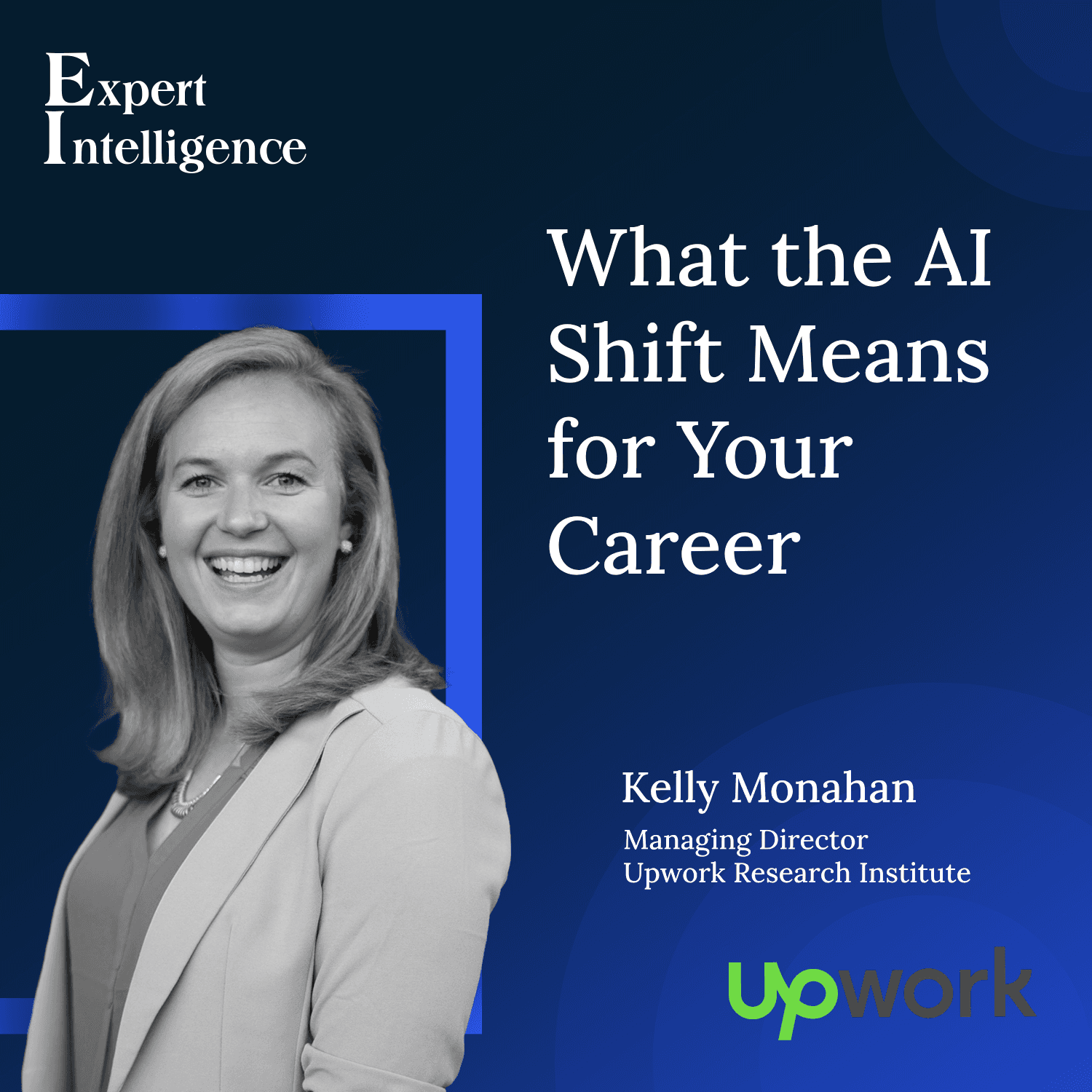
What the AI Shift Means for Your Career with Kelly Monahan
Episode Description In this episode, Paul Estes interviews Kelly Monahan, Managing Director of Upwork's Research Institute and co-author of "Essential." They discuss the complex dynamics of the labor market influenced by AI, where 77% of employees feel that AI complicates their work instead of easing it. Kelly emphasizes the need for leaders to adapt to these changes and introduces frameworks for becoming 'anti-fragile' in a rapidly evolving workplace.
---
Key Themes and Discussions
The AI Productivity Paradox
- Definition: The phenomenon where new technology (like AI) is expected to enhance productivity but often leads to short-term inefficiencies.
- Insight: Historically, productivity gains from new tech are overstated initially and underestimated in long-term impacts.
- Relevance: Many executives expect instant productivity increases from AI, while employees often feel the opposite.
Misalignment Between Leadership and Workforce
- Disconnect: Leaders view AI as a tool for automation, while employees see it as a source of increased complexity.
- Trust Issues: There is a significant lack of trust in AI outputs among employees, contributing to a friction-filled work environment.
Transitioning from Degrees to Skills
- Shift in Employment Landscape: The traditional value of a college degree is declining; skills are becoming paramount.
- Need for Credentialization: Developing systems to recognize and validate skills rather than relying solely on formal education is vital.
- Exciting Opportunities: The shift away from degree-centric hiring could democratize access to high-paying jobs.
Anti-Fragility Framework
- Concept: Moving beyond resilience (the capacity to withstand shocks) to anti-fragility (the ability to adapt and thrive amid disruptions).
- Application: Workers must pivot their skillsets and embrace continuous learning to remain relevant.
Effective AI Strategies
- Organizational Level:
- Focus on Value Creation: AI should be leveraged not just for cost-cutting but for innovation and new market opportunities.
- Alignment of Goals: Ensuring that organizational strategies around AI are clearly communicated and aligned with employee experiences is crucial.
- Individual Level:
- Reframe Work: Employees need to find ways to use AI to free up time for creative and value-add projects instead of engaging in busy work.
---
Practical Takeaways
- Building Skills: Workers should prioritize learning how to effectively use AI tools to enhance their roles rather than viewing them as threats.
- Diverse Inputs: Engaging with diverse perspectives and knowledge is essential for fostering creativity in the workplace.
- Cognitive Capacity Management: Understanding personal peak productivity times can enhance creative output and decision-making.
---
References Mentioned
- [Essential](https://www.amazon.com/Essential-Distributed-Generative-Human-Powered-Leadership/dp/1394276583) by Christie Smith and Kelly Monahan
- [Antifragile](https://www.amazon.com/Antifragile-Things-That-Disorder-Incerto/dp/0812979680) by Nassim Nicholas Taleb
- [The Black Swan](https://www.amazon.com/Black-Swan-Improbable-Robustness-Fragility/dp/081297381X) by Nassim Nicholas Taleb
- [Thinking, Fast and Slow](https://www.amazon.com/Thinking-Fast-Slow-Daniel-Kahneman/dp/0374533555) by Daniel Kahneman
---
Conclusion This episode emphasizes the ongoing transformation in the workplace due to AI and the importance of adapting to these changes. By focusing on skill development and embracing a mindset of anti-fragility, both leaders and employees can navigate the complexities of the modern work environment effectively.
Subscribe to "Expert Intelligence" for more insights into navigating the evolving world of work.
Written by AI. May contain mistakes. Listen to the episode to check what was said.
Transcript
Automatic transcript. May contain errors.0:00There's a huge miscommunication and disconnect in the organization today. Leaders are trying to use this as an automation substitution tool. The reality is humans are going to always need to be in the loop. We, quite frankly, still don't trust the AI output. There's this friction that's happening of we want to see productivity gains at the very top. But from a grounds-up perspective, we know that the technology is not at all close to where leaders think if they're looking at this for pure automation or substitution.
0:28Today, we're joined by Kelly Monahan, whose research is helping us all navigate the current dynamic landscape. From the insights in her latest book, Essential, which focuses on distributed teams and gen AI, to her cutting-edge research as a managing director of Upwork's Research Institute. Her latest research reveals that 77 % of employees feel that AI makes work harder, not easier. And she knows why and how to fix it. Kelly, welcome to the podcast. Thanks so much, Paul. It's a pleasure to be here today. So I follow your work. I love your insights. Anybody who wants to get a really practical, non-hype view of what's going on and insights that help you navigate things, I recommend you following Kelly.
1:05But I want to start with what is going on? You know, all this attempt to attribute dynamic shifts we're seeing in the labor markets purely to AI. So as someone who spends their professional time trying to understand this, explain it to us. Yes. You know, we've been using the term VUCA, volatile, complex, uncertain for, you know, years now. I think we can fairly say that is the constant, is that uncertainty and volatility really, I think, are going to mark our modern work history moving forward. And I agree with you. I think there's so much, and we're going to talk about this, mistrust, dissatisfaction, mental health issues that are arising.
1:42And I think the scapegoat in the conversation today is AI. And I think that's what leaders are really grappling on, too. But if we were to take a step back and look at reality, so much happened between the years 2020 and 2022 that really mark where we are today. The very first thing is inflation and the cost of capital. Cash has gotten so much more expensive on companies' balance sheets. And so at the end of the day, corporations are always about managing that profit and loss. And I think that, you know, being able to pull out costs within the business is seen as one of those levers to help retain cash.
2:16The second thing is we cannot continue to overlook the pandemic that occurred and the change in customer behavior. And I think what's happened is customers have now returned to whatever the net new normal is, which is moving a little bit offline back into the real world. And what happened is tech hired in mass. I mean, I moved to Meta during this time. I was one of those people who got hired alongside the 20 ,000 other workers. And guess what? It was probably a little too much. And the demand really was not able to be sustained and we didn't need the supply anymore. And so you have a combination of capital costs rising, profound change in customer demand.
2:52And then you also have Chatshapy team through the scene late 2022. And so all three of those confounding factors are leading to where we are today. People sometimes discount the first two. Yes. Like, hey, there was massive overhiring and the world changed and we went through a pandemic and we tend to think of it as only the technology. You talked about productivity. Your research shows that 96 % of executives expected a boost in productivity. And a lot of employees are saying, hey, hey, this isn't all that it's cracked up to me. In fact, I have a couple of people who live in my neighborhood that work at major Fortune 500 companies.
3:25And they echo this. They're like, hey, my VP told me that everybody needs to use AI coding. And my coders are using it and saying, hey, interesting, a little helpful, but at the early stages. Tell me a little bit about the AI productivity paradox. Yeah. Yeah, you know, and this AI productivity paradox has occurred almost any time a new technology has come onto the scene where we tend to overestimate the short-term productivity gains and then underestimate the longer-term systematic gains that come with the technology. And so what's happening today, as we just talked about, leaders are under a lot of pressure from their boards, shareholders, investors to do more with less in today's environment.
4:04And so you've got a shiny object in the name of generative AI coming onto the scene. And I think it's important for your audience to remember, like, AI itself is not new. AI was developed back in the 1950s, and it's been constantly under development. There's come through hype cycles, even winters, where it has never delivered up to its promise. And I think that's why we have to be careful in today's conversation, too, is that we don't unintentionally go into an AI winter because we've overstated the promise of where the technology is today. And I think the reality is most times the new technology comes onto the scene.
4:35You've worked with all these big tech firms and leaders before. We try to then take people out. We think this is going to be a job substitution. Okay, we shouldn't need as many workers because now we have this new technology. But the reality is anyone who has worked with generative AI and where it's at today is it's great at task iteration, at brainstorming. Anthropic released a big research report that showed about 60 % of the use cases are for augmentation, not automation tasks. And I think there's a huge miscommunication and disconnect in the organization today. Leaders are trying to use this as an automation substitution tool.
5:08The reality is, I think for the foreseeable future, humans are going to always need to be in the loop. I think if you're a coder and you're an expert, you can clearly see where there's still hallucinations or where we, quite frankly, still don't trust the AI output. And so there's this friction that's happening of we want to see productivity gains at the very top. But from a grounds-up perspective, we know that the technology is not at all close to where leaders think if they're looking at this for pure automation or substitution. Let's talk about the elephant in the room degree requirements. We're shifting from a place where skills matter.
5:42And more and more, I'm starting to see. And in my own experiences, which is why I enjoy working with freelancers, you're getting skills from different places that may not be a traditional classroom. How does that work? And what do you see in it? So this is going to be probably one of the most difficult transitions that HR community in particular is going to have to make because it's going to require a complete overhaul of our tech stack in the way that we think about the entire talent acquisition process. But the reality is for about, we could probably say for about 20, 30 years, people who held a college degree had an easier time finding employment and were finding higher paying jobs.
6:18But the reality is, as you just mentioned, we're no longer dealing with that four-year degree means that you're now can work alongside AI, means that you're adaptable and agile, and you can be a critical thinker. And that degree is no longer holding that same merit that it used to in the past. Google famously realized that a degree was actually not a great predictor of success within their organization. And so the question is, how do we actually then identify skills? How do we credentialize them in a way that from a scalability perspective, HR professionals, hiring managers can agree, yes, this person does have some sort of skill in this space.
6:53But I actually think this is a very exciting time because a college degree and the cost of it has gone up almost about 1 ,800 % in the last 30 years. And so I do think the ability to democratize access to higher paying jobs without necessarily having that boundary of needing a college degree or barrier, I think, is actually going to be really promising. And I'm curious to see what new talent might emerge. But we as leaders and HR professionals have to change our mental model of what a successful candidate looks like today. You're talking about the future. So I know you live in the future, which is awesome.
7:26I wanted to come back to all that you're seeing and all that your research is showing. There's a lot of people that very acutely feel the future today. There's a debate whether the quote is good, but the future is just not evenly distributed. What would you tell someone who is either looking at their job, realizing that it's changing or going to change, or maybe they even lost their job? After my last episode, I talked to a career coach who's helping people navigate this, and she's using AI, and so it was a really interesting conversation. And one of the listeners reached out and said, hey, how do I build resiliency?
8:01I understand everything everyone's telling me, but tell me what to do. Help. And so what are you seeing, and how would you tell a colleague who's in one of those situations based on all of your knowledge? Yeah. First things before I maybe go into some of the research is, just from a human-related perspective, anyone who has lost their job and are realizing that their skills are quickly becoming out of date are going to change. I understand the anxiety, the stress, and quite frankly, the exhaustion this is causing in our workforce today. As we just talked about, we're coming out of a global pandemic.
8:34We're coming out of a period of time where there has been collective trauma and stress. And now I think we're seeing this at an organizational level continue to be perpetuated. And so I think what the reality is today, a framework that I think a lot about is actually going beyond resiliency to anti-fragility. You know, the gentleman who wrote Black Swan wrote a second book that most people haven't heard of called Anti-Fragile. And essentially what happens is when you have a stress or a shock in the system, three things happen. Either it breaks, meaning it's fragile, it stays the same. And so it's able to withstand that.
9:06And that's what resiliency is. Or it actually adapts and evolves and becomes something different. And I think that's the challenge of what we have to figure out today is there is stress and shock in the system, whether that's through a layoff, whether that's through AI, you pick whatever you want to fill in the blank there. And the question you have to ask yourself is how do I become different in response to this? I will tell you, if you're trying to play by the same playbook, if you're trying to double down on the same skillset that you had five years ago, that is probably not going to work. It's going to make you more fragile.
9:36And so I think the question we have to be asking ourselves as a community of people and also as organizations is how do we actually help people become anti-fragile and become continuous learners and actually become and think about work differently in light of what's happening today. You talk a lot about work innovators. And work innovators, this cohort of people, they're adopting AI. They're kind of on the cutting edge. But what is a truly effective AI strategy? You know, hey, I don't want to be fragile. I want to kind of adapt and stay professionally relevant. And AI is a big thing. I probably need to learn some skills.
10:12And so given where we are in the hype cycle with especially Gen AI, so I'm not talking about traditional machine learning. With Gen AI, what does a successful strategy look like at the professional level and then at the organizational level? To be honest with you, a good strategy is when those professional and individual level actually align. We've got new research coming out that continues to show a disconnect at the organizational level of, one, communicating what the AI strategy is, what the end goal is, and even having a good understanding. is this a tool or is this becoming a teammate to individuals within their system?
10:47So I think alignment right off the bat is going to be a big challenge. And I think it's going to be a big focus in the next year. Let's start with the organizational level. Number one, the best use of technology is not to cut costs. It's to actually find new value, new markets, new customers, and innovate. And my concern is the knee-jerk reaction we're seeing in the research. And just as you talk to leaders out there is it's being used as a cost-cutting lever right now of how do we actually take cost? How do we become more efficient? And I think that can only take you so far. And I don't think this is an either or conversation.
11:19I think you can use AI and soon-to-be AI agents and agentic AI systems to reduce cost. But I think the more powerful play and lever is actually how you figure out to grow revenue and personalize the customer experience and better understand and build predictive models that have you have better forecasting. And so I think that is at an organizational level is to make sure that we're not favoring short-term efficiency and losing our end goal here of a new technology that should be creating new value. At an individual level, it is all about how you think about your work differently. I think one of the most depressing research studies I ever saw was from Slack that showed that at the time savings, the majority of employees still engaged in busy work.
11:59So AI came in and saved about, I think it was like 23 % of someone's time and they filled it with busy work. And that is what we have to figure out as an individual level is how do we reprogram ourselves to actually find creativity, brainstorming, value-add projects when so much of that's actually been taken out of the system over the last several years in favor of scalability and reliability. So I'm always amazed when I look at your content or even talking to you now, your ability to comprehend research and piece it together and synthesize it and like have it make sense. As a researcher, somebody who's trying to understand the trends and help shed light on to how people can think about navigating this, like you said, a very acute shift over a five-year time period.
12:43How are you using AI? I am using AI in a lot of places. And so at Upwork, where I am, we've got ChatGPT, the enterprise pro version. And so as a researcher, there's a lot of my job that can be done, quite frankly, with AI today. As you think about qualitative research, projects that used to either be completely out of scope, because in the day where I'm in a for-profit business, I don't do grant writing, I have 18 months to go study something, I've got to turn around things pretty quickly. So much qualitative research was out of scope because literally the human hours that would be required to read transcripts, find themes, code, was enormous.
13:22And so what I'm really seeing AI helpful in my work stream is bringing qualitative research back to the forefront of a lot of the questions we're asking today. I was able to do six focus groups and what would have taken me, again, weeks to then synthesize and understand, Paul, I'm talking minutes yesterday where I was able to upload the transcripts. Again, the key here is I know the focus groups. I understood the questions that were being asked. I'm an expert in this field and domain, so I knew how to prompt and get what I needed. in short manner. But the ability to start seeing the human data and being able to play with words as opposed to just numbers is an area I'm leaning in and using daily.
14:02I'm also using AI quite a bit to help with executive communication. I come from the academic world, tend to write sometimes in a way that may not be the most concise. And so being able to just word vomit all over chat GPT and say, okay, tell me the three things I now need to go tell my CEO has been a great use case as well. So anything communication-wise, qualitative data, I still think it has some work to do on the quantitative side. So I'm doing still a lot of that quantitative work myself, as I still think we've got some room to grow there. You know, it's interesting. I overthink a little bit.
14:35Okay. And when I write, I overwrite. So one of the prompts that I use most often is, you are an expert copywriter. Reduce this content by 60 % while still giving this message. Yes, exactly. And it's very helpful because when you're trying to communicate and communicate effectively, what's the famous Mark Twain quote, I would have written you a shorter letter if I had the time. Yes. And as someone who has written, and I'm sure you've had this experience given you have two books, getting that succinct messaging into a way that is effectively communicated is an art form. Yes. A lot of effort goes into that.
15:09And a lot of it is the redactive part of taking a thought or taking a message that you want to deliver and getting it down into something that's digestible. And I've found that all of the models, I use Claude for a lot of my writing, are really helpful at doing that. Or asking a question. The one thing I tell everyone who does a prompt is always say, and please ask me any questions you need to complete this task. Because it's fascinating to me the questions that it asks me. Because I wasn't thinking completely or, hey, given the task you're trying to complete, you need to consider these things.
15:43And a lot of times, it's not like this genius level insight. It's usually a super basic insight that I should have thought of and I forgot. Yes, totally. Yes, I'm going to start practicing that too. Because if you use the deep research feature, it's constantly then coming back from the five to six questions that actually needs to complete the task. But I love that, like prompting it. Because again, that's the way it should be used for is bringing out our human intelligence. And I think we've lost a little bit of that as the North Star of why we should be using this tool to begin with? I did a hackathon and went to a bunch of different organizations over in the UK.
16:15And as I was meeting with the various teams, I showed them deep research. Okay. And they picked a topic and we hit deep research. But the fascinating thing that opened up their eyes was the logical steps by which it went through to answer a question. And so it's really funny. I will go and ask it a question and then I will not go read the answer. I will go look at the thought process or the logic flow it used to answer the question. Because in that information is usually like five or six or seven other things that are, if you're doing a mind map or something, you know, that make you go and you think.
16:50And so it was showing them how to use the tools in a way that enhanced thinking instead of like just looking at the answer and then trying to spit out the answer to whatever you were trying to do. So it's just some of those best practices that I think are interesting as people start to adopt these tools. How are you seeing various groups inside your organization adopt AI? I have friends that are in HR and friends that are in finance and a wife that is program manager in technology. And they all tell different stories. And I can't tell whether it's the people I'm around that are sort of struggling with the experiencing, because I live in the hype cycle, right?
17:28All my social media is literally telling me that everybody's using AI. And then I talk to folks and they're like, kind of doing my day job every once in a while, I'll do a prompt or something. But there's not as big of an adoption as social media algorithms would have you believe. You know, I think it's a great question. And I think it's something I'm still trying to assess, too. I mean, obviously, as a researcher in this space, my algorithm is very biased towards, I think, power AI users. But, you know, I get the advantage of my personal network, which tends to be across all different sorts of industries.
18:00industries, blue collar industries and white collar industries. And in some ways, I do think the adoption rates of AI have been overstated for sure. And I think that drives headlines. But I think what I am concerned about is people have played around with a tool that hasn't quite, we haven't quite figured out how to either, as our report found, gain the productivity. And it doesn't really, I don't really know how to interact with it. There's been no skilling initiative associated with this. It just, in most cases, people have been given a login and said, you know, good luck. And so I think that is where a big miss is.
18:34Actually, you know, coming from Accenture, I think they're one of the best of this. They have a whole program called Technology Fluency. It is required, just like your compliance training is required. It is required. When I was there, you had to go through 10 modules of AI, cloud computing, quantum computing, and like really becoming an expert in this field. And I see the same thing happening here at Upwork, where we are both given access to the tools, permission, obviously the boundaries in which to protect our client's IP and our own IP, but then also the skilling that needs to go alongside of this.
19:06And I think that's a big portion of this, the leadership adoption that I think all employees are looking for of like, are my leaders actually using this? We just came off a big offsite at Upwork where all the leaders shared how they are using it. And it was really fascinating to hear how legal teams were designing document analyzers, chat GPTs, and really beginning to customize, I would say, is where we are on the upward journey based on our function and the need. Whether it's document analyzer for me, whether that's from a research perspective, you know, building, we built a work innovator research assistant to take on a lot of that entry-level data analysis for us.
19:40I think through our project management team was talking through how they're using AI features within their project management software. So it's really interesting. I think if you have this skilling plus leadership adoption component, I'm seeing it fast forward within organizations. If one of those levers are missing, I think there's probably actually a lot of confusion happening of what should I actually be doing with this new tool. I was thinking as you were talking of how much corporate training I've taken. I mean, even on facilities, like there was this time that they made us take facilities.
20:09But the other re-skilling was all not mandatory, wasn't required, hey, on your own time. It makes me think of what China did over the past year where every student from K to 12 is now required mandatory training. So think of your compliance, whatever training, at least being exposed to AI in an education setting and very thoughtfully eight hours a year. And that's one of the things when I go and I look at the education or even our workforce, that that sort of requirement is not mandatory. I have a couple of friends who have lost their jobs and what can I do? And I'm like, start digging in, start grinding away, creating something, getting proficient and starting to understand how to use these tools.
20:55If not to find your next job, it'll be a required skill at your next job. So I just published my newsletter today and one of the articles was how to use AI to find a job. Oh, cool. And so even if you're looking for a job, you can reskill and use AI to do that. Absolutely. So I want to get a sneak peek into your brain of what's coming up in the research. Like what's on your punch list? What can we expect next from Kelly? What is she thinking about? What are the next trends? If I feel like I'm a leader who kind of understands the AI space and I've got my hands around how to navigate it, realizing it's dynamic, what's next in Kelly's head?
21:33There are two things that I am really focused on right now, both at Upwork and just also as a researcher. So the very first is we're going to have a brand new piece of research coming out this July, which I'm really excited about. And it's really talking through the human behavior change as AI goes from tools to teammate. And we're going to unpack the good, bad, and ugly of, quite frankly, what we're seeing, the way that humans are interacting with AI, and then versus the way humans are interacting with each other. And so I still think there is so much foundational work we have to do in our, like, we were not good at treating people well, I would say within organizations before AI come.
22:09I mean, that's why I wrote essential leadership. And I think we're adding fuel to the fire by now adding AI into the system and it's actually deteriorating some of our human relating. And I think that that's an area of opportunity we need to focus. So I always am really interested is how does human behavior change as new tools and technology come into the system? So July, that's coming out July 9th. The second thing, Paul, I am laser focused on right now at Upwork is how do we think about the skilling pathways for people who are going to either be, the competition is going to get really tough in certain professions, whether that's writing, translation, even coding, I think are kind of the three that we think a lot of, of where AI is creating the current disruption.
22:50What are those tangential skill sets that people need to be pivoting towards now, today, in order to start ensuring that they are able to get projects that they're coming on Upwork or employed in a full-time position over the next five to seven years. I think we at Upwork have such great visibility into the data that we can actually begin to see the skills that are growing and in demand. And as a researcher, what I really want to help people is these are going to be trade-off costs. And so like one example during the pandemic is that, you know, someone gave was, oh, these store clerks that were being displaced because retail shops and restaurants were open should all move into coding positions.
Read the full transcript
23:26And the time, the energy, the education, and the skills development that's required to make that leap is profound. And I think we were actually setting people up for disappointment. And so what I'm becoming really obsessed with is what are those shorter skills stepping stones that we can start getting people stepping towards to start moving in the right direction? And I do think we're gonna have a profound labor market shift over the next three to five years as AI continues to develop and as just the world of work continues to change. And I think we've got a great responsibility and hopefully an exciting opportunity at Upwork to really think about how we help people rethink not just the world of work, but the skills they should be developing for such a time as this.
24:04As a big fan of your work, I'm looking forward to the second one because I really want to understand and really help people understand. And that's the journey I'm on. That's why I do this podcast because I'm constantly trying to learn. Everybody goes, well, how do you reskill? I'm like, you wake up every day and you kind of do it. It's done through. And especially with AI, it's not one of those things that you can learn by watching a video. Like I think traditional learning was always done by video or you read a book. This is very much a hands-on, messy sort of learn by doing technology that's different than I'm learning to use features of a product.
24:41Like if I was a designer trying to learn Adobe, it's more like the creative thing of what am I trying to create, not the tool itself, which is kind of different when you use the word tool for the technology? Oh, a hundred percent. And I think one of the things that I'm really been fascinated learning just through some interviews and recent research is the people who are power users or AI right now, and they're really actually happy with it and getting the productivity games, view it as configuring a coworker. I mean, it's all about configuration as opposed to, to your point, what is the new product feature I need to have?
25:09And that's just a total mindset shift. And I'm excited for more people, I think, to truly understand that. Obviously, all the work that you're doing in this space and even some of the practical examples you gave today of even how to prompt a little bit better and differently, you're encouraging that two-way interaction and dialogue. And if we all think about, well, how can I configure AI to help me rethink my role? I think that's a great starting point for most people today. I was talking to my daughter who, she uses ChatGPT and we create AI songs and I'm just trying to expose them in fun ways and they create images.
25:39But the hard part is creativity. When we talk about creativity, It's hard. It's one thing to write in a research paper that the most important thing is human creativity. But the reason that artists are rare is because it takes a lot of dedication, persistence, and creative talent, which is often a conflict with the logical engineering thinking that is rewarded in a lot of jobs. And by the way, the work that we're going to be doing, creating automation and systems and things like that. What does the research tell you about creativity? Oh, Paul, that is a good question. To your point, I think creativity is a rare resource, unfortunately, in a lot of our corporate workforce.
26:22And there's a variety of reasons for that. One, creativity from a research perspective comes from slack in the system, and it comes from slack in your cognitive capacity. when Daniel Kahneman did a famous research around thinking fast and slow and creativity, we've got about five to 7 % of our cognitive capacity every day that is dedicated and devoted towards system two thinking where creativity would lie. Everything else, 90 to 95 % of our decision-making is just gut reactions. We're thinking fast. And that's just the way we're wired. And so I asked people, if you know that you only have five to 7 % of your day, essentially, that you can devote to critical thinking, creativity.
27:01Where is that in your day? And I worry so much of our structuring our days where our best time and thinking maybe in the morning or maybe when you're supposed to be making those creative decisions, but we're trying to do brainstorming sessions at four. Many people are logging in after dinner and still trying to get creative thinking, working on projects at six, seven o 'clock at night. And just, we're working against our biological system in the way that we're actually wired as humans. And so from a research perspective, you need slack in the system, you need to really capitalize on that five to seven percent that you have every day to devote towards this.
27:33And then the second thing I will say, and I don't mean to get in the soapbox with this, but creativity doesn't just come from you sitting alone and having these thoughts. It comes from understanding and knowledge of others. We are creative because we are social beings. And I think making sure that we're spending time reading, learning from each other in diverse dialogue with people that don't think like us or not necessarily in our field or discipline is where the creativity actually originates and stems from. And I worry too many of us are not thinking outside of literally our box or people in our communities to spark and feel where some of that new thinking might arise.
28:07And so that's the two things I challenge. Do you have enough slack in the system to be creative? And are you getting enough diverse input in order to actually spur and spark the creativity you need? Your second point really resonates with me. I've recently redefined my relationship with my phone. And one of the reasons was that I found that the algorithms, whether it was AI or whether it was politics or everything else, was really starting to stop my ability to be around diverse thoughts or like to be creative to your second point. I mean, I think we talk a lot about diversity of thought and then we pick up devices or log into algorithmic websites that literally fight against that.
28:45And so we're sort of in this space where if you believe that creativity, which is, I believe to be true, you believe to be true, and artists are inspired from all sorts of things. If that is true, then the technology you interact with, the brain food that you put into your head needs to be different. One of the things that I'm starting to explore is, I think we're in an age where we're eating a lot of junk food for the brain. If you want to be a high performance athlete, things that you eat and how you exercise are all important. If you want to even today stay relevant, let's forget Like I want to be massively successful.
29:19If you want to navigate this change, the carbon in your head is what's going to help you navigate this change. And so what you feed it, whether it's the food you eat or the exercise, I think people talk about, but the content that you put into it is important. And so I just wanted to build on your diversity of thought, because I think we, people say it and it sounds kind of interesting. And then people pick up their phones and now they're down a rabbit hole where there is no diversity of content or thought coming into their brains digitally. Yep. Yeah, I think it's spot on. Kelly, thank you so much for your time.
29:49Your insights are helping people stay relevant and learning how to orchestrate the balance of human intelligence. As you remind us, the skills gap is not a talent shortage, it's a leadership challenge. And every leader out there that hopefully listened today got something from this conversation on how to help not only yourself, but your organization navigate this complexity as you start to think in systems and navigate this change. So thank you again. And for everybody out there, most importantly, stay curious. Thanks, Paul.
30:18Thank you.
From the publisher
Kelly Monahan, Managing Director of Upwork's Research Institute and co-author of Essential, reveals why 77% of employees feel AI makes work harder, not easier—and what leaders can do about it. In this eye-opening conversation with Paul Estes, Kelly breaks down the real forces behind today's labor market shifts, from inflation and capital costs to the pandemic's lasting impact on customer behavior.
From her research on the frontlines of the future of work, Kelly shares practical frameworks for moving beyond resilience to "anti-fragility"—the ability to adapt and evolve when systems face stress and shock. Whether you're a leader trying to implement AI effectively or a professional wondering how to stay relevant, this conversation offers actionable insights on navigating our rapidly changing work landscape while keeping human creativity and relationships central.
You'll Learn:
- Why the AI productivity paradox is happening and how to overcome it
- The difference between AI as a tool versus AI as a teammate, and what it means for your workflow
- How to move from fragile to anti-fragile thinking when facing career disruption
- Why skills are becoming more valuable than degrees and how to credential them effectively
- The "configuration mindset" that separates AI power users from frustrated beginners
- How to preserve cognitive capacity for creativity in an increasingly automated world
- What successful organizational AI strategies look like beyond mere cost-cutting
References Mentioned:
- Essential by Christie Smith and Kelly Monahan
- Antifragile by Nassim Nicholas Taleb
- The Black Swan by Nassim Nicholas Taleb
- Thinking, Fast and Slow by Daniel Kahneman
Subscribe to Expert Intelligence so you don't miss future conversations with industry leaders at the forefront of technological transformation. Each episode brings you practical insights to navigate our rapidly evolving digital landscape.
Producer: David Grabowski Theme Music: Aleksey Chistilin